1 816 résultats
1966AUB-3939Lausanne 1966. Bel ex. relié, rel. Ornée d'éd., gd in-8 (24 cm x 21), 152 p. avec cartes, table chronologique, ill. et tables.
180645517Paris Chez Bernard 1806. No wrappers. Ectracts from "Annales de Chimie ou Recueil de Mémoires." Vol. 57. Pp. 131-174 a. pp. 225-272. With the titlepage to volume 57. <br/><br/><em>First appearance of a classic paper in which Proust describes his discovery of Grape.Sugar and the identificationof this with glucose. He investigated the varieties of sugar that occur in sweet vegetable juices distinguishing three kinds and he showed that the sugar in grapes of which he announced the existence to his classes at Madrid is identical with that obtained from honey by the Russian chemist J. T. Lowitz.Proust is famous for his work on the steadiness of composition of chemical compounds."In chemistry the law of definite proportions sometimes called Proust's Law states that a chemical compound always contains exactly the same proportion of elements by mass. An equivalent statement is the law of constant composition which states that all samples of a given chemical compound have the same elemental composition. For example oxygen makes up 8/9 of the mass of any sample of pure water while hydrogen makes up the remaining 1/9 of the mass. Along with the law of multiple proportions the law of definite proportions forms the basis of stoichiometry."Wikipedia. </em> unknown
180645517Paris, Chez Bernard, 1806. No wrappers. Ectracts from ""Annales de Chimie ou Recueil de Mémoires.."" Vol. 57. Pp. 131-174 a. pp. 225-272. With the titlepage to volume 57.
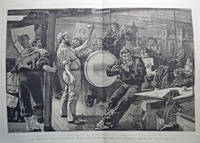
42294London. The Graphic. Sept 1875. overall 40x 58cm 15.3/4" x 23" engraved plate illustration fine condition. Ar. see Holland p279-280. [London]. The Graphic. Sept, 1875 unknown
C7-FYOP-ZXD2Discovery Channel University. VHS Tape. Good. 0x0x0. Good Discovery Channel University unknown
67272aafNew York, American geographical society, 1939,. gr. in-8vo, XII + 311 p. + 88 ill. (photogr. plates), orig. publisher’s illustrated red cloth. Spines sunned, else a fine set.
12382, Paris, Editions la Decouverte, 2003., Broche, couverure d' editeur, 13,5x22cm, 259pp.
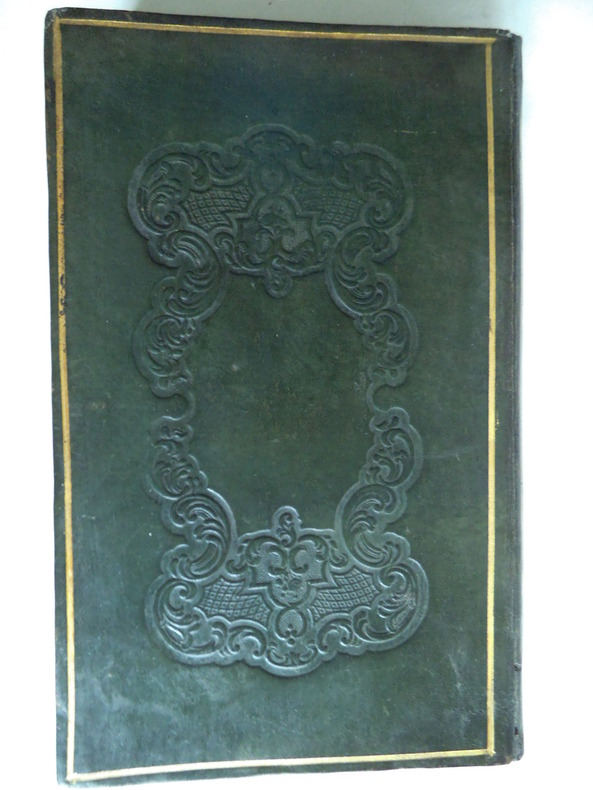
5623in 8 plein cuir glacé vert,fers à la rocaille,en long, filet en encadrement,et titre dorés,au dos.Plaque à froid avec filet doré en encadrement,sur les plats.Filet doré sur coupe.(Ecole Ste Barbe doré sur le premier plat)Faux-titre, frontispice gravé sous serpente,titre,2 pages de table,423 pages, tranches marbrées.Paris Dezobry,E Magdeleine & Cie 1840, bine complet du frontispice qui manque souvent, rousseurs éparses,principalement en début et fin de volume. Un petit frottement sur le premier plat,sans gravité
28002Wiesbaden : Springer 2017. XXXI, 262 Seiten ; 21 cm, 385 g Top Zustand, Broschur, Softcover/Paperback, Exemplar in sehr gutem Erhaltungszustand, Neupreis in Euro: 59,00
68735aafNew York, Pantheon Books, 1983, in-4to, 190 p., rich. ill. with color plates, orig. cloth, with DJ.
100149855Mouez enez sun in8. Sans date. Agrafé. Enez Sun est un carnet de voyage illustré qui présente l'île de Sein à travers le regard du géographe Louis Brigand avec des illustrations de Didier-Marie Le Bihan. L'ouvrage aborde l'histoire l'actualité et la géographie de cette île bretonne en offrant un portrait à la fois sentimental et documenté de ce territoire insulaire
40188Payot.1990.In-8 br.Couv.renforcée.480 p.avec Table des Matières. TBE sauf dos insolé.
347 pages. Originally published in 1872. "One of the most readable and colourful early accounts of life on the Northwest Coast." - from dust jacket. Average wear. Unmarked. Dust jacket now preserved in Brodart cover. Binding tight. A sound copy. Book
19656140Paris, René Julliard, 1965 ; in-8, broché ; 366 pp. , (1) f.
41629sd Editions Arthème Fayard, Collection "Le Livre Populaire" - Sans date (circa 1910) - In-12, broché, couverture illustrée - 382 p.
2011500058959MAGNARD 2011 160 pages 21 8x1 2x28 6cm. 2011. pocket_book. 160 pages.
Book is in excellent condition with creaseless covers and spine, green page ends. Binding is solid and square, covers have sharp corners, exterior shows no blemishes, text/interior is clean and free of marking of any kind. 416 pages. Contents include: Genghis Khan, Kublai, Affeo, Nicolo Polo, Tartary, Armenia, Cathay, Manji, Thebet, Region of Darkness, Great Turkey, 13th Century Asia, Middle Kingdom, Crusades, Age of Discovery, A Description of the World, Orient, Renaissance Europe Copyright 2011 Pistil Books
73571Paris, Club du Livre, Philippe Lebaud, 1977. 29 x 23, 297 pp., gravures sur bois des XIIIe et XIVe siècles, reliure d'édition plein cuir brun à 4 nerfs, plats et dos décorés (noir et or), sous étui carton (ouverture bordée de cuir), tête dorée, parfait état.
103.991Paris, La Découverte, 1998. 12 x 19, 2 volumes, 447 pp (pagination continue), broché, très bon état.
188249173Paris: Gauthier-Villars 1882. 4to. No wrappers. In: "Comptes Rendus Hebdomadaires des Seances de l'Academie des Sciences" Vol 94 No 4 15 17. Pp. 149- 184 pp. 997-- 1068 a. pp. 1139- 1214. 3 entire issues offered. Poincare's papers: pp. 163-168 1038-1042 a. 1166-67. <br/><br/><em>First appearance in print of the discovery of the automorphic forms which Poincaré named Fuchsian functions."One of Poincaré's first discoveries in mathematics dating to the 1880s was automorphic forms. He named them Fuchsian functions after the mathematician Lazarus Fuchs because Fuchs was known for being a good teacher and had researched on differential equations and the theory of functions. Poincaré actually developed the concept of these functions as part of his doctoral thesis. Under Poincaré's definition an automorphic function is one which is analytic in its domain and is invariant under a discrete infinite group of linear fractional transformations. Automorphic functions then generalize both trigonometric and elliptic functions." Wikipedia. </em> unknown
188460243Berlin Stockholm Paris F. & G. Beijer 1882-84. Large4to 272 x 230 mm. Three volumes uniformly bound in contemporary half calf with gilt lettering to spine. In "Acta Mathematica" volume 1-5. Light wear to extremities boards and spines with scratches. Stamp to verso of front board in all volumes. First three leaves in first volume detached otherwise internally fine and clean. Vol. I pp. 1-62; Pp. 193-294; Vol. II pp. 97-113; Vol. III. pp. 49-92; Vol. IV pp. 201-312; Vol. V pp. 209-278. <br/><br/><em>First publication of these groundbreaking papers which together constitute the discovery of Automorphic Functions. "Before he was thirty years of age Poincaré became world famous with his epoch-making discovery of the "automorphic functions" of one complex variable or as he called them the "fuchsian" and "kleinean" functions." DSB.These manuscripts written between 28 June and 20 December 1880 show in detail how Poincaré exploited a series of insights to arrive at his first major contribution to mathematics: the discovery of the automorphic functions. In particular the manuscripts corroborate Poincaré's introspective account of this discovery 1908 in which the real key to his discovery is given to be the recognition that the transformations he had used to define Fuchsian functions are identical with those of non-Euclidean geometry. See Walter Poincaré Jules Henri French mathematician and scientist.The idea was to come in an indirect way from the work of his doctoral thesis on differential equations. His results applied only to restricted classes of functions and Poincaré wanted to generalize these results but as a route towards this he looked for a class functions where solutions did not exist. This led him to functions he named Fuchsian functions after Lazarus Fuchs but were later named automorphic functions. First editions and first publications of these epochmaking papers representing the discovery of "automorphic functions" or as Poincaré himself called them the "Fuchsian" and "Kleinian" functions."By 1884 Poincaré published five major papers on automorphic functions in the first five volumes of the new Acta Mathematica. When the first of these was published in the first volume of the new Acta Mathematica Kronecker warned the editor Mittag-Leffler that this immature and obscure article would kill the journal. Guided by the theory of elliptic functions Poincarë invented a new class of automorphic functions. This class was obtained by considering the inverse function of the ratio of two linear independent solutions of an equation. Thus this entire class of linear diffrential equations is solved by the use of these new transcendental functions of Poincaré." Morris Kline.Poincaré explains how he discovered the Automorphic Functions: "For fifteen days I strove to prove that there could not be any functions like those I have since called Fuchsian functions I was then very ignorant; every day I seated myself at my work table stayed an hour or two tried a great number of combinations and reached no results. One evening contrary to my custom I drank black coffee and could not sleep. Ideas rose in crowds; I felt them collide until pairs interlocked so to speak making a stable combination. By the next morning I had established the existence of a Class of Fuchsian functions those which come from hypergeometric series; i had only to write out the results which took but a few hours.the transformations that I had used to define the Fuchsian functions were identical with those of Non-Euclidean geometry." </em> hardcover
19902135003Stuttgart: Franz Steiner Verlag 1990. X, 330 Seiten. With some illustrations. Gr. 8° (22,5-25 cm). Orig.-Broschur. [Softcover / Paperback].
1390348695.Gpaperback. Good. Access codes and supplements are not guaranteed with used items. May be an ex-library book. paperback
75371aafBasel, C. Schultze, 1864, in-8vo, nach Angaben im Helveticat, (Kat. schweiz. Landesbibl. on-line): ohne die 12 kolorierten Lithogr. die dazugehören, Halbleder d. Zeit, Rückenvergoldung.
185943325Leipzig Johann Ambrosius Barth 1859. Without wrappers as issued in "Annalen der Physik und Chemie. Hrsg.von Poggendorff" Bd. 107 Viertes Stück.= Heft No. 8 of 1859. The entire issue offered Heft 4 of vol. 107 with titlepage to vol. 107. Pp. 497-660. - Plücker's papers: pp. 497-539 a. 638-643. Clean and fine. <br/><br/><em>First printing of this milestone paper describing Plückers first observations on Cathode Rays which he called "the beautiful and mysterious green glow" and produced by discharges in tubes exhausted by means of the Geissler pump. These importent observations lead directly to Röntgens discovery of the Röntgen Rays."Cathode rays were first observed by Julius Plücker in 1859 the paper offered. They are rays which are found in the neighbourhood of the point of exit of an electrical current passing through a Geissler tube. These rays stimulated intense interest and experiment. William Crookes greatly improved these discharge tubes and intensified the degree of rarification of gases within them. The tubes in this form is known as Crookes tube. Crookes declared his conciction that the cathode rays represented matter in a fourth hitherto unobserved form.It was reserved for J.J. Thomson in 1908 to discover the true nature of the cathode rays."PMM no 386. </em> unknown