5 988 résultats
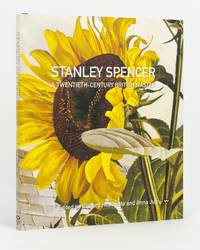
2016139503Mile End: Wakefield Press 2016. First Edition. Hardcover. Very Good/Fine. Mile End Wakefield Press 2016. Large quarto iv 100 pages with numerous illustrations many in colour. Papered boards lightly bumped at the extremities; an excellent copy with the near-fine dustwrapper. A presentation copy to 'Bob' Dr Robert Edwards AO with a signed birthday inscription from Richard Heathcote 'From one museum professional to another . 6.IV.18' sometime Director of Carrick Hill house museum and gardens. The book was published in conjunction with the exhibition of the same name held at Carrick Hill. Wakefield Press hardcover
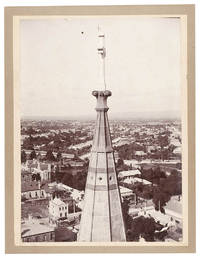
96068A vintage gelatin silver photograph 210 × 150 mm on the original mount. The photograph has a small chip and slight surface loss near the bottom right-hand corner affecting only the canopy of a large tree; the mount is a little worn with light marginal stains well clear of the image. Undated but probably circa 1900 with a horse-drawn tram and a bicycle the only vehicles on King William Road below; the photographer is unidentified. unknown
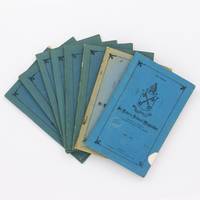
1914131663Adelaide: W.K. Thomas & Co. Printers 1914. First Edition. Paperback. Very Good. Adelaide W.K. Thomas & Co. Printers 1914 to 1919. Octavo eight issues ranging between 48 and 80 pages plus plates in some of them. Several of the plates reproduce photographs relating to Australians in the war including a folding panorama of North Beach Anzac and several snapshots taken in the field. Title-wrappers slightly worn and marked and two issues have minimal expert conservation; minor signs of age and use but overall in very good condition. Spanning the First World War this run offers powerful insights into the effects of the war on the school community. Among the usual sporting fixtures and school news are first-hand accounts of important actions sent back to Australia by 'old boys' on active service and numerous short obituaries. Recurring sections include a nominal roll of former pupils in uniform details of their awards and medals and an ever-growing roll of the wounded missing and killed. Particularly noteworthy are accounts of: 1 The Gallipoli landings from several soldiers; 2 The Battle of Cocos; 3 Light Horse actions in the Palestine; 4 Naval actions in the Persian Gulf; and 5 Trench warfare on the Western Front. The names of decorated old scholars appear regularly including Arthur Blackburn VC. <p>The ties of the Old School seem to have been strong even on the battlefield. In the obituary for Lieutenant Eric W. Talbot 10th Battalion it is noted that 'On April 24th 1915 the night before the landing he sat with Col. Price Weir who made use of his draughtsmanship to prepare the landing plans. In the attack at dawn he first had command of scouts and being allowed to choose his men he selected a team entirely of old "Saints"' Number 90 page 61. <p>The issues present in this run are Number 86 May 1914 Number 90 August 1915 Number 92 August 1916 Number 94 May 1917 Number 95 August 1917 Number 98 August 1918 Number 101 September 1919 and Number 102 December 1919. Offered with them is the 'Programme of the Annual Sports held on the School Oval on Saturday April 29th 1916' small octavo 19 pages; a little marked. 9 items. W.K. Thomas & Co., Printers paperback
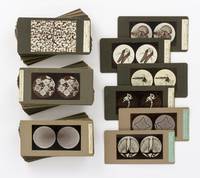
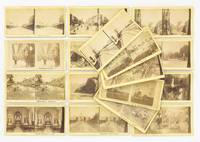
1905140504North Adelaide: The Photographer 1905. Very Good. North Adelaide The Photographer circa 1905. A collection of 87 stereo-microphotographs comprising original gelatin silver photographs with the pairs of images printed as one plate approximately 65 × 120 mm mounted on stiff card approximately 88 × 178 mm in various shades of grey. There are 21 with printed labels captioned 'Wm. P. Dollman John St. N. Adelaide S. Aus.' with numbered manuscript captions the numbers range from 2 to 228; there are 14 with unnumbered manuscript captions on plain labels; the remaining 52 are on plain cards. There are only six duplicates and none of them are an identical matching pair. Minimal signs of age and use; overall in excellent condition. The literature on the photographic history of Australia is singularly quiet on the life and work of William Parmeter Dollman 1846-1908. He is not to be found in Davies and Stanbury or Photohistory SA the pioneering research work of Robert Noye now on the website of the Art Gallery of South Australia. However he was definitely recognised in his own time. His obituary appears in the 'Evening Journal' on 7 October 1908: 'The death is announced from heart failure at the age of 63 of Mr. William Parmeter Dollman of North Adelaide. The deceased gentleman came to South Australia from England in 1853 and for about 30 years had been in the service of the proprietors of "The Register" and its associated journals as a printer and reader. He was sub-overseer of the newsroom for several years but relinquished that position to return to the reading room. Mr. Dollman was held in the highest respect for his integrity and ability and was much esteemed by his intimate friends. He was a member of the microscopical section of the Royal Society and conducted a great deal of microscopical research. He was an authority on the instrument itself a student of electricity and a skilful photographer'. <p>We have traced a number of newspaper references to his photography not least in a list of prize-winners in connection with the 14th annual exhibition of the SA Society of Arts reported in the 'South Australian Register' on Thursday 15 December 1870. 'Six entirely untouched stereoscopic views . by W.P. Dollman' were awarded a cash prize of £1 1s. Given that the other prize-winners in the photography section were Bernard Goode and Townsend Duryea this is high praise indeed. <p>An article by Dollman appeared in the 'Journal of the Royal Microscopical Society' in June 1906: 'A Simple Method of producing Stereo-Photomicrographs sic' 3 pages plus a full-page illustration of one of the stereo-microphotographs present in this collection 'Polyzoa Idmonea radians'. It was 'Read February 21 1906'. Dollman states 'I have made a hobby of stereoscopic photography since 1865 and as well have handled many Microscopes optical work being always an attraction to me. Some twelve or more months ago a friend called my attention to an article on stereo-photomicrography in the "British Journal of Photography Almanac" for 1894 by the then-editor . who therein explained several methods of producing stereograms of microscopic objects. I adopted what I thought the simplest method that of obscuring by a semicircular shield half of the objective in use. <p>A good deal of my apparatus is makeshift - that is diverted from other uses - but is effectual. My optical outfit is the best both in low and high powers condensers etc.'. <p>In addition to the 87 stereo-microphotographs there is a stereophotograph captioned on a plain label 'Photo-microscopic Apparatus' depicting an impressive set-up in Dollman's studio as described in the journal article. This card and two others with hand-written captions on plain labels have the following inscription in ink on the verso: 'Not for competition. Wm. P. Dollman North Adelaide'. Also included with the collection is a slightly damaged unmounted single microphotographic print 74 mm square. 89 items. The Photographer unknown
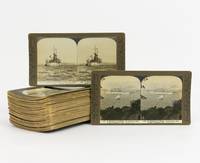
138959Very Good. The original gelatin silver photographs are uniformly mounted on 'The Rose Stereographs' cards with the pair of images printed as one plate 86 × 144 mm; card size 98 × 178 mm with printed captions within each image. All captions commence with the words 'The American Fleet in Australia'. The broken top right-hand corner of one card is held in place with clear tape just touching the top corner of the photograph; all other cards and photographs are in excellent condition. In August and September 1908 the American Grand Fleet which included 16 white-painted battleships visited Sydney and Melbourne during its 14-month world tour. 'George Rose visited both cities armed with his stereoscopic camera and went on board the USSs "Louisiana" and "Wisconsin" taking photographs. He produced exactly 100 views for sale #12800 to #12899 which were packaged as sets of 35 or 36 views in attractive green and gold boxes. Collectors find it difficult to find all the views as the box contents were a random selection with a bias towards the more attractive views and avoidance of shots that were similar' Ron Blum: 'George Rose Australia's Master Stereographer' 2022 fourth edition. This group comprises #12850 to #12899 with the exception of the following eight items: 12851 12854 12856 12860 12862 12863 12880 and 12887. 42 items. unknown
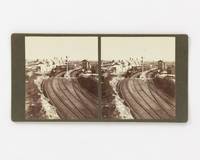
138947Very Good. Original gelatin silver photographs with the pairs of images printed as one plate 86 × 144 mm mounted on light yellow cards 98 × 178 mm uniformly printed and decorated on the verso 'Photographed by Edwin C. Thomas. Australasian Stereo Views'. Some have hand-written captions see below. Minimal signs of age and handling; overall in excellent condition. The 'Petersburg Times' on Friday 12 May 1893 contained a short article under the headline 'Photography'. 'It will be noted by our advertising columns that Mr Edwin C. Thomas has commenced business at Petersburg as a Photographer and thus another long felt local want has been filled. The Studio which is replete with the latest accessories to the photographic art is in Jervois Street opposite the Courthouse. <p>Besides the ordinary work of the photographer Mr Thomas makes a specialty of stereoscopic views in which he is very successful. The prices quoted for photographs are extremely moderate whilst good work is assured. We believe there is a good opening for a photographer in the town and we hope Mr. Thomas may be successful in working up a thriving business. Farmers and others who would like their residences taken should communicate with him'. <p>Thomas merely appears on the 'List of Names' compiled by Robert Noye AGSA. Davies and Stanbury simply note 'Edwin Thomas Petersburgh sic Peterborough South Australia 1894'. Institutional holdings of his works are almost non-existent: if Trove is any indicator the State Library of SA is the only location of any of his photographs with a grand total of two examples one of which is a battered stereo view of 'Stoney Creek near Quorn' B 78542. <p>The 'Evening Journal' and the 'South Australian Register' both carry the following snippet on Tuesday 18 October 1892: 'From Mr. Edwin C. Thomas travelling photographer we have received six stereo views of South Australian scenes: two of the Burra Burra Mines and one each of the Kooringa State School Botanic Gardens Parkside Asylum and King William street. The workmanship is good and the pictures are attractive'. <p>Ten of the stereographs in this collection have short captions in ink: nine are on the verso four of which have the same caption on the recto with the other five having some variant of it; one is captioned solely on the recto 'Mr Crocker's Farm'. In the main they confirm what is apparent from the scene and apart from a number in Adelaide King William Street Adelaide Arcade Parkside Lunatic Asylum several in the Botanic Gardens they depict scenes in Clare the interior of the Catholic Church at Seven Hills Orroroo Port Augusta Quorn Saltia Pichi Richi Pass and unidentified rural settings. <p>One identifying S.A. Blondin walking a high wire in Quorn enables us to date it to the month and year. The 'Manning Index of South Australian History' online records that 'A photograph of "Blondin at Quorn" is in the Pictorial Australian on Monday 1st October 1894 page 169'. It is a slightly different image - Blondin seems to have taken a step or two forward and is now balancing on one leg - and the caption states 'With a Country Photographer - Blondin at Quorn. From a Negative by Mr. E. Thomas'. 17 items. unknown
1892139126Littlehampton: Thomas Sladdin 1892. Very Good. Littlehampton Thomas Sladdin circa 1892. Two individual albumen paper photographs each approximately 82 × 74 mm mounted on a plain stereocard approximately 88 × 175 mm; the photographer's inkstamp 'Thos. Sladdin Photo.' is on the verso. tiny mark to one photograph; in excellent condition. Davies and Stanbury record 'Thomas Sladden Sladdin' working as a photographer at three locations in SA: Littlehampton 1890-91; Sedan 1892-94; and Lyndoch 1895-1900 with his brother John. Littlehampton is the closest of the three to Murray Bridge. Thomas Sladdin unknown
107893The gelatin silver photographs image size 160 × 205 mm or the reverse in three instances are mounted on thick flush-cut cardboard; there are some chips and trifling imperfections around the edges and two have slight surface imperfections in background areas; overall they are in very good condition. The images cover a wide range of activities: two are at the quarry face; two show the light railway leading from the quarry; three are at or in the crushing plant; and two show the mine buildings surrounded by vineyards; workmen appear in all but two of them. 9 items. unknown
186780150Adelaide: David Gall 1867. First Edition. Hardcover. Very Good. Adelaide David Gall 1867. Duodecimo vi 82 52 'Chowla Advertiser' pages. Original flourescent green papered boards with expanded title page details repeated within a border on the front cover and with the contents listed on the rear; covers slightly marked and a little rubbed bumped and worn at the extremities with the hinges a little cracked; spine sunned lightly mottled and a little glue-stained; thin light tidemark to the top edge of the front endpaper; a very good copy of a scarce book rarely found with the spine intact and internally this copy is nothing short of fine. 'Storrie exhibits a keen sense of satire not only with regard to conventional tales whose perclivities are mercilessly ridiculed but also with regard to colonial society itself' Depasquale: A Critical History of South Australian Literature 1836-1930. Incidentally this is the first novel published in Adelaide. See Ferguson 16305 for confirmation of the Storrie/ McTavish connection. David Gall hardcover
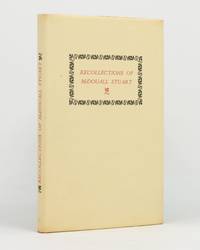
1984146489Adelaide: Sullivan's Cove 1984. Hardcover. Good. Adelaide Sullivan's Cove 1984 first thus. Small octavo 86 1 statement of limitation pages. Cloth; tiny bump to the top edge of three consecutive leaves; a very g ood copy with the very good dustwrapper slightly marked. Number 159 of only 225 copies of this first edition in book form. W.P. Auld 1840-1911 'was one of the eleven men who went with Stuart on his final expedition across the continent from Adelaide in 1861-62 . It was he who nursed the stricken leader during the greater part of the journey back'. These recollections first appeared as articles in the 'Adelaide Observer' in 1891 and 1904 and the 'Adelaide Register' in 1910 and 1911. Provenance: Dick Kimber Richard Glyn Kimber AM 1939-2024 author anthropologist and historian with his signature R.G. Kimber on the front free endpaper. Sullivan's Cove hardcover
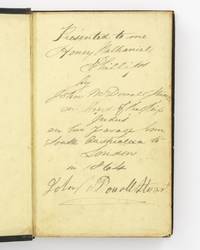
1860135299London: George E. Eyre and William Spottiswoode 1860. First Edition. Hardcover. Very Good. London George E. Eyre and William Spottiswoode 1860. 'Small pica 16mo' unpaginated. Original full morocco all edges gilt; leather a little rubbed at the extremities with a small glass-ring on the front cover; some foxing throughout; mild signs of age and use including a dried sprig of maidenhair fern loosely inserted at one opening; in very good condition. The front free endpaper is signed by John McDouall Stuart at the foot of the following inscription: 'Presented to me Henry Nathaniel Phillips by John McDouall Stuart on board of the Ship "Indus" on her pasage sic from South Australia to London in 1864'. <p>Written on the verso in another hand is '"Ask and it shall be given you". Matt 7th - 7.v'. The book has the contemporary blindstamp of the Adelaide booksellers W.C. Rigby 53 Hindley St Adelaide on the top corner of the rear free endpaper. We would like to think the book was purchased in Adelaide inscribed with a most apposite Biblical text and given to Stuart prior to his departure from Adelaide in late 1861 on his ultimately successful sixth expedition across the continent and back. However in many ways it was a Pyrrhic victory: 'Ill with scurvy and nearly blind Stuart had to be carried on a stretcher slung between two horses; recovering sufficiently to ride by the time they reached Mount Margaret on 26 November he pushed on with three of the party and arrived in Adelaide on 17 December 1862. On a public holiday on 21 January 1863 crowds lined the streets amid banners strung from buildings. He was awarded £2000 though allowed only the interest from it and his party received £1500 between them. <p>White-haired exhausted and nearly blind Stuart decided to visit his sister in Scotland and sailed in April 1864. He later went to London. His claims for a greater reward from the South Australian government led to another £1000 again with only the interest. His "Explorations in Australia. The Journals of John McDouall Stuart" was edited by W. Hardman and published in 1864. <p>He died of ramolissement and cerebral effusion on 5 June 1866 aged only 50 in London and was buried in the Kensal Green cemetery. He has remained a lonely and independent figure with a fierce pride. His reputation as a heavy drinker has led detractors to minimize his achievements even to the extent of doubting that he reached the Indian Ocean in 1862' 'Australian Dictionary of Biography'. Surprisingly apart from this singularly personal gift from Stuart Henry Nathaniel Phillips has left no other trace of his existence that we can find. George E. Eyre and William Spottiswoode hardcover
1988140158Adelaide: Sullivan's Cove 1988. First Edition. Hardcover. Fine/Fine. Adelaide Sullivan's Cove 1988. Duodecimo 72 pages. Cloth with a paper title-label on the front cover; a fine copy with the fine dustwrapper. Number 147 of only 175 copies. 'The little-known diary and virtually unknown despatches of Major Warburton's 1866 fifth expedition'; previously unpublished apart from some contemporary observations reprinted here from the 'South Australian Register'. Sullivan's Cove hardcover
1988140157Adelaide: Sullivan's Cove 1988. First Edition. Hardcover. Near fine/Fine. Adelaide Sullivan's Cove 1988. Duodecimo 70 pages plus a frontispiece. Papered boards lightly bumped at the head of the front joint; bookseller's label on the front pastedown; a near-fine copy with the fine dustwrapper. Number 24 of only 135 copies. Sullivan's Cove hardcover
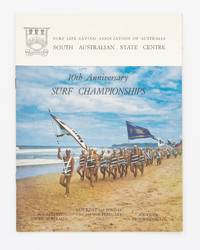
1963136627Sydney: Surf Life Saving Association of Australia South Australian State Centre 1963. First Edition. Paperback. Very Good. Sydney Surf Life Saving Association of Australia South Australian State Centre 1963. Quarto 26 pages with illustrations and pictorial advertisements plus advertisements on the covers. Saddle-stapled colour-pictorial card covers; staples slightly rusty; an excellent copy. Surf Life Saving Association of Australia, South Australian State Centre paperback
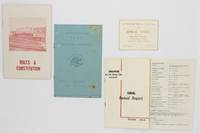
1963136739Semaphore: Semaphore Surf Life Saving Club 1963. First Edition. Paperback. Very Good. Semaphore Semaphore Surf Life Saving Club 1963. Octavo; wrappers; pagination variations and any blemishes listed below; overall in excellent condition. A Rules & Constitution 64 pages with illustrations and advertisements plus pictorial wrappers and an unnumbered leaf bound in at either end all printed in red. B and C 10th Annual Report. Season 1962-63 12 pages plus the wrappers; one copy has additional names pencilled in on the page of office bearers. D and E Semaphore SLSC Annual Dinner. Hotel Osborne Saturday August 3rd 1963 4 pages including the bill of fare plus the slightly stained wrappers. A deckle- and gilt-edge invitation card to the event is loosely inserted. 5 items. Semaphore Surf Life Saving Club paperback
1925106835Adelaide: 'The Register' Print 1925. First Edition. Paperback. Fine. Adelaide 'The Register' Print 1925. Duodecimo 19 pages with 2 full-page portrait illustrations from photographs. Title-wrappers; a fine copy. The author is identified on the first page. 'The Hon. Sir Josiah Symon KCMG has courteously handed us for publication the following extremely interesting biographical sketch. In his note accompanying the MS Sir Josiah says: "Mr Sutherland was my uncle. The sketch was written by his younger son the late James de la Zouche Sutherland who was a barrister and solicitor of the Supreme court very shortly before his death'. David Sutherland 1801-1879 arrived in South Australia in 1840; 'Obituaries Australia' has a very informative account of his life. Not in Trove. 'The Register' Print paperback
1885129679Adelaide: Carey Page & Co. Printers 'Published under the Author's own immediate Supervision' 1885. First Edition. Hardcover. Very Good. Adelaide Carey Page & Co. Printers 'Published under the Author's own immediate Supervision' 1885. Octavo viii 288 24 local advertisements pages plus 17 lithographs a frontispiece view after J.M. Skipper 15 individual portrait illustrations and one plate containing three portraits and 2 mounted albumen paper portrait photographs. Mid-brown stippled cloth lettered and decorated in gilt on the spine; cloth a little marked and lightly worn at the corner tips; spine sunned; inner hinges cracked but firm; endpapers offset with the leading half of the rear flyleaf neatly excised; name-stamp or signature on four early pages with an old price in ink on the flyleaf and initial blank; a very good copy internally excellent. The photographs are of Captain Samuel White Sweet 130 × 71 mm presumably a self-portrait and George Loyau 98 × 58 mm credited in the negative to George & Walton: he is facing the camera with his head turned a little to the left. This is another variant see Holden 71 of an item usually found with the author's photograph only and to further complicate matters the latter occurs in at least three variant forms as well!. In our experience this issue with the portrait of Samuel Sweet is most uncommon. Captain Samuel White Sweet 1825-1886 sea captain surveyor and photographer took command in January 1869 'of the two-masted schooner "Gulnare" which was later bought by the South Australian government for the Northern Territory survey expedition'. Between February 1869 and April 1872 he made five trips to the Northern Territory. 'In September 1870 in Darwin he photographed the official party at the ceremonial planting of the first pole of the overland telegraph; he also took pictures of the township the men at work and forest scenery.' He spent the next three years as a master mariner based in Adelaide until 11 May 1875 when 'his ship the "Wallaroo" with his wife aboard ran aground in a gale on Office Beach Wallaroo. An inquiry attributed it to Sweet's error of judgment and he was censured. He retired from the sea opened a photographic studio in Adelaide and concentrated on landscapes. With his horse-drawn dark room he travelled through South Australia taking hundreds of skilful pictures of the outback stations and homesteads. The colony's foremost documentary photographer of the 1870s in the early 1880s he was one of the first to use the new dry-plate process' 'Australian Dictionary of Biography'. Carey, Page & Co., Printers ('Published under the Author's own immediate Supervision') hardcover
1815219781815. Very good condition. Early hand colored copper engraving of Sydney with Aborigines tending a fire at the left foreground tents on the shore in the middle ground and the harbor with many sailing ships and the city in the distance. <br /> <br /> With the text sheet in both German and French which describes Sydney as a place of exile for English criminals: "Elle Sydney sert en meme tems sic de lieu d'exil pour les criminelles anglais qu'on y transporte et que l'on applique aux ouvrages publics sic jusqu'a ce qu'ils aient subi leurs peines." At the top of the text sheet "Melanges CXCV Vol VIII No. 48". <br /> <br /> Text sheet with a bit of fox spotting; the upper corner with 3/4" crescent torn away not affecting text. The engraving bright and clean. 8 1/2 x 6 3/4" image on paper 9 1/2 x 7 3/4" unknown
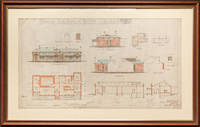
1907122957Adelaide: English & Soward Architects Cowra Chambers Grenfell Street 1907. First Edition. Hardcover. Very Good. Adelaide English & Soward Architects Cowra Chambers Grenfell Street 1907. A series of 13 architectural drawings 11 of them hand-coloured and several rough pencilled sketches overall visible image size 540 × 975 mm matted and behind glass in a later wooden frame external dimensions 755 × 1190 mm. The thick cartridge paper has a short 28 mm closed tear to the left-hand edge a semi-circular onlay of opaque drafting cloth over a large chip to the top edge covering most of the word 'Committee' and a few pinholes top and bottom; trifling signs of handing; overall a very attractive item in excellent condition. The main drawings in black ink and up to six different watercolours comprise the Front Elevation West South Elevation Ground Plan Back Elevation and Cellar; there are also four sections and a number of minor details. It has been signed by the contractor A.E. Kauffmann and dated 8 July 1907 and witnessed by Adelaide architect George Klewitz Soward who has also added elsewhere 'English & Soward Architects Cowra Chambers Grenfell Street Adelaide'. The fine building still stands in Tanunda today serving the same purpose for which it was constructed. <p>The Tanunda Club dates back to the last months of 1891 when 'there was a move to initiate discussion on how the local townspeople could best achieve convivial society as well as promote the products of the region. From its very beginning the club was a social centre for people from all walks of life where its members could relax partake of refreshments and enjoy discussions in the company of others. By May 1906 the Club's finances were in a very healthy state. It was perhaps with a sense of pride in the Club's achievements that Mr Adolph Schulz addressed a general meeting and mentioned that "according to the financial standing of the Club we might build a substantial front and proposed that a general meeting be called to test the feeling of the members". There was a spirit of prediction in Schulz's words. By October rough sketches for the proposed edifice had been prepared and were quickly approved - the grand new Clubhouse was underway! In January 1907 tenders for the proposed building were accepted after Mr Juncken had explained every detail of the work from the materials to be used to the dimension of the rooms. By December 1907 new furnishings for the rooms were being purchased. <p>The building itself was to be a credit not only to the Club but to the whole town of Tanunda. It was of fairly simple rectangular design topped by a roof with Dutch gables. The MacDonnell Street facade was plain yet superb. A steeply pitched verandah ran the entire length. It had turned wooden posts beautiful lacework at the timber joins and an impressive low fence and magnificently worked wrought-iron gateway. Above this verandah running like a ribbon down the facade was a rendered parapet. It had gables at either end and a central rounded feature with the words CLUBHOUSE inserted in large gold letters. The building's substantial size prominent position and fine construction made it one of Tanunda's outstanding features. It could be looked upon as an enormous asset. In one sense it changed the face of both the Club and its importance in the community' Rob Linn: 'The Tanunda Club - a Centenary History' 1991. English & Soward, Architects, Cowra Chambers, Grenfell Street hardcover
187321033Germany: Schreiber J.F. 1873. First printing. Print. Very good condition. Chromolithograph depicting basalt pillars on the coast of Tasmania. The image measures 26.2 x 36.2 cm on a sheet 31.6 x 41.2 cm. Central fold slight dusting around the edges. Libraries Australia ID 774855. Schreiber J.F. unknown
2016131706Mile End: Wakefield Press 2016. First Edition. Paperback. Near fine. Mile End Wakefield Press 2016. Large octavo xii 572 pages with 40 maps and 160 illustrations from photographs. Colour-pictorial card covers slightly rubbed; a near-fine copy. Wakefield Press paperback
75053Offered together with a copy of MARSDEN Susan: Working Lines. A History of Robe Electric Telegraph Station and Post Office 1987; card covers octavo i 34 pages with 20 illustrations. This booklet gives details of the introduction of intercolonial telegraphy. An example of a slightly later version of this form is reproduced on page 13; among other changes it no longer states that 'The Government will not be answerable for errors caused by indistinct writing'. unknown
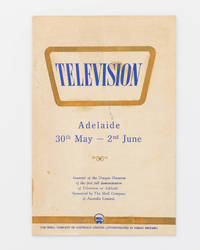
1949120110Adelaide: The Shell Company of Australia Limited 1949. Adelaide The Shell Company of Australia Limited 1949. Octavo 6 pages formed from a folded sheet of stiff card. The two outer surfaces are a little marked and discoloured; minor tanning inside from an acidic newspaper cutting no longer present; light crease down the centre; a very presentable copy with the front panel printed in blue and gilt. This demonstration occurred over a decade before television was officially launched in Adelaide on 5 September 1959. The Shell Company of Australia Limited unknown
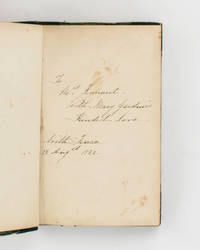
1850110032London: James Blackwood 1850. Hardcover. London James Blackwood early edition circa 1850s. Duodecimo xxxii 33-323 pages plus a frontispiece 'Castle of Chillon'. Early half calf and marbled papered boards all edges and endpapers marbled with the spine extensively gilt-decorated in compartments with a contrasting title-label; leather a little rubbed at the extremities and bumped at the corners; marbled paper moderately rubbed and worn along the edges with slight loss to the rear cover; early leaves slightly marked; a binder's blank at the rear has an internal tear; overall a very presentable copy. The initial binder's blank is inscribed 'To Mrs Tennant With Mary Gardner's Kindest Love. North Terrace. 28 Augst 1862'. With more than a little help from the 'Australian Dictionary of Biography' we have discovered this was a wedding present. On that day Rachael Christina Ferguson married a young Andrew Tennant 1835-1913 pastoralist and politician Tennant Creek is named after his father. One of their daughters Rosina Forsyth Tennant married the pastoralist William Tennant Mortlock yes genealogy is sometimes confusing. One of their children was John Andrew Tennant Mortlock 1894-1950 pastoralist and philanthropist. He was the State Library of South Australia's most significant benefactor and the Mortlock Wing is named after him. James Blackwood hardcover
1914100690Blackwood: Literary Society of the Blackwood Coromandel and Belair Club 1914. First Edition. Hardcover. Very Good. Blackwood Literary Society of the Blackwood Coromandel and Belair Club 1914. Octavo 12 issues bound as one volume 288 pages 24 pages each issue with a handful of illustrations. The first number has 'Second Edition' printed at the head of the first page. A note on Trove states that 'the only difference identified is on page 5 where a different verse is printed in each edition'; in this one it is a topical limerick about 'An elderly farmer of Mitcham'. Original gilt-decorated cloth containing the twelve separate issues of the drop-title magazine; binding a little worn at the extremities with the front cover bowed and a little ink-marked; old tape-stains to the endpapers; vertical crease down the middle of most issues where folded before binding; trifling signs of use and age; a very good copy of a rare item with the ownership details of local pioneer Frank Chapman of Coromandel Valley on the front flyleaf. This elusive journal was 'devoted to the interests of the Adelaide Hills suburbs Blackwood Coromandel Valley Belair and Eden Hills'. The editorial to what became the final issue commences thus: 'Many a good man has been hung for no fault of his own and "The Blackwood Magazine" because the Kaiser has chosen to embroil the world is to be suspended'. Literary Society of the Blackwood, Coromandel and Belair Club] hardcover