5 957 résultats
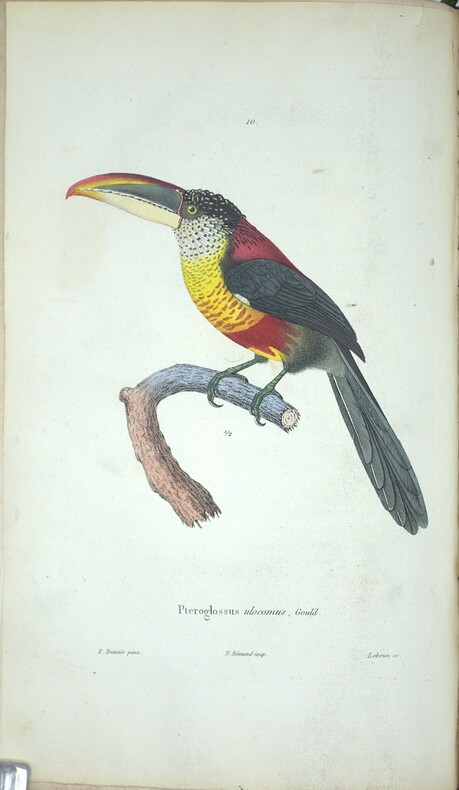
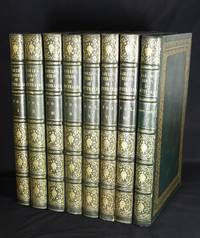
186929221London: by the author printed by Richard and John E. Taylor 1840-_ 1869. First edition. A FINE COPY OF GOULD'S MOST IMPORTANT WORK which was issued in 41 parts over 30 years and occupied more than half of his career. In the original publishers' full morocco gilt stamped binding.<br /> <br /> Provenance: Presented to the Right Reverend Mathew Blagden Hale by the members of the Church of England and other Denominations of Christians of Western Australia Perth October 28th 1876. With large presentation label printed in gold dated in each volume. Mathew Blagden Hale 1811-1895 was the first Bishop of Western Australia and founder of Hale School.<br /> <br /> Gould started work on the Birds of Australia in 1837 but ceased this effort when he found he did not have enough material to work from in England. He and his family departed for Australia where his wife had two brothers and remained there for 18 months collecting new specimens in New South Wales and Tasmania. John Gilbert was sent to collect specimens from Western Australia Queensland and South Australia. As Gould had introductions to the explorers working at the time he also received contributions of specimens from Sturt and Grey. As a result of this intensive effort 300 new species were claimed by Gould. <br /> <br /> AUSTRALIAN EXPLORERS' CONTRIBUTION TO GOULD'S BIRDS OF AUSTRALIA<br /> <br /> In May 1838 Gould his wife Elizabeth John Gilbert their zoological collector one of their sons a nephew & two servants sailed for Australia. On their 27 montsh stay in the Colonies they received assistance from all sides ~ the Colonial Governors and most importantly the early explorers of Australia's interior.<br /> <br /> In Tasmania the Goulds were looked after by the Governor Sir John Franklin of later Arctic fame and Lady Franklin who were greatly interested in the flora and fauna of the country. Gould and Gilbert explored much of Tasmania and the Bass Strait islands. <br /> <br /> In February 1839 John Gilbert departed for an eleven month stay in the Swan River Colony. Gilbert made further explorations to the Northern Territory with Ludwig Leichhardt but during Leichhardt's overland expedition in 1845 from Brisbane to Port Essington was tragically killed by aboriginals. Book - Journal of an Overland Expedition in Australia. 1847.<br /> <br /> In June of 1839 Gould began a journey with Captain Charles Sturt from Adelaide to "the Murray Scrubs" the Mallee returning to Adelaide in July from where he visited Kangaroo Island before returning to Hobart. Books- Two Expeditions into the Interior of Southern Australia. 1833 & Narrative of an Expedition into Central Australia. 1849.<br /> <br /> Contributions of specimens & information came from all quarters. George French Angas contributed eggs and information about the Yellow- eared Black Cockatoo. Book- South Australia Illustrated one of the great Australian topographical view books. In the course of his hydrographical voyage on the H.M.S. Rattlesnake John MacGillivray contributed information about the Great Palm Cockatoo. Book- Narrative of the Voyage of H.M.S. Rattlesnake commanded by the late Captain Owen Stanley. 1852 Cape York area. T.L. Mitchell surveyor general of New South Wales supplied descriptions of the Leadbeater's Cockatoo commonly known as the "Major Mitchell". Books- Three Expeditions into the Interior of Eastern Australia.1838 & Journal of an Expedition into the Interior of Tropical Australia.1848. <br /> <br /> The last voyage of the "Beagle" was in Australian waters from 1837 to 1843. In 1841 Capt. Wickham suffering ill-health was relieved of his command by Lieut. John Lort Stokes Book - Discoveries in Australia; with an account of the Coasts and Rivers explored and surveyed during the Voyage of H.M.S. Beagle In the Years 1837- 1843. 1846. The task of the expedition was to survey those parts of the northern coast of Australia not already charted by Flinders or King. Accompanying them on this trip was the young lieutenant George Grey whose duty it was to explore the land in Australia's northwest with a view to establishing a permanent settlement there. Book - Journals of Two Expeditions of Discovery in North-West and Western Australia. 1841 The scientific appendices in volume two of Grey's "Journals" include one on birds by John Gould ~ " Mr. Gould kindly forwarded the following enumeration of the species which have come under his notice as inhabiting that part of the country Western Australia." There follows a 7 pp listing of birds of W.A. "Officers of the Beagle" are credited by Gould's "Handbook to the Birds of Australia" as supplying information on the Rose-breasted Cockatoo. <br /> <br /> To conclude the history of Australia's inland exploration is inextricably bound up with Gould's masterwork The Birds of Australia. It was an extremely fertile and productive time in Australia ~ Sturt Mitchell & Angas in eastern & southern Australia; Leichhardt MacGillivray Stokes & Grey in the north & west. Reading the letter-press that accompanies each color plate of Gould's Birds bears witness to the combined efforts of Gould and the explorers and settlers of Australia ~ Gould constantly refers to specimens and information on the birds' customs and habitat sent to him by various explorers. Many times this spirit of cooperation overflows into the naming of the bird itself. Gould was the touchstone who pulled together the contributions of Australia's explorers into the foundation work on Australia's ornithology. This combined with Gould's work with Darwin interpreting the specimens from the famous "Beagle" voyages takes Gould's Birds of Australia out of a strictly natural history realm and places it firmly alongside the great scientific discovery expeditions of the 19th century.<br /> <br /> GOULD'S CONTRIBUTION TO DARWIN'S THEORY OF EVOLUTION<br /> <br /> Before the Goulds' plans for the work on the Birds of Australia came to fruition John Gould became involved in a co-operative project with another scholar - Charles Darwin. In October 1836 Darwin returned to England from his 5 year circumnavigation on the H.M.S. Beagle on which John Lort Stokes served for 18 years- rising from midshipman in 1825 to commander in 1841. Darwin needed expert help in the description & identification of the preserved birds insects rocks shells & insects for his production of the Zoology of the Voyages of H.M.S. Beagle. Darwin had heard of Gould's books from Thomas Campbell Eyton a naturalist friend from Cambridge days who had bought Gould's Toucan prints. They were expensive he wrote but of good value as he had since been offered a higher price! Through the Zoological Society where Gould had established his reputation as a premier taxidermist Darwin initially made contact with Gould about a special Rhea seen during his travels in Northern Patagonia. This Rhea was an ostrich of dark mottled color with shorter legs than the Common Rhea. Conrad Martens the artist on the Beagle expedition shot one for food and it was cooked and eaten before Darwin realized that it was a less-known species. Fortunately the head neck feathers & skin had been preserved and were sent to the Zoological Society where it was put together and a nearly perfect specimen made for display. Gould classified the Rhea as a new species "Rhea Darwinii". <br /> <br /> The third volume of the "Zoology of the Voyage of the H.M.S. Beagle" contained fifty bird plates which was advertised by Darwin as "taken from sketches made by Mr. Gould himself and executed on stone by Mrs. Gould". When Gould & Darwin were examining the birds brought from the Galapagos Islands they were fascinated by a group of about thirteen finches of the same species which had curiously different-sized beaks. These modifications occurred on different islands and it was the investigation of this and other scientific data accumulated over a long period that led to Darwin's theories of evolution by adaptation formulated many years later. Frank Sulloway Harvard University 1982 has investigated Gould's part in Darwin's theory of evolution and shows that Gould astutely realised the basic peculiarities of these birds thus paving the way for Darwin's first notes on the "Transmutation of Species". Gould presented descriptions of the Galapagos finches and mockingbird specimens at the Zoological Society in January 1837. However he was unable to finish his work for Darwin. Due to the rush before the Goulds' departure to Australia parts of his manuscript were left unresolved and the work was completed by George Robert Gray of the British Museum.<br /> <br /> As Gould only published 250 sets of "The Birds of Australia" the number of complete copies which could possibly come on the market is significantly diminished by many factors ~ the work was issued in parts and not all copies were bound which would contribute to their demise over time. Many of the sets that survive are in institutional hands and unlikely to come onto the market. Over the last 20 years at least 10 copies have been "broken up" and sold as plates. This loss of a number of complete sets will certainly lead to a complete and undisturbed Gould attracting a premium by virtue of its increasing scarcity. <br /> <br /> 8 imperial folio volumes including supplement 2 pp list of subscribers 681 hand-colored lithograph plates including 3 double-page by John and Elizabeth Gould or by Gould and H.C. Richter. Printed by Hullmandel and Walton. Occasional minor spotting. Uniformly bound in publisher's green period full green morocco sides with gilt borders spines gilt in 6 compartments gilt edge by Clyde. The books are presently in the UK. <br /> <br /> Nissen IVB 370; Anker 174 and 179; Fine Bird Books p. 78; Wood p. 365; Zimmer pp 255-6 and 259; Sauer 9 and 18; Ferguson 4773 & 10032a. <br /> <br /> Bibliography: Lambourne Maureen Wm. McEvoy & Dr. Gordon Sauer. "John Gould - BIRD MAN" London 1987 Wantrup Jonathan "Australian Rare Books 1788-1900" Sydney 1987. by the author, printed by Richard and John E. Taylor, (1840-_ unknown
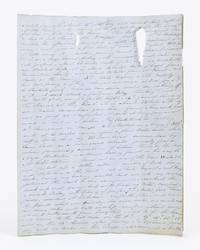
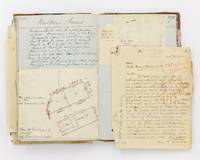
135288Fair. Quarto 12 pages last two blank. A saddle-sewn gathering of blue paper; two holes to each leaf apparently insect damage with some minor loss to the text; some marks and short edge tears; nevertheless an extraordinary relic in decent condition overall. The first nine pages closely written in ink in a single hand which we know to be that of pastoralist Alfred Barker 1812-1880 contain a version of Stuart's journal for the period from 31 March the beginning of the expedition to 17 May 1859 with some significant variation from the published versions. Importantly the final half-page of text is unmistakably in the hand of John McDouall Stuart himself. This passage - an addendum written in pencil and comprising material not included in published versions of the journal - describes the extent of Stuart's claims of pastoral land at Chambers Creek. The journal is accompanied by a loose bifolium containing manuscript directions to Chambers Creek quarto 2 pages also in Barker's hand with a small diagram of Hummock Hill. <p>The journal ends after the entry for 17 May 1859. Published accounts of the expedition indicate that Stuart spent the following three days in camp finalising his report on the survey of Chambers Creek which was sent back to his patrons James and John Chambers and William Finke on 20 May by way of one of the expeditioners Campbell. The specific nature of the variations from the published versions leads us to conclude that Stuart sent with this material an edited version of his field journal to that date the originals of both manuscripts are now lost. Barker brother-in-law and business partner of the Chambers brothers would have copied the present manuscript directly from Stuart's original manuscript. It pays scant attention to the daily happenings of the expedition but records detailed information about the country with a particular regard to its suitability for pastoral use precisely the information most valuable to patrons intent on building a pastoral empire. <p>Stuart's manuscript addendum to Barker's copy of his report must have been written in the short period between his return on 3 July 1859 and the departure in August of the same year of his third expedition into the interior. He had given John Chambers power of attorney in relation to his claims on the runs at Chambers Creek where he had claimed a staggering 1500 square miles of land. The matter had still not been settled at his departure and Stuart's precise description of the extent of his claim were evidently intended to allow his patrons to consolidate it in his absence. <p>The detailed manuscript text on the separate bifolium also supports a date from the middle of 1859. It gives a set of straightforward directions to Chambers Creek via the crucial series of waterholes that Stuart had identified as well as some details of the surrounding country. Barker was soon to follow this route north to stock Stuart's empty cattle runs the explorer lacking the resources to do so himself. While these instructions are in Barker's hand they must have been prepared in consultation with Stuart in preparation for the cattle drive north. <p>Returning from his third expedition Stuart was pleased to find Barker's cattle thriving on the saltbush on his land. After great difficulty and scandal the grant was finally made for an unprecedented area of 1000 square miles but many suspected that the beneficiary of the vast territory would be Chambers and Finke not the explorer Barker's contribution going unremarked in newspaper accounts of the time. This would be borne out in the coming years. <p>The textual history of the journal of Stuart's second expedition makes the survival of this document all the more important. In her introduction to the edition of the journal published by the Friends of the State Library of South Australia 2002 Valmai Hankel writes: 'This expedition is the only one for which no manuscript diary or fair copy survives. As it was regarded as a private venture unlike the five other expeditions its results were not reported to Parliament so its journal was not published as a parliamentary paper. The only known versions are those published in the "Journal" of the Royal Geographical Society RGS vol.31 1861 pp.65-83 and in "Explorations in Australia. The Journals of John McDouall Stuart during the years 1858 1859 1860 1861 & 1862" edited by William Hardman London: Saunders Otley 1864 .'. <p>The RGS and Hardman versions of the text are generally more discursive but both are the result of editing by third parties and would have been based on fair copies of the journals. Hardman in particular was an unsympathetic editor 'Stuart seems to be almost an illiterate person .' and often redrafted Stuart's matter-of-fact observations to fit more closely the mould of a Victorian travel narrative. Our manuscript on the other hand is not only contemporaneous with the expedition but also likely closer in content to the lost field journals before editorial intervention and judicious redaction and revisions for political and commercial considerations. <p>A full transcription of the journal is available as are a list of variations from the published version. One example will suffice to indicate the significance of this manuscript. Hankel's introduction states that 'The expedition's main aims were to survey the Chambers Creek lease and to prospect for gold . Stuart's major discovery was more links in the chain of springs later known as mound springs which Warburton and Babbage had found in 1858. Hergott found the first on 13 April; although Stuart named them after their discoverer he does not say so in either version of his journal' page x. The manuscript states that 'on the 13th Hergott after finding St Stephens Pool dry and no water in the Range - discovered a batch of Springs South of the Pool - abundance of Water - distance from this camp to Hergotts Springs 30 Miles - Native Cucumbers found here'. <p>These documents were purchased together with an important archive relating to Alfred Barker's pastoral properties offered separately and now sold. The archive contains letters that substantiate serious irregularities in the handling of Stuart's pastoral lease at Chambers Creek which when read in conjunction with the above material make the story of his final years even more distressing. Copies of the relevant letters are included with the manuscript. unknown
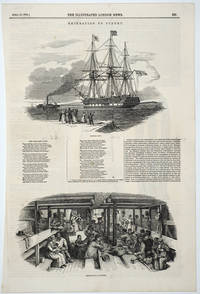
28182A valuable reference collection of images and articles that shaped perceptions of Australia to the wider world in the 19th century. This is a collection of over 800 woodcut illustrations and articles from the 19th century from the Illustrated London News The Graphic and The Illustrated Times & other less successful periodicals. The images of the ILN and Graphic are a comprehensive and systematic collection of Australian related images and articles from 1842 ILN and 1870 Graphic through the end of 1899. This collection was started in London in the late 1970s. It was our intention to create a comprehensive reference of every woodcut image of Australian interest in the two major British periodicals from their start date to 1900. We were living in North London not too far from Omniphil Limited a company based in Chesham Bucks. They were the preeminent dealers in woodcut images from British periodicals in the 1970s and 80s. We visited their premises repeatedly and sat and turned the pages of every single volume of their reference set noting the images related to Australia and purchasing a copy of those images. Another component of the collection is an assemblage of Australian images from lesser-known periodicals such as the Illustrated Times the Pictorial Times The Illustrated News of the World Gleason's Pictorial Drawing Room Companion Harper's Weekly Canadian Illustrated News and a few singletons from the Illustrated Family Paper l'Opinion Publique and the Australasian Sketcher. <br /> <br /> An important component of this collection is the associated Excel listing of the prints & text. These are indexed by year month & day image title print size associated text and folder number. <br /> <br /> The total collection is housed in nine A3 folders with fixed sleeves. Early years have 2 sheets per sleeve; later years are sometimes grouped together to fit into the available room in the album. The folders are approx. 12 ½" x 17" x 1". They were manufactured in England by Rexel Nyrex with the following label in the back inside cover "Rexel / Nyrex / PFV / A3 / 24 Made in Gt. Britain." The company still manufactures plastic products. We have not been able to ascertain if these are archival but the prints have been in the folders for at least 43 years and there has been no degradation. <br /> <br /> The only exception to the completeness of the collection is ship prints which were quite expensive at the time we assembled the collection. <br /> <br /> The collection is organized in three parts: <br /> Part I - The Illustrated London News 1842-1899; Part II - The Graphic 1870-1899; Part III - The Illustrated Times the Pictorial Times and other British & North American periodicals 1845-1883.<br /> <br /> Combined these original woodblock prints and articles are a valuable reference collection that shaped perceptions of Australia to the wider world in the 19th century a collection which would now be all but impossible to assemble. <br /> <br /> Part I<br /> Australian images from The Illustrated London News British periodical from its start in 1842 thru 1899. A comprehensive collection of Australian related images & articles from this groundbreaking periodical - the world's first illustrated weekly news magazine; the first periodical to employ special war correspondents and illustrators; the first to publish color supplements. The Australian material begins in the first publication on May 14 1842 and runs through the last article in the century in June 1899 and has approximately 467 images and 29 substantial articles. <br /> <br /> Australia is mentioned in the text of the first issue with an article "Sheep Farming in Australia" on p.15 about 4 column inches from the Inverness Courier. On the verso is an amusing illustration of a publicity stunt of the publishers. The founder Herbert Ingram paid hundreds of men to carry large sign boards in the streets reading "The Illustrated London News 30 Engravings Price 6D." The highly exaggerated drawing shows the sign bearers stretching as far as the eye can see on London footpaths. The caption reads "The 'Illustrated London News' Published Every Saturday. Thirty Engravings. Price Sixpence. The above engraving represents the public announcement of this paper on Friday last. Two hundred men paraded the streets of London to proclaim the advent of this important publication." Below the rule is printed "London: Printed by R. Palmer at the Office of Palmer & Clayton 10 Crane-court; and published by J. Clayton at 320 Strand. - Saturday May 14 1842." The first image of an Australian subject is in the December 23 1843 issue "New Government House Sydney" with text. The revenue stamp appears at the bottom left of the page. The discovery of gold in Australia is announced in a long article on the cover on Sept. 6 1851 entitled "Another El Dorado" in an article 15 column inches long. The last image is from June 1899 the Australian cricketeers in London- "The Australian Cricket Team / The Team up-river: leaving Boulter's Lock / The Test match at Lords Between England and Australia: Trumper and Hill at the Wickets". <br /> <br /> The ILN collection is housed in six A3 folders with fixed sleeves. Early years have 2 sheets per sleeve; later years are sometimes grouped together to fit into the available room in the album.<br /> <br /> Folder 1 - 1842-1852; 68 images & 12 articles<br /> Folder 2 - 1852-1854; 70 images & 13 articles<br /> Folder 3 - 1855-1861; 50 images & 1 article<br /> Folder 4 - 1862-1864; 55 images & 1 article<br /> Folder 5 - 1865-1884; 90 images & 2 articles<br /> Folder 6 - 1886-1899; 135 images<br /> <br /> Although Gale subscription service has a digitized resource titled the "Illustrated London News Historical Archive 1842-2003" this collection is invaluable as it is composed of the actual period woodblock prints and articles accessible in six A 3 folders. <br /> <br /> Part II<br /> Australian images from The Graphic British periodical from its start in 1869 thru 1899. Australian related images from The Graphic the British weekly illustrated newspaper first published on 4 Dec 1869 which was set up as a rival to the Illustrated London News. <br /> <br /> The Australian images begin in March 1870 and runs through 1899 approximately 242 images. There are 13 double page images 2 full weekly issues for the Sydney & Melbourne Exhibitions with the continuing supplements; 1 color Christmas issue; 74 full page and 39 half page illustrations. Highlights include images of bush and settlers' lives Tichborne case cricket Victorian gold the Kelly gang black trackers wool shipping ostriches a shearing dispute. <br /> <br /> The first Australian related image in The Graphic was published on the cover of the March 12th 1870 edition "Picnic in Australia To the Officers of the Flying Squadron." The last image for the 19th century is dated July 1899. The Graphic is housed in two folders are A3 approx. 12 ½" x 17" x 1". <br /> <br /> Part III<br /> Australian images from The Illustrated Times the Pictorial Times and other British periodicals as well as North American periodicals including Gleason's Pictorial Drawing Room Companion Harper's Weekly and others. London; New York; Boston; Canada: Various publishers 1845-1883. A collection of some of the scarcer woodcut images of Australian related images from various shorter-lived illustrated periodicals published in England and North America. These include The Pictorial Times The Illustrated Times The Illustrated News of the World Gleason's Pictorial Drawing Room Companion Harper's Weekly Canadian Illustrated News and a few singletons from the Illustrated Family Paper l'Opinion Publique and the Australasian Sketcher. These are scarcer publications than the market-dominating Illustrated London News & The Graphic. The collection starts in March 1870 and runs through 1899 approximately 107 images. <br /> <br /> Of particular interest is a series in the Illustrated Times entitled "England Versus Australia" illustrated by Florence Claxton. Claxton was an English artist who spent part of her adolescence in Sydney NSW in the 1850s. Throughout 1863 and early 1864 Miss Claxton drew imagined comparisons between the two environments not uniformly biased towards either country. In the first "Daughters Here" has a group of gentlewomen sitting in a lovely drawing room making lace playing piano or gazing in the mirror. "Sons There" shows the men doing the laundry mending and cooking. "Governesses Here" shows a gaggle of governesses seemingly subject to the whims of a butler; "Want of Governesses There" shows a home with the mother distraught the children causing absolute pandemonium & the father sitting and reading the paper. In another "Needlewomen Here" the seamstresses work themselves to exhaustion in a dark room with one light; "A Modiste There" shows a prosperous woman with many customers. <br /> <br /> We did not have access to a reference set for these smaller publications so these images are an assemblage not a comprehensive and consistent collection. <br /> <br /> The Pictorial Times. 1843-1848 Opened by Henry Vizetelly his brother and Andrew Spottiswoode. Eventually it was purchased by Ingram owner of the ILN and merged with The Lady's Newspaper. Unfortunately this newspaper did not date their issues but sometimes dates are to be found in text.<br /> <br /> The Illustrated Times. 1855-1862. A rival to the ILN edited by Henry Vizetelly who had left the ILN to open it. Vizetelly campaigned in the 1850s for the repeal of the Stamp Act. Its eventual repeal was a great boon allowing the new paper to be published at the low price of two pence.<br /> <br /> The Illustrated News of the World 1858-1864. This was published by John Tallis famed for his atlases with maps adorned with views. According to OCLC: 7091980 It started in Feb. 1858 and ceased in Aug. 1864<br /> .<br /> Gleason's Pictorial Drawing-Room Companion was a 19th-century illustrated periodical published in Boston Massachusetts. The magazine was founded by Frederick Gleason in 1851. According to OCLC: 10261386 it ran from 1851 - 1854. The publication name was changed to Ballou's Pictorial Drawing-Room Companion in 1855 after managing editor Maturin Murray Ballou bought out the interest of Gleason. Unfortunately this newspaper did not date their issues but sometimes dates are to be found in text.<br /> <br /> Harper's Weekly A Journal of Civilization was an American political magazine based in New York City. Published by Harper & Brothers from 1857 until 1916 it featured foreign and domestic news fiction essays on many subjects and humor alongside illustrations. It carried extensive coverage of the American Civil War including many illustrations of events from the war. During its most influential period it was the forum of the political cartoonist Thomas Nast. <br /> <br /> This collection is housed in one A3 folder approx. 12 ½ x 17" x 1" with fixed sleeves. The prints & text are indexed by newspaper and thence by year month & day image title print size & associated text including some artists and folder number. <br /> <br /> A collection of primary source documents revealing the perceptions and attitudes towards Australia in the 19th century. hardcover
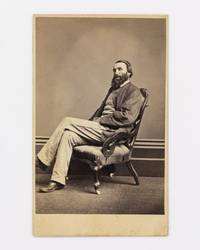
1866135300Adelaide: Townsend Duryea 1866. Adelaide Townsend Duryea printed circa 1866; original negative circa 1863. An albumen paper photograph 90 × 59 mm mounted on the original card 102 × 62 mm with 'T. Duryea Photographer to His Excellency 66 King William St. Adelaide' printed on the verso under the Vice-Regal Coat of Arms. 'Townsend Duryea began making cartes de visite in late 1862 or early 1863 and was advertising his "new" style of carte in May 1863' Bob Noye AGSA website. The portrait taken in Duryea's Adelaide studio shows Stuart after his epic crossing of the continent of Australia: he is visibly depleted - emaciated even - with his injured hand positioned awkwardly in his lap. The accident that caused this permanent injury occurred on 25 October 1861 the day the main party of the successful sixth expedition departed Adelaide. Stuart later described it in a letter to Charles Sturt: 'the accident I received from one of the horses being in a state of strangulation and endeavoured to release him reared up struck me in the temple knocked me senseless and springing again with his hind feet on my right hand has disabled me for life' Ian Mudie: 'The Heroic Journey of John McDouall Stuart' 1968 page 171. It is a most evocative image of the great explorer towards the end of his life. <p>The negative number 18592/3 is inscribed in ink on the verso below Duryea's imprint. This particular imprint dates to around 1866 see Noye and the negative number is consistent with this date. Noye notes that 'A carte with a number belonging to a much earlier number range would be a reprint from an old negative held in storage'; this suggests that this photograph is not printed from the original negative perhaps lost damaged or destroyed. This further suggests that this photograph is printed from a negative produced by rephotographing an existing print of the portrait of Stuart taken earlier by Duryea. This would explain why Stuart has what appears to be his left hand in his lap: the image is printed in reverse. <p>It was likely produced after news of the explorer's death in London on 5 June 1866 had reached Adelaide. A small item of local news 'Mr T. Duryea's Studio' in the 'South Australian Register' on 23 November 1866 lends weight to this possibility: 'A visitor to Adelaide may spend a very pleasant and profitable half-hour in Mr Duryea's photographic studio where a number of elegant photographs in every style of art are displayed. Mr. Duryea also exhibits some superior examples of photographs worked up in water-colours which are soft and some of them exquisitely finished. Amongst these there is a fine portrait of the late J.M. Stuart the explorer'. This carte de visite is clearly not that exhibition piece but it is most definitely a fine portrait. Townsend Duryea unknown
95963The archive comprises nearly 440 pieces each approximately 320 × 510 mm or larger many from the later 1970s when Mitchell was at the height of his powers. A unique commentary on the personalities and events of the times: when Hawke Fraser and Dunstan were in power Nixon went to China the war in Vietnam ended and the first wave of 'boat people' began to arrive here many Indigenous Australians were in a parlous state cricket and cricketers still caused grief . Approximately 440 items. unknown
1693319626London: for John Dunton 1693. First edition in English. 10 88 97-186 6 pp. Ad leaves in the rear. 12mo. Period calf rebacked. Early inscription on the front endpaper "Sale at King's Jan. 1806 2.6 3/6. First edition in English. 10 88 97-186 6 pp. Ad leaves in the rear. 12mo. The First Appearance of the Words "Australia" and "Australians" in Print. The rare first English edition of the most famous of all the fictitious accounts of Australia. <br/><br/>This amusing and entertaining imaginary voyage of Jacques Sadeur to the Congo and thence to 'Australia' recounts his multiple shipwrecks and being dropped on the western shores of Australia after being saved by a winged creature. He gives an imaginative description of 'Australian' laws and customs the region's hermaphroditic culture Sadeur being an hermaphrodite himself the natural history mineral resources religion and language. The book ends with a highly fanciful description of Madagascar.<br/><br/>First published in French in 1676 the author Foigny was a defrocked and exiled Franciscan and the work was banned by the Church. Of particular note is that John Dunton the translator and publisher of the present first Engish edition anglicises the name "Terre Australe" into Australia and the inhabitants into Australians -- the first such usage of the words in print.<br/><br/>The first edition in English is very rare with only a handful of institutional holdings in Great Britain North America and Australia. Wing F1395; ESTC R20648; Friedrich p. 16ff; Spate p. 83; Davidson A Book Collector's Notes pp. 41-42 for John Dunton unknown books
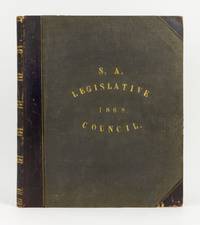
1868142860Adelaide: Townsend Duryea 1868. First Edition. Hardcover. Very Good. Adelaide Townsend Duryea 1868. A large quarto album approximately 415 × 365 mm containing 18 albumen paper portraits each approximately 280 × 210 mm mounted on the rectos of cloth-hinged thick card leaves interleaved with guards plus one leaf of letterpress see below. Contemporary half roan and cloth lettered and tooled in gilt with a binder's ticket on the front pastedown 'Bound at the "Register" Office Grenfell Street Adelaide'; covers slightly worn; leaves slightly cockled; one guard missing; most photographs lightly discoloured near the right-hand edge; a few light spots of foxing mainly to the guards and the versos of the mounts and some minor signs of age and handling but overall in excellent condition. The subjects include some of the most prominent figures in early colonial South Australia. In order of appearance the portraits depict John Morphett President Henry Ayers Charles Hervey Bagot John Henry Barrow Charles George Everard John Baker William Wedd Tuxford Thomas Elder William Peacock William Morgan Thomas Hogarth John Tuthill Bagot Thomas English Henry Mildred John Crozier William Parkin John Hodgkiss and Emanuel Solomon. <p>The 'South Australian Advertiser' for 20 August 1868 records that: 'Mr. Duryea is preparing a parliamentary group containing the members of both Houses of the Legislature which promises to be an effective affair. The members of the Council have already given him sittings and a fine series of portraits is the result'. In the subsequent months Duryea exhibited the photographs at his King William Street studio but most accounts refer to them assembled as a group around Morphett. This photo-collage with the portraits all heavily cropped is almost certainly the basis for a contemporary carte de visite published by Duryea see SLSA B 9258. However most of the images in this album appear to be rare or even unrecorded in their uncropped form; indeed the only other examples we located were of Henry Ayers and Charles Hervey Bagot. It is also rare to find photographs of early colonists at all let alone of this size quality and quantity. <p>The guard leaves for the portraits of Morphett Hogarth J.T. Bagot and Mildred contain manuscript biographical details in a single hand. Although we have not identified the writer it is likely to be one of the eighteen MLCs as he refers to 'our chamber' in the entry for Morphett. The portrait of C.H. Bagot is accompanied by a similar short biography but this time in letterpress and misspelling his middle name as 'Harvey'. C.H. Bagot English Mildred Crozier Parkin and Solomon are identified in another hand on the mounts beneath the image. Townsend Duryea] hardcover
108073The very fine portrait visible image size 545 × 395 mm in its original ornate gilt frame external dimensions 740 × 595 mm is exquisitely hand-painted and signed by the famous colonial photographer Townsend Duryea 1823-1888. His original label is affixed to the paper backing on the verso of the frame 'T. Duryea Artist Photographer 66 and 68 King William Street Adelaide' and in our opinion he has created a masterpiece as both artist and photographer with this work. James Hurtle Fisher commenced practice as a solicitor in London in 1816 and 'was drawn into the colonizing movement in 1835. He was selected as resident commissioner one of the most important offices under the South Australian Act . second only to the governor'. Fisher 'left England in July 1836 with the governor's party in the "Buffalo" arriving on 28 December 1836 at Holdfast Bay where the official oaths were administered a proclamation was read and a ceremony marked the beginning of settlement. <p>In January 1837 Fisher erected his reed hut and Land Office near the survey camp of Colonel William Light at the north-western corner of the new capital site; the destruction of these temporary buildings by fire on 23 January 1839 caused both men serious loss. Fisher had been allowed to draft his own instructions which were not shown to Governor Sir John Hindmarsh. Disputes between the two men over their respective powers had begun on the voyage and were soon revived in the new Council of Government and more violently outside and led in February 1837 to the Resident Magistrate's Court binding the participants over to keep the peace towards each other. The new governor George Gawler was appointed both governor and resident commissioner a radical departure from the principles on which the colony had been founded' ADB. <p>Fisher returned to his profession and became a leader of the South Australian Bar. In October 1840 he was elected first mayor of Adelaide; in 1860 he became the first resident South Australian to be knighted. Townsend Duryea was at the King William Street address from 1858 until his illustrious career as a photographer 'was cut short when his studio and entire collection of 50000 negatives were destroyed by fire on 18 April 1875' ADB. We suggest as a date for this magnificent portrait 'circa 1870'. unknown
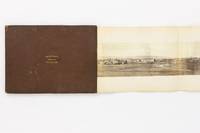
1866141595Adelaide: Townsend Duryea 1866. First Edition. Hardcover. Adelaide Townsend Duryea circa 1866. A photograph album 254 × 340 mm containing a magnificent panorama of Adelaide comprising five roughly uniform albumen paper photographs mounted as issued slightly overlapping to form a continuous image 124 × 880 mm on a linen-backed card mount 244 × 951 mm folded into three plus 12 albumen paper photographs nine of them around 130 × 200 mm or the reverse one 130 × 172 mm and the last two approximately 220 × 285 mm mounted on the rectos of stiff card leaves. Original russet pebble-grain cloth lettered in gilt on the front cover; cloth slightly flecked with minor wear to the extremities; endpapers foxed with slight loss to silverfish and the rear free endpaper is missing; leading edge ribbon ties appear never to have been inserted; mounts lightly cockled and occasionally lightly spotted and foxed; bottom margin of the final mount lightly stained with trifling loss to silverfish; minimal signs of age and use; overall a very pleasing copy with the photographs - and in particular the stunning panorama - in uniformly fine condition. The twelve individual photographs are captioned in pencil on the mounts: 'View in botanical gardens - showing Asylum' 'View in Botanical Gardens' 'View in Gardens' five captioned simply 'Botanical Gardens' 'Bridge between N & S Adelaide' 'near Willunga' and two captioned 'Willunga' both superb large-format prints. <p>New York-born Townsend Duryea 1823-1888 emigrated to Australia Melbourne in 1852 and commenced work as a photographer the following year. In 1855 he relocated his studio to Adelaide. By the early 1870s Duryea's panoramas royal portraits and prizes won in Society of Arts photographic competitions had made him famous 'Australian Dictionary of Biography'. Much more detail on Duryea may be had from the lengthy article in Joan Kerr's 'Dictionary of Australian Artists . to 1870'. However the panorama in this album is not the one described in Kerr 'a fold-out 360-degree panorama of Adelaide taken from the tower of Adelaide Town Hall in 1865 was the album's major feature' nor is it the larger panorama 'taken from the top of the GPO tower soon after it was completed in 1870'. The present panorama is taken from a local rise in North Adelaide and sweeps left to right from the hills towards the sea. All of these panoramas are very rare indeed not least because 'Duryea's studio and enormous collection of glass-plate negatives stated to number 50 000 were destroyed by fire in 1875'. This catastrophe effectively ended Duryea's career as a photographer. It must assuredly account for the genuine scarcity of material by Duryea on the open market other than bread-and-butter carte de visite portraits. <p>This album is very rare in our experience and if the available records are any guide for long before we came on the scene in the mid-1970s. Although this is the fourth example we have handled it is also only the fourth one we have seen on the open market in that time. We have inspected three other examples in institutions; all seven copies are bound similarly and contain the same panorama. However the balance of the contents varies in quantity and image selection in each instance. <p>Duryea began to advertise these albums in Adelaide newspapers in August 1866. One such from the 'South Australian Register' for 28 August 1866 reads: 'DURYEA'S VIEW ALBUMS. These Albums are neatly bound in cloth and form a beautiful acquisition either for the drawing-room table or transmission home. A PANORAMIC VIEW of the CITY of ADELAIDE and the SUBURBS three feet in length has been introduced as a Frontispiece; and as a further advantage purchasers have the privilege of choosing Photographs from a large Album containing 90 of the most interesting and picturesque Views of Adelaide and the Country. The above are open to the inspection of the public at Mr. Duryea's Studio 66 and 68 King William-street. Any of the Views mentioned above can be had separately. Photographs of Gentlemen's Country Seats Business Offices Shops &c. taken at the shortest notice by Ross's Improved Wide Angle Lens'. <p>Provenance: Edwin Ashby 1861-1941 South Australian property developer and naturalist; by descent. While Ashby was obviously not the first owner of this album its numerous images of the Botanical Gardens must have appealed to him. The fine gardens he established at his property 'Wittunga' at Blackwood in the Adelaide hills after the turn of the century were later donated to the State by his heirs and are now the Wittunga Botanic Garden. Townsend Duryea hardcover
190029494Norfolk Island 1900. Oblong small folio. 13 1/2 x 10 1/2 inches. 42 carbon prints on 42 cream card album leaves each mounted within ruled frame with printed caption below the photographs measuring approximately 6x8 inches. Contemporary red morocco upper cover titled in gilt within a gilt border marbled endpapers gilt edges<br/> <br/>Provenance: Hon. B.R. Wise Attorney General lettered in gilt on upper cover<br/> <br/>Early photographs of a remote Pacific Island.<br/> <br/>Norfolk Island a largely autocratic dependency of Australia was first sighted by Captain James Cook on his second voyage and settled by the First Fleet in 1788. For the first half century of the 19th century the island was largely used as a penal colony with many of the worst offenders transferred from Australia to the remote island. In the 1850s after use of the island as a penal colony was abandoned the island was settled by the Pitcairn Island descendents of the Bligh mutineers. In the 1860s the Anglican church established a large Melanesian mission on the island. The present images by an unknown but likely Australian photographer comprise views of Kingston various lagoons and bays landscape scenes featuring the island's iconic pine tree and other vegetation images at the Melanesian Mission and group portraits of the island's inhabitants presumably including Bligh mutineer descendents. The original owner of this album was Bernhard Ringrose Wise 1858-1916 whose name appears on the upper cover; Wise served as the Attorney General of Australia from 1899-1904. unknown books
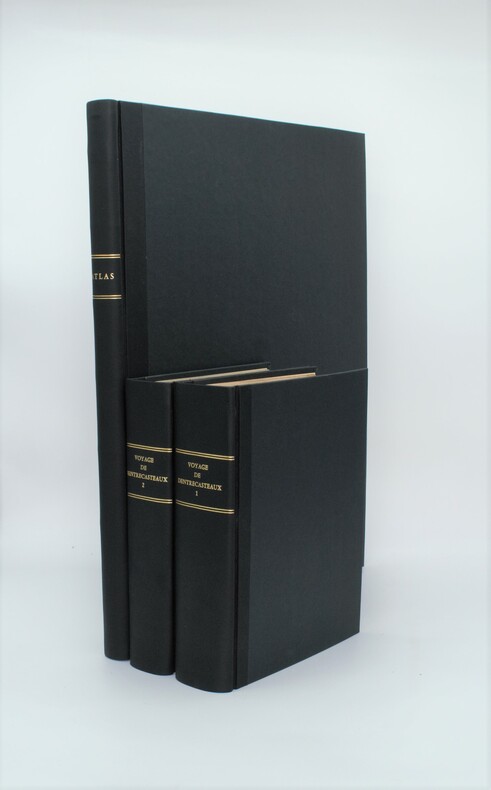
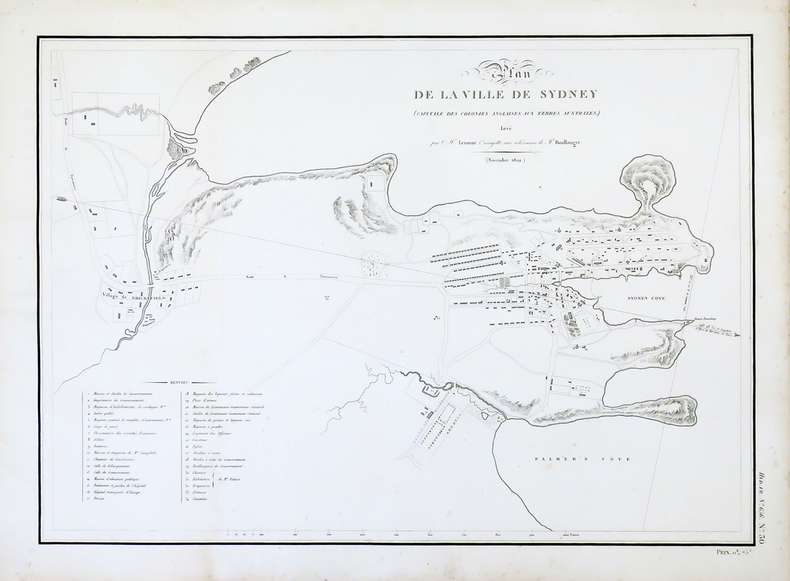
1807PHO-1A Paris, Dépôt général des Cartes et Plans de la Marine et des Colonies, 1807 et De L’Imprimerie Impériale, 1808 RARE ENSEMBLE COMPLET en 3 volumes TEXTE ; 2 forts vol. in-4° ; (2)-LVI-704 pp.-32 pl. h.-t. repliées in-fine (I-XXXII)/(2)-VIII-692 pp.-1 pl. h.-t. Repliée sur papier bleuté , relié demi cuir , dos lisse avec titre et tomaison , tranches mouchetées , mouillure angulaire sur 7 planches, petites rousseurs sur les planches . ATLAS ; 1 volume grand in-folio (560x445) ,page de titre-1 fnch. (Table )-39 cartes et vues h.-t. , dont 29 à double page ,dressées par l'ingénieur hydrographe C. F. Beautemps Beaupré et gravées sur cuivre par E. Collin , relié demi cuir , dos lisse ,cachets répétés , petites rousseurs .
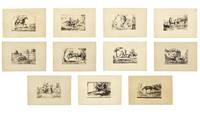
1864142931Adelaide: The Author 1864. Fine. Adelaide The Author 1864. Eleven albumen paper photographs approximately 88 × 134 mm mounted on the recto of individual cards approximately 165 × 240 mm neatly captioned below the plate with the title at the head of the first one with all captions by George Hamilton himself. A few light spots and marks to some of the cards; essentially in fine condition with the photographs uniformly rich in colour. The Art Gallery of South Australia has all 11 original artwork - pen and ink with wash - in its collection. The 'Adelaide Observer' on Saturday 27 August 1864 contains a review of Hamilton's recently self-published book 'a well-conceived well-written neatly-printed and elegantly-illustrated brochure under the above title'. It describes at length the illustrations '11 in number photographed from the author's drawings by Colonel Biggs Mr. Baines and Professor Hall and they bear ample evidence of the artistic taste as well as the correct judgment displayed in the spirited originals'. <p>Robert Holden 'Photography in Colonial Australia. The Mechanical Eye and the Illustrated Book' 1988 describes this book and one other Molesworth Jeffrey's 'Various Exercises and Fragments in Metre by Divers Authors' Hobart 1864 as being the 'first recorded use of original photographs as illustrations in commercially produced and dated books' in Australia. His descriptive bibliography records that the published work indeed contains 'Photographs of eleven drawings . by Colonel Briggs sic from rough sketches by the author. It would appear that these images were printed eleven to a sheet and then arranged in random order throughout the text'. His collation of the three copies in the State Library of South Australia indicates the individual print sizes range from 20 × 35 mm to a maximum of 40 × 60 mm. <p>The present offering clearly predates the published use of these images and its presentation is much to be preferred. The first and most obvious difference is the superior size and quality of the prints. However the captions greatly enhance the images; when they are read and viewed in the intended order numbers 1-11 are lightly pencilled in the top right-hand corner of the cards this becomes a proto-photobook of the highest order . and far from being a prosaic account of how to look after a horse as the title might suggest it is a searing indictment of the widespread ill-treatment of horses. 'Mr. Hamilton proceeds with pen and pencil to describe and portray some of the trials a horse has to undergo from the time his liberty is first invaded in the bush until in the last scene of all that ends this painful history he is reduced to the drudgery of a hackney car'. <p>See Ferguson 10180b and 10181a; Holden 50 and 51 plus pages 13-21. Both bibliographies contain errors. 11 items. The Author] unknown
1833PHO-2302Paris, Imprimerie Royale, Arthus Bertrand, au dépôt général de la marine, 1833-1839. 5 vol. in-8 (25,5x16,5cm) demi-chevrette rouge, dos à nerfs orné (reliure de l'époque), supplément lépidoptères broché de I. [2] ff.-xli-558-[1] pp. ; II. [2] ff.-481-[1] pp., grande carte dépliante (piqûres, coupures aux pliures sans manque) ; III. [2] ff.-510-[1] pp. ; IV. [2] ff.- 480 pp. ; V. [2] ff., 195-200 pp., Supplément Lépidoptères 30pp., 70 planches dont 61 soigneusement aquarellées. Rousseurs touchant principalement le texte et très peu les planches, mouillures claires par endroits au texte, feuillets volants pour le supplément. Sans les deux grands atlas historique et hydrographique, mais bien complet du très rare 5e volume d'histoire naturelle, paru ultérieurement qui manque presque toujours et complet des planches. Ce rarissime cinquième et dernier volume de texte, qui comporte 2 parties, renferme le rapport fait à l'Académie des sciences le 4 février 1833 sur les collections d'histoire naturelle recueillies pendant le voyage de la corvette La Favorite…, les Recherches sur les marsupiaux par Fortuné Eydoux et Laurent, la 2e partie Zoologie par Fortuné Eydoux et Paul Gervais, le supplément sur les Lépidoptères nouveaux par Feisthamel.
95220The Radfords were born in Devon emigrated to South Australia in October 1838 and lived in the Barossa Valley from the mid-1840s until their death. From the perceived ages of the subjects these images would appear to date from the 1850s. Other later images of the Radfords are held in the State Library of South Australia. They substantiate the identification and confirm that these daguerreotypes by an anonymous photographer are of rural South Australian origin as the Radfords did not leave the colony after they arrived here in 1838. Both images are in excellent condition with the original brass mats one a little tarnished preservers and glass but uncased as found. Any daguerreotype of Australian origin is rare rural South Australian ones excessively so in our experience. 2 items. unknown
1899111095London: Macmillan and Co. Limited 1899. Very Good. London Macmillan and Co. Limited 1899. Octavo xx 671 pages with 12 unnumbered line illustrations of churingas a map and 130 illustrations mainly after photographs plus 2 folding maps 3 folding charts 4 folding chromolithographic plates and an erratum slip tipped in at page 1 noting that on page 570 the tassel should be 'pubic' not 'public'. Olive-green gilt-pictorial buckram a little flecked and rubbed with the spine a little sunned; all edges uncut; scattered light foxing; minimal chipping to some uncut leading edges; an excellent copy. The head of the title page is signed in ink by both authors as 'W. Baldwin Spencer' and 'F.J. Gillen'. Inscribed in indelible pencil before the signatures in an unknown hand is 'With Kindest Regards from'. <p>The 'Australian Dictionary of Biography' makes short work of the significance of the book and by extension this signed copy in its entry on Sir Walter Baldwin Spencer 1860-1929: 'The 1894 Horn scientific exploring expedition to central Australia recruited Spencer as zoologist and photographer. Because of friction between members and their sponsor Spencer later combined mediation with editorship of all four volumes of reports. His own seminal contribution included his classic biogeographic interpretation of Australian faunal distribution. This expedition rekindled his anthropological interest when he met F.J. Gillen the Alice Springs postmaster Francis James Gillen 1855-1912 ethnologist. What began as his offer to assist in publishing Gillen's ethnological notes matured into an enduring partnership and a landmark in anthropological history. <p>In 1896 Spencer joined Gillen for the most intensive field-work then attempted in Australia. "The Native Tribes of Central Australia" 1899 which resulted was to influence contemporary theories on social evolution and interpretations of the origins of art and ceremonial. It impressed Sir James Frazer author of "The Golden Bough" who developed a lifelong friendship with Spencer'. Macmillan and Co. Limited unknown
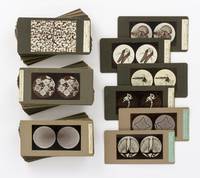
1905140504North Adelaide: The Photographer 1905. Very Good. North Adelaide The Photographer circa 1905. A collection of 87 stereo-microphotographs comprising original gelatin silver photographs with the pairs of images printed as one plate approximately 65 × 120 mm mounted on stiff card approximately 88 × 178 mm in various shades of grey. There are 21 with printed labels captioned 'Wm. P. Dollman John St. N. Adelaide S. Aus.' with numbered manuscript captions the numbers range from 2 to 228; there are 14 with unnumbered manuscript captions on plain labels; the remaining 52 are on plain cards. There are only six duplicates and none of them are an identical matching pair. Minimal signs of age and use; overall in excellent condition. The literature on the photographic history of Australia is singularly quiet on the life and work of William Parmeter Dollman 1846-1908. He is not to be found in Davies and Stanbury or Photohistory SA the pioneering research work of Robert Noye now on the website of the Art Gallery of South Australia. However he was definitely recognised in his own time. His obituary appears in the 'Evening Journal' on 7 October 1908: 'The death is announced from heart failure at the age of 63 of Mr. William Parmeter Dollman of North Adelaide. The deceased gentleman came to South Australia from England in 1853 and for about 30 years had been in the service of the proprietors of "The Register" and its associated journals as a printer and reader. He was sub-overseer of the newsroom for several years but relinquished that position to return to the reading room. Mr. Dollman was held in the highest respect for his integrity and ability and was much esteemed by his intimate friends. He was a member of the microscopical section of the Royal Society and conducted a great deal of microscopical research. He was an authority on the instrument itself a student of electricity and a skilful photographer'. <p>We have traced a number of newspaper references to his photography not least in a list of prize-winners in connection with the 14th annual exhibition of the SA Society of Arts reported in the 'South Australian Register' on Thursday 15 December 1870. 'Six entirely untouched stereoscopic views . by W.P. Dollman' were awarded a cash prize of £1 1s. Given that the other prize-winners in the photography section were Bernard Goode and Townsend Duryea this is high praise indeed. <p>An article by Dollman appeared in the 'Journal of the Royal Microscopical Society' in June 1906: 'A Simple Method of producing Stereo-Photomicrographs sic' 3 pages plus a full-page illustration of one of the stereo-microphotographs present in this collection 'Polyzoa Idmonea radians'. It was 'Read February 21 1906'. Dollman states 'I have made a hobby of stereoscopic photography since 1865 and as well have handled many Microscopes optical work being always an attraction to me. Some twelve or more months ago a friend called my attention to an article on stereo-photomicrography in the "British Journal of Photography Almanac" for 1894 by the then-editor . who therein explained several methods of producing stereograms of microscopic objects. I adopted what I thought the simplest method that of obscuring by a semicircular shield half of the objective in use. <p>A good deal of my apparatus is makeshift - that is diverted from other uses - but is effectual. My optical outfit is the best both in low and high powers condensers etc.'. <p>In addition to the 87 stereo-microphotographs there is a stereophotograph captioned on a plain label 'Photo-microscopic Apparatus' depicting an impressive set-up in Dollman's studio as described in the journal article. This card and two others with hand-written captions on plain labels have the following inscription in ink on the verso: 'Not for competition. Wm. P. Dollman North Adelaide'. Also included with the collection is a slightly damaged unmounted single microphotographic print 74 mm square. 89 items. The Photographer unknown
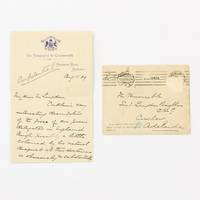
137300Fine. Octavo 4 pages a bifolium on the crested notepaper of Parliament House Melbourne in the original envelope marked 'Personal' and addressed in Deakin's hand to 'The Honourable Sir J. Langdon Bonython C.M.G. Carclew Adelaide' contemporary Melbourne postmark; stamp removed. Letter folded in half for posting; apart from a couple of ink blotches in fine condition; envelope with flap detached and with some pencilling on the verso. Deakin was sworn in as Prime Minister on 2 June 1909 after being elected leader of the Liberal Party which had recently formed from the 'Fusion' of his Protectionist Party with the Anti-Socialist Party. Sir Langdon Bonython a fellow Protectionist had sat with Deakin in the inaugural Parliament of Australia as a member for the Division of South Australia later for the Division of Barker. In this letter Deakin reflects on the difficulties confronted by his new government including preselections in South Australia but is generally optimistic about its progress. However his government would soon suffer a resounding defeat at the hands of Andrew Fisher's Labor Party in the federal election of 13 April 1910. <p>The letter reads in full 'Aug 11.09. My dear Sir Langdon Cockburn's very interesting description of the prose of our press delegates in England though possibly a little coloured by his natural disgust at their doctrines is obviously & substantially true. It defines their attitude of old & new always the same as is proper in a party that does not change. He very clearly perceives their policy of playing to both sides & sees when they have obtained encouragement. Your allusion to the Division of Wakefield is obscure. I have not been asked to assist & have not assisted in any way in the selection of a candidate. He has been chosen entirely on your side & by your associations. When Paddy Glynn got in he found the whole matter so far advanced in making the selection in the constituency that nothing could be done. Up to date I have not been asked to endorse Foster though no doubt we shall have to do so if required. You must be aware of this though you poke fun at me. The time has not yet come for getting into touch with the constituencies. We have not discovered whom we can rely upon or at all events how far. We are making good progress here & in NSW but the other states are still out of hand or rather none have been in order. It is a long task to attempt to get an effective control of Australia. We are gradually getting it within our immediate spheres of influence. But this is written at the table during the debate to which I have to listen with one ear & half my attention. Kind regards. Yours very truly Alfred Deakin'. <p>Deakin's entry in the 'Australian Dictionary of Biography' gives some important context to these final months of his political career. 'In May 1909 he agreed to the fusion of anti-socialists Liberal-Protectionists and Forrest's "corner" group. A bewildered Fisher was curtly dismissed. Close friends still believed in Deakin's integrity but to many others his actions seemed nothing but a naked grab for power a base move to regain office at any price by a man who thought he was indispensable. The political confusion produced some of the most dramatic scenes in Federal parliamentary history. Lyne - never a friend of Deakin and now a foe - denounced his former leader as a "Judas" a charge which the vindictive Billy Hughes believed slandered the disciple. Deakin was sworn in for the third and last time as prime minister on 2 June 1909. The Fusion government given its short span of life and the few points of agreement between the uniting parties was remarkably active . The Fusion government entered the election of April 1910 confident of victory but in the event it was routed. In a heavy poll Labor gained absolute majorities in both the House and Senate. Deakin who campaigned on a mainly negative anti-Labor platform barely escaped defeat in Ballarat. Only a handful of his personal followers survived.' <p>Sir John Langdon Bonython 1848-1939 was an important South Australian editor newspaper proprietor philanthropist and parliamentarian. 'He became a follower of Alfred Deakin who wanted him to give his full time to politics; their friendship survived a sharp disagreement over the composition of Deakin's ministry of July 1905 and his disappointment that Deakin's recommendation of him for a K.C.M.G. in 1908 was not accepted. Bonython did not contest the 1906 election although the Labor Party proposed to grant him and other Protectionists immunity from opposition; he suspected that his party would soon be out of power and travelling to Melbourne for parliamentary sittings was becoming irksome' ADB. The Cockburn referred to at the beginning of the letter is presumably Sir John Alexander Cockburn 1850-1929 former Premier of South Australia delegate to the Constitutional Conventions unofficial ambassador in Britain and friend of Sir Langdon's ADB. unknown
1783PHO-2039A Paris, Chez Barrois l’aîné, 1783. In-8° (195x120) Relié plein veau époque, pièce de titre rouge, dos lisse orné, tranches rouges. VIII, 290 pp, illustré de 2 cartes dont 1 repliée h.-t. et 5 pl. h.-t., Complet du dernier feuillet, extrait du privilège à la date du 11 mai 1782, établi par Condorcet secrétaire de l’Académie des sciences. Quelques frottements aux charnières.
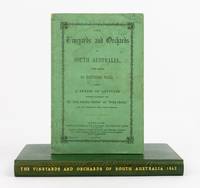
1862140418Adelaide: Printed and published at the 'Advertiser' and 'Chronicle' Offices 1862. First Edition. Paperback. Very Good. Adelaide Printed and published at the 'Advertiser' and 'Chronicle' Offices 1862. Octavo 78 xxii advertisements pages plus advertisements on both sides of the rear wrapper. Original green wrappers with the title page details repeated within a different border on the front cover; wrappers a little marked and creased with some slight wear at the corners affecting also the bottom corner-tip of the last few leaves; spine a little cracked but sound with minimal loss at both ends; minor signs of age and use but overall an excellent copy of a rarity seldom found in any condition - let alone as pleasing as this - now housed in a fine mid-green morocco Solander box by Sangorski & Sutcliffe. Descriptions 'are given of most of the most important vineyards and of some of the less important of them having due regard to age extent and quality of produce. South Australia will without doubt become one of the most important Wine countries of the world. The experiments of the past twenty years have proved the advantage of its soil and climate and enough practical knowledge has been acquired to enable its Vignerons to guard against the common errors which so frequently produced discouragement in the earlier days of the Colony'. The original articles are here supplemented 'by revision and some trifling annotations'. <p>Ferguson 18189 noting only green cloth boards. Printed and published at the 'Advertiser' and 'Chronicle' Offices paperback
1885ABC_49517Australia 1885. Folio ca. 44 x 36.5 cm. Contemporary gold-tooled black morocco with the title lettered in gold on the front gold-tooled turn-ins gilt edges watered-silk end papers. With 65 albumen prints. 29 ll. Late 19th-century photo album with views of New South Wales. The album contains 65 albumen prints of highlights in the region primarily in Sydney and the Blue Mountains. It was bought by the civil engineer Clément van de Velde dates unknown who was born in Belgium and moved to Australia in 1884 where he attempted to set up a sugar-beet industry. He also served as the vice-consul for Belgium. He gifted the album to his friend Cobus in 1885 possibly as a keepsake for a trip they undertook together.At least a third of the photographs show important buildings and other landmarks in Sydney including the Government House the Town Hall the General Post Office the Australian Museum the different colleges of the University of Sydney the Department of Lands building and the public library in Bent Street that has been demolished in 1967. Most of these buildings were relatively new at the time these photographs were taken. Also included are photographs of Hyde park and the Captain Cook monument the Man O'War steps Argyle cut Mrs Macquarie's Chair and the botanic gardens. The other photographs in the album show the towns and nature surrounding Sydney such as the Katoomba Falls the Three Sisters Govetts Leap and Mount Victoria in the Blue Mountains the Zig Zag railway the Fitzroy Falls Fort Denison Broken Bay various views of the Nepean River as well as four portraits of Australian Aboriginals.With a contemporary French inscription on the verso of the first flyleaf "Mon cher Cobus Je prie de vouloir accepter cet album en souvenir de nos bons rapporte. Votre dévote Clément van de Velde. Sydney 10 may 1885.". The binding has been professionally restored the boards are somewhat scratched and dented. The leaves are warped and foxed the lower corners of some of the leaves are torn without affecting the photographs the photographs have somewhat discoloured. Otherwise in good condition.l Cf. McLennan N. T. "Henri van de Velde 1878-1947" in: Australian Dictionary of Biography 16 2002. hardcover
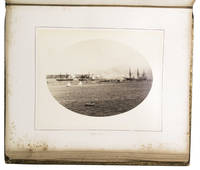
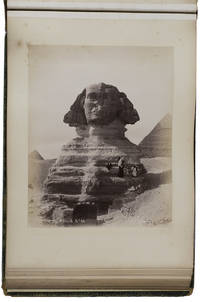
1895ABC_475631895. Oblong folio 28 x 39 cm. Contemporary gold-tooled black morocco gilt edges. With 58 photograph prints ca. 21 x 25.5 to 13.5 x 20 cm. Mounted on both sides of the leaves in the album. 60 pp. The album contains 15 silver albumen photographs of Melbourne taken mainly from the series C. Rudd's new views of Melbourne 1886-1887 by Charles Rudd 1849-1901. They show Collins Street Melbourne town hall the public library Parliament House the Court of Law Government House and various other buildings and infrastructure as well as botanical gardens such as Fitzroy Gardens. The photographs of Sydney were the work of the renowned Australian photographer Henry King 1855-1923 born in England in 1855 who emigrated to Australia with his family in 1856. He worked as a photographer at J. Hubert Newman's studio in Sydney before opening his own studio in 1880. King gained recognition for his photographic studies of Australian Aboriginal people and his scenic views of Sydney. He died in 1923 leaving behind his wife son and three daughters. His glass negatives were acquired by J.R. Tyrrell after his death and are now held by the Powerhouse Museum. King is one of Australia's most significant early photographers. The album contains seventeen of Kings photographs of the harbour including Farm Cove and the Circular Quay Government House and interior and exterior photographs of the town hall King and George Street the Mutual Life Association Building the General Post Office and the Ferner Botanical Garden. Rural New South Was appears in nine photographs including images of Illawarra National Park the Hawkesbury River and a series of outdoor photographs taken along the coast at Blackwall and dated July 1895.This curious album of 58 photographs from France Egypt and most importantly Australia opens with a section with six photos from Marseille showing street views the city harbour the Avenue du Prado and the castles.The ten photographs from Egypt depict both the cultural highlights of the country such as the Pyramids the Sphinx the Citadel of Cairo and the Palace of Gizeh as well as ordinary Arabian villages and street scenes. They stemmed from the ateliers of the Abdullah brothers of Constantinople. The Abdullah Frères namely Viçen 1820-1902 Hovsep 1830-1908 and Kevork 1839-1918 Abdullahyan were three Ottoman brothers of Armenian heritage who gained international fame as photographers during the late Ottoman Empire. Some evidence suggests that he may have collaborated with the Zangaki Brothers and he may have been the official photographer for the Universal Company of the Suez Canal. Later he worked in partnership with the British-Italian photographer Antonio Beato.With an owners inscription in pencil "a appartenu Alfred Schmid" some photographs are captioned in black ink or pencil detailing the places. With a small label from the bookshop that sold the album: "Papeterie Sauwen-Jehotte" in Antwerp. The edges are somewhat bumped and some browning and foxing throughout. Otherwise in good condition. unknown
1756PHO-4862 Volumes in 4°de 1 titre ,XIV pp, 463 pp, 4pp pour le tome I et 1 titre ,513 pp, 2pp, veau marbré époque, dos à nerfs ornés avec pièce de titre et de tomaison ,tranches rouges, coins usés,charnières fendues Édition originale. UN DES RARES EXEMPLAIRES CONTENANT LES 7 FEUILLETS SUPPLEMENTAIRES (437*- 450*) dans le premier volume intitulé Découvertes des Hollandois dans l'Australasie.
LBW-3943[1812]. 355 x 497 mm.
129361First Edition. Hardcover. Very Good. A folio ledger 330 × 205 mm with information on the hotels on approximately 130 pages plus a further 90 or so letters documents notes floor plans and maps pinned to leaves or loosely inserted. Half calf and cloth; minor signs of external wear; trifling signs of handling to some of the inserted paperwork; overall in excellent condition. The Lion Brewing and Malting Company in North Adelaide was founded in 1884 and floated in 1888 the same year as the South Australian Brewing Company Limited 'in order to secure the brewing hotel and property assets of Beaglehole and Johnston . The company owned many hotels in South Australia' Wikipedia. 'The Register' on 24 April 1914 reported that 'At the Lion Brewery North Adelaide which has been in existence for many years the last brew of beer has been made. The company who owns it has arranged with the Walkerville Brewing Company to supply all its houses in future and a contract has been entered into with the Lion Company to supply the other with malt'. When Lion was eventually taken over by the SA Brewing Company in 1973 'The Canberra Times' 1 August 1973 noted that 'Lion's name is misleading as it operates in the hotel trade and not in the brewing field. It owns 25 hotel freeholds in SA and recently agreed to pay $550000 for the 50% interest of the estate of F.S. Sison deceased in six hotels'. When both these companies - the Lion and the SA Brewing Company - entered the industry in the 1880s 'it was common practice for breweries wishing to protect and expand their trade to do so by obtaining control over as many retail outlets as their finances would permit. The tenants of theses outlets hotels were required by contract to stock only the products of the brewer owner. Investment of hotels therefore was conceived and practised essentially as an aid to protect and expand brewery output. The return by way of rents was of secondary importance and was usually much below the yields available from alternative invests' Michael Cudmore: 'History of the South Australian Brewing Company Limited' page 33. The Trade Practices Act 1974 made illegal this very lucrative 'tied house' system. This unique register gathers together in one volume a wealth of fascinating detail relating to this system pertaining to approximately 60 hotels across the state. Country localities include Elliston Hamley Bridge Goolwa Jamestown Kingston Maitland Narracoorte Port Augusta Port Lincoln Rivoli Bay Saddleworth and Stockport. Many of the city and suburban hotels are still familiar names: the Bath Britannia British Cremorne Cross Keys Land of Promise Mitcham Inn Oxford Royal Oak Talbot Union Walker's Arms and Wheatsheaf. hardcover
98413Babbage was 'engineer scientist and explorer . son of Charles Babbage Cambridge professor of mathematics and the first computer pioneer and his wife Georgina sister of W.W. Whitmore a founder of South Australia. In 1856 Babbage was sent north to search for gold as far as the Flinders Ranges. He found none but discovered the MacDonnell River Blanchewater and Mount Hopeful. He was the first to dispel the current idea of the impassability of the Lake Torrens "horseshoe" . In late 1857 he was appointed leader of a northern expedition. Babbage left in February 1858 to explore the country between Lakes Torrens and Gairdner and further to the north and west. His concept of exploration was based on thorough survey mapping and examination of the country ideals with which Francis Dutton commissioner of crown lands agreed in his instructions and early correspondence. With cumbrous and ingenious equipment Babbage carried out the first part hampered by bad terrain and lack of water. But he had no sense of urgency and was thus completely out of tune with the current concept of opening up new country for quick exploitation. His slowness led to public and parliamentary clamour to which Dutton later succumbed and sent Peter Egerton Warburton to supersede him. <p>Meanwhile Babbage had moved north from the Elizabeth River discovered Hermit Hill and delineated the western shores of Lake Eyre South. There Warburton relieved him on 5 November. Based on his experiences of 1856 Babbage also believed in a gap in the "horseshoe" and at Hermit Hill confirmed his belief. He had actually crossed the gap but Warburton was the first to traverse it completely. On grounds of unfair treatment Babbage successfully petitioned for a parliamentary inquiry. In 1858-59 voluminous evidence was taken but no report issued. He then withdrew from public life until 1866. In 1870-72 Charles Todd employed Babbage as an assistant in planning and plotting the Overland Telegraph line and as a supervisor of contractors. His achievements as an explorer were notable but the accompanying controversy tended unduly to overshadow them and his attainments in other fields' 'Australian Dictionary of Biography'. <p>Indeed 'the reports from the expedition were . a significant prelude to Stuart's successful crossing of the continent from south to north' in 1861-62 The Davidson Collection Third Sale July 2007 lot 565. This lengthy preamble should help explain the connection between the following eleven foolscap folio Parliamentary Papers relating to Benjamin Babbage published in Adelaide by the Government Printer in 1858 and 1859. <p>1 Northern Exploration. Reports &c of Explorations into the Interior by Messrs. Babbage Warburton Geharty and Parry. SAPP25/1858; 51 pages plus 2 large folding maps. <p>2 Northern Exploration. Further Correspondence respecting the Exploring Party under Command of Mr. Babbage. SAPP25/1858; 6 pages. <p>3 Cost of Northern Exploration. SAPP36/1858; 1 page. <p>4 Northern Exploration. Correspondence between the Hon. the Commissioner of Crown Lands and the Commissioner of Police Major Peter Egerton Warburton relative to the Progress of the Northern Exploring Parties. SAPP127/1858; 4 pages. <p>5 Northern Explorations. Reports from Messrs Babbage and Warburton and Police-Trooper Burtt on Exploration into the North and North-Western Interior of South Australia. SAPP151/1858; 19 pages plus 3 maps 2 folding. <p>6 Petition of B.H. Babbage. SAPP154/1858; 1 page. <p>7 Northern Exploration. Letter with Enclosure from Major Warburton relative to Exploration in the Neighborhood of Lake Torrens. SAPP159/1858; 3 pages. <p>8 Northern Exploration. Correspondence between the Honourable the Commissioner of Crown Lands and Major Warburton relative to the Northern Exploration. SAPP166/1858; 6 pages. <p>9 Cost of Northern Explorations. SAPP20/1859; 1 page. <p>10 Minutes of Evidence taken by the Select Committee appointed to enquire into and report on the Petition of B.H. Babbage. SAPP21/1859; 63 pages. <p>11 Northern Exploration. Correspondence between the Government and Messrs. Babbage and Warburton relative to Northern Explorations. SAPP37/1859; 2 pages. <p>As often with these Parliamentary Papers relating to expeditions the maps are a constant source of pleasure. The best one in this group is one of the large folding maps in SAPP25/1858: 'Sketch of the Country North of the Gawler Ranges' 324 × 485 mm. It is a lithographed map printed in two colours in an unusual manner blue on the left red on the right: 'The portion in Blue is taken from a Plan supplied by Major Warburton. The portion in Red is taken from a Drawing supplied by Mr Babbage'. These parliamentary papers printed on blue stock have been neatly removed from several bound volumes; essentially they are in uniformly fine condition ideal candidates for preservation in a more appropriate binding. <p>South Australian Parliamentary Papers Numbers 25 25 36 127 151 154 159 and 166 of 1858 and 20 21 and 37 of 1859 McLaren 4981-4983 16481 4984-4986 16485 16486 4987 and 4988 respectively. Items 16481 16485 and 16486 are listed under Warburton only and not Babbage as well. We suggest they should be there; we have called them 4983A 4986A and 4986B in our annotated copy of the bibliography. Offered together with a related item Victorian Parliamentary Paper Number 1 of 1859 'Report on the Plants collected during Mr Babbage's Expedition into the North-Western Interior of South Australia in 1858' by Ferdinand Mueller foolscap folio 21 pages stab-sewn and uncut as issued; a fine copy albeit with minor infill to the bottom corner of the first two leaves. McLaren 13749. <p>The complete suite of Parliamentary Papers relating to Babbage's 1858 Northern Exploring Expedition and its aftermath is very rare; for example the exceptional collection of Rodney Davidson contained only six of the above twelve items which sold in four lots to the one buyer for $5360 in 2007. 12 items. unknown