SWEET, Captain Samuel WhiteBiblio.com
3 315 résultats
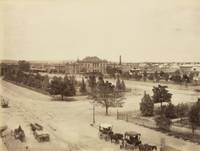
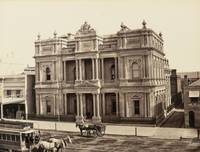
127218Fine. Albumen paper photographs each approximately 157 × 207 mm in fine condition; the mount has a few trifling blemishes. The Bank of South Australia building still stands on King William Street Adelaide. The photographer's credit and reference number 'Sweet Adelaide 92' is scratched in the negative. The imposing hospital buildings now demolished are photographed from an elevated vantage point probably the roof of the Botanic Hotel across North Terrace and the wide-angled view shows a sparsely-developed city now lost to history. The reference to Sweet was painted out in the original negative before this print was made suggesting it may be a posthumous print. Captain Samuel White Sweet 1825-1886 was a sea captain surveyor and photographer: after he was censured when his ship ran aground in 1875 he 'retired from the sea opened a photographic studio in Adelaide and concentrated on landscapes. With his horse-drawn dark room he travelled through South Australia taking hundreds of skilful pictures of the outback stations and homesteads. The colony's foremost documentary photographer of the 1870s in the early 1880s he was one of the first to use the new dry-plate process' 'Australian Dictionary of Biography'. unknown
127211Fine. Albumen paper photographs each approximately 157 × 207 mm in fine condition; the mount has a few trifling blemishes. The first photograph appears to be taken from the top of the old Treasury Building looking south-west across the square at the imposing Supreme Court building still extant. The second photograph is a panoramic view of the city skyline centred on the towers of the Town Hall and the GPO; a tall chimney on the riverbank pouring out black smoke stands visually between them. Captain Samuel White Sweet 1825-1886 was a sea captain surveyor and photographer: after he was censured when his ship ran aground in 1875 he 'retired from the sea opened a photographic studio in Adelaide and concentrated on landscapes. With his horse-drawn dark room he travelled through South Australia taking hundreds of skilful pictures of the outback stations and homesteads. The colony's foremost documentary photographer of the 1870s in the early 1880s he was one of the first to use the new dry-plate process' 'Australian Dictionary of Biography'. unknown
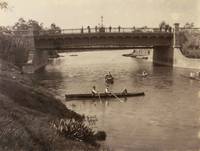
127216Albumen paper photographs each approximately 157 × 207 mm; the road scene has been printed from a broken negative and a hairline crack and small fingerprint are visible in the central portion of the sky; the top margin of the mount on this side has some spots of residual glue and the bottom edge of the mount on the other side has a few trifling surface chips; overall the condition is excellent. The photographer's credit and reference number 'Sweet Adelaide 335' is scratched in the negative of the City Bridge the second bridge built over the Torrens at that spot in 1877. Oarsmen in four boats in the foreground have clearly paused for the event as have the numerous pedestrians on the bridge. The second photograph shows Adelaide's twin towers - the Town Hall and the GPO - in the distance but the most prominent features of the scene are the tall eucalypts lining the road and the cart-horses drinking at a shaded trough. <p>Captain Samuel White Sweet 1825-1886 was a sea captain surveyor and photographer: after he was censured when his ship ran aground in 1875 he 'retired from the sea opened a photographic studio in Adelaide and concentrated on landscapes. With his horse-drawn dark room he travelled through South Australia taking hundreds of skilful pictures of the outback stations and homesteads. The colony's foremost documentary photographer of the 1870s in the early 1880s he was one of the first to use the new dry-plate process' 'Australian Dictionary of Biography'. unknown
2014046893Camden NSW: Belgenny Farm Trust 2014. vii 168pp glossary bw & col ills map. Or card. Slight edge wear to covers. Camden Park is Australia's oldest surviving farm founded by Governor Macarthur. Thsi book looks at the 20th century history of the farm and the community which has grown around it in the 20th century through interviews with workers and residents of the estate. First Edition. Soft Cover. Very Good. 4to. Belgenny Farm Trust Paperback
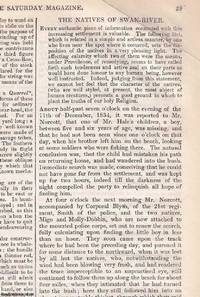
1836372989The Saturday Magazine Johh William Parker London 1836. Card Covers. Good Condition. 8 pages. Approximately A4 size with illustrations. Two pages are devoted to the Australian content the other six regard other matter. Size: 19 x 28 cms. Category: Saturday Magazine; Special Interest. This item may require more postage than the rates shown for delivery outside the UK. If extra postage is required we will contact you before processing your order and you will be given the details and option to decline the extra cost. The Saturday Magazine unknown
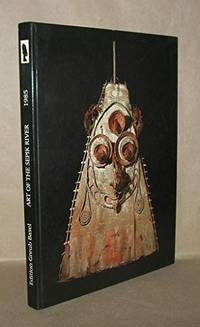
19850006493Basel SW: Tribal Art Centre 1985. Hardcover. Fine. Folio 217 pages laminated pictorial boards <br/><br/>Magnificent catalogue of an exhibition of Sepik Art mostly sculptures which traveled to 9 museums across the globe. Excellent texts of the history and meaning of these artworks as well as a descriptive catalogue. With maps. Tribal Art Centre hardcover
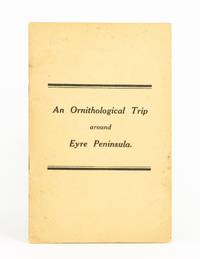
1924143019Adelaide: S.A. Ornithologist 1924. First Edition. Paperback. Very Good. Adelaide S.A. Ornithologist 1924. Octavo 46 pages with one illustration from a photograph plus a folding map. Saddle-stapled flush-cut wrappers a little foxed and very slightly worn; rubbed; mild signs of age and use; a very good copy. 'Reprinted from S.A. Ornithologist Vol. VIII Part 5 pages 118-130 1st January 1924'. The last two pages consist of another short paper from the same issue A.M. Morgan's 'The Nest and Eggs of Diaphorillas textilis myal' Eyre Peninsula Western Grasswren. S.A. Ornithologist paperback
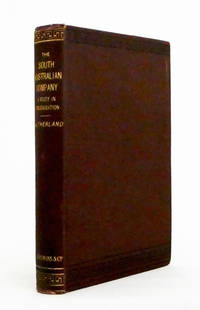
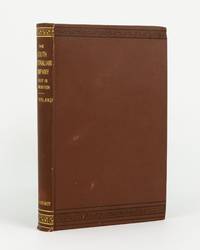
1898BIB328802London: Longmans Green and Co. 1898. Octavo Size. Very Good in original brown cloth with gilt title on spine. Black & white illustrations. "With the Compliments of The South Australian Company Adelaide 14th July 1898" stamped to rear free endpaper. Previous owner's name inked to bottom edge and top corner of title page clipped. Robust professional packaging and tracking provided for all parcels. 238 pages. The formation of the company followed considerable lobbying by the South Australian Association a group consisting of philanthropists radical thinkers dissenters and merchants. After a years of negotiation false starts changes and amendments to suggested charters the British Parliament finally gave approval and passed the South Australian Foundation Act on 15 August 1834. The founding Board of directors were George Fife Angas Chairman; Raikes Currie; Charles Hindley M.P.; James Hyde; Henry Kingscote; John Pirie Alderman; Christopher Rawson; John Rundle M.P.; Thomas Smith; James Ruddell Todd; and Henry Waymouth; with Edmund John Wheeler Manager; Samuel Stephens Colonial Manager; and Edward Hill Secretary pro tem. . Very Good. 1st Edition. Hardback. Longmans, Green and Co. hardcover
1898144827London: Longmans Green and Co 1898. First Edition. Hardcover. Very Good. London Longmans Green and Co. 1898. Octavo viii 238 pages with 5 illustrations plus 3 plates and a frontispiece with a tissue-guard. Brown cloth lettered in gilt on the spine decorated in black on the front cover and in blind at the rear; top corners and the foot of the spine a little bumped; all edges uncut; endpapers and first and last pages a little tanned; pencil annotation on one page; mild signs of age and use; an excellent copy. 'With the Compliments of The South Australian Company. Adelaide 14th. July 1898.' is inkstamped on the recto of the frontispiece. Provenance: Charles Glover 1870-1936 several times Lord Mayor of Adelaide with his bookplate on the front pastedown. Longmans, Green, and Co hardcover
49987062like new. unknown
1527820696.Gpaperback. Good. Access codes and supplements are not guaranteed with used items. May be an ex-library book. paperback
1983AME_9780908237890Chapman 1983. 1st. Hardcover. New/New. Chapman hardcover
63143712University of New South Wales Press UNSW Press 1st Edition . Hardback. Used. University of New South Wales Press UNSW Press hardcover
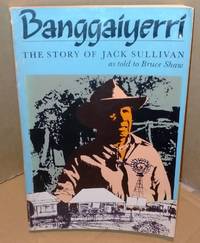
1983013452Canberra: Australian institute of Aboriginal Studies 1983 light rubbing to spine edges viii 264 pp Jack Sullivan known as Banggaiyerri by his Djamindjong people was a half caste who lived amongst the cattle men of Western Australia includes Sullivan's family tree a glossary of colloquialisms and Aboriginal and Pidgin words and expressions etc. Shaw wrote this from taped conversations . First Edition. Soft Cover. Very Good/No Jacket. 8vo - over 7 - 9 tall. Australian institute of Aboriginal Studies paperback
1995021817Berrimah NT: Australian Institute of Agricultural Science northern Territory Zone 1995. xiv 305pp appendices references tables. Or pictorial card. Prev owners name on title page. Sections include ley pastures and their use; no-tillage planters and crop performance; constraints- soils weeds pests; and evaluation of ley farming systems in northern Australia. First Edition. Soft Cover. Fine. 4to. Australian Institute of Agricultural Science, northern Territory Zone Paperback
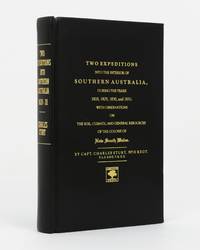
2001146556North Adelaide: Corkwood Press 2001. Hardcover. Fine. North Adelaide Corkwood Press 2001 new edition reset in one volume/ 1849. Octavo xvi 504 pages plus a colour map and 16 plates 6 in colour. Full black calf lettered in gilt on the spine and front cover; a fine copy. Number 5 of 50 copies of the deluxe edition. The six-page introduction by Nicolas Rothwell is new to this version which does not include the large maps originally published separately. Corkwood Press hardcover
1999140188North Adelaide: Corkwood Press 1999. Hardcover. Fine/Fine. North Adelaide Corkwood Press 1999 first thus/ 1834. Octavo xlvi 298 pages with a frontispiece plus a colour map and 14 plates 4 in colour. Papered boards; a fine copy with the fine colour-pictorial dustwrapper. One of the 'Les Hiddins Series of Explorers' Journals'. Corkwood Press hardcover
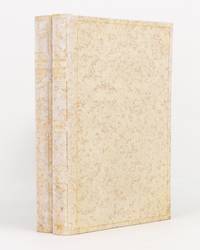
1963141195Adelaide: Libraries Board of South Australia 1963. Hardcover. Very Good. Adelaide Libraries Board of South Australia 1963 facsimile edition/ 1833. Octavo two volumes iv lxxx 219 and iv vi 271 pages plus plates and maps one folding. Full leather pigskin - a presentation binding; boards slightly bowed; endpapers and the margins of the first and last few leaves in each volume slightly tanned; an excellent set. Australiana Facsimile Editions Number 4. Peade A4: 1117 sets. A personal bookplate is mounted on the front free endpaper of the first volume; a short letter relating to the gift of these volumes is loosely inserted. 2 items. Libraries Board of South Australia hardcover
1833BIB329093<p>Adelaide: Libraries Board of South Australia. 19631833. Octavo Size approx 15x22cm. Near Fine condition - an excellent set. Beige marbled faux leather boards with gilt title to spine - as issued. Colour and black & white illustrations. Maps. Australiana Facsimile Editions No. 4. Facsimile edition of the 1833 Smith Elder edition. Peade A4 - 748 copies. Although there was a later reprint of another 389 copies. Robust professional packaging and tracking provided for all parcels. 220 272 pages. Captain Charles Sturt was a British explorer of Australia and part of the European exploration of Australia. He led several expeditions into the interior of the continent starting from both Sydney and later from Adelaide. His expeditions traced several of the westward-flowing rivers establishing that they all merged into the Murray River. He was searching to determine if there was an "inland sea". . Near Fine. Facsimile Edition. Hardback.</p> Libraries Board of South Australia hardcover
1999146555North Adelaide: Corkwood Press 1999. Hardcover. Fine. North Adelaide Corkwood Press 1999 new edition reset/ 1833. Octavo xlvi 298 pages plus 17 pages of plates including a colour double-page map and 4 illustrations in full colour. Full black calf lettered in gilt on the spine and front cover; a fine copy. Number 15 of only 30 copies of the deluxe issue all inscribed dated September 1999 and signed by Les Hiddins who provided the introduction new to this edition. Corkwood Press hardcover
198273994Lane Cove: Doubleday 1982. Hardcover. Fine/Fine. Lane Cove Doubleday 1982 facsimile edition/ 1833. Octavo two volumes ii lxxx 219 and ii vi 271 pages plus 18 plates and a folding map. Synthetic cloth; a fine set with the fine dustwrappers. Doubleday hardcover
1988028702Sydney: Buying Systems 1988. HEAVY. 227pp index bibliography directory hundreds of bw & col ills. Or pictorial card covers. Small bump at top corner with resultant small corner creases to some pages .A brief history of fashion in Australia followed by a focus on contemporary fashion and designers which comprises the bulk of the book. First Edition. Soft Cover. Very Good. 4to. Buying Systems Paperback
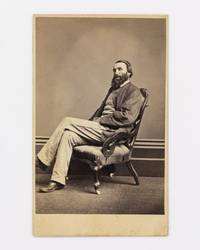
1866135300Adelaide: Townsend Duryea 1866. Adelaide Townsend Duryea printed circa 1866; original negative circa 1863. An albumen paper photograph 90 × 59 mm mounted on the original card 102 × 62 mm with 'T. Duryea Photographer to His Excellency 66 King William St. Adelaide' printed on the verso under the Vice-Regal Coat of Arms. 'Townsend Duryea began making cartes de visite in late 1862 or early 1863 and was advertising his "new" style of carte in May 1863' Bob Noye AGSA website. The portrait taken in Duryea's Adelaide studio shows Stuart after his epic crossing of the continent of Australia: he is visibly depleted - emaciated even - with his injured hand positioned awkwardly in his lap. The accident that caused this permanent injury occurred on 25 October 1861 the day the main party of the successful sixth expedition departed Adelaide. Stuart later described it in a letter to Charles Sturt: 'the accident I received from one of the horses being in a state of strangulation and endeavoured to release him reared up struck me in the temple knocked me senseless and springing again with his hind feet on my right hand has disabled me for life' Ian Mudie: 'The Heroic Journey of John McDouall Stuart' 1968 page 171. It is a most evocative image of the great explorer towards the end of his life. <p>The negative number 18592/3 is inscribed in ink on the verso below Duryea's imprint. This particular imprint dates to around 1866 see Noye and the negative number is consistent with this date. Noye notes that 'A carte with a number belonging to a much earlier number range would be a reprint from an old negative held in storage'; this suggests that this photograph is not printed from the original negative perhaps lost damaged or destroyed. This further suggests that this photograph is printed from a negative produced by rephotographing an existing print of the portrait of Stuart taken earlier by Duryea. This would explain why Stuart has what appears to be his left hand in his lap: the image is printed in reverse. <p>It was likely produced after news of the explorer's death in London on 5 June 1866 had reached Adelaide. A small item of local news 'Mr T. Duryea's Studio' in the 'South Australian Register' on 23 November 1866 lends weight to this possibility: 'A visitor to Adelaide may spend a very pleasant and profitable half-hour in Mr Duryea's photographic studio where a number of elegant photographs in every style of art are displayed. Mr. Duryea also exhibits some superior examples of photographs worked up in water-colours which are soft and some of them exquisitely finished. Amongst these there is a fine portrait of the late J.M. Stuart the explorer'. This carte de visite is clearly not that exhibition piece but it is most definitely a fine portrait. Townsend Duryea unknown
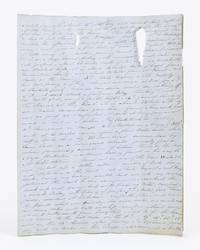
135288Fair. Quarto 12 pages last two blank. A saddle-sewn gathering of blue paper; two holes to each leaf apparently insect damage with some minor loss to the text; some marks and short edge tears; nevertheless an extraordinary relic in decent condition overall. The first nine pages closely written in ink in a single hand which we know to be that of pastoralist Alfred Barker 1812-1880 contain a version of Stuart's journal for the period from 31 March the beginning of the expedition to 17 May 1859 with some significant variation from the published versions. Importantly the final half-page of text is unmistakably in the hand of John McDouall Stuart himself. This passage - an addendum written in pencil and comprising material not included in published versions of the journal - describes the extent of Stuart's claims of pastoral land at Chambers Creek. The journal is accompanied by a loose bifolium containing manuscript directions to Chambers Creek quarto 2 pages also in Barker's hand with a small diagram of Hummock Hill. <p>The journal ends after the entry for 17 May 1859. Published accounts of the expedition indicate that Stuart spent the following three days in camp finalising his report on the survey of Chambers Creek which was sent back to his patrons James and John Chambers and William Finke on 20 May by way of one of the expeditioners Campbell. The specific nature of the variations from the published versions leads us to conclude that Stuart sent with this material an edited version of his field journal to that date the originals of both manuscripts are now lost. Barker brother-in-law and business partner of the Chambers brothers would have copied the present manuscript directly from Stuart's original manuscript. It pays scant attention to the daily happenings of the expedition but records detailed information about the country with a particular regard to its suitability for pastoral use precisely the information most valuable to patrons intent on building a pastoral empire. <p>Stuart's manuscript addendum to Barker's copy of his report must have been written in the short period between his return on 3 July 1859 and the departure in August of the same year of his third expedition into the interior. He had given John Chambers power of attorney in relation to his claims on the runs at Chambers Creek where he had claimed a staggering 1500 square miles of land. The matter had still not been settled at his departure and Stuart's precise description of the extent of his claim were evidently intended to allow his patrons to consolidate it in his absence. <p>The detailed manuscript text on the separate bifolium also supports a date from the middle of 1859. It gives a set of straightforward directions to Chambers Creek via the crucial series of waterholes that Stuart had identified as well as some details of the surrounding country. Barker was soon to follow this route north to stock Stuart's empty cattle runs the explorer lacking the resources to do so himself. While these instructions are in Barker's hand they must have been prepared in consultation with Stuart in preparation for the cattle drive north. <p>Returning from his third expedition Stuart was pleased to find Barker's cattle thriving on the saltbush on his land. After great difficulty and scandal the grant was finally made for an unprecedented area of 1000 square miles but many suspected that the beneficiary of the vast territory would be Chambers and Finke not the explorer Barker's contribution going unremarked in newspaper accounts of the time. This would be borne out in the coming years. <p>The textual history of the journal of Stuart's second expedition makes the survival of this document all the more important. In her introduction to the edition of the journal published by the Friends of the State Library of South Australia 2002 Valmai Hankel writes: 'This expedition is the only one for which no manuscript diary or fair copy survives. As it was regarded as a private venture unlike the five other expeditions its results were not reported to Parliament so its journal was not published as a parliamentary paper. The only known versions are those published in the "Journal" of the Royal Geographical Society RGS vol.31 1861 pp.65-83 and in "Explorations in Australia. The Journals of John McDouall Stuart during the years 1858 1859 1860 1861 & 1862" edited by William Hardman London: Saunders Otley 1864 .'. <p>The RGS and Hardman versions of the text are generally more discursive but both are the result of editing by third parties and would have been based on fair copies of the journals. Hardman in particular was an unsympathetic editor 'Stuart seems to be almost an illiterate person .' and often redrafted Stuart's matter-of-fact observations to fit more closely the mould of a Victorian travel narrative. Our manuscript on the other hand is not only contemporaneous with the expedition but also likely closer in content to the lost field journals before editorial intervention and judicious redaction and revisions for political and commercial considerations. <p>A full transcription of the journal is available as are a list of variations from the published version. One example will suffice to indicate the significance of this manuscript. Hankel's introduction states that 'The expedition's main aims were to survey the Chambers Creek lease and to prospect for gold . Stuart's major discovery was more links in the chain of springs later known as mound springs which Warburton and Babbage had found in 1858. Hergott found the first on 13 April; although Stuart named them after their discoverer he does not say so in either version of his journal' page x. The manuscript states that 'on the 13th Hergott after finding St Stephens Pool dry and no water in the Range - discovered a batch of Springs South of the Pool - abundance of Water - distance from this camp to Hergotts Springs 30 Miles - Native Cucumbers found here'. <p>These documents were purchased together with an important archive relating to Alfred Barker's pastoral properties offered separately and now sold. The archive contains letters that substantiate serious irregularities in the handling of Stuart's pastoral lease at Chambers Creek which when read in conjunction with the above material make the story of his final years even more distressing. Copies of the relevant letters are included with the manuscript. unknown
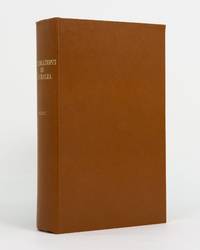
1977145911Adelaide: Libraries Board of South Australia 1977. 2nd Edition. Hardcover. Very Good. Adelaide Libraries Board of South Australia 1977 second impression/ 1975 facsimile edition/ 1865 second edition/ 1864. Octavo iv xxiv 511 pages plus 13 plates and 2 maps one a very long folding map. Synthetic cloth slightly bumped at the extremities; boards slightly bowed; an excellent copy. Peade A198: one of only 904 copies. Libraries Board of South Australia hardcover