[River Murray]. KINLOCH, ArthurBiblio.com

705 résultats
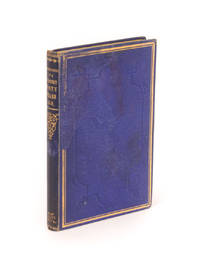
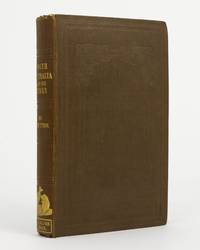
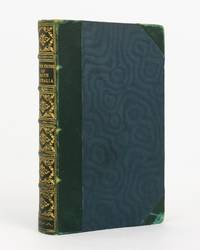
1853100379Adelaide: W.C. Cox Printer 1853. First Edition. Hardcover. Very Good. Adelaide W.C. Cox Printer 1853. Octavo 46 pages. Relatively recent quarter morocco and buckram by the Law Bindery Melbourne; title leaf a little foxed with minimal light scattered foxing to a few other leaves; an excellent copy with most interesting provenance see below. The author Clerk of the Executive Council of South Australia was on board the vessel; this is his account of the first successful navigation of the Murray as far as Swan Hill by Captain Francis Cadell. Fellow-passenger James Allen also published his version of events. Captain William Randell and his paddle-steamer 'Mary Ann' left Goolwa at the Murray mouth ahead of Cadell and travelled much farther up the Murray but Cadell overtook him en route and reached Swan Hill first. However both men deservedly earned the bonus of 2000 pounds offered by the South Australian Government 'for each of the first two steamers to travel up the Murray as far as the Darling junction' 'Australian Dictionary of Biography'. We have noted previously the manuscript correction page 5 line 4 'largest' to 'longest' river and presume it is in Kinloch's hand. At the head of the title page of this copy is the pencilled ownership name possibly his signature of Robert Wadsworth over-written in red ink by the subsequent owner 'John Shillinglaw from Robert Wadsworth 1854'. Shillingworth has annotated the text in both pencil and red ink three and seven pages respectively. The pencilling identifies the 'gentleman's son' working as a shepherd as 'old "Bigodd Macdonald"' and asks elsewhere of a sentence nine lines long 'what does this wretched twaddler mean' he's got a point too!. Robert Wadsworth was eventually Clerk of the Victorian Executive Council from 1875 to 1889; of passing interest to bibliophiles his son Arthur 1864-1931 was the first Commonwealth Parliamentary Librarian having 'charge of the Commonwealth library for over twenty-six years while also being titular head of the Victorian State parliamentary library' ADB. <p>John Joseph Shillinglaw 1831-1905 public servant and historian was the eldest son of the librarian of the Royal Geographical Society. 'He was to study under Captain John Washington eminent maritime surveyor and in 1852 he migrated with his father and brothers to Victoria arriving in October. From November he was chief clerk of petty sessions at Williamstown and in 1854 was appointed inspector and sometime acting superintendent of the Water Police. He was also secretary to the Steam Navigation Board until December 1857. In 1856-69 he was shipping-master for the Port of Melbourne and registrar of seamen; he helped to found the first Sailors' Home and did much to improve the working conditions of seamen'. It is hardly surprising that he should be given a copy of this book soon after its publication. He held various public service positions over the years; from 1885-94 he 'was secretary to the royal commission on vegetable products. He was also secretary to the Board of Viticulture. Shillinglaw was an enthusiast in whatever department he worked; however he is remembered for his association with colonial literature and history'. He was the author of numerous books and on his death his estate 'included a vast collection of papers and rare books' presumably including this item ADB. Ferguson 11196. W.C. Cox, Printer hardcover
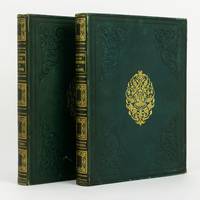
183987631London: Fisher Son & Co 1839. First Edition. Hardcover. Fair. London Fisher Son & Co. 1839 and 1840. Quarto two volumes iv xxxvi 84 pages plus a map 46 full-page plates including an unlisted plate facing page 54 'Ancient Archway of Cavern in the Balkan Mountains' and an engraved vignette title page; and iv 100 pages including the cumulative index plus a double-page map 48 full-page plates and an engraved vignette title page. Most plates have the original tissue-guards. Matching full dark green morocco the spines lettered and decorated in gilt in compartments all sides decorated in gilt and blind; all edges gilt; covers a little bumped and lightly worn at the corners; leather a little scuffed and marked; scattered foxing and minor signs of handling more so in the first volume which is inexpertly reinserted in its binding with a rear endpaper that would be greatly improved by removing and replacing it and a front free endpaper that appears to be original but salvaged from the rear and amateurishly lined with tissue; overall a decent set which certainly presents well on the shelf. Provenance: John Michael Skipper 1815-1883 artist solicitor and South Australian pioneer with his ownership initials on the engraved title page of the first volume and his signature and most interesting inscription of the front free endpaper of the second volume: 'J M. Skipper from Mrs. Thomas March 14th. 1841' his mother-in-law. <p>Skipper was born in Norwich the son of a solicitor; 'he was intended for the law but was more interested in art in which he was encouraged by his uncle. In 1833 he abandoned his studies to become a midshipman in the East India Co.'s "Sherbourne" bound for Calcutta. On his return deciding to migrate he arranged to be articled to Charles Mann the new South Australian advocate-general and sailed in the "Africaine" arriving at Holdfast Bay on 6 November 1836. He sketched scenes on the voyage and met Frances Amelia eldest daughter of Robert Thomas; he married her on 28 December 1839' 'Australian Dictionary of Biography'. <p>Accordingly these volumes not only date from the foundation years of British settlement in the colony they also come from two of the first settlers. They are offered together with a copy of 'The Diary and Letters of Mary Thomas 1836-1866. Being a Record of the Early Days of South Australia. Edited by Evan Kyffin Thomas' Adelaide 1925 revised and enlarged third edition/ 1915. It is an account of the Thomas family's journey to South Australia on the 'Africaine' in 1836 and the fascinating early years of colonization as described in Mary's letters to her brother in England. Her husband Robert was the first newspaper publisher in South Australia and important details of the practical difficulties involved in the printing business are included. <p>This is one of 300 unbound copies of the original 1925 edition discovered in the family attic in 1985; the entire cache has now been attractively bound in full reconstituted morocco. It comes in a slipcase with a fine copy of the first edition of a companion family volume 'Maisie. Her Life in her Letters from 1898 to 1902' edited by Joan Kyffin Willington Adelaide 1992. Each book in this 'collectors' duo' contains a numbered certificate of authenticity signed by Joan Kyffin Willington Maisie's granddaughter and Mary's great-great-granddaughter. 4 items. Fisher, Son & Co hardcover
1832PHO-1689Paris, J. Tastu, 1832, In-folio, demi-chagrin noir, dos orné de filets dorés à froid Atlas de botanique seul comprenant 76/80 pl. sur chine collé, liste des planches in fine, peu de défauts.
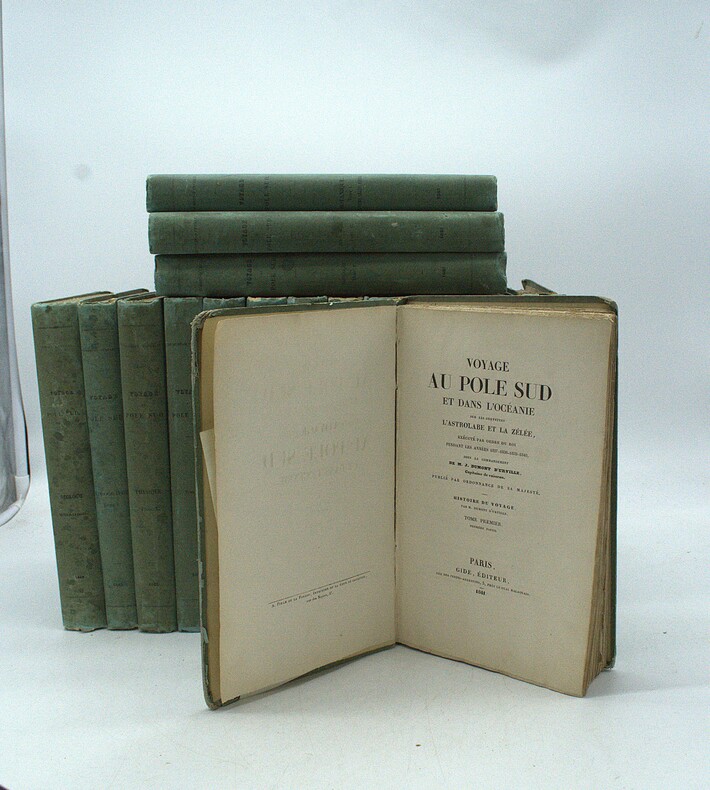
1841PHO-1967Paris, Gide, 1841-1848, in-8, cartonnage éditeur, frottements, qlqs petits manques de matière, coins usés, qlqs coiffes usées, qlqs taches aux plats, T4 avec manque au dos et en haut du 1er plat 16 volumes de texte (sur 21) comprenant : Histoire du voyage, 1841-1846. 10 volumes en premier tirage, (1er tome, 1ère partie correspondant au 1er tome, 1er tome seconde partie correspondant au 2nd tome et 2nd tome, 1ère partie correspondant au tome 3), T2 mouillure en marge sur les derniers feuillets, T4 mouillure, T2 rousseurs, papier légèrement bruni aux tomes 3,4,5,6,7,8 et début tome 9. Zoologie, 1846, 2 volumes (sur 4, tome 1 et2) Botanique, 1845, 1 volume (sur 2), tome 1, plantes cellulaires, papier légèrement bruni Physique, 1842. 1 seul volume (en raison de la mort de Vincendon-Dumoulin) bien que d’autres annoncés, papier légèrement bruni Géologie, Minéralogie et Géographie physique du Voyage. 1848- 1 volume (sur 2, le second paru en 1854), 1 planche in-fine, papier légèrement bruni Hydrographie. 1843. 1 volume (sur 2), 1 planche in-fine, papier légèrement bruni.
1844PHO-2326Paris, Artus Bertrand, 1844, 2 volumes in-8 (220 x 135 mm), xlvi-295pp.-2ff.-298p-1058p., Demi-chagrin et coins, dos lisse avec auteur, titre et tomaison, très légers défauts. Illustrée de 2 cartes dépliantes gravées par S. Jacobs, montées en fin du premier volume : "Carte de l’archipel Taïti par Vincendon-Dumoulin", 1844 et "Carte de l’île Taïti d’après Vilson et les travaux récents de la frégate l’Artémise".
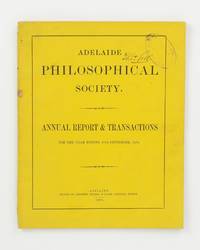
1871144583Adelaide: Printed by Andrew Thomas & Clark at the 'Register' 'Observer' and 'Journal' Offices 1871. First Edition. Paperback. Very Good. Adelaide Printed by Andrew Thomas & Clark at the 'Register' 'Observer' and 'Journal' Offices 1871. Quarto 42 pages with a diagram plus 7 plates 2 showing sunspot observations the remainder meteorological graphs numbered 1-5. Printed yellow wrappers lightly creased and marked with minor loss to the ends of the spine; small burst with minor loss to one leaf affecting a few words in a handful of lines of text in one column recto and verso; small light stains to the bottom edge of the five meteorological graphs at the rear; a few creases marks and other signs of age and handling; overall in excellent condition. The pamphlet comprises a title page list of office-bearers and members and the report for the year each one leaf verso blank followed by 11 papers read at the society's meetings during the year. The papers are: <p>'Irrigation' by C.S. Hare 2 pages with a small diagram; <p>'The Camel in South Australia' by J.S. Lloyd 4 pages; <p>'The Use and Properties of Plants. No. II' by Richard Schomburgk 2 pages; <p>'The Currents of the Air and the Ocean. No. III' by Benjamin Herschel 3 pages; <p>'The Importance of Silk Culture as a Branch of Colonial Industry' by T.S. Reed 2 pages; <p>'Remarks on Sun Maps' by D.B. Adamson 1 page plus 2 plates; <p>'Light Railway Construction' by R.C. Patterson 6 pages; <p>'The Influence of Forests on Climate' by Richard Schomburgk 2 pages being the leaf with minor loss; <p>'Light Railway Construction' by A.F. Lindsay 5 pages; <p>'The Cause of Disease in Silkworms' by Richard Schomburgk 1 page; and <p>'Some Observation on the Rainfall at Adelaide and the Connection between Meteorological Changes and the Yield of Wheat' by Benjamin Herschel 3 pages plus 5 plates containing meteorological graphs. Loosely inserted is a lengthy newspaper clipping from 'The Register' 19 May 1858 on 'Camels in Australia' based heavily on information supplied by Arthur Horrocks brother of the ill-fated explorer John Ainsworth Horrocks. <p>The Adelaide Philosophical Society was founded in 1853 and in 1880 became the Royal Society of South Australia. This annual report lists the name of the 73 current members: the president His Excellency Sir James Fergusson 12 'Honorary and Corresponding Members' and 60 ordinary members. The final paragraph of the short report will sound familiar to anyone who has served on a committee: 'The Council wish to impress upon members the necessity of paying their subscriptions punctually; during the past year out of sixty-seven ordinary members it appears only thirty-nine have paid their annual subscriptions'. These extremely small numbers let alone the passage of 150 or more years must account for the utmost rarity of this publication. <p>Provenance: Thomas Gill 1849-1923 the South Australian historian and bibliographer with his ownership signature on the front cover; later the Royal Geographical Society of Australasia South Australian Branch with its stamp ditto. 'Gill was also a governor of the Public Library Museum and Art Gallery of South Australia from 1896 until his death and a member of the Library Association of Australasia. He wrote "The History and Topography of Glen Osmond" 1905 for the Glen Osmond Institute. Gill was treasurer of the South Australian branch of the Royal Geographical Society of Australasia from its inception in 1885 until his death. The society's acquisition of the valuable York Gate Library was largely due to his energy and enthusiasm. His library was sold to the society for £300 as his will directed' but numerous items from his collection mainly duplicates of existing holdings in the RGSSA library were later sold. Printed by Andrew, Thomas, & Clark, at the 'Register,' 'Observer,' and 'Journal' Offices paperback
1845109128Adelaide: Andrew Murray Printer Rundle Street Sold by C. Platts Bookseller Hindley Street . 1845. First Edition. Paperback. Adelaide Andrew Murray Printer Rundle Street Sold by C. Platts Bookseller Hindley Street . 1845. Octavo xii last blank 106 pages plus a folding etching but lacking the folding frontispiece map noted by Ferguson. Original bright green wrappers with the full title page details repeated on the front cover with the date of publication now added; wrappers a little marked but expertly conserved the front cover is now lined on the verso stabilizing a long tear and filling in some minor loss to the edges; title page a little marked; occasional chips and dog-ear creases to the uncut edges; trifling signs of age and use but essentially a very agreeable copy. The State Library of South Australia has a copy of this item with the map and it's a beauty - a hand-coloured lithograph 322 × 213 mm produced in 'Goodwood nr Adelaide' in 1845. However reading between the lines a case may be made for stating that not all copies were issued with the map. Its absence here notwithstanding this is by any account a very rare publication and worthy of serious consideration on at least two counts. The folding plate is an etching paper size approximately 220 × 280 mm of 'Ridley's Reaping Machine. S. Australia' signed and dated in the plate 'NRF 1845'. The artist is Frederick Robert Nixon circa 1817-1860 who arrived in Adelaide in May 1838 to take up a position as assistant surveyor. In 1845 he published 'Twelve Views in Adelaide and its Vicinity South Australia. Drawn etched and printed by F.R. Nixon'; it was the earliest South Australian plate book. He was a self-taught artist who 'had to manufacture all his machinery for preparing and pressing his etchings . they are superior as works of art and accurately as well as pleasingly depict the scenes which they represent 'The South Australian' 21 February 1845. Nixon left Adelaide in May 1846 bound for Mauritius where he died in 1860. Kerr's 'The Dictionary of Australian Artists' 1992 records that the Ridley etching was the only other one he is known to have produced. There is a lengthy chapter 10 pages on the Aboriginal inhabitants and the chapter on horticulture contains seven pages on vines and wine-making with the information credited to M. Vaillant see page 58. Ferguson 4014. Andrew Murray, Printer, Rundle Street (Sold by C. Platts, Bookseller, Hindley Street ...) paperback
188080022Adelaide: J. Williams Printer for the Author 1880. 2nd Edition. Hardcover. Very Good. Adelaide J. Williams Printer for the Author 1880 second edition/ 1879. Octavo viii 84; 80; and 23 pages plus 3 albumen paper photographs of 5 drawings on 3 unnumbered leaves. Blue cloth lettered in gilt on the spine with both sides ruled in gilt and decorated in blind; covers a little bumped and rubbed at the extremities with minor wear to the corners; spine unevenly sunned; light stains to the front cover removing some of the gilt from the left-hand border; rear free endpaper replaced with near-matching paper tanning the last page a blank; overall a very good copy internally excellent. A presentation copy inscribed in ink on the front free endpaper 'From G. Hamilton to Capt Dashwood with the Author's best wishes 22 Dec 1880'. George Frederick Dashwood 1806-1881 arrived in South Australia in the early 1840s; in 1843 he 'was appointed one of the four non-official nominees in South Australia's first Legislative Council. From 1847 to 1852 he was commissioner of police' 'Australian Dictionary of Biography'. George Hamilton 1812-1883 succeeded him in that role in 1867 retiring the year before his death. He arrived in Adelaide in 1839 when he overlanded cattle along Charles Bonney's southern route. A most satisfying association copy presented from one significant pioneer to another in the twilight of their lives. <p>The particulars of the photographs match those given in Holden where the discrepancy in the number of plates present as against listed is explained. The plates are of drawings by Hamilton; he contributed similar sketches to the published journals of Grey and Eyre. The first edition was not photographically illustrated. <p>Ferguson 10184 inadequately describing the plates; Holden 49. J. Williams, Printer [for the Author] hardcover
185378787Adelaide: W.C. Cox Printer 1853. First Edition. Hardcover. Very Good. Adelaide W.C. Cox Printer 1853. Octavo 46 pages. Antique-style quarter calf and marbled papered boards; title page slightly dusty and a trifle marked with two tiny closed tears to the top edge; a few pencilled emphases to the margins; light vertical crease down the centre of the last six leaves; an excellent copy. The author Clerk of the Executive Council of South Australia was on board the vessel; this is his account of the first successful navigation of the Murray as far as Swan Hill by Captain Francis Cadell. Fellow-passenger James Allen also published his version of events. Captain William Randell and his paddle-steamer 'Mary Ann' left Goolwa at the Murray mouth ahead of Cadell and travelled much farther up the Murray but Cadell overtook him en route and reached Swan Hill first. However both men deservedly earned the bonus of 2000 pounds offered by the South Australian Government 'for each of the first two steamers to travel up the Murray as far as the Darling junction' 'Australian Dictionary of Biography'. W.C. Cox, Printer hardcover
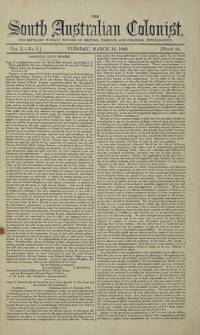
184080314London: 'Printed for the Proprietor by William Cecil Huttmann' 1840. First Edition. Hardcover. London 'Printed for the Proprietor by William Cecil Huttmann' 1840. Folio 352 pages 16 pages each issue. Early binder's cloth recently rebacked retaining the top two-thirds of the original spine; cloth marked and mottled with some neat restoration to the corners; edges a little marked; very light tidemarks to the leading edge of the front flyleaf and an initial blank; leading edge of the first few leaves of Number 22 slightly chipped; bottom left-hand corner piece missing from the last leaf with the loss of about 15 words of text and a small amount of the colophon which is the same in each issue; overall an excellent run of the first 22 issues of this very rare weekly newspaper which ceased publication with Volume 1 Number 29 on Tuesday September 22 1840. The prospectus appears on pages 7 and 8 of the first issue; the proprietors' object is 'not mercenary but patriotic . they are not the organs of any party . they will offer a fearless and uncompromising opposition to every deviation from the self-supporting principle on which South Australia is founded'. Their aim in part 'is to present an impartial record of the colonial intelligence . 1st from the colonial papers; 2ndly from direct correspondents in the colony and other exclusive sources'. Accordingly it contains much original material. The editor was John Stephens 1806-1850; 'about 1838 George Fife Angas employed him to write emigration propaganda. Stephens's first notable work was "The Land of Promise" republished in 1839 as "The History of the Rise and Progress of the New British Province of South Australia". In that year his exposure of absurdities in T. Horton James "Six Months in South Australia" London 1839 ran to three editions. He also edited the "South Australian Colonist" on which Angas lost heavily; it was replaced in 1841 by the monthly "South Australian News" at a cheaper rate' 'Australian Dictionary of Biography'. The ownership signature of Robert Kyffin Thomas is pencilled onto the front flyleaf and the blindstamp of the 'Register & Observer Office Adelaide' appears on an early blank leaf. Sir Robert Kyffin Thomas 1851-1910 the grandson of Robert Thomas who arrived on the 'Africaine' at Holdfast Bay in 1836 with a printing press was himself an influential newspaperman in the state. 'In 1877 he became the principal joint proprietor of the "South Australian Register" and as chief of staff he also edited the "Adelaide Observer". A parliamentary reporter he was in charge of the Hansard branch until 1882 when he became general manager of the "South Australian Register" which became the "Register" in 1901' ADB. Ferguson 3082. 'Printed for the Proprietor, by William Cecil Huttmann' hardcover
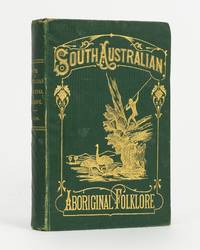
1879144271Adelaide: E. Spiller Acting Government Printer 1879. First Edition. Hardcover. Very Good. Adelaide E. Spiller Acting Government Printer 1879. Octavo viii 174 2 24 'The Grammar of the Narrinyeri Tribe' xii lithographed 'Facsimiles of Letters Written by Aborigines' one leaf folding 2 25-28 index pages including a page of lithographed music plus 9 lithographs from drawings by Aboriginal artists and 7 original albumen silver photographs 3 are approximately 105 × 145 mm; 4 are approximately 115 × 95 mm mounted on captioned leaves. Original green cloth attractively blocked in gilt on the front board and in blind at the rear; spine ruled and lettered in gilt; covers a little worn and marked with the binding a little shaken; acidic paper tanned with the folding facsimile document splitting at one fold; mounts a little cockled; trifling loss to the corner-tip of one photograph; page 29 printed close to the right-hand edge an imposition error during production; a few mild signs of age and handling; a very good copy of a rare and important work with the photographs in excellent condition. An early ownership signature on an initial blank is proving difficult to decipher Ruppard Sheppard. The original photographs that illustrate the book are almost certainly the work of Captain Samuel Sweet see Robert Holden: 'Photography in Colonial Australia. The Mechanical Eye and the Illustrated Book' 1988. We have handled a number of copies of this work and this copy conforms with what we suggest might be called the first and most desirable issue of these photographs. The substance of the book was derived from a 48-question circular compiled by George Taplin and 'distributed to all the keepers of aborigines' depots throughout the colony and to all persons who are known to be acquainted with the manners customs and languages of the aborigines'; the value of the work may be judged by the editor's remark in the introduction 'that much information has been elicited and that most of the papers show that the writers have used their powers of observation in an intelligent manner'. The untimely death of Taplin in June 1879 at the early age of 47 may account for the failure of further volumes in the series to materialize. <p>Ferguson 16711; Holden 105 and pages 49-51. E. Spiller, Acting Government Printer hardcover
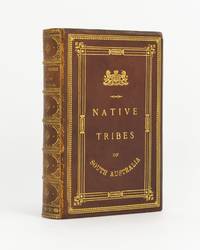
1879144282Adelaide: E.S. Wigg & Son 1879. Hardcover. Very Good. Adelaide E.S. Wigg & Son 1879 first thus. Octavo xliv 316 pages plus 8 tinted lithographs with tissue-guards. Full russet morocco extensively tooled in gilt; all edges gilt; spine lightly sunned; joints slightly cracked but firm; a few minor signs of age and handling internally; overall in excellent condition. The handsome colonial presentation binding has the ticket 'Bound at Government Printing Office Adelaide S.A.' on the rear pastedown; it was almost certainly executed by Emanuel Spiller the South Australian Government Printer at the time. An early binder's blank contains the inscription 'The South Australian Institute to Dr. Francis Reuleaux; Privy Councillor and Royal Professor; Chief Commissioner for the Empire of Germany at the Melbourne International Exhibition. Adelaide 1881'. Franz Reuleaux 1829-1905 was an influential German mechanical engineer who oversaw German machinery exhibits at the Sydney and Melbourne exhibitions 1879-81. He is best known as the father of modern kinematics. His armorial bookplate with manuscript inventory number is mounted opposite the inscription. <p>Spiller's name appears as exhibitor and jury-member of competitions and exhibitions of binding and printing throughout the 1880s. The 'Sydney Mail and New South Wales Advertiser' for 27 March 1880 carries a lengthy article by John Plummer on colonial bookbindings displayed at the Sydney International Exhibition noting that '. in the South Australian Court Mr. E. Spiller the Government printer of Adelaide occupies the foremost rank'. <p>The book itself is an important early collected reprint of works already scarce at the time; the lithographs and lengthy 34-page introduction by Woods were new to this edition. Not commonly known is that Taplin's substantial contribution 'The Narrinyeri' 156 pages plus 6 preliminaries is the text of the revised edition of 1878 see his informative preface dated 12 April 1878 at page xliii. The Wyatt contribution was not previously published as such; the text here was 'principally extracted from his official reports' stemming from his relatively short and unhappy time as the third South Australian Protector of the Aborigines from 1837 to 1839 'Australian Dictionary of Biography'. The contributions by Meyer Schuermann Gason and Bennett first appeared in 1846 1846 1874 and 1869 respectively. Ferguson 13095 noting blue sand-grain cloth and another binding in half leather but not an unillustrated edition we have identified. E.S. Wigg & Son hardcover
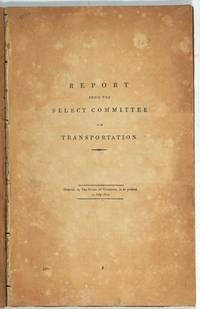
181227311London: The House of Commons 1812. First printing. Self wrappers pamphlet. Very good condition. A rare and important British Blue Paper illustrating Governor Macquarie's early years. The report published in 1812 was the result of a report by a Parliamentary Select Committee to explore the future of transportation of convicts to New South Wales a system that had operated for almost 25 years. It includes a complete transcript of evidence given by many important witnesses including former Governor John Hunter former Governor William Bligh Scottish Martyr Maurice Margarot Matthew Flinders First Fleet chaplain Richard Johnson and many other colonial officials. Extracts from several of Macquarie’s early dispatches are included. <br /> <br /> The report is a document of great significance in the early history of Australia. It is the first major document from the Macquarie era. It endorsed the existing system of transportation and “the liberal views of the present Governor†and became the foundation for Macquarie’s program of civil and administrative improvement. Ferguson 543; Wantrup 3; Trove Libraries Australia ID 4191118.<br /> <br /> Foolscap folio 117pp last blank. Parliamentary papers / House of Commons ; no. 341; Disbound from a compilation lacking the original blue wrappers with later brown paper wrappers which have tanned the title and last page. Internally a bright clean copy of a very scarce piece of Australiana. The House of Commons unknown
1840WRCAM53792Sydney: W.A. Duncan Australasian Chronicle Office 1840. 52pp. Dbd. Minor toning some loose leaves. Good. A rare trial account of a peculiar though perhaps an oddly-justified assault in Australia in 1840. "James Mudie had in his book THE FELONRY OF NEW SOUTH WALES reflected upon the capacity of Kinchela's father in his office as judge. The younger Kinchela waited for Mudie who had recently returned to the colony and administered many lashes one witness said 50 with a horsewhip. The defence was that Mudie well deserved what he got as a common libeller and that Judge Kinchela was now aged and unable to take his own part. The jury returned a verdict for the plaintiff in the sum of £50 - one pound for each stroke" - Ferguson. Some might call the horsewhipping a simple case of frontier justice. <br> <br> Together Ferguson and OCLC locate only five copies all in Australia. FERGUSON 3104. OCLC 220294602. W.A. Duncan, Australasian Chronicle Office unknown books
184139808Paris, Clarey, 1841. In-8 de (4)-III-259 pp. maroquin vert, dos orné à nerfs, triple filet doré d’encadrement sur les plats, dentelle intérieure dorée, tranches dorées sur marbrure, non rogné (Brany).
185522345Paris A. Courcier [1855] in-8 (23 x 14,5 cm) percaline noire de l'éditeur, dos lisse et premier plat orné d'un décor polychrome, tranches dorées, dos passé, qqs rouss
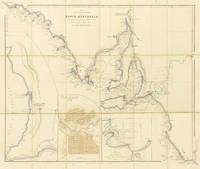
1839144319London: John Arrowsmith 1839. Very Good. London John Arrowsmith 5 February 1839 second state/ 1838. A hand-coloured engraved map printed surface approximately 536 × 655 mm sheet size approximately 562 × 665 mm dissected into 18 panels and mounted on linen folding down to 188 × 113 mm with plain paper mounted on the two external surfaces. A few small spots; some very faint offsetting; unobtrusive marks and pencilling to the backing linen on the verso; an excellent copy. A very early map of the fledgling colony of South Australia with three inset maps showing: 1. The eastern coast of Gulf St. Vincent; 2. 'The City of Adelaide with the Acre Allotments numbered surveyed by Col. Light'; and 3. 'Sketch of Nepean Bay and Kingscote Harbour by Wm. Chesser'. <p>'Arrowsmith's Australian Maps' an online resource by Dorothy Prescott suggests this is the second state prior to the addition of a fourth inset map of Encounter Bay in the upper right-hand corner. <p>Provenance: James Edge-Partington with his bookplate by Charles Praetorius on one of the external surfaces; afterwards Geoffrey Ingleton with the G. & N. Ingleton bookplate and the Ingleton Collection catalogue inkstamp and number 10415. John Arrowsmith unknown
1846139438London: T. and W. Boone 1846. First Edition. Hardcover. Very Good/Dust Jacket Included. London T. and W. Boone 1846. Octavo ii x 361 pages with 7 illustrations in the text 2 full-page plus 5 plates 4 tinted a map and a large folding hand-coloured map by John Arrowsmith printed surface 613 × 494 mm sheet size 683 × 530 mm in a pocket. Three additional advertisements from the publisher are tipped in namely: on the front endpaper 2 pages for J. Lort Stokes' expedition; before page 1 a slip printed recto only for Eyre; and on the rear flyleaf an 8-page catalogue for T. and W. Boone's 'Library of Australian Travels'. Original brown ribbed cloth lettered and decorated in gilt on the spine with the sides decorated in blind; all edges uncut; cloth slightly chipped at the head of the spine with the joints slightly split now protected with a Mylar dustwrapper; folding map lightly offset and marked; plates and adjacent pages a little foxed and offset; stitching slightly strained near the centre of the textblock; a few other minor signs of age and handling; overall an excellent copy of a scarce work difficult to find in this condition and rarely found complete with the map. A presentation copy inscribed in ink on the front free endpaper 'Mrs T. Wilkinson with the authors kind regard'. <p>Wantrup: 'Thomas & William Boone's Library of Australian Travels' page 81 this copy conforming with his Aii variant. Ferguson 4267. T. and W. Boone hardcover
1879123987Adelaide: E.S. Wigg & Son 1879. Hardcover. Very Good. Adelaide E.S. Wigg & Son 1879 first thus. Octavo xliv 316 pages plus 8 tinted lithographs with tissue-guards. Original publisher's half morocco and watered cloth; spine lettered and decorated in gilt in compartments; edges and endpapers marbled; leather moderately rubbed at the extremities; trifling signs of age and use; a very good copy internally excellent. An early collected reprint of works already scarce at the time; the lithographs and lengthy 34-page introduction by Woods were new to this edition. Not commonly known is that Taplin's substantial contribution 'The Narrinyeri' 156 pages plus 6 preliminaries is the text of the revised edition of 1878 see his informative preface dated 12 April 1878 at page xliii. The Wyatt contribution was not previously published as such; the text here was 'principally extracted from his official reports' stemming from his relatively short and unhappy time as the third South Australian Protector of the Aborigines from 1837 to 1839 'Australian Dictionary of Biography'. The contributions by Meyer Schuermann Gason and Bennett first appeared in 1846 1846 1874 and 1869 respectively. Ferguson 13095 noting blue sand-grain cloth and another binding in half leather but not an unillustrated edition we have identified. <p>Provenance: John Harris Browne 1817-1904 expeditioner and pastoralist with his contemporary ownership signature 'J.H. Browne 1879' on the front flyleaf. 'In 1844-45 he went as medical officer with Charles Sturt's expedition into Central Australia. Unusually observant and intensely practical he was probably the most useful member of the party and although he suffered like the others from scurvy his courage and professional skill certainly brought Sturt back alive' 'Australian Dictionary of Biography'. The later armorial bookplate of James Angas Johnson 1841-1902 accountant pastoralist and a grandson of George Fife Angas is mounted on the front pastedown. The marginal annotation in pencil on page 212 alongside text relating to body painting of the 'Port Lincoln Tribe' may be in his hand: 'The White paint is Gypsum the Black is the Black Oxide of Manganese the Red is Hematite viz Red Iron ore'. E.S. Wigg & Son hardcover
1837PHO-2280Paris, Arthus Bertrand, 1837, 2 volumes (3) grand in-4° (30x24,5cm), VIII pp., 742 pp., demi chagrin et coins époque, dos lisse avec auteur, titre et tomaison, frottements au dos, quelques rousseurs, défaut à la coiffe supérieure. Édition originale du texte du voyage du Bougainville autour du monde, manque l’atlas.
1843133575London: Printed by J.C. Hailes 1843. First Edition. Hardcover. Very Good. London Printed by J.C. Hailes 1843. Octavo 30 9 pages plus a folding map 'Plan of part of South Australia 1843' 216 × 171 mm and 2 folding survey plans 'Plan of the Two Special Surveys on the River Light 1843' 341 × 185 mm and 'Plan of the Special Survey on the River Murray 1843' 245 × 193 mm. Original blind-stamped cloth lettered in gilt on the front panel with the title later added in white ink along the spine; cloth a little sunned on the spine with light wear to the extremities; endpaper hinges cracked; residual paste along a strip at the top of the front free endpaper; occasional trifling spots of foxing; maps a little offset; nevertheless an excellent copy of an extremely rare publication relating to the early land surveys in South Australia. The first section comprises a 'Statement of the Proceedings of the Directors for the Information of the Proprietors' with the final unpaginated section consisting of a statement of accounts for the surveys of the River Light and the River Murray. This copy has the ownership signature dated 1855 of London corn factor John Burrows and contains noteworthy annotations and additional manuscript material relating to his family's land speculations in South Australia and New Zealand. John has neatly annotated both of the survey plans with details of the selections on the River Light and the River Murray owned by him and his mother Jane. These appear to have been inherited from his father Thomas and subsequently expanded in the 1860s. The rear endpapers contain detailed notes in another hand summarising the family's colonial landholdings and giving details of their agents in Adelaide and Wellington we suggest in the 1870s. A clipping from another document mounted on the rear pastedown gives similar information. Additional material comprises: <p>1. An autograph letter addressed to John Burrows from his Adelaide agent James Walsh dated 1872 regarding the lease of two blocks in the abortive township of Victoria 85 km north of Adelaide octavo; 2 pages of a bifolium affixed with sealing wax to the verso of the final page. The meagre rents received are demonstrative of Victoria's failure it is located approximately 12 km north of Kapunda and was soon eclipsed by that town after the discovery there of copper ore in 1842. A leaf from a later letter is similarly mounted inside the bifolium. <p>2. A loosely-inserted autograph letter addressed to Thomas Burrows from his agent Daniel Riddiford in Wellington dated 24 January 1841 regarding his selections in New Zealand quarto 1 page of a bifolium folded to form the cover stamped 'Ship Letter"; complete with the address panel postmark and wax seal. Riddiford was himself a pioneering runholder in Wairarapa and Hutt River. <p>3. A manuscript document outlining lands on the River Light and River Murray owned by C.J. Heath another absentee landowner and corn factor. We are unsure of the nature of his connection to John Burrows but they shared an Adelaide agent Joel Roberts see 'The South Australian Advertiser' for 27 May 1873. <p>4. A newspaper clipping with content relevant to the subject of the book with its source the South Australian 'Advertiser' 13 June 1878 written in ink in the margin by James Walsh. <p>Provenance: John Burrows as above; possibly James Walsh see above; later Charles R.J. Glover with his armorial bookplate on the pastedown. Charles Richmond John Glover 1870-1936 the first lord mayor of Adelaide public benefactor businessman and book collector; some 2787 lots of his books were sold by auction over five days in late 1970 and we know from long and unhappy experience that he is responsible for the lettering in white ink on the spine. His bookplate is mounted in the bottom left-hand corner of the front pastedown and the top right-hand corner of the plate was not glued down as it partially covers an earlier coat of arms possibly hand-drawn in black ink. It features Britannia extending a hand in greeting to an Indigenous man holding a spear with a rocky cliff and a kangaroo in the background. This image is based on the design of the emblem used on the South Australian flag between 1876 and 1904. <p>Ferguson 3706 citing a lengthy 1934 William Dawson and Sons Limited catalogue record for this particular copy. Printed by J.C. Hailes hardcover
184380073London: J.C. Hailes and S. Gilbert 1843. First Edition. Hardcover. Very Good. London J.C. Hailes and S. Gilbert 1843. Octavo 32 pages plus a small folding map 205 × 156 mm an engraving of Adelaide and 2 full-page lithographs: 'Farm of J. Barton Hack . Echiunga sic Springs Mount Barker' and two portraits on the one plate of Kertamaroo King John and Mogata his wife. Later half calf and cloth retaining the original pale yellow front wrapper lettered 'South Australia in 1842' and with numerous binder's blanks at the rear to make a more substantial object; covers slightly rubbed at the extremities and high spots; wrapper lightly stained and creased with the leading edge neatly reinforced presumably when the binding was done; first and last leaves lightly foxed with the last one lightly marked; trifling signs of handling; a very good copy. This copy contains the armorial bookplate of Henry Percival Moore and his pencilled ownership initials on an early binder's blank. Moore was the Colonial Manager for the South Australian Company from 1901 to 1929. Interestingly the lithographs are by George French Angas from the artwork of others 'a sketch by Col. Gawler' in the first instance and from drawings 'Model'd from life by Mrs Walker - cropped to Walk' in the second. There are some extracts from official reports and various statistics up to August 1842 but the book is comprised predominantly of first-hand accounts often in the form of lengthy quotes from letters from settlers. The passage of time puts things into perspective. There is a PS to Alexander Lorimer's letter: 'I have neglected to mention that vineyards are forming by many of the settlers'. The closely-printed two pages on Aborigines concludes with this paragraph: 'It is hoped that a conviction of the deep responsibility which we have incurred toward the aboriginal inhabitants of that beautiful country of which we have taken possession will render the minuteness of the preceding information not unacceptable'. Ferguson 3721 not mentioning Angas nor identifying the author. Susan Woodburn has recently alerted us to a paragraph in the 'Adelaide Observer' of 1 July 1843: 'The "South Australian News" of January last announces the publication of a pamphlet to be entitled "South Australia in 1842" not by "One who is going" but by "One who lived there four years". We understand it will contain a full true and particular account of the Colony and be embellished with views of Adelaide Mr Hack's Farm and the portraits of two natives King John and his wife. We suspect our friend David McLaren to be the author of the pamphlet'. David McLaren 1785-1850 arrived at Kingscote Kangaroo Island in April 1837 as the second colonial manager of the South Australian Company. He left Adelaide on his return to London in January 1841 'Australian Dictionary of Biography'. J.C. Hailes and S. Gilbert hardcover
1822PHO-1375Paris, Leblanc, 1822 ,2 volumes in-8 de texte et un Atlas , petit in-folio (27,5x37,5cm) Texte ; 2 volumes in-8 , 2ff.-xxx-452pp. , 2ff.-506pp. , relié toile , dos lisse avec titre et tomaison. Atlas ; un volume in-folio ,2ffnch (Titre et liste des planches) et 26 planches dessinées par l’auteur dont une carte et 12 planches en couleurs d’époque, relié demi maroquin vert , dos orné avec titre et les armes royales et chiffre de Louis-Philippe, timbre de sa bibliothèque sur le titre (Neuilly) , ex-libris , exemplaire sur grand papier, frottements aux plats avec petit manque de papier , coins et coupes usés , quelques rousseurs.
1900108066Adelaide: Paris Nesbit to Number 15 then John Newton Wood 1900. First Edition. Hardcover. Fine. Adelaide Paris Nesbit to Number 15 then John Newton Wood 1900 and 1901. Foolscap folio 242 pages. Each issue drop-title as issued in contemporary flush-cut cloth-backed papered boards; cloth renewed; boards lightly worn at the extremities and a little marked; the contents are in fine condition. Number 32 the first one in Volume 2 is a different format - shorter and wider - and the leading margins are folded back 40 mm. 'The small religious newspaper "Morning" was founded in 1900 by the gifted but unbalanced lawyer Paris Nesbit. The newspaper was initially used largely as a vehicle for his personal views on religion and Adelaide society. Nesbit unashamedly stated that the newspaper was his own voice and would be run "as Christ would if He were subject to the present limitations of my faculties" . Nesbit and his family - in particular his sister Agnes Benham - were interested in the "new thought" movement of the 1890s with its socialism and sexual reform. Early issues of the newspaper contained items commenting on Nesbit's short stint in the Parkside Mental Asylum in 1898 which he felt had been politically motivated by his enemies including the premier Charles Kingston. Kingston as well as other political and church leaders were criticised in early issues of the newspaper as were various Adelaide lawyers. Nesbit felt particularly strongly about religious hypocrisy. Benham contributed book reviews and periodic articles mostly on religious topics during the early life of "Morning". Much attention was given by various contributors many writing under pseudonyms to Benham and Nesbit's views that ideal marriage relationships were based on intellectual and spiritual connection. After just four months Nesbit handed over the editorship of the newspaper to the printer John Newton Wood who steered the newspaper towards an interest in spiritualism and vegetarianism' SA Memory online. The final issue appeared in 1909. Paris Nesbit (to Number 15), then John Newton Wood hardcover
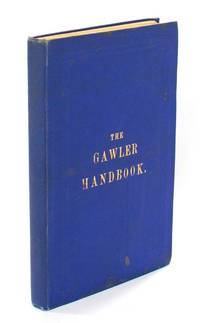
1880104186Adelaide: Goodfellow & Hele almost certainly the author: James Dally was convinced 1880. First Edition. Hardcover. Very Good. Adelaide Goodfellow & Hele almost certainly the author: James Dally was convinced 1880. Octavo 182 30 advertisements pages plus 6 lithographed plates of farm machinery by James Martin & Co. and 17 albumen paper carte de visite photographs individually mounted on tipped-in captioned leaves. Blind-decorated blue cloth lettered in gilt on the front cover; cloth slightly rubbed and bumped at the extremities a little marked and bubbled and lightly sunned on the spine; some mounts lightly creased a production flaw; a few trifling signs of use; a very good copy but internally fine with the photographs in superb condition. Ferguson 11744; Holden 70. Holden's entry is more accurate and informative although the photographs may vary slightly between copies. The photograph facing page 17 in this copy is of the 'Gawler Institute' showing the Institute building and Town Hall rather than 'Frankel's Hotel' as called for in Holden. These variations notwithstanding two separate editions were produced: one in wrappers with advertisements on the verso of the front cover and on both sides of the rear cover without photographs but with the lithographs not noted by Ferguson; the other in gilt-lettered cloth without the cover advertisements containing 17 mounted photographs plus the lithographs. Both contain 30 pages of advertisements at the rear. Rare in any state and in our view the version on offer is one of the more important and interesting photographically illustrated books produced in Australia. <p>'The handbook is illustrated with a number of views by Mr J. Taylor the local photographic artist representing the most important edifices and establishments in town' Holden quoting a contemporary review. The frontispiece is a portrait of John McKinlay 1819-1872; there are 14 pages devoted to him he married a Gawler woman in the early 1850s and was based in the town until his death. Justice is not done to the other photographs in describing them prosaically as 'the most important edifices and establishments in town'. Without exception signs of life and day-to-day activities flesh out the images and most of the businesses - butcher shop photographic studio cordial factory furnishing warehouse music emporium - feature well-stocked windows or yards and numerous staff members or customers. Holden reproduces two interesting ones including perhaps the best the butcher shop captioned merely 'Hodgson & Clements' but there are wonderful vignettes in many others. <p>Not least of these are the horse-drawn tram in front of the 'Commercial Bank' and the ornate hearse outside 'F. Fowler's Furnishing Warehouse'. While we are on the subject of death one chapter stands out. Among those to be expected say on 'Horticultural and Agricultural Progress. Gardens around Gawler' or 'The Humbug Society. Flam! Bam! Sham!' or 'The Streets - Number of Businesses - Description of Hotels' there is Chapter XI: 'The Neville and Adamson Tragedy'. Its thirteen pages describe in great detail the events surrounding the double suicide 'and its romantic accomplishment' of Neville and his partner Adamson. 'It is universally believed that Neville was the leading spirit in the suicide and so strong was Adamson's affection love friendship or whatever it may be termed for his companion that he consented to take that final leap in the dark in the wine cellar with him to visit that "bourne whence none return"'. Provenance: J. Cluny Harkness Federal President of the Chamber of Manufactures in the 1950s according to Trove with his pictorial bookplate on the front pastedown. Goodfellow & Hele [almost certainly the author: James Dally was convinced] hardcover