2 185 résultats
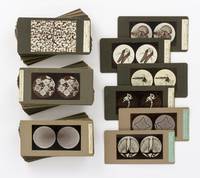
1905140504North Adelaide: The Photographer 1905. Very Good. North Adelaide The Photographer circa 1905. A collection of 87 stereo-microphotographs comprising original gelatin silver photographs with the pairs of images printed as one plate approximately 65 × 120 mm mounted on stiff card approximately 88 × 178 mm in various shades of grey. There are 21 with printed labels captioned 'Wm. P. Dollman John St. N. Adelaide S. Aus.' with numbered manuscript captions the numbers range from 2 to 228; there are 14 with unnumbered manuscript captions on plain labels; the remaining 52 are on plain cards. There are only six duplicates and none of them are an identical matching pair. Minimal signs of age and use; overall in excellent condition. The literature on the photographic history of Australia is singularly quiet on the life and work of William Parmeter Dollman 1846-1908. He is not to be found in Davies and Stanbury or Photohistory SA the pioneering research work of Robert Noye now on the website of the Art Gallery of South Australia. However he was definitely recognised in his own time. His obituary appears in the 'Evening Journal' on 7 October 1908: 'The death is announced from heart failure at the age of 63 of Mr. William Parmeter Dollman of North Adelaide. The deceased gentleman came to South Australia from England in 1853 and for about 30 years had been in the service of the proprietors of "The Register" and its associated journals as a printer and reader. He was sub-overseer of the newsroom for several years but relinquished that position to return to the reading room. Mr. Dollman was held in the highest respect for his integrity and ability and was much esteemed by his intimate friends. He was a member of the microscopical section of the Royal Society and conducted a great deal of microscopical research. He was an authority on the instrument itself a student of electricity and a skilful photographer'. <p>We have traced a number of newspaper references to his photography not least in a list of prize-winners in connection with the 14th annual exhibition of the SA Society of Arts reported in the 'South Australian Register' on Thursday 15 December 1870. 'Six entirely untouched stereoscopic views . by W.P. Dollman' were awarded a cash prize of £1 1s. Given that the other prize-winners in the photography section were Bernard Goode and Townsend Duryea this is high praise indeed. <p>An article by Dollman appeared in the 'Journal of the Royal Microscopical Society' in June 1906: 'A Simple Method of producing Stereo-Photomicrographs sic' 3 pages plus a full-page illustration of one of the stereo-microphotographs present in this collection 'Polyzoa Idmonea radians'. It was 'Read February 21 1906'. Dollman states 'I have made a hobby of stereoscopic photography since 1865 and as well have handled many Microscopes optical work being always an attraction to me. Some twelve or more months ago a friend called my attention to an article on stereo-photomicrography in the "British Journal of Photography Almanac" for 1894 by the then-editor . who therein explained several methods of producing stereograms of microscopic objects. I adopted what I thought the simplest method that of obscuring by a semicircular shield half of the objective in use. <p>A good deal of my apparatus is makeshift - that is diverted from other uses - but is effectual. My optical outfit is the best both in low and high powers condensers etc.'. <p>In addition to the 87 stereo-microphotographs there is a stereophotograph captioned on a plain label 'Photo-microscopic Apparatus' depicting an impressive set-up in Dollman's studio as described in the journal article. This card and two others with hand-written captions on plain labels have the following inscription in ink on the verso: 'Not for competition. Wm. P. Dollman North Adelaide'. Also included with the collection is a slightly damaged unmounted single microphotographic print 74 mm square. 89 items. The Photographer unknown
192760008Sydney NSW; Hobart Tasmania & New York: Beatties Studio; Photographers Photo Service ca. 1927-1934. Two vols. Thick oblong folio. 13.5 x 10.25 x 2 in. 200; 170 pp unpaginated. on thick black paper stock. With 197 silver gelatin photographs all tipped-in nearly all w/ typescript mimeograph captions mounted below or alongside sized from 5 x 7 in. up to 8 x 10 in. most sized 8 x 10 in. all printed on glossy photo stock some on thicker heavier weight most w/ pencil annotations typescript or imprints on verso a few w/ photographer’s imprint w/in negative at lower fore-edge others w/ embossed armorial photo studio stamp of kangaroo on shield. Uniformly bound in contemporary black pebbled flexible shagreen nested steel backed post-binders black brass screw-posts at gutter margin chipping edgewear to covers some scuffing spine leather covering perished occasional closed tears & chipping to some leaves light faint previous mounting offsetting occasional soiling or slight dampstaining to a few leaves still a VG- set of albums with nearly all of the photographs in excellent condition and with strong bright contrast. These substantial land promotion albums appear to have been designed to tout the advantages for potential homesteaders investors and visitors to Australia from the end of the Roaring 20’s into the Great Depression. Nearly 200 photos depicting bustling cities & shipping ports mines manufacturing burgeoning housing sports flora & fauna and some of the indigenous Australian Aborigine peoples extol the possibilities in Oceania’s economic engine. Following World War I Australia had seen massive changes in population and increasing economic and social changes following the devastation of World War I and the worldwide influenza pandemic with over 215000 killed and wounded between both catastrophes. With the onset of the Great Depression economic activity slowed and unemployment soared to nearly 20%. These albums include several photos of the newly constructed Canberra Provisional Parliament House completed in 1927 with bare land and little infrastructure nearby except for the Hotel Canberra. Designed originally to hold politicians and visitors when the parliament was in session the Hotel was built by contractor John Howie and designed by John Smith Murdoch. Several photos of Sydney Australia the streets a flapper driving her sporty 1927 Chevrolet Capitol AA Roadster and the famed beaches of Sydney. Several photos depict the Australian Lifesaving Clubs which began in 1907 as surf life saving with the Bondi Surf Bathers’ Life Saving Club but which denied full membership to women until 1980. One particular photo depicts a young comely Australian woman surfer leaning against her wooden longboard only about 15 years after Isabel Letham’s famed ride with Duke Kahanamoku in 1915. Many of the Sydney images reveal a capitol city in transition including horse-drawn cars alongside 1920’s automobiles and electric trolleys and trams. Also featured are photographs of the New Castle Steel works the Lithgow Steel Works whose blast furnace site closed in 1928 and the Mt. Boppy gold mining process mill depicting the cyanid vats to extract the ore. Still others show the Burrinjack Dam construction which had begun before World War I but not finished until 1928; horse-drawn silver ore mining wagons in the Barrgorang Valley from the Yerranderle Mines along roads to Camden NSW; orchards long the McDonald River and raising rabbits for the New South Wales Wool & Fur Co. Ltd. at Castle HIll near Parramatta. Also featured are many aerial and street photos of Queensland Brisbane Docks Victoria Bridge Queen Street with streetcars horse breaking in outback stations grape & cotton harvesting children attending “Bush Schools†and more. Still more reveal the bustling wharves at the Freemantle sheep sheering railway yards boaters on Henley-on-Yarra Flinders Street Station wheat harvest and farming and even the one of the famed wheat windjammers “The Carnandale.†Several of the photos depict the indigenous Australian Aborigines with one of the captions noting that 60000 “Full-Blood and 19000 half-caste Aborigines with 40000 still nomadic and others working sheep and cattle stations.†Another photo is included of two young Maori girls as well.The second album also contains views of a traveling salesman or traveling “Bust Hawker†featuring a horse-drawn wagon with sides hinged up and shoppers as well as aerial photos of gardens banana plantations date farms logging Kerri Trees in Western Australia and an entire section devoted to photos of Australian fauna. These depict Wombats Kangaroos pink & white Cockatoos Cassowary birds Wallabys Barn Owls Koala Bears Black Swans Opossums a Platypus Lyre-birds Kokaburra birds Australian penguins and others. Identified photographs by John Beattie Jr. from Beatties Studio Hobart Tasmania include Mt. Rugby from Balmoral Beach Big Ben Gum Tree on the estate of W.L. Clennett Saw Mill Proprietor Port Esperance whose height was nearly 250 feet as well as Dobson’s Basin Geeveston depicting a remarkable group of fen tree bowers. Originally founded in the 1840’s by the Anson Brothers John Beattie d. 1930 son of a Scottish-Australian emigre photographer worked for them in the 1880’s and then purchased the business renaming it Beatties Studio. He operated the studio for decades was the photographer who first developed all of Amundsen’s original photos of his South Pole Expedition in a single day and was an active proponent of the indigenous Aborigine population often defying popular opinion and authority over their historical mistreatment. Sadly a 1933 fire destroyed the studio and most of the negatives but it was reconstituted and many negatives and images rediscovered afterwards. See: Elizabeth Heffernan Exciting New World: Australia in the 1920s Royal Australian Historical Society 2022; Georgie Burgess Photography Pioneer John Beattie Shared Tasmania’s Wild Places with the World ABC Radio Hobart March 9 2019. Beatties Studio; Photographers Photo Service, hardcover
1940180936Adelaide: 20 July 1940. We're off to see the inland; the wonderful inland of Aust! A personal album kept by the Australian opera singer Una Rosalind Hale. It documents the trip she and 11 other schoolgirls took on 9 May 1940 travelling by train from Port Pirie to Alice Springs and the aboriginal community of Hermannsburg. They were given a tour of Alice Springs by Reverend Harry Griffiths who designed and opened the ANZAC Hill Memorial. Hale 1922-2005 was born in Adelaide to the Unitarian minister George Ernest Hale. This album dates from her education at Adelaide Methodist Ladies' College. As she describes on page 1 the girls were accompanied by their headmistress and four teachers on a train journey to the Australian inland. The photographs show their stopovers at Port Augusta Marree and Coward Springs where they posed for photographs outside the train and with aboriginal people. Once in Alice Springs the group were given a tour by Reverend Harry Griffiths and his wife Dorothy shown on pages 14 and 31. The album contains shots of the church and the manse where they stayed as well as the countryside and the missionary trips they performed. These include to Todd River Hermannsburg Palm Valley Standley Chasm and Simpson's Gap. One spread contains four photographs of a place they named "MLC Rock" and another contains a photograph of two girls riding a camel "with a steadfast and a strong intent fearful of the consequences". The two loose photographs show the Sydney Harbour Bridge and the AMP Building once Australia's tallest building completed in 1962. Hale moved to Britain in 1946 to study at the Royal College of Music. "On leaving the college she joined the Carl Rosa Opera Company and quickly established herself in such roles as Marguerite Faust Violetta La traviata Micaela Carmen Mimì La bohème and Donna Anna Don Giovanni invariably with success. Of a disastrous production of Tannhäuser The Times wrote: 'The one redeeming feature was the Elisabeth of Una Hale.'" The Times. She then joined the Covent Garden Company in 1954 and starred as Ariadne in the Australian premiere of Araidne auf Naxos in 1962. Oblong folio 190 x 276 mm. With 84 gelatin silver photographs mostly 63 x 85 mm snapshots landscape or portrait photographic postcard half-tone photographic illustration colour newspaper clipping colour manuscript map all corner-mounted on card leaves with manuscript captions. Two additional gelatin silver commercial photographs loosely inserted. Contemporary crocodile skin-textured boards black string binding with tassle light brown textured lining. Binding a little worn photographs generally bright with some toning slight silvering to postcard: a very good example. "Una Hale: Australian lyric soprano who shone in the 1950s and 1960s" The Times 12 March 2005. hardcover
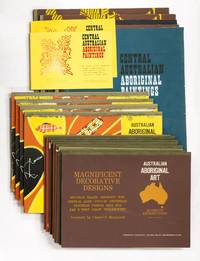
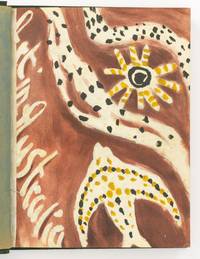
1967138977Melbourne: Newcraft Publicity 1967. First Edition. Paperback. Very Good. Melbourne Newcraft Publicity 1967 to 1969. Seventeen portfolios in various formats see below each containing a page or two of text and 5 colour serigraphs printed on card unless otherwise stated and interleaved with tissue-guards. Thick card covers with cloth spines; minor blemishes to some covers; minor damage to a bottom corner of portfolio B Volume 4 see below with loss of the corner-tip to the last three plates; overall the contents are in excellent condition. Two volumes are bound in portrait format; the others are presented in landscape format albeit with the spine along the top edge. The National Library of Australia catalogue states that this material was 'Available only in set of 24 portfolios at $310.00 . "Authentic reproductions ready for framing". Edition limited to 200 numbered copies' we have not traced the original source of this information. However we have incorporated below a number of pertinent details gleaned from Trove; in particular we found the relevant catalogue records provided by the State Library of Victoria to be the most informative. <p>A Magnificent Decorative Designs. Melville Island Abstract - Map Central Aust. - Pintubi Churingas - Victorian Possum Skin Rug - Far N. West Coast Phallocrypt 375 × 505 mm; #13/116. <p>B Australian Aboriginal Art. Primitive Traditional Decorative four volumes each 403 × 550 mm and all numbered #095; together with three larger-format volumes each approximately 550 × 795 mm respectively #1/086 #2/090 and unnumbered. The third volume without the subtitle 'Primitive Traditional Decorative' contains seven plates reproducing ones that appear in the smaller-format volumes; six are printed on paper the seventh is printed on the inside rear card cover. <p>C Cave Paintings of Arnhemland Volumes 1 2 3 and 5; each approximately 385 × 500 mm; all #126. The title of the fifth volume is 'Ceremonial Cave Paintings of Arnhemland "Amazing Anthropomorphic Figures"'. <p>D Central Australian Aboriginal Paintings. Brilliant Abstract Designs of the Pitjantjatjara two volumes bound portrait-format each 750 × 550 mm respectively #66 and #2/100. The first volume has a brown cover decorated in ochre and lettered in black; the second volume has a blue cover decorated in white and lettered in black. Both volumes contain seven plates. <p>E Magnificent Bark Paintings of Arnhemland and the Islands Volumes 1 2 and 4; each approximately 380 × 500 mm; respectively #1/126 #2/116 and #101. The title of the fourth volume is 'Magnificent Bark Paintings of Arnhemland'. <p>Offered together with three plates mounted as issued on thick card; these also appear in the volume of duplicated plates noted in B above. Also included are two copies of another Newcraft Publicity item 'Central Australian Aboriginal Paintings' by Winifred Hilliard wrappers oblong quarto with 7 colour plates; the second copy is numbered 153. Although the lengthy subtitles are different 'The Pitjantjatjara Abstracts. Designs in Vibrant Colours from Ancient Mythological and Totemic Motifs by Aboriginal Artists at Ernabella in the Musgrave Ranges' and 'Ancient Mythological and Totemic Motifs in Vibrant Colors by Finke River Aboriginal Artists' the contents are the same albeit in a different order and with minor variation to the introductory text. To complicate matters even more the same contents appear in the first very much larger-format volume in D above. <p>We have identified five portfolios not present in this run cross-referenced with the descriptions above: A Magnificent Decorative Designs. Volume 1 Churinga Patterns Ground and Rock Paintings; <p>C Cave Paintings of Arnhemland. Volume 4; E Magnificent Bark Paintings of Arnhemland. Volume 3: Oenpelli Portfolio; Australian Aboriginal Art: Bark Paintings - Angurugu Groote Eylandt Gulf of Carpentaria; and Australian Aboriginal Art: Decorated Shields of North Queensland. The SLV also identifies one related item we do not have: 'Australian Aboriginal Art' Melbourne Newcraft Publicity 1969. It is described as being a single volume 750 mm tall containing 'Colour prints on paper of items of aboriginal art miniaturised from the series of authentic reproductions of bark and cave paintings in the Newcraft collection of 23 portfolios'. 22 items. Newcraft Publicity paperback
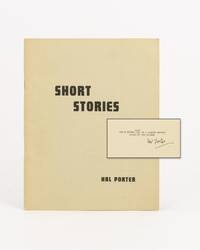
1942140203Adelaide: The Author 1942. First Edition. Paperback. Near fine. Adelaide The Author 1942. Quarto 63 pages. Saddle-stapled grey card covers lettered in black very slightly creased and marked with one trifling snag at the foot of the spine; edges slightly thumbed; a near-fine copy. Two typographical errors have been corrected in pencil by the author: on the dedication page it is now 'juvenilia' not 'juvenalia' at the end of the first line; and on page 55 'spoilation' is now 'spoliation'. However we note in passing that 'daguerrotype' in the line above got through unnoticed. Number 138 of an undated limited edition with the upper limit not stated numbered and signed by Hal Porter. This is a presentation copy of his first stand-alone work additionally inscribed and signed in ink at the head of the title page 'To dear Lucy Lockett with love and gratitude from Hal. 14 xii 1944'. The recipient Lucy Lockett Ayers 1886-1971 was a granddaughter of Sir Henry Ayers. <p>The revised edition of Porter's biography by Mary Lord 'Hal Porter - Man of Many Parts' 1993 states '"Short Stories" came out late in 1942 in a limited edition of 250 copies. Most if not all were numbered and signed then distributed randomly and recklessly by the author. The volume contained fourteen stories none of which had been published and one of which was the prize-winning "And from Madame's sic"' page 28. The precise details of the publication remain unclear. Lord's checklist indicates that the book was printed by the Adelaide 'Advertiser' and gives a date of '1942' but the very few perfunctory press notices relating to the book appear in April and May 1943 perhaps suggesting a later date of publication. Although copies are undoubtedly now extremely scarce whatever the truth of the matter this presentation inscription demonstrates that Porter still had copies to hand in December 1944. <p>The stories contained in this collection are 'The Room' 'And from Madame's .' 'The Two Bachelors' 'At Aunt Sophia's' 'No-one Knows!' 'Miss Rodda' 'Carnival Piece' 'Cafe Samovar' 'Scene: The Bend of a River' 'Otto Ruff' 'Gone Away' 'The White Rabbit' 'Miss Brockel' and '- And Nothing More'. <p>Loosely inserted is a typescript of a contemporary review of the book 1 page quarto with two of the six paragraphs struck out with pencil. We have been unable to determine whether or not it was published or if Lucy Lockett Ayers is the reviewer. 2 items. The Author paperback
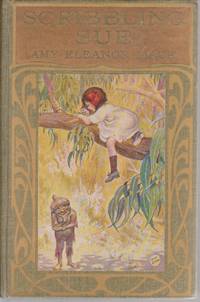
1914010886Sydney: Angus & Robertson 1914 First edition dated July 1914 from the publishers 31 page catalogue at the rear RARE and scarce in the wrapper May Gibbs earliest 'Gumnut' style illustrations The dust jacket has edge wear and chipping and some short tears the front fold in flap is missing both the pasted on illustrations with May Gibbs art are present and intact these pasted on paper plates are also present on the book cover and spine book is tidy with small ink inscription to fep dated 1918 very slight foxing to closed edges colour frontspiece and four other full page black and white plates all by May Gibbs. x 228pp 31pp publisher's catalogue decorated cloth. First Edition. Decorative Cloth. Very Good/Fair. Illus. by May Gibbs. 8vo - over 7 - 9 tall. Angus & Robertson hardcover
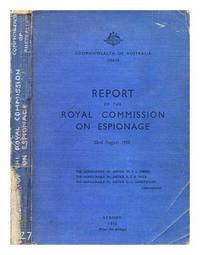
1955343835Sydney : A. H. Pettifer Govt. Printer for New South Wales 1955. Paperback edition. Softcover. Provenance: BBC copy. Near fine paperback copy; edges very slightly dust-dulled. Remains particularly well-preserved overall; tight bright clean and especially sharp-cornered. Physical description; v 483 pages : illustrations facsimiles ; 23 cm. Subjects; Diplomatic and consular service Soviet Australia. Espionage Soviet Australia. Espionage Australia. Espionage Russian Australia. Petrov Vladimir Mikha lovich 1907-1991. Sydney : A. H. Pettifer, Govt. Printer for New South Wales paperback
198538454The Fertility Society of Australia. New. 1985. Paperback. FREE UPGRADE to Courier/Priority Shipping Upon Request IN STOCK AND IMMEDIATELY AVAILABLE FOR SHIPMENT - PRISTINE Mild cover shelf wear; else flawless. 72 pages. -- with a bonus offer-- . The Fertility Society of Australia paperback
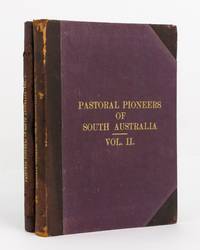
1925141101Adelaide: Publishers Limited 1925. First Edition. Hardcover. Very Good. Adelaide Publishers Limited 1925 and 1927 first editions. Quarto two volumes 207 1 colophon and 263 pages with numerous portraits and illustrations from photographs. Matching original half maroon roan and cloth lettered in gilt on the spines and front covers; leather a little rubbed and scuffed with minor wear to the extremities and the head and foot of the spine of the first volume expertly renewed; cloth flecked mottled and a little marked; endpapers in the first volume a little tanned with the margins discoloured by the leather turn-ins; trifling signs of age and use; a very good set internally excellent of these rarely-seen first edition volumes. An important series of lengthy biographical sketches of SA pioneering pastoralists. 'Publication of the series began in the "Adelaide Stock and Station Journal" on January 10 1923 and continued weekly until August 10 1927. During that period a total of 230 articles was published and the number of pastoralists to receive attention is in the neighbourhood of 300. No really representative pioneer sheep-farmer or cattle-breeder who operated in South Australia has been overlooked and in many cases it has been possible to retrieve from almost complete oblivion the interesting records of lesser lights' foreword to the second volume. A short article in 'The News' 8 July 1941 relating to a substantial gift of books and papers to the SA Archives by A.T. Saunders states in part that 'Among the books is a copy of the very rare first volume of Cockburn's "Pastoral Pioneers of South Australia"'. We recall reading in one of James Dally's catalogues in our early days in the late 1970s that many copies of the first volume of this work were destroyed in a fire. Although we cannot substantiate this fact in our experience it is indeed an absolute rarity. <p>Provenance: Alexander Cockburn brother of the compiler of these volumes. The verso of the title page is inscribed 'To Alexander Cockburn from his son Malcolm as a Souvenir of the first fee received by him for his professional services Dec 1925'. At the foot of the foreword Malcolm has written 'The majority of the sketches herein were written by Rodney Cockburn brother of Alexander Cockburn'. 2 items. Publishers Limited hardcover
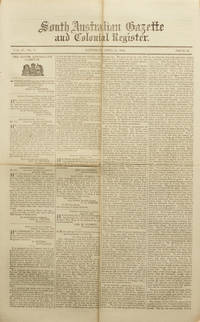
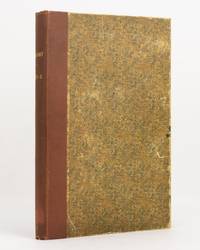
190684574Adelaide 1906. Fair. Adelaide 1906 facsimile of Number 1 1878 facsimile of Number 2 and 1837 to 1840. Tabloid approximately 128 issues each generally 4 to 6 pages but Number 10 lacks the last leaf. Unbound as published more than half of them or disbound with some inner marginal blemishes; marginal stains to a few early issues; occasional signs of use and age; the first issue on acidic paper discoloured and brittle; overall in decent condition. The original first number was published in London the second one in Adelaide almost a year later. Although the originals of these two significant issues are not present in this run it must be said that ALL of these early issues of South Australia's first newspaper are utterly rare on the open market and the opportunity to purchase virtually all of the first three years' worth and more will probably not arise again. unknown
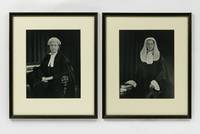
19621455901962. Fine. 1962. Two vintage gelatin silver photographs visible image size 237 × 187 mm matted glazed and framed to match external dimensions 366 × 306 mm. Both photographs and frames are in fine condition. Dame Roma Mitchell 1913-2000 was Australia's first female Queen's Counsel judge university chancellor and state governor among other achievements. Mitchell was particularly proud of her appointment as Queen's Counsel in September 1962 considering it a highlight of her career and these fine portrait photographs must have been commissioned to mark this occasion. Both show her in court dress against an identical backdrop and with similar props. In one she wears her everyday bar wig and bands and in the other she wears full ceremonial dress with lace jabot and cuffs and full-bottomed wig worn only on formal occasions. <p>Mitchell's appointment attracted scant media attention but an article in 'The Australian Women's Weekly' on 10 October 1962 makes more ado of her new full-dress regalia than it does of her already-distinguished legal career and pioneering advocacy of women's causes: 'Miss Mitchell an easy-to-talk-to elegantly dressed woman of 48 is tall and will wear full dress with distinction'. For women QCs 'full dress is laid down thus: "Coat made of black superfine cloth in the same style as a man's coat except that it should not be skirted but instead be short as in a lady's ordinary suit . black flexible buttons. Plain white blouse . lace frill and ruffles at wrist. Plain black skirt of superfine cloth. Black silk stockings . black patent-leather ladies' court shoes . cut-steel buckles. Black silk gown . full bottomed wig . black silk "wig-bag" . white gloves"'. <p>The State Library of South Australia holds examples of both images PRG 778/57/5 and PRG 778/57/6 but does not identify the photographer. 2 items. unknown
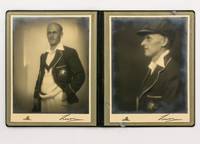
1934144537London 28 George Street Hanover Square W.1.: Lenare 1934. First Edition. Hardcover. Very Good. London 28 George Street Hanover Square W.1. Lenare 1934. Two large-format gelatin silver photographs each 351 × 264 mm signed by the photographer in the negative with his studio inkstamp and manuscript reference number on the versos. Some silvering-out mainly around the edges; tiny creases to the corners of the white margins of one print; overall in excellent condition loosely inserted in the original cloth portfolio lettered in gilt on the padded front panel in excellent condition albeit with a spot of surface wear near the middle of the spine. Clarrie Grimmett the NZ-born Australian Test cricketer was one of the finest leg-spinners of his time. He is photographed in two different poses: head-and-shoulders from the side wearing his cap and blazer; and three-quarter length from the front wearing pullover and blazer with cap in hand. Lenare was the professional name of Leonard George Green 1883-1946; he specialised in society portraits at his London studio. <p>Provenance: Clarrie Grimmett originally purchased at the Christie's auction of the Clarrie Grimmett Collection sold in Melbourne on 13 May 1998. Grimmett played 37 Tests between 1924 and 1936 taking 216 wickets at an average of 24.21. His record for the fastest bowler to take 200 wickets in Tests achieved in his 36th match stood for 82 years and was broken only in 2018. His first-class record of 1424 wickets in 248 matches between 1911 and 1941 includes 513 wickets in his 79 Sheffield Shield matches. He was a Wisden Cricketer of the Year in 1931 along with Don Bradman. He was posthumously inducted into the Australian Cricket Hall of Fame in 1996 as one of the ten inaugural members and in 2009 he was inducted into the ICC Cricket Hall of Fame. 2 items. Lenare hardcover
193025919Melbourne: Produced by Northfield Studios and J.E. Hackett 1930. Very good condition. Color lithograph travel poster depicting a mother koala with a cub clinging to her back in the top of a gum tree by the noted Australian illustrator James Northfield. Signed in the image at the lower right.<br /> <br /> Northfield 1887 - 1973 was the subject of the 2006 volume by the National Library of Australia Michelle Hetherington titled 'James Northfield and the Art of Selling Australia'. Northfield's work is prized for its draftsmanship & design and a distinctly Australian sense of color and light.<br /> <br /> Window card size 13 1/2 x 19 1/2". One small mark in margin only upper left corner left by old sticky tape. OCLC: 910601564 locates one copy only at the Library of Congress same image larger format. Trove 54841871 locates one copy at the National Library of Australia same image larger format. Produced by Northfield Studios and J.E. Hackett unknown
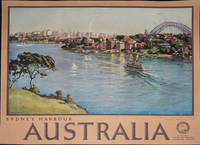
193518842Australian National Travel Association 1935. Very good overall. Travel poster illustrated by Sydney Harbour centered on the harbour with a ferry and sailboats with the Sydney Harbour Bridge in the top right background. A color lithograph 20 x 24.75" 50.8 x 62.25 cm. Further text; "Painting by Will Ashton R.0.I. W.T. Baker & Co Ltd. Engravers and printers. Australian National Travel Association." Crinkles and some light creases with a couple of light marks in the sky above the Bridge. Australian National Travel Association unknown
1941137250Sydney: 'Sydney Morning Herald' 1941. First Edition. Paperback. Very Good. Sydney 'Sydney Morning Herald' 1941 and 1942. Large quarto 84 to 88 pages each issue extensively illustrated in colour and black and white; bound-in in the first number is a small two-part perforated order-gift subscription form. Binder's cloth retaining the original colour-pictorial card covers with the rear cover now bound in immediately after the front cover in each case; cloth a little flecked; edges a little foxed; endpapers discoloured; light foxing to a few leaves adjacent to the boards; in excellent condition. The fourth and final series of 'Art in Australia' comprised only six quarterly numbers between March 1941 and August 1942. They were a marked departure in all respects from the previous 94 numbers of the journal which commenced publication in 1916: new editor new format new emphasis on international art. The editorial in the first issue spells this out succinctly: there will be 'a complete change in appearance and methods of production with a broadening of policy. In the past "Art in Australia" has been almost entirely devoted to the painting sculpture and architecture of this country. Luxurious productions from France England and other countries were available to inform the artist student and art-lover of the work and activities of the art world outside. But the barbarity unleashed in Europe is destroying much of the art of the past and present and has made it impossible for periodicals we prized so much to continue production. The countries of their origin have fallen under Hitler's yoke men responsible for their production - artists and writers - killed art galleries and elaborate printing and processing plants blown to bits. But Art cannot die and we in Australia can and will carry on our efforts to preserve encourage and foster the culture our enemies would destroy. In spite of paper shortages and many other difficulties "Art in Australia" will play its widened part by presenting the art of all countries all periods and all schools'. <p>Peter Bellew modelled its visual excellence and intellectual content on 'Verve' and 'under his stewardship the art historian and director of London's National Gallery Sir Kenneth Clark declared it "unquestionably the best art magazine being published today anywhere in the world"' Harding and Morgan: 'Modern Love - The Lives of John and Sunday Reed' 2015. Notwithstanding the end came without warning: Series 4 Number 6 August 1942 the last one published with a strong and parochial editorial about the 'Need for War Artists' contained no hint of its fate. 'Sydney Morning Herald' paperback
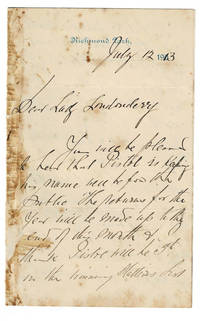
191397593Richmond Park South Australia: July 12 1913. 1913. Good. - Approximately 300 words penned on 4 sides of a folded sheet of creamy white paper with each page measuring 8 inches high by 5 inches wide. "Richmond Park" is printed at the top of the cover page. Aldridge has altered the partially printed date from "1903" to "1913". Started on the cover page Aldridge has continued his letter on the last page to then conclude on the inner 2 leaves. Signed "J.H. Aldridge" on the inner leaf. Once apparently mounted along the inner edge with glue or tape there are heavy stains with remnants of glue to the inner edge of the first and last page. There is a tiny tear along the fold with some light brown stains or foxing to all four pages. Good. <p>A RARE LETTER REPLETE WITH HORSE RACING ASSOCIATIONS. Aldridge writes to the Marchioness of Londonderry praising the horse he purchased from her and the Marquis of Londonderry. "You will be pleased to hear Pistol is keeping his name well before the public.I think Pistol will be 5th on the Winning.List in all Australia of course in this State 'South Australia' he is easily 1st.Londonderry by Pistol Antilles won the Broken Hill Cup a few days ago & the Chairman in presenting the cup to the winner referred to the fact that the horse got his name from his Breeder the Marchioness of Londonderry.Pistol is a most prolific father of winners & that is better than one good one & twenty duffers as some sires record. I believe there is only one sire in Australia which has produced more winners this year." He goes on to complain about the season as a whole mentions some "great loss" that she has had and he wishes the Marquis well and that "his illness worries will be settled ere long" Signed "J. H. Aldridge".<p>James Henry "Jim" Aldridge 1849-1929 was a popular and highly respected Australian sportsman. he began his career as a hotelier in Adelaide. He managed the Globe Hotel in Rundle Street a hotel that was popular with sportsmen. He later took charge of the Grand Hotel Broken Hill and the Gresham Hotel. In 1890 with the intent of establishing a stud farm he purchased at a Sydney sale the Stallion Carlyon. Carlyon was to be the lord of the harem so to speak. In addition he purchased a richly bred brood of a half-dozen mares. Sometime between 1888 and 1890 Aldridge purchased Richmond Park in South Australia from its original owner John Chambers. With the Chester horse Carlyon and the stud established Aldridge rapidly became well-known as a breeder. Carlyon and the thoroughbreds he sired at the Richmond Park stud farm made Aldridge's name famous throughout Australian racing circles. Although still able to perform as a stud Carlyon was badly injured in 1905. As it happened however in 1904 Aldridge had purchased Pistol the son of the famous English sire Carbine. Pistol was foaled in 1899 and arrived in South Australia as a five year old. He was purchased from the Marquis of Londonderry for the large sum of 1250 pounds. As a stud Pistol performed into his 26th year and sired winners of more than 641 races out of 1423 competitions. Up until Aldredge's death in 1829 the Pistol progeny had won approximately 200000 pounds in stake money. In atribute after his death the Chairman of the S.A.J.C. South Australian Jockey Club Whitmore Blake Carr "Doc Carr" wrote: "For years Mr. Aldridge has been one of the best widely known and most popular identities of the turf in South Australia and one to whom the sport owed much of its maintenance and stability. When he ran horses he did so for the pure love of the sport and the applause which always attended the success of his colours was a fine tribute by the racing public to the popularity of the owner. He was an exceptionally fine judge of a horse. The gratifying results which have been achieved at Richmond Park making it stand today so high in the list of studs in the Commonwealth was due to his sound judgment and ripe experience." Richmond Park, [South Australia]: July 12, 1913. unknown
1933040077Sydney: Angus & Robertson 1933. x 285pp glossary bw ills endpaper maps. Or brown 'art leather' front panel of jacket bound in as issued. Light toning to edges endpapers toned occasional light to moderate foxing. SIGNED and numbered #167by author on limitation page. One of the rarest Idriess items. Issued in an edition of only 200 copies shortly after the first print run. Seldom seen on the market. . Signed by Author. Signed Limited Edition. Hard Cover. Very Good/Bound in as issued. 8vo. Angus & Robertson Hardcover
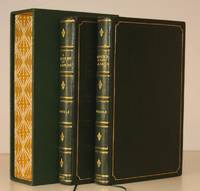
195211532John Murray 1952-57. 2 vols. 8vo. First Edition with title-vignettes several illustrations in the text and 2 maps one double-page on green stock; handsomely bound in full dark green crushed morocco sides with gilt frame borders backs with raised bands second and fourth compartments ruled and lettered in gilt all other compartments tooled in gilt gilt tops hand-made endpapers ribbon markers original backstrips and upper board images preserved and mounted on new and separate leaves at front custom-made slip-case an elegant set ideal as a gift or for presentation. Bright set of Grimble's classic travel-autobiography set in the Gilbert and Ellice Islands of the Central Pacific John Murray, hardcover
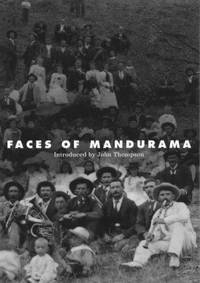
1997mon0002967061National Library of Australia 1997-01-01. Hardcover. Good. . National Library of Australia hardcover
1925140245Adelaide: 'Printed for the Publishers by Hunkin Ellis & King' 1925. First Edition. Hardcover. Very Good. Adelaide 'Printed for the Publishers by Hunkin Ellis & King' 1925 to 1928. Tabloid 48 monthly issues bound as one volume approximately 12 pages per issue each with the large pictorial masthead and illustrated advertisements. Contemporary quarter cloth and marbled papered boards lightly rubbed with slight wear to the extremities; acidic paper uniformly tanned; minimal signs of age and use; in excellent condition. The editorial in Volume X Number 12 31 December 1928 states that 'It would be a pity for this independent non-party and outspoken monthly to go out and we hope such an event will not happen but after carrying on the paper for ten years we feel with advancing years that we cannot longer bear the strain of the extra work involved in its publication. Perhaps we may be able to sell it .'. Apparently they were unable to do so and this proved to be the last issue of the journal. <p>From Volume IX Number 3 March 1927 the last words in the subtitle were changed from 'Progressive Farmers' to 'Progressive People'. However a far more radical transformation had occurred earlier foreshadowed in the second issue in this run: the front cover proclaims 'Special this issue -- The Proposed Aboriginal State'. Genders had been appointed to the general committee of the Aborigines' Friends' Association in early 1924 but he established the Aborigines' Protection League in November 1926 with Dr Herbert Basedow as president and himself as honorary secretary to promote the cause of an 'Australian Black State' in the Northern Territory. The final issue records that the APL had been 'largely instrumental in awakening a world-wide interest in the position of the Australian aboriginals and as the official organ of the League "Daylight" may justly claim to have assisted in this much overdue movement'. <p>'Contested Destinies: Aboriginal Advocacy in South Australia's Interwar Years' by Robert Foster 'Aboriginal History' Volume 42 2018 available online provides much detail on Genders 'Daylight' the Australian Black State and the APL. 'Printed for the Publishers by Hunkin, Ellis & King' hardcover
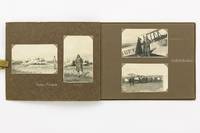
1929142560Adelaide: Harry Carew Nott 1929. Fine. Adelaide Harry Carew Nott 1929. A commercial photograph album oblong quarto 230 × 318 mm comprising 4 card leaves cord-bound in overlapping card covers with 21 gelatin silver photographs 84 × 136 mm or the reverse loosely attached with photocorners on both sides of the leaves and the inside surface of the covers; all photographs are captioned in white ink on the mount. Cord-bound commercial album stamped in blind 'Portraiture'; covers slightly marked and a little worn at the corners; the contents are in fine condition the last photograph is creased and cracked at one corner. A lengthy article related to this event appeared in 'The Advertiser' Thursday 23 May 1929: 'The Victorian section of the Australian Aero Club will conduct an aerial pageant at the Essendon Aerodrome near Melbourne on Saturday afternoon. The programme of events includes the Aerial Derby for which over 20 machines have been entered. Of these about eight will represent New South Wales and eight Victoria. South Australia will also have a strong representation. <p>Seven planes will leave the Parafield Aerodrome for Melbourne this morning at 9.30 if the weather permits. The following planes will comprise the formation: D.H. 60 Gipsy Moth G-AUIB D.H. Moth V-HUAM D.H. Moth V-EUAR D.H. Gipsy Moth G-AUIV D.H. Gipsy Moth G-AUKO Avro Avian G-AUSY and probably the De Havilland "Old Gold" passenger machine. The first three are Aero Club planes and the others are privately owned. <p>Flying-Officer J.A. Mollison Aero Club instructor will be leader of the formation and Mr. C.A. Hewitt will be deputy-leader. Others making the flight to Melbourne are Messrs. N. Birks J.A. Jukes A.H. Wilkins E.B. Lawson P. Knapman F. Wellington S. Hamilton L. Wood J. Churchill Smith secretary of Aero Club and Dr. H.C. Nott. The flight to Essendon will be made via Nhill Victoria. Friday will be spent by the airmen in tuning up engines for the races on the following day'. <p>The first eight photographs were taken at Parafield Aerodrome in outer-suburban Adelaide with portraits of Nott and Wood identified. These are followed by two at Nhill Aerodrome 'Mollison refuelling' and 'Lawson'; two at Ararat Aerodrome 'on Racecourse'; and eight taken at Rockbank 28 kms west of Melbourne. These are captioned 'Mollison taking off in "1B"'; 'Hewitt'; 'Nott in "A5"'; Lawson Mollison Hewitt & Wellington éxamining "A17"'; 'Hewitt Mollison Lawson & Wellington'; 'Nott Mollison Lawson & Wellington'; and 'Mollison Lawson & Hewitt'. <p>The last one taken from the air is captioned 'Crashed Aero at Nhill'. The Nhill Aviation Heritage Centre website records that on 23 May 1929 'J.A. Mollison arrived from Adelaide with 6 aircraft. One crash-landed at old Dimboola road aerodrome instead of landing at New site at Halpin Park'. The pilot was possibly Lin Wood. Harry Carew Nott unknown
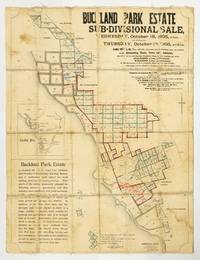
1905130579Adelaide: Elder Smith & Co. Ltd. printed by Vardon & Pritchard Litho. 1905. Fair. Adelaide Elder Smith & Co. Ltd. printed by Vardon & Pritchard Litho. 1905. A large map printed on paper and mounted on linen as issued external dimensions 955 × 740 mm with freehold boundaries printed in blue and an inset locality plan 200 × 180 mm. Later manuscript addenda include red ink outlines on some blocks with acreages in blue ink; 'Sold' written in black ink on the most northerly blocks; a group of blocks close to St Kilda outlined and hatched in orange for 'ICI' Imperial Chemical Industries began construction of solar evaporation lagoons in the area in 1935; and some additional blocks added in ink close to Two Wells. The map has been folded into eight panels and the paper has flaked off in places particularly along the folds resulting in minor loss to the printed surface; a few light stains and minor signs of use and age; overall a decent copy of an item we find no record of in Trove or elsewhere. On offer was approximately 23000 acres of freehold land and 13000 acres of leasehold land. The 'Narracoorte Herald' Tuesday 24 October 1905 contains a report on the sale which took place the previous Wednesday: 'the well-known Buckland Park Estate which has been subdivided . is being offered to the public in blocks of from 40 to 1800 acres. There was a splendid attendance landowners and pastoralists from all parts of the state being present. Competition was however very dull and only nine sic lots found purchasers at the auction sale. The following lots were sold: Block 5 186 acres £3 2s. 0d. per acre; block 1 118 acres 30s. per acre; block 53 60 acres £7 per acre; block 54 57 acres £7 per acre; block 55 40 acres £7 per acre; block 56 40 acres £7 per acre; block 83 196 acres with leasehold given in £1 Is. per acre; block 84 105 acres with leasehold given in £4 per acre. The blocks offered on Wednesday comprised only the poorer quality country. The remainder of the estate will be sold privately'. A successful conclusion to that sale apparently did not take place for another five years. The South Australian pastoralists' who's who 'Our Pastoral Industry' Adelaide 1910 records that the pioneering pastoralist George Brooks 1849-1926 and his son Edmund Albert Brooks purchased 'the picturesque estate at Buckland Park comprising 20000 acres . situated about 25 miles north of Adelaide' from Leonard Browne in 1910 the property is featured under 'The Brownes of Moorak Buckland Park and Booboorowie' pages 137-156. Elder, Smith & Co. Ltd. (printed by Vardon & Pritchard, Litho.) unknown
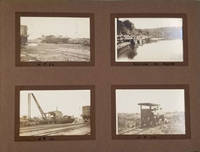
1926238471926. Photography. Good overall. 200 original photographs of a 1925/26 trip which begins in the Philippines and includes Singapore Java Australia New Zealand and Suva with many great images of Middle Harbor in Sydney. This is followed by a railway trip across Canada from the Pacific coast and Banff cross country ending in Montreal with the last image of the Engineering building at McGill University.<br /> The album is likely an American military man's photographic record of his trip beginning in December 1925 and ending April 1926 as many of the images are of railways bridges ships and military installations and one image identifies a Captain Richardson in white Navy uniform. <br /> <br /> The album opens with images of the Philippines with rail yards captioned "H. P. Co"; Fabrica Occ. Negros; San Carlos; Fort Santiago Manila; SS "Taiping" of A-O Line; Zamboanga including a shot of "Pettit Barracks" this was the location of the US Army's 43rd Infantry Regiment which was a Philippine scout unit in 1921; Fort Pilar Zamboanga; SS 'Darvel' at Jolo; and city streets of Jolo.<br /> <br /> The next stage of the trip is the through southeast Asia and Malaysia and Indonesia with images of Sandakan North Borneo; Jesselton Soldier's Monument rubber grove; Labuan government building Naval cemetery two western men in the caption identified as "Jefferson & Watt"; Singapore Bridge government building street scene reservoir old cemetery; Johore Causeway; Fort Canning; Batavia current day Jakarta Indonesia Batavia street scenes bridge canals old Portuguese fort; near Djokjakarta; lowland locomotive; Papandajan smoking craters; Mendoet; Borodbudur temples; Prambanan temples; Surabaya; KPM SS 'Plancius' Dutch ship; Semarang steam tram; KPM SS 'Houtman'; old Fort Macassar; and Celebes canal works views of country side.<br /> <br /> On to Australia with Brisbane Victoria Bridge Sydney Harbor north & south Head Garden Island "Sydney bridge site" the future site of the Bridge Fort Dennison Spit Bridge Middle Harbor Middle Head Bradley's Head Kuringai Chase Manly and Darling Harbor.<br /> <br /> Auckland and Fiji are next with images of the RMS 'Niagara' at Auckland and views from Mt. Eden; then on to Suva Fiji with city views landscapes and natives & their dwellings. The author is next in Canada with a Canadian Pacific Railway trip with views from the train windows of the Selkirks Rockies Banff Cascades Mt. Rundle Banff hot springs Mt. Royal Montreal the St. Lawrence River the Victoria Bridge and closing with a shot of the facade of the Engineering Building at McGill University. <br /> <br /> Oblong album 9 1/4 x 7 1/2". Three quarter leather and stamped patterned paper covered boards the leather at corners rubbed and perished at the spine. 50 pages with 4 photographs per page a total of 200 images 3 x 2 1/2" each dated and captioned on the frame. Photographs in excellent condition. unknown
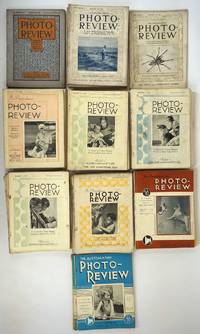
193729404Sydney: Baker & Rouse Kodak Australasia Harrington's Ltd. 1937. Paperback book. Good overall. An early but broken run of these two photographic periodicals 98 issues in total. The illustrated magazines filled with articles images period advertisements used equipment ads and advice columns as well as notes from individuals and different photographic societies and clubs. Published monthly or so a total of 98 issues. <br /> <br /> 'The Australasian Photo-Review is significant in its longevity and insight into the development of photography in Australia 1894-1956.' NSW State Library website. These copies of the Australasian Photo-Review include: 1921 - Mar May Jul; 1922 - Jan-Apr Jun-Aug Dec; 1923 - Jan. only; 1931 - Feb-Jun Sep-Oct Dec; 1931 - Jan Mar Apr June-Jul Sep-Dec; 1933 - Jan-Mar May-Dec; 1934 - Jan-May Jul-Dec; 1935 Jan-Mar May Jul-Dec; 1936 - Feb-Oct; 1937 - Jan-Mar. 74 issues in total.<br /> <br /> Harrington's Photographic Journal 1910-1927 superseded the Australian Photographic Journal 1892-1910. Issues of Harrington's include: 1921 - Jan-Dec; 1922 - Jan-Sep Dec; 1923 - Jan-Feb. 24 issues in total.<br /> .<br /> From the library of the Franklin Institute Philadelphia with infrequent stamps. Original printed wrappers some chipped & all slt. dusty but sturdy. Baker & Rouse, Kodak (Australasia), Harrington's Ltd. paperback
1967000465New Zealand: Reed 1967. First Edition. Original Cloth. As New/Good. Westra Ans. Inscribed and signed by Westra on the title page "With love to the Hildreths Ans Wellington 29 - 9 - 1972" also inscription Tokanui Christian Psychiatric Research Miracle 1975 Arnold G Brooker Per Ardua Ad Astra 429251" also "Makara Beach IX - XII - 75" Small repairs to rear of dustjacket with archival PH7-70 tape to small closed tears. In Brodart Clear archival cover. 4to - over 9¾" - 12" tall. The late Arnold Brooker was an eccentric fixture on the streets of Wellington who campaigned for the rights of the mentally ill. <br/><br/> Reed hardcover