Its Spread and Severity in HawaiiBiblio.com
977 résultats
0260708674.Gpaperback. Good. Access codes and supplements are not guaranteed with used items. May be an ex-library book. paperback
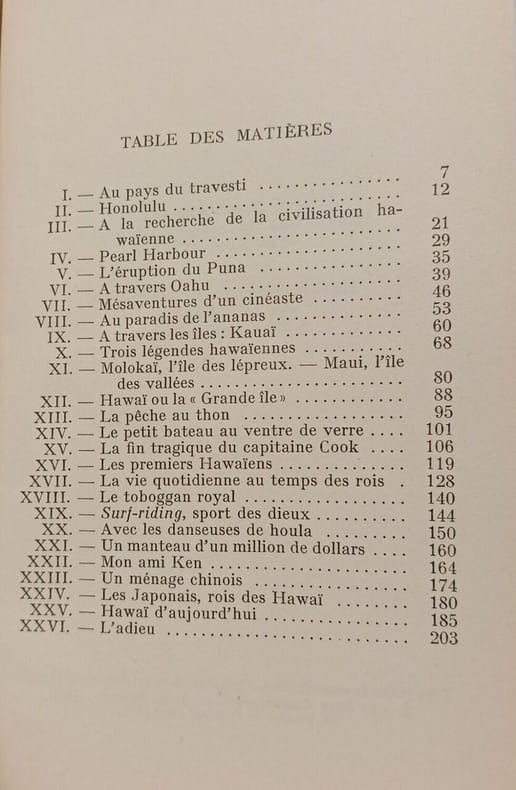
1956100150524Bibliothèque "Arts et Voyages" 1956 in8. 1956. Cartonné. Jacques Chegaray spécialiste du Pacifique relate son voyage prolongé dans les îles Hawaï après avoir visité la Polynésie et les îles de la Sonde. L'ouvrage s'inscrit dans sa série de récits d'aventures et de reportages à travers le monde mêlant observations rencontres avec les autochtones et documentation photographique et filmique
1956100151794Editions Amiot - Dumont 1956 in8. 1956. Cartonné. Jacques Chegaray spécialiste du Pacifique relate son voyage prolongé dans les îles Hawaï après avoir visité la Polynésie et les îles de la Sonde. L'ouvrage mêle observations rencontres avec les autochtones et documentation photographique et filmique s'inscrivant dans sa série de récits d'aventures et de reportages à travers le monde
19341832Honolulu, Bishop Museum, 1934. 16 plates, 99 pages, Original-Broschur. etwas bestoßen, Schnitt, Titel u. 1 S. leicht fleckig, Zustand 2.
1961LFA-126737712Un ouvrage de 315 pages, format 140 x 215 mm, relié cartonnage sous jaquette couleurs, publié en 1961, Le Livre Contemporain, bon état
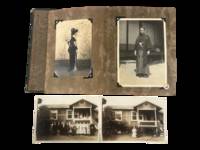
1930227421930. Japanese-American Hawaii Japanese American military family photograph album 1930s documenting everyday life of a Nisei household in interwar Hawaii and tracing the transpacific connections linking Japanese American communities with Japan and Japanese occupied Manchuria. The photographs record family relationships social gatherings military friendships and overseas travel at a time when second generation Japanese Americans were negotiating identity within both American and Japanese spheres of influence. Handwritten captions written in the first person suggest the compiler was a Nisei man with associations to the United States Army referring to relatives and companions as "My father" "My sis Chiyo" and identifying a group of men in a tropical field as "China Souza Manuel myself Choy" further captioned "Army Buddies." During the 1930s Japanese Americans faced significant barriers to military advancement on the mainland United States yet Hawaii's National Guard accepted some Nisei soldiers prior to the Second World War due in part to the islands' large Japanese population. The album therefore documents a rare prewar moment when Japanese American military participation and family life intersected within the broader social landscape of Hawaii.<br /> <br /> Photo album compiled during the 1930s containing approximately 103 original silver gelatin photographs mounted to brown paper leaves and annotated in ink identifying individuals and locations. Bound in green pebbled boards titled "Photo Album" in gilt on the cover. Each photo measures approximately 2.5 x 3.5 inches to 5 x 7 inches. Album measures approximately 6 x 9.5 inches. The images depict family gatherings beach excursions on Oahu graduations and informal portraits of relatives and friends. Early pages include a graduation photograph of Edna Omatsu and portraits of family members including Uneiko members of the Takayama family Jeanette Ayako and a military dressed man identified as Rob Ogawa. One family group portrait shows individuals wearing leis with the caption "Honolulu - Hakada's Departure to Japan." Several photographs document military friendships and camp environments including the previously noted "Army Buddies" image. A small sequence captioned "Manchurian Trip" records the family's travels through northern China during the period of Japanese control following the establishment of the Japanese puppet state of Manchukuo in 1932 illustrating the mobility of Japanese diaspora families moving between Hawaii Japan and imperial territories across East Asia.<br /> <br /> Interwar Hawaii contained one of the largest Japanese populations outside Japan with Japanese immigrants and their American born children forming a substantial portion of the islands' workforce and social life during the 1930s. Album spine partially detached at front cover with wear to boards; photographs remain clean and crisp with mostly legible handwritten captions. Overall very good condition. Nisei communities balanced participation in American civic institutions with continuing family linguistic and cultural ties to Japan creating networks that stretched across the Pacific. This album documents those connections through scenes of leisure education military companionship and international travel shortly before the geopolitical tensions that culminated in the Pacific War. unknown
1947219701947. Japanese-American WWII Official yearbook of the 1947 graduating class at Punahou School in Honolulu Hawaiʻi which serves as a vivid document of postwar life in a multiracial student body that included a notable presence of Japanese American students. Bound in embossed dark blue leatherette. 8.5" x 11". Heavily illustrated. Published two years after the end of World War II this year's volume shows the continued presence and leadership of Nisei students despite the hardship faced in school years prior. With numerous signed messages by students-including Japanese American classmates such as W. Kobayashi G. Ogawa and H. Takakuwa-this volume provides rare evidence of social reintegration and interracial camaraderie in the wake of a war that saw Japanese Americans subjected to mass suspicion and surveillance across the United States. While Japanese Americans in Hawaiʻi were spared the large-scale incarceration endured by their mainland counterparts they still lived under martial law from 1941 to 1944. During this time thousands were dismissed from government jobs arrested without charge or pressured to prove loyalty-conditions that deeply affected the Nisei generation. Many of the students represented here likely had family members who served in the famed 100th Infantry Battalion or the 442nd Regimental Combat Team the most decorated unit in U.S. military history. Others may have experienced community surveillance loss of employment or restricted freedoms under Hawaiʻi's military government. In this context the 1947 Oahuan is not simply a yearbook-it is a document of recovery dignity and the quiet persistence of young Japanese Americans reclaiming space in public life through scholarship athletics and social visibility. This particular copy is especially notable for its extensive endpaper inscriptions with dozens of students having signed their names in ink making this a personalized artifact of postwar student life. The volume features photographs of senior portraits student clubs athletic teams and lively candid montages with Nisei students prominently and equitably featured. Sports team photos show a remarkable ethnic diversity with surnames like Kobayashi and Koneshige appearing beside those of white and Hawaiian students. The visual presentation echoes Hawaiʻi's unique multiracial culture and hints at the relative integration of elite schools like Punahou in contrast to the segregation typical of many mainland institutions during this era. Endpapers are completely filled with original signatures. Wear to covers with some cracking at interior hinge and one corner of the pastedown torn. Overall very good condition. A rare signed witness to Nisei perseverance in a racially stratified but uniquely hybrid territory on the cusp of statehood. unknown
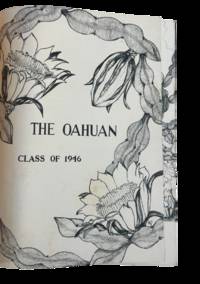
1946219301946. Japanese-American WWII Official yearbook of the 1946 graduating class at Punahou School in Honolulu Hawaiʻi which serves as a vivid document of postwar life in a multiracial student body that included a notable presence of Japanese American students. Bound in embossed dark blue leatherette. 8.5" x 11". Heavily illustrated. Published just one year after the conclusion of World War II the yearbook offers a rare and humanizing portrait of Japanese American youth in a period when many of their families were still reeling from forced incarceration surveillance or military service. While Japanese Americans in Hawaiʻi were spared the large-scale incarceration endured by their mainland counterparts they still lived under martial law from 1941 to 1944. During this time thousands were dismissed from government jobs arrested without charge or pressured to prove loyalty-conditions that deeply affected the Nisei generation. Many of the students represented here likely had family members who served in the famed 100th Infantry Battalion or the 442nd Regimental Combat Team the most decorated unit in U.S. military history. Others may have experienced community surveillance loss of employment or restricted freedoms under Hawaiʻi's military government. In this context the 1947 Oahuan is not simply a yearbook-it is a document of recovery dignity and the quiet persistence of young Japanese Americans reclaiming space in public life through scholarship athletics and social visibility. This yearbook reflects a moment of restoration and resilience capturing a cohort of Nisei students reclaiming normalcy through education sports and extracurricular life in a territory that would not become a state for another thirteen years. The 1946 Oahuan features dozens of portrait photographs and detailed bios of Japanese American seniors-including Florence Takahashi Alice Asahina and Raymond Akana-who were active in campus life through clubs like Hui Eleu Ka Punahou and the Camera Club. The prominence of these students across social and athletic leadership roles demonstrates the partial reabsorption of Japanese Americans into Hawaiʻi's civic fabric even as anti-Japanese sentiment lingered nationally. Particularly striking is the equal treatment of Asian and white students a stark contrast to the segregated yearbooks of most mainland U.S. high schools at the time. The layout includes numerous posed group photos framed by Oʻahu's lush volcanic landscape a reminder of the local terrain that shaped these students' hybrid island identities. Minor toning and faint edgewear; overall very good condition. A poignant and timely artifact from a transitional moment in Japanese American history reflecting the endurance and reintegration of Nisei students in a society still reckoning with its wartime policies. unknown
1947219311947. Japanese-American WWII Official yearbook of the 1947 graduating class at Punahou School in Honolulu Hawaiʻi which serves as a vivid document of postwar life in a multiracial student body that included a notable presence of Japanese American students. Bound in embossed dark blue leatherette. 8.5" x 11". Heavily illustrated. Published two years after the end of World War II this year's volume shows the continued presence and leadership of Nisei students despite the hardship faced in school years prior. With numerous signed messages by students-including Japanese American classmates such as W. Kobayashi G. Ogawa and H. Takakuwa-this volume provides rare evidence of social reintegration and interracial camaraderie in the wake of a war that saw Japanese Americans subjected to mass suspicion and surveillance across the United States. While Japanese Americans in Hawaiʻi were spared the large-scale incarceration endured by their mainland counterparts they still lived under martial law from 1941 to 1944. During this time thousands were dismissed from government jobs arrested without charge or pressured to prove loyalty-conditions that deeply affected the Nisei generation. Many of the students represented here likely had family members who served in the famed 100th Infantry Battalion or the 442nd Regimental Combat Team the most decorated unit in U.S. military history. Others may have experienced community surveillance loss of employment or restricted freedoms under Hawaiʻi's military government. In this context the 1947 Oahuan is not simply a yearbook-it is a document of recovery dignity and the quiet persistence of young Japanese Americans reclaiming space in public life through scholarship athletics and social visibility. This particular copy is especially notable for its extensive endpaper inscriptions with dozens of students having signed their names in ink making this a personalized artifact of postwar student life. The volume features photographs of senior portraits student clubs athletic teams and lively candid montages with Nisei students prominently and equitably featured. Sports team photos show a remarkable ethnic diversity with surnames like Kobayashi and Koneshige appearing beside those of white and Hawaiian students. The visual presentation echoes Hawaiʻi's unique multiracial culture and hints at the relative integration of elite schools like Punahou in contrast to the segregation typical of many mainland institutions during this era. Endpapers are completely filled with original signatures. Wear to covers with some cracking at interior hinge and one corner of the pastedown torn. Overall very good condition. A rare signed witness to Nisei perseverance in a racially stratified but uniquely hybrid territory on the cusp of statehood. unknown
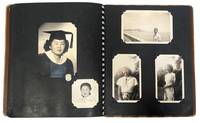
1946230681946. Japanese-American Women's Education Postwar Hawaiʻi identified Japanese-American university school girl's photo album. Oʻahu Territory of Hawaiʻi 1946-1950 spanning the years right after World War II. Approximately 260 silver gelatin photographs documenting the daily life friendships education and civic participation of a Japanese American young woman living on Oʻahu in the immediate postwar period. The photographs are mounted in a 9" x 11" woven album with photos cornered in on black board pages. Images range from small snapshot-format prints to larger horizontal photographs. Following Pearl Harbor Hawaii was initially considered a war zone and the Japanese Americans there were subject to heavy surveillance and civil rights violations until the war ended in 1945. This album ranges 1946 to circa 1950 with one loose photograph predating the album by approximately a decade likely depicting the compiler as a child. The compiler is identified by name in captions as Reiko who also went by "Rei" Reiko was a Japanese American college student and Pre-Med Club member residing on Oʻahu.<br /> <br /> This substantial and unusually well-captioned album offers a deeply personal record of Japanese American civilian life in Hawaiʻi following the end of World War II and the lifting of martial law. The first third of the album features extensive handwritten captions frequently identifying individuals locations and events while the latter portion contains fewer annotations but continues the visual narrative of family friendship and place. Reiko's life is documented across academic social and community spheres depicting college friendships Pre-Med Club activities leisure outings and participation in Laulima a Hawaiian community support organization emphasizing mutual aid and collective responsibility. Numerous images record friendships among young women posed confidently in dresses skirts slacks and swimsuits as well as traditional Japanese dress and Hawaiian dress and leis showcasing cross-cultural identity. Family life appears alongside repeated photographs of Lorraine Nakamuta age 2½ likely a relative shown in candid domestic and outdoor scenes some in western attire and a few photos playfully dancing in a straw hula skirt. The album also serves as a visual geographic survey of mid-century Hawaiʻi with identified sites including Halemaʻumaʻu Crater sugar cane fields irrigation infrastructure such as a wooden pipe transporting water Robert Louis Stevenson's hut beaches valleys and residential neighborhoods.<br /> <br /> Public and civic life figure prominently. Several sequences document an Hawaiian beauty pageant as well as floats marching bands and crowds celebrating the Philippine Islands Independence Day Parade July 4 1946 Honolulu situating Japanese American life within Hawaiʻi's broader multiethnic and postcolonial Pacific context. These images underscore the reemergence of public celebration and civic participation after wartime restriction while highlighting interethnic solidarity and shared urban space. Taken together the album constitutes a rare large-scale vernacular record of Japanese American womanhood education and community engagement during the transitional years between World War II and Hawaiʻi's statehood era. The album remains intact and structurally sound with thick board pages and photographs securely attached using original corner mounts. A few photos loose. Minor age-related wear is present including light scuffing to covers. Handwritten captions remain largely legible throughout. Overall very good condition. This album is an exceptional primary-source document for institutional collections offering sustained visual evidence of Japanese American youth culture women's education in the sciences and everyday resilience in postwar Hawaiʻi enriched by named individuals identified locations and detailed contemporaneous annotations. unknown
199727136München, WDV-Verlag Lektorat Edition, 1997. 191 Seiten , 22 cm, kartoniert
1374771London: Kegan Paul, 1989 in-4, xii-269 pages, nombreuses illustrations. Glossaire, bibliographie, index. Cartonné, jaquette, très bon état
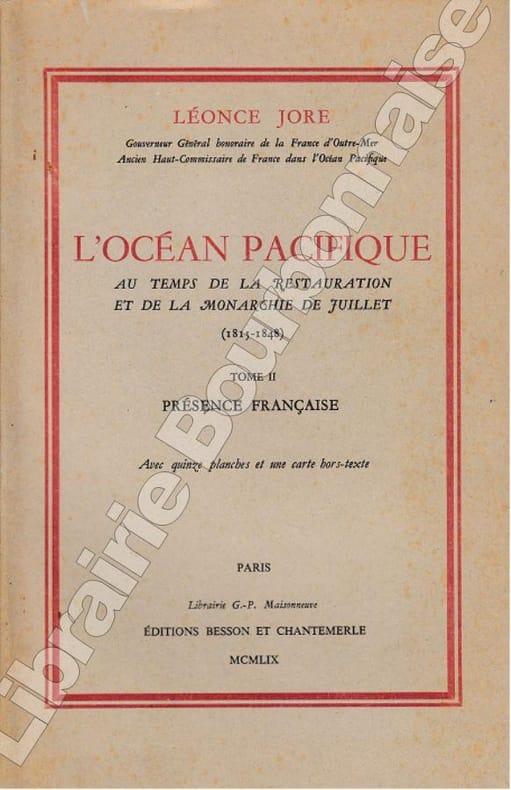
12406Paris, Besson et Chantemerle, 1959 ; 1 volume in-8, broché. 442pp.- 1 carte dépliante et 15 planches hors-texte. Papier jauni, bon état cependant.
ria9781107154919_inpHardback. New. New Book; Fast Shipping from UK; Not signed; Not First Edition; This book provides an analysis of impact crater morphology on Mars with spectacular images from the latest missions. It will be useful for researchers and graduate students interested in impact craters both terrestrial and extra-terres hardcover
R23897, Paris/ Braine-le-Comte, Maison-Mère 1931, xvi + 541pp.+ de nombreuses ills.hors texte, reliure cart., qqs.traces d'usage, 23cm.
1931R74812Paris/ Braine-le-Comte, Maison-Mère 1931 xvi + 541pp.+ de nombreuses ills.hors texte, br.orig.illustrée (petite manque en bas du dos), qqs.rousseurs, 23cm., bon état, R74812
xvi + 541pp.+ de nombreuses ills.hors texte, br.orig.illustrée (petite manque en bas du dos), qqs.rousseurs, 23cm., bon état, R74812
Paris/ Braine-le-Comte, Maison-Mère 1931, xvi + 541pp.+ de nombreuses ills.hors texte, reliure cart., qqs.traces d'usage, 23cm.
T22074, Honolulu (Hawaii), Honolulu Star-Bulletin 1942, 117pp., linen cover, VG, T22074
Honolulu (Hawaii), Honolulu Star-Bulletin 1942, 117pp., linen cover, VG, T22074
Large quarto in offwhite b&w illus stapled wraps; score (56 pages) : illustrations ; 31 cm. One b&w phot per song. In English with some Hawaiian words. Scarce. Chiefly for voice and piano. Includes tablature for ukulele. Contents: Aloha oe (Farewell to thee) / H.M. Queen Liliuokalani ; ukulele chords by Ernest Kai -- Honey moon isles / words by Wm. C. Hodges, Jr. ; music by Ernest K. Kaai -- Hawaii (ukulele song classic) / Ernest K. Kaii -- Rose hula / arr. by Ernest K. Kaai -- Sweet Lei Lehua / King Kalakaua ; arr. Ernest K. Kaai -- Ta maoli (hula) / arr. by Ernest K. Kaai -- Puuwaawaa / words by Mary E. Low ; music by Ernest K. Kaai -- Sweet lei Ilima / arr. Ernest K. Kaii -- Weedie (ukulele song classic) / Ernest K. Kaii -- Hola e pae (Hawaiian fox trot) / arr. by Ernest K. Kaai -- Lanakila Iaukea / Ernest K. Kaai -- Ipo lei manu (old Hawaiian folk-song) / arr. Ernest K. Kaai -- Kaena hula / arr. Ernest K. Kaai -- Kalanianaole / Ernest K. Kaai -- Akahi / arr. Ernest K. Kaai -- I love you (ukulele song classic) / words by Wm. C. Hodges, Jr., & Herbert Byrne ; music by Ernest K. Kaai. || Muscial scores. Songs, Hawaiian. Pictorial works.
0979676940.Gspiral_bound. Good. Access codes and supplements are not guaranteed with used items. May be an ex-library book. unknown
2008Q-0979676940Watermark Publishing 2008-01-31. Spiral-bound. New. In shrink wrap. Looks like an interesting title! Watermark Publishing unknown
DJ with light wear to extremities ; A novel based on the sordid Massie case, wherein four native Hawaiians were falsely accused of rape, while the US Navy protected one of its own; 8vo; 503 pages
1997105088o. O., The Kawainui Press, 1997. 111 S. Gr.-8° Groß-Oktav, Softcover/Paperback