293 résultats
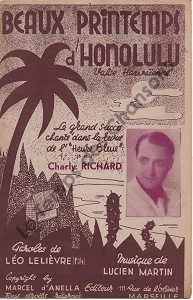
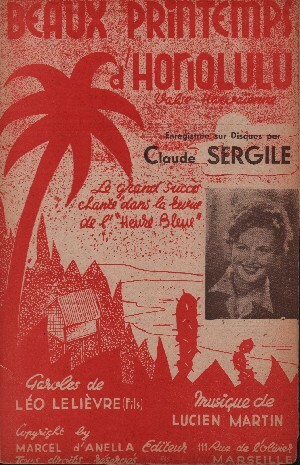
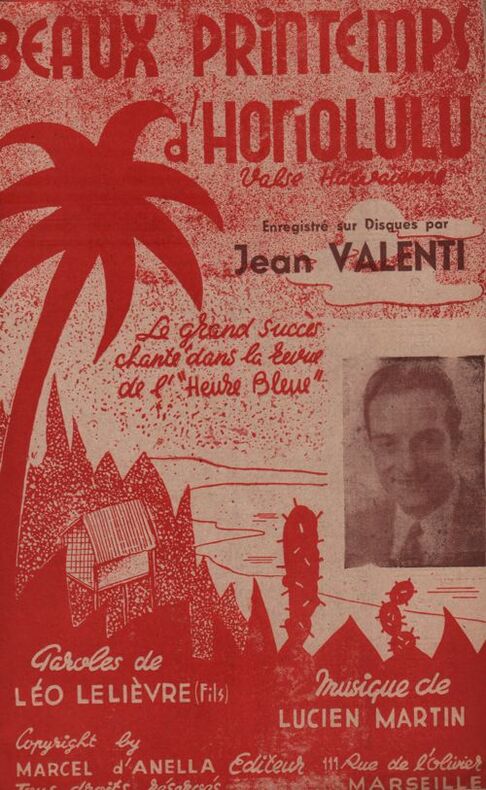
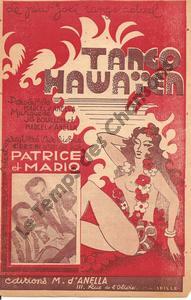
19425129Partitions sur la Polynésie d'AnellaMarcel 1942
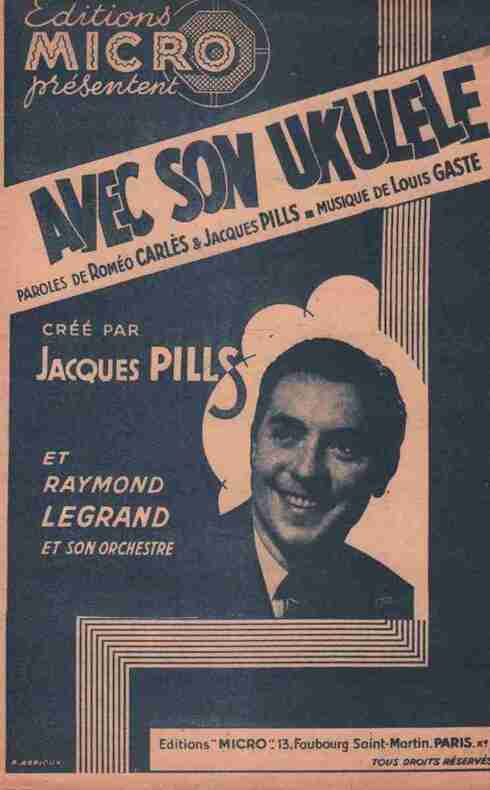
19455302Micro 1945 approx.
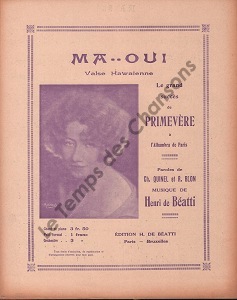
192028939Partitions sur la Polynésie de Béatti Henri 1920 approx.
193918043Partitions sur la Saison,Partitions sur l'Amérique du Nord d'AnellaMarcel 1939 approx.
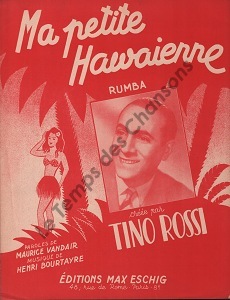
194728950Partitions sur la Polynésie Eschig Max 1947
193932641d'AnellaMarcel 1939 approx.
193426495Peter Maurice 1934
192229372Partitions sur l'Amérique du Nord Salabert 1922
193977264d'AnellaMarcel 1939 approx.
191018568Honolulu, Island Curio & Co., James Steiner, 1910. Private Mailing Card. Farbige Postkarte, gelaufen von Honolulu nach Mannheim, Waldparkstraße 4, mit Briefmarke, U.S. Postage, rot, two cents und Stempel, geschrieben und gestempelt am 24. Januar 1910. Kanten mit Abrieb, Rückseite mit kleinem Fleck, sonst gut erhalten.
19467700Wash. DC.: GPO 1946. First Edition. 39 parts and final report SD244. Illus. maps plates etc. Original printed wrappers. First edition. Complete file of all published. A compilation of mammoth scope and great research value.some ex-lib markings GPO unknown books
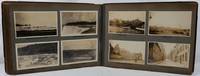
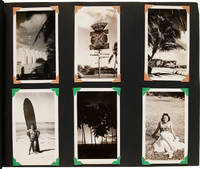
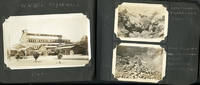
192548263Hawaii: n.p. ca. 1925. Oblong 8vo. 36 pp unpaginated. With 26 photos tipped-in 1 real photo postcard of the King Kamehameha Statue Kapaau Hawaii. Photo album with Koa wood covers gilt seal of Hawaii on front cover yarn tied at gutter margin a couple photos w/ minor creasing to corners postcard w/ corner slightly torn some leaves shaken still a nice copy. This charming Jazz Age photo album of a trip to Hawaii includes illustrations of disembarking on a Matson Navigation Company Steamship a visit to a sugar cane factory with railcars loaded with cane setting beside the factory and another image showing the burning of the cane field as well as one of a field hand with machete; Waikiki Beach with Diamond Head in the Background; Japanese workers planting rice in paddies and using oxen for plowing; pineapple & banana plantations; as well as others showing the tour group the homes they stayed and the beautiful natural landscape of the time. n.p., unknown
1922214040circa1922. Photograph album includes 96 photographs. The images are laid down on 28 pages. 30 show Japanese scenes or subjects 30 of Hawaii 4 of San Francisco 7 of Los Angeles 3 of Chicago 7 of New York 14 of Canada and a final quite artistic image of clouds at sunset or sunrise. Many are original silver gelatin privately taken photographs while some are postcards or commercially produced. Each photograph is neatly captioned in ink in English. The name I.B. Jones dated 1922 is neatly written in ink inside the upper cover. The cloth covered album is largely missing the morocco covering at the corners and along the spine and there is a gouge in the upper board but the binding is still sound. Top edge gilt. The photographs show some occasional silvering or fading but are overall in good to very good condition. 25 x 34cm. The Japanese photographs in this album were taken mainly in the Tokyo-Yokohama area and include some nice images of people and street scenes taken in Yokohama. . hardcover
1943WRCAM55582Hawaii 1943. 240 photographs including twenty-seven photo postcards measuring 2 1/2 x 3 1/2 to 8 x 10 inches the majority 2 3/4 x 4 1/2 inches corner- mounted; one certificate. Oblong folio. Textured brown cloth with gilt stamps of American eagle with shield and palm trees on front board "Aloha Hawaii" stamped in black brown cord binding. Presentation inscription on first leaf. Some wear to extremities front hinge just starting to crack. A few photos mildly rumpled but overall extremely well-preserved. Very good. An engaging album depicting an eerily peaceful Hawaii in the days leading up to and during the American participation in World War II in the Pacific. Prepared by Charles Ryan for Viola Suhar inscribed to her and with her address written beneath the Trader Vic's certificate the album begins with Ryan's "Trading License" from Trader Vic's in Honolulu dated October 21 1943. It then proceeds directly to twenty photos of planes at "Hickem" i.e. Hickam Field in Honolulu the principal Army Air Force base in Hawaii during the war. These photos were likely taken before the attack on Pearl Harbor as Hickam sustained substantial damage during that attack. Then follows numerous tourist photos of Hawaii many annotated with location. Included are several photos of "hula girls" surfers shots of downtown Honolulu beaches mountains and landmarks such as Lau Yee Chai Chinese restaurant the Chamberlain House Ka Hale Kamalani Iolani Palace Waikiki Beach and the Aloha Tower. In the midst of this are nine uncaptioned photos apparent reproductions of ships under attack and one of sailors escorting caskets. <br> <br> Also included are several photos including one handcolored image of sailors relaxing on the beach at Camp Andrews and at "The Breakers" the Navy beach club in Waikiki; sailors at work and doing laundry; and then two sets of photos one set enlarged of a particular sailor with one of him on a motorcycle and the second with his shirt open and tattoos visible which are presumably of Charles Ryan. Finally there are nine photos of the Church of Latter Day Saints Temple in Laie outside of Honolulu including a large 8 x 10 inches image of the entire site. It seems unlikely that Ryan was a Mormon considering the tattoos and the visit to Trader Vic's so perhaps this was simply part of his travels throughout Hawaii. Ryan was almost certainly in the military most likely the Navy but we could not find conclusive evidence of his service. Viola Suhar was a teacher in Perth Amboy New Jersey and likely Charles' sweetheart we did find a Viola Ryan working as a teacher in Perth Amboy in the 1950s. <br> <br> A carefully-assembled view of a calm Hawaii against the backdrop of war. hardcover books
194662004Guam & Pearl Harbor H.T.: 301st U.S. Naval Construction Battalion 1946. Oblong 4to. 12.5 x 9.25 in. 247 1 pp. With 100’s of photo illustrations a colour plate map plates. Navy-blue coloured boards 301st NCB Seabee badge in gilt on front cover gilt title on cover some edgewear scuffing to spine minor rubbing still a VG- copy. First edition of this very scarce souvenir yearbook chronicling the Herculean efforts of the storied 301st U.S. Naval Construction Battalion Seabees affectionately known as the “Harbor Stretchers†as they were specifically activated and formed to expand and deepen vital deep-water harbors at advance bases in the South Pacific during World War II. Activated April 1 1944 in Port Hueneme Advanced Base Depot CA they were dispatched to Guam starting April 21 1944 to begin clearing vast War debris from the defeated Japanese Naval units and were a specialized unit often operating under sustained constant enemy fire during the War. Based out of Guam 12 detachments scattered over the Pacific War zone dredging harbors under adverse conditions at some of the bloodiest island hopping battles such as Kwajalein Saipan Iwo Jima Okinawa Peleliu and Tinian. Dredges included the “Tualatin†moved to Midway in May 1944 the USS City of Dahlart at Pearl Harbor Dredge Indiana at Midway. Many of their salvage operations are depicted here along with an extended photographic synopsis of Guam during World War II. Worldcat locates 5 copies NYPL SF Maritime Nat. Hist. Park Navy Dept. Naval Hist. Lib. Heinz Center WI Vet Mus. Res. Ctr. 301st U.S. Naval Construction Battalion, hardcover
1935WRCAM52777Various locations in and around Honolulu Oahu Hawaii 1935. Seventy-eight mounted silver gelatin photographs either 3 1/2 x 5 1/4 inches or 2 1/2 x 3 1/2 inches. Oblong octavo photograph album paper-covered boards string-bound. Front cover detached covers and spine chipped. Some album pages chipped but photographs remain largely untouched. Very good. An absorbing collection of photographs capturing American military life in Hawaii during the first half of the 20th century with the great majority of the photographs captioned in ink on the album pages. The unnamed photographer and compiler of the photographs apparently served at the Schofield Barracks in Honolulu as he includes several photographs of the base including the "Boxing Bowl." He also records other notable locations around Honolulu including the Waipahu Sugar Mill the Kilaeua Crater Japanese Temple the Mid-Pacific Railway wreck Kapiolani Park the Honolulu railway station Sand Island the naval destroyer JEANNE D'ARC Sampans Haleiwa Bay the Monoa Hotel the Waipahi Sugar Mill Diamondhead and Kahala Bay Waikiki Beach several shots of volcanoes and lava formations and more. He even includes a shot of the pack mule he presumably used in his wanderings. Hawaiian photographs are scarce in the market and continually more desirable especially with holographic notations like those present in this intriguing album. hardcover books
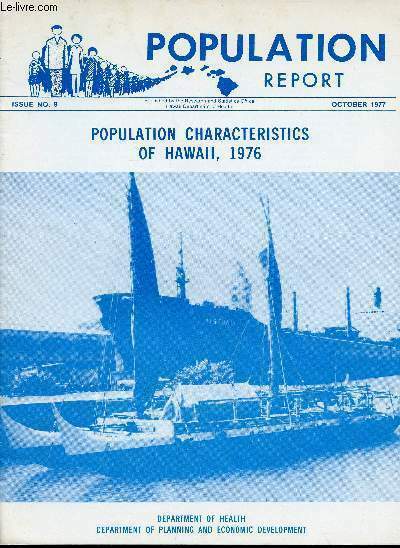
1977RO60148656Research and Statistics Office. 1977. In-4. Broché. Bon état, Couv. convenable, Dos satisfaisant, Intérieur frais. Envrion 30 pages. Texte en anglais.. . . . Classification Dewey : 420-Langue anglaise. Anglo-saxon
1979RO60148657Research and Statistics Office. 1979. In-4. Broché. Bon état, Couv. convenable, Agrafes rouillées, Intérieur frais. 26 pages. Texte en anglais.. . . . Classification Dewey : 420-Langue anglaise. Anglo-saxon
1976RO60148659Research and Statistics Office. 1976. In-4. Broché. Bon état, Couv. convenable, Dos satisfaisant, Papier jauni. 16 pages. Texte en anglais. Nombreuses cartes en noir et blanc, hors texte.. . . . Classification Dewey : 420-Langue anglaise. Anglo-saxon
1978RO60148662Department of Health, Hawaii. 1978. In-4. Broché. Etat d'usage, Couv. défraîchie, Agrafes rouillées, Intérieur frais. 34 pages. Texte en anglais.. . . . Classification Dewey : 420-Langue anglaise. Anglo-saxon
1947219701947. Japanese-American WWII Official yearbook of the 1947 graduating class at Punahou School in Honolulu Hawaiʻi which serves as a vivid document of postwar life in a multiracial student body that included a notable presence of Japanese American students. Bound in embossed dark blue leatherette. 8.5" x 11". Heavily illustrated. Published two years after the end of World War II this year's volume shows the continued presence and leadership of Nisei students despite the hardship faced in school years prior. With numerous signed messages by students-including Japanese American classmates such as W. Kobayashi G. Ogawa and H. Takakuwa-this volume provides rare evidence of social reintegration and interracial camaraderie in the wake of a war that saw Japanese Americans subjected to mass suspicion and surveillance across the United States. While Japanese Americans in Hawaiʻi were spared the large-scale incarceration endured by their mainland counterparts they still lived under martial law from 1941 to 1944. During this time thousands were dismissed from government jobs arrested without charge or pressured to prove loyalty-conditions that deeply affected the Nisei generation. Many of the students represented here likely had family members who served in the famed 100th Infantry Battalion or the 442nd Regimental Combat Team the most decorated unit in U.S. military history. Others may have experienced community surveillance loss of employment or restricted freedoms under Hawaiʻi's military government. In this context the 1947 Oahuan is not simply a yearbook-it is a document of recovery dignity and the quiet persistence of young Japanese Americans reclaiming space in public life through scholarship athletics and social visibility. This particular copy is especially notable for its extensive endpaper inscriptions with dozens of students having signed their names in ink making this a personalized artifact of postwar student life. The volume features photographs of senior portraits student clubs athletic teams and lively candid montages with Nisei students prominently and equitably featured. Sports team photos show a remarkable ethnic diversity with surnames like Kobayashi and Koneshige appearing beside those of white and Hawaiian students. The visual presentation echoes Hawaiʻi's unique multiracial culture and hints at the relative integration of elite schools like Punahou in contrast to the segregation typical of many mainland institutions during this era. Endpapers are completely filled with original signatures. Wear to covers with some cracking at interior hinge and one corner of the pastedown torn. Overall very good condition. A rare signed witness to Nisei perseverance in a racially stratified but uniquely hybrid territory on the cusp of statehood. unknown
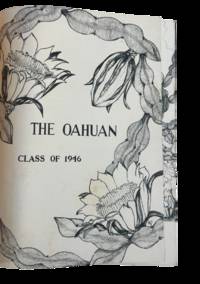
1946219301946. Japanese-American WWII Official yearbook of the 1946 graduating class at Punahou School in Honolulu Hawaiʻi which serves as a vivid document of postwar life in a multiracial student body that included a notable presence of Japanese American students. Bound in embossed dark blue leatherette. 8.5" x 11". Heavily illustrated. Published just one year after the conclusion of World War II the yearbook offers a rare and humanizing portrait of Japanese American youth in a period when many of their families were still reeling from forced incarceration surveillance or military service. While Japanese Americans in Hawaiʻi were spared the large-scale incarceration endured by their mainland counterparts they still lived under martial law from 1941 to 1944. During this time thousands were dismissed from government jobs arrested without charge or pressured to prove loyalty-conditions that deeply affected the Nisei generation. Many of the students represented here likely had family members who served in the famed 100th Infantry Battalion or the 442nd Regimental Combat Team the most decorated unit in U.S. military history. Others may have experienced community surveillance loss of employment or restricted freedoms under Hawaiʻi's military government. In this context the 1947 Oahuan is not simply a yearbook-it is a document of recovery dignity and the quiet persistence of young Japanese Americans reclaiming space in public life through scholarship athletics and social visibility. This yearbook reflects a moment of restoration and resilience capturing a cohort of Nisei students reclaiming normalcy through education sports and extracurricular life in a territory that would not become a state for another thirteen years. The 1946 Oahuan features dozens of portrait photographs and detailed bios of Japanese American seniors-including Florence Takahashi Alice Asahina and Raymond Akana-who were active in campus life through clubs like Hui Eleu Ka Punahou and the Camera Club. The prominence of these students across social and athletic leadership roles demonstrates the partial reabsorption of Japanese Americans into Hawaiʻi's civic fabric even as anti-Japanese sentiment lingered nationally. Particularly striking is the equal treatment of Asian and white students a stark contrast to the segregated yearbooks of most mainland U.S. high schools at the time. The layout includes numerous posed group photos framed by Oʻahu's lush volcanic landscape a reminder of the local terrain that shaped these students' hybrid island identities. Minor toning and faint edgewear; overall very good condition. A poignant and timely artifact from a transitional moment in Japanese American history reflecting the endurance and reintegration of Nisei students in a society still reckoning with its wartime policies. unknown
1947219311947. Japanese-American WWII Official yearbook of the 1947 graduating class at Punahou School in Honolulu Hawaiʻi which serves as a vivid document of postwar life in a multiracial student body that included a notable presence of Japanese American students. Bound in embossed dark blue leatherette. 8.5" x 11". Heavily illustrated. Published two years after the end of World War II this year's volume shows the continued presence and leadership of Nisei students despite the hardship faced in school years prior. With numerous signed messages by students-including Japanese American classmates such as W. Kobayashi G. Ogawa and H. Takakuwa-this volume provides rare evidence of social reintegration and interracial camaraderie in the wake of a war that saw Japanese Americans subjected to mass suspicion and surveillance across the United States. While Japanese Americans in Hawaiʻi were spared the large-scale incarceration endured by their mainland counterparts they still lived under martial law from 1941 to 1944. During this time thousands were dismissed from government jobs arrested without charge or pressured to prove loyalty-conditions that deeply affected the Nisei generation. Many of the students represented here likely had family members who served in the famed 100th Infantry Battalion or the 442nd Regimental Combat Team the most decorated unit in U.S. military history. Others may have experienced community surveillance loss of employment or restricted freedoms under Hawaiʻi's military government. In this context the 1947 Oahuan is not simply a yearbook-it is a document of recovery dignity and the quiet persistence of young Japanese Americans reclaiming space in public life through scholarship athletics and social visibility. This particular copy is especially notable for its extensive endpaper inscriptions with dozens of students having signed their names in ink making this a personalized artifact of postwar student life. The volume features photographs of senior portraits student clubs athletic teams and lively candid montages with Nisei students prominently and equitably featured. Sports team photos show a remarkable ethnic diversity with surnames like Kobayashi and Koneshige appearing beside those of white and Hawaiian students. The visual presentation echoes Hawaiʻi's unique multiracial culture and hints at the relative integration of elite schools like Punahou in contrast to the segregation typical of many mainland institutions during this era. Endpapers are completely filled with original signatures. Wear to covers with some cracking at interior hinge and one corner of the pastedown torn. Overall very good condition. A rare signed witness to Nisei perseverance in a racially stratified but uniquely hybrid territory on the cusp of statehood. unknown
1994441774PN. New. 1994. Soft Cover. Date is original print. This is a reprint edition. . PN paperback
1994274569PN. New. 1994. Soft Cover. Date is original print. This is a reprint edition . PN paperback