"AMPÈRE, ANDRÉ-MARIE.Livre Rare Book

620 résultats
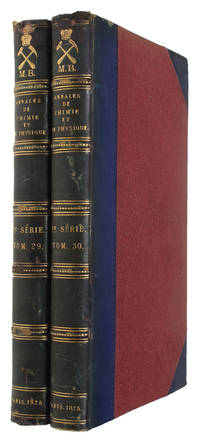
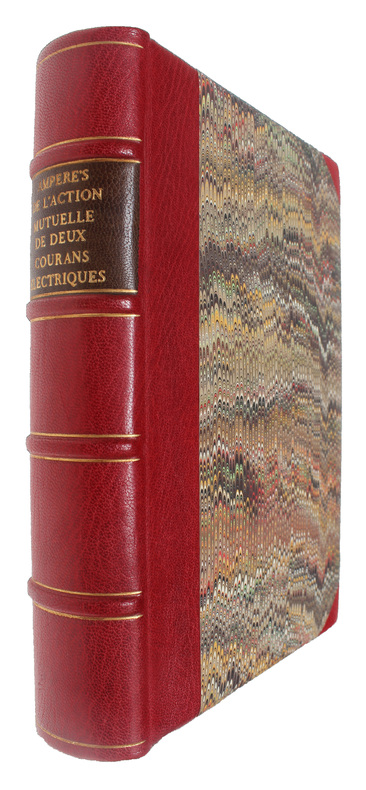
182543749Paris, Crochard, 1825. 8vo. 2 contemporary half calfs w. richly gilt spines. Light wear at top of spines. Minor scratches to upper compartments of spines. Small stamps on verso of title-pages and verso of plates. In: ""Annales de Chimie et de Physique, Par MM. Gay-Lussac et Arago."", tome 29 a. 30. - 448 pp. and 3 folded engraved plates + 448 pp. and 2 folded engraved plates. (The entire volumes offered). Ampère's papers: pp. 381-404 (tome 29) + Suite pp. 29-41 (tome 30) + ""Lettre à Gerhardi"": pp. 373-381 (tome 29). Clean and fine throughout.
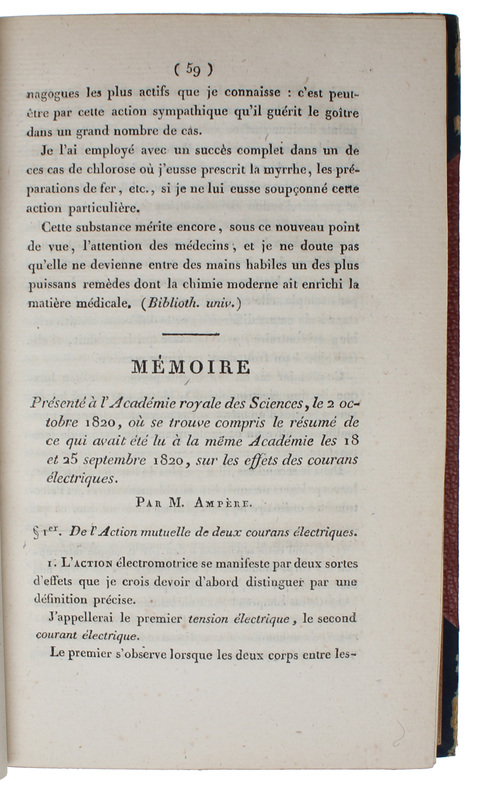
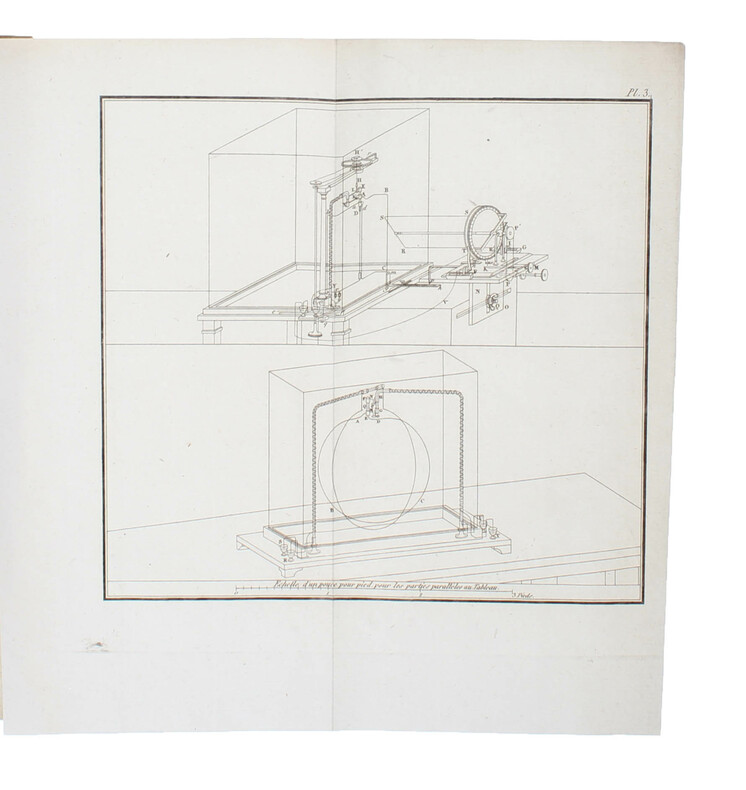
182041350Paris Crochard 1820. 8vo. Without wrappers as extracted from "Annales de Chimie et de Physique" Volume 15 pp. 59-76 and pp.170-218. Five engraved plates accompanying the memoires showing the experimental equipments. Half-title and title-page to volume 15 present. <br/><br/><em>First edition of the first announcement of Ampère's discoveries on electromagnetism. Ampère first heard of Ørsted's discovery of electromagnetism on the 4th of September when Arago announced Ørsted's results to the Paris Academy of Sciences. In Ørsted's experiment a current-carrying wire is held over and under a compass needle - the result being that the needle is positioned at 45 degrees in respect to the wire. Ampére immediately saw that this result made no physical sense and realized that the true nature of the effect could not be observed until the force of terrestrial magnetism was somehow neutralized; what Ørsted had observed and reported on was the resultant of the force from the wire and that from the earth's magnetic field. Ampère discovered that the compass needle sets at 90 degrees to the current-carrying wire when the effect of terrestrial magnetism is eliminated. He also observed that current-carrying wires which are formed as spirals act as permanent magnets and this lead him to his theory that electricity in motion produces magnetism and that permanent magnets must contain electrical currents. And thus Ampère laid the foundation of the new field of electrodynamics.Ampère announced his theory and experimental results for the first time in a series of memoires read before the Paris Academy of Sciences in September and October 1820. These memoires were first published in the September and October issues of Arago's "Annales de Chimie et de Physique" the offered items. In November Ampère had a separate printing of his findings published under the title 'Mémoires sur I'action mutuelle de deux courans électriques sur celle qui existe entre un courant électrique et un aimant ou le globe terrestre et celle de deux aimans I'un sur I'autre.' Dibner 62 Norman 43. On the title-page of this publication it is stated 'Extrait des Annales de Chimie et de Physique' and therefore this publication is often identified as an offprint of the two offered papers see the Norman sales catalogue for an example. This is however untrue since it contains considerable changes and additions in comparison with text of the journal issues see Williams: What were Ampère's Earliest Discoveries in Electrodynamics ISIS volume 74 p.492.Honeyman 82 Barchas 51 Wheeler 762. Sparrow Milestones No 8. </em> unknown
182543749Paris Crochard 1825. 8vo. 2 contemporary half calfs w. richly gilt spines. Light wear at top of spines. Minor scratches to upper compartments of spines. Small stamps on verso of title-pages and verso of plates. In: "Annales de Chimie et de Physique Par MM. Gay-Lussac et Arago." tome 29 a. 30. - 448 pp. and 3 folded engraved plates 448 pp. and 2 folded engraved plates. The entire volumes offered. Ampère's papers: pp. 381-404 tome 29 Suite pp. 29-41 tome 30 "Lettre à Gerhardi": pp. 373-381 tome 29. Clean and fine throughout. <br/><br/><em>First appearance of this famous memoir in which Ampère presented his collected results on electrodynamics to the French Academy creating the foundation of 19th century developments in electricity and magnetism. In the words of James Clark Maxwell "We can scarcely believe that Ampère really discovered the law of action by means of the experiments which he describes. We are led to suspect what indeed he tells us himself that he discovered the law by some process which he has not shown us and that when he had afterwards built up a pefect demonstration he removed all traces of the scaffolding by which he raised it."The offered memoir was published BEFORE the famous "Theorie mathématique des phénomènes électro-dynamiques uniquement déduite de L'expérience" which did not appear until 1827. That 1827-Memoire incorporates together with a new presentation of Ampère's results from 1820 1822 1823 the offered memoir 1825. Horblit: 100 - Dibner: 62."From 1814 until 1820 Ampére did not perform the kind of research that would have made it into the annals of the histrory of science but on September 11 1820 when he heard Francois Arago speak about Oersted's work he got fresh inspiration and started the work that made him famous. Arago related how Oersted had found that a steady electric current influences the orientation of a compass needle. After a weak Ampère had determined experimentally that that two straight parallel and current-carrying wires execute a force on each other. The magnitude of the force is inversely proportional to the distance between the wires and proportional to the strenghts of the current. During the following years he continued his researches both experimentally and theoretically. he built an instrument for measuring electricity that later was developed into the galvanometer. Finally in 1825 he presented his collected results to the Academy IN ONE OF THE MOST CELEBRATED MEMOIRS IN THE HISTORY OF NATURAL PHILOSOPHY The paper offered." Citizen's Compendium p. 2. - Norman No 47.The volumes contain many other notable papers by: Wöhler Fresnel Marcet Berzelius Felix Savart De la Rive Braconnet Boussingault Magnus Poncelet Vaugelin Poisson Gay-Lussac Faraday Laplace etc. </em> unknown
182022536Paris: Chez Crochard 1820. First Edition. Boards. Very Good. First Edition. 448 pages plus 5 plates 1 folding. 8vo. Contemporary quarter calf over marbled boards with black spine labels. Early label Coquard a Epinal on front pastedown. The entire volume of "Annales de Chimie et de Physique" Vol. Quinzieme XV 15 offered. Surface wear/damage to the leather finish resulting in minor loss to gilding and top label and minor fraying to the head/tail spine panel. Small spot of worming inside lower rear board at the gutter. Text generally bright and clean. <br/><br/>This volume contains the original journal appearance of the separately issued "Memoires sur l'Action Mutuelle de Deux Courans Electriques" in three sections over two articles pp. 59-76 & 170-218. Section 1: "De l'Action mutuelle de deux courans electriques" pages 59-76 continued as "Suite Du Memoire sur l'Action mutuelle entre deux courans electriques entre un courant electrque et un aimant ou le globe terrestre et entre deux aimans" on pages 170-188. Section 2: "Direction des courans electriques par l'action du globe terrestre" on pages 188-196. Section 3: "De l'Action mutuelle entre un conducteur electrique et un aimant" pages 196-218. Plus plate number 4 in the rear which illustrates the articles. Boards. Ampere is today celebrated for his fundamental work in the new field of electrodynamics. The three part paper offered here established "the relationship between electric current-flow and magnetism and established the new science of electrodynamics." Norman <br/><br/>"In a four page circular dated Copenhagen July 21st 1820 H.C. Orsted communicated his great discovery that a closed voltaic circuit exerts forces on an adjacent magnetic needle. In more modern language: a current-carrying electric circuit gives rise to magnetic forces in its surroundings. Orsted had found the long sought affinity between electricity and magnetism. The letter reached Arago . who at the next meeting of Academie des Sciences on Sept. 11th 1820 with Ampere in attendance presented the letter and Orsted's experiment. It was indeed a memorable meeting. Already at the next weekly meeting on Sept. 18th Ampere delivered an explanation of Orsted's experiment and supported it with new experiments of his own. At every weekly meeting in the following months Ampere produced new results." Ekelof<br/><br/>'In this first paper Sept. 18 he explains the law determining the position of the magnetic needle in relation to the electric current and he also makes known his intended experiments with spiral of helical wires which he predicts will acquire and retain the properties of magnets so long as the electrical current flows through them He constructed his spirals and helices and to the astonishment of all he produced magnets formed only of spools of copper wire traversed by electric currents.' Mottelay<br/><br/>The Honeyman sale #82 notes that the paper offered here is "The first appearance of the first of a series of important papers reporting Ampere's discoveries on the electric current." Honeyman also had #83 the first separate appearance of these journal articles published as "Memoires sur l'Action mutuelle de deux courans electriques." which we believe had additional information not present in this journal appearance and hence is not a traditional "offprint" but a later state of the work. Norman notes that Ampere developed the science of electrodynamics over the next seven years publishing in a "bewildering array of journal articles offprints and revisions of earlier works.further noting some 'reprints' of Ampere's articles appear in as many as five different versions."<br/><br/>This is an opportunity to own the original first printed appearance of Ampere's fundamentally important work in Electrodynamics. It would be an interesting collection to build the variations of Ampere's work over those seven years to see how his thought evolved. As far as we are aware there is no standard bibliographic reference for Ampere's work.<br/><br/>Dibner Heralds of Science 62 first separate edition; Honeyman Sale 82 original journal appearance; Mottelay Bibliographical History of Electricity and Magnetism p. 472 ; Norman 43 first separate edition. Ekelof Catalogue of Books and Papers in Electricity and Magnetism pp 284-286; Sparrow Milestones of Science p33 first separate edition. Chez Crochard unknown books
1822317111822. Paris Méquignon-Marvis 1822 8° 3 91 II pp. 33 Fig. untrimmed in contemporary brochure; preserved in halfleather book box; fine copy. First Edition of a scare and early publication on electricity and magnetism "A very valuable Treatise' Mottelay. 'In a four page circular letter dated Copenhagen July 21st 1820 H.C. Oersted communicated his great discovery that a closed voltaic circuit exerts forces on an adjacent magnetic needle. In more modern language: a current-carrying electric circuit gives rise to magnetic forces in its surroundings. Oersted had found the long sought affinity between electricity and magnetism' Ekelöf Catalogue of Books and Papers in Electricity and Magnetism p. 286. 'Scarcely had the news of Oersted's discovery reached France when a French philosopher Ampère set to work to develop the important consequences which it involved. Physicists had long been looking for the connection between magnetism and electricity and had perhaps inclined to the view that electricity was somehow to be explained as a magnetic phenomenon. It was in fact under the influence of such ideas that Oersted was led to his discovery. Ampère showed that the explanation was to be found in an opposite direction. He discovered the ponderomotive action of one electric current on another and by a series of well-chosen experiments he established the elementary laws of electro-dynamic action starting from which by a brilliant train of mathematical analysis he not only evolved the complete explanation of all the electro-magnetic phenomena observed before him but predicted many hitherto unknown. The results of his researches may be summarized in the statement that an electric current in a linear circuit of any form is equivalent in its action whether on magnets or other circuits to a magnetic shell bounded by the circuit whose strength at every point is constant and proportional to the strength of the current. By his beautiful theory of molecular currents he gave a theoretical explanation of that connection between electricity and magnetism which had been the dream of previous investigators . "Oersted" remarks Babinet "was the Christopher Columbus of magnetism; Ampère became its Pizarro and its Fernando Cortez"' Mottelay Bibliographical History of Electricity and Magnetism p. 474. Ampère's collaborator in the present publication Jacques Babinet 'did excellent work in different areas of physics. He was an early advocate of the wave theory of light and produced important results in the theory of refraction' Ekelöf p. 287. An additional interesting aspect of the present paper is a first outline of Ampère's ideas concerning an electric telegraph p. 71. The work is in fact an offprint from the Supplement to the French translation of Thomas Thompson's System of Chemistry: Système de Chimie. Traduit . par J. Riffault. The supplement is entitled: Supplément . présentant ce qui a été fait de nouveau dans cette science . depuis l'époque 1819 où cette traduction a paru Paris 1822 see Cole 1283. In the supplement the text of Ampère and Babinet occupies pp. 163-256. Overmier and Senior p. 127; not in Gartrell or Wheeler Gift. hardcover
182058978Paris, Crochard, 1820. 8vo. In 'Annales de Chimie et de Physique', Volume 15, pp.59-76170-218. The entire volme 15 offered here. 448 pp., 5 engraved plates. Bound in contemporary half calf with gilt spine, Raised bands. Minor scratches to spine. Corners a bit bumped. Five engraved plates accompanying the memoires. Clean and fine.
58978Paris Crochard 1820. 8vo. In 'Annales de Chimie et de Physique' Volume 15 pp.59-76;170-218. The entire volme 15 offered here. 448 pp. 5 engraved plates. Bound in contemporary half calf with gilt spine Raised bands. Minor scratches to spine. Corners a bit bumped. Five engraved plates accompanying the memoires. Clean and fine. <br/><br/><em>First edition of the first announcement of Ampère's discoveries on electromagnetism. Ampère first heard of Ørsted's discovery of electromagnetism on the 4th of September when Arago announced Ørsted's results to the Paris Academy of Sciences. In Ørsted's experiment a current-carrying wire is held over and under a compass needle - the result being that the needle is positioned at 45 degrees in respect to the wire. Ampére immediately saw that this result made no physical sense and realized that the true nature of the effect could not be observed until the force of terrestrial magnetism was somehow neutralized; what Ørsted had observed and reported on was the resultant of the force from the wire and that from the earth's magnetic field. Ampère discovered that the compass needle sets at 90 degrees to the current-carrying wire when the effect of terrestial magnetism is eliminated. He also observed that current-carrying wires which are formed as spirals act as permanent magnets and this lead him to his theory that electricity in motion produces magnetism and that permanent magnets must contain electrical currents. And thus Ampère laid the foundation of the new field of electrodynamics. Ampère announced his theory and experimental results for the first time in a series of memoires read before the Paris Academy of Sciences in September and October 1820. These memoires were first published in the September and October issues of Arago's 'Annales de Chimie et de Physique' the offered items. In November Ampère had a seperate printing of his findings published under the title 'Mémoires sur I'action mutuelle de deux courans électriques sur celle qui existe entre un courant électrique et un aimant ou le globe terrestre et celle de deux aimans I'un sur I'autre.' Dibner 62 Norman 43. On the title-page of this publication it is stated 'Extrait des Annales de Chimie et de Physique' and therefore this publication is often identified as an offprint of the two offered papers see the Norman sales catalogue for an example. This is however untrue since it contains considerable changes and additions in comparison with text of the journal issues see Williams: What were Ampère's Earliest Discoveries in Electrodynamics ISIS volume 74 p.492. Honeyman 82 Barchas 51 Wheeler 762. </em> hardcover
182035601Paris, Crochard, 1820. 8vo. In 'Annales de Chimie et de Physique', Volume 15, pp.59-76170-218. The entire volme 15 offered here in contemporary fine half calf with gilt spine. Five engraved plates accompanying the memoires. A fine copy.
182043521Paris, Crochard, 1820. 8vo. In 'Annales de Chimie et de Physique', Volume 15, pp. 59-76 170-218. The entire volme 15 offered in a nice contemporary half calf with gilt spine. A bit of wear to extremities. Five engraved plates accompanying the memoires. A very fine copy.
35601Paris Crochard 1820. 8vo. In 'Annales de Chimie et de Physique' Volume 15 pp.59-76;170-218. The entire volme 15 offered here in contemporary fine half calf with gilt spine. Five engraved plates accompanying the memoires. A fine copy. <br/><br/><em>First edition of the first announcement of Ampère's discoveries on electromagnetism. Ampère first heard of Ørsted's discovery of electromagnetism on the 4th of September when Arago announced Ørsted's results to the Paris Academy of Sciences. In Ørsted's experiment a current-carrying wire is held over and under a compass needle - the result being that the needle is positioned at 45 degrees in respect to the wire. Ampére immediately saw that this result made no physical sense and realized that the true nature of the effect could not be observed until the force of terrestrial magnetism was somehow neutralized; what Ørsted had observed and reported on was the resultant of the force from the wire and that from the earth's magnetic field. Ampère discovered that the compass needle sets at 90 degrees to the current-carrying wire when the effect of terrestial magnetism is eliminated. He also observed that current-carrying wires which are formed as spirals act as permanent magnets and this lead him to his theory that electricity in motion produces magnetism and that permanent magnets must contain electrical currents. And thus Ampère laid the foundation of the new field of electrodynamics.Ampère announced his theory and experimental results for the first time in a series of memoires read before the Paris Academy of Sciences in September and October 1820. These memoires were first published in the September and October issues of Arago's 'Annales de Chimie et de Physique' the offered items. In November Ampère had a seperate printing of his findings published under the title 'Mémoires sur I'action mutuelle de deux courans électriques sur celle qui existe entre un courant électrique et un aimant ou le globe terrestre et celle de deux aimans I'un sur I'autre.' Dibner 62 Norman 43. On the title-page of this publication it is stated 'Extrait des Annales de Chimie et de Physique' and therefore this publication is often identified as an offprint of the two offered papers see the Norman sales catalogue for an example. This is however untrue since it contains considerable changes and additions in comparison with text of the journal issues see Williams: What were Ampère's Earliest Discoveries in Electrodynamics ISIS volume 74 p.492.Honeyman 82 Barchas 51 Wheeler 762. </em> unknown
182043521Paris Crochard 1820. 8vo. In 'Annales de Chimie et de Physique' Volume 15 pp. 59-76; 170-218. The entire volme 15 offered in a nice contemporary half calf with gilt spine. A bit of wear to extremities. Five engraved plates accompanying the memoires. A very fine copy. <br/><br/><em>First edition of the first announcement of Ampère's discoveries on electromagnetism. Ampère first heard of Ørsted's discovery of electromagnetism on the 4th of September when Arago announced Ørsted's results to the Paris Academy of Sciences. In Ørsted's experiment a current-carrying wire is held over and under a compass needle - the result being that the needle is positioned at 45 degrees in respect to the wire. Ampére immediately saw that this result made no physical sense and realized that the true nature of the effect could not be observed until the force of terrestrial magnetism was somehow neutralized; what Ørsted had observed and reported on was the resultant of the force from the wire and that from the earth's magnetic field. Ampère discovered that the compass needle sets at 90 degrees to the current-carrying wire when the effect of terrestial magnetism is eliminated. He also observed that current-carrying wires which are formed as spirals act as permanent magnets and this lead him to his theory that electricity in motion produces magnetism and that permanent magnets must contain electrical currents. And thus Ampère laid the foundation of the new field of electrodynamics.Ampère announced his theory and experimental results for the first time in a series of memoires read before the Paris Academy of Sciences in September and October 1820. These memoires were first published in the September and October issues of Arago's 'Annales de Chimie et de Physique' i.e. the offered item. In November Ampère had a seperate printing of his findings published under the title 'Mémoires sur I'action mutuelle de deux courans électriques sur celle qui existe entre un courant électrique et un aimant ou le globe terrestre et celle de deux aimans I'un sur I'autre.' Dibner 62 Norman 43. On the title-page of this publication it is stated 'Extrait des Annales de Chimie et de Physique' and therefore this publication is often identified as an offprint of the two offered papers see the Norman sales catalogue for an example. This is however untrue since it contains considerable changes and additions in comparison with text of the journal issues see Williams: What were Ampère's Earliest Discoveries in Electrodynamics ISIS volume 74 p.492.Honeyman 82 Barchas 51 Wheeler 762. </em> unknown
182440488Paris 1824. <p>Ampère André Marie 1775-1836. Autograph letter signed to Samuel Hunter Christie 1784-1865. Paris 14 July 1824. 1 page. 225 x 175 mm. Light marginal staining lacuna from ink oxidation affecting one word. </p> <p>From Ampère founder of the science of electrodynamics to British mathematician and physicist Samuel Hunter Christie who performed important research on terrestrial and other forms of magnetism:</p> <p>"Depuis que vous m'avez fait l'honneur de m'envoyer votre excellent mémoire sur le sujet de physique sur lequel nous travaillons particulièrement tous deux je désirais vivement trouver une occasion pour vous envoyer un des 3 ou 4 exemplaires qui me reste de mon ouvrage sur ce sujet dont l'édition est épuisée. . . .Je joins à mon recueil une petite brochure qui en est extraite et qui est l'exposé rapide de tous les faits découverts relativement à l'électricité dynamique."</p> <p>Ever since you did me the honor of sending me your excellent memoir on the subject of physics on which we are both particularly working I have wanted very much to find an occasion to send you one of my 3 or 4 remaining copies of my work on this subject which is out of print. . . . I add to my work a small pamphlet extracted from it which is a brief summary of all the discoveries relating to electrodynamics.</p> <p>The "ouvrage" Ampère referred to here was his Recueil d'observations électro-dynamiques 1823 representing "the most complete single summary of his accomplishments to that date" Hofmann p. 321; the work included observations on terrestrial magnetism. The "petite brochure" was Ampère's Précis de la théorie des phénomènes électro-dynamiques pour servir de supplément au "Recueil d'observations électro-dynamiques" 1824. Ampère whose scientific creativity far exceeded his powers of organization was in the habit of issuing numerous revisions additions and explanations to his previously published works; the Précis is an example of this practice. Ampère sent these two publications to Christie via his friend Baron Jean-Frédéric Maurice 1775-1851 a Swiss-born mathematician and astronomer.</p> <p>Samuel Hunter Christie Ampère's correspondent is best known for inventing a forerunner of the "Wheatstone bridge" method for comparing the resistances of wires of different thicknesses published in the Philosophical Transactions in 1833. At the time of Ampère's letter Christie had published two works Observations on Magnetic Attractions 1821 and On the Diurnal Deviations of the Horizontal Needle when under the Influence of Magnets 1823. We do not know which one of these he presented to Ampère. Hofmann André-Marie Ampère 1995. </p> . unknown books
181644516Paris, Crochard, 1816-25. Bound in 2 fine recent hmorocco. In: ""Annales de Chimie et de Physique, Redigées par MM. Gay-Lussac et Arago"", Tome I, IV, IX, X, XI, XV, XVII, XX, XXI, XXIII, XXVIII and XXIX. Some memoirs with scattered brownspots. All but volume 15 with the orig. titlepages to the volumes. Vol. XV having instead of the titlepage, a sample of the orig. printed wrappers, December issue 1820. Bound at end of volume 2. The memoir, no. 25a below is inserted at the end of volume 2. Some of the memoirs having textillustrations. Some versos of titlepages with stamps.
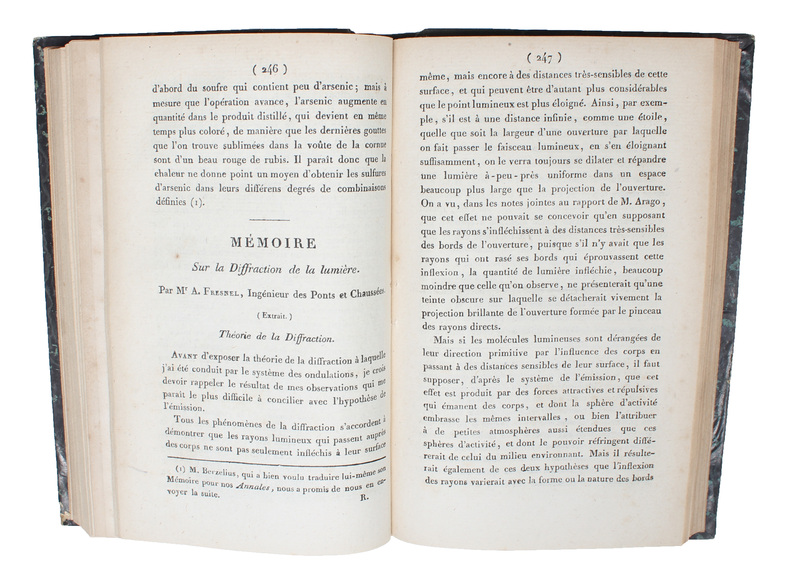
181644516Paris Crochard 1816-25. Bound in 2 fine recent hmorocco. In: "Annales de Chimie et de Physique Redigées par MM. Gay-Lussac et Arago" Tome I IV IX X XI XV XVII XX XXI XXIII XXVIII and XXIX. Some memoirs with scattered brownspots. All but volume 15 with the orig. titlepages to the volumes. Vol. XV having instead of the titlepage a sample of the orig. printed wrappers December issue 1820. Bound at end of volume 2. The memoir no. 25a below is inserted at the end of volume 2. Some of the memoirs having textillustrations. Some versos of titlepages with stamps. <br/><br/><em>First appearances of this groundbreaking series of papers and memoirs in which Fresnel established the scientific basis for the wave theory of light and gave the theoretical framework for explaining in the context of his theory of the transversal nature of lightwaves the phenomena of double refraction refraction dispersion polarization interference diffraction patterns diffraction fringes as light spreads around objects etc. He developed mathematically the hypothesis of the wave nature of light and he demonstrates its conformity with experience. His study of light was a dynamic interplay between theory and observation between mathematics and experiment. - The offered series also comprises the contributions from Arago and the rapports from The French Academy's committees by Ampère Biot and Fourier - see below nos. 6111415a.nd 18."From the point of view of method his investigations extended from the manual operations of the laboratory to the most abstract mathematical analyses. Few physicists since Newton had been so versatile."Silliman in "Historical Studies in the Physical Sciences" vol. 4 p. 155."The wave-thory at this time was still encumbered with difficulties. Diffraction was not satisfactorily explained; for polarization no explanation of any kind was forthcoming; the Huygenian construction appeared to require two different luminiferous media within double refracting bodies; and the universality of that construction had been impugned by Brewster's discovery of biaxial crystals. The upholders of the emission theory emboldened by the success of Laplace's theory of double refraction thought the time ripe for their final triunph; and as a step to this in March 1817 they proposed Diffration as the subject of the Academy's prize for 1818. Their expectation was disappointed; and the successful memoir afforded the first of a series of reverses of which in the short space of seven years the corpuscular theory was completely owerthrown. The author was Augustin Fresnel."Whittaker "A History of the Theories of Aether & Electricity" vol. 1 p.107 ff."This concept of transverse waves met with the greatest hostility from the scientists of the day who could not imagine an extremely fluid and rarified ether which at the same time possessed the mechanical properties of a rigid body. Even Arago admitted that he could not follow the exuberant engineer in his ideas. ButFresnel was convinced that at last he had the key to many mysteries and with his model of waves he gave a full clarification of the phenomena of polarization. With insuperable precision he explained a long series of extremely complicated experiments such as those of chromatic polarization that Arago himself had discovered by chance in 1811 and which the followers of Newton could not explain in spite of all their efforts. Following this line Fresnel reached the synthesis which is his masterpiece.we must recall the final interpretation that he gave of the famous phenomenon of partial reflection by transparent surfaces that simple phenomenon which until then had puzzled Grimaldi Newton and Huygens and which in Malus's experiments had unexpectedly acquired a special importencee as it had been compared to the great mystery of double refraction."Ronchi "The Nature of Light" p. 255 ff.Comprising:1. Mémoire sur la Diffraction de la lumière où l'on examine particululièrement le phénomène des franges colorées que présentent les ombres des corps éclairés par un point lumineux. "Ann.Chim.P." Tome 1. 1816. With titlepage to vol. 1. Pp. 239-281 and 1 folded engraved plate.2. Extrait d'une Lettre de M. Fresnel à M. Arago sur l'influence de la chaleur dans les couleurs développées par la polarisation.Tome 4. 1817. With titlepage to vol. 4. Pp. 298-300.3. Lettre de M. Fresnel à M. Arago sur l'influence du mouvement terrestres dans quelques phénomènes terrestres dans quelques phénoménes d'optique. Tome 9. 1818. With titlepage to vol. 18. Pp. 57-70.4. Note additionelle à la Lettre de M. Fresnel à M. Arago insérée dans le dernier Cahier des Annales. Tome 9. 1818. Pp. 286-287.5. FRESNEL & ARAGO. Sur l'Action que le rayons de lumiére polarisés exercent les uns sur les autres. Tome 10. 1819. With titlepage to vol. 10. Pp. 288-305. - Also with "Extrait d'un ouvrage du P. Grimaldi intitulé: Traité physico-mathérmatique de la lumiere des couleurs et de l'iris". Pp. 306-312.6. ARAGO. Rapport par M. Arago à l'Academie des Sciences au nom de la Commission qui avait été chargée d'examiner les Mémoires envoyés au concours pour le prix de la diffraction. Tome 11. 1819. With titlepage to vol. 11. Pp. 5-30.7. Mémoire sur la Diffraction de la Lumiere. Extrait. This importent Price-Memoir was only printed in full in 1826. Tome 11. 1819. Pp. 246-296.8. Suite Du Mémoire sur la Diffraction de la Lumière. Tome 11. 1819. Pp. 337-378. Note sur des Essais ayant pour but de décomposer l'eau avec un aimant. Pp. 219-222.9. Note sur des Essais ayant pour but de décomposer l'eau avec un aimant. Tome 15. 1820. Pp. 219-222. No titlepage to vol. 15.10. Résume d'un Mémoire sur la Reflexion de la lumière. Tome 15. 1820. Pp. 379-386. Tome 15 is here represented with the last issue of the year Decembre 1820 pp. 337-448 and instead of the titlepage having the orig. printed wrappers bound at end of the second volume.11. ARAGO & AMPÈRE. Rapport fait à l'Academie des Sciences le lundi 4 juin 1821 sur un Mémoire de M. Fresnel relatif aux couleurs des lames cristallisées douées de la double réfraction. Tome 17. 1821. Titlepage to vol. 17. Pp. 80-102.12. Note sur le Calcul des teintes que la polarisation développe dans les lames cristallisées. Tome 17. 1821. Pp. 102-111.13. IIe Note sur la Coloration des lames cristallisées. Tome 17. 1821. Pp. 167-196.14. BIOT. Remarques de M. Biot sur un Rapport lu le 4 juin 1821 à l'Academie des Sciences par MM. Arago et Ampere. Tome 17. 1821. Pp. 225-258.15. ARAGO. Examen des Remarques de M. Biot. Tome 17. 1821. Pp. 258-273. 16. Addition à la IIe Note insérée dans le Cahier précédent par M. Fresnel. Tome 17. 1821. Pp. 312-315.17. Note sur les remarques de M. Biot publiées dans le Cahier précédent. Tome 17. 1821. Pp. 393-403.18. FOURIER AMPÈRE ET ARAGO. Rapport fait à l'Academie sur un Mémoire de M. Fresnel relatif à la double réfraction. Commission: Fourier Ampère et Arago. Tome 20 1822. With titlepage to vol. 20. Pp. 337-344.19. Note sur la double réfraction du verre comprimé. Tome 20. 1822. Pp. 376-383.20. Explication de la Réfraction dans le système des ondes. Tome 21 1822. Titlepage to vol. 21. Pp. 225-241. LAGRANGE. Sur la Théorie de la lumière d'Huygens. Pp. 241-246.21. Sur l'Ascension des nuages dans l'atmosphère. Tome 21 1822. Pp. 260-263.22. Réponse de M. Fresnel à la Lettre de M. Poisson insérée dans le tome XXII des Annales p. 270. Tome 23 1823. Titlepage to vol. 23. Pp. 32-49.23. Note sur le Phénomène des anneaux colorés. Tome 23 1823. Pp. 129-134.24. Suite de la Réponse de M.A. Fresnel à la Lettre de M. Poisson. Tome 23 1823. Pp. 113-122.25. Extrait d'un Mémoire sur la double Réfraction particulière que présente le cristal de roche dans la irection de son axe. Tome 28 1825. Titlepage to vol. 28. Pp. 147-161. 25 a Extrait d'un Mémoire sur la double Réfraction. Tome 28 1825. Pp. 263-279. According to Buchwald "The Rise of the Wave Theory opf Light" p. 462 these 2 extracts composes the entire memoire.26. Note sur la Répulsion que des corps échauffés exercent les uns sur les autres à des distances sensibles. Lue à l'Institut le 13 juin 1825. Tome 29 1825. Titlepage to vol. 29. Pp. 57-62.27. Extrait d'un Mémoire sur la Loi des modifications imprimées à la lumière polarisée par sa réflexion totale dans l'intérieur des corps transparens. Tome 29 1825. Pp. 175-187. This paper was never printed in full. </em> unknown
182242940Paris, Crochard, 1822. In-8 de (4)-383 pp. (erreurs de pagination sans manque), table, errata, 10 planches repliées signées Adam d'après Girard, basane racinée, dos lisse orné de filets dorés (reliure de l'époque).
18234768Paris: Crochard 1823. <p>A beautiful copy bound in contemporary red morocco of the definitive version of this continually evolving collection of important memoirs on electrodynamics by Ampère 1775-1836 and others over the period 1820-1823 beginning with his 'Premier Mémoire' the "first great memoir on electrodynamics" DSB.</p>. DOCUMENTING THE BIRTH OF ELECTRODYNAMICS. <p>A beautiful copy bound in contemporary red morocco of the definitive version of this continually evolving collection of important memoirs on electrodynamics by Ampère 1775-1836 and others over the period 1820-1823 beginning with his 'Premier Mémoire' the "first great memoir on electrodynamics" DSB. "Ampère had originally intended the collection to contain all the articles published on his theory of electrodynamics since 1820 but as he prepared copy new articles on the subject continued to appear so that the fascicles which apparently began publication in 1821 were in a constant state of revision with at least five versions of the collection appearing between 1821 and 1823 under different titles" Norman. Some of the 25 pieces in the collection are published here for the first time others appeared earlier in journals such as Arago's Annales de Chimie et de Physique and the Journal de Physique. But even the articles that had appeared earlier are modified for the Receuil or have additional notes by Ampère to reflect his progress and changes in viewpoint in the intervening period. Many of the articles that are new to the present work concern Ampère's reaction to Faraday's first paper on electromagnetism 'On some new electro-magnetical motions and on the theory of magnetism' originally published in the 21 October 1821 issue of the Quarterly Journal of Science which records the first conversion of electrical into mechanical energy and contains the first enunciation of the notion of a line of force. Faraday's work on electromagnetic rotations would lead him to become the principal opponent of Ampère's mathematically formulated explanation of electromagnetism as a manifestation of currents of electrical fluids surrounding 'electrodynamic' molecules. The Receuil contains the first French translation of Faraday's paper followed by extended notes by Ampère and his brilliant student Félix Savary 1797-1841. Ampère's reaction to Faraday's criticisms are the subject of several of the articles in the second half of the Receuil. The collection also includes Ampère's important response to a letter from the Dutch physicist Albert van Beek 1787-1856 in which "Ampère argued eloquently for his model insisting that it could be used to explain not only magnetism but also chemical combination and elective affinity. In short it was to be considered the foundation of a new theory of matter. This was one of the reasons why Ampère's theory of electrodynamics was not immediately and universally accepted. To accept it meant to accept as well a theory of the ultimate structure of matter itself" DSB. The volume concludes with a résumé of a paper read by Savary to the Académie des Sciences on 3 February 1823 and a letter from Ampère to Faraday dated 18 April 1823 which does not appear in the Table of Contents showing that this definitive version of the Receuil was in fact published in 1823. Only three other copies of this work listed by ABPC/RBH. </p> <br /> <p>Provenance: Marcel Gompel 1883-1944 ex-libris on front paste-down - Répertoire général des ex-libris français: G1896. A Jewish professor at the Collège de France Gompel worked in the Laboratoire d'Histoire naturelle des corps organisés from 1922 to 1940 under the direction of André Mayer. In World War II he became a hero of the French resistance and was finally tortured and executed on orders from Klaus Barbie the chief of the Gestapo in Lyon. When Barbie came to trial the prosecutors used Gompel's case as a particularly clear and egregious example of his guilt of crimes against humanity. His superb library was stolen by the Nazis. </p> <br /> <p>The collection opens with the 'Premier Mémoire' 1 numbering as in the list of contents below first published in Arago's Annales at the end of 1820. This was Ampère's "first great memoir on electrodynamics" DSB representing his first response to the demonstration on 21 April 1820 by the Danish physicist Hans Christian Oersted 1777-1851 that electric currents create magnetic fields; this had been reported by François Arago 1786-1853 to an astonished Académie des Sciences on 4 September. In this memoir Ampère "demonstrated for the first time that two parallel conductors carrying currents traveling in the same direction attract each other; conversely if the currents are traveling in opposite directions they repel each other" Sparrow Milestones p. 33. </p> <br /> <p>The first quantitative expression for the force between current carrying conductors appeared in Ampère's less well-known 'Note sur les expériences électro-magnétiques' 2 which originally appeared in the Annales des Mines. Ampère stated without proof that if two infinitely small portions of electric current A and B with intensities g and h separated by a distance r set at angles α and β to AB and in directions which created with AB two planes at an angle γ with each other the action they exert on each other is </p> <br /> <p>gh sin α sin β sin γ k cos α cos β/r2</p> <br /> <p>where k is an unknown constant which he stated could 'conveniently' be taken to be zero. This last assumption was an error which significantly retarded his progress in the next two years before he stated correctly that k = − 1/2 in his article 13 published for the first time in the Receuil. This article comprised 'notes' on a lecture 12 delivered to the Institut in April 1822 in which he surveyed experimental work carried out by himself and others since 1821 he also published for the first time there the words 'electro-static' and 'electro-dynamic'. The full theoretical and experimental proof of the correct value of k appeared in two articles in Arago's Annales in 1822 19 and 20 in an article by Savary 22 and in experiments with de la Rive 17 see below. </p> <br /> <p>On 20 January 1821 Ampère performed an experiment together with César-Mansuète Despretz 1798-1863 intended to support his own theory of the interaction of electric currents against a rival theory of Jean-Baptiste Biot 1774-1862 and Félix Savart 1791-1841 presented to the Académie on 30 October 1820. This was reported in article 21 the first "experimentally based semi-axiomatic presentation of electrodynamics" Hofmann p. 316. A small cylindrical magnet was placed at the same distance from two perpendicular current carrying wires. The Biot-Savart theory predicted that the magnet would experience no net force; Ampère's theory predicted that the magnet would experience a non-zero torque from the nearby currents. But when Ampère and Despretz performed the experiment the magnet did not move p. 343. This defeat together with illness and fatigue caused Ampère to suspend his electrodynamical researches for several months. What little energy he could muster for electrodynamics was mainly devoted to correspondence.</p> <br /> <p>According to Ampère magnetic forces were the result of the motion of two electric fluids; permanent magnets contained these currents running in circles concentric to the axis of the magnet and in a plane perpendicular to this axis. By implication the earth also contained currents which gave rise to its magnetism. It was not long however before Auguste Fresnel 1788-1827 pointed out to his friend Ampère that his theory had several difficulties notably the fact that the supposed currents in magnets should have a heating effect which was not observed. Fresnel suggested that the electric currents circulated around each molecule rather than around the axis of the magnet. In January 1821 Ampère publicly accepted Fresnel's idea. </p> <br /> <p>Not everyone was convinced of the identity of electricity and magnetism however. Humphry Davy 1778-1829 expressed doubts in a letter to Ampère of 20 February 1821 7. Ampère's idea of magnetism created by circulating electric currents was also in direct opposition to a theory put forward by Johann Joseph von Prechtl 1778-1854 and supported by the great Swedish chemist Jöns Jacob Berzelius 1779-1848 according to which electromagnetism was 'transverse magnetism' - whereas Ampère eliminated magnetism and showed how all the phenomena could be accounted for by the action of two electric fluids Prechtl and Berzelius reduced electromagnetism to magnetic action. Berzelius expressed this view in his letter 3; Ampère responded in a letter to Arago 4. </p> <br /> <p>In April 1821 Ampère wrote to Paul Erman 1764-1851 professor of physics at the University of Berlin and perpetual secretary of Berlin's Royal Academy in response to Erman's Umrisse zu den physischen verhältnissen des von Herrn Professor Oersted entdeckten elektro-chemischen Magnetismus Berlin 1821. Ampère declared that his electric theory of magnetism was established "as solidly as a physical theory can be since in only admitting it at first as a hypothesis it serves to predict and make known in advance all the magnetic phenomena formerly known those which M. Oersted has discovered and the new properties whose existence in voltaic conductors I have made known. When one finds such an agreement between the facts and the hypothesis from which one started can one recognize it merely as a simple hypothesis Is it not on the contrary a truth founded on incontestable proofs" In the same letter Ampère calmly harvested Erman's experimental discoveries as further confirmatory evidence. "The observations described in the memoir which you have been so good as to send me are all the more new proofs of it. For if I am not mistaken they could all be predicted according to the theory in which magnets are considered to be assemblages of what I call electric currents" Hofmann pp. 277-8. Erman's experiments influenced Ampère's investigations of induction in July 1821 in which he very nearly anticipated Faraday's landmark discovery of electromagnetic induction a decade later see below.</p> <br /> <p>Ampère again stressed the 'identity' of electricity and magnetism in a lecture to the Académie on 2 April 1821 5. He also expressed his views on the nature of magnetism in a letter to Gaspard de la Rive 1770-1834 8. "Perhaps in an attempt to accommodate the positivistic inclinations of some of his Parisian colleagues or to avoid the adoption of hypotheses Ampère normally wrote on electricity and magnetism in a phenomenological vein eschewing noumenal questions. But there were exceptions: an example occurred in a letter of 15 May 1821 to the Swiss physicist Gaspard de la Rive which was published in the recipient's journal Bibliotheque universelle. Adopting the two-fluid theory of electricity then prevalent in France he spoke rather in passing of "the series of decompositions and of recompositions of the fluid formed by the reunion of the two electricities of which one regards electrical currents as composed" p. 122. Thus at this time Ampère's aetherian framework was based on electric current regarded as de- and recomposition of fluids and magnetism construed in terms of these currents rotating around each magnetic molecule" Grattan-Guinness p. 927.</p> <br /> <p>As far as Ampère was concerned "The physical theory of electrodynamics was now complete. Given the concepts of the ether and the electromotive force of matter as Ampère had formulated them all the observed effects could be explained; not only explained but subjected to mathematical analysis. The combination was a potent one and the accuracy of Ampère's calculations and the depths of his insight led many to embrace his theory. Ampère however was not satisfied with merely creating a model of electrodynamic action. By 1821 he was intoxicated by his vision and convinced that his electrodynamic molecules really existed. They must then also explain other areas of physics and chemistry.</p> <br /> <p>"In his 'Answer to the Letter of M. van Beck' i.e. van Beek 11 published in October 1821 Ampère turned his attention once again to the problem of chemical combination . What determined whether a reaction would take place and if so with what violence was the electrical condition of the participating molecules. To explain the mechanism of chemical combination Ampère had recourse to another analogy; molecules were not only like voltaic piles but also like Leyden jars. The facts of electrochemistry proved "that the particles of substances are essentially in two opposed electrical states." In order to preserve its electrical neutrality each molecule therefore decomposed the ambient ether to attract the electricity of the opposite sign. Ampère did not say if this was why each molecule was surrounded by electric currents but his use of the Leyden jar analogy would appear to rule out this possibility. The molecule presumably had both an inherent electrical charge and electric currents associated with it. It was the inherent static charge that caused chemical combination; the resultant combination of the two electricities gave rise to heat and light and both the material and energy relations of reactions could be understood in terms of the same mechanism . There can be no doubt that he took his own theory seriously as a general theory of matter. Nor was he alone in this. During the 1820's Becquerel in Paris and Auguste de la Rive 1801-73 in Geneva used the electrodynamic model in their researches in electrochemistry" Williams pp. 150-1.</p> <br /> <p>Late in 1821 however Ampère's satisfaction with his theory of magnetism was seriously challenged by Faraday's discovery of electromagnetic rotation a development which thrust Faraday immediately into the first rank of European scientists. "In the autumn he had to face a powerful criticism from Faraday whose paper 'On some new electro-magnetical motions' came out in a French translation 9 in Arago's Annales soon after its appearance in a London journal. A seminal paper in Faraday's contributions to the topic it announced that continuous rotation could occur if a pivoted cylindrical magnet moved around a fixed wire and also if a pivoted wire moved round a fixed magnet. In October he sent to Ampère and Jean-Nicolas-Pierre Hachette 1769-1834 one of his pieces of apparatus and Ampère demonstrated its working to the Académie in November.</p> <br /> <p>"From the theoretical point of view the chief challenge to Ampère's view was Faraday's conviction that such motions could not be explained by theories based on inter-molecular forces. Faraday's alternative drawn from this and other experiments was to give preference to curved 'lines of force'; but Ampère was anxious to preserve his own approach. Accordingly when the translation was prepared he had a set of appendicial notes 10 made by a new helper Félix Savary polytechnicien of the promotion of 1815 and thus one of Ampère's old students and in 1821 principally a geographer by profession. Ampère added his name to these notes to indicate his agreement with them. In his second note Savary rejected Faraday's implicit claim in the paper that the rotatory motion could be taken as a 'primitive fact' in electromagnetic phenomena and in the next note he showed how that motion could be explained in Ampère's terms" Grattan-Guinness p. 928.</p> <br /> <p>"In his original article describing the discovery of a continuous rotation of one extremity of a current-carrying wire around a magnet as well as the rotation of one extremity of a magnet around a current-carrying wire Faraday stated the following: "Having succeeded thus far I endeavoured to make a wire and a magnet revolve on their own axis by preventing the rotation in a circle round them but have not been able to get the slightest indications that such can be the case; nor does it on consideration appear probable." Ampère on the other hand considered that this new kind of motion might be produced in the laboratory. He was also the first to obtain it experimentally. He communicated his discovery to the Academy of Sciences of Paris in 7 January 1822 14. In order to obtain continuous rotation of a magnet around its axis Ampère initially floated it in mercury by the help of a counterweight in its lower extremity. By closing the circuit a constant current flowed vertically downwards through the upper extremity of the magnet leaving laterally along its lower portion and going through the mercury. When this constant current was flowing through the magnet it rotated around its axis relative to the ground" Assis & Chaib p. 123. Ampère wrote to Faraday in April 1823 describing these electromagnetic rotation experiments 24.</p> <br /> <p>In the letter to van Beek 11 described earlier Ampère described an experiment suggested by Fresnel to decide whether in a ring of copper macroscopic currents would be induced by a nearby coil or magnet. A first trial in July 1821 produced a negative result which fitted well into Ampère's theory of molecular currents. When he repeated the experiment with a more powerful magnet in August 1822 however he indeed obtained an effect and realized that this was the induction of currents by magnets. But as a consequence of his struggle with Faraday's rotations he concentrated on his magnetic theory. Although the positive result of the induction experiment again opened the way for both interpretations of magnetization it did not provide any positive hint concerning which of them should be preferred. Thus Ampère declared only that the result did not refer to his theory and decided not to pursue it further. A decade later when Faraday again discovered electromagnetic induction and gained great publicity Ampère bitterly complained about his former disregard of the result.</p> <br /> <p>Between 1821 and 1822 Gaspard de la Rive van Beek and Faraday performed some experiments showing that the poles of a cylindrical magnet are not located exactly at the extremities of the magnet as was predicted by Ampère's theory. These experiments forced Ampère to modify his conception of microscopic currents. In a letter addressed to Gaspard de la Rive dated 12 June 1822 15 Ampère included a figure which presents the equilibrium configuration of the microscopic currents around the particles of the magnet due to the interaction of all microscopic currents. That is due to the collective interactions between the small current-carrying loops the planes of these molecular currents should no longer remain orthogonal to its magnetic axis . This final conception of molecular currents presented by Ampère with their planes inclined relative to the axis of an uniformly magnetized bar is accepted in its essence up to the present time" Assis & Chaib p. 105.</p> <br /> <p>As described earlier Ampère had concluded in his article 13 that the constant k in his law for the force between current carting wires should be equal to −1/2. This implied however that two collinear and parallel current elements should repel one another when both currents flowed in the same direction towards the same point in space. Sceptical about this prediction he performed with Auguste de la Rive in September 1822 in Geneva an experiment to test it reported in 17 pp. 284-5 . This experiment has received several names in the literature: "Ampère's floating wire experiment" "Ampère's hairpin experiment" and "Ampère's bridge experiment." Ampère himself gave a very clear description: "Two very interesting electro-magnetic experiments have lately been made by M. Ampère in the laboratory of M. de la Rive at Geneva. M. Ampère had been induced from his mathematical investigations to expect a repulsion between two portions of an electrical current passing in the same direction and in the same right line or that every part of an electrical current would repel the other parts a result which may be comprehended by conceiving an endeavour in the current to elongate itself. The experiment which M. Ampère has contrived to illustrate this action of the current consisted of dividing a dish into two parts by a division across the middle and filling each division with mercury a piece of wire was then bent into the form of the letter U but the curved part was bent to one side so that the two limbs of the wire might lie on the mercury one on each cell and the bent part pass over the division without touching it. The wire was covered with silk except a small portion at each extremity by which the communication was established with the mercury" Assis & Chaib p. 145. "Ampere and Auguste de La Rive reported that as soon as a current was sent through the circuit and regardless of the direction of this current the originally stationary floating wire was propelled across the mercury pool away from the terminals connected to the power source. Ampere immediately attributed this phenomenon to repulsive forces between collinear pairs of current elements that is pairs in which one member is an element of the current in the mercury flowing between the bare end of the wire and the adjacent terminal and the other is an element of one of the linear segments of the wire. Interpreted in these terms the experiment represented a striking confirmation of the prediction Ampère had made to the Académie three months earlier. The importance Ampère ascribed to this demonstration was promptly reflected in the way he publicized it. For example in sharp contrast to his ambiguous and incomplete descriptions of induction the text he composed for his verbal report to the Académie includes a thorough and accurate account of the floating-wire demonstration" Hofmann pp. 317-8.</p> <br /> <p>In his article 22 Savary provided further support for Ampère's conclusion that k = −1/2 by analyzing an experiment carried out in 1820 by the chemists Joseph Louis Gay-Lussac 1778-1850 and Jean-Joseph Welter 1763-1852. "Initially they utilized an unmagnetized steel ring which did not interact with a compass needle. If this ring was broken into pieces its pieces also had no influence upon the magnetized needle. They then coiled a toroidal helix around this ring and a constant current flowed through it. The current was then turned off and the helix was removed out of the ring. The ring did not interact with a compass needle placed nearby. However when the ring was broken into pieces each piece did now interact with the magnetized needle. Each piece behaved now as a small magnet. That is each small piece of the ring was magnetically polarized with a North and a South pole so that it became magnetized" Assis & Chaib p. 149. Savary showed that the results of this experiment were possible only if k = 1 or −1/2 and as previous experiments by Ampère had shown that k could not be positive he could conclude that k = −1/2. "Savary's contribution was well publicized by Ampère. He wrote several complimentary reviews for influential journals and wrote to la Rive that Savary's presentation of his work to the Académie marked "a kind of epoch in the history of dynamic electricity" Hofmann p. 321.</p> <br /> <p>List of Contents author is Ampère unless otherwise stated:</p> <br /> <br /> Premier Mémoire. De 1'Action exercée sur un courant électrique par un autre courant le globe terrestre ou un aimant pp. 3-68<br /> AMPÈRE & Gillet de LAUMONT Additions au mémoire précédent - note sur les expériences électro-magnétiques de MM. Oersted Ampère Arago et Biot pp. 69-92<br /> BERZELIUS Lettre à M. Berthollet sur l'État magnétique des corps qui transmettent un courant d'électricite pp. 93-99<br /> <br /> <br /> Lettre de M. Ampère à M. Arago pp. 99-108<br /> Notice sur les Experiences électro-magnétiques de MM. Ampère et Arago lue à la séance publique de l'Académie royale des Sciences de Paris le 2 avril 1821 pp. 109-112<br /> Lettre de M. Ampère à M. Erman secrétaire de 1'Académie Royale de Berlin pp. 113-120<br /> DAVY Extrait d'une Lettre de Sir H. Davy à Mr. Ampère pp. 120-121<br /> Extrait d'une Lettre de Mr. Ampère au Prof. De La Rive pp. 121-124<br /> FARADAY Mémoire sur les mouvemens électro-magnétiques et la théorie du magnétisme pp. 125-158<br /> AMPÈRE & SAVARY Notes relatives au Mémoire de M. Faraday pp. 158-167<br /> Réponse de M. Ampère à la Lettre de M. Van Beck sic sur une nouvelle Expérience électro-magnétique pp. 169-198<br /> Exposé sommaire des nouvelles Expériences électro-magnétiques faites par différens Physiciens depuis le mois de mars 1821 lu dans la séance publique de l'Académie royale des Sciences le 8 avril 1822 pp. 199-206<br /> Notes sur cet exposé des nouvelles Expériences relatives aux Phénomènes produits par 1'action électrodynamique faites depuis le mois de mars 1821 pp. 207-236<br /> Expériences relatives aux nouveaux phénomènes électro-dynamiques que j'ai obtenus au mois de decembre 1821 pp. 237-250<br /> Extrait d'une Lettre de M. Ampère au Prof. De La Rive sur des expériences électro-magnétiques 22 June 1822 pp. 252-258<br /> De l'Action qu'exerce la Terre sur les conducteurs voltaïques pp. 259-261<br /> De la RIVE Mémoire sur l'Action qu'exerce le globe terrestre sur une portion mobile du circuit voltaïque pp. 262-286<br /> Remarks on the preceding memoir pp. 286-292<br /> Second Mémoire. Sur la Détermination de la formule que représente 1'action mutuelle de deux portions infiniment petites de conducteurs voltaïques pp. 293-318<br /> Additions au Mémoire précédent. Extrait d'un Mémoire présenté à l'Académie royale des Sciences dans la séance du 16 septembre 1822 pp. 319-324<br /> Exposé méthodique des phénomènes électrodynamiques et des lois de ces phénomènes pp. 325-344<br /> SAVARY Extrait fait par M. Savary du Mémoire qu'il a lu à l'Académie royale des Sciences le 3 fevrier 1823 pp. 345-354<br /> Observations additionelle pp. 354-364<br /> Extrait d'une Lettre de M. Ampère à M. Faraday Paris 18 avril 1823 pp. 365-378<br /> <br /> <p>Table pp. '357-360' errata on p. '360'</p> <br /> <p>Errata p. 383.</p> <br /> <p>The bibliographical complexity of this work is a direct result of Ampère's modus operandi: "His work was marked by flashes of insight and it often happened that he would publish a paper in a journal one week only to find the next week that he had thought of several new ideas that he felt ought to be incorporated into the paper. Since he could not change the original he would add the revisions to the separately published reprints of the paper and even modify the revised versions later if he felt it necessary" Norman. Our version of the Receuil is more extensive than the most complete copy owned by Norman and is probably that alluded to in the note to item 45 in the Norman catalogue: "Another probably later version has been noted with additional pages 361-378 plus an additional page of errata p. 383 and ten instead of nine plates." This copy additionally has pp. 223-236 which are missing from the Norman copy and to which the additional plate refers.</p> <br /> <p>Ekelof 819; Norman 44-45 less complete issues; Ronalds 10; Wheeler Gift 784 copy with 344 pages only - "The author's classical investigations in electro-dynamics together with experimental illustrations. Also a paper by De la Rive on the action of the earth on a movable circuit carrying a current". Assis & Chaib Ampère's Electrodynamics 2015. Grattan-Guinness Convolutions in French Mathematics 1800-1840 1990. Hofmann André-Marie Ampère 1995. Williams Michael Faraday 1965.</p> <br/> <br/> 8vo 204 x 126 mm pp. ii 1-3 4-167 1 blank 169-250 252-258 1 blank 259-378 1 358-360 383 with 10 folding engraved plates plates 1-5 signed by Adam after Girard one small text woodcut. Contemporary red morocco gilt by Lefebvre flat spine richly decorated and lettered in gilt borders of covers gilt-tooled within double rules inner gilt dentelles all edges gilt. A very fine copy. Crochard unknown
182051054(Paris, 1820). Small 8vo. Contemporary (original?) blank blue paper wrappers. Annulated stamp to title-page, otherwise a nice, clean, and fresh copy. 68 pp. + 5 engraved plates.
182051054Paris 1820. Small 8vo. Contemporary original blank blue paper wrappers. Annulated stamp to title-page otherwise a nice clean and fresh copy. 68 pp. 5 engraved plates. <br/><br/><em>First edition in the extremely scarce off-print of the first announcement of Ampère's seminal discoveries on electromagnetism which laid the foundation for electrodynamics. Ampère first heard of Ørsted's discovery of electromagnetism on the 4th of September when Arago announced Ørsted's results to the Paris Academy of Sciences. In Ørsted's experiment a current-carrying wire is held over and under a compass needle - the result being that the needle is positioned at 45 degrees in respect to the wire. Ampére immediately saw that this result made no physical sense and realized that the true nature of the effect could not be observed until the force of terrestrial magnetism was somehow neutralized; what Ørsted had observed and reported on was the resultant of the force from the wire and that from the earth's magnetic field. Ampère discovered that the compass needle sets at 90 degrees to the current-carrying wire when the effect of terrestial magnetism is eliminated. He also observed that current-carrying wires which are formed as spirals act as permanent magnets and this lead him to his theory that electricity in motion produces magnetism and that permanent magnets must contain electrical currents. And thus Ampère laid the foundation of the new field of electrodynamics."Ampère professor of mathematics at the Polytechnique heard of Oersted's discovery and immediately set up a series of experiments to determine the exact relationships of current-flow and magnetism. In a week Ampère presented the first of a series of papers establishing the laws of forces acting between conductors carrying current." Dibner. Ampère's seminal results were announced in a series of memoires read before the Paris Academy of Sciences in September and October 1820. These memoires were first published in the September and October issues of Arago's "Annales de Chimie et de Physique" and in November Ampère had the scarce seperate printing of his findings published under the title "Mémoires sur I'action mutuelle de deux courans électriques sur celle qui existe entre un courant électrique et un aimant ou le globe terrestre et celle de deux aimans I'un sur I'autre". It is this publication that is considered "his first great memoir on electrodynamics" DSB.Sparrow: 8; Dibner: 62; Honeyman: 83; Barchas 51 only the periodical-issue; Wheeler 762 only the periodical-issue. </em> unknown
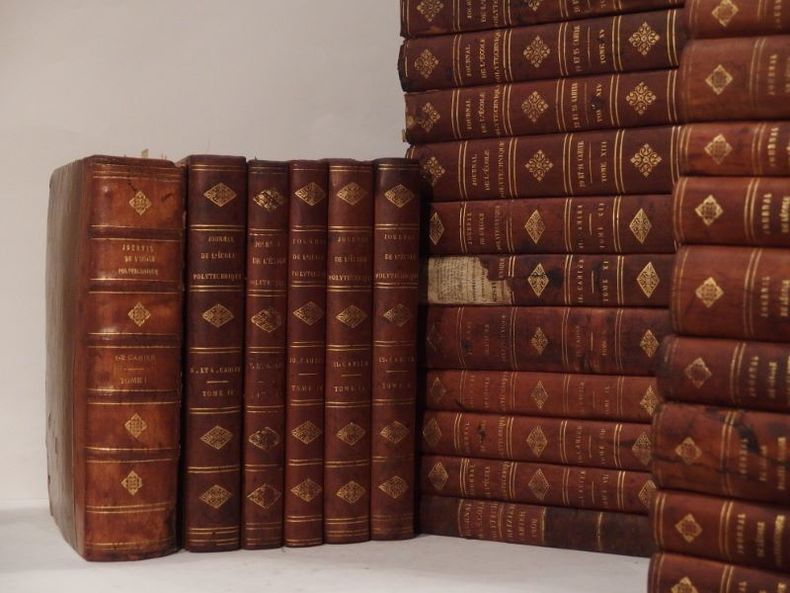
13594Paris, De l'Imprimerie de la République, Régent et Bernard, Bachelier, Mallet-Bachelier, Gauthier-Villars, An III (1794) - 1881. 48 tomes (1 à 8 et 10 à 49) in-4 reliés en 27 volumes, 160 planches hors-texte, quelques figures dans le texte, reliure demi-basane ou veau à coins (reliure frottée, manques à quelques coiffes, quelques mors fendillés, manque la moitié du dos au tome 11, dos du tome 20 tabîmé, mors supérieur du tome 1 fendu, rousseurs éparses). Tampons humides ("Bibliothèque de l'Université de France", "Echange autorisé", "Dons n° 12961", "Ecole Polytechnique") et ex-libris : Citoyen Messier (manuscrit), Lefebure de Fourcy 1869 (impr.) et "Monsieur Lefebvre" (manuscrit), Paul Serret (d'après un certificat de la Librairie scientifique A. Hermann, daté 1884 et signé par le libraire, qui confirme qu'il s'agit d'une collection ayant fait l'objet d'un échange autorisé avec la Bibliothèque de l'Université - cf. cachets, et par exemple l'ex-dono manuscrit suivant, répété : "à Mr. Lefebvre, Elève de l 'Ecole Polytechnique, De la part du Conseil de la dite Ecole").
182144552Paris 1821. <p>Ampère André Marie 1775-1836. Mémoires sur l'action mutuelle de deux courans électriques sur celle qui existe entre un courant électrique et un aimant ou le globe terrestre et celle de deux aimans l'un sur l'autre. Extrait des Annales de Chimie et de Physique. 68pp. 5 folding plates. Paris: impr. de Feugeray 1821. 196 x 128 mm. Old paper wrappers small crease in back wrapper. Minor foxing but fine otherwise.</p> <p> First Separate Edition of Ampère's two landmark memoirs establishing the science of electrodynamics significantly revised from the journal versions. Ampère was present at the Académie des Sciences on Sept. 11 1820 when François Arago performed—for the first time in France—Hans Christian Oersted's experiment demonstrating the magnetic effects of current-carrying wires on magnetized needles. Inspired by Oersted's discovery Ampère immediately concluded that magnetism was electricity in motion an intuitive leap which he sought to confirm by experiment. During September and October 1820 Ampère performed a series of experiments designed to elucidate the exact nature of the relationship between electric current-flow and magnetism as well as the relationships governing the behavior of electric currents in various types of conductors. His investigations reported weekly before the Académie des Sciences established the new science of electrodynamics.</p> <p> Among the discoveries described in this memoir are Ampère's demonstration of the tangential orientation of a magnetic needle by an electric current when terrestrial magnetism is neutralized; his proof that conducting planar spirals attract and repel each other and respond to bar magnets in an analogy to magnetic poles; and his demonstration of electrodynamic forces between linear conducting wires. The memoir's plates illustrate the several instruments that Ampère devised to carry out his experiments.</p> <p> Ampère's scientific genius while capable of remarkable leaps of insight was somewhat lacking in organization and discipline. It often happened that Ampère would publish a paper one week only to find the following week that he had thought of several new ideas that he felt ought to be incorporated into the paper. Since he could not alter the original he would add his revisions to the separately published reprints of the paper and even modify the revised versions later if he felt it necessary; some of his papers exist in as many as five different versions. Dibner Heralds of Science 62. Hofmann Andre-Marie Ampère ch. 7 containing a detailed account of Ampère's investigations. Norman 43. </p> . unknown books