AMPERE, ANDRE-MARIEBiblio.com
Ampere A TsengBiblio.com
Nanofabrication: Fundamentals And Applications
A9789812705426Paperback / softback. New. paperback

The Saint Bookstore · Royaume-Uni126,13 £GB≈ 144,02 €
343 résultats
182843747Paris Crochard 1828. No wrappers. In: "Annales de Chimie et de Physique Par MM. Gay-Lussac et Arago." tome 37 sec. cahier Titlepage to vol. 37 pp. 113-223. Entire issue offered. Ampere's paper: pp. 113-139 a. 1 large folded engraved plate. <br/><br/><em>First appearance of Ampere's last major paper on magnetism and electricity. As in his most importent paper from 1827 he shows the unification of the electric and the magnetic fields and treats the relations mathematically. </em> unknown
A9789812705426Paperback / softback. New. paperback
2008AME_9789812700766World Scientific Publishing 2008. 1. Hardcover. New/New. World Scientific Publishing hardcover
62637237World Scientific Publishing Company Incorporated pp. 584 . Papeback. Used. World Scientific Publishing Company, Incorporated unknown
61419734World Scientific Publishing Company Incorporated pp. 584 . Hardback. Used. World Scientific Publishing Company, Incorporated hardcover
2008AME_9789812705426World Scientific Publishing 2008. 1. Soft Cover. New/New. World Scientific Publishing paperback
ria9789812705426_inpPaperback. New. New Book; Fast Shipping from UK; Not signed; Not First Edition; N/A paperback
ria9789812700766_inpHardcover. New. New Book; Fast Shipping from UK; Not signed; Not First Edition; N/A hardcover
2008x-9812705422World Scientific Pub Co Inc 2008. Paperback. New. illustrated edition. 574 pages. 10.00x6.25x1.00 inches. World Scientific Pub Co Inc paperback
2008x-9812700765World Scientific Pub Co Inc 2008. Hardcover. New. illustrated edition. 574 pages. 10.00x6.75x1.00 inches. World Scientific Pub Co Inc hardcover
2008SL-9812705422World Scientific Publishing Company 2008-03-03. paperback. New. In shrink wrap. Looks like an interesting title! World Scientific Publishing Company paperback
20088738VB2008. Illustrated. World Scientific Publishing Company 2008. 17 x 24 cm. 584 pages. HC Versand aus Deutschland / We dispatch from Germany via Air Mail. Einband bestoßen daher Mängelexemplar gestempelt sonst sehr guter Zustand. Imperfect copy due to slightly bumped cover apart from this in very good condition. Stamped. hardcover
9812705422.Gpaperback. Good. Access codes and supplements are not guaranteed with used items. May be an ex-library book. paperback
2008Q-9812705422World Scientific Publishing Company 2008-03-04. Paperback. New. In shrink wrap. Looks like an interesting title! World Scientific Publishing Company paperback
2008SONG9812705422World Scientific Publishing Company 2008-03-04. paperback. Used: Good. 6.54x1.32x9.69. Buy with confidence. Excellent Customer Service & Return policy. World Scientific Publishing Company paperback
2008SONG9812700765World Scientific Publishing Company 2008-02-01. hardcover. Used: Good. 6.69x1.25x9.61. Buy with confidence. Excellent Customer Service & Return policy. World Scientific Publishing Company hardcover
2008DADAX9812705422World Scientific Publishing Company 2008-03-04. paperback. New. 6.54x1.32x9.69. Buy with confidence. Excellent Customer Service & Return policy. World Scientific Publishing Company paperback
1016516428.Ghardcover. Good. Access codes and supplements are not guaranteed with used items. May be an ex-library book. hardcover
182051054Paris 1820. Small 8vo. Contemporary original blank blue paper wrappers. Annulated stamp to title-page otherwise a nice clean and fresh copy. 68 pp. 5 engraved plates. <br/><br/><em>First edition in the extremely scarce off-print of the first announcement of Ampère's seminal discoveries on electromagnetism which laid the foundation for electrodynamics. Ampère first heard of Ørsted's discovery of electromagnetism on the 4th of September when Arago announced Ørsted's results to the Paris Academy of Sciences. In Ørsted's experiment a current-carrying wire is held over and under a compass needle - the result being that the needle is positioned at 45 degrees in respect to the wire. Ampére immediately saw that this result made no physical sense and realized that the true nature of the effect could not be observed until the force of terrestrial magnetism was somehow neutralized; what Ørsted had observed and reported on was the resultant of the force from the wire and that from the earth's magnetic field. Ampère discovered that the compass needle sets at 90 degrees to the current-carrying wire when the effect of terrestial magnetism is eliminated. He also observed that current-carrying wires which are formed as spirals act as permanent magnets and this lead him to his theory that electricity in motion produces magnetism and that permanent magnets must contain electrical currents. And thus Ampère laid the foundation of the new field of electrodynamics."Ampère professor of mathematics at the Polytechnique heard of Oersted's discovery and immediately set up a series of experiments to determine the exact relationships of current-flow and magnetism. In a week Ampère presented the first of a series of papers establishing the laws of forces acting between conductors carrying current." Dibner. Ampère's seminal results were announced in a series of memoires read before the Paris Academy of Sciences in September and October 1820. These memoires were first published in the September and October issues of Arago's "Annales de Chimie et de Physique" and in November Ampère had the scarce seperate printing of his findings published under the title "Mémoires sur I'action mutuelle de deux courans électriques sur celle qui existe entre un courant électrique et un aimant ou le globe terrestre et celle de deux aimans I'un sur I'autre". It is this publication that is considered "his first great memoir on electrodynamics" DSB.Sparrow: 8; Dibner: 62; Honeyman: 83; Barchas 51 only the periodical-issue; Wheeler 762 only the periodical-issue. </em> unknown
0265772613.Ghardcover. Good. Access codes and supplements are not guaranteed with used items. May be an ex-library book. hardcover
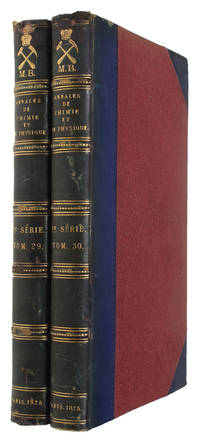
182559780Paris Crochard 1825. 8vo. Bound in contemporary half calf with gilt lettering to spine. In: "Annales de Chimie et de Physique Par MM. Gay-Lussac et Arago." tome 29. Entire volume offered. Very light occassional foxing otherwise a fine and clean copy with no institutional stamps. Pp. 381-404; 373-381. Entire volume: 448 pp. folded plate. <br/><br/><em>First appearance of this famous memoir in which Ampère presented his collected results on electrodynamics to the French Academy creating the foundation of 19th century developments in electricity and magnetism. In the words of James Clark Maxwell "We can scarcely believe that Ampère really discovered the law of action by means of the experiments which he describes. We are led to suspect what indeed he tells us himself that he discovered the law by some process which he has not shown us and that when he had afterwards built up a pefect demonstration he removed all traces of the scaffolding by which he raised it." The offered memoir was published BEFORE the famous "Theorie mathématique des phénomènes électro-dynamiques uniquement déduite de L'expérience" which did not appear until 1827. That 1827-Memoire incorporates together with a new presentation of Ampère's results from 1820 1822 1823 the offered memoir 1825. Horblit: 100 - Dibner: 62. "From 1814 until 1820 Ampére did not perform the kind of research that would have made it into the annals of the histrory of science but on September 11 1820 when he heard Francois Arago speak about Oersted's work he got fresh inspiration and started the work that made him famous. Arago related how Oersted had found that a steady electric current influences the orientation of a compass needle. After a weak Ampère had determined experimentally that that two straight parallel and current-carrying wires execute a force on each other. The magnitude of the force is inversely proportional to the distance between the wires and proportional to the strenghts of the current. During the following years he continued his researches both experimentally and theoretically. he built an instrument for measuring electricity that later was developed into the galvanometer. Finally in 1825 he presented his collected results to the Academy IN ONE OF THE MOST CELEBRATED MEMOIRS IN THE HISTORY OF NATURAL PHILOSOPHY The paper offered." Citizen's Compendium p. 2. - Norman No 47. The volumes contain many other notable papers by: Wöhler Fresnel Marcet Berzelius Felix Savart De la Rive Braconnet Boussingault Magnus Poncelet Vaugelin Poisson Gay-Lussac Faraday Laplace etc. </em> unknown
182548082Paris Crochard 1825. 8vo. Bound in 2 uniform later hcloth. Gilt lettering to spines. In: "Annales de Chimie et de Physique Par MM. Gay-Lussac et Arago." tome 29 a. 30. - 448 pp. and 3 folded engraved plates 448 pp. and 2 folded engraved plates. The entire volumes offered. Ampère's papers: pp. 381-404 tome 29 Suite pp. 29-41 tome 30 "Lettre à Gerhardi": pp. 373-381 tome 29. Some scattered brownspots. <br/><br/><em>First appearance of this famous memoir in which Ampère presented his collected results on electrodynamics to the French Academy creating the foundation of 19th century developments in electricity and magnetism. In the words of James Clark Maxwell "We can scarcely believe that Ampère really discovered the law of action by means of the experiments which he describes. We are led to suspect what indeed he tells us himself that he discovered the law by some process which he has not shown us and that when he had afterwards built up a pefect demonstration he removed all traces of the scaffolding by which he raised it."The offered memoir was published BEFORE the famous "Theorie mathématique des phénomènes électro-dynamiques uniquement déduite de L'expérience" which did not appear until 1827. That 1827-Memoire incorporates together with a new presentation of Ampère's results from 1820 1822 1823 the offered memoir 1825. Horblit: 100 - Dibner: 62."From 1814 until 1820 Ampére did not perform the kind of research that would have made it into the annals of the histrory of science but on September 11 1820 when he heard Francois Arago speak about Oersted's work he got fresh inspiration and started the work that made him famous. Arago related how Oersted had found that a steady electric current influences the orientation of a compass needle. After a weak Ampère had determined experimentally that that two straight parallel and current-carrying wires execute a force on each other. The magnitude of the force is inversely proportional to the distance between the wires and proportional to the strenghts of the current. During the following years he continued his researches both experimentally and theoretically. he built an instrument for measuring electricity that later was developed into the galvanometer. Finally in 1825 he presented his collected results to the Academy IN ONE OF THE MOST CELEBRATED MEMOIRS IN THE HISTORY OF NATURAL PHILOSOPHY The paper offered." Citizen's Compendium p. 2. - Norman No 47.The volumes contain many other notable papers by: Wöhler Fresnel Marcet Berzelius Felix Savart De la Rive Braconnet Boussingault Magnus Poncelet Vaugelin Poisson Gay-Lussac Faraday Laplace etc. </em> hardcover
182547420Paris Crochard 1825. Extracted from "Annales de Chimie et de Physique Par MM. Gay-Lussac et Arago." tome 29 a. 30. Ampère's papers: pp. 381-404 a. 1 folded engraved plate tome 29 Suite pp. 29-41 tome 30 "Lettre à Gerhardi": pp. 373-381 tome 29. With both halftitlepages to vol. 29 a. 30. Scattered brownspots. <br/><br/><em>First appearance of this famous memoir in which Ampère presented his collected results on electrodynamics to the French Academy creating the foundation of 19th century developments in electricity and magnetism. In the words of James Clark Maxwell "We can scarcely believe that Ampère really discovered the law of action by means of the experiments which he describes. We are led to suspect what indeed he tells us himself that he discovered the law by some process which he has not shown us and that when he had afterwards built up a pefect demonstration he removed all traces of the scaffolding by which he raised it."The offered memoir was published BEFORE the famous "Theorie mathématique des phénomènes électro-dynamiques uniquement déduite de L'expérience" which did not appear until 1827. That 1827-Memoire incorporates together with a new presentation of Ampère's results from 1820 1822 1823 the offered memoir 1825. Horblit: 100 - Dibner: 62."From 1814 until 1820 Ampére did not perform the kind of research that would have made it into the annals of the histrory of science but on September 11 1820 when he heard Francois Arago speak about Oersted's work he got fresh inspiration and started the work that made him famous. Arago related how Oersted had found that a steady electric current influences the orientation of a compass needle. After a weak Ampère had determined experimentally that that two straight parallel and current-carrying wires execute a force on each other. The magnitude of the force is inversely proportional to the distance between the wires and proportional to the strenghts of the current. During the following years he continued his researches both experimentally and theoretically. he built an instrument for measuring electricity that later was developed into the galvanometer. Finally in 1825 he presented his collected results to the Academy IN ONE OF THE MOST CELEBRATED MEMOIRS IN THE HISTORY OF NATURAL PHILOSOPHY The paper offered." Citizen's Compendium p. 2. - Norman No 47. </em> unknown
182543749Paris Crochard 1825. 8vo. 2 contemporary half calfs w. richly gilt spines. Light wear at top of spines. Minor scratches to upper compartments of spines. Small stamps on verso of title-pages and verso of plates. In: "Annales de Chimie et de Physique Par MM. Gay-Lussac et Arago." tome 29 a. 30. - 448 pp. and 3 folded engraved plates 448 pp. and 2 folded engraved plates. The entire volumes offered. Ampère's papers: pp. 381-404 tome 29 Suite pp. 29-41 tome 30 "Lettre à Gerhardi": pp. 373-381 tome 29. Clean and fine throughout. <br/><br/><em>First appearance of this famous memoir in which Ampère presented his collected results on electrodynamics to the French Academy creating the foundation of 19th century developments in electricity and magnetism. In the words of James Clark Maxwell "We can scarcely believe that Ampère really discovered the law of action by means of the experiments which he describes. We are led to suspect what indeed he tells us himself that he discovered the law by some process which he has not shown us and that when he had afterwards built up a pefect demonstration he removed all traces of the scaffolding by which he raised it."The offered memoir was published BEFORE the famous "Theorie mathématique des phénomènes électro-dynamiques uniquement déduite de L'expérience" which did not appear until 1827. That 1827-Memoire incorporates together with a new presentation of Ampère's results from 1820 1822 1823 the offered memoir 1825. Horblit: 100 - Dibner: 62."From 1814 until 1820 Ampére did not perform the kind of research that would have made it into the annals of the histrory of science but on September 11 1820 when he heard Francois Arago speak about Oersted's work he got fresh inspiration and started the work that made him famous. Arago related how Oersted had found that a steady electric current influences the orientation of a compass needle. After a weak Ampère had determined experimentally that that two straight parallel and current-carrying wires execute a force on each other. The magnitude of the force is inversely proportional to the distance between the wires and proportional to the strenghts of the current. During the following years he continued his researches both experimentally and theoretically. he built an instrument for measuring electricity that later was developed into the galvanometer. Finally in 1825 he presented his collected results to the Academy IN ONE OF THE MOST CELEBRATED MEMOIRS IN THE HISTORY OF NATURAL PHILOSOPHY The paper offered." Citizen's Compendium p. 2. - Norman No 47.The volumes contain many other notable papers by: Wöhler Fresnel Marcet Berzelius Felix Savart De la Rive Braconnet Boussingault Magnus Poncelet Vaugelin Poisson Gay-Lussac Faraday Laplace etc. </em> unknown
182845872Paris Crochard 1828. No wrappers. In: "Annales de Chimie et de Physique Par MM. Gay-Lussac et Arago." tome 39 Sec. Cahier With halftitle to vol. 39. pp. 113-224. Entire issue offered. Ampere's paper: pp. 113-145 a. 1 folded engrave plate. The plate with a few mostly marginal brownspots. <br/><br/><em>First appearance of Ampere's mathematical treatment of Fresnel's ondulatory theory of light agreeing with Fresnel and opposed to Biot and Laplace who advocated a corpuscular theory. </em> unknown