VIDA (Marcus Hieronymus / Marco Girolamo).Livre Rare Book

33 résultats
155921611Lugduni [Lyon], apud Haered. Seb. [Sébastien] Gryphii [Gryphe], 1559. Un vol. au format in-16 (120 x 78 mm) de 575 pp. Reliure (XVIIIème) de pleine basane marbrée havane, plats jansénistes, dos lisse orné de doubles filets dorés, pièce de titre de maroquin caramel, titre doré, tranches rouges.
155717607(Lyon) Lugduni, apud Antonium Vincentum (AntoineVincent), 1557 (Excudelat Symphorianes Barbierus) ; in-8, demi-veau glacé, dos à quatre nerfs, titre et date dorés (reliure du XIXe) ; 253 pp. , (1) pp. imprimeur, absence dernier f. blanc. (a-q8)
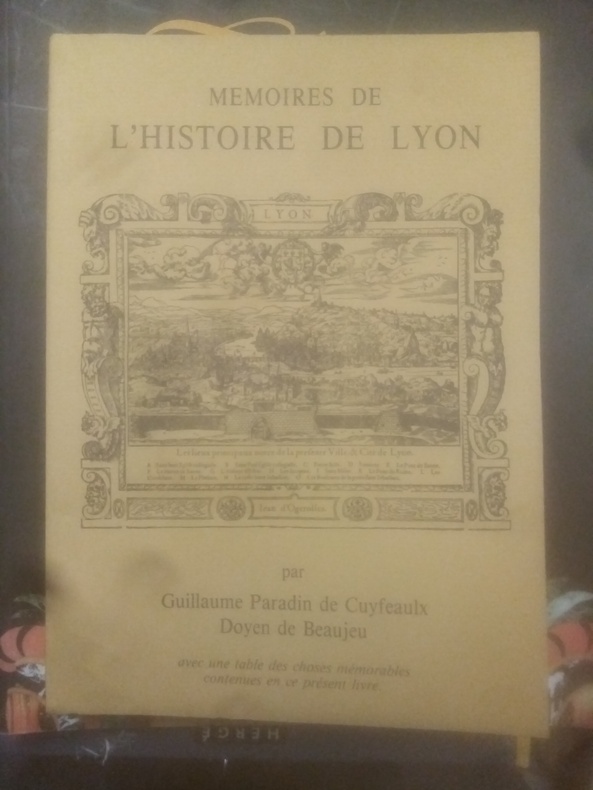
1573LYONNNNNNNNN0922Lyon, Dioscor Editions, 1985, 15 x 21, deux textes de 460 et 119 pages sous une même couverture souple illustrée. Réimpression des textes parus chez Antoine Gryphius en 1573 et 1574.
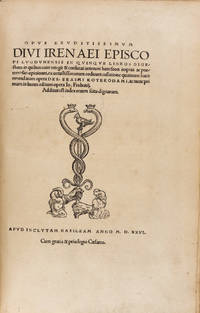
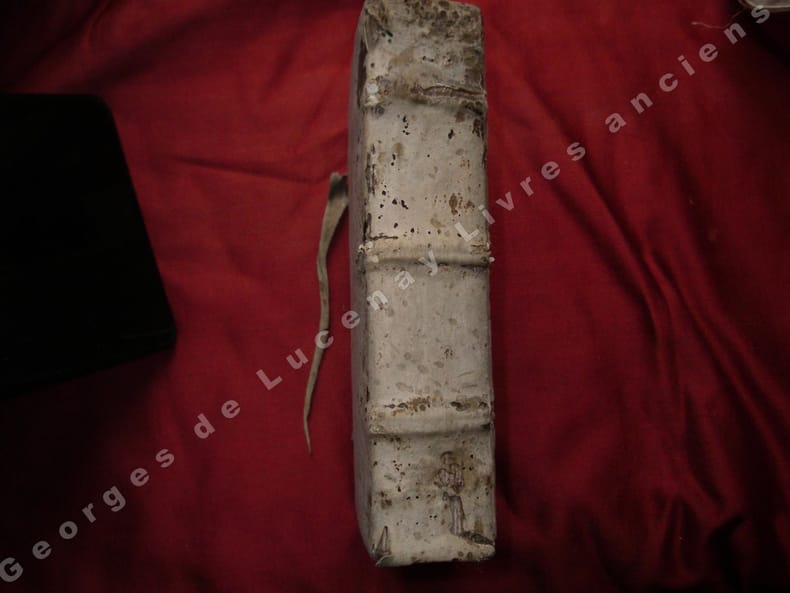
1571D10980Basel: Eusebius Episcopius & heirs of his brother Nicolaus 1571. Hardcover. Very Good. 8vo 165 x 104mm. 36 621 63 pages including final leaf with printers device of the word EPISCOP. Episcopus separated by stork surmounting bishops crozier on verso. Edited by Desiderius Erasmus; revised by Johann Jacob Grynaeus. Contemporary calf over wooden boards with blind-stamped arabesque centerpiece on covers brass catches lacking clasps rebacked spine gilt labeled IRENAEI HAERESES 1571; front joint cracked but cords intact; dark stain on opening leaves paper cracks and small holes in title not affecting text some light dampstaining in hinge toward end. 17th-century signature of Robert Baillie to title the famous Covenanter according to pencil note on front endpaper. 19th-century Chiesa Libera stamp on title; and pictorial bookplate of Douglas and Mildred Horton dated 1962 to front pastedown. Reverend Dr. Douglas Horton married Mildred née McAfee in 1945 who was a prominent female captain in the United States Naval Reserve and later the president of Wellesley College. <br/><br/>Irenaeus theological treatise written c. 180 attacked contemporary Christian heresies particularly Gnosticism and the system devised by Valentinus c. 100-c. 160. Irenaeus treatise also supported the idea that bishops maintained apostolic ties to the era of Christ and that a bishop was the best guide to understanding scripture. Given the very bishop-centric message of this work perhaps it is not curious at all that the Episcopius press expressed interest in printing it In Latin Episcopus is bishop. It was not until the 16th century that Irenaeus Opus eruditissimum was widely disseminated first published in Latin by Froben of Basel in 1526 and in the original Greek in 1570. Erasmus famously edited this Latin edition which appeared a year after the first Greek. In it he removed two annotations which referred to baptism and purgatory and also corrected a passage concerning the fault of Adam. The text itself is a new translation of the first book with an extensive dedication to the Basel Mayor Bernhard Brand and the founder of the Basel Reformed Orthodoxy Church Johann Jacob Grynaeus. Irenaeus Opus appears in 10 editions before this one published in both Basel 1528 1534 1548 1554 1560 and Paris 1541 1545 1563 1567 1570. This volume once belonged to Robert Baillie 1602-1662 a Glaswegian and Presbyterian minister and writer known for his Letters which faithfully recorded public events and his participation via correspondence. Baillie was a leader in the 17th century movement that rejected the Church of Englands Book of Common Prayer. From a reformative point of view Baillie would have found interest in Irenaeus work which recognized the canonical character of the gospels. For a work against the Gnostics it is said to contain valuable historical information and a great many New Testament quotations which are a witness to the New Testament text long prior to any extant manuscript; it is the first systematic exposition of Christian theology--Sarton I 294. Hoffmann II 466. Eusebius Episcopius & heirs of his brother Nicolaus hardcover
152642820865<p>FIRST EDITION of the works of Irenaeus "<strong>the father of Christian theology</strong>" as he is widely known.</p><p>Irenaeus is one of the most important of the early Church Fathers. Writing at the end of the second century with the authority of direct links to the followers of the original Apostles he defended the Church against existential threats and helped to establish its fundamental underpinnings.</p><p>Irenaeus's principal work is <em>Adversus Haereses</em> Against Heresies "<strong>one of the most precious remains of early Christian antiquity</strong>." The work comprises a refutation of the Gnostic heresies then a serious threat to the Church and exposition and defense of the Catholic faith" Roberts ed. Saint Irenaeus of Lyons <em>Against Heresies</em>. This is "the chief work of Irenaeus and truly of the highest importance; it … constitutes an invaluable source of information on the most ancient ecclesiastical literature from its beginnings to the end of the second century. In refuting the heterodox systems Irenaeus often opposes to them the true doctrine of the Church and in this way furnishes positive and very early evidence of high importance. Suffice it to mention the passages so often and so fully commented upon by theologians and polemical writers concerning the origin of the Gospel according to St. John the Holy Eucharist and the primacy of the Roman Church" <em>Catholic Encyclopedia</em>.</p><p><strong>Irenaeus is "one of the few really original and creative thinkers in the history of the church … He united the ethical and religious the legal and the mystical and so founded historic Catholicism … To no other Father does Catholic theology owe so much"</strong> McGiffert.</p><p>"Irenaeus asserted in a positive manner the validity of the Jewish Bible the Old Testament which the Gnostics denied claiming that it upheld the laws of the Creator God of wrath. Though Irenaeus did not actually refer to two testaments one old and one new he prepared the way for this terminology. He asserted the validity of the two testaments at a time when concern for the unity and the difference between the two parts of the Bible was developing. Many works claiming scriptural authority which included a large number by Gnostics flourished in the 2nd century; by his attacks on the Gnostics Irenaeus helped to diminish the importance of such works and to establish a canon of Scriptures" <em>Encyclopedia Britannica</em> 11th ed. Irenaeus the earliest witness to the four gospels as canon played a central role in establishing the canonical Christian Bible.</p><p>Edited by Erasmus this first edition of Irenaeus was central to Erasmus's effort to publish the works of the Church Fathers at the Froben Press at Basel. Erasmus was convinced that the Roman Catholic Church would only be fully reformed and renewed by turning again to the Bible as interpreted by the Fathers of the Church. More than any other single figure Erasmus brought to light the ancient writings of the Church Fathers. In the case of Irenaeus Erasmus crowed in his preface "Why should I not call him 'mine' since I found him almost buried and have done my best to clear away the dust of ages and restore him to the light"</p><p>The first edition of Irenaeus is very scarce in collector's condition. No example has appeared for public sale in the past thirty years.</p><p>Bound with the following work which is first in the volume:</p><p>CLEMENT I Pope. <em>Divi Clementis Recognitionvm Libri X. Ad Iacobvm Fratrem Domini Rvfino Torano Aqvileiense Interprete…</em> Basel: Froben 1526.</p><p>First edition. This work once attributed to Pope Clement I concerns on St. Peter and his disciple Clement. The ornamental borders are designed by Hans Holbein.</p><p>Folio. Contemporary blind-tooled pigskin over wooden boards stained and with some wear and scratches clasps manuscript title on spine. Early inscriptions including marginalia and underlining h4 repaired small wormhole to last leaf. A very good copy.</p> Froben hardcover
1571D10980Basel: Eusebius Episcopius & heirs of his brother Nicolaus 1571. Hardcover. Very Good. 8vo 165 x 104mm. 36 621 63 pages including final leaf with printers device of the word EPISCOP. Episcopus separated by stork surmounting bishops crozier on verso. Edited by Desiderius Erasmus; revised by Johann Jacob Grynaeus. Contemporary calf over wooden boards with blind-stamped arabesque centerpiece on covers brass catches lacking clasps rebacked spine gilt labeled IRENAEI HAERESES 1571; front joint cracked but cords intact; dark stain on opening leaves paper cracks and small holes in title not affecting text some light dampstaining in hinge toward end. 17th-century signature of Robert Baillie to title the famous Covenanter according to pencil note on front endpaper. 19th-century Chiesa Libera stamp on title; and pictorial bookplate of Douglas and Mildred Horton dated 1962 to front pastedown. Reverend Dr. Douglas Horton married Mildred née McAfee in 1945 who was a prominent female captain in the United States Naval Reserve and later the president of Wellesley College. <br/><br/>Irenaeus theological treatise written c. 180 attacked contemporary Christian heresies particularly Gnosticism and the system devised by Valentinus c. 100-c. 160. Irenaeus treatise also supported the idea that bishops maintained apostolic ties to the era of Christ and that a bishop was the best guide to understanding scripture. Given the very bishop-centric message of this work perhaps it is not curious at all that the Episcopius press expressed interest in printing it In Latin Episcopus is bishop. It was not until the 16th century that Irenaeus Opus eruditissimum was widely disseminated first published in Latin by Froben of Basel in 1526 and in the original Greek in 1570. Erasmus famously edited this Latin edition which appeared a year after the first Greek. In it he removed two annotations which referred to baptism and purgatory and also corrected a passage concerning the fault of Adam. The text itself is a new translation of the first book with an extensive dedication to the Basel Mayor Bernhard Brand and the founder of the Basel Reformed Orthodoxy Church Johann Jacob Grynaeus. Irenaeus Opus appears in 10 editions before this one published in both Basel 1528 1534 1548 1554 1560 and Paris 1541 1545 1563 1567 1570. This volume once belonged to Robert Baillie 1602-1662 a Glaswegian and Presbyterian minister and writer known for his Letters which faithfully recorded public events and his participation via correspondence. Baillie was a leader in the 17th century movement that rejected the Church of Englands Book of Common Prayer. From a reformative point of view Baillie would have found interest in Irenaeus work which recognized the canonical character of the gospels. For a work against the Gnostics it is said to contain valuable historical information and a great many New Testament quotations which are a witness to the New Testament text long prior to any extant manuscript; it is the first systematic exposition of Christian theology--Sarton I 294. Hoffmann II 466. Eusebius Episcopius & heirs of his brother Nicolaus hardcover books
151398871513 daim sur carton, lies ( 1 subsiste sur 4), dos à n. in-8, (20ff.), cxxxvi ff., Lxxxiij ff. (3ff)., Lyon Johannus Thomas 1513
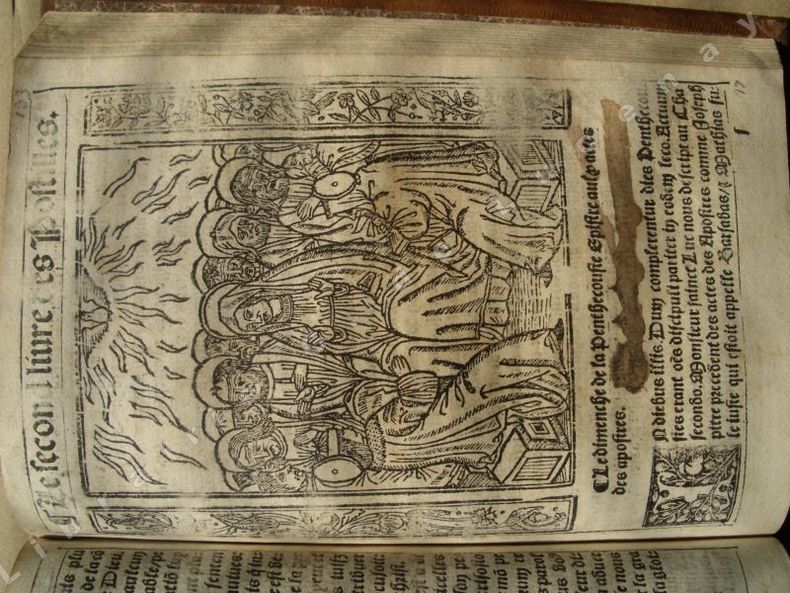
153099521530 rel. XIXe dans une sorte de maroquin brun, estampé à froid faisant penser à un cuir d'ameublement… 2 parties en 1 vol. in-4 gothique à longues lignes 228ff., sign. a-y, *,A-E8. Titre imprimé en rouge et noir orné d'une grande vignette sur bois, une autre au début de la deuxième partie ( La Vierge et les Apôtres à la Pentecôte) et grand nombre d'autres dans le texte, titre encadré d'arabesques. a-p8 ,(qi, q2, q7, q8), r4, s-z8, *8, A-C8 (manquent q3, 4, 5 ,6 et après C8) On les vend à Lyon auprès de Nostre Dame de Confort chez Olivier Arnoullet (1530 ou 1546)