Paris - Chereau, Jacques (1688 - 1776)Biblio.com
151 résultats
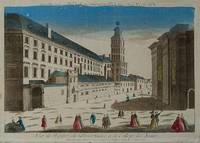
1700200060AG1700. Paris Jacques Chereau c.1700s. Original hand-coloured engraved vue d'optique. Plate Size: 39.3 cm x 28.5 cm. Sheet Size: 41.5 cm x 29.7 cm. Original print. In very good condition. Clean crisp and bright impression. A beautifully coloured vue d'optique of 18th Century Paris. A beautiful original hand-coloured copperplate engraving that shows a view of The Paris Observatory and the College des Jesuits on the left bank of the Seine. In the foreground people are shown out strolling and conversing. Below the printed area is the title and the following address of the publisher in French: "A Paris chez J. Chereau rue St. Jacques au dessus de la Fontaine St. Severin aux 2 Colonnes No. 257." Jacques Chéreau 1688 - 1776 was a portrait engraver printmaker and publisher of optical prints in a neighbourhood of printmakers at the Rue Saint-Jacques variously given on prints as "au Grand St. Remy" "au Coq" or "au dessus de la Fontaine St. Severin" in Paris France. From about 1740 to about 1820 optical prints also called "vue optique" or "vue d'optique" prints were made to be viewed through a Zograscope or other devices of convex lens and mirror all of which produced optical illusion of depth. Intaglio optical prints have exaggerated converging lines and bright hand-colours which contribute to the illusion of depth. Typically the legends of optical prints have reversed words along the top edge as those would be seen though the scope but words on the bottom of the prints are normal. Jacques and his brother were considered some of the most prolific publishers of prints in Paris. Subjects include current events views of the known world and fantasy compositions. Wikipedia unknown
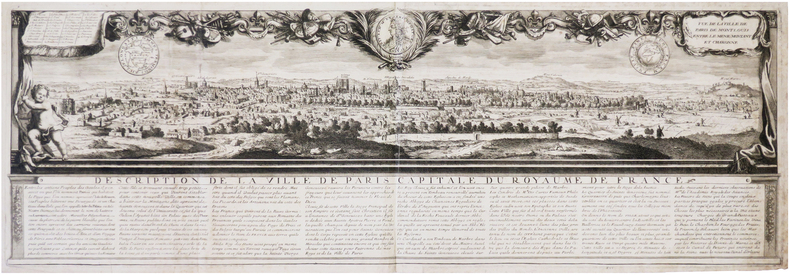
1690LBW-7907[Paris], J.B. Nolin, [circa 1690]. 255 x 775 mm.
16393300368London: Cornelius Bee and Laurence Sadler 1639. Book. Good. Cloth. Folio - over 12" - 15" tall. Text in latin. pp title 3 4 1 3 145 title of the " Additamenta" 149 - 310 2 8 2 1. Signature of Richard Vaughan editor of " The Chronicles of Mattew Paris " on fep his extensive annotations appear throughout the first part of the text. A sound textblock in a plain 20th cent cloth binding end papers replaced. Cornelius Bee and Laurence Sadler Hardcover
1670900376AGParis:, um 1670. Kupferstich, Blattmaß. 18 x 27 (quer). Plattenmaß: 13 x 24 cm (quer). [2 Warenabbildungen]
1700910198CGParis:, N. Langlois, um 1700. Kupferstich Bildgröße 16 x 26,5 cm, Blattgröße 21 x 31 cm.
165295251652 broché - 16,5x25 - 300 pp - 1923 - Ancienne Imprimerie CIVAL, Vesoul, F. DESSAUT, Directeur.
1652601841 vol. in-8 cartonnage postérieur, brochure reliée sous couv. postérieure (1835), De l'Imprimerie de la Veuve I. Guillemot, Paris, 1652, 15 pp.
163438615Besenson Besançon: Iehan Tomas Jean Thomas 1634. Small 8vo 175x115 cm. Contemporary calf spine gilt in compartments gilt faded leather rubbed. viii336 pp. paper sl. browned in places One of his works against the monks very rare Iehan Tomas (Jean Thomas) hardcover
16526156CParis:, Gervais Alliot & Jean Guignard., 1652. (ca. 24,5 x 18,5 cm). (10) 476, 106 (2) Seiten, mit einigen Vignetten im Text (Französische Sprache) / 476, 106 p. (French Language). Ganzleder der Zeit mit godgeprägter Rückenbeschriftung, auf 5 Bünden / Original brown calf with gilt stamped title to spine. [4 Warenabbildungen] Erstausgabe / First edition. Einband mit Gebrauchsspuren (berieben) und Läsuren. Vorderdeckel und erste Lage gelockert, letzte Lage ebenfalls gelockert. Buchblock sonst stabil. Innen sonst gut erhalten, Seiten praktisch ohne Stockflecken / Boards with some rubbing and small damaged a
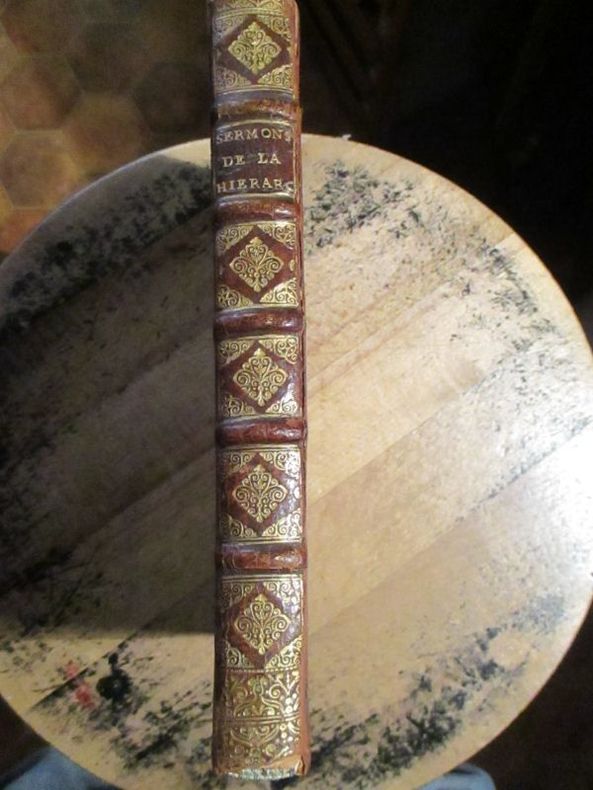
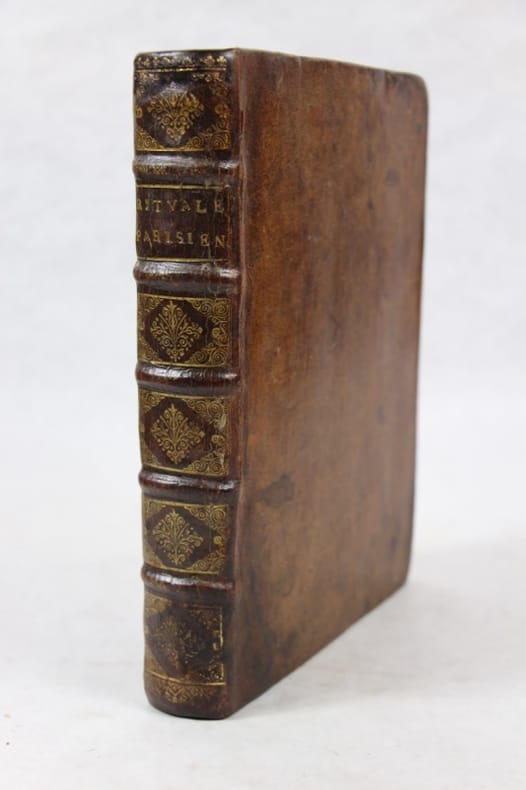
1697127894à Paris, chez Charles Osmont, M. DC. XCVII. 1697 In-4 25,5 x 18,5 cm. Reliure de l’époque veau havane, dos à nerfs encadrés de fers dorés, [29]-648 pp., table des chapitres, table des matières. Coiffe de tête arasée, mors fendillés en tête et en pied, coins frottés, page de titre avec découpe tampon ?, mouillures marginales en contreplat et page de garde, sinon intérieur en bon état.
169013055slnd [Paris, J. Boudot] 1690 Petit in-4 plein veau raciné, dos à nerfs, caissons richement ornés, LII- 420- 8 ff. Titre gravé par Ertinger, 58 planches hors-texte, figures dans le texte. Bon exemplaire.
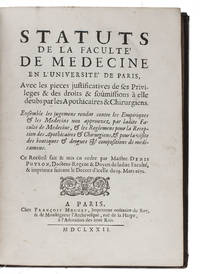
1672HCHB08RSGIM2Paris 1672. 4to. François Muguet Contemporary calf gold-tooled spine. With a few woodcut headpieces. 56 26 111 1 blank 4 20 56 22 2 blank 115 1 blank 43 1 blank 10 2 blank 16 4 16 pp. Collection of laws privileges and jurisprudence relating to the Faculty of Medicine of the University of Paris up to 1672. Most concern the publication of certain books the relationship of the Faculty with several guilds and the rules concerning the autopsy of corpses.The book opens with the university reform of 1600 which added many classical authors to the curriculum. For the Faculty of Medicine this meant the official establishment of Galen as the primary authority on botanical medicines. Interest in the work of Galen was highly stimulated by new translations from the Greek that had appeared in the 16th century and by 1600 the Paris Faculty was heavily mired in the doctrines of Galen which would remain so up until the 18th century.With a few contemporary annotations and corrections. Paper somewhat browned and with a few spots. A small corner of p. 11 of the index is cut out. Pp. 17-44 of the final part appear to be missing but this seems to be the case in every edition of this text we have located. Binding worn at the extremities with the head and foot of the spine damaged and a crack in the back hinge. A good copy.l Krivatsy 12063. unknown
169661484Paris, Muguet [et] Paris, Quillau, 1696 [et] 1716, in-12, 2 ouvrages en 1 volume in-12 de frontispice, 190 et 20 pages, puis 173 et (13) pages, Broché, sous couverture muette d'attente de l'époque, Seconde édition des Statuta facultatis medicinae parisiensis après une première édition parue en 1660 ; et Nouvelle édition, après une parution en 1715, du texte de Jean-Baptiste Doye, médecine parisien, doyen de la Faculté de médecine de Paris en 1715. Bon exemplaire, tel que paru. Couverture rigide
168259641682 A Paris chez Helie Josset rue saint Jacques à la Fleur-de-Lys d'or 1682 In8 plein veau dos à 5 ners fleurons 294 pages
1643100A Paris, 1643, in-12, 7 feuillets non chiffrés (faux-titre, titre et table des chapitres), 169 pages -3 feuillets non chiffrés (fautes d'impression et Extraits des registres de minuttes du Tabellionnage de la Ville de Dieppe), plein vélin de l'époque.
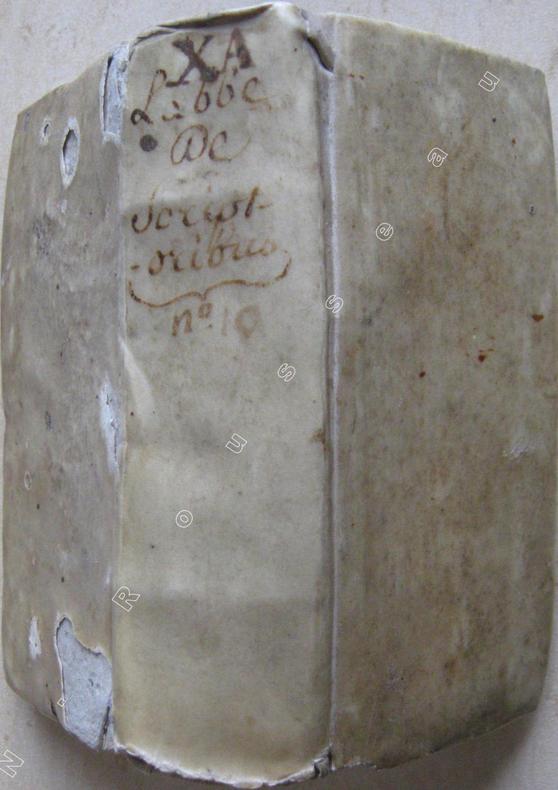
165991861659 Parisiis, apud G. Benard, 1659; in-32, plein velin de l'époque, titre manuscrit au dos; (8)ff. (dont le titre), 567pp. Ex-libris manuscrits anciens sur les gardes ( Domur Bajocensis et L'Honoré de Corbigny).
16842108230405xbvkÀ Rotterdam, chez Reinier Leers, M.DC.LXXXIV. (1684). Singleside printed Titlesheet with smaller alllegoric woodblock illustration, 335 (5) pages, 1 blank sheet. - French full-leather binding of the period over 5 raised bands with richly gilt spine and gilt-titled original red-leather spinelabel; 8vo.(ca. 16 x 9 x 2 cm).
169751973P., L. Josse 1697 Petit in-4 plein veau raciné, dos à nerfs, caissons richement ornés, 631 pp. Index. Notation musicale. Bon exemplaire.
16431781643 Paris, 1643. Un volume petit in-8 plein vélin blanc d'époque, [blanc], [titre], 242 pages, [blanc]. Notes manuscrites en page de titre, bel état malgré un léger manque au dos et une mouillure claire au haut des pages.
1644130698S.l. ; chez Julian Jacquin, Imprimeur à Paris 1644 In-12, plein vélin souple muet de l’époque , 14- 20- 93- 177 pp. Reliure fanée, petits accrocs de recouvrement du premier plat. Bon exemplaire.
16864982Toulouse: Chez Jean Boude 1686. Soft cover. Very Good. 4to - over 9¾ - 12" tall. 8 pp. Bound in marbled wrappers and housed in a fine red morocco case. $3850 Extremely rare first and only edition of this detailed popular newsletter concerning the contemporary reception of three Siamese ambassadors in Paris in September of 1686. The report gives a full description of their entrance their itinerary and the names and qualities of the individual ambassadors - whose 9-month stay in northern France between 1686 and 1687 must have provoked enormous interest. Providing the reader with some background the work notes that the King of Siam having been only recently convinced of the greatness of Louis XIV and the French nation has decided to send three more mandarins as envoys. "Ces Mandarins sont tres-honnestes les meilleures gens du monde doux civils & complaisans de tres-bonne & agreeable humeur .". According to this account they arrived at Brest on the 18th of June and reached Paris only on the 12th August. On the 'first day of this month of September' the delegation was officially presented to Louis XIV. Its centerpiece was the King of Siam's letter to Louis written on a blade of gold encased in a golden boëte bottle and poised atop a golden chalice all of which was carried aloft on a machine by 12 Swiss guards. The ambassadors themselves it is recorded took care to cover the machine with their parasols. Upon meeting the king "ils firent une profonde reverence en leur maniere se prosterant & mettant leurs mains sur leur vissage". The gifts presented by the envoys are notable for their overwhelming Japanese provenance a closed center of trade to the French and are accompanied here by occasional offhand remarks. Two vases of tombac a flexible alloy similar to brass are thought "presque aussi précieux que l'or" and are imputed to be "what the ancients called electrum"; two samurai swords presented by the King of Japan to the King of Siam are accompanied by the remark "they say that those who know how to handle these swords properly can cut a man's body in half; it's this that makes them beyond price"; etc. An antique marble sculpture apparently depicts a Chinese man whom the Siamese call To inghoing; "we belivee that this is the same as he whom we call Confuscius". The writer of the newsletter seems surprisingly well-informed and is certainly aware of the plans of the official retinue suggesting a source perhaps close to the court. "They are presently busy seeing the beauties and the riches of the Capital of our Kingdom. Around February after they have had their final royal audience they will return and recount all that they have seen and assuredly they will not forget what they have learned and understood of the suprising reunion of Protestants to the Roman religion for the King of Siam having proposed Louis le Grand as a model in all things and desiring to be able to make his entire kingdom French.has demanded that the King send him missionaries persons experienced in warfare wise men and men learned in many arts." Following this account of the ambassadors' visit is a brief 'Description du Royaume de Siam' - with much reference to Arab and Moorish settlements to the Siamese love of music to their 'superbly-dressed women' etc. Thanks to royal decree Siam enjoys public schools in which laws and religion are taught in the vernacular but the sciences are reserved for a learned tongue. Inspired no doubt by the Chinese rites controversty the commentator notes that despite their plural deities the Siamese do believe in one Creator of the Earth and the Heavens and they do maintain that the world will end in fire. The final leaf of the work is occupied with a discussion of the 'names and qualities' of the amabassadors. OCLC records only the copy at Cornell. OCLC 64004509 Chez Jean Boude paperback books
16864982Toulouse: Chez Jean Boude 1686. Soft cover. Very Good. 4to - over 9¾ - 12" tall. 8 pp. Bound in marbled wrappers and housed in a fine red morocco case. $3850 Extremely rare first and only edition of this detailed popular newsletter concerning the contemporary reception of three Siamese ambassadors in Paris in September of 1686. The report gives a full description of their entrance their itinerary and the names and qualities of the individual ambassadors - whose 9-month stay in northern France between 1686 and 1687 must have provoked enormous interest. Providing the reader with some background the work notes that the King of Siam having been only recently convinced of the greatness of Louis XIV and the French nation has decided to send three more mandarins as envoys. "Ces Mandarins sont tres-honnestes les meilleures gens du monde doux civils & complaisans de tres-bonne & agreeable humeur .". According to this account they arrived at Brest on the 18th of June and reached Paris only on the 12th August. On the 'first day of this month of September' the delegation was officially presented to Louis XIV. Its centerpiece was the King of Siam's letter to Louis written on a blade of gold encased in a golden boëte bottle and poised atop a golden chalice all of which was carried aloft on a machine by 12 Swiss guards. The ambassadors themselves it is recorded took care to cover the machine with their parasols. Upon meeting the king "ils firent une profonde reverence en leur maniere se prosterant & mettant leurs mains sur leur vissage". The gifts presented by the envoys are notable for their overwhelming Japanese provenance a closed center of trade to the French and are accompanied here by occasional offhand remarks. Two vases of tombac a flexible alloy similar to brass are thought "presque aussi précieux que l'or" and are imputed to be "what the ancients called electrum"; two samurai swords presented by the King of Japan to the King of Siam are accompanied by the remark "they say that those who know how to handle these swords properly can cut a man's body in half; it's this that makes them beyond price"; etc. An antique marble sculpture apparently depicts a Chinese man whom the Siamese call To inghoing; "we belivee that this is the same as he whom we call Confuscius". The writer of the newsletter seems surprisingly well-informed and is certainly aware of the plans of the official retinue suggesting a source perhaps close to the court. "They are presently busy seeing the beauties and the riches of the Capital of our Kingdom. Around February after they have had their final royal audience they will return and recount all that they have seen and assuredly they will not forget what they have learned and understood of the suprising reunion of Protestants to the Roman religion for the King of Siam having proposed Louis le Grand as a model in all things and desiring to be able to make his entire kingdom French.has demanded that the King send him missionaries persons experienced in warfare wise men and men learned in many arts." Following this account of the ambassadors' visit is a brief 'Description du Royaume de Siam' - with much reference to Arab and Moorish settlements to the Siamese love of music to their 'superbly-dressed women' etc. Thanks to royal decree Siam enjoys public schools in which laws and religion are taught in the vernacular but the sciences are reserved for a learned tongue. Inspired no doubt by the Chinese rites controversty the commentator notes that despite their plural deities the Siamese do believe in one Creator of the Earth and the Heavens and they do maintain that the world will end in fire. The final leaf of the work is occupied with a discussion of the 'names and qualities' of the amabassadors. OCLC records only the copy at Cornell. OCLC 64004509 Chez Jean Boude paperback
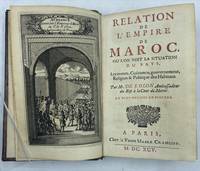
169513274Paris: Chez la Veuve Mabre Cramoisy 1695. Piccola gora bruna sull’angolo inferiore destro del margine delle pagine da 127 a fine volume sempre ben distante dal testo; tracce di distacco di ex libris sulla prima sguardia; ben conservato per il resto. Legatura coeva in tutta pelle fregi titoli dorati sul dorso a cinque nervi sguardie marmorizzate tracce di ex libris rimosso sull’anteriore e tagli marezzati in dodicesimo cm 16x10 pp 16 227 5 frontespizio parzialmente rubricato antiporta e 9 tavole incise di cui una ripiegata una carta bianca in apertura e in fine. Piccola gora bruna sull’angolo inferiore destro del margine delle pagine da 127 a fine volume sempre ben distante dal testo; tracce di distacco di ex libris sulla prima sguardia; ben conservato per il resto. Relazione dell’ambasceria del Cavaliere di S. Olon inviato da Luigi XIV presso il Sultano alawide Mulay Ismail 1645-1727 per concludere un’alleanza commerciale che avrebbe incluso tra l’altro uno scambio di prigionieri e la reciproca assistenza contro i pirati algerini e ottomani. S. Olon sbarcò a Tétouan ad aprile 1693 ed incontrò il Sultano a Meknès a giugno ma la ratifica dell’accordo non fu ultimata - addirittura l'ambasciatore fu brevemente imprigionato dalle autorità di Tétouan. La relazione apparve già nel 1694 col titolo di Estat Present de l’Empire de Maroc e fu ristampata l’anno seguente in questa edizione arricchita dell’apparato inciso da Daniel met de Penningen nativo di Anversa e attivo ad Amsterdam dal 1685 alla morte nel 1696; il successo dell’opera portò a traduzioni in inglese e olandese entro la fine del secolo XVII. Le tavole incise sono in tutto dieci: l’antiporta raffigurante l’incontro tra S. Olon e il Sultano la pianta ripiegata della città e fortezza di Larache riconquistata da Mulay Ismail nel 1689 e alcune immagini di costumi 4 semplici e 4 che presentano 2 figure ritratte sia di fronte sia di spalle. «The author was sent by Louis XIV. to effect an exchange of slaves and to conclude a treaty of peace and alliance against the Algerines. He disembarked in the Bay of Tetuan and met the Sultan at Mekenes but he had to leave the country without effecting his object. He was even imprisoned for some time at Tetuan by the Kaid of that place.» R. Lambert Playfair A Bibliography of Morocco n. 308. Boucher de la Richarderie IV p. 46. Chez la Veuve Mabre Cramoisy unknown
167430769Lyon Claude Muguet 1674 Petit In-12 un portrait - un frontispice - 6 ff - une carte dépliante d'allemagne - une planche dépliante de fortifications - une gravure - une planche dépliante et une planche d'" apothicairerie " - 274 pp reliure usagée mais non déreliée , veau sombre,
1680R300113806CHEZ ESTIENNE MICHALLET. 1680. In-12. Relié plein cuir. Bon état, Couv. convenable, Dos à nerfs, Intérieur frais. Avertissement + table des chapitres + 219 + 24 pages - dos à 5 nerfs - titre et caissons dorés sur le dos - 2 photos disponibles.. . . . Classification Dewey : 840.04-XVII ème siècle