KEERE (Pieter van den) & HOEY (François van).Livre Rare Book
151 résultats
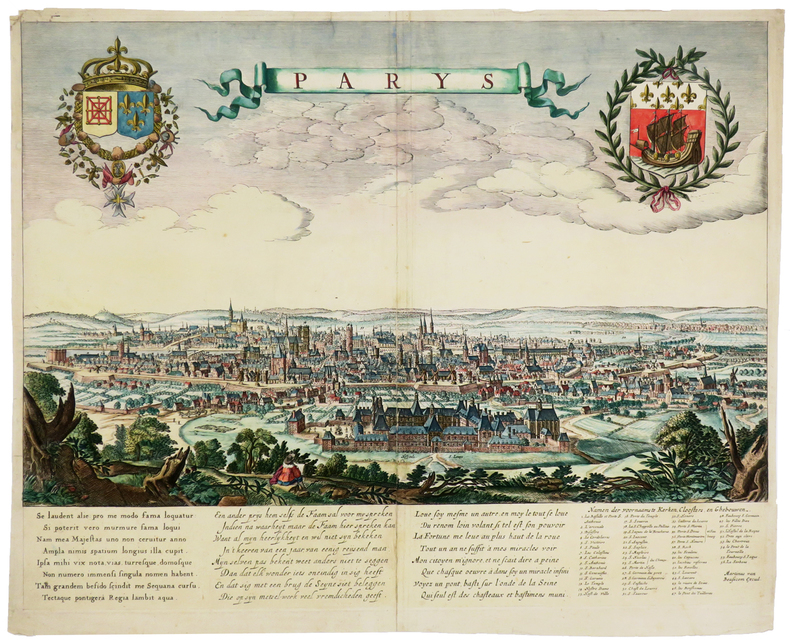
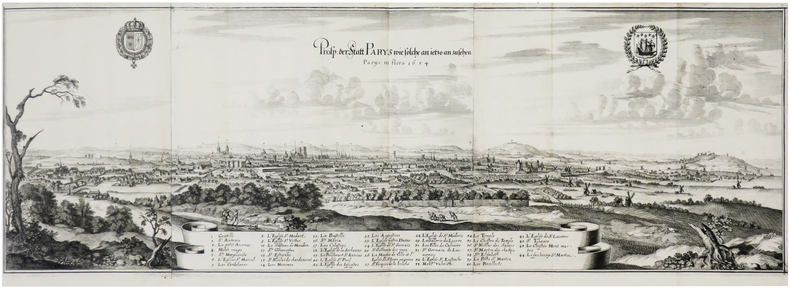
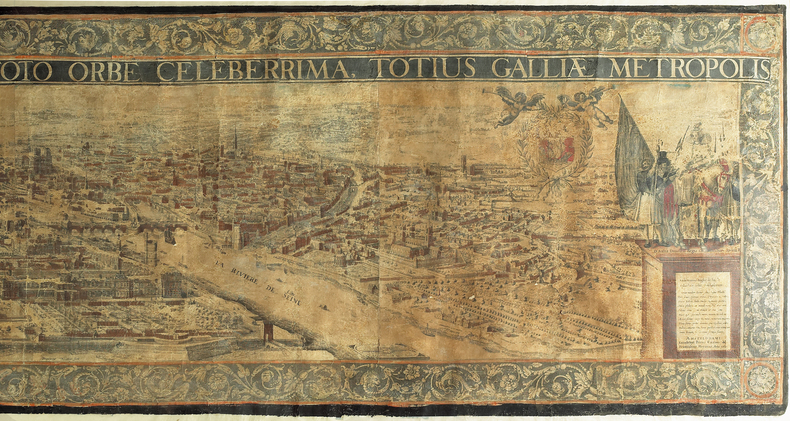
1617LBW-982[Amsterdam, 1617]. En quatre feuilles jointes de 590 x 2240 mm ; encadré sous verre.
1654B66141654. small lower marginal tears at B1 2 and N2; some contemporary ink under linings; wide margin paper. Overall this rare work is in very good condition. . Binding: Contemporary full crushed brown morocco spine raised with six 6 bands; worn gilt title on two; compartments faded; all edges speckled red and green. Notes: Rare. Second augmented after the first edition published earlier the same year 1654. Text in Latin. Place printer or publisher are unidentified; printer’s device of: Troyes: Nicolas I Oudot’s heirs printer; <br>Three parts in one volume. <br>This is a rare edition of this early French astrological work printed the same year as its first edition. Some of the text especially relating to predictions was regarded exceedingly offensive immediately condemned leading to contents either to be removed or whole copies burned; the present second edition was published without the contentious contents i.e. volvelles making predictions about Islam its future development Christianity and England France and Spain; five 5 volvelles remain in this edition relating to Henry IV of France and constellations of the heavens at the time of creation.<br>Sotheby’s states: "The first two parts are attributed on their title-pages to a Francisci Alleius and comprise an explication of his 'new method of astrology' and comments and observations on 'the fate of the universe. ' The third part is a commentary on the preceding two sections by the Capuchin Yves de Paris who is presumed to be the true author of the entire work. Expurgated editions themselves very rare were printed in Paris in 1654-56 and Rennes in 1658."<br>While the contents give no indication of the publisher printer or place the printer’s device of Nicolas Oudot Troyes founder of the Bibliothèque bleue is engraved on the first title. <br>Caillet III 11557. Thorndike VIII 310ff. Peignot Dictionnaire des livres condamnés au feu II 204f. <br> Size: Folio 343x215mm. Illustration: Two illustrated titles with woodcut engraved printer’s devices the first depicting a flower filled basket the second a fruit filled bowl; woodcut engraved floral initials and head pieces at openings; moreover five astrological figures; of these twelve 12 are moveable parts and five 5 fixed; of the five three have retained their threaded marker. Provenance: Armorial bookplate on upper pasted endpaper. References: Brunet I 185; Caillet III 11557; Dorbon Bib. Estoterica 61; Houzeau and Lancaster 5217. Thorndike VIII 310ff. Peignot Dictionnaire des livres condamnés au feu II 204f. Pages: Ll: bl. vol I: 2 pp.12; vol II: pp.57 p.1; vol III: pp. 26; bl. Collation: e1-2 A1-C2; A1-N2 O1-3; A1-F2 G1; bl. with watermark Category: Book Religious Christianity; Book Europe France; Book Science & Technology; unknown
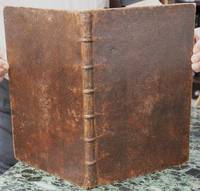
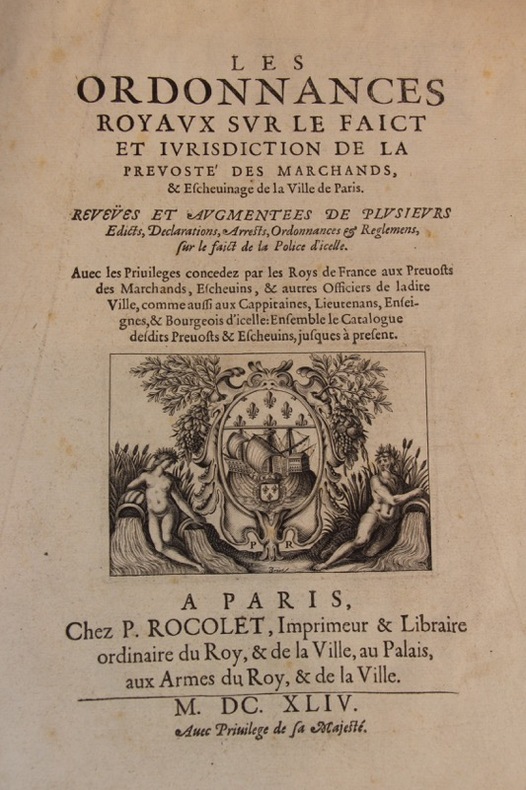
164461556Paris, P. Rocolet 1644 In-folio, plein maroquin pourpre, sur les plats double encadrements de filets classiques dorés bordés de roulettes ornées, fleurs de lys dorées aux angles de l’encadrement intérieur, lequel est empli d’un semé de fleurs de lys avec armes dorées au centre, dos à nerfs orné de caissons de semé de fleurs de lys dorées, tranches dorées rel. de l'époque, [4] ff.- 533 pp. -[4] ff. Dos restauré habillement. Vignette de Pierre Rocolet gravée sur cuivre par Briot, au f. de titre. Le frontispice gravé par Claude Mellan manque, petites galeries de vers marginales, quelques mouillures marginales.
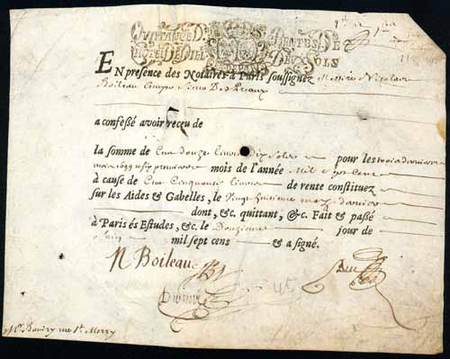
16990000121699 Une page format oblong (140 X 175 mm) sur parchemin. Document en partie imprimé "Quittance Hôtel de Ville - Gen.[alité] de Paris - Rentes de deux Sols".
16864982Toulouse: Chez Jean Boude 1686. Soft cover. Very Good. 4to - over 9¾ - 12" tall. 8 pp. Bound in marbled wrappers and housed in a fine red morocco case. $3850 Extremely rare first and only edition of this detailed popular newsletter concerning the contemporary reception of three Siamese ambassadors in Paris in September of 1686. The report gives a full description of their entrance their itinerary and the names and qualities of the individual ambassadors - whose 9-month stay in northern France between 1686 and 1687 must have provoked enormous interest. Providing the reader with some background the work notes that the King of Siam having been only recently convinced of the greatness of Louis XIV and the French nation has decided to send three more mandarins as envoys. "Ces Mandarins sont tres-honnestes les meilleures gens du monde doux civils & complaisans de tres-bonne & agreeable humeur .". According to this account they arrived at Brest on the 18th of June and reached Paris only on the 12th August. On the 'first day of this month of September' the delegation was officially presented to Louis XIV. Its centerpiece was the King of Siam's letter to Louis written on a blade of gold encased in a golden boëte bottle and poised atop a golden chalice all of which was carried aloft on a machine by 12 Swiss guards. The ambassadors themselves it is recorded took care to cover the machine with their parasols. Upon meeting the king "ils firent une profonde reverence en leur maniere se prosterant & mettant leurs mains sur leur vissage". The gifts presented by the envoys are notable for their overwhelming Japanese provenance a closed center of trade to the French and are accompanied here by occasional offhand remarks. Two vases of tombac a flexible alloy similar to brass are thought "presque aussi précieux que l'or" and are imputed to be "what the ancients called electrum"; two samurai swords presented by the King of Japan to the King of Siam are accompanied by the remark "they say that those who know how to handle these swords properly can cut a man's body in half; it's this that makes them beyond price"; etc. An antique marble sculpture apparently depicts a Chinese man whom the Siamese call To inghoing; "we belivee that this is the same as he whom we call Confuscius". The writer of the newsletter seems surprisingly well-informed and is certainly aware of the plans of the official retinue suggesting a source perhaps close to the court. "They are presently busy seeing the beauties and the riches of the Capital of our Kingdom. Around February after they have had their final royal audience they will return and recount all that they have seen and assuredly they will not forget what they have learned and understood of the suprising reunion of Protestants to the Roman religion for the King of Siam having proposed Louis le Grand as a model in all things and desiring to be able to make his entire kingdom French.has demanded that the King send him missionaries persons experienced in warfare wise men and men learned in many arts." Following this account of the ambassadors' visit is a brief 'Description du Royaume de Siam' - with much reference to Arab and Moorish settlements to the Siamese love of music to their 'superbly-dressed women' etc. Thanks to royal decree Siam enjoys public schools in which laws and religion are taught in the vernacular but the sciences are reserved for a learned tongue. Inspired no doubt by the Chinese rites controversty the commentator notes that despite their plural deities the Siamese do believe in one Creator of the Earth and the Heavens and they do maintain that the world will end in fire. The final leaf of the work is occupied with a discussion of the 'names and qualities' of the amabassadors. OCLC records only the copy at Cornell. OCLC 64004509 Chez Jean Boude paperback
16864982Toulouse: Chez Jean Boude 1686. Soft cover. Very Good. 4to - over 9¾ - 12" tall. 8 pp. Bound in marbled wrappers and housed in a fine red morocco case. $3850 Extremely rare first and only edition of this detailed popular newsletter concerning the contemporary reception of three Siamese ambassadors in Paris in September of 1686. The report gives a full description of their entrance their itinerary and the names and qualities of the individual ambassadors - whose 9-month stay in northern France between 1686 and 1687 must have provoked enormous interest. Providing the reader with some background the work notes that the King of Siam having been only recently convinced of the greatness of Louis XIV and the French nation has decided to send three more mandarins as envoys. "Ces Mandarins sont tres-honnestes les meilleures gens du monde doux civils & complaisans de tres-bonne & agreeable humeur .". According to this account they arrived at Brest on the 18th of June and reached Paris only on the 12th August. On the 'first day of this month of September' the delegation was officially presented to Louis XIV. Its centerpiece was the King of Siam's letter to Louis written on a blade of gold encased in a golden boëte bottle and poised atop a golden chalice all of which was carried aloft on a machine by 12 Swiss guards. The ambassadors themselves it is recorded took care to cover the machine with their parasols. Upon meeting the king "ils firent une profonde reverence en leur maniere se prosterant & mettant leurs mains sur leur vissage". The gifts presented by the envoys are notable for their overwhelming Japanese provenance a closed center of trade to the French and are accompanied here by occasional offhand remarks. Two vases of tombac a flexible alloy similar to brass are thought "presque aussi précieux que l'or" and are imputed to be "what the ancients called electrum"; two samurai swords presented by the King of Japan to the King of Siam are accompanied by the remark "they say that those who know how to handle these swords properly can cut a man's body in half; it's this that makes them beyond price"; etc. An antique marble sculpture apparently depicts a Chinese man whom the Siamese call To inghoing; "we belivee that this is the same as he whom we call Confuscius". The writer of the newsletter seems surprisingly well-informed and is certainly aware of the plans of the official retinue suggesting a source perhaps close to the court. "They are presently busy seeing the beauties and the riches of the Capital of our Kingdom. Around February after they have had their final royal audience they will return and recount all that they have seen and assuredly they will not forget what they have learned and understood of the suprising reunion of Protestants to the Roman religion for the King of Siam having proposed Louis le Grand as a model in all things and desiring to be able to make his entire kingdom French.has demanded that the King send him missionaries persons experienced in warfare wise men and men learned in many arts." Following this account of the ambassadors' visit is a brief 'Description du Royaume de Siam' - with much reference to Arab and Moorish settlements to the Siamese love of music to their 'superbly-dressed women' etc. Thanks to royal decree Siam enjoys public schools in which laws and religion are taught in the vernacular but the sciences are reserved for a learned tongue. Inspired no doubt by the Chinese rites controversty the commentator notes that despite their plural deities the Siamese do believe in one Creator of the Earth and the Heavens and they do maintain that the world will end in fire. The final leaf of the work is occupied with a discussion of the 'names and qualities' of the amabassadors. OCLC records only the copy at Cornell. OCLC 64004509 Chez Jean Boude paperback books
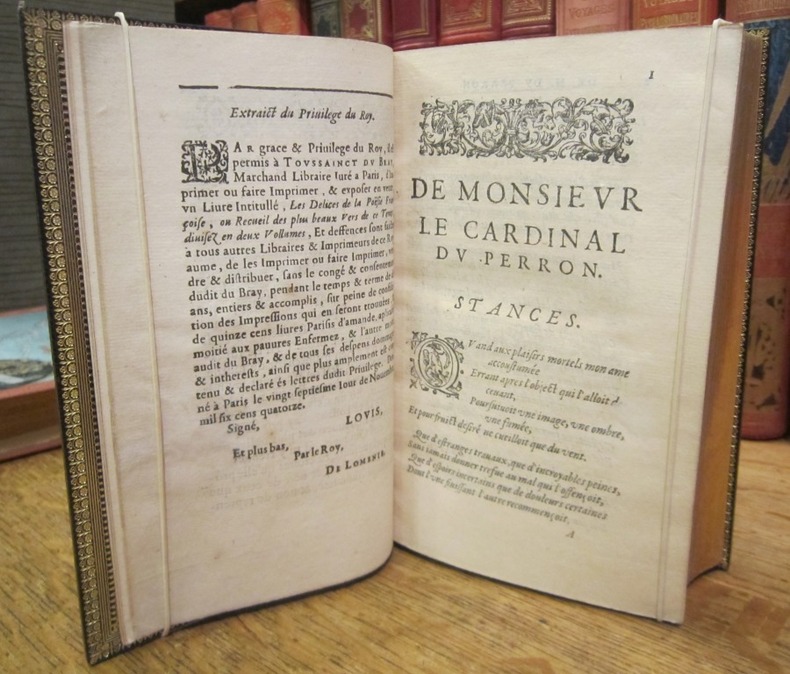
1615002850Paris, Chez Toussainct du Bray, 1615
1700710361700. Handsome Manuscript Copy of the Coutume de Paris Manuscript. Paris. Coutume de la Prevoste et Vicomte de Paris. Paris c.1700-1750. ii 389 1 pp. Quarto 8" x 6-1/2". Contemporary tree sheep gilt spine with raised bands and lettering piece edges rouged ribbon marker. Light rubbing and shallow scuffing to boards faint illegible name to rear board moderate rubbing to extremities with wear to spine ends and corners joints just starting at ends later owner signature to front pastedown crack in text block between title page and following leaf. Light toning to interior text in fine almost calligraphic hand within ruled margins a few nineteenth-century notes laid in. $3500. Enhanced with a table of contents this handsomely written copy of the Paris coutume was intended for annotation. There is large blank space below the text on each page and occasional blank leaves. The laid-in slips have brief annotations about the coutume and its articles. Two of them have dates from the nineteenth century. Our assignment of a c.1700-1750 date to the manuscript is based on its binding orthography and handwriting style. unknown books
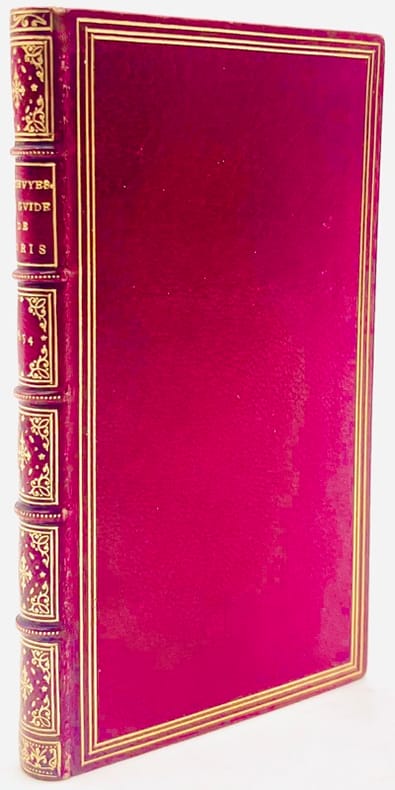
165443432A Paris, chez Cardin Besongne, 1654. DECHUYES. Liste generalle des Messagers, Postes, Courriers, Coches & Rouilliers de France. Avec leurs logemens, les jours qu'ils partent de cette Ville & qu'ils y arrivent. A Paris, chez Cardin Besongne, 1654. In-12 de 34 pp. 2 parties en 1 vol. in-12, maroquin rouge, dos orné à nerfs, triple filet doré sur les plats, dentelle dorée, tranches dorées (Masson-Debonnelle).
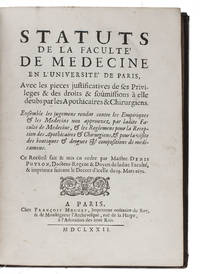
1672HCHB08RSGIM2Paris 1672. 4to. François Muguet Contemporary calf gold-tooled spine. With a few woodcut headpieces. 56 26 111 1 blank 4 20 56 22 2 blank 115 1 blank 43 1 blank 10 2 blank 16 4 16 pp. Collection of laws privileges and jurisprudence relating to the Faculty of Medicine of the University of Paris up to 1672. Most concern the publication of certain books the relationship of the Faculty with several guilds and the rules concerning the autopsy of corpses.The book opens with the university reform of 1600 which added many classical authors to the curriculum. For the Faculty of Medicine this meant the official establishment of Galen as the primary authority on botanical medicines. Interest in the work of Galen was highly stimulated by new translations from the Greek that had appeared in the 16th century and by 1600 the Paris Faculty was heavily mired in the doctrines of Galen which would remain so up until the 18th century.With a few contemporary annotations and corrections. Paper somewhat browned and with a few spots. A small corner of p. 11 of the index is cut out. Pp. 17-44 of the final part appear to be missing but this seems to be the case in every edition of this text we have located. Binding worn at the extremities with the head and foot of the spine damaged and a crack in the back hinge. A good copy.l Krivatsy 12063. unknown
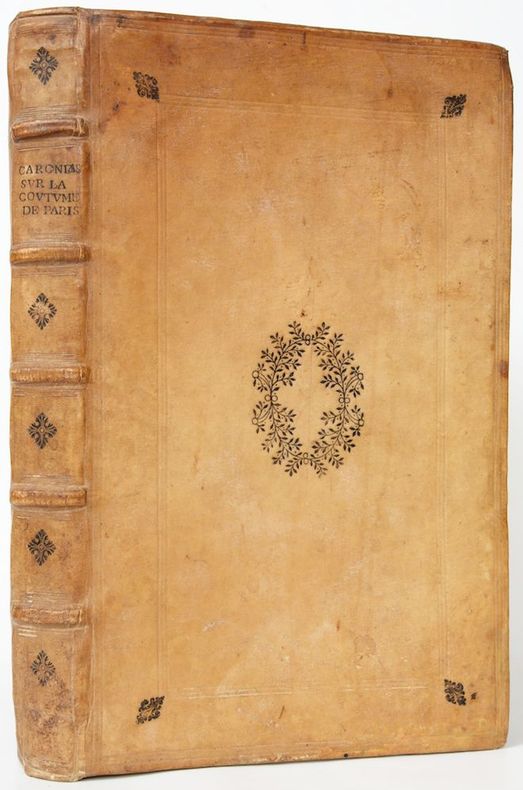
161311293A Paris, Chez P. Mettayer, 1613. In-folio de (16)-243-(10) ff., vélin rigide estampé, dos à cinq nerfs orné de fleurons, sur les plats cartouches laurés et fleurons en écoinçons dans un double encadrement à froid (reliure de l'époque).
167046641Sébastien Mabre-Cramoisy Cuir Paris 1670
16942355Paris, chez Jean de Laulne, 1694. In-4 – 20 x 26 cm. Reliure de l’époque en plein veau havane, dos à cinq nerfs guillochés orné de caissons à fleurons, fers d’angles, filets et pointillés dorés, titre doré, roulette dorée sur les coupes et en encadrement des contreplats, tranches rouges. 4 f. bl., 4 ff. 448 pp. Edition originale et probablement unique de cet ouvrage longtemps considéré comme une référence sur le sujet. Comme indiqué en page de titre, ce traité se divise en quatre parties où sont étudiés le rôle des universitaires de la Sorbonne dans l’établissement de l’imprimerie, l’impression grecque et hébraïque et le contrôle de la librairie d’une part, celui d’Ulric Gering, « premier imprimeur de Paris », d’autre part, ainsi que « les imprimeurs » et « la matière d’imprimerie ». Bibliothécaire à la Sorbonne, l’auteur, André Chevillier (1636-1700), inscrit ses recherches dans le sillage du célèbre bibliothécaire et bibliographe érudit Gabriel Naudé (1600-1653), l’un des premiers à se pencher sur les origines de l’imprimerie dans la capitale (Addition à l’histoire de Louis XI, 1630). Il aurait fourni de nombreux renseignements au libraire Jean II de La Caille, pour son Histoire de l’Imprimerie et de la Librairie, où l’on voit son origine et son progrès jusqu’en 1689, avant de compiler en 1694 le résultat de ses propres travaux, menés à partir de sources inédites et fondamentales : les archives et les livres imprimés dans le tout premier atelier parisien. Selon Anatole Claudin (Les origines de l’imprimerie à Paris. La première presse de la Sorbonne, Paris, 1899), « son ouvrage, fait consciencieusement et sans prétention, est rédigé avec méthode et discernement. Bien que l’esprit critique lui fasse défaut en certains points, le livre est excellent pour l’époque à laquelle il a été rédigé ». D’où son succès durable auprès des grands bibliographes durant près de deux siècles. Il faudra attendre 1876, puis 1885 pour que J.P.A. Madden et Jules Philippe proposent des ajouts ou des correctifs à l’œuvre de Chevillier, ouvrant la voie à de nouvelles interprétations et explorations.
1688002823Paris, Estienne Michallet, 1688
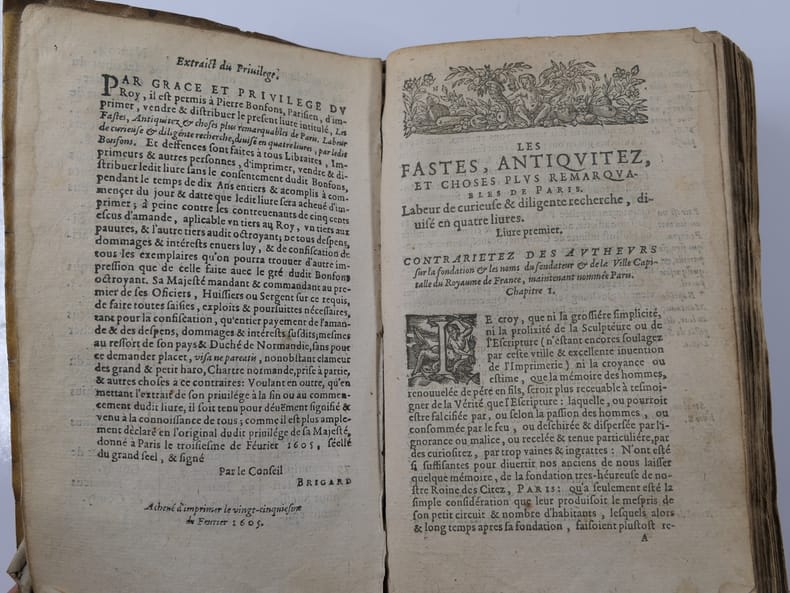
160581125Paris, Par Nicolas & Pierre Bonfons, en leurs boutiques, Rue neuve Nostre Dame, 1605, in-12 (10x17cm), plein vélin de l'époque, titre manuscrit au dos, 336p. Dos creusé, couture toutefois bien solide. Manques marginaux sur la page de titre ainsi que dans la dédicace "A Monsieur François Myron". Contient 1ff page de titre, 1ff A Monsieur, 2ff Aux lecteurs, 4ff Table des chapitres, 5ff Table des plus belles remarques, 5ff Table & Privilège. Texte illustré de vignettes, lettrines et de 52 bois gravés hors-texte. Page 79 absente. Il s'agit, dans une version remaniée et augmentée par Pierre Bonfons et son père Nicolas Bonfons (ce dernier gendre de Corrozet), de la dernière version de l'ouvrage célèbre de Gilles Corrozet (1510-1568) : "La Fleur des antiquitez, singularitez & excellences de la plusque noble & triumphante ville & cité de Paris", paru originellement en 1532, et constamment réédité avec des modifications pendant tout le reste du XVIe siècle. Les Fastes ant. a été réédité en 1607 et 1608. L'iconographie reprend les figures d'après Jean Rabel données dans l'édition de 1588 (Brunet II, 307)
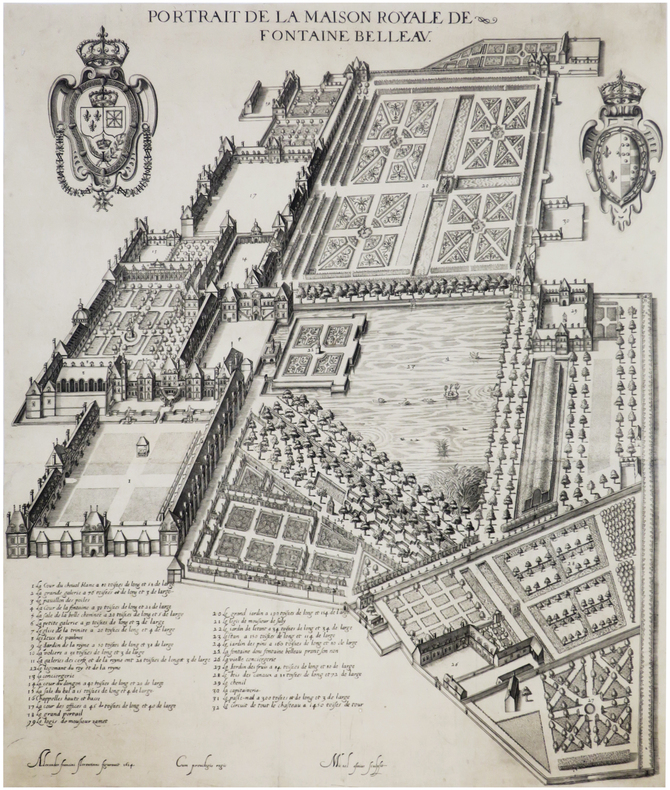
1650LBW-5727[circa 1650]. 406 x 516 mm.
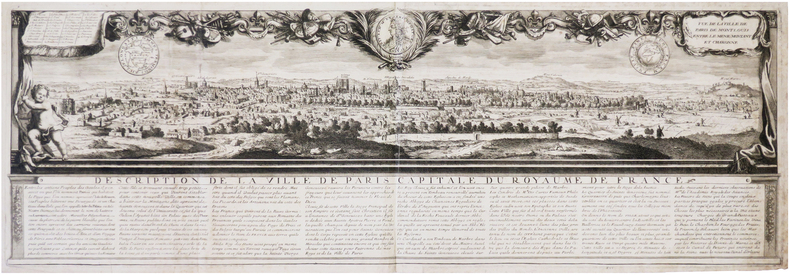
1690LBW-7907[Paris], J.B. Nolin, [circa 1690]. 255 x 775 mm.
1650LBW-1908circa 1650. 353 x 483 mm.
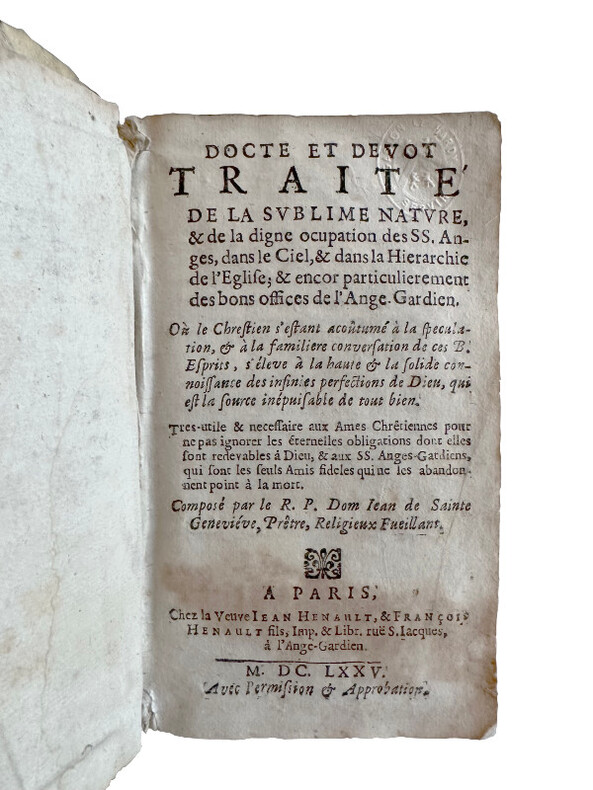
1675LCPCREL-0015(Un extraordinaire et très curieux traité du XVII siècle sur les Anges et sur les Anges Gardiens. Une rarissime édition originale, conservée dans son vélin souple du temps) DE SAINTE GENEVIEVE Jean (Dom). "DOCTE ET DEVOT TRAITE DE LA SUBLIME NATURE & DE LA DIGNE OCUPATION DES S.S. ANGES, DANS LE CIEL, & DANS LA HIERARCHIE DE L'EGLISE; & ENCOR PARTICULIEREMENT DES BONS OFFICES DE L'ANGE GARDIEN...". 1675, Paris, Vve Iean Henault, & François Henault. 3 livres en 1 volume in-12° (152x95 mm) (dimensions pages 146x85 mm) (12) ff. (titre, oraison, dédicace, avertissement, approbation, tables), 495 pp., (10) pp. (table), (1) p. b. (a6, c6, A-S6, T2, *6, V4, X-Z6, Aa-Xx6) Reliure strictement de l'époque en vélin souple avec titre manuscrit sur le dos. Edition Originale et Unique, rarissime. Très probablement imprimé à petit nombre d'exemplaires. Petite tache claire d'encre sur le titre, sinon superbe exemplaire frais et conservé dans sa toute première reliure du temps. Un extraordinaire livre sur les Anges, leur nature, leur hierarchie, leur mission pour Dieu et auprès des hommes et sur les Anges Gardiens. "La nature angelique est si noble, si excellente, & si pure, qu'elle est toute spirituelle, & incoruptible : n'estant composée, que d'un pur acte vivant, qui n'est en soy, autre chose qu'un simple être actuel, ou, comme disent les Philosophes, une forme essentielle jointe à sa subsistance, qui termine la nature, & rend la personne de chaque Ange, distincte & séparée, des autres particulières qui ont la même nature". (...) "... mais ce manque de pénetration vient de l'imperfection de nôtre Nature : laquelle estant composée de corps & d'esprit, il nous est impossible de nous figurer, & encore moins de voir ou de regarder fixement, une chose purement spirituelle (comme est l'Ange en sa personne, & en sa nature) sinon par la pointe de nôtre esprit, & par la force du raisonnement necessaire, pour former l'idée, & ouvrir un pléne & parfaite conoissance d'une chose". "... la langue des Anges est plus sublime & parfaite, qu'elle est plus simple, & plus nette, faisant voir les choses immédiatement dans leurs propres espéces intentionneles, & purement spirituelles, par la seule direction de la volonté". Sur l'auteur, Jean de Sainte Geneviève, aucune information trouvée, sauf qu'il est l'auteur d'une "Science des Saints..." de 1668. Trés probablement il a été réligieux au couvent des Feuillants situé dans la rue Saint-Honoré à Paris. Apparemment seulement deux exemplaires dans les collections publiques françaises (Amiens et Lyon). Provenance : Un cachet ex libris de Gaston Le Hardy (1833-19..), historien et écrivain normand. Il a écrit, entre autres, une "Histoire de Nazareth et de ses sanctuaires" (1905). (LCPCREL-0015)
1655LBW-7681[Francfort], 1654 [1655]. En trois feuilles jointes de 263 x 792 mm.
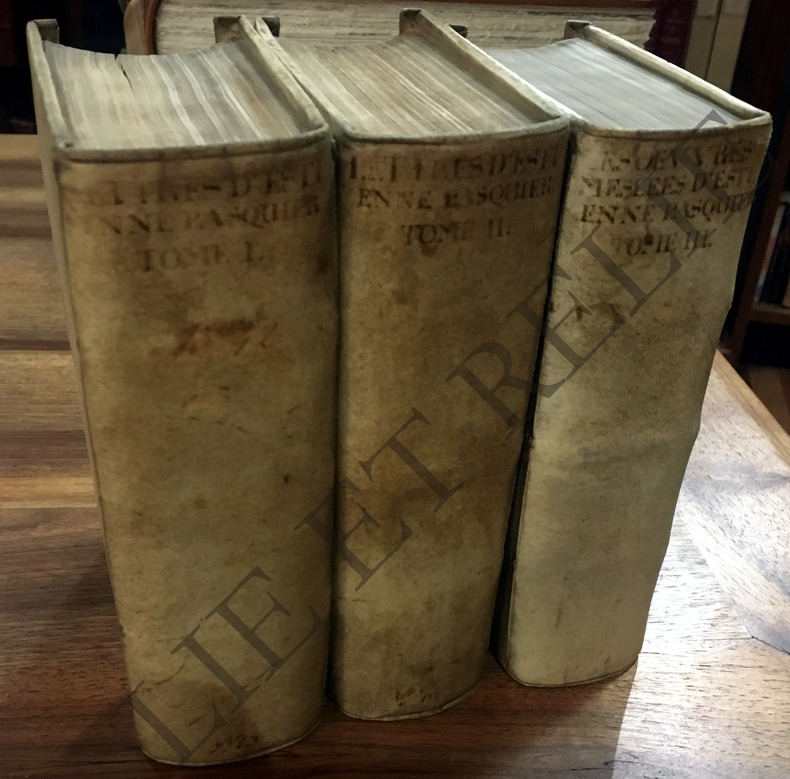
1619YRG-212Étienne Pasquier (1529_1615) - Jurisconsulte et historien français. TABLE DES EPISTRES et Matières contenues en ce volume les 3 tomes contiennent toutes les œuvres poétiques de PASQUIER- 3 vol. fort in-8 vélin ivoire de l'époque, titre manuscrit au dos- Edition la plus complète contenant vingt deux livres, elle a été partagée entre Laurent Sonnius et Jean Petit-Pas 1619 - A paris avec privilège du Roy.
16753455Fredericum Leonard, Typographum Regis, 1675. In-folio (37,5 x 25,5 cm), 632 pp., 23 ff. d'index et errata (texte en Latin), reliure d'époque veau brun, dos à nerfs orné (quelques défauts d'usage mais très bon état intérieur, sans rousseurs). Edition originale. Cet ouvrage rare est l'une des meilleures sources pour l'histoire de l'ancienne Gaule, rédigé sous forme de dictionnaire, il n'a pas même été remplacé par le célèbre d'Anville.
164648535Le tout diligemment recueilly par Me Iean Du Fresne, Advocat en ladite Cour de Parlement, avec une Table des Matières, 1 vol. in-4 reliure plein vélin, Chez Henry Le Gras, Paris, 1646, 4 ff. 499 pp.
1657PHO-1458A Troyes, par Nicolas Oudot, et se vendent à Paris: Chez François Clousier, 1657. in-4; [6ff. (sur 7: feuillet de dédicace en fac-simile), dont titre, portrait légendé de La Boullaye, préface], 558p., [5ff. Table, fautes, privilège du 12 février 1657]; 33 illustrations sur bois dans le texte dont 16 à pleine page. Reliure d'époque en basane brune, dos à nerfs avec titre , coupes , coiffes et coins usés , frottements. un coin déchiré au titre sans atteinte au texte. Mouillure angulaire au premier portrait P. 73 déchirée avec manque de papier ,sans atteinte au texte. P. 165: manque en coin avec perte de qq mots; PP. 173 et 175: déchirures sans perte de texte; P. 234: manque de papier en pied avec perte de quelques mots; taches d'encre pp. 264 ; pp. 460 à 485: petites galeries de vers marginales en pied. Ex-libris manuscrit Dominium Antonium Biguet. Seconde édition