BERRY, WilliamBiblio.com
12 099 résultats
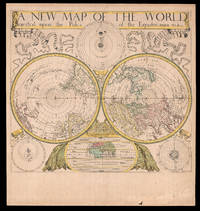
168018434London: Sold by Will Berry at the Signe of the Globe between Chearing-Cross and White-Hall c1680. 425 by 480mm 16.75 by 19 inches. The first polar projection world map published by an Englishman Engraved map fine original hand-colour Ptolemaic Tychonic and Copernican diagrams of the solar system around map map of the ancient world below. The first world map on polar projection to be published by an Englishman. Polar Projection Polar projection is a type of azimuthal projection based on a plane perpendicular to the Earth's axis through the poles. On polar-centered azimuthal projections longitude is represented by radial straight lines and latitude by concentric circles or parallels. One of the earliest examples of a polar map of this kind is Mercator's 1569 world map on which the Arctic is shown in an inset map on a polar projection rather than included as part of the main image on the eponymous cartographer's projection. Other early double hemisphere world maps on north and south polar projections include Gerard De Jode's Hemispheriu ab Aequinoctiali Linea 1593; Isaac Habrecht's map of 1628; Janssonius' Typus Orbis Terrarum from the same year; Jean Boisseau's Nouvelle Description de toute la terre universelle of 1640; and Novus Planiglobe Terrestris Per Utrumque Polum Conspectus engraved by Joan Blaeu before 1672 the only extant example of which bears the later imprint of Gerard Valck published around 1695. The present map by Berry is an example of the first map on polar projection to be published by an Englishman. The Map Published around 1680 Berry's map shows both the north and south hemispheres on a polar projection at a scale of approximately 1:100000000 with both extending to the equator which is scaled. The coast of Australia is incomplete and California is shown as an island. Other cartographic myths include the massive single Great Lake and the Straits of Anian. The sizes of the Philippines and Japan are exaggerated and the southern tip of South America has been truncated due to the projection. At first glance the work would appear to be a copy of Blaeu/Valck Novus Planiglobe Terrestris Per Utrumque Polum Conspectus; and although Berry's English title is an almost direct translation of Blaeu's work it is no merely slavish copy. Berry has reversed the hemispheres and significant cartographic differences are evident especially in the depiction of South America. Surrounding the hemispheres are cosmological diagrams showing the Ptolemaic Copernican and Tychonic solar systems as well as a smaller map of the ancient world. This shows only Europe Asia and Africa and is divided into layers of "temperate zone" "frozen zone" "unhabitable" and "habitable by the Antients" regions. Ribbons ornament the upper left- and right-hand corners streaming from the ends of the simple title banner along the upper edge. The map was engraved by John Rich who also executed his road map of Great Britain the year before. William Berry 1639-1718 In his Printed Maps in the Atlases of Great Britain and Ireland 15791870 Thomas Chubb describes Berry as a bookseller geographer and engraver who was active between about 1670 and 1703. Berry was the son of a Warwickshire baker probably apprenticed alongside his future partner Robert Morden c1650-1703 to Joseph Moxon 16271691 an engraver mapmaker globe-maker and instrument-maker. His most enduring partnership was later with Morden and together they sold topographical works prints maps charts and globes. Among their shared works were A New Map of the English Plantations in America 1673 William Leybourn's An introduction to astronomy and geography: being a plain and easie treatise of the globes 1675 and Playing cards depicting the Counties 1676. In 1677 they petitioned the Attorney General for "a licence to do all general and particular maps of the several parts of the world according to an alphabetical manner and method first projected by them against any other undertakers". Although there are individual maps and globes prepared by the pair the larger project never came to fruition although Berry is best remembered as the "English Sanson" for the set of maps of the world that he corrected and amended after Nicolas Sanson which were issued separately between 1680 and 1689. Rare we are only able to trace one institutional example held at The Library of Congress and a smaller facsimile at the British Library. Not in Shirley; LC G3200 1675 .B4. Sold by Will Berry at the Signe of the Globe between Chearing-Cross and White-Hall,
200342820840<p>Pre-publication printout. 2 356 pp. the published work was 446 pp. Comb-bound. Very good condition.</p><p><strong>Presentation copy inscribed by James Watson to Francis Crick and his wife: "For Francis and Odile from Jim 27 November 2002." This is the dedication copy with the printed dedication stating "To Francis Crick."</strong></p><p>Crick's wife Odile co-recipient of this presentation copy is famous for her drawing of the DNA molecule published in <em>Nature</em> in April 1953 and subsequently widely reproduced in textbooks scientific articles and popular literature. "It may be the most famous scientific drawing of the 20th century in that it defines modern biology" Terrence J. Sejnowski Salk Institute.</p><p>"A remarkable alignment of the planets is occurring in 2003: the 50th anniversary of the double helix and the completion of the sequence of the human genome. As a defining figure in both land- mark events no other human being on the planet is positioned to write as authoritatively about all this as Jim Watson. In <em>DNA: The Secret of Life</em> he does so with clarity style and wit. If you really want to know what happened in the most important half-century of biology since the world began read this" Francis Collins.</p><p><strong>This splendid presentation copy represents the greatest scientific collaboration of the 20th century. The names Watson and Crick will forever be linked in the history of science.</strong></p><p>Provenance: Francis and Odile Crick inscribed to them by James Watson.</p> [New York: Knopf] paperback
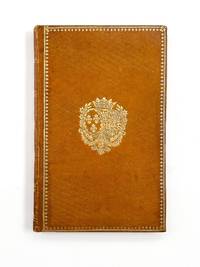
181655305Paris: Vente 1816. Fine. Royal wedding edition of this popular pre-Revolution comedy issued on the occasion of the marriage of Princess Marie-Caroline and the Duc de Berry - and from the library of the Duchess herself who famously sold her books after her failed coup in 1832. The Duchess's wedding occurred only a year after the restoration of the royal House of Bourbon in 1815 following Napoleon's final defeat at Waterloo. On that occasion a special performance of Andrieux's 1787 play was performed for the Duchess a devotee of the theater. This rare edition was printed as a memento of that event which was to have massive implications in French history. <br /> <br /> The Duchess's new husband was the king's brother; after the Duc de Berry's assassination in 1820 their son became the heir apparent to the French throne. But when the July Revolution of 1830 deposed the Bourbons the Duchess and her son went into exile. In 1832 however the Duchess of Berry clandestinely returned to France to lead a rebellion becoming "the most wanted woman in France" Samuels. Her coup failed and she was once again exiled; her story would later be dramatized in fiction by Alexandre Dumas as LES LOUVES DE MACHECOUL 1859. <br /> <br /> Realizing she would never return to her beloved library of some 8000 volumes at Chateau Rosny she made the decision to sell it. It was then one of the most famous libraries in France with a tremendous range in philosophy history travel science law theology fiction and theater. This copy's binding and bookplates mark its provenance from the library of the Duchess. It was bound by René Simier 1772-1843 who "had no superior and few rivals during his career" Ramsden 190 with his ticket announcing him as "Binder to the King to Her Royal Highness the Duchess of Berry and to His Royal Highness the Duke of Bordeaux." The binding is in the style the Duchess regularly ordered from Simier featuring her gilt arms on the boards upon a carefully selected full morocco. It further bears the engraved bookplate of Rosny on the unusual pink endpapers. Books from the Duchess's library still appear with some regularity on the market today but rarely with such a close personal connection to the Duchess herself. Contemporary full honey morocco boards stamped in gilt with the arms of the Duchess of Berry bound by René Simier with his ticket "Relieur du Roi de S.A.R. Madame Duchesse de Berry et de S.A.R. Mgr le duc de Bordeaux". Pink glazed endpapers all edges gilt. 4 82 pages. Engraved bookplate of the Bibliothèque de Rosny on front pastedown; bookplates also of Alexis Rouart and Eugène Aubry-Vitet. Only trace rubbing and soil. Vente unknown
ABE-15935612297361st Edition. Hardcover. Good. A collection of four novels from some of our most important 20th century environmental writers. Each book was a gift to the authors mother three of them inscribed. Each writer made his mark in both fiction and nonfiction in particular in nature writing and bioregionalism. A ready-made exhibit. <br /> <br /> Wendell Berry remains a leading figure in the environmental and agrarian movements with his deep attachment to his Kentucky farm. Edward Hoagland has been described by John Updike as the best essayist of my generation and has written widely on natural history. Paul Horgan won the Pulitzer Prize twice in history and in 1989 David McCullough argued persuasively in the New York Times that With the exception of Wallace Stegner no living American has so distinguished himself in both fiction and history. Peter Matthiessen is one of the few American writers that could rival Hogan and Stegner as distinguished in both fiction and history. He won the National Book Award in both fiction and nonfiction and wrote histories and natural histories. Needless to say their moms probably deserve some credit for their successes. Here we have from each writer a gesture of love and gratitude that is always a de facto dedication copy.<br /> <br /> But this cluster is also dubbed Mother Nature because she has left her mark on a couple of these books. Two of these books are in fair-to-good condition only but arguably this adds to their gravity. These were cherished family copies that nonetheless began to lose the battle against time and the elements. Peter Matthiessen's Partisans has lost its dust jacket is heavily stained on the FFEP and has been lightly lovingly chewed by insects. It remains readable but it is perhaps best served as an object of reverence with a reading copy near at hand. Paul Horgan's novel is also without its dust jacket perhaps because it was caught in flood and mudslide that devastated the Horgan family home in Albuquerque. This fact is not without resonance considering Horgan's best-known Pulitzer-and Bancroft-winning two volume book the Great River: The Rio Grande in North American History which the New York Times called an unfoldment of life. His most popular novel also was Whitewater about the flooding of a Texas town. Wendell Berry's novel is in very-good-plus shape and fittingly a flood is also part of its narrative only in a positive way: After the book was returned to Berry following his mother's death Berry later donated it to the Pendleton County Public Library to help it rebuild after its collections were lost to a devastating flood. Hoagland's book is in very good shape with only a little waviness to the upper half of the first three pages. Its specially bound in blue leather with marbled pastedowns perhaps a one-of-a-kind copy a gift from the publisher. As far as fitting our watery theme the best that can be said is that its central character is downcast flooded with emotion wandering a seedy hotel at the edge of Harlem. At least three of these books returned to these authors after their parents died itself another reflection of Mother Nature's work. Horgan's the fourth may have been cast out after that mudslide. Together this collection is a moving symbol of the river of time and the recycling of materials that was or is central to these men's environmental writing and ecological ethos. These books well embody Mother Nature. hardcover
1785(LCPCALM-0001)(L' exemplaire de Louise-Marie-Thérèse d'Artois, fille de la Duchesse de Berry dans sa reliure en maroquin rouge du temps à ses armes) "ALMANACH ROYAL, ANNEE M.DCC.LXXXV...". 1785, Paris, D'Houry. 1 vol. in-8° (204x130 mm) (dimensions pages 198x120 mm) 684 pp. Reliure de l'époque en maroquin vieux rouge ornée d'une magnifique plaque de Dubuisson. Armoiries en losange au centre des plats. Dos à cinq nerfs avec fleurs de lys et titre dorés. Coupes ornées et tranches dorées. Gardes de tabis bleu. Rares et infimes rousseurs. Très bel exemplaire. Spectaculaire reliure ornée d'une plaque de Dubuisson: elle est décrite sous le n° 184k du Catalogue Rahir (Livres dans de riches reliures, Paris, 1910) et sous le n° 10 du Classement de Christian Galantaris. Provenance: Exemplaire aux armes dorées de la Princesse Louise-Marie-Thérèse d'Artois (1819-1864), fille du Duc et de la Duchesse de Berry. Ex libris armorié Bibliothèque du Château de Rosamel. (LCPCALM-0001) (4.500,00 €) (Tous les livres provenant d'Italie possèdent la licence d'exportation (Attestato di Libera Circolazione) du Ministero dei Beni e Attività Culturali)
Faksimile in 980 numerierten Exemplaren. Das "Kleine Stundenbuch" ein großes Kunstwerk. Die bedeutendsten Buchmaler des ausgehenden 14. Jahrhunderts haben im Auftrag des Herzogs von Berry ein Kunstwerk geschaffen, das wegen der Reichhaltigkeit und Feinheit der Malerei als eines der großartigsten Zeugnisse spätmittelalterlicher Kunst bewertet wird. Der Herzog von Berry war der größte Kunstsammler und Mäzen seiner Zeit. Neuwertiges Exemplar.
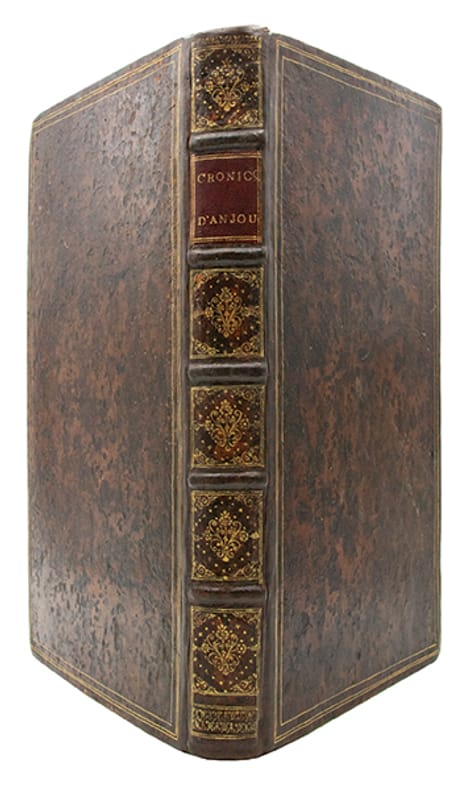
38945In-folio (323 x 214 mm), veau moucheté, dos à cinq nerfs orné de compartiments fleuronnés et cloisonnés et dune palette en pied, pièce de titre de maroquin rouge, plats encadrés de triples filets, tranches rouges (reliure du XVIIIe), (4), ccvii (i.e. 197) feuillets, (1) f. à la marque de Galliot du Pré, deux gravures sur bois, lettrines, manicules. Angers, Charles de Boingne et Clement Alexandre, Janvier 1529 [i.e 1530].
1977240208San Francisco: Sierra Club 1977. First edition. HC w DJ. PC VG/Good. SIGNED BY AUTHOR. Navy blue cloth white spine titling blind-stamped front corners bumped edgewear soiling to edges soiling to endpapers front hinge cracked SIGNED in black ink to title page small tear/knock to bottom edge affects up to p. 30 binding sound unmarked. Unclipped DJ $8.95 edgeworn w chips/nicks 3"" closed tear to top-edge loss to tips & bottom edge now in Brodart. PLEASE NOTE: We are happy to provide photos. Please contact us for any specific requests. BUYING AND SELLING USED AND RARE BOOKS FROM HISTORIC EAST NASHVILLE SINCE 2012. Sierra Club hardcover
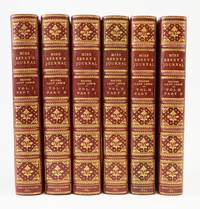
1865ST19156London: Longmans Green and Co 1865. FIRST EDITION. 222 x 146 mm. 8 3/4 x 5 3/4". Three volumes extended to six. Edited by Lady Theresa Lewis. <br/> EXCEPTIONALLY PRETTY CRIMSON CRUSHED MOROCCO HANDSOMELY GILT BY MORRELL signed on front inner dentelles covers bordered with double rules raised bands spines gilt in compartments featuring drawer pull and cinquefoil cornerpieces and elegant floral centerpiece elaborately gilt inner dentelles top edge gilt other edges rough trimmed. EXTRA-ILLUSTRATED WITH MORE THAN 275 ENGRAVED PLATES 30 of them views the rest portraits four of the plates folding and eight in color. One plate with small skillfully repaired tear at fore edge a few leaves and a dozen plates with sprinkled foxing isolated light offsetting and minor stains and soiling in the text but AN EXTREMELY FINE SET THE LOVELY BINDINGS UNUSUALLY BRIGHT AND VIRTUALLY UNWORN and internally very fresh and clean.<br/> <br/> This lavishly illustrated and handsomely bound set documents the very long and meaningful life of a spinster devoted to her father and her sister—and to literature. Mary Berry 1763-1852 grew up in a family of modest fortune yet she knew a great many important people including Princess Caroline of Wales the estranged wife of the Regent their daughter Princess Charlotte and the author Mme. de Stael who described Mary as "by far the cleverest woman in England." Mary met Lord Byron and Napoleon but her greatest friend was Horace Walpole the society wit letter-writer and builder of the neo-gothic extravaganza Strawberry Hill. Walpole who met Berry and her younger sister Agnes when they were in their twenties became so fascinated by their wit and wisdom that he persuaded them to settle with their father near him at "Little Strawberry Hill" which he bequeathed to them in his will. He left them his manuscripts as well and Mary Berry became the editor of his works. She also authored a play and a study of English and French society but our collection of her journal entries and letters put together by Lady Theresa Lewis 1803-65 is Mary Berry's most enduring legacy. The journal begins when Mary at 20 sets out with her father and Agnes for a tour of Holland Switzerland and Italy where she looks at paintings attends plays and records the ups and downs of stagecoach travel. The letters and entries in her journal written until her death give a rare picture of her times and her clever and endearing personality. At the same time some entries are melancholic in which she attributes falling short of achievements commensurate with the level of her abilities and never experiencing marriage and motherhood. Besides charming portraits of the Berry sisters the illustrations in our expanded set depict the authors they read Dryden for example the painters whose works they viewed the many notable figures they met or gossiped about royalty politicians actresses people of fashion and views of the places they visited. Our lovely set was produced by the London bindery of W. T. Morrell established about 1861 as successor to the firm begun by Francis Bedford who in turn had taken over the famous bindery of Charles Lewis. Prideaux in her "Modern Bookbindings" published in 1906 says that Morrell at that time had a very large business that supplied "all the booksellers with bindings designed by his men" bindings that were "remarkable for their variety and merit." The six volumes here look remarkably attractive on the shelf. Longmans, Green, and Co unknown
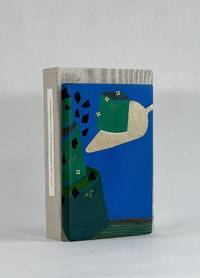
9573Monterey KY: Larkspur Press 2006. Full Leather. Fine binding. Octavo. 4 36 4 pp. Limited edition number 9 of 75 copies on Somerset Book paper there was also an edition of 500 regular copies. Signed by Wendell Berry at the colophon; additionally noted by Fox the year it was bound. In full goatskin binding with a series of leather onlays tooled in gold and blind all creating a fantastic pictorial binding. Accompanying the binding is a fine paper portfolio with publisher's prospectuses samples and associated material; additionally some templates related to Fox's binding. All housed a custom clamshell by Fox. <br /> <br /> The text offers a lens into the 19th century view of how a native of region assesses the value of the natural wonders. Berry's commentary at the end of Allen's text brings the troubling viewpoint into a modern context: "The chapter is built upon a division of mind which in our time has become terrifying but which Allen believed to be no more than a simple equation. On the one hand in a sentimentally romantic fashion he was sensitive to the natural life of the area which was then still intact. And on the other hand he seems eager for the destruction of this virgin bounty that so inspired him. I say 'the destruction' and not 'the use' for his language is patently that of an exploiter intent upon 'conquering' nature." A sobering volume that will most surely always remain relevant. Larkspur Press unknown
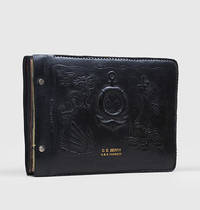
1934115861Chefoo Yantai Shanghai Singapore: 1934-37. Battleships baseball and the Bund An evocative album containing over 300 photographs both personal and from commercial studios recording the active service of the USS Parrott DD-218 on the China Station with the Asiatic Fleet - part of Destroyer Division 58 - including the Asiatic neutrality patrol in 1935 and 1936 offering a wealth of images of China Japan the Philippines and the South Pacific on the eve of the Second Sino-Japanese War 7 July 1937-9 September 1945 and the Second World War. Studio photographs include a number from the renowned commercial photographers Afong based in Yantai formerly Chefoo Joseffa and Skvirsky both established in Shanghai. It was compiled by Yeoman 2nd Class E-5 Charles Edmond Berry and opens with two fine photographs of the officers and crew of the Parrott on deck two colour-tinted photographs showing the ship at anchor and a humorous pictorial advertising photo from the Afong studio including an image of the studio exterior - clearly issued to all ships passing through Yantai - and featuring the Parrott at the centre. There follows an often joyful evocation of life onboard a US Navy destroyer prior to the Second World War with photos of the after-parties at the famed Beach Cafe in Chefoo which featured White Russian "hostesses" and tremendous amounts of alcohol as well as the morning-after breakfasts. Berry has also included panoramic photos of the Asiatic fleet in harbour at Chefoo Yantai and Hong Kong even including a humorous photographic pictorial "Bootlegger's Map of the United States." There are a series of photos showing the other US Navy Clemson-class destroyers on station with the Parrott the USS Pillsbury USS Bulmer USS John D. Ford USS Paul Jones USS Smith Thompson and USS Pope as well as various shipboard shenanigans baseball games battleships and destroyers on maneuvers gunnery practice loading of shells crew pets Liberty parties sailors carousing down the Bund in Shanghai buying souvenirs in Cuba sailing through the Panama Canal sightseeing trips to a walled city in Northern China the Great Wall of China cremation ceremonies in Bali riding rickshaws snake charmers and more. There are photos of Pan American Airways flying boats landing and unloading passengers in China many street scenes in Shanghai Hong Kong Tsing Tao Qingdao including the beheading of Chinese robbers outside the town Peking and Singapore. Of special interest are the series of photos showing Chinese Naval Ships from the Republic of China Navy in the mid-1930s including the CNS Yixian sunk by Japanese aircraft in September 1937; CNS Yisheng which had been converted into a gunboat in 1928 later sunk the CNS Shin Shey built in 1911 converted to a gunboat in 1929 sunk in 1938 and many others. There are also images of Kobe Yokohama street cars in Shanghai parks in Tokyo street scenes in Kyoto and views of the temples there. The USS Parrott DD-218 was a Clemson-class destroyer laid down by William Cramp & Sons Philadelphia and launched in 1919 commissioned in 1920 with a complement of 157 officers and enlisted men. The Parrott spent most of her career sailing with the Asiatic Fleet was awarded the Yangztze Service Medal in part for humanitarian assistance during the flooding of 1931-32 operating through the Chinese Civil War which resulted in considerable naval activity in Chinese waters collecting hydrographic data in and around Saigon then French Indochina in 1935. By 1940 she had served successively as station ship at Amoy Xiamen and Swatow Shantou China. From 7 July to 4 October she patrolled China waters based at Tsing Tao Qingdao and then made calls to other northern Chinese ports returning to Manila on 11 October. There in the early months of 1941 she was refitted with anti-mine and detection gear for anti-submarine warfare. The Parrott saw action in several theatres of war: South China Sea Battle of the Java Sea Atlantic Convoys and the bombardment of Spanish Morocco. She was accidentally rammed by the SS John Morton in Norfolk Naval Shipyard in 1944 and so severely damaged that she was decommissioned that same year and saw no further active service. Thick oblong quarto 380 x 280 x 51 mm. 319 corner-mounted original photographs ranging in size from 102 x 63 mm to 292 x 240 mm including 6 colour-tinted images and 4 panoramas 292 x 145 mm many studio prints captioned in the negative often with the photographer's stamp at lower corner a few with manuscript annotations verso coloured and patterned tissue guards intact white pink blue and jade-green. Contemporary heavily embossed black padded-calf post-binder photo album front board with devices of a Chinese Dragon a junk the Great Wall a life-preserver and anchor title in gilt as above nickel-plate posts rounded corners 52 leaves of black heavy card-stock most of the original tissue guards preserved. Together with a very appealing group of related ephemera and publications including: The Missions to Seamen The Sailors' Institute Anson Road Singapore; The Short Cut to Beauty: Hong Kong's Peak Tram; jocular Subpoena and Summons Extraordinary Royal High Court of the Raging Main Domain of Neptunus Rex two copies; U.S. Naval Despatch USS Parrott; Voyage Smoker USS Henderson en route to Honolulu T.H. to Guam M.I.; Radio Press News en route Manila P.I. to Guam M.I. 23 March 1937; Map of Shanghai dog tags and Bakelite Jesus medallion all preserved together in the original canvas sailcloth bag with stud fasteners. A few slight scuffs to binding occasional creasing to the mounting leaves very minor damage to a couple photographs overall in excellent condition. hardcover
157515133Francofurti, Ex officina Typographica Nicolai Bassei, 1575. 3 parties en 1 vol. in-folio (210 x 320 mm) à 2 colonnes par page de (6) pp. 1 f. bl. 137-(23) pp. (8)-145-(13) pp. 245-(18) pp., index pour chaque partie, basane fauve, dos à quatre nerfs, pièce de titre manuscrite, décor de filets droits, de frises et de roulettes, estampé à froid sur les plats, lacets (reliure de l'époque).
Faksimile in 980 numerierten Exemplaren. Die Bilderhandschrift "Tres Belles Heures" markiert einen Höhepunkt mittelalterlicher Buchmalerei. Das Werk wurde geschaffen zu Beginn des 15. Jahrhunderts von den begnadetsten Künstlern jener Zeit. Die berühmten Gebrüder Limburg gestalteten die beiden letzten Seiten der Handschrift. Verschwenderisch in Gold und Farben wurden die einzelnen Miniaturen ausgemalt. Neuwertiges Exemplar.
196859947London, Macmillan, 1968. Large8vo. In contemporary full green cloth with gilt lettering to spine. In ""Nature"", vol. 220, 1968. Entire vol. 220, October - December offered. Small white paper label pasted on to lower part of spine. Stamps to fore edges. Pasted down- and free end-papers with stamps and paper labels from Gettysburg College Library. ""Withdrawn""-stamps to pasted down front end-paper and front free end-paper. P. 650. [Entire volume: (2), 1366, III- XXVIII pp.].
196859947London Macmillan 1968. Large8vo. In contemporary full green cloth with gilt lettering to spine. In "Nature" vol. 220 1968. Entire vol. 220 October - December offered. Small white paper label pasted on to lower part of spine. Stamps to fore edges. Pasted down- and free end-papers with stamps and paper labels from Gettysburg College Library. "Withdrawn"-stamps to pasted down front end-paper and front free end-paper. P. 650. Entire volume: 2 1366 III- XXVIII pp. <br/><br/><em>First appearance of this short paper in which the taxonomy of coronaviruses is first presented and which also coins the name “Coronavirus†accepted by the International Committee for the Nomenclature of Viruses. Human coronaviruses were discovered in the 1960'ies and by mid-1967 it was recognized that viruses IBV MHV B814 and 229E were structurally and biologically similar so that they form a distinct group. Using electron microscopy the three viruses were shown to be morphologically related by their general shape and distinctive club-like spikes. Tyrrell met Waterson and Almeida in London to decide on the name of the viruses. Almeida had earlier suggested the term "influenza-like" because of their resemblance but Tyrrell thought it inappropriate and not very precise. Almeida came up with the unusual name "coronavirus". “Even though we could only base our judgement on the electron microscope images we were quite certain that we had identified a previously unrecognized group of viruses. So what should we call them 'Influenza-like' seemed a bit feeble somewhat vague and probably misleading. We looked more closely at the appearance of the new viruses and noticed that they had a kind of halo surrounding them. Recourse to a dictionary produced the Latin equivalent corona and so the name coronavirus was born.†Cold Wars: The Fight Against the Common Cold “Particles of IBV are more or less rounded in profile; although there is a certain amount of polymorphism there is also a characteristic "fringe" of projections 200 Å long which are rounded or petal shaped rather than sharp or pointed as in the myxoviruses. This appearance recalling the solar corona is shared by mouse hepatitis virus and several viruses recently recovered from man namely strain B814 229E and several others. In the opinion of the eight virologists these viruses are members of a previously unrecognized group which they suggest should be called the coronaviruses to recall the characteristic appearance by which these viruses are identified in the electron microscope.†From the present paper. </em> hardcover
29709FAKSIMILIE VERLAG LUZERN 2003. THIS FACSIMILIE EDITION IS THE FAITHFUL RECREATION OF THE ILLUMINATED MANUSCRIPT THE CLOISTERS 1954 ACC. NO. 54.1.1 PRESERVED IN THE METROPOLITAN MUSEUM NEW YORK. PUBLISHED IN A SINGLE EDITION OF 980 NUMBERED COPIES 900 OF WHICH WERE FOR SALE. THIS IS NUMBER 770. HAND-SEWN AND BOUND IN GOATSKIN AND GOLD-TOOLED BY STEINBRENER OF SCHARDING. COLOUR PRINTING BY PRINT AND ART OF GRAZ. COMPLETE WITH A BOOK OF 107 PAGES ON THE WORK BY MEISS BEATSON AND PLUMMER QUARTER LEATHER ALL HOUSED IN A PERSPEX BOX. FAKSIMILIE VERLAG LUZERN, 2003 hardcover
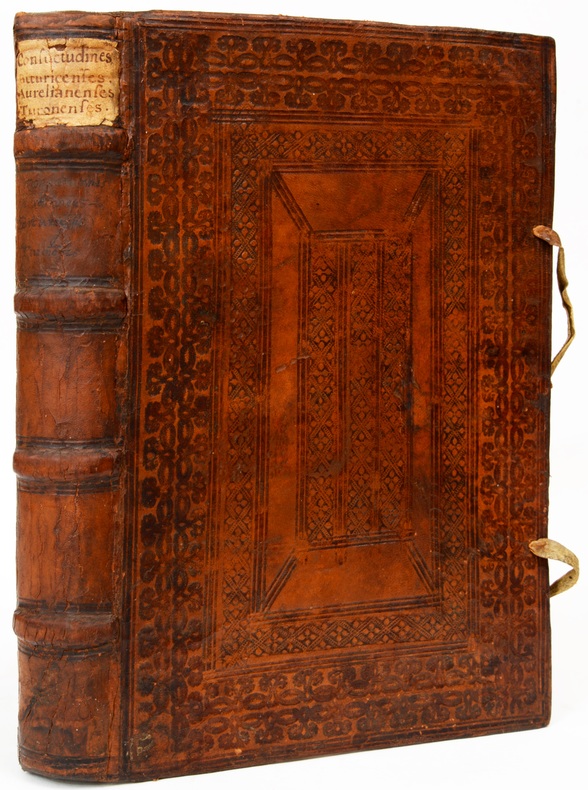
24420Bourges ? 0 In Quarto , 916 pp et une table manuscrite. Recueil factice de 79 titres. Exceptionnelle réunion comprenant , Un portrait gravé de Catherinot - Le patriarcat de Bourges ( 20 pp ) - Les archevêques de Bourges ( 8 pp) - Les Eglises de Bourges ( 10 pp) Les diocèses de Bourges ( 8 pp ) Le Pouillé de Bourges ( 16 pp) Le Vray Avaric (12 pp ) Les tribunaux de Bourges ( 12 pp ) Le Siège de Bourges ( 4 pp) Bourges Souterrain ( 8 pp ) Les patronages de Berry (8 pp) Le Sanctuaire de Berry ( 35 pp dont 2 ff manuscrits ) - Le Nécrologe de Berry ( 8 pp ) - Le Bullaire de Berry ( 4 pp ) - Le Diplomataire de Berry ( 4 pp ) - Annales Ecclésiastiques de Berry ( 4 pp ) Annales Thémistiques de Berry ( 3 ff manuscrits ) Annales académiques de Boyrges (4 pp ) - Annales typographiques de Bourges ( 8 pp ) - Le Nobiliaire de Berry ( 8 pp) - Les ducs et duchesses de Berry ( 4 pp ) - Le droit de Berry ( 12 pp ) - La chronographie de Berry ( 8 pp ) - le calvinisme de Berry ( 4 pp ) - Les Philippes de Berry ( 8 pp ) - les dominateurs de Berry ( 4 pp ) - les fondateurs de Berry ( 8 pp ) - Les fastes Consulaires de Bourges ( 4 pp ) Les Illustres de Berry ( 12 pp ) - Les Recherches de Berry ( 8 pp ) - Les Alliances de Berry ( 6 ff manuscrits - Antiquités Romaines de Berry ( 8 pp ) - La Gaule Grecque ( 8 pp ) - N.C. Fori Biturcensis Inscriptio ( 44 pp ) - Nicolai Catharini scholarum Biturcarum inscriptio ( 12 pp ) - Que le parquet de Bourges est du corps de l'université ( (2) - 20 pp ) - Manuel de l'hospital général de Bourges ( 27 pp ) - manifeste de l'hopital de Bourges ( 7 pp ) - Les Avocats du Roy, conseillers, dissertation ( 8 pp ) - La Régale Universelle ( 20 pp ) - La Religion Unique ( 12 pp ) - Remarques sur le Testament de monsieur de Cujas ( 4 pp ) - La vie de Mademoiselle de cujas ( 4 pp )- Le mal Assigné ( 4 pp ) - Distiques sur le Louvre au Roy ( Plaquette In-12 de 2- 10 pp chez Jean Toubeau, 1672. insérée dans le recueil - Les Axiomes du droit François ( 8 pp ) - L'Avantage sans avantage ( 4 pp ) - Nicolai Catharini, Astigationes ad hymnos ecclesiae ( 8 pp ) - Que les coustumes ne sont point de droit étroit (19 pp ) - Nicolai Catharini Chronicon juris Sacri ( 4 pp ) - Nicolai Catharini Codex Testamentarum ( 4 pp ) La date mal contestée ( 4 pp ) - les doublets de la langue ( 12 pp) -Nicolai Catharini Gratianum recensitus ( 4 pp ) - Nicolai Catharini imperium romanum ( 4 pp ) - Les Intimez calomniez ( 4 pp ) - La main de Scevola ( 12 pp ) - Les Novales de Venesme ( 4 pp ) - le Prest Gratuit ( 92 pp ) -Les paralleles de la Noblesse ( 4 pp ) - Les pasquinades Anciennes ( 4 pp ) - La prévention ( 8 pp ) - Nicolai Catharini Antediluviani ( 4 pp ) - Le Journal du Parlement à Monsieur de Guéret ( 4 pp ) - Repotia Catharinica ( ( 4 pp ) - La Commission pour le sieur Catherinot ( 4 pp ) - Manifeste pour le seigneur de Coulons sur Oran ( 8 pp ) - Escu d'Alliance ( 20 pp et une planche d'Héraldique ) - Factum pour M. Nicolas Catherinot sieur de coulons ( ...) contre M rené Dorsanne, Seigneur de Tizay (...) ( 10 pp ) - Tombeaux domestiques ( 4 pp ) - Tombeau Généalogique ( 40 pp ) - L'art d'Imprimer ( 12 pp ) - Traité des Martyrologes ( 4 pp ) - Traité de l'Architecture ( 24 pp ) - Traité de la peinture ( 24 pp ) - Traité de l'Artillerie ( 16 pp ) - Traité de la Marine ( 27 pp ) - 2 ff de tables manuscrites. reliure d'époque, plein veau mors fendu, reliure du XVIIIème siècle. Bien souvent publiées à compte d'auteur par le sieur Catherinot, Avocat Original, Curieux, éclectique, ces plaquettes sont devenues très rares.
200319393Lucerne, Faksimile Verlag Luzern, 2003, n° 83 d'un tirage unique limité à 980 ex., 2 vol. in-8°, 1 vol. de commentaires de 220 pp. en FRANCAIS et 1 vol. fac-similé de 225 ff., 172 miniatures. Reliure plein maroquin richement orné doré, roulettes dorées sur les coupes et remplis, toutes tranches dorées, volume de commentaires en demi-cuir, les 2 vol. dans leur emboîtage en plexi d'origine. Proche du neuf.
200319393Lucerne, Faksimile Verlag Luzern, 2003, n° 83 d'un tirage unique limité à 980 ex., 2 vol. in-8°, 1 vol. de commentaires de 220 pp. en FRANCAIS et 1 vol. fac-similé de 225 ff., 172 miniatures. Reliure plein maroquin richement orné doré, roulettes dorées sur les coupes et remplis, toutes tranches dorées, volume de commentaires en demi-cuir, les 2 vol. dans leur emboîtage en plexi d'origine. Proche du neuf.
198391288Down East Books. New. 1983. Hardcover. 0892721642 . FREE UPGRADE to Courier/Priority Shipping Upon Request - IN STOCK AND IMMEDIATELY AVAILABLE FOR SHIPMENT - Flawless copy brand new pristine never opened -- 179 illustrations. Catalogue Raisonne Catalog Raisonné Complete Works Life and Work Raisonnee -- with a bonus offer . Down East Books hardcover
1680024707London: William Berry 1680. .Kingdoms and States which are found there at present/Described by Sanson/Corrected and amended By William Berry =Kopftitel; Text der figürlich reich verzierten Kartusche oben rechts: Asia Divided into its Principall Regions in which may be seen the extent of the Empires Monarchies Kingdoms and States which at present divide Asia/To the Most serene and Most Sacred Majesty of Charles II./By the Grace of God King of Great Britain France and Ireland/This Map of Asia is humbly Dedicated and Presented By Your Majesties Loyal Subject and Servand William Berry; Text der reich verzierten Kartusche links oben: Scale es folgen Maßstäbe verschiedener Länder/London/Sold by William Berry at the Sign of the Globe between Charing-Cross and White-Hall/1680; SW-Kupferstich-Landkarte nach Nicolas Sanson d'Abbeville gestochen von William Berry; ca. 51 x 39 cm; Falzspuren einige Tintenflecken hauptsächlich ausserhalb des Druckbildes mässige Lichtverfärbung; professionell hinter Glas gerahmt in schwarzem Holzrahmen; äußerst selten; for description in other languages of this extremely rare map please don't hesitate to contact me. . Gut. Landkarte. William Berry unknown
22557USA: 20th Century Fox 2005. An original movie poster for 'Robots' from 2005. Measuring 100cm x 68cm. SIGNED by Robin Williams Halle Berry Ewan McGregor Greg Kinnear Drew Carey Amanda Bynes and the director Chris Wedge. In very good condition indeed 'Robots' 2005 is an animated science-fiction comedy set in a world populated entirely by mechanical beings. Robin Williams voices 'Fender' a fast-talking scrap-collecting robot whose manic humour and improvisational energy dominate the film. The story follows idealistic inventor Rodney Copperbottom as he challenges corporate greed and planned obsolescence. Williams's performance provides anarchic comic relief while reinforcing the film's themes of creativity individuality and social responsibility beneath its colourful family-friendly surface. 20th Century Fox unknown
L3 box1056 b1Andy Catlett: Early Education. By Wendell Berry. Wood Engravings by Wesley Bates. Published by Larkspur Press in 2010. Hardcover 30 pages.<br />This chapbook was handset in Garamond type printed on a hand-fed C & P then handbound. <br />950 copies were printed on Mohawk Superfine paper. A special edition of 100 copies was printed on Zerkall Book paper this book is one of this printing. <br /><br />The wood engravings were cut by Wesley Bates. <br />Design composition printing and binding by Deborah Kessler Leslie Shane Carolyn Whitesel and Gray Zeitz at Larkspur Press.<br /> Larkspur Press hardcover
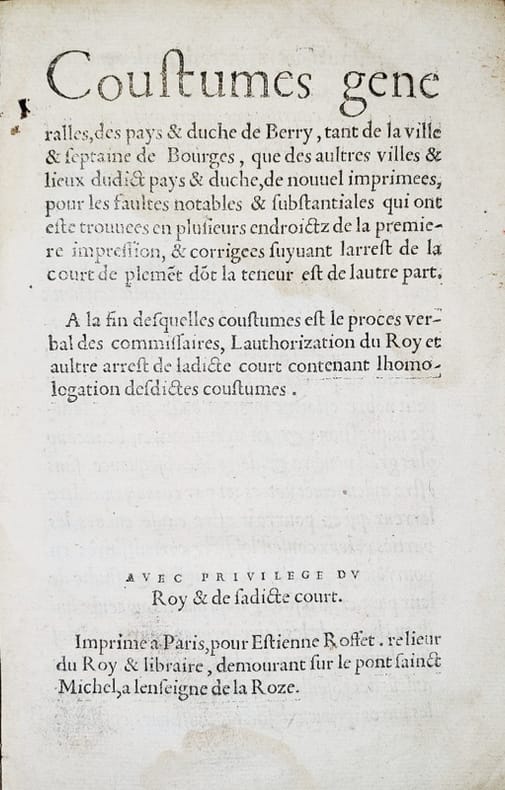
154144716Paris, Estienne Roffet, 1541. In-8 de 151 ff. chiffrés et 1 f. non chiffré, veau brun, dos à nerfs (reliure du XVIIe siècle).
2018Crete NE: The Best Cellar Press 1975. First edition. Softcover. Very good. <p>A standout association copy of this handsome chapbook inscribed on the front free endpaper: “To the Stegners with affection from the Berrys.†In Wendell Berry’s hand. Berry studied with Stegner "the Dean of Western Writers" as a Wallace Stegner Fellow at Stanford University and the two became lifelong friends. Berry’s essay "Wallace Stegner and the Great Community" in his collection What Are People For explains his influence even before he arrived at Stanford: "I saw plainly that this man when he was perhaps my age had known how to write and that he had known how much better than I did.†Stegner in turn wrote of Berry “It is hard to say whether I like this writer better as a poet an essayist or a novelist. He is all three at a high level." Stiff textured tan-gray wraps staple bound. Tan endpapers and stiff green pages. No limitation stated. Includes the poem "To Gary Snyder" another longtime friend. Very good with sunning along the spine and upper margins more pronounced on rear wrap; small slight scuff at top of front wrap. A great connection between renowned writers of place both with a strong moral and critical backbone</p> . The Best Cellar Press unknown

_1.jpg)