426 résultats
First Edition, 4to, xv, [i], 196pp., frontis., ex-library, 10 full-page facsimiles, orig. cloth-backed boards, lower hinge torn, uncut. As well as describing, in great detail, each work from Caxton's press it also includes some early imprints of Wynkyn de Worde, printed immediately after Caxton's death.
First Edition, 4to, xv, [i], 196pp., frontis., 10 full-page facsimiles, orig. cloth-backed boards, uncut. As well as describing, in great detail, each work from Caxton's press it also includes some early imprints of Wynkyn de Worde, printed immediately after Caxton's death.
First edition, [vi], 198pp., frontis., illustrs., orig. cloth, d.w. Signed by Nixon in pencil with several critical notes within the text, Nixon's 3 page list of the main points relating to William Caxton & Westminster for a forthcoming talk. Provenance: From the library of Howard M. Nixon (1909-1983), British librarian and bookbinding historian.
5016Florence, Claras Aquas, 1970. In-8 broché, 167 p. Dédicace de l'auteur (à son parrain). Très bon état. Extractum ex Periodico "Archivum Franciscanum Historicum", An. 63 (1970).
36333Paris, Librairie ancienne Honoré Champion sans date, vers 1910, 225x140mm, VIII- 98pages, broché. Couverture légèrement défraîchie, à l’intérieur, très bon état.
195365031953. Paris éditions Giraud-Badin 1953 - Broché 14 5 cm x 23 cm 60 pages - Texte de Denise Humbert préface de Jean Bonnerot envoi de l'auteur - Non coupé bon état
73Académie des sciences,inscriptions et belles-lettres de Toulouse Vers 1900
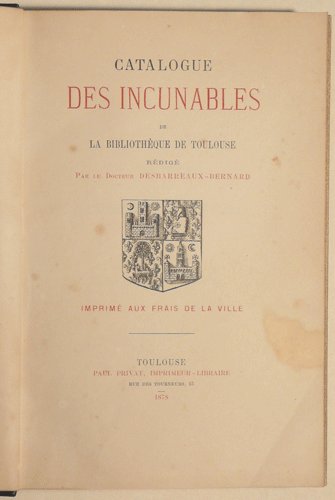
18780010151878 Toulouse, Paul Privat, 1878. In-8 (173 X 243 mm) demi-chagrin bleu nuit, dos quatre nerfs, auteur et titre dorés, tête mouchetée (Reliure postérieure) ; LXXIII-266 pages + XXV planches dépliantes et 27 planches hors-texte dont une non numérotée. Quelques rousseurs.
First edition, 3 vols., bound in 4, 4to (279 x 185 mm), ONE OF 100 COPIES PRINTED ON THICK AND LARGE PAPER WITH EXTRA PLATES, [4], xxv, [7], 462,lxxix, [1]; [2], 555, [1]; [2], 298; [2], 299-622, lxiipp., with the author's wood-engraved device on each title-page, a wood engraving of the elaborately-quartered coat of arms of the Roxburghe Club on the dedication page, 85 engraved plates ((including the private plate of 'Diana de Poictiers' in vol. 2, which was apparently destroyed after only 50 copies had been printed, and a proof of the 'Prater' plate in vol. 3), 62 illustrations printed on fine and thin "India" paper and mounted on the text leaves, 55 other illustrations in the text, with the additional sixty engraved plates on 52 leaves from Lewis' Series of Groups bound in at the appropriate places as designated by Lewis in his 'Directions to the binder', contemporary notes in pencil to several endpapers and a few within the text, text and plates have staining of varying degrees, pale stain to many lower margins, a little damage to endpapers where bookplates have been removed, full red hard grain red morocco,,covers waterstained, spines lettered in gilt, all edges gilt. Unfortunately this handsome large paper copy has suffered from water damage sometime in the past, additional photographs are available upon request. This set with the additional set of etchings on india paper by George Lewis, of a classic work of the utmost importance for its wealth of eye-witness information and anecdotes about printed books, manuscripts, buildings, other artefacts and people, both from past centuries and from the author's own day, for the extraordinary collection of illustrations, mostly drawn during the tour itself, and finally as a sumptuous piece of book production. As soon as the book appeared, leading scholars derided Dibdin for his lack of scholarship, especially concerning early manuscripts and printed books. But one must distinguish between the extensive and extremely useful information about things and people Dibdin saw during his 1818 tour, and his own interpretations and conclusions, which now serve only as a window to the attitudes of the time. Dibdin's enthusiasm, readable style and entertaining anecdotes, moreover, caught the mood of his age, making the book extremely popular and influential. Lewis' A Series of Groups... was intended to accompany Dibdin's Tour but was rejected by Dibdin as unworthy of his book. Lewis, most perturbed, issued them at his own expense and presented his case in the eight-page Advertisement which was separately printed. Jackson 48; 56; 56n: Windle & Pippin A38a; A44; D13.
9454broché - 16x24 - 176pp - 1984 - editions cahiers dolois n°7
Small 4to (230 x 185 mm), 19, [1]pp., orig. printed wrappers bound-in, cont. cloth, slight stain to lower fore-edge of covers.
4to, 136pp., 53 facsimiles, orig. cloth. A complete listing, as known at the time, of all extant copies of 15th-century English books. Has 431 entries with detailed descriptions of the different imprints, noting variations where pertinent. Also provides location of copies.
First edition, [x], 136pp., 4to, 53 facsimiles, orig. cloth-backed boards, t.e.g. A complete listing, as known at the time, of all extant copies of 15th-century English books. Has 431 entries with detailed descriptions of the different imprints, noting variations where pertinent. Also provides location of copies.
1893T100146London, Kegan Paul, Trench, Trübner & co. 1893 x + 219pp. + 13 plates out of text, original 1893-edition, Large paper edition ; 150 copies printed on Dutch handmade paper of which this is no.125, pages loose (as published), 37x27cm., few occasional foxing/browning, good condition, T100146
x + 219pp. + 13 plates out of text, original 1893-edition, Large paper edition ; 150 copies printed on Dutch handmade paper of which this is no.125, pages loose (as published), 37x27cm., few occasional foxing/browning, good condition, T100146
1511PHO-1971Florence, Sd (circa 1511 ou avant février 1513), Antonio Tubini et Andrea Ghirlandi, in-8, A8-C6, parchemin époque, page de garde détachée avec manque, vieille mouillure claire sur 2 feuillets.
463Divisés en XII livres. ... Nouvelle Édition, Imprimée sur celle de Marseille, avec son ancienne Approbation... À Québec, (Montréal), Chez Fleury Mesplet & Charles Berger, Imprimeurs & Libraires, 1776. In 12 (15.7 cm) (6)f.,610p.,(1)f. Reliure originale pleine basane très frottée, épidermures, chemins de vers, tranches brunies. Exemplaire incomplet de 38 feuillets (p. 339-358; 365-380; 387-406 et 411-430). Plusieurs autres feuillets avec taches ou déchirures, sans pertes de texte sauf p. 133-136 et 173-174. Vlach & Buono 457. Tremaine 232. Lande S 691. Gagnon II, 313: « Ce volume en parfaite condition est une grande rareté ». [ Incunable canadien.]
[400 incunabolo Vicenza](cm. 28.5 x 20.2) Ottima piena pergamena XVIII secolo, titolo manoscritto al dorso. -cc. 220 non numerate (di 224), carattere gotico, 58 linee 2 colonne, spazi per capitali con letterina guida. mancano solo le prime 2 carte di testo, non segnate, la successiva bianca A1, e l'ultima O6 anch'essa bianca. Seconda edizione stampata a Vicenza (prima 1478) di questa opera che ebbe uno straordinario successo, solo nel 400 si conoscono più di 30 edizioni!!! Descrive con cura la liturgia del tempo, il rito romano, spiega i vari significati allegorici ed è considerata una pietra miliare della liturgia del tardo medioevo; simbolismo, riti, paramenti ecc... L'"editio princeps" è uno dei libri più famosi al mondo, stampato nel 1459 a Magonza dal fust e Schoeffer, e considerato daH. P. Kraus, nella sua autobiografia, uno dei libri più belli e perfetti che esistono. Una copia straordinaria è apparsa in vendita nel 2012 a 750.000 euro, nel catalogo di una nota libreria antiquaria di londra che propone 75 incunaboli da sogno. Complessivamente alla nostra copia mancano 2 carte di testo e 2 carte bianche. Inizia con carta A2 presente, con 2 note manoscritte coeve al margine alto, e termina con la carta 223 che contiene il colophon; questa carta è stata rimessa, presenta bruniture e lievi fioriture. Il margine in alto, con alone a scomparire sulle prime carte, altrimenti esemplare molto bello, nitido e con buoni margini alcune note coeve a carta 213 e 214. provenienza: Asta Sotheby's Firenze 1982, lotto 34. * H.C. 6482; *IGI 3629; * Goff D 423 (solo 6 copie); * GW 9120; *Proctor 7159, * Oates 2679; *Polain 4342: Olschki "Monumenta" cat. 53 (1903) n° 1323 (scompleto); * Harvard libr. 3496. Questa nostra edizione di Vicenza manca al BMC. [f83] Libro
27314Bordeaux / Paris Société des Bibliophiles de Guyenne / Bibliothèque Nationale 1976 in 8 (25x16,5) 1 volume broché, couverture imprimée, 146 pages [1], avec 20 planches hors-texte en noir et blanc. Catalogue rédigé par Ghislaine Elliott-Loose. Index des lieux d'impression, des imprimeurs, des provenances, table de concordance. Collection de la Revue française d'histoire du livre, II. Bel exemplaire ( Photographies sur demande / We can send pictures of this book on simple request )
Very Good Turkish, Ottoman (1500-1928) Original color map of Eastern Anatolia, Dogu Beyazit, Bayazid, Bargiri, Nakhchevan, Karakilise, Van, etc. 50x60 cm. In Ottoman script (Enverî). 1 p. Scale: 1:200.000. Slightly toned, several small holes on paper. Otherwise a very good copy. Enverî script is the war minister Enver Pasha's alphabet and writing amendment, which he tried to implement within the Ministry of War between 12 March 1914 and 10 August 1914. Starting from the Tanzimat (Westernization) period in the Ottoman Empire, the discussions on simplification in language, writing, alphabet and reading-writing had increased and at the end of the 19th century, military necessities also became one of the concerns. The problems such as the low rate of literacy among the recruited soldiers, the need to teach the soldiers how to read and write in a short time, and their misconceptions about the spelling of proper nouns led Enver Pasha to add the writing problem to his reform agenda, once he took office. Enver Pasha's reform is based on the principle of writing the Ottoman letters, which take different forms in the beginning, in the middle and at the end according to their unification with the other letters, separately in their original state without merging them. While this new alphabet was being created, the existing 32 letters in the Ottoman were preserved. The 8 vowels in the Turkish language, which could not be written with the old letters, was shown by placing small marks on the existing vowels and by doing so a new alphabet consisting of a total of 40 letters was created. With this alphabet, officially called 'Ordu Elifbasi', rules were adopted such as writing of the letters without merging them, writing the words as they are pronounced. At first glance, Enver Pasha's writing reform, which appeared as a definite solution to the theory of the solution of the ongoing debates on the alphabet and the spelling, formed a wide experiment field in the military. It was not possible to use Ordu Elifbasi, which essentially is a transliteration alphabet that allows transferring the sounds of these three different languages (Turkish, Arabic, Persian) to a single alphabet, in the daily life. Thanks to this new alphabet and spelling, learning to read and write were accelerated to some extent. However, it was seen that the literacy rate of the well-educated, literate people fell to the spelling and did not even progress. This alphabet and spelling reform, which Enver Pasha thought of spreading to the whole country, caused much more problems as it was experienced in the army. Although it was postponed until the end of the mobilization period following the declaration of the mobilization, Ordu Elifbasi, which remained in force for 152 days, eventually failed to be realized. (Source: Karakus: Enver Pasha's Alphabet And Spelling Attempt: Ordu Elifbasi (Army Alphabet)).In this extremely rare document, there are some articles and thoughts on a case. This is one the serie of the Bonn projection maps which are the first map series in modern techniques in Turkey and the Ottoman Empire. In order to produce these maps covering Turkish territory, Reconnaissance Branch was incorporated into The Mapping Commission. The maps were produced in the datum based on the latitude and longitude of Ayasofya Mosque in equal area Bonn Projection. The field works for the 123 sheets covering the country were conducted by 76 staff. The production was completed in 18 years starting from east west. Field works continued without stopping except in years 1914 and 1920. This map series called also reconnaissance maps contributed a lot to producing 1:25.000 scale maps. Extremely rare. KW: "Harfleri Islah Cemiyeti" Hurûf-i munfasila Reform Turkish Letter revolution First World War WW 1 Map Geography Military maps.
Three parts in 6 vols., folio, limited to 350 copies, over 2,000 illustrs, orig. cloth, lightly marked. This monumental work is the most exhaustive bibliographical study of illustrated books of any place, country or period ever published, and it set new standards for descriptions. Essling, one of Italy's most famous collectors, assembled a vast collection of early Venetian woodcut books which served as a basis for his bibliography of Venetian illustrated books from 1450-1525. In all 2,585 works are meticulously described and collated.
1493D4438Venice: Johannes Rubeus 1493. Hardcover. Very Good. Venice: Johannes Rubeus 1 January 1493. Folio 315 x 225mm. 174 leaves. Collation: a 7; b-x 8; tabula 7. 61 lines Roman type capital spaces unrubricated. Contemporary notation and hand-drawn manicules indicating the text throughout many are whimsically flourished or holding objects. Final blank on watermarked paper of flying swan in pearled medallion. Content are in three parts the first is a revised and augmented version with excerpts taken from classical authors and Italian humanists and formulas for letter-writing. The second part consists of an anthology of prose writers including Cicero Lactantius Macrobuius Plutarchus etc. The third part contains selections from Petrarch dramatic poets Terence Seneca Plautus and a variety of humanist speeches by Renaissance copyists letter-writers and philosophers including Johannes Lamola Poggius Florentinus Galeatius Sforza and the author himself. Contents: Leaf 2a title: Oratorum omnium Poetarum: Hystoricorum: ac Philosophorum elegantes dicta: per Clarissimum iurum Albertum de Eiib in unum collecta faeliciter incipiunt. Leaves 120a-123b contain: Liber augustalis imperatorum Francisci Petrarchae Benvenuto Rambaldis continuation of Petrarchs Epitome vitarum virorum illustrium; Leaves 125a-129b: Francisci Petrarchae de aduersa fortuna Remedia; Leaves 129b- 132b: Francisci Petrarchae: de prospera fortuna remedia. Leaf 168b Colophon: Summa Oratorum omnium: Poetarum: Historicorum: ac Philosophorum Autoritates in unum collectae per clarissimum uirum Albertum de Eyb Vtriusque iuris doctorae eximium: quae Margarita poetica dicitur: faeliciter finae adepta est. M.CCCCLXXXXIII. Kalae. Ianuarii. Leaves 169a-175b: Tabula. totius . oprois. 18th-century three-quarter sheep over marbled pasteboards spine gilt with title silk book mark; wanting first and final original blank a few wormholes at the beginning and end some just affecting text; faint dampstaining in the upper margins few creased corners corner torn of m2 and marginal tear m8 very slightly spotted and soiled in places. From the Collection of Baron de Eyb his heraldic lithographed ex-libris dated 1899 to front pastedown an evident descendant of the author. Eyb is the name of an old Franconian noble family which is named after Eyb in Ansbach. It is likely this volume was owned by a contemporary with familial ties to the author and stayed within the family until the early 20th century. Eighth Edition of this important work of German Humanism. Albrecht von Eyb one of the earliest German Humanists was born in 1420 near Ansbach. Eyb went to Italy and devoted himself to humanistic study at the Universities of Pavia and Bologna. He returned to Germany in 1451 having been appointed Canon at Eichstätt and Bamberg. From 1452 to 1459 he was again a student at Bologna gaining the degree of doctor in 1459. That same year Eyb wrote Margarita poetica in honor of his mother Margarete von Wolmershausen. It was first published in Nuremberg by Johann Senschschmidt in 1472 and reprinted at least 13 times by 1503. It remained a popular manual of classical rhetoric by its three distinct focuses: letter-writing model orations and florilegia compilation of excerpts. The work is known for its vivid expression found within selected passages from classical and contemporary authors from Cicero to Petrarch. The Catholic Encyclopedia calls it a textbook of humanistic rhetoric consisting of a collection of passages in prose and verse from Latin authors to which are added specimens of humanistic eloquence. Of only about 40 in existence OCLC locates 13 copies of this edition in US collections. BMC V 417; Goff E177; GW 9536; HC 6824; Madsen 1547; Schmitt I 4233; Sheppard 4121; Proctor 5132 <br/><br/> Johannes Rubeus hardcover books
1493D4438Venice: Johannes Rubeus 1493. Hardcover. Very Good. Venice: Johannes Rubeus 1 January 1493. Folio 315 x 225mm. 174 leaves. Collation: a 7; b-x 8; tabula 7. 61 lines Roman type capital spaces unrubricated. Contemporary notation and hand-drawn manicules indicating the text throughout many are whimsically flourished or holding objects. Final blank on watermarked paper of flying swan in pearled medallion. Content are in three parts the first is a revised and augmented version with excerpts taken from classical authors and Italian humanists and formulas for letter-writing. The second part consists of an anthology of prose writers including Cicero Lactantius Macrobuius Plutarchus etc. The third part contains selections from Petrarch dramatic poets Terence Seneca Plautus and a variety of humanist speeches by Renaissance copyists letter-writers and philosophers including Johannes Lamola Poggius Florentinus Galeatius Sforza and the author himself. Contents: Leaf 2a title: Oratorum omnium Poetarum: Hystoricorum: ac Philosophorum elegantes dicta: per Clarissimum iurum Albertum de Eiib in unum collecta faeliciter incipiunt. Leaves 120a-123b contain: Liber augustalis imperatorum Francisci Petrarchae Benvenuto Rambaldis continuation of Petrarchs Epitome vitarum virorum illustrium; Leaves 125a-129b: Francisci Petrarchae de aduersa fortuna Remedia; Leaves 129b- 132b: Francisci Petrarchae: de prospera fortuna remedia. Leaf 168b Colophon: Summa Oratorum omnium: Poetarum: Historicorum: ac Philosophorum Autoritates in unum collectae per clarissimum uirum Albertum de Eyb Vtriusque iuris doctorae eximium: quae Margarita poetica dicitur: faeliciter finae adepta est. M.CCCCLXXXXIII. Kalae. Ianuarii. Leaves 169a-175b: Tabula. totius . oprois. 18th-century three-quarter sheep over marbled pasteboards spine gilt with title silk book mark; wanting first and final original blank a few wormholes at the beginning and end some just affecting text; faint dampstaining in the upper margins few creased corners corner torn of m2 and marginal tear m8 very slightly spotted and soiled in places. From the Collection of Baron de Eyb his heraldic lithographed ex-libris dated 1899 to front pastedown an evident descendant of the author. Eyb is the name of an old Franconian noble family which is named after Eyb in Ansbach. It is likely this volume was owned by a contemporary with familial ties to the author and stayed within the family until the early 20th century. Eighth Edition of this important work of German Humanism. Albrecht von Eyb one of the earliest German Humanists was born in 1420 near Ansbach. Eyb went to Italy and devoted himself to humanistic study at the Universities of Pavia and Bologna. He returned to Germany in 1451 having been appointed Canon at Eichstätt and Bamberg. From 1452 to 1459 he was again a student at Bologna gaining the degree of doctor in 1459. That same year Eyb wrote Margarita poetica in honor of his mother Margarete von Wolmershausen. It was first published in Nuremberg by Johann Senschschmidt in 1472 and reprinted at least 13 times by 1503. It remained a popular manual of classical rhetoric by its three distinct focuses: letter-writing model orations and florilegia compilation of excerpts. The work is known for its vivid expression found within selected passages from classical and contemporary authors from Cicero to Petrarch. The Catholic Encyclopedia calls it a textbook of humanistic rhetoric consisting of a collection of passages in prose and verse from Latin authors to which are added specimens of humanistic eloquence. Of only about 40 in existence OCLC locates 13 copies of this edition in US collections. BMC V 417; Goff E177; GW 9536; HC 6824; Madsen 1547; Schmitt I 4233; Sheppard 4121; Proctor 5132 <br/><br/> Johannes Rubeus hardcover
4to, one of 350 numbered copies, [66]pp., from the library of Dr H.A. Feisenberger with his signature, orig. paper covered boards, head and foot of spine slight chipped, unopened, uncut.
4to, 8pp., followed by 18 leaves of facsimiles, orig. two-tone cloth, uncut, a very good copy.