416 résultats
18153015Vers 1815 1815 Inventaire manuscrit vers 1815 d’une bibliothèque privée sans doute de la région de Limoge.Feuillets de différents formats assemblés en désordre, 18ff« Voici donc en abrégé et par ordre des matières le tableau sommaire en différents genres des ouvrages (…) tels qu’ils sont classés et placés par doubles rangées de chacune des tablettes de ladite grande armoire. »« De main gauche, dixième tablette deuxième rangée de livre mélange de vieilles brochures et imprimés, première rangée sur le fond et l’arrières, vieux ouvrages en parchemin.Deuxième tablette : inventions, secrets et jeux récréatifs, sept volumes en parchemin.« Magasin des modes françaises et anglaises. Plan généalogique de fortifications de guerre (plus loin) collection informe et dévastée (aujourd’hui sans ordre), mais considérable et précieuse en ce qu’elle est composée d’un très grand nombre d’estampes et gravures anciennes et de différents genres de la main d’hommes alors célèbres dans l’école. Les unes et les autres enfermées comme enfouies pèle et mêle sous des cartons multipliés et de différentes grandeurs et formats. "
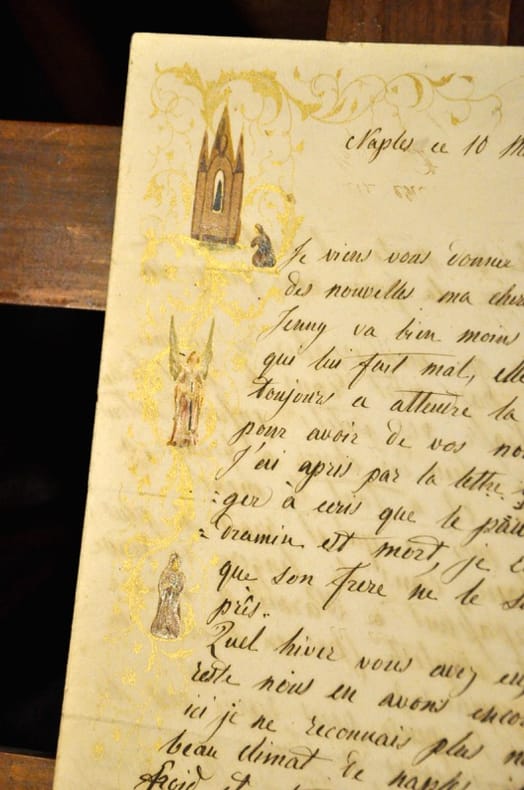
3018Naples, 10 mai 1850. Très belle lettre écrite sur un petit bi-folium, agrémenté en marge d’une grande composition à l’or et de trois aquarelles dans le style troubadour : Un personnage en prière devant une église, un ange et une sainte femme (pochoir et aquarelle). Une charmante lettre adressée à sa « chère Grum », le climat de Naples n’est pas clément, « Le Roi a ete bon pour eux il a permis a Adinolphe de porter l’uniforme de Husard de la garde vous pensez sa joie », suivent quelques nouvelles domestiques. Très beau document dans l’esprit néo gothique cher à la Duchesse.
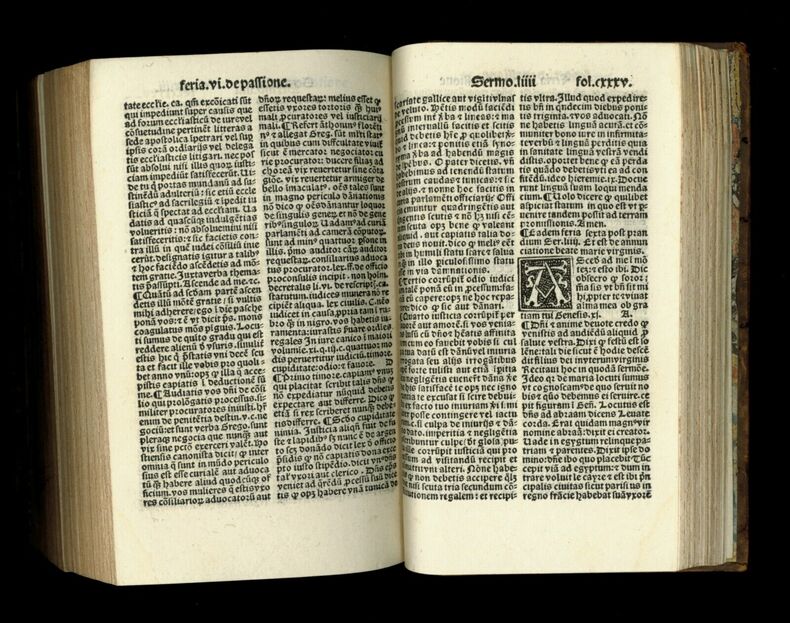
[Incunabolo] (cm. 33) mz. pelle d' epoca, 3 nervi e assicelle in legno. Dorso con difetti, un piatto rimesso in epoca successiva.-- carte 310 numerate (di 313) + carte 5 non numerate. Caratteri gotici di differenti grandezze, due colonne, 66 linee. Bei capolettera ornati e figurati grandi e piccoli a fondo nero. Uno particolarmente bello a carta 239. Incunabolo molto bello e importante per il prezioso commento ai quattro vangeli scritto dal 1261 in poi dal grande aquinate, filosofo e dottore ufficiale della chiesa cattolica. L' ultima carta (oo6) contiene il colophon, il registro e la bella marca tipografica a fondo nero dello Scoto per la quale vedi Kristeller n° 281. Incunabolo particolarmente raro. Secondo Goff nessun esemplare in America, manca a Polain, Harvard, Cat. Harper (1930) e al grande Cat. 24 di rosenthal che nel 1900 mette in vendita a Monaco ben 3500 incunaboli. Purtroppo mancano solo 3 carte iniziali numerate 1,3 e 4 con segnatura a1, a3, a4. Le ultime sei hanno lievi macchie e aloni sempre ai margini. Le prime carte presenti, numerate 2,5,6,7,8 sono staccate e difettose, la n° 2 ha un buco con perdita di testo, meritano di essere restaurate. Tutto il resto del volume da carta 9 segnata b1 a carta 313 segnata oo è in esemplare veramente bello nitido fresco e marginoso. Il verso dell' ultima carta è bianco e porta un ex libris manoscritto dell' epoca: "ad usum fratris Raphaelis de Urbino...ipse liber". * Hain 1336; * I.g.i. 9519; * Proctor 5043; * Oates 1669; * Pellechet 909; * Olschki "Monumenta" 891; * Olschki " Inc. Typ." 23; * Walters "Inc. Typ." p. 32; * Bmc V 441.[f80] Libro
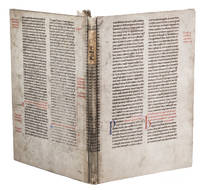
14869BDEHOBV62VDWürzburg: Georg Reyser 1486. Later bound in two leaves from a 13th-century vellum theological manuscript rubricated and decorated with alternating red and blue initials with penwork. Folio. Printed in red and black in rotunda type 32 lines; printed area: 18 x 12 cm; type: 112a. With illustrations cut from 19th- or 20th-century reproductions of early woodcuts ca. 21 x 14 cm pasted on the front Annunciation and back pastedown Christophorus with the year "cccc xx tercio". Interesting example of the study of early printing in 19th-century England. The 12 leaves come from the library of the 19th-century collector Dr C. Inglis whose father boasted an impressive collection of early printed books. Inglis believed that the leaves came from an unknown work titled De vita et honestate clericorum ex consilio Moguntinum printed in 1453 by Gerhardus Episcopus. Tipped in is a letter to Inglis by the well-known bibliographer William Blades discussing this matter. Although the text opens with "De Vita et honestate clericorum ex consilio Maguntinensis Gerhardi Archiepiscipi" it was in fact part of Statuta synodalia herbipolensia printed at Würzburg by Georg Reyser in ca. 1486. The first 6 leaves are 2-d7 and the final 6 leaves are quire g.With owner's inscription of Sir Edward Coates bookplate with initials "CC" Clifford Coates the bookplate of Dr. C. Inglis and some annotations on front pastedown; an autograph letter signed by Wiliam Blades to C. Inglis tipped to flyleaf. 12 well-preserved leaves.l Cf. BMC II 572; Goff S-741; Hain 15036; Hubay Inc. Universitätsbibl. Würzburg 1953; ISTC is00741000. Georg Reyser, hardcover
14617Bruxelles, 6 Novembre 1954. 1 vol. in-8° br., 71 pp. et 16 planches h.-t. en photogravure.[C05]
First edition, 8vo (205 x 130 mm), [4], vi, 158pp., portrait frontispiece, some light water-staining to a few margins, recent marbled boards, morocco title label to spine. "A sketch of the life of Gutenberg, with a eulogium of his invention."?Bigmore & Wyman. Bigmore & Wyman II, p. 70.
Very Good Turkish, Ottoman (1500-1928) Contemporary quarter dark burgundy leather bdg. Grey cloth boards. Four compartments at spine. Cr. 8vo. (20 x 14 cm). In Ottoman script (Old Turkish with Arabic letters). 96 p. [48 leaves]. 19 lines on each page. Printed on paper with European watermarks. A small tear up to the last page with no loss of text. Overall a fine copy. The 9th incunable of the Islamic world, written by Ibrahim Müteferrika and printed in his legendary Basmahane. Known as the most significant work by Müteferrika, this incunable is a political and state-theoretical treatise composed in order to improve the Ottoman government. In his book, Ibrahim Müteferrika used the sources written in Latin in the Europe of his period, and he presented it to Sultan Mahmud I right after the Patrona Halil Revolt (1730). Müteferrika divided the state forms of government in Europe into three groups with the titles "monarkiya" [i.e. monarchy], "aristokrasiya" [i.e. aristocracy], and "demokrasiya] [i.e. democracy]. In the work, the importance of the sciences (physics, astronomy, and geography) in the state administration was emphasized, and it was stated that a solid-state order could not be established in a country where these sciences were not developed. In addition to this, he used the term "Nizâm-i Cedîd" [i.e. The New Order] for the first time and stated that the Ottoman Empire should definitely adopt and implement the new military orders of the 18th century Europe. In addition, this work is one of the earliest in which the "democracy" term is used in the Islamic world. The book was published in French in Vienna and Paris in 1769 (Traite de la tactique ou méthode artificielle pour l'ordonnance des troupes, Vienne, 1769. Translated by Karl Emerich Alexander von Reviczky von Revisnye [Baron Reviczki]), and was translated from French into Russian in 1777. One of only 500 copies. The volume appeared in 1732, about one and a half years after the uprising of Patrona Halil Revolt which had overthrown the system of Sultan Ahmed III and Grand Vizier Damad Ibrahim. The writing, recalling the characteristics of Ottoman siyâsetnâme [i.e. the book of politics], calls the attention of the Ottoman leaders to the results of the state and military development and to the reasons for the strategic superiority of the rival European powers, while strongly condemning the several centuries long disinterest of the Ottomans to the external world. An important feature of the work is to break with the hitherto prevailing nostalgic attitude to bygone golden ages. Although observes the stylistic conventions in as much he speaks contemptuously about the Christian nations, in the content, already turns away from the indifference referring to the superiority of Islam. It announces in a list organized by items the reasons for the state's weakness and the conditions of rising. In harmony with the main aspects of contemporary Ottoman reforms, the work mainly focuses on the necessity of the reorganization of the army. It also offers a broader historical background by describing after the Greek philosophers the various types of states (6v-7v), or by treating the origins and reasons for the success of the foundations of European culture, the Roman Empire (19v-20v). The concept "Nizâm-I Cedîd" (i.e. the New Order), which would be used for the newly organized military formations of Sultan Selîm III (1789-1807), appears here for the first time referring to the modernized European army (17v-18r). "The utopistic optimism of Risâle-i Islâmîye may have had some rational basis, if one takes into account the Karlovci Treaty (1699) which was a rather positive correction in contrast to the previous series of Turkish failures in the Balkans, the European 'internal wars' of the first decade of the 18th century, and the experiences of the reform and peace years of the Tulip Period. However, the Usûl ül-hikem. was already inspired by the atmosphere after the Pozarevac Treaty (1718) which was a further stro
Very Good Turkish, Ottoman (1500-1928) Full leather new bdg. Original illustrated cover saved inside. Roy. 8vo. (24 x 17 cm). In Ottoman script (Old Turkish with Arabic letters). [12], 166, [2] p., b/w and color plates of Ottoman warships and scenes from naval wars, seven maps of the earliest examples of Ottoman cartography. Very rare second edition of this book on the history of Ottoman naval wars against Venetians began with the Crete campaign (War of Candia) in 1645 and lasted for years until 1656. The book was published first in 1729 in Müteferrika Printing House which was the first printing house in the Islamic world as the third printed book. This is the second edition including five maps of almost the same size (two paged) titled world map, The Mediterranean, The Archipelago (Aegean), The Adriatic Sea, and the compass-like in its first edition as well as two maps and twenty-six plates (some of them are color) and small illustrations of Ottoman ships as head of some carriage returns. Additional maps depict the city of Venice (from Kitab-i Bahriye [i.e. Book of Navigation) and the travels of Ottoman Admiral Sidi Ali Reis through the Sea of Oman. The Cretan War or the Fifth Ottoman-Venetian War, was a conflict between the Republic of Venice and her allies (chief among them the Knights of Malta, the Papal States, and France) against the Ottoman Empire and the Barbary States because it was largely fought over the island of Crete, Venice's largest and richest overseas possession. This account of Ottoman maritime warfare in Turkish, written in Safer 1067/November 1656. This date places the book in a moment of utmost danger for the Ottoman capital following the defeat of the Ottoman navy at the hands of the Venetians at the Dardanelles (4 Ramadan 1066/26 June 1656) and the subsequent loss of the islands of Lemnos and Tenedos. It is also written shortly after the appointment of Köprülü Mehmed Pasha as grand vizier (25 Dhulqada 1066/14 September 1656). Thus it is suggested to read it as a program of reform of the navy intended for a person whom Hadji Khalfa might have seen as the "man of the sword" who might revert the fate of the Empire. Of the four ulemâ [i.e. scholars] who wrote endorsements for the book, two are closely related to the Köprülü family. The first part is a history of Ottoman maritime campaigns from the beginning to 1067/1656, while the second is a systematic description of naval affairs, from administration and offices to shipbuilding, culminating in a list of 40 suggestions for the organization and strategy of the Ottoman navy, including the use of recent scientific and technological innovations. Thus the juxtaposition with history provides an argument for reform. Suggestions are largely centered around the traditional qanun-i qadim; there is no reference to high-board ships. The final pages include an important discussion of historical causality, explaining how divine omnipotence creates the consequence of historical causes, in reward for the righteous rule, or punishment of injustice. (Source: Ottomanhistorians). Özege 21273.
183831291838-1842 Une correspondance adressée à la femme de lettre féministe socialiste française, l’une des figures majeure du socialisme utopique du XIXe siècle, Flora Tristan (7 avril 1803 – 14 novembre 1844)Ensemble de 5 lettres adressées à Flora TRISTAN, formant 9 pages in4, in8 et in12, Alger, Paris et s.l, 1838-1842 et s.d.Adresses aux versos des seconds feuillets avec marques postales.Bory de Saint Vincent écrit ces lettres à Flora Tristan alors qu’elle a déjà pris contact avec Charles Fourier et travaille à son maître ouvrage.Elle publie en 1838 « Méphis » en deux volumes et vient de survivre à une tentative d’assassinat en 1839 par son ex-mari. Ses « Promenades dans Londres » en 1840 lui ont fait prendre conscience du prolétariat anglais l’amenant à publier en 1843 l’union ouvrière dans lequel se trouve cet adage célèbre « Prolétaires de tous les pays unissez vous ».La rencontre qu’elle fit avec Prosper Enfantin, qu’évoque Bory de Saint Vincent, eut une influence considérable sur la nature de ses réflexions.Bory de Saint Vincent va le lui présenter lors d’un dîner philosophique. Il évoque leurs « explorations ethnologiques » à Oran et ajoute « Je doute qu’il s’occupe encore de faire du saintsimonisme et des Religions. Il donne dans le positif, anime beaucoup de tables [...] ».
552(Québec, John Neilson, 1799). In-8 (20.6 cm) (1)f.,24p. Tiré d'un volume relié. Manque 2 feuillets, le faux-titre et le titre. Déchirure au 3e f., sans perte de texte, rousseurs. D'après Trémaine 1140, le tirage fut de seulement 497 exemplaires. TPL 731. Dionne I, 52. Gagnon I, 2723. Vlach & Buono 860. Lande 2079. [ Incunable canadien.]
2983Allemage XVe siècle Grande initiale A enluminée sur peau de vélin (150 x 125 mm) représentant Sain Laurent tenant son grill de la main gauche et un livre dans la main droite. Placé sur un fond rose pale orné de croisillons d'or liquide, Saint Laurent est vêtu d’une chasuble bleue orné de médaillons dorés. Bel effet de drapé servi bandes d’or ornant le vêtement.
Very Good Greek, Modern (post 1453) Original b/w city map of Byzantine Constantinople printed in 1936, Noemvrios (November). Oblong: 32x46 cm. In Greek (Modern). Folded. Scale: 1:2000. [GREEK MAP of BYZANTINE CONSTANTINOPLE] Byzantion Konstantinoupolis: To petrion kai ta peristh autou. Khartis topographikos - arkhaiologikos ikpointheis kai katartistheis upo Misn. It show Haliç (The Golden Horn) section and shores of Constantinople.
42926Paris, Thielman Kerver, 1498. In-8 gothique sur peau de vélin (115 x 175 mm) de (112) ff. (sig. A-O8), 25 lignes à la page, veau brun sur ais à large décor estampé à froid, dos orné à nerfs, tranches dorées, fermoirs (reliure de l’époque).
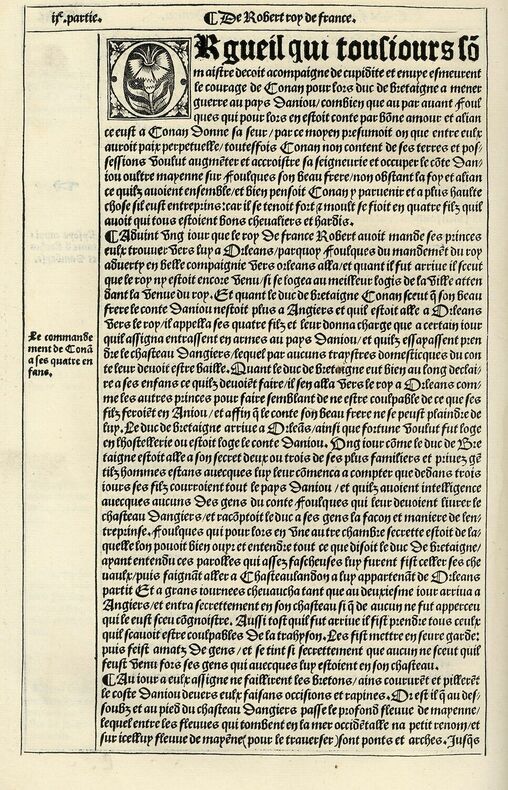
1529AMO-4514On les vend à Angiers en la boutique de Charles de Boingne et Clément Alexandre marchands libraires jurés de l'université dudit lieu. [Nouvellement imprimées à Paris par Anthoine Cousteau imprimeur pour Charles de Boigne et Clément Alexandre marchands libraires à Angers, et furent achevées d'imprimer au mois de janvier l'an 1529 [i.e. 1530]. 1 volume in-folio (30 x 20,5 cm | Hauteur des marges : 293 mm) de 4 feuillets non chiffrés (comprenant un feuillet de titre imprimé en rouge et noir dans un encadrement gravé sur bois avec Privilège au verso en date du troisième jour de décembre 1529, 2 feuillets de table (intervertis), un feuillet d'errata et omissions avec au verso une gravure sur bois pleine page représentant Louis de Savoie recevant l'ouvrage de l'auteur devant un collège d'évêques et de membres de la cour), CCVII [207] feuillets chiffrés et un feuillet avec la marque de Galliot du Pré (petit manque angulaire loin de la marque). Collationné complet malgré quelques erreurs de foliotation à l'impression. Texte imprimé dans un enacrement de filets noirs. Reliure pleine basane noire, dos orné (reliure datant du début du XIXe siècle). Reliure frottée, dos passé frotté, quelques usures. Intérieur assez frais. Quelques renforts de papier dans la marge intérieure ou extérieure de quelques feuillets. Exemplaire non lavé. Edition originale rare.
15691Paris, Enguilbert I, Jean I et Geoffroy I de Marnef (impr Philippe Pigouchet), 1491. In-8 gothique (143 x 100 mm) de (96) ff. (sig. a-m8), maroquin brun, dos à 5 nerfs, quadruple filet d'encadrement et fleurons aux angles à froid sur les plats, tranches dorées (reliure du XIXe siècle).
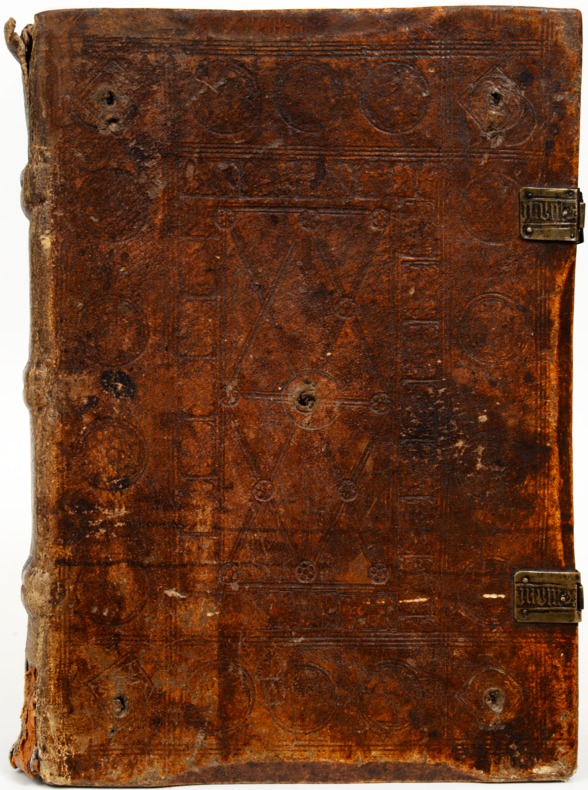
16006Ulm, Johann Zainer, [1478 ca]. Petit in-folio gothique (20 x 29 cm) de (418) ff. à 40 lignes par page, sans foliotation, réclames ni signatures dont 2 feuillets blancs (1er et 371e), peau de truie sur ais de bois biseautés, dos à trois nerfs, décor géométrique estampé à froid dans un encadrement de médaillons, titre manuscrit en noir sur le dos, fermoirs, traces de cabochons (reliure de l'époque).
2884Arnheim, 1799- 1815, Manuscrit constitué de feuillets de récupération, découpés et assemblés en cahiers reliés dans un petit in-8 en demi-veau miel. Un volume sur le thème des nombres.
Very Good Turkish, Ottoman (1500-1928) Original b/w map from Kitab-i Cihannuma which is one of the most important Turkish incunabula. Oblong large 4to. (31 x 37 cm). In Ottoman script. It shows Venice and Venetian Bay and Algerian shores at North Africa (Maghrib). Toponyms are in Turkish with Arabic letters. Written directions (Simal, Cenûb, Sark and Garb) on corners of the map, and decorative compass on Mediterranean Sea. Scale can be seen at left upper side (El-mikyas: Mil-i Islâmiyân Mil-i Frençe, and Mil-i Italiya]. It's one of the thirteen maps and plates from the book of Cihannuma. The story of Cihannuma can be considered as an effort to keep up with the speed that knowledge spread around the world at a time when literacy was highly limited. Kâtip Çelebi began to rewrite Cihannuma in 1654. During the next six years, he added to his books the knowledge he gained from the books he read. Kâtip Çelebi was vastly influenced by nonreligious positive knowledge, especially by the Atlas and later the Atlas Minor of Gerardus Mercator. He had the book translated from Latin to Turkish by a French recruit andenriched his own book with the new information. He brought together in Cihannuma the knowledge of geography and astronomy existing in Western sources (1654). Cihannüma has 13 charts and 27 maps. Mercator's maps are distinguished by their distinct properties. However, there are such maps which depict Istanbul, Anatolia, the Caucasus and the Orient that have to have been borrowed from other sources and there are those with relatively less detail that might have been prepared by Muslim geographers. Sources cite Ahmed El Kirimî (Ahmed the Crimean) and Galatali Migirdich as mapmakers for Cihannüma. Their names are placed on the maps. Another name that is mentioned is Tophaneli Ibrahim. Researchers agree on the fact that he is Ibrahim Müteferrika. Perhaps he wished to hasten the printing of the book. Perhaps he enjoyed making this contribution to a book he half owned. There is one map in Cihannüma which definitely does not belong to Mercator. Nor is there any information that it was originally charted by Müteferrika's team. Historians state that the 'invertedness' can be found in other maps made by Muslim cartographers. Since it is amap of Turkey, the difference can easily be perceived. The Mediterranean coasts of Turkey are at the top of the map while the Black Sea coasts are at the bottom. The compass on the map correctly indicates the North. The map seems to be inverted but it is not considered scientifically wrong to draw maps in this fashion...". (Source: Boyut; Kitab-i Cihannuma). Extremely rare.
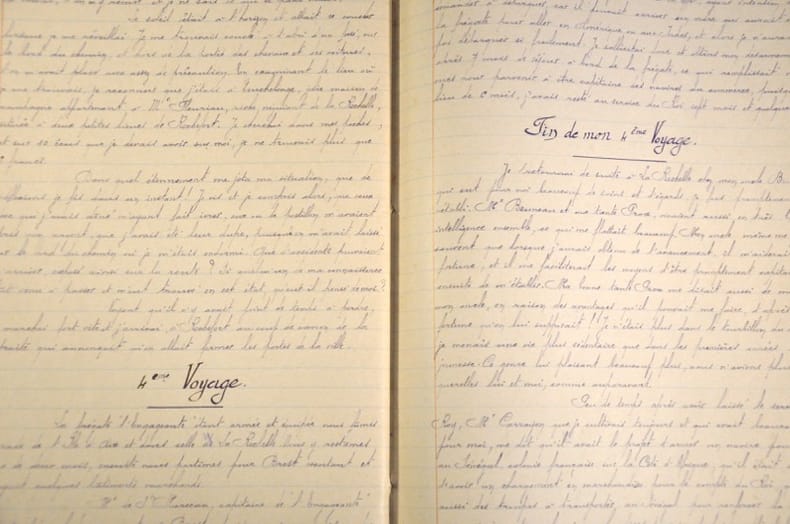
3042Vers la fin du XVIIIe siècle Cahier In 4 en couverture souple, « J.J Proa _ Mes mémoires » écrit à l’encre brune sur le plat supérieur. Manuscrit rédigé au net, certainement par un membre de la famille de J.J. Proa vers la fin du XVIIIe siècle. Manuscrit rédigé à l’encre violette très joliment calligraphiée. 1bl, 113ff, 2bl
Very Good Turkish, Ottoman (1500-1928) Original b/w city map of Byzantine Constantinople printed in ??? by Tüccarzâde Ibrahim Hilmi Çigiraçan, (1876-1963). Oblong: 37x50 cm. In Ottoman script. Folded. Scale is not described. Toponyms are Turkish besides some of old Byzantine. [OTTOMAN MAP of BYZANTINE CONSTANTINOPLE] Kurun-u vustâ inhâsinda Kostantiniyye. Doktor Moritma'nin tetkikâtina göre kable'l-feth-i sehrin plâni. Feth-i Kostantiniyye asârina aiddir. Published by Ibrahim Hilmi. Ibrahim Hilmi Çigiraçan was a Turkish publisher and author. He is one of the first Turkish publishers of the Ottoman Empire. He published more than 1000 books on history, literature, politics, religion and social issues and maps in the printing house he founded in 1896.
Very Good Turkish, Ottoman (1500-1928) Original color map of Eastern Anatolia, Dogu Beyazit, Bayazid, Bargiri, Nakhchevan, Karakilise, Van, etc. 50x60 cm. In Ottoman script (Enverî). 1 p. Scale: 1:200.000. Slightly toned, several small holes on paper. Otherwise a very good copy. Enverî script is the war minister Enver Pasha's alphabet and writing amendment, which he tried to implement within the Ministry of War between 12 March 1914 and 10 August 1914. Starting from the Tanzimat (Westernization) period in the Ottoman Empire, the discussions on simplification in language, writing, alphabet and reading-writing had increased and at the end of the 19th century, military necessities also became one of the concerns. The problems such as the low rate of literacy among the recruited soldiers, the need to teach the soldiers how to read and write in a short time, and their misconceptions about the spelling of proper nouns led Enver Pasha to add the writing problem to his reform agenda, once he took office. Enver Pasha's reform is based on the principle of writing the Ottoman letters, which take different forms in the beginning, in the middle and at the end according to their unification with the other letters, separately in their original state without merging them. While this new alphabet was being created, the existing 32 letters in the Ottoman were preserved. The 8 vowels in the Turkish language, which could not be written with the old letters, was shown by placing small marks on the existing vowels and by doing so a new alphabet consisting of a total of 40 letters was created. With this alphabet, officially called 'Ordu Elifbasi', rules were adopted such as writing of the letters without merging them, writing the words as they are pronounced. At first glance, Enver Pasha's writing reform, which appeared as a definite solution to the theory of the solution of the ongoing debates on the alphabet and the spelling, formed a wide experiment field in the military. It was not possible to use Ordu Elifbasi, which essentially is a transliteration alphabet that allows transferring the sounds of these three different languages (Turkish, Arabic, Persian) to a single alphabet, in the daily life. Thanks to this new alphabet and spelling, learning to read and write were accelerated to some extent. However, it was seen that the literacy rate of the well-educated, literate people fell to the spelling and did not even progress. This alphabet and spelling reform, which Enver Pasha thought of spreading to the whole country, caused much more problems as it was experienced in the army. Although it was postponed until the end of the mobilization period following the declaration of the mobilization, Ordu Elifbasi, which remained in force for 152 days, eventually failed to be realized. (Source: Karakus: Enver Pasha's Alphabet And Spelling Attempt: Ordu Elifbasi (Army Alphabet)).In this extremely rare document, there are some articles and thoughts on a case. This is one the serie of the Bonn projection maps which are the first map series in modern techniques in Turkey and the Ottoman Empire. In order to produce these maps covering Turkish territory, Reconnaissance Branch was incorporated into The Mapping Commission. The maps were produced in the datum based on the latitude and longitude of Ayasofya Mosque in equal area Bonn Projection. The field works for the 123 sheets covering the country were conducted by 76 staff. The production was completed in 18 years starting from east west. Field works continued without stopping except in years 1914 and 1920. This map series called also reconnaissance maps contributed a lot to producing 1:25.000 scale maps. Extremely rare. KW: "Harfleri Islah Cemiyeti" Hurûf-i munfasila Reform Turkish Letter revolution First World War WW 1 Map Geography Military maps.
Very Good Turkish, Ottoman (1500-1928) Original full brown morocco with traditional flap. Traditional flowers embossing on boards. Roy. 8vo. (23 x 16 cm). In Ottoman script. [3], 503 p. Hegira 1215 = Gregorian 1799. This is a classical and very important annotation in Turkish / Ottoman literature made to Sünbülzade's 'Tuhfe'. A dictionary in verse. 'Tuhfe' was a first books in Mühendishane printing house. After one year later Müderris Abdurrahman printed this annotation to 'Tuhfe'. Müderris Abdurrahman Efendi was the first director of the "Mühendishane Matbaasi" (Mühendishâne-i Berrî Humâyûn), which was opened in Üsküdar, Istanbul in 1797. Abdurrahman Efendi, who was a professor of algebra and geometry, took lessons on the techniques of fortification from the French experts for 10 years before the opening of the Mühendishane Printing House established during the 'Nizam-i Cedid' movements in 1793 and gave engineering courses in the newly established school while managing the Mühendishane Press. "Mühendishane", also known as "Üsküdar Matbaasi" under the direction of Müderris Abdurrahman Efendi has published especially "Cedid Atlas" (New Atlas) and other many important works. This first edition not in OCLC.; This Edition not in Özege; TBTK 1476.; Beydilli: Türk bilim ve matbaacilik tarihinde Mühendishâne Matbaasi ve Kütüphânesi, (1776-1826), pp. 253. First Edition. Extremely rare.
1515AMO-4519Venundantur Parhisiis in edibus Johannis Petit sub lilio aureo. [Impressus Joannis Barbier.] Impensis Johannis Petit bibliopole Parisiensis. Anno Domini millesimo quingentesimo decimoquinto. Pridie Kalendas Decembris [30 novembre 1515] 108-[92] f. (sign. a-z8, [-]8, [-]8) ; in-8° (collationné complet) Suit l'édition de 1511 imprimée par J. Barbier pour J. Petit (Renouard, ICP, II, 155). Matériel typographique de Jean Barbier. Texte sur 2 col. caractères gothiques, titre en rouge et noir, marque au titre. Références : Renouard, ICP, II, 1169. Renouard, Imprimeurs, III, p. 173, n° 238. Relié à la suite : Quadragesimale opus declamatum Parisiorum urbe ecclesia sancti Johannis in Gravia : per venerabilem patrem Sacre Scripture interpretem divini verbi preconem eximium : fratrem Oliverium Maillardi ordinis fratrum Minorum. Parisius sub eodem recollectum : ac novissime magno labore correctum impressionique traditum. Anno. M. CCCCC. XV. (Et per quendam... impensis vero honestiviri Johannis Petit bibliopole Parisiensis impressorum. Anno M. CCCCC. XVI. Dievero. XXV. mensis. Maii.) [1516] 174-[4] f. ; in-8° (collationné complet). Même pagination que l'édition de 1506 ou 1508 (Jean Barbier pour Jehan Petit également). Texte imprimé sur deux colonnes, caractères gothiques. Relié à la suite : Passio Domini nostri Jesu Christi a reverendo.p.Oliverii Maillard Parisius declamata. (Paris,) : J. Petit, (1519) | Paris : [Michel Lesclancher, imprimeur] : Jean Petit (libraire), Sans date [circa 1519] Sign. A-B (16 feuillets) ; in-8° (collationné complet) Daté d'après la marque de Jean Petit au titre (Renouard, Marques, n° 883). - Caractères gothiques à 2 colonnes. Référence : Renouard, ICP, II, 2136. Haebler, IV (marque de J. Petit) Renouard, 883 (marque de J. Petit) ; BP16_103799 (Bibliographie des éditions parisiennes du 16e siècle); Localisation d'exemplaires dans les fonds publics : Lausanne, BCU London, BL Oxford, BL. Ensemble 3 ouvrages reliés en 1 fort volume petit in-8 (162 mm x 100 mm | Hauteur des marges : 157 mm). Exemplaire avec de bonnes marges. Reliure plein veau brun glacé, dos lisse, filets dorés, titre doré "MAILLARD // SERMONS", doublures et gardes de papier marbré, tranches dorées. Roulette à froid en encadrement des plats. Reliure exécutée dans les premières années du XIXe siècle (sans doute pas après 1825). Reliure fraîche malgré quelques marques et frottements sans gravité, intérieur d'une grande fraîcheur totalement dépourvu de rousseurs, papier bien blanc. Première page de titre légèrement salie. Cachet sur le premier titre (bibliothèque Jean-François [-René-Marie-Pierre] de Kergariou (1779-1849)). Quelques faibles mouillures sans conséquence et peu visibles.
Very Good Turkish, Ottoman (1500-1928) Original dark brown handsome full leather bdg. with a traditional flap. Folio. (32 x 22 cm). In Ottoman script (Old Turkish with Arabic letters). [2], [6], 238 leaves. The size of the text block in red borders: 25.5 x 14.5 cm. 33 lines on each page. Printed on paper with European watermarks. The size of the text block in red borders: 25 x 14.5 cm. 33 lines on each page. Printed on paper with European watermarks. Handwritten title on the bottom edge. A fine copy. The 19th incunable of the Islamic world, printed by Ibrahim Müteferrika's legendary Basmahane. The publication of Ottoman chronicles which began in 1734 with the edition of Naimâ's history, continued after a long break in 1783. This volume, containing the works of three court chroniclers who followed each other in rapid succession, is a chronological continuation of Mehmed Râsid's history, published by Müteferrika. Arpaemînizâde Mustafa Sâmî (deceased 1734) was the court's historian from 1730 to 1733, Sâkir Hüseyin (died 1742) in 1733, and Subhî Mehmed (ca. 1711-1769) from 1739 to 1745. The work of the three chroniclers is known as one coherent historiography, which presents the events of Ottoman history from 1730 to 1744. This work is a particularly valuable source on the Habsburg-Ottoman war between 1736 and 1739, in which Subhî participated in person. The prestige of the work, which offers detailed data on the administrative events (appointments, dismissals, and other biographical communications) is further increased by the fact that Subhî in many cases used original documents. This chronicle includes the events between the years 1730-1743. Contents: Ahd-i Humâyûn [i.e. Imperial constitutional declaration]., Zikr-i tecdîd-i san'at-i tab' [i.e. Preface on the Muteferrika Press of Vasif Efendi]., Fihrist-i târîh-i Sami ve Sakir ve Subhi [i.e. Contents of the work]., Text., History of Subhi. The workshop of Müteferrika began its historical mission in 1728. They published 17 works in 22 volumes. The printing house served as a means to the long-term goal of Müteferrika, his efforts to broaden the horizon and modernize the knowledge of Ottoman society and Islamic civilization. This is evidenced by the subjects of the books selected for publishing, the motivations put forth in the publisher's introductions, as well as by the documents illuminating the background of the publication of each book, also published in print. In 1742, with the publication of the Persian dictionary of Hasan Suûrî, a chapter of Ottoman book printing came to an end. With the death of Müteferrika, the printing of Turkish books was temporarily interrupted. The first generation of Ottoman-Turkish prints was soon followed by a new series when in 1756 Ahmed and Ibrâhîm Efendi (the latter perhaps the founder's son, according to speculative sources) made an attempt to resurrect the legacy of Müteferrika through the possession of a decree obtained from the Sultan. However, this experiment did not prove to be lasting, as it did not last longer than the new edition of the first Turkish printed book, the Lugat-i Vankûlî. After this, for several decades there was no continuation to the Turkish book printing established by Müteferrika, until in 1783 the workshop was put in operation again for the publication of six more works. The subjects of these late 18th century works were dominated by history and military technology, thus Müteferrika's strategy of book distribution made its way hand in hand with the efforts of modernization of the Ottoman state. The second edition of Lugat-i Vankûlî followed the principles of the first edition, and its introduction was composed on the model of the introductory pages of the two last books published under Müteferrika's supervision. The works published after 1783 display a noticeable development in typography not only as to its somewhat refined visual impression but also in its structure. For example, the d+h and r+h ligatures, (For more info please visit our website)
Very Good Turkish, Ottoman (1500-1928) Original dark brown handsome full leather bdg. with a traditional flap. Folio. (32 x 22 cm). In Ottoman script (Old Turkish with Arabic letters). [9], 288 leaves. The size of the text block in red borders: 25 x 14.5 cm. 33 lines on each page. Printed on paper with European watermarks. Handwritten title on bottom edge. Marginal cutting on the first page. Overall a very good copy. The 20th incunable of the Islamic world, printed by Ibrahim Müteferrika's legendary Basmahane. Süleymân Izzî succeeded Mehmed Subhî Efendi (ca. 1711 - 1769) in 1745 as an official court historian (vaka'nüvis) and held this office until 1753, and is known as one of the three chroniclers for coherent historiography, representing the events in the Ottoman history from 1730 to 1744 and is a particularly valuable source on the Habsburg-Ottoman War between 1736 and 1739, as proven by his chronicle titled "Tevârîh-i Sâmî ve Sâkir ve Subhî", published in 1784. During this time, he recorded the contemporary events taking place between 1744 and 1753 in the Ottoman Empire. This work was the last item in a series of chronicles published by the printing house founded by Müteferrika. Franz Babinger writes that some parts of the book have been translated into German. Hammer translated one of the parts in question into German. All published, Izzi has planned the third part of his work, but this third part was never published. Contents: "Ahd-i Hümâyûn".; "Zikr-i iâde-i fenn-i tiba'at" [i.e. On the book pressing and publishing with a preface by Ahmed Vâsif Efendi].; "Fihrist-i Târîh-i Izzî" [i.e. Content of Izzi's history].; Izzî tarihinin birinci bölümü [i.e. The first chapter].; Izzî tarihinin ikinci bölümü [The second chapter]. The workshop of Müteferrika began its historical mission in 1728. They published 17 works in 22 volumes. The printing house served as a means to the long-term goal of Müteferrika, his efforts to broaden the horizon and modernize the knowledge of Ottoman society and Islamic civilization. This is evidenced by the subjects of the books selected for publishing, the motivations put forth in the publisher's introductions, as well as by the documents illuminating the background of the publication of each book, also published in print. In 1742, with the publication of the Persian dictionary of Hasan Suûrî, a chapter of Ottoman book printing came to an end. With the death of Müteferrika, the printing of Turkish books was temporarily interrupted. The first generation of Ottoman-Turkish prints was soon followed by a new series, when in 1756 Ahmed and Ibrâhîm Efendi (the latter perhaps the founder's son, according to speculative sources) made an attempt to resurrect the legacy of Müteferrika through the possession of a decree obtained from the Sultan. However, this experiment did not prove to be lasting, as it did not last longer than the new edition of the first Turkish printed book, the Lugat-i Vankûlî. After this for several decades there was no continuation to the Turkish book printing established by Müteferrika, until in 1783 the workshop was put in operation again for the publication of six more works. The subjects of these late 18th century works were dominated by history and military technology, thus Müteferrika's strategy of book distribution made its way hand in hand with the efforts of modernization of the Ottoman state. The second edition of Lugat-i Vankûlî followed the principles of the first edition, and its introduction was composed on the model of the introductory pages of the two last books published under Müteferrika's supervision. The works published after 1783 display a noticeable development in typography not only as to its somewhat refined visual impression, but also in its structure. For example, the d+h and r+h ligatures, characteristic of the first generation of Müteferrika's printed books, are replaced by separate letters. This extremely rare presented book is from the seven publications of this late period of the