426 résultats
Very Good Turkish, Ottoman (1500-1928) Contemporary quarter dark burgundy leather bdg. Grey cloth boards. Four compartments at spine. Cr. 8vo. (20 x 14 cm). In Ottoman script (Old Turkish with Arabic letters). 96 p. [48 leaves]. 19 lines on each page. Printed on paper with European watermarks. A small tear up to the last page with no loss of text. Overall a fine copy. The 9th incunable of the Islamic world, written by Ibrahim Müteferrika and printed in his legendary Basmahane. Known as the most significant work by Müteferrika, this incunable is a political and state-theoretical treatise composed in order to improve the Ottoman government. In his book, Ibrahim Müteferrika used the sources written in Latin in the Europe of his period, and he presented it to Sultan Mahmud I right after the Patrona Halil Revolt (1730). Müteferrika divided the state forms of government in Europe into three groups with the titles "monarkiya" [i.e. monarchy], "aristokrasiya" [i.e. aristocracy], and "demokrasiya] [i.e. democracy]. In the work, the importance of the sciences (physics, astronomy, and geography) in the state administration was emphasized, and it was stated that a solid-state order could not be established in a country where these sciences were not developed. In addition to this, he used the term "Nizâm-i Cedîd" [i.e. The New Order] for the first time and stated that the Ottoman Empire should definitely adopt and implement the new military orders of the 18th century Europe. In addition, this work is one of the earliest in which the "democracy" term is used in the Islamic world. The book was published in French in Vienna and Paris in 1769 (Traite de la tactique ou méthode artificielle pour l'ordonnance des troupes, Vienne, 1769. Translated by Karl Emerich Alexander von Reviczky von Revisnye [Baron Reviczki]), and was translated from French into Russian in 1777. One of only 500 copies. The volume appeared in 1732, about one and a half years after the uprising of Patrona Halil Revolt which had overthrown the system of Sultan Ahmed III and Grand Vizier Damad Ibrahim. The writing, recalling the characteristics of Ottoman siyâsetnâme [i.e. the book of politics], calls the attention of the Ottoman leaders to the results of the state and military development and to the reasons for the strategic superiority of the rival European powers, while strongly condemning the several centuries long disinterest of the Ottomans to the external world. An important feature of the work is to break with the hitherto prevailing nostalgic attitude to bygone golden ages. Although observes the stylistic conventions in as much he speaks contemptuously about the Christian nations, in the content, already turns away from the indifference referring to the superiority of Islam. It announces in a list organized by items the reasons for the state's weakness and the conditions of rising. In harmony with the main aspects of contemporary Ottoman reforms, the work mainly focuses on the necessity of the reorganization of the army. It also offers a broader historical background by describing after the Greek philosophers the various types of states (6v-7v), or by treating the origins and reasons for the success of the foundations of European culture, the Roman Empire (19v-20v). The concept "Nizâm-I Cedîd" (i.e. the New Order), which would be used for the newly organized military formations of Sultan Selîm III (1789-1807), appears here for the first time referring to the modernized European army (17v-18r). "The utopistic optimism of Risâle-i Islâmîye may have had some rational basis, if one takes into account the Karlovci Treaty (1699) which was a rather positive correction in contrast to the previous series of Turkish failures in the Balkans, the European 'internal wars' of the first decade of the 18th century, and the experiences of the reform and peace years of the Tulip Period. However, the Usûl ül-hikem. was already inspired by the atmosphere after the Pozarevac Treaty (1718) which was a further stro
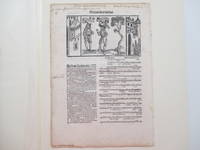
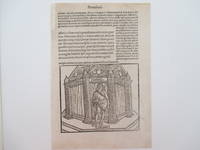
149617350AB1496. Straßburg Grüninger I.XI. 1496 305 : 21 cm. One leaf with one woodcut. Leaf LXX 'Secundus actus' from the "Heautontimorumenos". The woodcut shows the two protagonists of the play. - With some old annotations. - Hain/Copinger 15431; Goff T-94; GW M45481. unknown
149317352AB1493. Lyon 1493. 225 : 155 cm. One leaf with one woodcut. Leaf 223 shows the Terenz editor Calliopius in front of a polygonal building. The woodcut was also attributed to the master of the Lübeck bible.' - Hain/Copinger 15424; Goff T-91; GW M45397. unknown
D17853Hardcover. Fair. Leipzig: Martin Landsberg c.1492-1494 AND Leipzig: Verlag von S. Hirzel 1859. 2 works bound in one volume 8vo 193 x 123 mm. 41 of 42 leaves lacking blank final leaf. Bound in 19th century cloth over marbled boards sunned hand-written paper label on spine. First work with dampstaining at head and repairs with losses to text in final 8 leaves. Second work with light browning throughout. HC 13316. SOLD AS IS. <br/><br/> hardcover books
1472256254Strassburg: Johann Mentelin 1472. Single leaf printed recto and verso. Text in two columns 62 lines initials supplied in red 5 on recto one on verso. 1 vols. Folio. Fine. Mounted in card folder. Single leaf printed recto and verso. Text in two columns 62 lines initials supplied in red 5 on recto one on verso. 1 vols. Folio. From the Press of Johann Mentelin 1472. Hain 10366; BMC I 56; ISTC No. in00133000 Johann Mentelin unknown books
147159416Rome: Adam Rot 1471. after 2 Oct. 1471. 8vo 12 leaves printed in black with red heading some marginal chipping in two columns good. Probably HC 14820; Pr 3433; BMC IV 42; BSB-Ink 447; GW M42586. Rules and constitution of the Apostolic Chancery. Notes on Benedict XII 1334-1342; Boniface VIII 1294-1303; Paul II 1464-1471; Calixtus III 1455-1458; Boniface VIII 1294-1303; Alexander IV 1254-1261; Gregory X 1271-1276; Clement VI 1342-1352. Adam Rot unknown books
703Budapest, Magyar Helikon, 1978. Grand in-4° reliure pleine toile, jaquette illustrée. Avec 126 planches hors-texte en couleurs reproduisant les codex et les incunables de cette importante bibliothèque humaniste.
5 Parts bound in one, frontispieces, cont. cloth, 1,000 items.
4to, 56pp., orig. printed wrappers. A catalogue of Rattey's incunabula, collected over 20 years. This collection was later dispersed by Maggs.
First Edition, 4to, xi,[v],102pp., 16 facsimiles, orig. cloth, a fine copy. The collection dealt with in the present catalogue is not large, but is of considerable importance by reason of the extreme rarity of a number of the works which find a place in it. It describes 154 items. Of these 132 formed part of the famous Althrop Library.
232pp., numerous illustrs., orig. printed wrappers, torn and a little defective, uncut. Contains 1500 incunables, published on the occasion of the 500th anniversary of Gutenberg's birth.
4to, numerous coloured plates throughout, price list loosely inserted, orig. cloth, 97 items.
70pp., frontis., 16 plates, illustrs., in the text, orig. printed wrappers. 486 Items listed.
8vo (230 x 155 mm), viii, 274pp., 12 plates (mostly folding), cont. quarter morocco, marbled boards, lightly rubbed but a nice copy. 533 items described.
Frontis., 25 plates, orig. printed wrappers, 225 items.
18513126Première moitié du XIVe siècle 1851 Lettre ornée sur vélin (18,5x16,5 cm) extraite d’une page d’antiphonaire ou graduel, musique notée sur une portée à 4 lignes. Grande initiale F (17,3x10,5 cm) décorée aux gouaches et à l’encre à motifs abstraits bleus et vermillons pour la hampe et à l’encre vermillon verte et bleue pour les motifs ornementaux couvrant l’espace intérieur et les prolongation marginales.
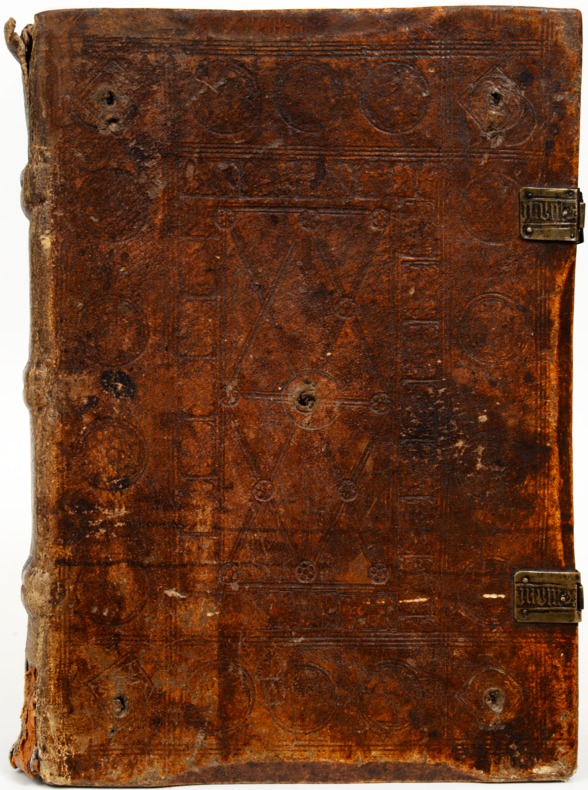
16006Ulm, Johann Zainer, [1478 ca]. Petit in-folio gothique (20 x 29 cm) de (418) ff. à 40 lignes par page, sans foliotation, réclames ni signatures dont 2 feuillets blancs (1er et 371e), peau de truie sur ais de bois biseautés, dos à trois nerfs, décor géométrique estampé à froid dans un encadrement de médaillons, titre manuscrit en noir sur le dos, fermoirs, traces de cabochons (reliure de l'époque).
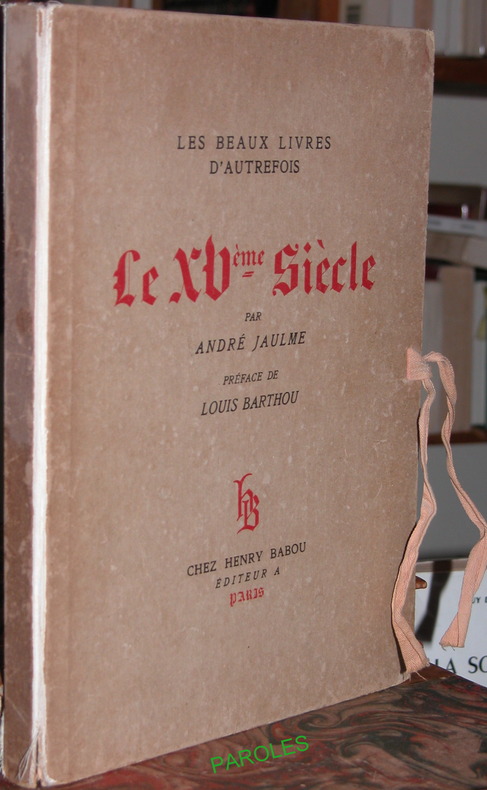
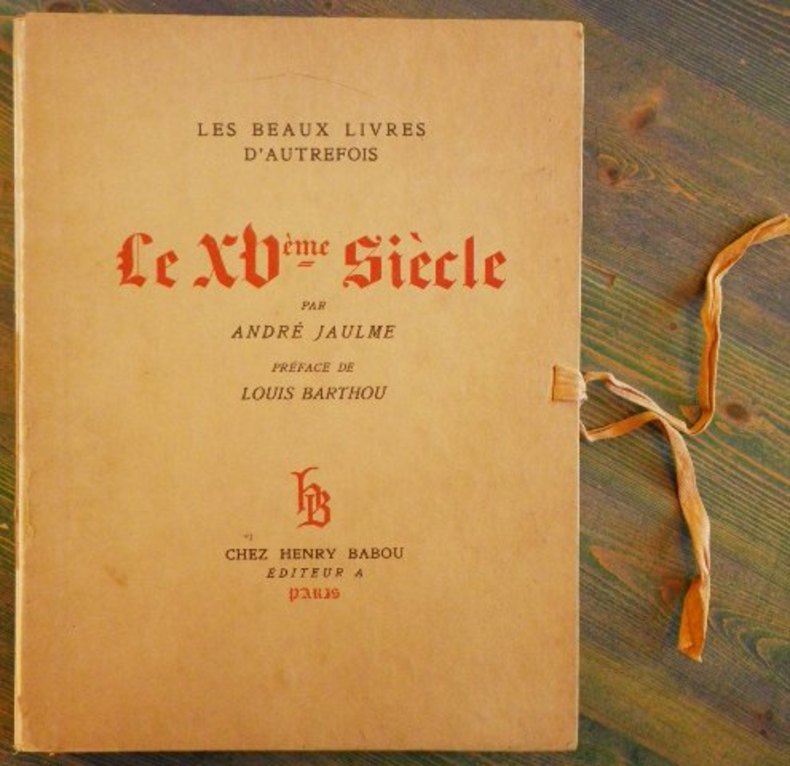
19299815Paris, Henry Babou, "Les Beaux livres d'autrefois", Henry Babou, "Les Beaux livres d'autrefois", 1929 1 volume 20,2 x 26,2cm En feuilles en portefeuille à lacet. 1feuillet, 1titre imprimé en rouge et noir et orné d'une vignette, 36p., 40 planches dont 1 en couleurs, 2 feuillets. Feuilles en bon état (quelques petites rousseurs surtout aux gardes); petites fentes aux charnières du portefeuille, et papier de couvrure déchiré le long de ces charnières.
Texte d'André JAULME (1897-1940), bibliothécaire à la Bibliothèque Nationale, sur la typographie et les incunables européens, suivi de 40 planches tirées en héliotypie par Marotte d'après les originaux de la Bibliothèque Nationale; lettre-préface de Louis BARTHOU. 1er volume de la collection "Les Beaux livres d'autrefois" dirigée par Marcel Valotaire. Tirage à 1150 exemplaires; 1 des 1010 sur vélin Johannot, justifié n°426 (après 140 sur japon). Français
795P., Chez Henry Babou, 1929, 1 petit in-4 en feuilles, sous chemise cartonnée (mors légèrement défraichis), de 36 pp + 40 planches H.T. tirées en héliotypie.
192939439Couverture rigide. En cahiers. Sous chemise cartonnée de l'éditeur avec liens. Légères rousseurs.
First Edition, 83pp., disbound.
First Edition, 83pp., orig. printed wrappers, unopened, uncut.
In-4 gr., lussuosa legatura editoriale in piena pelle (abrasioni alle cerniere), dorso a cordoni, astuccio con cuffia in pelle, 54 cc.nn., con il bellissimo frontespizio figurato e 8 grandi tavole anatomiche di cui 1 a colori. Riproduzione in facsimile della seconda edizione (1493) del primo testo di anatomia con figure originali. E' l'anatomia di Mondino de' Luzzi (1270-1326), il primo insigne anatomista degno di questo nome, pubblicata per la prima volta a Venezia nel 1491 dal medico Giovanni de Ketham, alemanno, nel suo cosiddetto "Fascicolo di medicina". Cfr. Castiglioni "Storia della Medicina", pp. 340, 420. Bella edizione su carta a mano, in tiratura di 350 esemplari numerato. Ben conservato.
Folio, [x],111,[3]pp., printed in Linotype Estienne with Civilite headings, Cockerell marbled paper boards, title label to spine, uncut. "This [library] was designed to be a guide and inspiration to a working printer and to illustrate the history of printing and all its adjuncts: types, pages, margins, woodcut and other decoration. The great names of Gutenberg, Fust and Schoeffer, Zel, Sweynheym and Pannartz, Wendolin of Speier, Jenson, Crantz, Gering and Friburger, and Caxton appear, and there are a number of examples of the fine borders and initials produced by the Zainers at Augsburg and Ulm and by Ratdolt at Venice."?Preface. Rogerson, 26.