[INCUNABLE] THOMAS D'AQUIN.Livre Rare Book
426 résultats
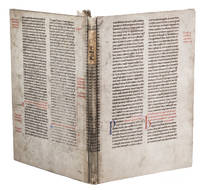
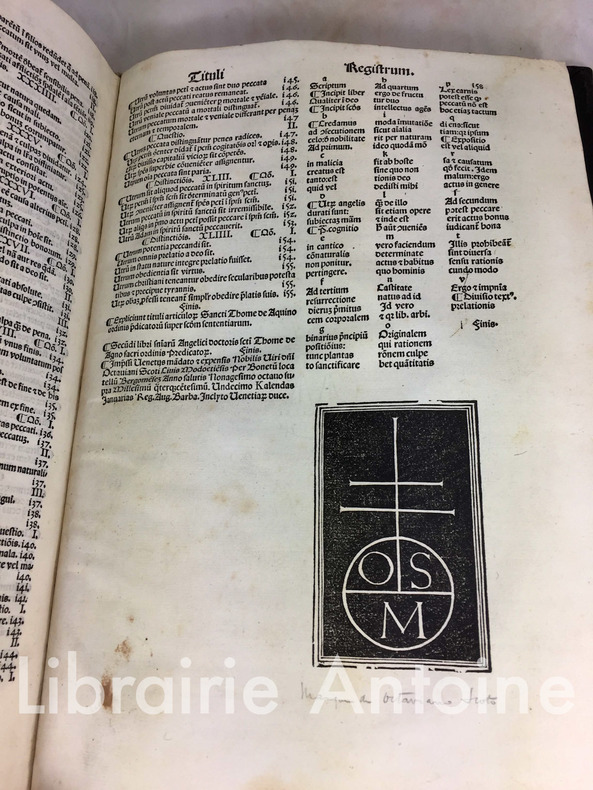
14983237Venise Bonetus Locatellus pour Octavianus Scotus 1498 In-folio, 157 sur 158 feuillets chiffrés (manque le f. 76), reliure en maroquin noir sur ais de bois, plats décorés à froid d'un double encadrement de fers répétés et soulignés d'une double paire de filets, au centre alignement de deux fers répétés, traces de fermoirs, dos à nerfs, gardes en vélin de réemploi d'un manuscrit liturgique (missel ou évangéliaire) du XIIème siècle.
65323[Köln], Conrad Winters von Homberg, [zwischen 17. März u. 20. September 1479]. 8°. 102 nn. Bll. (Got. Typ., 27 Zeilen, rubriziert u. mit einigen Initialen in Rot), Blindgepr. Ldr. d. Zt. über Holzdeckeln.
1492D16270Venice: Hieronymus de Paganinis 1492. Hardcover. Very Good. 7 September 1492 from colophon: “Impressa vero in felici Venetorum ciuitate sumptibus et arte Hieronymi de Paganinis Brixiensis. Anno gratie millesimo quadrigentesimo nonagesimosecundo. Septimus Idus septembris.”. 8vo 170 x 120mm. 510 leaves of 552 lacking the Interpretation of Hebrew Names 41 leaves at the end and final blank. Signatures: A10 a-z8 aa-zz8 A-P8 Q12. Title printed with “Biblia” in gothic letter in upper margin above rectangular woodcut of St. Peter holding keys within double ruled border captioned “Tu es petrus” later hand coloring to halo and garb of Peter. Title verso with the “Tabula alphabetica historiarum Bibliae” compiled by Gabriele Bruno. Text printed double column index in triple column 50 lines to a full column printed in gothic type with red rubrics and headings rubricated versal initials alternating red and blue ink printed marginal citations throughout. Modern vellum yapped edges endpapers renewed; register and first few leaves of prologue little frayed to the margins some light dampstaining near end only light intermittent stains edges lightly browned annotations trimmed close in few margins and few minor marginal repairs otherwise a sound and solid incunable edition of the Biblia Latina retaining the inaugural woodcut. Scattered period Latin annotations and manicules in margins occasionally repeating a word in Scripture like “Patientia” or names of the biblical persons from text “Helias” “Jezebel” or “Joab” and names of kings and their sons are also curiously given much attention writing in more lengthy memory devices for their relationships “Roboam filius Salamonis rex in Juda” – all seemingly the work of one scholar and another cancelled early inscription on A9 perhaps the name “Carolii”. Overall studied and plenty in inscriptions some annotations in Jerome’s prologue and later books are written in red <br />ink. This is the second octavo edition of the Latin Bible printed in Venice in 1492 containing the corrections by the Franciscan scholar Pierangelo da Montolmo named in the robust colophon as “Petrus Angelus de Monte Ulmi”; supposedly a folio edition was issued this <br />same year by the same printer Girolamo de’ Paganini or “Hieronymus de Paganinis” though not found in standard references. The earliest octavo edition of the Latin Bible also known as the “poor man’s Bible” was printed in Basel by Froben in 1491. This Venetian octavo <br />edition is the first Latin Bible to include the “Tabula alphabetica historiarum Bibliae” an alphabetical table of contents compiled by the Franciscan Gabriele Bruno or Brunus in 1489. It is also the earliest printed Bible to display a woodcut on the title – printers of <br />Bibles had previously avoided title pages to best imitate manuscript sources. This 1492 edition was reprinted in 1497 and corresponded closely to the Brescian edition of 1496; the more common 1497 reprint reused the St. Peter woodcut but omitted “Biblia” on the title page. The woodcut’s caption “Tu es Petrus” You are Peter is the formula spoken at papal coronations and the words have long been associated with arguments for papal authority. Interestingly Pope Alexander VI was ordained into the papal office the month prior to this printing on 11 August 1492. Corrected editions of the Bible abounded during the Renaissance a period of intense and progressive scholarship and increasing publishing opportunities; this edition is distinctly associated with Franciscan study and use and made revolutionary efforts to organize the Bible with Bruno’s new contents list. The new “pocket-sized” Bible was an easier and more affordable format to disseminate Scripture. Travelling clergy would have especially benefitted from its portability. This copy interesting for its somewhat heavy Latin marginalia dating closely to the period of the printing; the eager reader names biblical persons of interest and contemplates their genealogical relationships throughout. ISTC 594000. <br/><br/> Hieronymus de Paganinis hardcover books
149865400Brescia, Jacobus Britannicus, 24. Oktober 1498. Fol. Mit einigen Holzschn.-Initialen. 32 nn. Bll. (Rom. Typ., 45 Zeilen), Ppbd. d. 20. Jhds. m. Rückentitel.
In-4°; cc. (4), l’ultima bianca. In fine al testo una estesa nota manoscritta. Legatura in cartonato semplice. Molto raro. Il Tractatulus fu pubblicato autonomamente prima di essere incluso nella sua più ampia opera sull’Europa (Historia rerum Friderici…). Enea Silvio Piccolomini narra in questo pamphlet la storia dell’assedio di Costantinopoli da parte dei Turchi di Maometto II, evento che pose l’Europa sotto una minaccia militare e ne decretò una battuta d’arresto anche dal punto di vista culturale. Il resoconto dell’assedio descritto in queste pagine è piuttosto crudo (molti particolari in successive lettere verrano edulcorati); descrive tra l’altro la distruzione di Santa Sofia, la sua riduzione in stalla o lupanare: Iustiniani caesaris opus toto orbe famosum, nudatum sacra suppellectile ad omnes spurcicias patuit…sanctorum imagines aut luto fedate aut ferro delete: altaria diruta. In templis ipsis aut lupanaria meretricum facta aut equorum stabula. Parla di ignominia e irrisione della religione, di stupri e rapine. La politica durante il pontificato di Pio II ebbe come filo conduttore l’azione contro i Turchi ottomani che avevano conquistato Costantinopoli e stavano per espandersi nell’Impero Bizantino. Questo papa sentì fortissima l’urgenza di contrastare l’Islam e fondò per questo scopo anche l’ordine cavalleresco di Santa Maria di Betlemme. IGI 7755; BMC IV, 94. Very rare. The “Tractatulus” was published on its own before beeing included in a wider work about Europe (“Historia rerum Friderici”). Piccolomini tells in this small book the story of Constantinople siege by Mohamed the II, an occurence that put Europe under a military menace, and in a cultural deadlock position. The chronicle is raw and explicit (in later letters many details were censored); the Saint Sophie destruction is described, and its changement into a barn or a brothel. During his pontificate, Pius II strongly fought the Ottomans who kept Constantinople and were expanding towards the Byzantine Empire. This Pope felt the strong urgency to combat the Islam and stated the Saint Mary of Behtlem order.
1529AMO-4514On les vend à Angiers en la boutique de Charles de Boingne et Clément Alexandre marchands libraires jurés de l'université dudit lieu. [Nouvellement imprimées à Paris par Anthoine Cousteau imprimeur pour Charles de Boigne et Clément Alexandre marchands libraires à Angers, et furent achevées d'imprimer au mois de janvier l'an 1529 [i.e. 1530]. 1 volume in-folio (30 x 20,5 cm | Hauteur des marges : 293 mm) de 4 feuillets non chiffrés (comprenant un feuillet de titre imprimé en rouge et noir dans un encadrement gravé sur bois avec Privilège au verso en date du troisième jour de décembre 1529, 2 feuillets de table (intervertis), un feuillet d'errata et omissions avec au verso une gravure sur bois pleine page représentant Louis de Savoie recevant l'ouvrage de l'auteur devant un collège d'évêques et de membres de la cour), CCVII [207] feuillets chiffrés et un feuillet avec la marque de Galliot du Pré (petit manque angulaire loin de la marque). Collationné complet malgré quelques erreurs de foliotation à l'impression. Texte imprimé dans un enacrement de filets noirs. Reliure pleine basane noire, dos orné (reliure datant du début du XIXe siècle). Reliure frottée, dos passé frotté, quelques usures. Intérieur assez frais. Quelques renforts de papier dans la marge intérieure ou extérieure de quelques feuillets. Exemplaire non lavé. Edition originale rare.
149564829(Brescia, Angelus und Jacobus Britannicus, 26. März 1495. 8°. 94 nn. Bll. (1-2 Spalten, 40 Zeilen, Got. Typ.), Pgmt. d. 16. Jhds. m. durchzogenen Bünden.
149365208Venedig, Bonetus Locatellus für Octavianus Scotus, 4. Juni 1493. Fol. Mit großer Metallschnitt-Druckermarke am Schluss u. einigen meist schwarzgrundigen Holzschn.-Initialen. 313 num., 5 nn. Bll. (2 Kol., 66 Z., Got. Typ.), HPgmt. d. 19. Jhds. m. marmor. Deckeln u. Schnitt.
1493D4438Venice: Johannes Rubeus 1493. Hardcover. Very Good. Venice: Johannes Rubeus 1 January 1493. Folio 315 x 225mm. 174 leaves. Collation: a 7; b-x 8; tabula 7. 61 lines Roman type capital spaces unrubricated. Contemporary notation and hand-drawn manicules indicating the text throughout many are whimsically flourished or holding objects. Final blank on watermarked paper of flying swan in pearled medallion. Content are in three parts the first is a revised and augmented version with excerpts taken from classical authors and Italian humanists and formulas for letter-writing. The second part consists of an anthology of prose writers including Cicero Lactantius Macrobuius Plutarchus etc. The third part contains selections from Petrarch dramatic poets Terence Seneca Plautus and a variety of humanist speeches by Renaissance copyists letter-writers and philosophers including Johannes Lamola Poggius Florentinus Galeatius Sforza and the author himself. Contents: Leaf 2a title: Oratorum omnium Poetarum: Hystoricorum: ac Philosophorum elegantes dicta: per Clarissimum iurum Albertum de Eiib in unum collecta faeliciter incipiunt. Leaves 120a-123b contain: Liber augustalis imperatorum Francisci Petrarchae Benvenuto Rambaldis continuation of Petrarchs Epitome vitarum virorum illustrium; Leaves 125a-129b: Francisci Petrarchae de aduersa fortuna Remedia; Leaves 129b- 132b: Francisci Petrarchae: de prospera fortuna remedia. Leaf 168b Colophon: Summa Oratorum omnium: Poetarum: Historicorum: ac Philosophorum Autoritates in unum collectae per clarissimum uirum Albertum de Eyb Vtriusque iuris doctorae eximium: quae Margarita poetica dicitur: faeliciter finae adepta est. M.CCCCLXXXXIII. Kalae. Ianuarii. Leaves 169a-175b: Tabula. totius . oprois. 18th-century three-quarter sheep over marbled pasteboards spine gilt with title silk book mark; wanting first and final original blank a few wormholes at the beginning and end some just affecting text; faint dampstaining in the upper margins few creased corners corner torn of m2 and marginal tear m8 very slightly spotted and soiled in places. From the Collection of Baron de Eyb his heraldic lithographed ex-libris dated 1899 to front pastedown an evident descendant of the author. Eyb is the name of an old Franconian noble family which is named after Eyb in Ansbach. It is likely this volume was owned by a contemporary with familial ties to the author and stayed within the family until the early 20th century. Eighth Edition of this important work of German Humanism. Albrecht von Eyb one of the earliest German Humanists was born in 1420 near Ansbach. Eyb went to Italy and devoted himself to humanistic study at the Universities of Pavia and Bologna. He returned to Germany in 1451 having been appointed Canon at Eichstätt and Bamberg. From 1452 to 1459 he was again a student at Bologna gaining the degree of doctor in 1459. That same year Eyb wrote Margarita poetica in honor of his mother Margarete von Wolmershausen. It was first published in Nuremberg by Johann Senschschmidt in 1472 and reprinted at least 13 times by 1503. It remained a popular manual of classical rhetoric by its three distinct focuses: letter-writing model orations and florilegia compilation of excerpts. The work is known for its vivid expression found within selected passages from classical and contemporary authors from Cicero to Petrarch. The Catholic Encyclopedia calls it a textbook of humanistic rhetoric consisting of a collection of passages in prose and verse from Latin authors to which are added specimens of humanistic eloquence. Of only about 40 in existence OCLC locates 13 copies of this edition in US collections. BMC V 417; Goff E177; GW 9536; HC 6824; Madsen 1547; Schmitt I 4233; Sheppard 4121; Proctor 5132 <br/><br/> Johannes Rubeus hardcover books
1493D4438Venice: Johannes Rubeus 1493. Hardcover. Very Good. Venice: Johannes Rubeus 1 January 1493. Folio 315 x 225mm. 174 leaves. Collation: a 7; b-x 8; tabula 7. 61 lines Roman type capital spaces unrubricated. Contemporary notation and hand-drawn manicules indicating the text throughout many are whimsically flourished or holding objects. Final blank on watermarked paper of flying swan in pearled medallion. Content are in three parts the first is a revised and augmented version with excerpts taken from classical authors and Italian humanists and formulas for letter-writing. The second part consists of an anthology of prose writers including Cicero Lactantius Macrobuius Plutarchus etc. The third part contains selections from Petrarch dramatic poets Terence Seneca Plautus and a variety of humanist speeches by Renaissance copyists letter-writers and philosophers including Johannes Lamola Poggius Florentinus Galeatius Sforza and the author himself. Contents: Leaf 2a title: Oratorum omnium Poetarum: Hystoricorum: ac Philosophorum elegantes dicta: per Clarissimum iurum Albertum de Eiib in unum collecta faeliciter incipiunt. Leaves 120a-123b contain: Liber augustalis imperatorum Francisci Petrarchae Benvenuto Rambaldis continuation of Petrarchs Epitome vitarum virorum illustrium; Leaves 125a-129b: Francisci Petrarchae de aduersa fortuna Remedia; Leaves 129b- 132b: Francisci Petrarchae: de prospera fortuna remedia. Leaf 168b Colophon: Summa Oratorum omnium: Poetarum: Historicorum: ac Philosophorum Autoritates in unum collectae per clarissimum uirum Albertum de Eyb Vtriusque iuris doctorae eximium: quae Margarita poetica dicitur: faeliciter finae adepta est. M.CCCCLXXXXIII. Kalae. Ianuarii. Leaves 169a-175b: Tabula. totius . oprois. 18th-century three-quarter sheep over marbled pasteboards spine gilt with title silk book mark; wanting first and final original blank a few wormholes at the beginning and end some just affecting text; faint dampstaining in the upper margins few creased corners corner torn of m2 and marginal tear m8 very slightly spotted and soiled in places. From the Collection of Baron de Eyb his heraldic lithographed ex-libris dated 1899 to front pastedown an evident descendant of the author. Eyb is the name of an old Franconian noble family which is named after Eyb in Ansbach. It is likely this volume was owned by a contemporary with familial ties to the author and stayed within the family until the early 20th century. Eighth Edition of this important work of German Humanism. Albrecht von Eyb one of the earliest German Humanists was born in 1420 near Ansbach. Eyb went to Italy and devoted himself to humanistic study at the Universities of Pavia and Bologna. He returned to Germany in 1451 having been appointed Canon at Eichstätt and Bamberg. From 1452 to 1459 he was again a student at Bologna gaining the degree of doctor in 1459. That same year Eyb wrote Margarita poetica in honor of his mother Margarete von Wolmershausen. It was first published in Nuremberg by Johann Senschschmidt in 1472 and reprinted at least 13 times by 1503. It remained a popular manual of classical rhetoric by its three distinct focuses: letter-writing model orations and florilegia compilation of excerpts. The work is known for its vivid expression found within selected passages from classical and contemporary authors from Cicero to Petrarch. The Catholic Encyclopedia calls it a textbook of humanistic rhetoric consisting of a collection of passages in prose and verse from Latin authors to which are added specimens of humanistic eloquence. Of only about 40 in existence OCLC locates 13 copies of this edition in US collections. BMC V 417; Goff E177; GW 9536; HC 6824; Madsen 1547; Schmitt I 4233; Sheppard 4121; Proctor 5132 <br/><br/> Johannes Rubeus hardcover
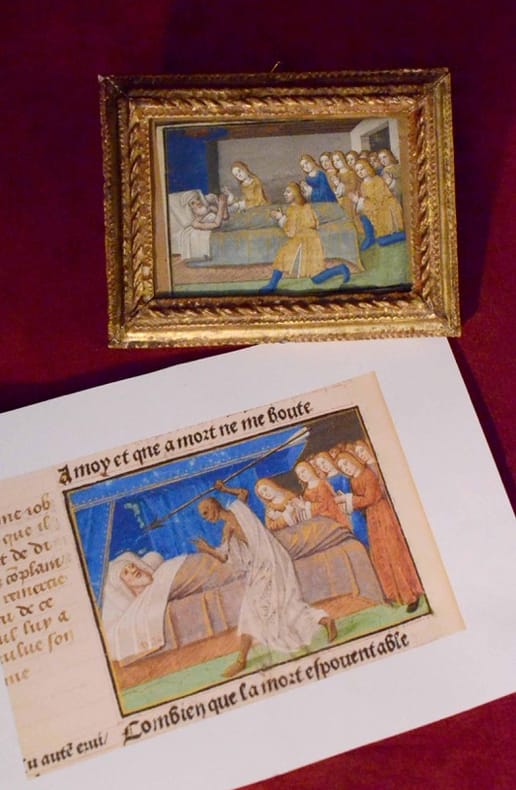
2548Deux miniatures sur vélin - l’une représentant « Job sur son fumier » (7,5 x 5, 5 cm) placée dans un petit encadrement mouluré doré ; la seconde « La mort de Job » (8,2 x 6 cm) dans un encadrement moderne.
1655149XVIIe circa 1655 Pas de couverture Dim : 26 x 21 cm.Gouache sur vélin tendue sur panneau de bois. Première moitié du XVIIe s.
18513126Première moitié du XIVe siècle 1851 Lettre ornée sur vélin (18,5x16,5 cm) extraite d’une page d’antiphonaire ou graduel, musique notée sur une portée à 4 lignes. Grande initiale F (17,3x10,5 cm) décorée aux gouaches et à l’encre à motifs abstraits bleus et vermillons pour la hampe et à l’encre vermillon verte et bleue pour les motifs ornementaux couvrant l’espace intérieur et les prolongation marginales.
Very Good Turkish, Ottoman (1500-1928) Original dark brown handsome full leather bdg. with a traditional flap. Folio. (32 x 22 cm). In Ottoman script (Old Turkish with Arabic letters). [2], [6], 238 leaves. The size of the text block in red borders: 25.5 x 14.5 cm. 33 lines on each page. Printed on paper with European watermarks. The size of the text block in red borders: 25 x 14.5 cm. 33 lines on each page. Printed on paper with European watermarks. Handwritten title on the bottom edge. A fine copy. The 19th incunable of the Islamic world, printed by Ibrahim Müteferrika's legendary Basmahane. The publication of Ottoman chronicles which began in 1734 with the edition of Naimâ's history, continued after a long break in 1783. This volume, containing the works of three court chroniclers who followed each other in rapid succession, is a chronological continuation of Mehmed Râsid's history, published by Müteferrika. Arpaemînizâde Mustafa Sâmî (deceased 1734) was the court's historian from 1730 to 1733, Sâkir Hüseyin (died 1742) in 1733, and Subhî Mehmed (ca. 1711-1769) from 1739 to 1745. The work of the three chroniclers is known as one coherent historiography, which presents the events of Ottoman history from 1730 to 1744. This work is a particularly valuable source on the Habsburg-Ottoman war between 1736 and 1739, in which Subhî participated in person. The prestige of the work, which offers detailed data on the administrative events (appointments, dismissals, and other biographical communications) is further increased by the fact that Subhî in many cases used original documents. This chronicle includes the events between the years 1730-1743. Contents: Ahd-i Humâyûn [i.e. Imperial constitutional declaration]., Zikr-i tecdîd-i san'at-i tab' [i.e. Preface on the Muteferrika Press of Vasif Efendi]., Fihrist-i târîh-i Sami ve Sakir ve Subhi [i.e. Contents of the work]., Text., History of Subhi. The workshop of Müteferrika began its historical mission in 1728. They published 17 works in 22 volumes. The printing house served as a means to the long-term goal of Müteferrika, his efforts to broaden the horizon and modernize the knowledge of Ottoman society and Islamic civilization. This is evidenced by the subjects of the books selected for publishing, the motivations put forth in the publisher's introductions, as well as by the documents illuminating the background of the publication of each book, also published in print. In 1742, with the publication of the Persian dictionary of Hasan Suûrî, a chapter of Ottoman book printing came to an end. With the death of Müteferrika, the printing of Turkish books was temporarily interrupted. The first generation of Ottoman-Turkish prints was soon followed by a new series when in 1756 Ahmed and Ibrâhîm Efendi (the latter perhaps the founder's son, according to speculative sources) made an attempt to resurrect the legacy of Müteferrika through the possession of a decree obtained from the Sultan. However, this experiment did not prove to be lasting, as it did not last longer than the new edition of the first Turkish printed book, the Lugat-i Vankûlî. After this, for several decades there was no continuation to the Turkish book printing established by Müteferrika, until in 1783 the workshop was put in operation again for the publication of six more works. The subjects of these late 18th century works were dominated by history and military technology, thus Müteferrika's strategy of book distribution made its way hand in hand with the efforts of modernization of the Ottoman state. The second edition of Lugat-i Vankûlî followed the principles of the first edition, and its introduction was composed on the model of the introductory pages of the two last books published under Müteferrika's supervision. The works published after 1783 display a noticeable development in typography not only as to its somewhat refined visual impression but also in its structure. For example, the d+h and r+h ligatures, (For more info please visit our website)
Very Good Turkish, Ottoman (1500-1928) Original dark brown handsome full leather bdg. with a traditional flap. Folio. (32 x 22 cm). In Ottoman script (Old Turkish with Arabic letters). [9], 288 leaves. The size of the text block in red borders: 25 x 14.5 cm. 33 lines on each page. Printed on paper with European watermarks. Handwritten title on bottom edge. Marginal cutting on the first page. Overall a very good copy. The 20th incunable of the Islamic world, printed by Ibrahim Müteferrika's legendary Basmahane. Süleymân Izzî succeeded Mehmed Subhî Efendi (ca. 1711 - 1769) in 1745 as an official court historian (vaka'nüvis) and held this office until 1753, and is known as one of the three chroniclers for coherent historiography, representing the events in the Ottoman history from 1730 to 1744 and is a particularly valuable source on the Habsburg-Ottoman War between 1736 and 1739, as proven by his chronicle titled "Tevârîh-i Sâmî ve Sâkir ve Subhî", published in 1784. During this time, he recorded the contemporary events taking place between 1744 and 1753 in the Ottoman Empire. This work was the last item in a series of chronicles published by the printing house founded by Müteferrika. Franz Babinger writes that some parts of the book have been translated into German. Hammer translated one of the parts in question into German. All published, Izzi has planned the third part of his work, but this third part was never published. Contents: "Ahd-i Hümâyûn".; "Zikr-i iâde-i fenn-i tiba'at" [i.e. On the book pressing and publishing with a preface by Ahmed Vâsif Efendi].; "Fihrist-i Târîh-i Izzî" [i.e. Content of Izzi's history].; Izzî tarihinin birinci bölümü [i.e. The first chapter].; Izzî tarihinin ikinci bölümü [The second chapter]. The workshop of Müteferrika began its historical mission in 1728. They published 17 works in 22 volumes. The printing house served as a means to the long-term goal of Müteferrika, his efforts to broaden the horizon and modernize the knowledge of Ottoman society and Islamic civilization. This is evidenced by the subjects of the books selected for publishing, the motivations put forth in the publisher's introductions, as well as by the documents illuminating the background of the publication of each book, also published in print. In 1742, with the publication of the Persian dictionary of Hasan Suûrî, a chapter of Ottoman book printing came to an end. With the death of Müteferrika, the printing of Turkish books was temporarily interrupted. The first generation of Ottoman-Turkish prints was soon followed by a new series, when in 1756 Ahmed and Ibrâhîm Efendi (the latter perhaps the founder's son, according to speculative sources) made an attempt to resurrect the legacy of Müteferrika through the possession of a decree obtained from the Sultan. However, this experiment did not prove to be lasting, as it did not last longer than the new edition of the first Turkish printed book, the Lugat-i Vankûlî. After this for several decades there was no continuation to the Turkish book printing established by Müteferrika, until in 1783 the workshop was put in operation again for the publication of six more works. The subjects of these late 18th century works were dominated by history and military technology, thus Müteferrika's strategy of book distribution made its way hand in hand with the efforts of modernization of the Ottoman state. The second edition of Lugat-i Vankûlî followed the principles of the first edition, and its introduction was composed on the model of the introductory pages of the two last books published under Müteferrika's supervision. The works published after 1783 display a noticeable development in typography not only as to its somewhat refined visual impression, but also in its structure. For example, the d+h and r+h ligatures, characteristic of the first generation of Müteferrika's printed books, are replaced by separate letters. This extremely rare presented book is from the seven publications of this late period of the
29846Venise, Léonard Wild, 1489 [sic, pour 1479]. 1 fort vol. in-4°, veau brun estampé à froid sur ais de bois, dos à nerfs en basane blonde jaspée orné de roulettes et de fleurons dorés, pièce de titre en maroquin vert, encadrement de filets et de petits fleurons à froid sur les plats, petits fleurons à froid disposés en cercle au centre, gardes de vélin. Reliure de l'époque, dos refait au début du XIXe siècle, plats très frottés, traces de fermoirs. Exemplaire grand de marges. Impression en car. goth. sur 2 coll. de 48 ll, exemplaire rubriqué, initiales peintes en rouge et en bleu, (1) f. blanc, (378) ff., (1) f. blanc. Signatures : [a-g]12 [h-v]8-12 18 212 [3-4]8 [5-13]12-8 A12 B10 a8 b10. Le f. a2 (qui comporte l'incipit) est en fac-similé sur papier ancien, manque le quart sup. du premier feuillet blanc; Mouillure marginale sur une trentaine de ff. en début de vol. Le reste de l'exemplaire est d'une grande fraîcheur.
1528AMO-4518Parisiis, ex officina Claudii Chevallonii sub sole aureo in dia ad divum Jacobum. 1528 mense Aprili. [Paris, Claude Chevallon, avril 1528] 1 fort volume in-folio (39 x 28 cm) de 28 feuillets non chiffrés, CCCCLIX fol. chiffrés (le folio CCLXXIX manque), XLVI fol. chiffrés et 1 fol. non chiffré. Titre imprimé en rouge et noir dans un encadrement gravé sur bois, marque de B. Rembolt sur le titre. Grande gravure sur bois au verso du folio I (L'auteur présentant son ouvrage). Grande gravure sur bois au verso du folio CCCCXVIII (Arbor consanguinitatis) et autre grande gravure au recto du feuillet suivant (qui n'est pas chiffré). Le dernier feuillet contient le registre. Texte imprimé en rouge et noir pour la plupart des feuillets, le plus souvent sur 4 colonnes avec différentes tailles de caractères, le tout en caractères gothiques. Reliure ancienne (probablement du début du XVIIe siècle) en veau brun. Reliure usagée encore solide. Manque de cuir au dos, mors fendus. A restaurer. Intérieur assez frais. Quelques mouillures sans gravité à quelques feuillets. Mouillure avec petit manque de papier dans la marge inférieure des derniers feuillets, sans atteinte au texte. Comme indiqué plus haut le folio 279 manque (trace d'arrachage dans la marge intérieure), sinon tous les autres feuillets sont présents. Superbe mise en page avec de très nombreuses grandes lettrines historiées.
1515AMO-4519Venundantur Parhisiis in edibus Johannis Petit sub lilio aureo. [Impressus Joannis Barbier.] Impensis Johannis Petit bibliopole Parisiensis. Anno Domini millesimo quingentesimo decimoquinto. Pridie Kalendas Decembris [30 novembre 1515] 108-[92] f. (sign. a-z8, [-]8, [-]8) ; in-8° (collationné complet) Suit l'édition de 1511 imprimée par J. Barbier pour J. Petit (Renouard, ICP, II, 155). Matériel typographique de Jean Barbier. Texte sur 2 col. caractères gothiques, titre en rouge et noir, marque au titre. Références : Renouard, ICP, II, 1169. Renouard, Imprimeurs, III, p. 173, n° 238. Relié à la suite : Quadragesimale opus declamatum Parisiorum urbe ecclesia sancti Johannis in Gravia : per venerabilem patrem Sacre Scripture interpretem divini verbi preconem eximium : fratrem Oliverium Maillardi ordinis fratrum Minorum. Parisius sub eodem recollectum : ac novissime magno labore correctum impressionique traditum. Anno. M. CCCCC. XV. (Et per quendam... impensis vero honestiviri Johannis Petit bibliopole Parisiensis impressorum. Anno M. CCCCC. XVI. Dievero. XXV. mensis. Maii.) [1516] 174-[4] f. ; in-8° (collationné complet). Même pagination que l'édition de 1506 ou 1508 (Jean Barbier pour Jehan Petit également). Texte imprimé sur deux colonnes, caractères gothiques. Relié à la suite : Passio Domini nostri Jesu Christi a reverendo.p.Oliverii Maillard Parisius declamata. (Paris,) : J. Petit, (1519) | Paris : [Michel Lesclancher, imprimeur] : Jean Petit (libraire), Sans date [circa 1519] Sign. A-B (16 feuillets) ; in-8° (collationné complet) Daté d'après la marque de Jean Petit au titre (Renouard, Marques, n° 883). - Caractères gothiques à 2 colonnes. Référence : Renouard, ICP, II, 2136. Haebler, IV (marque de J. Petit) Renouard, 883 (marque de J. Petit) ; BP16_103799 (Bibliographie des éditions parisiennes du 16e siècle); Localisation d'exemplaires dans les fonds publics : Lausanne, BCU London, BL Oxford, BL. Ensemble 3 ouvrages reliés en 1 fort volume petit in-8 (162 mm x 100 mm | Hauteur des marges : 157 mm). Exemplaire avec de bonnes marges. Reliure plein veau brun glacé, dos lisse, filets dorés, titre doré "MAILLARD // SERMONS", doublures et gardes de papier marbré, tranches dorées. Roulette à froid en encadrement des plats. Reliure exécutée dans les premières années du XIXe siècle (sans doute pas après 1825). Reliure fraîche malgré quelques marques et frottements sans gravité, intérieur d'une grande fraîcheur totalement dépourvu de rousseurs, papier bien blanc. Première page de titre légèrement salie. Cachet sur le premier titre (bibliothèque Jean-François [-René-Marie-Pierre] de Kergariou (1779-1849)). Quelques faibles mouillures sans conséquence et peu visibles.
13731480 circa 1480, Miniature sur vélin 11,4 x 7,5cm.
149165634(Köln, Heinrich Quentell, 1491). 4°. 10 nn. Bll. (Got. Typ., 38-39 Zeilen, rubriziert u. mit ausgefüllten Initialspatien), Ldr. d. 20. Jhds. m. goldgepr. Rückenschild.
In-4°; cc. (6). Per lo stampatore e la data ci sembra più corretto pensare che questa edizione preceda quella di Froben, Basilea, 1515, e che quindi sia da attribuire al tipografo Beplin nel 1513 (STC p. 208 Beplin, Roma 1513?; vedi anche British Library, 1513), piuttosto che seguire la lezione di F. Barberi, Tipografi romani del Cinquecento, Firenze, 1983, p. 53 (e ICCU) in cui questa edizione si attribuisce allo stampatore Etienne Guillery con la data 1518. Ristampato da Froben assieme agli epigrammi di Erasmo, questa elegia appassionata ed elogiativa della Guerra contro i Turchi è estremamente rara. Due sole copie in ICCU alla Biblioteca Apostolica Vaticana, e alla Biblioteca Trivuziana di Milano. Una alla British Library; non in OCLC. Alcuni epigrammi di letterati del circolo romano di Agostino Chigi accompagnano i versi; gli autori: Janus Parrhasius, Janus Vitalis, Monachus Severus, Decius Syllanus, Basilius Chalcondylas, Constantinus Achazas, Delius Hieronymus, Factius Polydorus, Pietro Foderè, Phoebus Ptolomaeus, Paulus Soranus. La materia dell’opera di Giano Damiani, letterato senese, fa riferimento alla questione che Leone X de’ Medici (1513-1521) si trovò a gestire quando i Turchi si presentarono alle porte dell’Oriente e del Mediterraneo. L’elegia è anche un inno alla pace, che non dimentica di citare le nazioni che sostennero lo Stato pontificio, tra cui gli spagnoli, i francesi, gli inglesi. Beplin, Johann, attivo a Roma dal 1506 a circa il 1515; tipografo di Strasburgo attivo a Roma. Secondo il Dizionario dei tipografi lavorò molto per Giacomo Mazzocchi, cui sarebbero appartenute le cornici usate per i frontespizi. I caratteri da lui adoperati erano gli stessi di Besicken e di Mazzocchi. Apud Sanctum Eustachium. Since the printer and date, it looks like this edition was printed before the Basel’s one (Froben, 1515) and it would be related to Beplin in 1513, more than the Barberi’s opinion, that attaches this edition to Guillery (and date 1518). Reprinted by Froben along with Erasmus’ epigrams, this passionate elegy of war against the turks is extremely rare. Some epigrams by scholars from the Roman Cirle of Agostino Chigi side the poems: Janus Parrhasius, Janus Vitalis, Monachus Severus, Decius Syllanus, Basilius Chalcondylas, Constantinus Achazas, Delius Hieronymus, Factius Polydorus, Pietro Foderè, Phoebus Ptolomaeus, Paulus Soranus. The matter of this work is the question dealed by Leone X de’ Medici when the Turks showed up to the doors of West world. It’s also an ode to peace, that quotes the nations supporting the Pope (Spain, France, England, between them). Johann Beplin operated in Rome since 1506 to 1515 ca. A typographer from Strasbourg, he worked in Rome for Giacomo Mazzocchi, the maker of frames used for title pages. The typefaces used by Beplin are the same used by Besicken and Mazzocchi.
[Incunabolo-Firenze] (cm.33) ottima mezza pergamena antica, ben restaurata, piatti realizzati con fogli dell' index della Cronica di Norimberga del 1493. -- cc. 208 nn.(di 222). Carattere romano, 40 linee, spazi per lettere capitali. incunabolo celeberrimo per la storia d' Italia e di Firenze, dalle origini al 1401 scritta dal grande umanista aretino Leonardo Bruni; contiene fra l' altro le più antiche notazioni biografiche su Dante Alighieri. La traduzione dell' Acciaiuoli apparve nel 1476, questa nostra seconda edizione a dire del Moreni, I 175, è "forse più bella della prima". Normalmente contiene anche la opera di Poggio Bracciolini "Historia Florentina" 1492, ma molti repertori la notano separatamente. Vedi olschki "Monumenta Typographica" n° 175 e 175/A e olschki "Incunabola Typographica" Cat. 94(1915) n° 26 e 27 dove una copia scompleta della sola parte del Bruni è venduta a caro prezzo. Mancano le prime otto carte segnate a + b1 e b8 + le ultime 4 carte segnate Px: 14 carte in tutto. Una macchia interessa 5 carte interne al III libro, con lettera capitale a tempera azzurra danneggiata, una lieve ombreggiatura all' estremo angolo bianco basso ad alcune carte interne, altrimenti esemplare bellissimo, nitido e a grandi margini di questo capolavoro tipografico di Bartolomeo Dei Libri. * Moreni I 175; * Hain 1563; * Goff B 1248; * I.G.I. 2203; * Pellechet 1116; * G.W. 5613; * Proctor 6197; * Oates in Cambridge 2354; * Harvard 2905; Bmc VI 649.[f72] Libro
[400 incunabolo Vicenza](cm. 28.5 x 20.2) Ottima piena pergamena XVIII secolo, titolo manoscritto al dorso. -cc. 220 non numerate (di 224), carattere gotico, 58 linee 2 colonne, spazi per capitali con letterina guida. mancano solo le prime 2 carte di testo, non segnate, la successiva bianca A1, e l'ultima O6 anch'essa bianca. Seconda edizione stampata a Vicenza (prima 1478) di questa opera che ebbe uno straordinario successo, solo nel 400 si conoscono più di 30 edizioni!!! Descrive con cura la liturgia del tempo, il rito romano, spiega i vari significati allegorici ed è considerata una pietra miliare della liturgia del tardo medioevo; simbolismo, riti, paramenti ecc... L'"editio princeps" è uno dei libri più famosi al mondo, stampato nel 1459 a Magonza dal fust e Schoeffer, e considerato daH. P. Kraus, nella sua autobiografia, uno dei libri più belli e perfetti che esistono. Una copia straordinaria è apparsa in vendita nel 2012 a 750.000 euro, nel catalogo di una nota libreria antiquaria di londra che propone 75 incunaboli da sogno. Complessivamente alla nostra copia mancano 2 carte di testo e 2 carte bianche. Inizia con carta A2 presente, con 2 note manoscritte coeve al margine alto, e termina con la carta 223 che contiene il colophon; questa carta è stata rimessa, presenta bruniture e lievi fioriture. Il margine in alto, con alone a scomparire sulle prime carte, altrimenti esemplare molto bello, nitido e con buoni margini alcune note coeve a carta 213 e 214. provenienza: Asta Sotheby's Firenze 1982, lotto 34. * H.C. 6482; *IGI 3629; * Goff D 423 (solo 6 copie); * GW 9120; *Proctor 7159, * Oates 2679; *Polain 4342: Olschki "Monumenta" cat. 53 (1903) n° 1323 (scompleto); * Harvard libr. 3496. Questa nostra edizione di Vicenza manca al BMC. [f83] Libro
14869BDEHOBV62VDWürzburg: Georg Reyser 1486. Later bound in two leaves from a 13th-century vellum theological manuscript rubricated and decorated with alternating red and blue initials with penwork. Folio. Printed in red and black in rotunda type 32 lines; printed area: 18 x 12 cm; type: 112a. With illustrations cut from 19th- or 20th-century reproductions of early woodcuts ca. 21 x 14 cm pasted on the front Annunciation and back pastedown Christophorus with the year "cccc xx tercio". Interesting example of the study of early printing in 19th-century England. The 12 leaves come from the library of the 19th-century collector Dr C. Inglis whose father boasted an impressive collection of early printed books. Inglis believed that the leaves came from an unknown work titled De vita et honestate clericorum ex consilio Moguntinum printed in 1453 by Gerhardus Episcopus. Tipped in is a letter to Inglis by the well-known bibliographer William Blades discussing this matter. Although the text opens with "De Vita et honestate clericorum ex consilio Maguntinensis Gerhardi Archiepiscipi" it was in fact part of Statuta synodalia herbipolensia printed at Würzburg by Georg Reyser in ca. 1486. The first 6 leaves are 2-d7 and the final 6 leaves are quire g.With owner's inscription of Sir Edward Coates bookplate with initials "CC" Clifford Coates the bookplate of Dr. C. Inglis and some annotations on front pastedown; an autograph letter signed by Wiliam Blades to C. Inglis tipped to flyleaf. 12 well-preserved leaves.l Cf. BMC II 572; Goff S-741; Hain 15036; Hubay Inc. Universitätsbibl. Würzburg 1953; ISTC is00741000. Georg Reyser, hardcover
150243414Bologne, Benedetto Faelli, 1502. In-folio de (3) ff. 1 f.bl. ccclxxxix ff. (sign. [*]4 (dernier blanc) a-t6 u4 x-z6 &6 [&]6 [rum]6 π6 A-H6 I-K8 L-Z6 AA-BB6 CC8 DD-OO6 PP7 , exemplaire sans le dernier feuillet blanc), maroquin lie-de-vin aux armes de Joaquín Gómez de la Cortina, dos orné à nerfs, titre et date en pied de dos dorés, tranches dorées (reliure du XIXe siècle).