426 résultats
Very Good Turkish, Ottoman (1500-1928) Contemporary quarter dark burgundy leather bdg. Grey cloth boards. Four compartments at spine. Cr. 8vo. (20 x 14 cm). In Ottoman script (Old Turkish with Arabic letters). 96 p. [48 leaves]. 19 lines on each page. Printed on paper with European watermarks. A small tear up to the last page with no loss of text. Overall a fine copy. The 9th incunable of the Islamic world, written by Ibrahim Müteferrika and printed in his legendary Basmahane. Known as the most significant work by Müteferrika, this incunable is a political and state-theoretical treatise composed in order to improve the Ottoman government. In his book, Ibrahim Müteferrika used the sources written in Latin in the Europe of his period, and he presented it to Sultan Mahmud I right after the Patrona Halil Revolt (1730). Müteferrika divided the state forms of government in Europe into three groups with the titles "monarkiya" [i.e. monarchy], "aristokrasiya" [i.e. aristocracy], and "demokrasiya] [i.e. democracy]. In the work, the importance of the sciences (physics, astronomy, and geography) in the state administration was emphasized, and it was stated that a solid-state order could not be established in a country where these sciences were not developed. In addition to this, he used the term "Nizâm-i Cedîd" [i.e. The New Order] for the first time and stated that the Ottoman Empire should definitely adopt and implement the new military orders of the 18th century Europe. In addition, this work is one of the earliest in which the "democracy" term is used in the Islamic world. The book was published in French in Vienna and Paris in 1769 (Traite de la tactique ou méthode artificielle pour l'ordonnance des troupes, Vienne, 1769. Translated by Karl Emerich Alexander von Reviczky von Revisnye [Baron Reviczki]), and was translated from French into Russian in 1777. One of only 500 copies. The volume appeared in 1732, about one and a half years after the uprising of Patrona Halil Revolt which had overthrown the system of Sultan Ahmed III and Grand Vizier Damad Ibrahim. The writing, recalling the characteristics of Ottoman siyâsetnâme [i.e. the book of politics], calls the attention of the Ottoman leaders to the results of the state and military development and to the reasons for the strategic superiority of the rival European powers, while strongly condemning the several centuries long disinterest of the Ottomans to the external world. An important feature of the work is to break with the hitherto prevailing nostalgic attitude to bygone golden ages. Although observes the stylistic conventions in as much he speaks contemptuously about the Christian nations, in the content, already turns away from the indifference referring to the superiority of Islam. It announces in a list organized by items the reasons for the state's weakness and the conditions of rising. In harmony with the main aspects of contemporary Ottoman reforms, the work mainly focuses on the necessity of the reorganization of the army. It also offers a broader historical background by describing after the Greek philosophers the various types of states (6v-7v), or by treating the origins and reasons for the success of the foundations of European culture, the Roman Empire (19v-20v). The concept "Nizâm-I Cedîd" (i.e. the New Order), which would be used for the newly organized military formations of Sultan Selîm III (1789-1807), appears here for the first time referring to the modernized European army (17v-18r). "The utopistic optimism of Risâle-i Islâmîye may have had some rational basis, if one takes into account the Karlovci Treaty (1699) which was a rather positive correction in contrast to the previous series of Turkish failures in the Balkans, the European 'internal wars' of the first decade of the 18th century, and the experiences of the reform and peace years of the Tulip Period. However, the Usûl ül-hikem. was already inspired by the atmosphere after the Pozarevac Treaty (1718) which was a further stro
Very Good Turkish, Ottoman (1500-1928) Original b/w city map of Byzantine Constantinople printed in ??? by Tüccarzâde Ibrahim Hilmi Çigiraçan, (1876-1963). Oblong: 37x50 cm. In Ottoman script. Folded. Scale is not described. Toponyms are Turkish besides some of old Byzantine. [OTTOMAN MAP of BYZANTINE CONSTANTINOPLE] Kurun-u vustâ inhâsinda Kostantiniyye. Doktor Moritma'nin tetkikâtina göre kable'l-feth-i sehrin plâni. Feth-i Kostantiniyye asârina aiddir. Published by Ibrahim Hilmi. Ibrahim Hilmi Çigiraçan was a Turkish publisher and author. He is one of the first Turkish publishers of the Ottoman Empire. He published more than 1000 books on history, literature, politics, religion and social issues and maps in the printing house he founded in 1896.
12 Parts., 4to, numerous plates throughout (some coloured, some folding), all parts illustrated in orig. printed wrappers unless otherwise described. A complete record of the sale of printed books, manuscripts and autographs which De Ricci described as "one of the most striking events in the history of the English sale-rooms". Huth's collection, which ranked among the finest in England, was rich in incunabula, voyages, Shakespearean and early English literature, and Bibles. Together these 12 sales consisted of 8,788 lots and totalled over ?350,000. [i] 12 June 1911. Autograph letters (246 lots). [ii] 4 July 1911. Engravings and woodcuts (341 lots). This catalogue was under printed and is especially difficult to obtain. [iii] 15 November 1911. Library, part I (lots 1-1228). Limited edition, spine broken. [iv] 5 June 1912. Library, part II (lots 1229-2596). Quarter calf. [v] 2 June 1913. Library, part III (lots 2597-3931). Lightly waterstained, spine broken. [vi] 7 July 1914. Library, part IV (lots 3932-4602). Limited edition. [vii] 4 July 1916. Library, part V (lots 4603-5205). New wrappers. [viii] 11 July 1917. Library, part VI (lots 5206-6060). Limited edition. [ix] 1 July 1918. Library, part VII (lots 6061-7182). [x] 8 July 1919. Library, part VIII (7183-7842). Un-illustrated, new wrappers. [xi] 22 June 1920. Library, part IX and final portion (lots 7843-7969). [xii] 27 February 1922. Unsold or imperfect books (232 lots). De Ricci, pp. 151-154.
9 Parts., 4to, numerous plates throughout, including some chromolithographed (some which a couple of the folding examples are adhered), list of prices and buyers' names bound in of the back of each part, uniform brown buckram, spines lettered in gilt. A complete record of the sale of printed books and manuscripts which De Ricci described as "one of the most striking events in the history of the English sale-rooms". Huth's collection, which ranked among the finest in England, was rich in incunabula, voyages, Shakespearean and early English literature, and Bibles. De Ricci, pp. 151-154.
5 Vols., 4to (268 x 180 mm), limited to 130, frontis., portrait, a very good ex-library set, later red quarter calf, cloth boards. Huth's collection, which ranked among the finest in England, was rich in incunabula, voyages, Shakespearean and early English literature, and Bibles. He began compiling this catalogue late in life, but finding it too time-consuming, he employed W.C. Hazlitt and F. S. Ellis to do most of the work. "With the assistance of Ellis and Hazlitt, Huth had started printing a magnificent catalogue of his library, with full titles of every item and exact collations, both entirely novel features in a library catalogue. The work was completed in five volumes two years after his death and has remained... a corner-stone of British bibliography." De Ricci, p. 151.
494(Québec, John Neilson ? 1794 ?) In-4 (24.9 cm) (1)f. [titre], 13p. [texte]. En feuilles. Fines rousseurs. Manque la page de titre et la p. 13 qui contient une Liste des Solennités, qui sont remplacées par des fac-similé. Vlach & Buono 520. Lande S 1096. Tremaine 875. [ Mandement de Monseigneur l'Évêque de Québec, qui révoque certaines dispositions de deux Mandements précédents et pourvoit à quelques autres objets. Sur la suppression de certains jours de fêtes. Incunable canadien qui d'après Tremaine a été tiré à 400 exemplaires.]
Reprinted with Additions and Corrections, 4to, 251 facsimiles, orig. cloth. The core of the work is a catalogue of cuts, covering all the books containing cuts printed by Caxton, Wynkyn de Worde, Richard Pynson and minor printers, preceded by an introduction, and followed by a bibliography of illustrated books and an index of cuts by sizes.
First Edition, 3 vols., 4to, xix, [i], 124; [viii], iv, 297, [1]; xiv, 161, [1], viii, 92, 11, [1]pp., a very good ex-library set, printed on thick Van Gelder paper, plates and illustrs., throughout (some coloured), orig. buckram, soiled, uncut, t.e.g. Describes many items acquired by Hodgkin from the Phillipps sales of manuscripts, also, the fine collection of incunabula. Volume three has an annotated bibliography of firework books. De Ricci, p. 187.
First Edition, 3 vols., 4to, xix, [i], 124; [viii], iv, 297, [1]; xiv, 161, [1], viii, 92, 11, [1]pp., printed on thick Van Gelder paper, plates and illustrs., throughout (some coloured), orig. buckram, uncut, t.e.g. a very nice set. Describes many items acquired by Hodgkin from the Phillipps sales of manuscripts, also, the fine collection of incunabula. Volume three has an annotated bibliography of firework books. De Ricci, p. 187.
3372Feuille d'incunable vénitien du quinzième siècle provenant de « Epistolae ». Venetiis, Dominus Pincius, sans date (vers 1500). Un feuillet in-folio (29.9 x 21.4 cm). Texte latin en caractères romains de 2 pages sur 2 colonnes de 62 lignes (folio 154 avec signature u ii et réclame). Très bel état. Goff H-177. OCLC 80971150.
4to, xvii, 278pp., facsimiles, orig. cloth.
First Edition, 4to, xiv, [ii], 208pp., a very good ex-library, frontis., 3 plates, 61 facsimiles of woodcuts, devices etc., orig. buckram, gilt, head and tail of spine slightly frayed, corners rubbed, uncut.
13 Volumes bound in five, large 8vo printed on good wove paper, [iv], 388; xii, 363, [1]; [iv], 295, [1]; vii, [iii], 355, [1]; [iv], 257; [iv], 314; [iv], 306; [iv], 170; [iv], 195, [1]; [iv], 117, [1]; [iv], 189, [1]; [iv], 83, [1]; [iv], 82, [2]pp., parts 1-3 in orig. boards, spines chipped, covers loose, orig. printed label on upper covers, uncut, parts 4-7 cont. half calf, rubbed, spine stained and spotted, parts-8-13 cont. quarter morocco, rubbed, foot of spine torn, faint stamp of 'Mercantile Library, Philada.', front hinge shaken, title page to part 8 loose, prices and buyers' names supplied in a cont. hand, a made-up set of the complete English sale catalogues of the library of Richard Heber (the 13th volume is notoriously rare). Heber was a book collector on a monumental scale, De Ricci estimated his library between two and three hundred thousand volumes. The sales took place at a time when the market was absolutely glutted and there were practically no buyers. The total realised was ?65,774, for books which had cost their late owner a good deal over ?100,000. "The Dibdinian age may be aptly said to terminate with the dispersal of the gigantic library accumulated by Richard Heber, a bibliomaniac if there ever was one... From 1800 to 1830, he purchased at every London sale... He thought nothing of securing whole libraries... When he died, his books filled two houses in London, one at Hodnet, one at Oxford, one at Ghent and one at Paris, not to speak of smaller stores at... other Continental cities. The total number of volumes in his library must have been between two and three hundred thousand, and it is doubtful whether any private individual has ever owned so large a library... The London sales produced ?56,744, for books which had cost their late owner over ?100,000. The market was absolutely glutted and there were practically no new buyers... The Heber catalogues, although... arranged in the most inconvenient manner, are daily consulted by every bibliographer... His series of Continental books, early Italian and Spanish works, later Latin poetry, humanistic treatises... were unrivalled... The real strength... was, however, in the field of early English literature... For thirty years he... purchased nearly every item which came on the market".?De Ricci, p.102. Organised according to the residences where Heber kept his libraries, the present catalogues number 1 - 13 and were held in 1834, 1835, 1836 & 1837. Sotheby's managed the sale for parts 1- 3 and 9 - 10; R. H. Evans, for parts 4 and 6 - 8 and 11; B. Wheatley, parts 5 and 12-13.
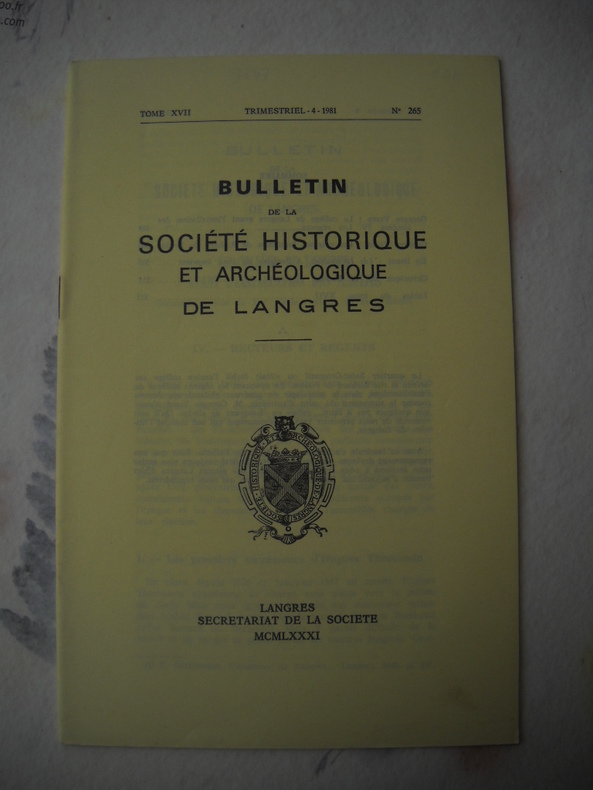
9047broché - 15.5x24 - pages 489 à 520 - tome XVII - 4 éme trimestre 1981 - n° 265
4to, [vii]pp., 158 columns, with the H.P. Kraus bookplate, orig. printed wrappers. Dealing with the printers Ludwig Hohenwang and Johannes Zainer. The bibliographical part list 166 books printed at Ulm during the 15th and early 16th century.
Two volumes, complete. The bibliography of an excellent collection: well over 1100 items, precisely described. [11], 251; x, 37 pp. With a few facsimile plates. 4to. Main volume in publisher's cloth; supplement in wraps. Fine and bright. Scarce.
Main work 7 vols., orig. cloth, Reichling 7 parts, orig. printed wrappers, 14 volumes in total. This work is the basic bibliography to which anyone working on fifteenth-century books refers or is referred to, this set includes the important appendix by Reichling.
Two volumes in one. The standard bibliography of Spanish and Portuguese books printed up to the year 1500. 720 items meticulously described, many in great detail. 4to, fine and bright in publisher's cloth.
A standard monograph on Iberian incunabula and post-incunabula. Dozens of facsimile plates. Large, squarish 8vo. Publisher's cloth. As new.
Folio, [iv],xlpp., with the H.P. Kraus bookplate, 46 plates, cont. quarter roan, spine rubbed, marbled sides. The marks of 93 different Spanish and Portuguese printers are included in this study. An alphabetical list of printers' and publishers' names refers the reader to biographical sketch in which each name appears. Information presented includes the dates during which a printer was active, cities in which he worked, and associates with whom he worked. Clear prints of marks are provided, as are the title, author, date and city of publication, and size of book(s) in which each mark appears, as well as citations to other scholarly resources. The index of printers' and publishers' names is comprehensive, guiding users of this work to both the main entry on a printer or publisher as well as to entries in which the name is mentioned, which makes this a useful book for researching the interactions between various printers.
[iv],165pp., frontis., 33 facsimiles, orig. cloth.
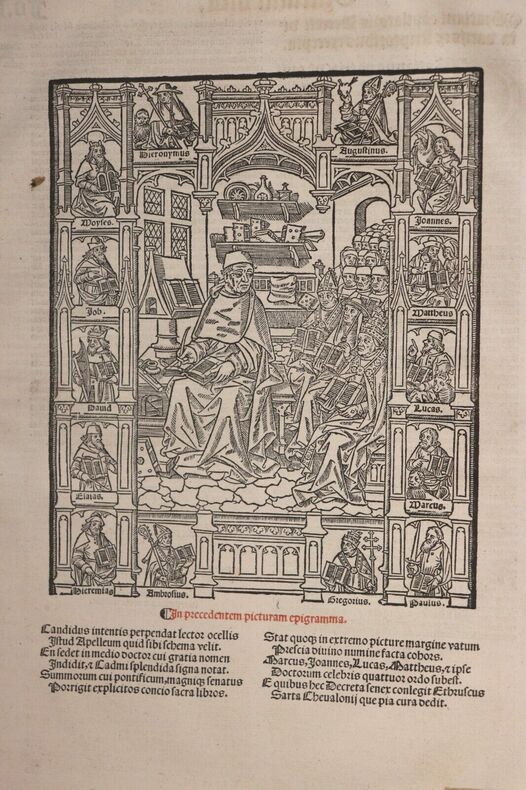
1528AMO-4518Parisiis, ex officina Claudii Chevallonii sub sole aureo in dia ad divum Jacobum. 1528 mense Aprili. [Paris, Claude Chevallon, avril 1528] 1 fort volume in-folio (39 x 28 cm) de 28 feuillets non chiffrés, CCCCLIX fol. chiffrés (le folio CCLXXIX manque), XLVI fol. chiffrés et 1 fol. non chiffré. Titre imprimé en rouge et noir dans un encadrement gravé sur bois, marque de B. Rembolt sur le titre. Grande gravure sur bois au verso du folio I (L'auteur présentant son ouvrage). Grande gravure sur bois au verso du folio CCCCXVIII (Arbor consanguinitatis) et autre grande gravure au recto du feuillet suivant (qui n'est pas chiffré). Le dernier feuillet contient le registre. Texte imprimé en rouge et noir pour la plupart des feuillets, le plus souvent sur 4 colonnes avec différentes tailles de caractères, le tout en caractères gothiques. Reliure ancienne (probablement du début du XVIIe siècle) en veau brun. Reliure usagée encore solide. Manque de cuir au dos, mors fendus. A restaurer. Intérieur assez frais. Quelques mouillures sans gravité à quelques feuillets. Mouillure avec petit manque de papier dans la marge inférieure des derniers feuillets, sans atteinte au texte. Comme indiqué plus haut le folio 279 manque (trace d'arrachage dans la marge intérieure), sinon tous les autres feuillets sont présents. Superbe mise en page avec de très nombreuses grandes lettrines historiées.
31814Grand in-8, demi-chagrin noir, dos lisse orné de petits filets et fers dorés, titre doré en long, couverture conservée, 83 p. Lille, Imprimerie L. Danel, 1907.