[Leviticus; Numeri; Deuteronomium. (Das dritte bis fünfte Buch Mose). - Biblia latina mit Postilla des Nicolaus de Lyra]Antiquariat.de

424 résultats
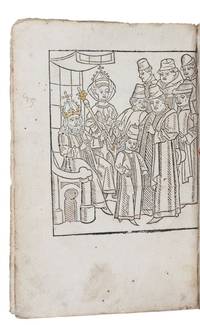
64370[Nürnberg, Anton Koberger, 1487]. Fol. Mit 2 Textholzschnitten. Durchg. m. eingemalten Initialen in Rot u. Blau sowie rubriziert. 100 nn. Bll. (Got. Typ., 2 Kol., 72-73 Zeilen, Text von Kommentar umgeben), Geheftet (ausgebunden; ohne Einband).
64353[Nürnberg, Anton Koberger, 1487]. Fol. Durchg. m. eingemalten Initialen in Rot u. Blau (die beiden Anfangsinitialen größer) sowie rubriziert. 22 nn. Bll. (Got. Typ., 2 Kol., 72-73 Zeilen, Text von Kommentar umgeben), Geheftet (ausgebunden; ohne Einband).
64452[Nürnberg, Anton Koberger, 1487]. Fol. Mit einer goldgehöhten Anfangsinitiale u. einem Textholzschnitt. Durchg. m. eingemalten Initialen in Rot u. Blau sowie rubriziert. 82 nn. Bll. (Got. Typ., 2 Kol., 72-73 Zeilen, Text von Kommentar umgeben), Geheftet (ausgebunden; ohne Einband).
64453[Nürnberg, Anton Koberger, 1487]. Fol. Mit eingemalten Initialen in Rot u. Blau sowie rubriziert. 60 nn. Bll. (Got. Typ., 2 Kol., 72-73 Zeilen, Text von Kommentar umgeben), Geheftet (ausgebunden; ohne Einband).
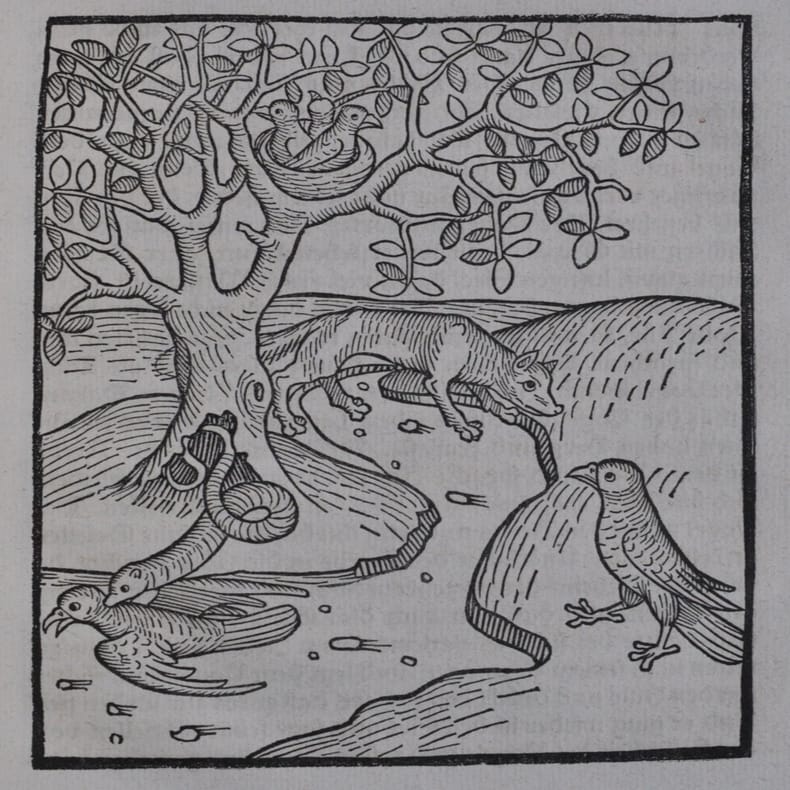
46405613Berlin, Mauritius Verlag, s. d. (vers 1910-20) ; in-4, cartonnage d’éditeur. 62 pp. non chiffrées.Choix de fables animalières extraites du Livre de Sagesse des anciens sages de Jean de Capoue, traducteur latin du XIIIe siècle. Ces fables provenant d’Inde ont eu une large diffusion grâce à la traduction de Capoue. Cette édition reproduit la traduction allemande publiée à Ulm en 1483 ainsi que 24 grands bois à pleine page de cette édition incunable.
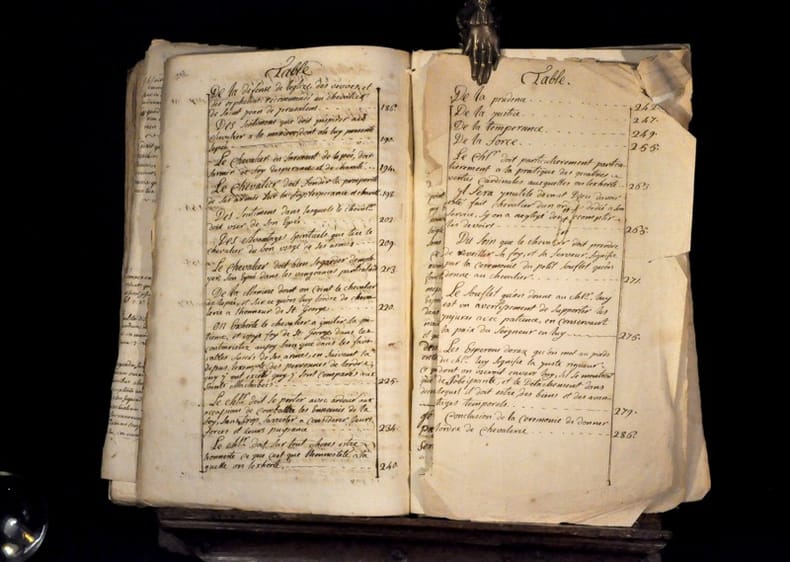
16883205Circa 1688 Manuscrit composé de 15 cahiers assemblés par des lacets et reliés entre eux par une cordelette de lin (177 feuillets in-folio (230 x 355 mm). Calligraphie très lisible, écrite à l’encre noire et à l’encre rouge, réglé au crayon en marge. Quelques déchirures, manques dans les premiers feuillets. Manuscrit très fortement raturé et surchargé. Composition - Avant-propos, 6ff.- Suivi de : « Formulaire de la profession reguliere des Chevaliers de Malte » (à l’encre rouge) 1ff.- Suivi de : « Oraisons que le prestre dit avant la profession ». En latin aux encres rouges et noires, 2ff.- Suivi de : « La forme de Donner l’ordre de Chevalerie, Les oraisons finies, le prestre commence la messe et sarreste avant levangil alors celui quy se dispose a recevoir l’habit se leve de devant l’autel, et va se mettre a genoux devant le chevalier quy la luy doit donner : pour en recevoir premierement lordre de chevalerie lequel luy dit (…), 4ff.- Suivi de : « Troisieme section contenant les paroles qui se prononcent en faisant les vœux », 1page. - suivi de : « Quatrième section contenant la forme de donner la croix et l’habit régulier de l’ordre et les oraisons quiserecitent pour conclusion de la cérémonie » 2 ff.- Suivi de : « Oraison après profession » (à genoux devant l’autel), 3ff.- Suivi de : « Reflexions dun Chevalier de Malte Religieux de l’ordre militaire des hospitaliers de Saint [Jean] de jerusalem. Sur la grandeur et les devoirs de son Etat ». 326 pages numérotées, dont les 4 derniers blancs. Le dernier marqué au verso d’une autre écriture : « Recu Ch de Malthe dan langue de provence le premier 7 bre 1572. »Défauts : Saut de pagination entre la dernière page de table marquée 293 à la partie commençant par : « réflexion d’un chevalier » paginée 303.
14869BDEHOBV62VDWürzburg: Georg Reyser 1486. Later bound in two leaves from a 13th-century vellum theological manuscript rubricated and decorated with alternating red and blue initials with penwork. Folio. Printed in red and black in rotunda type 32 lines; printed area: 18 x 12 cm; type: 112a. With illustrations cut from 19th- or 20th-century reproductions of early woodcuts ca. 21 x 14 cm pasted on the front Annunciation and back pastedown Christophorus with the year "cccc xx tercio". Interesting example of the study of early printing in 19th-century England. The 12 leaves come from the library of the 19th-century collector Dr C. Inglis whose father boasted an impressive collection of early printed books. Inglis believed that the leaves came from an unknown work titled De vita et honestate clericorum ex consilio Moguntinum printed in 1453 by Gerhardus Episcopus. Tipped in is a letter to Inglis by the well-known bibliographer William Blades discussing this matter. Although the text opens with "De Vita et honestate clericorum ex consilio Maguntinensis Gerhardi Archiepiscipi" it was in fact part of Statuta synodalia herbipolensia printed at Würzburg by Georg Reyser in ca. 1486. The first 6 leaves are 2-d7 and the final 6 leaves are quire g.With owner's inscription of Sir Edward Coates bookplate with initials "CC" Clifford Coates the bookplate of Dr. C. Inglis and some annotations on front pastedown; an autograph letter signed by Wiliam Blades to C. Inglis tipped to flyleaf. 12 well-preserved leaves.l Cf. BMC II 572; Goff S-741; Hain 15036; Hubay Inc. Universitätsbibl. Würzburg 1953; ISTC is00741000. Georg Reyser, hardcover
1497WB19676Strasbourg: Johann Reinhard Grüninger 26 April 1497. Hardcover. Very Good. Chancery Folio; 304 x 207mm; 490 leaves of 492 lacking blank Z6 and the final leaf of the table; a bifolium from gathering B is bound in A. It features red and blue Lombard capitals with a woodcut depicting Saint Jerome on the title page. The first bifolium has undergone extensive repair work at the gutter and outside edges with the first leaf being soiled chipped and laid down on new paper. Throughout the volume there are smaller repairs and tears with one larger tear that has been repaired affecting the text on page ss2. <br /> <br />Dampstaining and some soiling are present particularly at the ends and there is worming affecting some of the text. The final leaf has been heavily repaired resulting in loss of text at the outer edge. The book is bound in modern black blindstamped morocco with clasps in a style reminiscent of the period with gilt edges showing some signs of wear. The provenance of the book includes extensive marginalia with an inscription indicating it belonged to Georgius Wenceslaus Pastor of Olbersdorf dated 1635 who acquired it from Samuel Ursinus. <br /> <br />A Bible printed by the prolific Strasbourg printer Johann Reinhard Grüninger replete with annotations credibly by Georgius Wenceslaus the Lutheran pastor who served in Olbersdorf a town in the historical region of Silesia which is now part of modern-day Poland. It features a woodcut on the title page portraying Saint Jerome depicted both in contemplative study and in prayer at the foot of the cross. <br /> <br />HC 3122; BMC I 111; BSB-Ink B-476; GW 4277; Bod-inc B-308; Goff B-600; ISTC ib00600000. Uncommon in commence. <br/><br/> [Johann (Reinhard) Grüninger,] hardcover
14805273Gouda: Gheraert Leeu 1480. Contemporary limp sheepskin parchment without a spine so that the sewing is completely visible. Kept in a modern brown half morocco clamshell box. 4to 20.5 x 14 cm. With 4 full-page woodcuts plus 14 repeats. The first shows King Pontianus on his throne the Queen standing next to the throne and the seven wise men standing before them with one telling a story. The last shows the same group but with the king's son Diocletianus telling his story The other two show in one case a wise man and in the other the queen telling a story to the king and are used for various stories. That with a wise man has scroll with an opening where type is set to indicate which wise man is speaking. The first illustrated edition in any language of one of the oldest and most popular texts of early European literature. It is also the first illustrated book printed by Gheraert Leeu just before his better-known Dialogus creaturarum. No copy of any edition before 1483 in any language is recorded in a Dutch library. Known in English as The seven sages of Rome it is a series of educational short stories within a "frame story" in the tradition of the Indian Panchatantra the Arabian Nights etc. and some of the stories are variations on stories told there. These stories were first published in Latin at Cologne in 1472. Leeu probably published the first edition in the Low Countries in Dutch with only a single woodcut dated 25 July 1479. That edition is known only from two incomplete copies. His present Latin edition must date between that and 3 June 1480 so it is not clear whether it preceded the unillustrated Deventer edition of 1479 or later. Our copy is preserved in its original limp parchment and only very slightly trimmed giving wide margins 1.5 4 and 5 cm. With 8 early owners' inscriptions one dated 1579 and others clearly older four small and mostly marginal worm holes running through the first leaves and the usual traces of age and handling. The parchment is stained and slightly wrinkled. Nearly untrimmed and in good condition.l Campbell 947; Goff S-448; Goudriaan Een Drukker zoekt publiek. Gheraert Leeu te Gouda 1477-1484 list of publications no. 46; Hain 3000; ILC 1952; ISTC is00448000 7 copies; Klebs Incunabula 906.4; Kok Woodcuts in Incunabula printed in the Low Countries 69. 1-4; Polain 1970; Van Thienen & Goldfinch 1952 same 7 copies; Vijfhonderste Verjaring Boekdrukkunst Nederlanden 127 with. ill.; not in BMC STC Dutch; Incunabula in Dutch Libraries; Gheraert Leeuw exhibition at Gouda 1992; cf. Lexicon des Mittelalters VII pp. 1836-1839. Gheraert Leeu, unknown
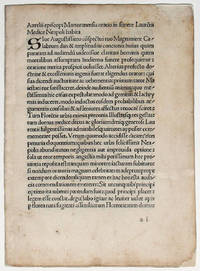
14922680<p>4to. 20.5 x 15 cm 4to. 20.5 x 15 cm 8 ff. rather dog-eared at edges and with some light soiling. Disbound in a cloth-covered box.<br /></p><p>Rare first edition of this funeral oration for Lorenzo de Medici read in Santa Maria Nuova on 16 April 1492 evidently the only contemporary printed oration of the many delivered and printed in his honor to survive.</p><p>"Lorenzo de' Medici… born January 1 1449 Florence Italy—died April 9 1492 Careggi near Florence Florentine statesman ruler and patron of arts and letters was the most brilliant of the Medici. He ruled Florence with his younger brother Giuliano 1453–78 from 1469 to 1478 and after the latter's assassination was sole ruler from 1478 to 1492." Brittanica.com</p><p>The present publication is the sole oration devoted to Lorenzo in the Short-Title List of Funeral Orations from the Italian Renaissance Ca. 1374-1534 compiled by John McManamon and the only printed example featured in the 1992 exhibition at the Bibliotheca Nazionale Centrale <i>Lorenzo dopo Lorenzo La Fortuna Storica di Lorenzo il Magnifico. </i>Notwithstanding the poor survival rate of ephemeral publications and the controversial character of the <i>laudandus</i> the statistic remains remarkable. The motive for the present oration was overwhelmingly political and meant to insure continuation of the traditionally strong alliance between Naples and Florence at a difficult time of dynastic transition. According to Miglio <i>DBI </i>X.369-70 the work was published before it was read.</p><p>A Naples edition was published the same year from the press of Cristannus Preller IGI VI.1722-A. The work was re-published in the 19th century by Vito Capialbi <i>in Memorie di R. Zeno e A. Bienato</i> Naples 1838 49-86. Milanese born Aurelio Bienato was Reader in Rhetoric at the University of Naples 1470-80 and later elected Bishop of Martirano modern Catanzaro in which sinecure he remained until his death. Miglio also lists an unpublished commentary on Quintilian <i>Iter Italicum</i> I.415-16 II.570 and a collection of Latin verses <i>Elegantiarum epithomata</i> an epitome of Lorenzo Valla's <i>Elegantiae linguae latinae</i> which went through a number of incunable editions 1479/80; 1488; 1491. </p><p>US copies ISTC: Huntington Newberry and Yale. </p><p>Provenance: Ritman copy.</p>Goff B-667; BMC vi.784; GW IV.1346; Paolo Pira ed. Lorenzo dopo Lorenzo. La Fortuna Storica di Lorenzo il Magnifico Florence Biblioteca Nazionale 1992 I.24; John M. McManamon Funeral Oratory and the Cultural Ideals of Italian Humanism 1989 p. 256 & 41-43. Phillipus de Mantegatiss
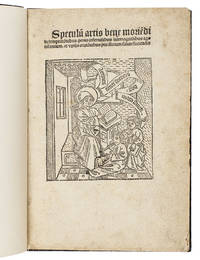
1495ABC_47543Cologne: Heinrich Quentell 1495. Recent marbled paper over boards by the Geneva bookbinder Jean-Luc Honegger b. 1953 who set up his atelier ca. 1978 signed with his honegger stamp in blue ink at the foot of the back paste-down sewn on 3 recessed supports the marbled paper in an antique spot pattern see Wolfe 162-163 with black spots on unusually fine-grained grey Stormont spots and with veins in red turquoise orange dark blue and white black morocco spine label with the title in gold roman capitals reading up the spine. Small Chancery 4to 20.5 x 14.5 cm. With a large woodcut 10.0 x 8.8 cm on the title page: depicting a teacher Pope Gregory the Great ca. 600 CE declared a saint in 1295 with a dove on his shoulder his attribute seated behind a lectern with an open book instructing two of his pupils seated before him each with a book in his hands with above them a scroll inscribed Accipies tanti doctoris dogmata sancti. Set in a single column with 36 lines to the page in a rotunda gothic type Quentell type 7 here 79G though in the Typenrepertorium 80G with a larger textura gothic for the first line of the title Quentell type 10 155G though the only capital in that line is the 8 mm lombardic initial S Quentell initials e described as 6/7 mm but noting that they are used with type 10. With spaces left for manuscript initials 1 6-line and many 3-line a few - mostly on b1v and b2r - with manuscript guide letters in black ink. Most pages with a few words underscored in black ink. Quentells second quarto edition of the well-known manual on the art of dying in the original Latin matching his ca. 1493 quarto edition almost line for line and using the same woodcut quite different from any used with this text before that date. Quentells quarto editions contain the original long version of the text known as Speculum artis bene moriendi often attributed to Matthaeus de Cracovia or Albertus Magnus editions in Italian are often attributed to Dominicus de Capranica Cardinal of Fermo. The Ars moriendi was one of the earliest incunabula printed and consists of two related Latin texts written around 1415 and 1450 offering guidance on how to have a good death according to Christian beliefs of the late Middle Ages. The texts were written in response to the Black Death and social upheavals of the 15th century with the earliest versions likely composed in southern Germany. The highly popular Ars moriendi was translated into many West European languages and was the first in a tradition of guides to death and dying. The first edition in the original Latin appeared ca. 1474 but was preceded by a German edition in 1473 and perhaps by an edition in Italian described as ca. 1471/75. Quentell published the Latin text together with other works in a folio edition described as ca. 1484/89 but he published four quarto editions of the Ars moriendi alone described as ca. 1493 the present ca. 1495 ca. 1498 and another probably after 1500. He published no Ars moriendi editions in vernacular languages. His first three quarto editions have the same collation but the present edition matches the ca. 1493 edition almost line for line and uses the same woodcut while the ca. 1498 edition differs considerably and uses a different woodcut.Heinrich Quentell one of the greatest early Cologne printer-publishers issued many theological and philosophical texts for university use but also liturgical texts working both alone and with Johann Helman who may have also jointly employed contract printers and dispatched servants to sell books. Quentell was one of the first printers to consistently provide his books with title-pages with approximately 91% of his over 380 publications including one.Quentell used the present Magister cum discipulis-woodcut in several other editions including the Heymericus de Campo Promptuarium argumentorum 1492 GW 12406 and Jacobus van Gruitrode Speculum aureum animae peccatricis 1493 GW M10728. Wynkyn de Worde used a copy in his Parabolarum Alani cum commento 1508 STC 254.3 and other printers copied it as well.All Quentells Ars moriendi editions are undated and the present one used his types 7 and 10 and initials e which all apeared in his books in the period 1488 to 1500. The present edition is probably dated ca. 1495 in the literature because it appears to fall between the two quarto editions thought to date from ca. 1493 and ca. 1498.The bookbinder Jean-Luc Honegger still active today is best known for his bindings for the Bibliothèque Nationale de France in Paris and the Bodmer Foundation near Geneva. With the bookplate of the Bibliotheca Philosophia Hermetica Joost Ritman in Amsterdam and probably bound for them. Slightly browned water stains at the foot of a few leaves not approaching the text some smudges in the margins and on the blank final page. The binding slightly worn at the extremities and with a few unobtrusive scratches on the back board. Otherwise in very good condition and only slightly trimmed about 5 mm at the head and probably no more at the fore-edge and foot giving generous margins about 2 3 and 4 cm at the head fore-edge and foot respectively and some leaves with tranchefiles at the foot.l Bibliothèque Nationale Catalogue des incunables A598; BMC I p. 294; Bod-Inc A449; Bohonos Szandorowska Incunabula quae in bibliothecis Poloniae asservantur 562; BSB-Ink A766; Buffévent VIII 45; Goff A1098; Günther Wiegendrucke der Leipziger Sammlungen 781; GW 02610; HC 14911; ISTC ia01098000; Madsen Kongelige Biblioteks inkunabler 352; Ohly-Sack 274; ÖNB-Ink A483; Pell 1339; Polain 972; Proctor 1425; Sack Freiburg 306; Sallander Uppsala 2046; Schramm VIII 484; Schreiber Manuel de lamateur de la gravure sur bois et sur métal au XVe siècle 3671; Thienen Incunabula in Dutch libraries 425; UBL-Ink A354; USTC 739947; Voulliéme Die Buhdrucker Kölns 305; Voulliéme Inkunabeln der Königlichen Bibliothek 1011; Voulliéme Trier 697. Heinrich Quentell, hardcover
45867Johann Gruninger Strasbourg 1485. 8vo Intact single page with appropriate light age tanning and creases and only a small tear at upper left edge. This is a single page of a very famous hand printed German bible from one of Europe's most important pre 1500 printers. Recently mounted on black board with a gold frame. Both sides are printed and the page is only lightly attached at its upper edge to the mounting. Obviously over 530 years old now and is a small example of great historical interest. Johann Gruninger Strasbourg 1485 unknown
229889Lisbonne, 1988 in-8, 442 pp., 1359 numéros décrits, une collette d'errata, avec 16 illustrations hors texte en noir et en couleurs, skaï marine (reliure de l'éditeur).
244626Londres, Maggs, 1938, in-8, [2] ff. n. ch., 264 pp., [7] ff. n. ch. de tables, 419 numéros décrits à prix marqués, avec des illustrations en noir dans le texte, broché.
239166Florence-Rome, Leo S. Olschki [Imprimerie Giuntina], 1915, 4 parties en un vol. in-8, VII pp., 240 pp., 120 pp., 72 pp., 148 pp., 1000 numéros décrits, avec des illustrations dans le texte et une planche dépliante hors texte, percaline mi-partie bleue et crème, filets dorés sur les plats, tête rouge (reliure de l'éditeur).
244167Paris, Honoré Champion, s.d. (1911) in-8, VIII pp., 98 pp., un f. n. ch. de table, broché, non coupé.
17632Genève, Slatkine reprints, 1973. 1 vol. in-8°, toile ocre Bradel, titre doré en long au dos. Reliure de l'éditeur. Très bon exemplaire. XII-154 pp., (2) ff.[D06]
29007Angers, Jean de La Tour, s.d. [1494-1495]. 2 ouvrages en 1 vol. in-16, veau brun, dos à nerfs orné de petites fleurs de lys dorées encadrées de doubles filets à froid, double encadrement d'un triple et d'un double filet à froid sur les plats, petites fleurs de lys aux angles de l'encadrement intérieur, fleuron doré au centre. Reliure moderne dans le goût du XVIe siècle. Cachet sur la garde blanche de Claude Lambert (Sablé, XXe s.), note manuscrite datée de 1710 au v° du premier feuillet par un avocat du Mans, note bibliographique du XIXe siècle et cachet de L. Lefebvre, prêtre de Mamers sur le dernier feuillet blanc en fin de volume. Premier feuillet dans une frise typographique gravée sur bois comprenant un personnage et des oiseaux dans des feuillages, impression en caractères gothiques à 23 lignes, qq. lettres peintes en rouge, ciii ff., (10) ff.; LIV ff., (1) f. blanc. Signatures : [A-N]8 O10 ; [a-g]8. Il manque les feuillets de titre (A1 et a1) des deux ouvrages. Quelques annotations marginales.
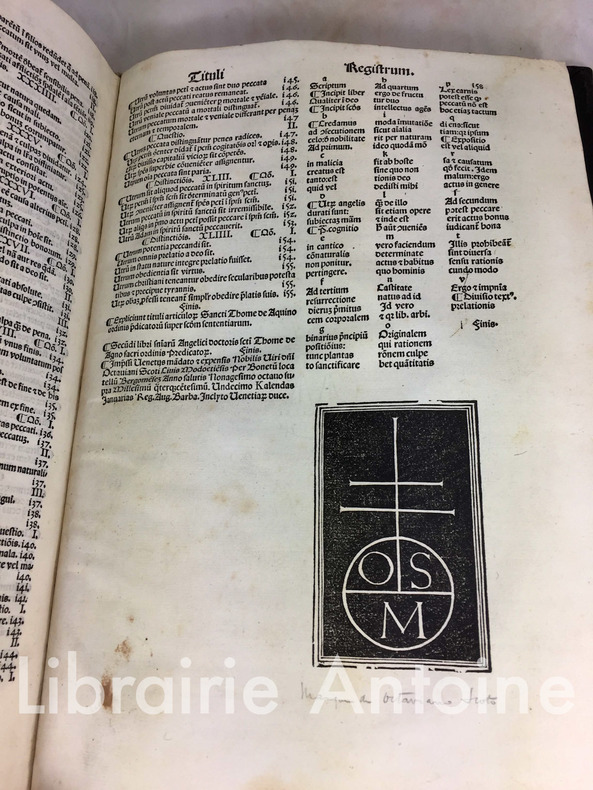
3237Venise Bonetus Locatellus pour Octavianus Scotus 1498 In-folio, 157 sur 158 feuillets chiffrés (manque le f. 76), reliure en maroquin noir sur ais de bois, plats décorés à froid d'un double encadrement de fers répétés et soulignés d'une double paire de filets, au centre alignement de deux fers répétés, traces de fermoirs, dos à nerfs, gardes en vélin de réemploi d'un manuscrit liturgique (missel ou évangéliaire) du XIIème siècle.
29846Venise, Léonard Wild, 1489 [sic, pour 1479]. 1 fort vol. in-4°, veau brun estampé à froid sur ais de bois, dos à nerfs en basane blonde jaspée orné de roulettes et de fleurons dorés, pièce de titre en maroquin vert, encadrement de filets et de petits fleurons à froid sur les plats, petits fleurons à froid disposés en cercle au centre, gardes de vélin. Reliure de l'époque, dos refait au début du XIXe siècle, plats très frottés, traces de fermoirs. Exemplaire grand de marges. Impression en car. goth. sur 2 coll. de 48 ll, exemplaire rubriqué, initiales peintes en rouge et en bleu, (1) f. blanc, (378) ff., (1) f. blanc. Signatures : [a-g]12 [h-v]8-12 18 212 [3-4]8 [5-13]12-8 A12 B10 a8 b10. Le f. a2 (qui comporte l'incipit) est en fac-similé sur papier ancien, manque le quart sup. du premier feuillet blanc; Mouillure marginale sur une trentaine de ff. en début de vol. Le reste de l'exemplaire est d'une grande fraîcheur.
1931LFA-126719344Un catalogue de 308 pages, format 190 x 255 mm, illustré, broché, publié en 1931, A. Bontemps, bon état, rare
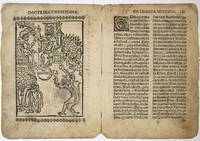
15606658México 1560. First Edition — Primera edición. 200x147mm. 7¾x5¾". México anterior a 1560. En 4º 200 x 147mm. 4 pp. fols. 52 y 53. Texto en mixteca. 1 xilografÃa a toda página. Hermoso grabado en madera producido en México durante la época incunable de su imprenta publicado antes de 1560. Pertenece a una Doctrina Christiana en lengua mixteca. En la hoja 52 verso gran xilografÃa a toda página representando a Dios sentado en el trono con la bola del mundo a sus pies su hijo sentado a la derecha y el EspÃritu Santo a la izquierda debajo un grupo Santos rezando y una imagen del demonio. Se trata de una de las primeras xilografÃas impresas en América. unknown
64406[Nürnberg, Anton Koberger, 1487]. Fol. Mit 13 (dav. 2 ganzs.) Textholzschnitten. Durchg. m. eingemalten Initialen in Rot u. Blau sowie rubriziert. 64 nn. Bll. (Got. Typ., 2 Kol., 72-73 Zeilen, Text von Kommentar umgeben), Geheftet (ausgebunden; ohne Einband).
64454[Nürnberg, Anton Koberger, 1487]. Fol. Mit einem ganzs. Textholzschnitt. Mit eingemalten Initialen in Rot u. Blau sowie rubriziert. 36 nn. Bll. (Got. Typ., 2 Kol., 72-73 Zeilen, Text von Kommentar umgeben), Geheftet (ausgebunden; ohne Einband).
Second edition, [2 ads], [36]pp., with printed title-page and half-title, engraved headpiece, the advert leaf includes two editions of Beckford's Vathek and A Description of Fonthill Abbey. Small 4to (235 x 145 mm), 2 works in one, recent half calf to style, marbled boards, spine tooled in gilt. A survey of the principal public and private libraries in England, listing highlights of the collections and concluding with brief accounts of 30 important English book auctions from the 17th century onwards. William Beckford assisted in the compilation of this work, particularly in the description of his own library at Fonthill. The Dialogue in the Shades is a two-part pamphlet of satirical verse is a response to Dibdin's Lincolne Nosegay and the Bibliographical Decameron. The attribution varies from William Beckford to the Clarke brothers. This second edition is issued with an additional half-title, title-page with note from 'Mr. Wynkem' on the verso, and with the addition of The Diary of Roger Payne, a work in the same vein. A rare anti-Dibdinia item. Windle & Pippin, D9.