424 résultats
3369Feuille d'incunable romain du quinzième siècle provenant de « Opera, scilicet : tractatus V... » Romae, Eucharium Silber, 1495. Un feuillet in-folio (30.8 x 21.8 cm). Texte latin en caractères romains de 2 pages de 56 lignes (folio tiré du « Nelli de Balionibus; In funere »). Mouillures claires à la marge de tête. Bel état. Brunet I, 1521. Graesse II, 28. Goff C-73.
3370Feuille d'incunable romain du quinzième siècle provenant de « Opera, scilicet : tractatus V... » Romae, Eucharium Silber, 1495. Un feuillet in-folio (30.8 x 21.8 cm). Texte latin en caractères romains de 2 pages de 56 lignes (folio tiré du « Nelli de Balionibus Car. Saxoferratensis »). Mouillures claires à la marge de tête. Bel état. Brunet I, 1521. Graesse II, 28. Goff C-73.
3371Feuille d'incunable romain du quinzième siècle provenant de « Opera, scilicet : tractatus V... » Romae, Eucharium Silber, 1495. Un feuillet in-folio (30.8 x 21.8 cm). Texte latin en caractères romains de 2 pages de 56 lignes (folio tiré de « Descriptio Thrasimeni »). Mouillures claires à la marge de tête. Bel état. Brunet I, 1521. Graesse II, 28. Goff C-73.
150243414Bologne, Benedetto Faelli, 1502. In-folio de (3) ff. 1 f.bl. ccclxxxix ff. (sign. [*]4 (dernier blanc) a-t6 u4 x-z6 &6 [&]6 [rum]6 π6 A-H6 I-K8 L-Z6 AA-BB6 CC8 DD-OO6 PP7 , exemplaire sans le dernier feuillet blanc), maroquin lie-de-vin aux armes de Joaquín Gómez de la Cortina, dos orné à nerfs, titre et date en pied de dos dorés, tranches dorées (reliure du XIXe siècle).
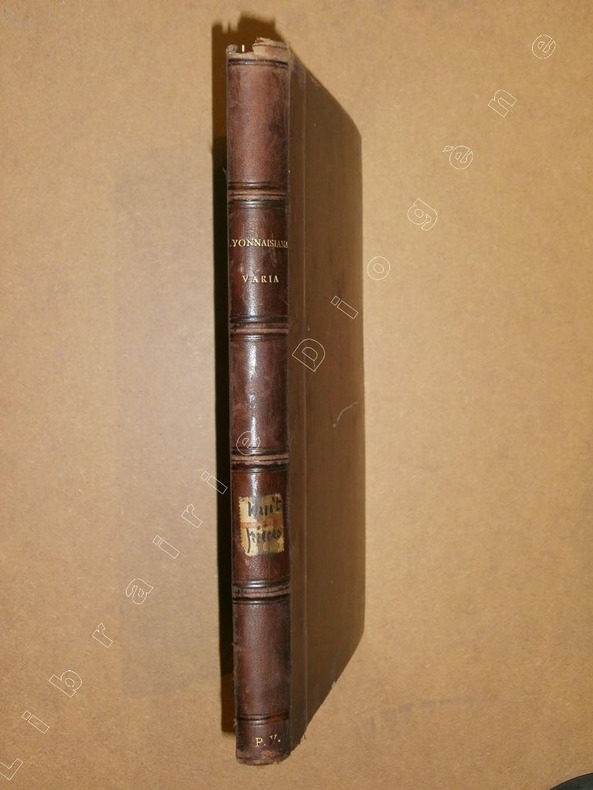
883381861-1888, demi-basane, divers documents reliés ensemble, reliure en mauvais état, un feuillet détaché (sans manque), un page manuscrite en fin de volume, quelques rousseurs sur les pages.
First Edition, 4to, frontis., 17 plates, orig. cloth. A study of a small collection of medical incunabula and early 16th century books originally collected by Pol. Most of the volumes listed were purchased from Maggs Bros. in 1929 and are now in the Cleveland Medical Library.
1376328Calcutta: Bibliographical Society of India, 1981 in-8, (4)-x-vii-80 pages. Cartonnage d'éd., bon état, tirage de 200 exemplaires. Includes bio-data of authors and index. (Navaditya series, no. 2).
ST-CLOUD, imp. Bélin frères - 1900 - In-4 Relié, couverture conservée - nombreuses reproductions de livres, bandeaux illustrations, reliure, affiches, dessins etc - 139 pages - Rare Ouvrage sur le livre, sa composition et dérivés
3451ST-CLOUD, imp. Bélin frères - 1900 - In-4 Relié, couverture conservée - nombreuses reproductions de livres, bandeaux illustrations, reliure, affiches, dessins etc - 139 pages - Rare
Large 8vo, xiv, [2], 312pp., orig. printed wrappers bound-in, cont. quarter morocco, spine gilt a little rubbed, 643 items. An incredible array of early printing from some of the major libraries of the time. "The aim of this catalogue is to give examples of the work of Typography during the first fifty years of its existence in the various countries into which it was introduced during the fifteenth century." ? Preface.
65279[Köln, Drucker des Salomon et Marcolphus (Ludwig von Renchen), nicht nach 1478). Fol. Mit einer rot eingemalten Initiale am Beginn. 66 nn. Bll. (ohne das erste u. letzte weiße; 40 Zeilen, Got. Type). HLdr. d. 20. Jhds. m. goldgepr. Rückentitel u. Rotschnitt.
13731480 circa 1480, Miniature sur vélin 11,4 x 7,5cm.
1861Belle et fraîche miniature (à vue : 7 x 7 cm) extraite d’un antiphonaire italien. Italie du Nord, dernier tiers du XIVe siècle.Le personnage se situe dans une grande initiale très abondamment rehaussée d’or à la feuille.Belle composition, dans un parfait état de conservation.
1862Miniature italienne sur fond d’or à la feuille représentant un ange musicien (7 x 6 cm).Une composition originale et expressive qui, bien que légèrement passée, conserve beaucoup de charme.
1863Miniature sur vélin extraite d’un antiphonaire français (7 x 6,5 cm), lettre D représentant l’Esprit Saint sous forme d’une colombe descendant sur les apôtres et la vierge Marie, sur un fond pourpre chargé de rinceaux d’or.Quelques traces d’usure dues aux baisers de dévotion.
1938Miniature italienne sur vélin, XIVe siècleBelle et fraîche miniature (à vue : 7 x 7 cm) extraite d’un antiphonaire italien. Italie du Nord, dernier tiers du XIVe siècle. Le personnage se situe dans une grande initiale très abondamment rehaussée d’or à la feuille. Belle composition, dans un parfait état de conservation.
149565636[Paris, Pierre Le Dru für] Jacques Moerart, o. J. (um 1495). 8°. Titel m. einer fast blattgr. Holzschn.-Druckermarke. 95 (statt 96, fehlt das letzte weiße) Bll. (Got. Type, 32 Zeilen, rubriziert), Brauner Maroquin-Bd. d. frühen 20. Jhds., der Vorderdeckel m. grünen Intarsien u. reicher floraler Vergoldung, Rücken-, Deckel- u. Innenkantenverg., goldgepr. Rückentitel u. Goldschnitt.
26554, Brussel, Paleis der Academien, 2009, Paperback, soft cover, original editor's jacket, 17.9x25.9 cm., 434 pp., index Auctorum Operumque, Index Personarum et Locorum.
27 (1) pp.met illustraties (facsimiles), 27cm., mooie staat
1985B58348Antwerpen, De Schutter 1985 27 (1) pp.met illustraties (facsimiles), 27cm., mooie staat
65274[Basel, Michael Wenssler, nicht nach 1474]. Fol. 190 nn. Bll. (das letzte weiß; Got. Typ., 34 Z.), durchg. rubriziert u. mit zahlr. in Rot eingemalten Initialen. HLdr. d. 20. Jhds. m. goldgepr. Rückentitel.
1493D4438Venice: Johannes Rubeus 1493. Hardcover. Very Good. Venice: Johannes Rubeus 1 January 1493. Folio 315 x 225mm. 174 leaves. Collation: a 7; b-x 8; tabula 7. 61 lines Roman type capital spaces unrubricated. Contemporary notation and hand-drawn manicules indicating the text throughout many are whimsically flourished or holding objects. Final blank on watermarked paper of flying swan in pearled medallion. Content are in three parts the first is a revised and augmented version with excerpts taken from classical authors and Italian humanists and formulas for letter-writing. The second part consists of an anthology of prose writers including Cicero Lactantius Macrobuius Plutarchus etc. The third part contains selections from Petrarch dramatic poets Terence Seneca Plautus and a variety of humanist speeches by Renaissance copyists letter-writers and philosophers including Johannes Lamola Poggius Florentinus Galeatius Sforza and the author himself. Contents: Leaf 2a title: Oratorum omnium Poetarum: Hystoricorum: ac Philosophorum elegantes dicta: per Clarissimum iurum Albertum de Eiib in unum collecta faeliciter incipiunt. Leaves 120a-123b contain: Liber augustalis imperatorum Francisci Petrarchae Benvenuto Rambaldis continuation of Petrarchs Epitome vitarum virorum illustrium; Leaves 125a-129b: Francisci Petrarchae de aduersa fortuna Remedia; Leaves 129b- 132b: Francisci Petrarchae: de prospera fortuna remedia. Leaf 168b Colophon: Summa Oratorum omnium: Poetarum: Historicorum: ac Philosophorum Autoritates in unum collectae per clarissimum uirum Albertum de Eyb Vtriusque iuris doctorae eximium: quae Margarita poetica dicitur: faeliciter finae adepta est. M.CCCCLXXXXIII. Kalae. Ianuarii. Leaves 169a-175b: Tabula. totius . oprois. 18th-century three-quarter sheep over marbled pasteboards spine gilt with title silk book mark; wanting first and final original blank a few wormholes at the beginning and end some just affecting text; faint dampstaining in the upper margins few creased corners corner torn of m2 and marginal tear m8 very slightly spotted and soiled in places. From the Collection of Baron de Eyb his heraldic lithographed ex-libris dated 1899 to front pastedown an evident descendant of the author. Eyb is the name of an old Franconian noble family which is named after Eyb in Ansbach. It is likely this volume was owned by a contemporary with familial ties to the author and stayed within the family until the early 20th century. Eighth Edition of this important work of German Humanism. Albrecht von Eyb one of the earliest German Humanists was born in 1420 near Ansbach. Eyb went to Italy and devoted himself to humanistic study at the Universities of Pavia and Bologna. He returned to Germany in 1451 having been appointed Canon at Eichstätt and Bamberg. From 1452 to 1459 he was again a student at Bologna gaining the degree of doctor in 1459. That same year Eyb wrote Margarita poetica in honor of his mother Margarete von Wolmershausen. It was first published in Nuremberg by Johann Senschschmidt in 1472 and reprinted at least 13 times by 1503. It remained a popular manual of classical rhetoric by its three distinct focuses: letter-writing model orations and florilegia compilation of excerpts. The work is known for its vivid expression found within selected passages from classical and contemporary authors from Cicero to Petrarch. The Catholic Encyclopedia calls it a textbook of humanistic rhetoric consisting of a collection of passages in prose and verse from Latin authors to which are added specimens of humanistic eloquence. Of only about 40 in existence OCLC locates 13 copies of this edition in US collections. BMC V 417; Goff E177; GW 9536; HC 6824; Madsen 1547; Schmitt I 4233; Sheppard 4121; Proctor 5132 <br/><br/> Johannes Rubeus hardcover books
1493D4438Venice: Johannes Rubeus 1493. Hardcover. Very Good. Venice: Johannes Rubeus 1 January 1493. Folio 315 x 225mm. 174 leaves. Collation: a 7; b-x 8; tabula 7. 61 lines Roman type capital spaces unrubricated. Contemporary notation and hand-drawn manicules indicating the text throughout many are whimsically flourished or holding objects. Final blank on watermarked paper of flying swan in pearled medallion. Content are in three parts the first is a revised and augmented version with excerpts taken from classical authors and Italian humanists and formulas for letter-writing. The second part consists of an anthology of prose writers including Cicero Lactantius Macrobuius Plutarchus etc. The third part contains selections from Petrarch dramatic poets Terence Seneca Plautus and a variety of humanist speeches by Renaissance copyists letter-writers and philosophers including Johannes Lamola Poggius Florentinus Galeatius Sforza and the author himself. Contents: Leaf 2a title: Oratorum omnium Poetarum: Hystoricorum: ac Philosophorum elegantes dicta: per Clarissimum iurum Albertum de Eiib in unum collecta faeliciter incipiunt. Leaves 120a-123b contain: Liber augustalis imperatorum Francisci Petrarchae Benvenuto Rambaldis continuation of Petrarchs Epitome vitarum virorum illustrium; Leaves 125a-129b: Francisci Petrarchae de aduersa fortuna Remedia; Leaves 129b- 132b: Francisci Petrarchae: de prospera fortuna remedia. Leaf 168b Colophon: Summa Oratorum omnium: Poetarum: Historicorum: ac Philosophorum Autoritates in unum collectae per clarissimum uirum Albertum de Eyb Vtriusque iuris doctorae eximium: quae Margarita poetica dicitur: faeliciter finae adepta est. M.CCCCLXXXXIII. Kalae. Ianuarii. Leaves 169a-175b: Tabula. totius . oprois. 18th-century three-quarter sheep over marbled pasteboards spine gilt with title silk book mark; wanting first and final original blank a few wormholes at the beginning and end some just affecting text; faint dampstaining in the upper margins few creased corners corner torn of m2 and marginal tear m8 very slightly spotted and soiled in places. From the Collection of Baron de Eyb his heraldic lithographed ex-libris dated 1899 to front pastedown an evident descendant of the author. Eyb is the name of an old Franconian noble family which is named after Eyb in Ansbach. It is likely this volume was owned by a contemporary with familial ties to the author and stayed within the family until the early 20th century. Eighth Edition of this important work of German Humanism. Albrecht von Eyb one of the earliest German Humanists was born in 1420 near Ansbach. Eyb went to Italy and devoted himself to humanistic study at the Universities of Pavia and Bologna. He returned to Germany in 1451 having been appointed Canon at Eichstätt and Bamberg. From 1452 to 1459 he was again a student at Bologna gaining the degree of doctor in 1459. That same year Eyb wrote Margarita poetica in honor of his mother Margarete von Wolmershausen. It was first published in Nuremberg by Johann Senschschmidt in 1472 and reprinted at least 13 times by 1503. It remained a popular manual of classical rhetoric by its three distinct focuses: letter-writing model orations and florilegia compilation of excerpts. The work is known for its vivid expression found within selected passages from classical and contemporary authors from Cicero to Petrarch. The Catholic Encyclopedia calls it a textbook of humanistic rhetoric consisting of a collection of passages in prose and verse from Latin authors to which are added specimens of humanistic eloquence. Of only about 40 in existence OCLC locates 13 copies of this edition in US collections. BMC V 417; Goff E177; GW 9536; HC 6824; Madsen 1547; Schmitt I 4233; Sheppard 4121; Proctor 5132 <br/><br/> Johannes Rubeus hardcover
3025Circa 1968 Tapuscrit in 4 broché de 64 ff portant en page de titre « MARGARET (titre provisoire) / Scénario original de D. Medveczki et R. Topor » .
65209[Basel, Michael Wenssler, nicht nach 1474]. Fol. 52 nn. Bll. (34 Z., Got. Typ.). - Angeb. - Ders. De morali lepra. [Ebda., nicht nach 1475]. 68 nn. Bll. (34 Z., Got. Typ.), Roter Maroquin-Bd. d. 18. Jhds. a. 5 Bünden m. goldgepr. Deckelfileten, Rückenverg., 2 goldgepr. grünen Rückenschildern, Steh- u. Innenkantenverg. u. dreiseitigem Goldschnitt.