424 résultats
First Edition, 7 parts, orig. printed wrappers, uncut. Important appendix to Hain & Copinger.
179630116Montréal Cour du Banc du Roi, District de Montréal [1796] Un feuillet in-8 à l'italienne, 2 pages.
First Edition, 5 vols., in one, xii, [vi], 629, [1]; 30; viii, 44; iv,29; vi, 5pp., half morocco. [Sold with:] KRONENBERG (M.E.) Campbell's Annales de la Typographie N?erlandaise au XVe Si?cle: Contributions to a New Edition. 1956. 4to, orig. cloth. The first part of this work contains the titles of incunabula in alphabetical order; the second part consists of an alphabetical table of Dutch typographers, with a list of the works issued from their presses. From the library of Bernard H. Breslauer.
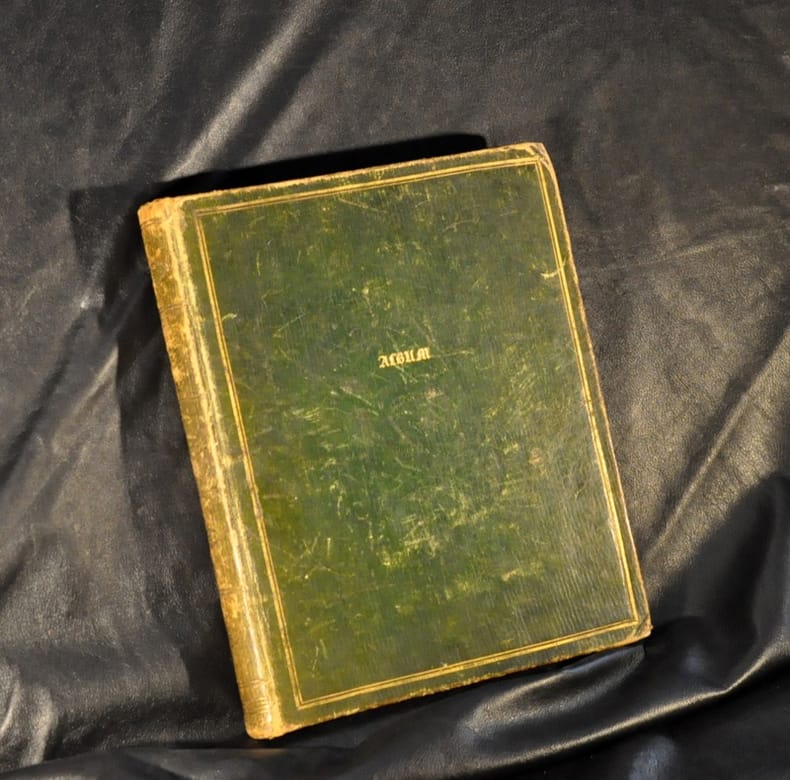
2998Album romantique de 205x260 mm, relie en basane maroquinee verte portant en super- libros sur le premier plat « Album ». Il se compose de feuillets de papier fort bleu montes sur onglets. Sur le verso de la premiere page, une table des matieres manuscrite.Les dessins au nombre de 39 sont colles a pleine page et certains d’entre eux sont decoupes, amputant une partie du dessin, ou sommairement replies en haut ou en bas. Certains dessins decoupes dans leur partie inferieure laissent deviner des ecritures au crayon qui ont ete otees. Un seul dessin, celui d’Anthony Thouret comporte une legende manuscrite.Le papier utilise est un papier fin, hativement decoupe. La plupart des dessins ont ete plies en deux ou en quatre. Certains semblent avoir ete mis sous enveloppe , certains ont ete dechires en tout ou partie puis recolles avec une bande en papier.
In-4°; cc. (6). Per lo stampatore e la data ci sembra più corretto pensare che questa edizione preceda quella di Froben, Basilea, 1515, e che quindi sia da attribuire al tipografo Beplin nel 1513 (STC p. 208 Beplin, Roma 1513?; vedi anche British Library, 1513), piuttosto che seguire la lezione di F. Barberi, Tipografi romani del Cinquecento, Firenze, 1983, p. 53 (e ICCU) in cui questa edizione si attribuisce allo stampatore Etienne Guillery con la data 1518. Ristampato da Froben assieme agli epigrammi di Erasmo, questa elegia appassionata ed elogiativa della Guerra contro i Turchi è estremamente rara. Due sole copie in ICCU alla Biblioteca Apostolica Vaticana, e alla Biblioteca Trivuziana di Milano. Una alla British Library; non in OCLC. Alcuni epigrammi di letterati del circolo romano di Agostino Chigi accompagnano i versi; gli autori: Janus Parrhasius, Janus Vitalis, Monachus Severus, Decius Syllanus, Basilius Chalcondylas, Constantinus Achazas, Delius Hieronymus, Factius Polydorus, Pietro Foderè, Phoebus Ptolomaeus, Paulus Soranus. La materia dell’opera di Giano Damiani, letterato senese, fa riferimento alla questione che Leone X de’ Medici (1513-1521) si trovò a gestire quando i Turchi si presentarono alle porte dell’Oriente e del Mediterraneo. L’elegia è anche un inno alla pace, che non dimentica di citare le nazioni che sostennero lo Stato pontificio, tra cui gli spagnoli, i francesi, gli inglesi. Beplin, Johann, attivo a Roma dal 1506 a circa il 1515; tipografo di Strasburgo attivo a Roma. Secondo il Dizionario dei tipografi lavorò molto per Giacomo Mazzocchi, cui sarebbero appartenute le cornici usate per i frontespizi. I caratteri da lui adoperati erano gli stessi di Besicken e di Mazzocchi. Apud Sanctum Eustachium. Since the printer and date, it looks like this edition was printed before the Basel’s one (Froben, 1515) and it would be related to Beplin in 1513, more than the Barberi’s opinion, that attaches this edition to Guillery (and date 1518). Reprinted by Froben along with Erasmus’ epigrams, this passionate elegy of war against the turks is extremely rare. Some epigrams by scholars from the Roman Cirle of Agostino Chigi side the poems: Janus Parrhasius, Janus Vitalis, Monachus Severus, Decius Syllanus, Basilius Chalcondylas, Constantinus Achazas, Delius Hieronymus, Factius Polydorus, Pietro Foderè, Phoebus Ptolomaeus, Paulus Soranus. The matter of this work is the question dealed by Leone X de’ Medici when the Turks showed up to the doors of West world. It’s also an ode to peace, that quotes the nations supporting the Pope (Spain, France, England, between them). Johann Beplin operated in Rome since 1506 to 1515 ca. A typographer from Strasbourg, he worked in Rome for Giacomo Mazzocchi, the maker of frames used for title pages. The typefaces used by Beplin are the same used by Besicken and Mazzocchi.
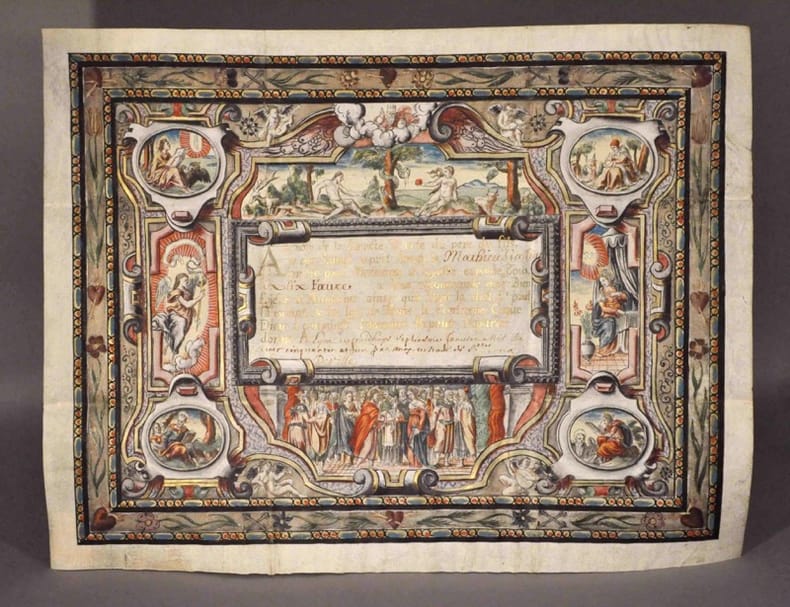
2502(1ff) Feuillet en vélin 41 x 31,5 cm, cartouche central calligraphié à l’or, encadré dans un décor de figures bibliques à la gouache.
Second Edition, 2 vols., 4to, liv,620pp., xii,494pp., orig. cloth, d.w. lightly soiled. The "STC" is one of the milestones in the retrospective bibliography of English books.
5 Parts bound in one, frontispieces, cont. cloth, 1,000 items.
4to, [ii]25pp., of facsimiles, orig. printed boards, uncut.
First Edition, [xii],447pp., frontis., 1 facsimile letter, orig. cloth.
4to, numerous illustrs., (some coloured), orig. decorated wrappers, 86 lots.
149764069New York & Strassburg: Ben Abramson Johann Gruninger 1946; 1497. 4to. 48 pp. Double-page title illustrated w/ woodcut engraving w/ 7 additional woodcut engravings. Quarter-orange cloth over illustrated boards cover art facsimile reproductions of illustrated leaves from the 1497 Buch der Cirurgia minor edgewear slight scuffing minor bumping to couple corners still VG copy; One leaf. 4to. 2 pp unpaginated. preserved in fold over flaps on front pastedown left margin repaired faint tidemark on upper third at corner still G clear artifact numbered on verso of title w/ gilt booklabel for the Aldredge Bookstore Dallas TX on rear pastedown. First editions thus No. 52 of 112 copies printed of this limited edition containing an original leaf from the 1497 edition: “the first important printed treatise in German. It combines a compilation of the ancient and medieval authorities with Brunschwig’s own extensive experience. . . and is notable for its woodcuts some of the earliest specimens of medical illustration.†The leaf included here is a survivor from Chapter Three addressing how to find veins and treat open wounds. Sigerist’s work was first published as an essay introduction with the R.Lier & Co. 1923 facsimile of Brunschwig’s Book of Cirurgia. See: Garrison & Morton 5559. Ben Abramson, [Johann Gruninger], hardcover
179130118Montréal Cour des Plaidoyers Communs, District de Montréal [1791] Un feuillet in-8 à l'italienne, 2 pages.
Roy. 8vo., First and Sole Edition; original printed wrappers, lower wrapper with two closed tears and minor marginal loss, a very good, clean copy. A presentation copy from the British Medical Journal to the library of the British Medical Association with its stamps on front wrapper, title and first leaf of list (only). Originally published in the periodical 'Annals of Medical History', New Series, Vol. 3, Nos. 2,3,4, this is the third such list of the College's incunabula following those of 1919 and 1923. This, the best edition, reprints the entire list numbering 404 examples. VERY SCARCE.
xviii, 245pp., 12 illustrs., orig. cloth. Eight studies, including: Literature on Hebrew incunabula since the Second World War - Notes on Hebrew printing at Naples about 1490 - A list of copies of Hebrew incunabula, disappeared since the outbreak of the Second World War.
First Edition, 4to, xv, [i], 196pp., frontis., ex-library, 10 full-page facsimiles, orig. cloth-backed boards, lower hinge torn, uncut. As well as describing, in great detail, each work from Caxton's press it also includes some early imprints of Wynkyn de Worde, printed immediately after Caxton's death.
First Edition, 4to, xv, [i], 196pp., frontis., 10 full-page facsimiles, orig. cloth-backed boards, uncut. As well as describing, in great detail, each work from Caxton's press it also includes some early imprints of Wynkyn de Worde, printed immediately after Caxton's death.
First edition, 4to, xiv, 898pp., frontis., 7 plates, orig. cloth. One of the standard classic reference works on early printed books. Describes over 4,000 items. An indispensable work.
Small 4to, frontis., 7 plates, facsimiles, orig. cloth. One of the standard classic reference works on early printed books. Describes over 4,000 items. An indispensable work.
4to, viii,75,[3]pp., one of 250 copies printed by D.B. Updike at the Merrymount Press, one plates, orig. cloth, uncut, t.e.g.
First Edition, large 8vo, xiv,361pp.,12 plates, orig. cloth. Describes some 662 items in detail (525 of which are books).
4to, ex-library, numerous facsimiles, orig. printed wrappers bound-in, library buckram, 376 items.
First edition, [vi], 198pp., frontis., illustrs., orig. cloth, d.w. Signed by Nixon in pencil with several critical notes within the text, Nixon's 3 page list of the main points relating to William Caxton & Westminster for a forthcoming talk. Provenance: From the library of Howard M. Nixon (1909-1983), British librarian and bookbinding historian.
First edition, 3 vols., bound in 4, 4to (279 x 185 mm), ONE OF 100 COPIES PRINTED ON THICK AND LARGE PAPER WITH EXTRA PLATES, [4], xxv, [7], 462,lxxix, [1]; [2], 555, [1]; [2], 298; [2], 299-622, lxiipp., with the author's wood-engraved device on each title-page, a wood engraving of the elaborately-quartered coat of arms of the Roxburghe Club on the dedication page, 85 engraved plates ((including the private plate of 'Diana de Poictiers' in vol. 2, which was apparently destroyed after only 50 copies had been printed, and a proof of the 'Prater' plate in vol. 3), 62 illustrations printed on fine and thin "India" paper and mounted on the text leaves, 55 other illustrations in the text, with the additional sixty engraved plates on 52 leaves from Lewis' Series of Groups bound in at the appropriate places as designated by Lewis in his 'Directions to the binder', contemporary notes in pencil to several endpapers and a few within the text, text and plates have staining of varying degrees, pale stain to many lower margins, a little damage to endpapers where bookplates have been removed, full red hard grain red morocco,,covers waterstained, spines lettered in gilt, all edges gilt. Unfortunately this handsome large paper copy has suffered from water damage sometime in the past, additional photographs are available upon request. This set with the additional set of etchings on india paper by George Lewis, of a classic work of the utmost importance for its wealth of eye-witness information and anecdotes about printed books, manuscripts, buildings, other artefacts and people, both from past centuries and from the author's own day, for the extraordinary collection of illustrations, mostly drawn during the tour itself, and finally as a sumptuous piece of book production. As soon as the book appeared, leading scholars derided Dibdin for his lack of scholarship, especially concerning early manuscripts and printed books. But one must distinguish between the extensive and extremely useful information about things and people Dibdin saw during his 1818 tour, and his own interpretations and conclusions, which now serve only as a window to the attitudes of the time. Dibdin's enthusiasm, readable style and entertaining anecdotes, moreover, caught the mood of his age, making the book extremely popular and influential. Lewis' A Series of Groups... was intended to accompany Dibdin's Tour but was rejected by Dibdin as unworthy of his book. Lewis, most perturbed, issued them at his own expense and presented his case in the eight-page Advertisement which was separately printed. Jackson 48; 56; 56n: Windle & Pippin A38a; A44; D13.
Very Good Turkish, Ottoman (1500-1928) Original dark brown handsome full leather bdg. with a traditional flap. Folio. (32 x 22 cm). In Ottoman script (Old Turkish with Arabic letters). [9], 288 leaves. The size of the text block in red borders: 25 x 14.5 cm. 33 lines on each page. Printed on paper with European watermarks. Handwritten title on bottom edge. Marginal cutting on the first page. Overall a very good copy. The 20th incunable of the Islamic world, printed by Ibrahim Müteferrika's legendary Basmahane. Süleymân Izzî succeeded Mehmed Subhî Efendi (ca. 1711 - 1769) in 1745 as an official court historian (vaka'nüvis) and held this office until 1753, and is known as one of the three chroniclers for coherent historiography, representing the events in the Ottoman history from 1730 to 1744 and is a particularly valuable source on the Habsburg-Ottoman War between 1736 and 1739, as proven by his chronicle titled "Tevârîh-i Sâmî ve Sâkir ve Subhî", published in 1784. During this time, he recorded the contemporary events taking place between 1744 and 1753 in the Ottoman Empire. This work was the last item in a series of chronicles published by the printing house founded by Müteferrika. Franz Babinger writes that some parts of the book have been translated into German. Hammer translated one of the parts in question into German. All published, Izzi has planned the third part of his work, but this third part was never published. Contents: "Ahd-i Hümâyûn".; "Zikr-i iâde-i fenn-i tiba'at" [i.e. On the book pressing and publishing with a preface by Ahmed Vâsif Efendi].; "Fihrist-i Târîh-i Izzî" [i.e. Content of Izzi's history].; Izzî tarihinin birinci bölümü [i.e. The first chapter].; Izzî tarihinin ikinci bölümü [The second chapter]. The workshop of Müteferrika began its historical mission in 1728. They published 17 works in 22 volumes. The printing house served as a means to the long-term goal of Müteferrika, his efforts to broaden the horizon and modernize the knowledge of Ottoman society and Islamic civilization. This is evidenced by the subjects of the books selected for publishing, the motivations put forth in the publisher's introductions, as well as by the documents illuminating the background of the publication of each book, also published in print. In 1742, with the publication of the Persian dictionary of Hasan Suûrî, a chapter of Ottoman book printing came to an end. With the death of Müteferrika, the printing of Turkish books was temporarily interrupted. The first generation of Ottoman-Turkish prints was soon followed by a new series, when in 1756 Ahmed and Ibrâhîm Efendi (the latter perhaps the founder's son, according to speculative sources) made an attempt to resurrect the legacy of Müteferrika through the possession of a decree obtained from the Sultan. However, this experiment did not prove to be lasting, as it did not last longer than the new edition of the first Turkish printed book, the Lugat-i Vankûlî. After this for several decades there was no continuation to the Turkish book printing established by Müteferrika, until in 1783 the workshop was put in operation again for the publication of six more works. The subjects of these late 18th century works were dominated by history and military technology, thus Müteferrika's strategy of book distribution made its way hand in hand with the efforts of modernization of the Ottoman state. The second edition of Lugat-i Vankûlî followed the principles of the first edition, and its introduction was composed on the model of the introductory pages of the two last books published under Müteferrika's supervision. The works published after 1783 display a noticeable development in typography not only as to its somewhat refined visual impression, but also in its structure. For example, the d+h and r+h ligatures, characteristic of the first generation of Müteferrika's printed books, are replaced by separate letters. This extremely rare presented book is from the seven publications of this late period of the