12 résultats
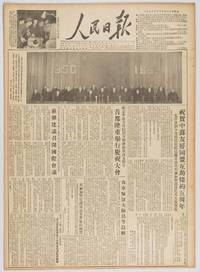
1419218250Number 2411. February 141955. 2 photographic illustrations 53.5 x 38cm text in traditional Chinese characters. Browning a few washi repairs good condition. This edition of the People's Daily celebrates the 5th anniversary of the Sino-Soviet Treaty of Friendship Alliance and Mutual Assistance signed in 1950 with congratulatory messages the text of speeches on cooperation details of USSR's assistance to China and explanations about why China had been lagging behind industrially and economically. Although privately less than happy with some aspects of the treaty China had to appear enthusiastic in the public arena. The talking-up of China's relationship with the USSR would have been seen as essential at this time; just a month prior the US had signed a Mutual Defense Treaty with the Republic of China and drawn up the 'Formosa Resolution' authorising the use of US forces to defend Taiwan. <br> <br>The front page features a wide-angle photographic illustration of the celebration of the Fifth Anniversary of the signing of the Sino-Soviet Treat of Friendship Alliance and Mutual Assistance; in the front row L to R are Chen Shutong Dong Biwu Shen Junru Lin Boqu Liu Shaoqi Song Qinlin Guo Moruo Luo Maijin Russian Delegate Zhou Enali Li Jishen Wu Yuzhang Peng Zhen and Huang Yanpei. Includes the text of a speech by Song Qingling. . unknown
142036957Folio Society 2014 2016. 8vo. with frontispiece and 9 coloured plates; pictorial cloth gilt back a fine copy in publisher's board slip-case. Folio Society, hardcover
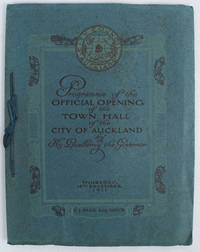
1419173626Auckland.: The Brett Printing & Publishing Company. Thursday 14th December1911. Illustrated frontispiece and numerous black & white photographic illustrations. Original illustrated blue soft covered wrappers with yap edges and silk ties. 47pp. On the verso of the frontispiece is hand written. " With Compliments Jan. 1920. I. Naylor Organ Builder." A little soiling to the covers but a very good copy. Includes 7 pages relating to the organ. . The Brett Printing & Publishing Company. paperback
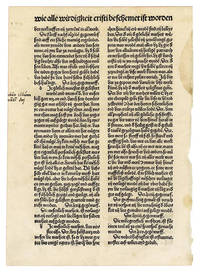
1491008037Nuremberg Germany: Anton Koberger 1491. No Binding. Good. 4to - over 9¾ - 12" tall. An original leaf from Schatzbehalter der wahren Reichtümer des Heils Treasure Chest of the True Riches of Salvation by Stephan Fridolin a late medieval work popularizing Scripture in text and image. Printed in Nuremberg by Anton Koberger on 8 November 1491 thus a true incunabulum. One of 354 leaves. Leaf size: 29.25 x 21 cm. Each leaf side contains underneath a heading 41 printed lines in 2 columns. Col. width: 7.3 cm. The recto heading is cristi uber sich genummenhaben likely a continuation of the heading of the previous page. The verso heading is wie alle wirdigkeit cristi beschemetist worden How Christ's dignity was humiliated. Both headings in lower case. Printed at the foot of the second column recto is signature "a c"; without foliation or catchword. As to the recto page in the margin at the base of the first column is a handwritten notation in light black ink. In the upper right margin is a notation that appears to read 1Ag. As to the verso page in the left margin is a handwritten notation in black ink. Also with a light crescent-shaped stain along the top half of the inner margin as to both sides and a much smaller light stain below that else clean. No worm holes or wrinkling observed. Rated a Good Plus to Very Good Minus leaf. Although most incunabula were printed in Latin best estimates are that 10.8 percent were printed in German using the Latin alphabet. Northern Bavarian Nordbairisch was a dialect spoken in the Nuremberg area in the Middle High German era 1050-1350 but overlapped with East Franconian Ostfränkisch. These were regional forms of German gradually losing status during 1350-1650 the Early New High German Frühneuhochdeutsch era. Since the ENHG printers had a commercial interest in making their texts acceptable to a wide readership they often strove to avoid purely local forms of language. This gave rise to so-called Druckersprachen "printers' languages" which are not necessarily identical to the spoken dialect of the town where the press was located. Most MHG and ENHG words survive into modern German in some form or other: this leaf contains one word jehen 'say' which has since disappeared from the language. But many words have changed their meaning substantially. Typeface closely resembles that used by Anton Koberger of Nuremberg in his 1483 German Bible and 1488 German translation of the Golden Legend but not that of his 1484 Reformation der Stadt Nurnberg. Cf. the facsimile ed. published as Schatzbehalter v. 28 in the series The Printed Sources of Western Art ed. T. Besterman Portland Or.: Collegium Graphicum 1972. <br/> <br/> Anton Koberger unknown
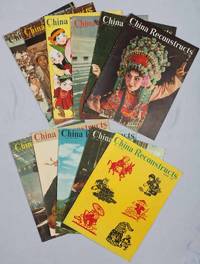
1461217587Peking.: China Welfare Institute. Vol. VIII. Nos. 1-4 6-121959. A broken run of 11 issues of the magazine China Reconstructs 1959. Issue 5 May 1959 is missing. All are in original coloured pictorial wrappers profusely illustrated throughout in black and white with some colour photographic illustrations usually 40pp. Number 12 includes an index for the full year. Text in English except for Language Corner 30.5 x 23cm. Some occasional wear to spines. Some insect damage to a few leaves in places else in very good condition. This influential magazine was established by Soong Ching-ling in 1949. Published in 6 languages including Arabic and Chinese the purpose was to present a very positive view of Chinese life and culture to the outside world. <br> <br>Articles in these issues include many of educational and cultural interest: Making Documentary Films in China Merging Factory and School Peking After 10 Years Checkerboard of Canals Women of the Communes How We Dug More Coal Than Britain Opening an Imperial Tomb New Blossoms On An Old Tree Szechuan Opera is Reborn Tibetan Serfdom Nears Its End "The Philanthropist" by Lao Sheh Pottery Tomb Figures Learning from Ancient China's Medicine The Traditional Theatre Today Tracing the Thread of the Past The Great Decade - A Prelude to Progress Yet Greater with a pictorial fold-out. <br> <br>Articles of particular historical significance at the beginning of the Great Leap Forward include: A Leap That Has Made History Lushan's "Pig-Iron" Sputnik A Glorious Era: A Glorious People with a photographic illustration of Soong Ching Ling near the furnace set up in her garden The Building of a Giant How China Gets High Farm Yields Back Street Rolling Mill New View of Water Conservancy The Race for Electric Power Economic Achievements The Bumper Crop Charter The Leap Forward Continues The New Trend in Local Steel Manufacture and more. <br> <br>Issue Number 12 has an index for the whole year inserted. . China Welfare Institute. unknown
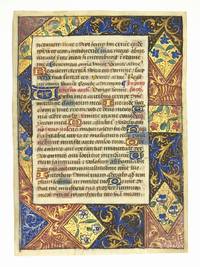
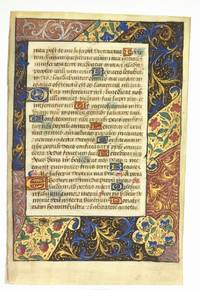
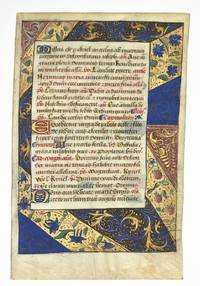
1500731031500. Fine. fin XVe- début XVIe s. 12.20 x 16.70 cm feuillet sur parchemin Recto verso fragments of a manuscript book of hours on parchment with sumptuously illuminated full-page borders. This compartmentalized division of ornaments is representative of the production from Rouen and Parisian workshops at the turn of the 16th century. Two illuminated pages on a recto verso leaf: border divided into bands and lozenges decorated with floral motifs and leafy designs gilt initials painted in alternating red and blue and rubrics. The richness of the illumination characterizes these liturgical books intended for laypeople. Books of hours were at the time jewels of piety both an instrument of religious practice and a social statement affirmed by the richness of the artists' work. A true small painting this leaf is probably extracted from a luxurious volume where each page was carefully painted. We find here a fragment of the Office of the Dead at the moment of the first nocturn of matins. On the recto of the leaf: antiphon ""Dirige me"" followed by psalm five ""Verba mea auribus percipe Domine."". The office of the dead is a set of prayers dedicated to the salvation of the souls of the deceased. More than commiseration this devotion reflects the constant fear of medieval men for death. Script called cursiva libraria on long lines. Witness to the formalization of cursive script at the dawn of the French Renaissance this script is emblematic of the production of French scribes for laypeople during the period. unknown
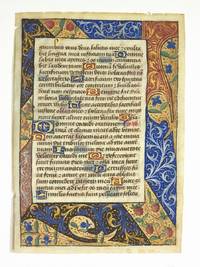
1500731581500. Fine. fin XVe- début XVIe s. 12.20 x 16.70 cm feuillet sur parchemin Recto-verso fragment of a manuscript book of hours on parchment with sumptuously illuminated full-page borders. This compartmentalized division of the ornaments is representative of the production of Rouen and Parisian workshops at the turn of the 16th century. Two illuminated pages on a recto-verso leaf: border divided into bands and flowers decorated with floral motifs and leafy designs gilt initials painted in alternating red and blue and rubrics. The richness of the illumination characterizes these liturgical books intended for laypeople. Books of hours were at the time jewels of piety both an instrument of religious practice and a social claim affirmed by the richness of the artists' work. A veritable small painting this leaf is probably extracted from a luxurious volume where each page was carefully painted. We find here a fragment of the Office of the Dead at the moment of lauds. On the recto of the leaf: antiphon ""A porta"" followed by the canticle ""Ego dixi in dimidio dierum meorum."". The office of the dead is a collection of prayers dedicated to the salvation of the souls of the deceased. More than commiseration this devotion reflects the constant fear of medieval men for death. Script called cursiva libraria on long lines. Witness to the formalization of cursive writing at the dawn of the French Renaissance this script is emblematic of the production of French copyists for laypeople during the period. unknown
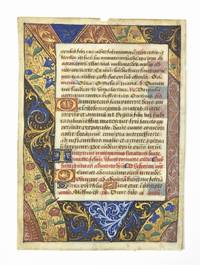
1500731611500. Fine. fin XVe- début XVIe s. 12.20 x 16.70 cm feuillet sur parchemin Recto verso fragments of a manuscript book of hours on parchment with sumptuously illuminated full-page borders. This division into compartments of the ornaments is representative of the production of Rouen and Parisian workshops at the turn of the 16th century. Two illuminated pages on a recto verso leaf: border divided into bands and fleur-de-lis decorated with floral motifs and scrollwork gilt initials painted in alternating red and blue and rubrications. The richness of the illumination characterizes these liturgical books intended for laypeople. Books of hours were at the time jewels of piety both an instrument of religious practice and a social claim affirmed by the richness of the artists' work. A veritable small painting this leaf is probably extracted from a luxurious volume where each page was carefully painted. We find here a fragment of the penitential psalms the end of the fourth psalm ""Miserere mei Deus secundum magnam misericordiam tuam."" and the beginning of the following one ""Domine exaudi orationem meamet clamor."". This part of books of hours ordinarily serves to ask forgiveness for one's sins and to express repentance. Writing called cursiva libraria on long lines. Witness to the formalization of cursive writing at the dawn of the French Renaissance this script is emblematic of the production of French copyists for laypeople during the period. unknown
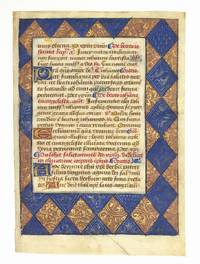
1500731401500. Fine. fin XVe- début XVIe s. 12.20 x 16.70 cm feuillet sur parchemin Recto verso fragments of a manuscript Book of Hours on parchment with sumptuously illuminated full-page borders. This compartmentalized division of ornaments is representative of the production of Rouen and Parisian workshops at the turn of the 16th century. Two illuminated pages on a recto verso leaf: the border is divided into bands decorated with floral motifs and leafy designs gilt initials painted in alternating red and blue and rubriques. The richness of the illumination characterizes these liturgical books intended for laypeople. Books of Hours were at the time jewels of piety both an instrument of religious practice and a social claim affirmed by the richness of the artists' work. A veritable small painting this leaf is probably extracted from a luxurious volume where each page was carefully painted. Here we find a fragment of the Hours of the Virgin between the end of the office of none and the beginning of vespers. Despite the antiphon ""Missus est"" different from the classical usage of the Roman ritual we find following it the usual psalm eight: ""Dixit dominus."". This antiphon is found rather in the liturgy of the diocese of Die but with the announcement of the rubric preceding vespers we can suppose a minor Roman usage. Writing called cursiva libraria on long lines. Witness to the formalization of cursive writing at the dawn of the French Renaissance this writing is emblematic of the production of French copyists for laypeople during the period. unknown
1500731071500. Fine. fin XVe- début XVIe s. 12.20 x 16.70 cm feuillet sur parchemin Recto verso fragments of a manuscript book of hours on parchment with sumptuously illuminated full-page borders. This compartmentalized division of ornaments is representative of the production from Rouen and Parisian workshops at the turn of the 16th century. Two illuminated pages on a recto verso leaf: border divided into bands and lozenges decorated with floral motifs fruits and leafy designs gilt initials painted in alternating red and blue line fillers and rubrics. The richness of the illumination characterizes these liturgical books intended for laypeople. Books of hours were at the time jewels of piety both an instrument of religious practice and a social statement affirmed by the richness of the artists' work. A true small painting this leaf is probably extracted from a luxurious volume where each page was carefully painted. We find here a fragment of the suffrages which contains four prayers to the Saints: to St. John the Baptist St. John the Evangelist and two others ""Pulchre salutationes ad xpm. videlicet in elevatione corporis ipsius"" followed by ""Alia salutatio. Salue sancta caro dei."" Script called cursiva libraria on long lines. Witness to the formalization of cursive script at the dawn of the French Renaissance this script is emblematic of the production of French scribes for laypeople during the period. unknown
1500731501500. Fine. fin XVe- début XVIe s. 12.20 x 16.70 cm feuillet sur parchemin Recto verso fragments of a manuscript book of hours on parchment with sumptuously illuminated full-page borders. This compartmentalized division of ornaments is representative of the production of Rouen and Parisian workshops at the turn of the 16th century. Two illuminated pages on a recto verso leaf: border divided into bands decorated with floral motifs and foliate scrolls gilt initials painted in alternating red and blue and rubrics. The richness of the illumination characterizes these liturgical books intended for laypeople. Books of hours were at the time jewels of piety both an instrument of religious practice and a social statement affirmed by the richness of the artists' work. A veritable small painting this leaf is probably extracted from a luxurious volume where each page was carefully painted. We find here a fragment of the hours of the Virgin between the end of the office of vespers and the beginning of compline. The succession of pieces at the end of vespers approaches the use of Die but the capitulum differs ""Egredietur virga radice iesse et flos de radice eius ascendet"" this could also be a minor Roman use as the rubric of the announcement of vespers announced it. Writing called cursiva libraria in long lines. Witness to the formalization of cursive writing at the dawn of the French Renaissance this writing is emblematic of the production of French copyists for laypeople during the period. unknown
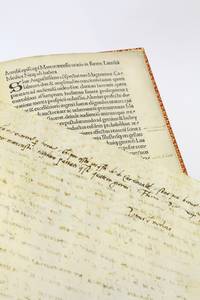
149262206Milan: Philippus de Mantegatiis 1492. Fine. Philippus de Mantegatiis Milan s. d. après le 8 avril 1492 et s. d. 1493 20.80 x 13.80 cm relié Oratio in funere Laurentii de Medicis habita. With an autograph letter signed by Piero II de' Medici to Dionigi PucciPhilippus de Mantegatiis Milan n. d. after April 8 1492 208 x 138 cm 8 f. Sig: a8 later morocco & for the letter n. d. 1493 22 x 30 cm 1 page and a few lines on a folded leave First edition of the eulogy of Lorenzo de' Medici said by Aurelio Bienato bishop of Martorano Catanzaro Calabria on 16 April 1492 in the church of Santa Maria la Nuova in Florence eight days after the prince died. This eulogy is followed by a short eight-verse poem. This is the only printed eulogy of Lorenzo the Magnificent John McManamon Funeral Oratory and the Cultural Ideals of Italian Humanism 1989. 19th century binding full red morocco. Several brackets and handwritten notes from then. Ex-libris of Prince Piero Ginori Conti 1865-1939 an Italian businessman and politician on the first pastedown. Ex-libris of Gianni de Marco's Library. Opposing a complete different approach from the usual laudatory praises Aurelio Bienato introduces Lorenzo the Magnificent as a modern prince a European model a patron of arts and literature but also a guarantor for peace in Italy. The purpose of his text is above all political: he underlines and praises the recent diplomatic ties between Florence and Naples enabling Lorenzo the Magnificent to establish his power over the Florentine city. This volume comes with an autograph letter signed by Piero de' Medici son of Lorenzo the Magnificent addressed to Dionigi Pucci himself a diplomat and friend of the sender. 28 lines written in a fine and slim writing. Address of the recipient at the back of the second leaf. Wax seal marks. Light brown spotting. In this letter Piero the Unfortunate claims his allegiance to Ferdinand II of Aragon king of Naples. Actually as he was writing this letter he had already reached a neutrality agreement with Charles VIII King of France who was about to capture by force the realm of Naples he considered his. Despite this agreement Piero II de' Medici was nonetheless compelled to surrender unconditionally and seek exile in Venice: this is the beginning of the first Italian war. In two years on the throne he destroyed everything the Medici dynasty had built during the former century. Rare collection of documents evoking the climax and the dawn of decay of the mighty Medici dynasty the most influential family of the Italian Renaissance. Philippus de Mantegatiis unknown