3 002 résultats
1788125980New York: Printed and Sold by J. and A. McLean 1788. First edition of The Federalist one of the rarest and most significant books in American political history which "exerted a powerful influence in procuring the adoption of the Federal Constitution." 12 mo two volumes bound in one bound in full contemporary calf rebacked preserving most of original gilt-ruled spine with red morocco label. In very good condition. Housed in a custom half morocco clamshell box. An exceptional example of this landmark book. When Alexander Hamilton invited his fellow New Yorker John Jay and James Madison a Virginian to join him in writing the series of essays published as The Federalist it was to meet the immediate need of convincing the reluctant New York State electorate of the necessity of ratifying the newly proposed Constitution of the United States. The 85 essays under the pseudonym 'Publius' were designed as political propaganda not as a treatise of political philosophy. In spite of this The Federalist survives as one of the new nation's most important contributions to the theory of government" PMM 234. The Federalist "exerted a powerful influence in procuring the adoption of the Federal Constitution not only in New York but in the other states. There is probably no work in so small a compass that contains so much valuable political information. The true principles of a republican form of government are here unfolded with great clearness and simplicity" Church 1230. "A generation passed before it was recognized that these essays by the principal author of the Constitution and its brilliant advocate were the most authoritative interpretation of the Constitution as drafted by the Convention of 1787. As a commentary and exposition of the Constitution the influence of the Federalist has been profound" Grolier American 100 56. Of the only 500 copies published Hamilton is said to have sent nearly 50 copies to Virginia for the ratifying convention. The remaining 450 copies sold poorly and "the publishers complained in October 1788 long after New York had ratified the Constitution that they still had several hundred unsold copies" Maggs 815. Printed and Sold by J. and A. McLean unknown books
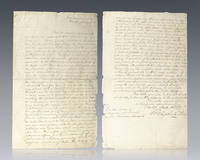
1781125872April 10 1781. Exceptionally rare autograph letter signed by George Washington as Commander-in-Chief of the Continental Army to French ally Jean-Baptiste Donatien de Vimeur comte de Rochambeau whose military assistance in the Siege of Yorktown essentially ended the Revolutionary War. The body of the letter is entirely in the hand of Alexander Hamilton and dated 10 April 1781. In the spring of 1781 officials from Massachusetts approached Rochambeau with a proposal to attack the British post at the mouth of the Penobscot river which had been established in June 1779 to secure timber for shipyards in Halifax and to protect Nova Scotia from any American advance. On April 6 Rochambeau informed Washington that he was willing to send a detachment of troops and that Admiral Destouches would offer naval assistance but observing that he was under Washington's command he would await his approval before approving the action Rochambeau to Washington 6 April 1781 Papers of George Washington Library of Congress. Washington here responds offering his gratitude that Destouches who had only recently lost a naval engagement with the British in an unsuccessful attempt to relieve Lafayette in Virginia would be willing "to undertake the expedition to Penobscot and to you for your readiness to furnish a detachment of troops for the same purpose. The object is certainly worth attention and if it can be effected will be very agreeable to the States particularly to those of the East." He trusts that Destouches "can best judge from the situation of the enemy's fleet how far it may be attempted with prudence and Your Excellency from the information you have recently received what number of troops will be sufficient for the enterprise--I am persuaded it will be calculated how far it is probable the enemy may follow with a part of their fleet--whether the post can be carried by a coup de main or may require so much time as to make it likely the operation will be interrupted before its conclusion--in case of a superior squadron being sent by the enemy what possibility there is of protection or a safe retreat for the ships and even for the land force through an unsettled country in which numbers perished for want of provision in a former attempt--All these are points too important not to have been well weighed and your conversations with the Massachusetts deputies will have been able to enlighten you upon them." Here he is referencing the unsuccessful attempt by Massachusetts in 1779 to destroy the post abandoned when British ships with reinforcements forced an arduous overland retreat by the Americans. Despite his assurances that <span class="match">Rochambeau</span> and Destouches had matters well in hand <span class="match">Washington</span> took the "liberty to remark on two things--one that it appears to me frigates without any ships of the line will answer the purpose as well as with them and less will be risked than by dividing the body of the fleet. Frigates especially the forty fours will afford a safe escort to the troops against any thing now in those Seas and with respect to a detachment from the enemy's fleet it would be always proportioned to the force we should send and if we have two sixty fours they would even be an object for their whole fleet. The other observation I would make is that dispatch being essential to success it will in my opinion be adviseable not to depend on any cooperation of the Militia but to send at once such a force from your army as you deem completely adequate to a speedy reduction of the post. The country in the neighbourhood of Penobscot is too thinly inhabited to afford any resource of Militia there and to assemble and convey them from remote places would announce your design--retard your operations and give leisure to the enemy to counteract you. Indeed I would recommend for the sake of secrecy to conceal your determination from the State itself." On 15 April <span class="match">Rochambeau</span> replied to <span class="match">Washington</span> observing that while he had sufficient troops to spare "your Excellency's observations upon the Separation of our fleet and upon the danger to be interrupted by superior forces during the course of the Expedition which Mr Destouches does not Look on as possible to be undertaken with his frigates only are the motives which cause this project to be Laid aside for the present moment." <span class="match">Rochambeau</span> to <span class="match">Washington</span> 15 April 1781 Papers of George <span class="match">Washington</span> Library of Congress. Soon <span class="match">Washington</span> and <span class="match">Rochambeau</span>'s attention returned again to Virginia and within months their combined forces would be closing in on Yorktown. In near fine condition. Exceptionally rare and desirable being the only communication between the storied commanders of the Yorktown campaign to appear at auction in more than a century. In 1780 French nobleman Jean-Baptiste Donatien de Vimeur comte de Rochambeau was appointed commander of land forces as part of the project code named Expedition Particuliere. He was given the rank of Lieutenant General in command of some 7000 French troops and sent to join the Continental Army under George Washington during the American Revolutionary War. He landed at Newport Rhode Island on 10 July but was held there inactive for a year due to his reluctance to abandon the French fleet blockaded by the British in Narragansett Bay. The College in the Colony of Rhode Island and Providence Plantations now known as Brown University served as an encampment site for some of Rochambeau's troops and the College Edifice was converted into a military hospital now known as University Hall.3 In July 1781 the force left Rhode Island and marched across Connecticut to join Washington on the Hudson River in Mount Kisco New York. Washington and Rochambeau then marched their combined forces to the siege of Yorktown and the Battle of the Chesapeake. On 22 September they combined with the Marquis de Lafayette's troops and forced heavily outnumbered and trapped Lord Cornwallis to surrender on 19 October. The siege of Yorktown was a decisive victory for the American Continental Army and proved to be the last major land battle of the American Revolutionary War in the North American region as the surrender by Cornwallis and the capture of both him and his army prompted the British government to negotiate an end to the conflict and ultimately resulted in the Treaty of Paris of 1783. unknown books
124196Rare original Anthony Berger carte-de-visite signed by Abraham Lincoln as President; the most recognizable portrait of Lincoln which was later used as the model for the Lincoln cent. Original mounted albumen photograph double ruled in gilt with "Brady's National Photographic Portrait Galleries" stamp to the verso. Boldly signed by Abraham Lincoln "A Lincoln." With an additional inscription on the verso which reads "Contributed for the benefit of the S.A.S. of Westford Mass. at their Levee Dec. 14th 1864 by Mr. Lincoln." Through the use of many paid assistants renowned 19th century portraitist Mathew B. Brady produced thousands of photographs documenting the American Civil War including portraits of Lincoln Grant and both Union and Confederate soldiers in camps and battlefields. The body of work created by Brady's photographers including Anthony Berger Alexander Gardner and Timothy O'Sullivan has become the most important visual documentation of the Civil War. Taken on February 9 1864 by the manager of Brady's Washington studio Anthony Berger this the most recognizable portrait of the 16th president of the United States was later used by Victor David Brenner to create the Lincoln cent. During this same sitting Berger also took the photograph of Lincoln that would later appear on the five dollar bill. The present example was signed by Lincoln to help the Sanitary Association of Westford Massachusetts raise funds for Unions soldiers toward the end Civil War. An example at Heritage Auction brought 175000 in 2006. In near fine condition. An exceptional piece. Abraham Lincoln served as the 16th President of the United States from March 1861 until his assassination in April 1865. He led the United States through the American Civil War the country's greatest moral cultural constitutional and political crisis and in doing so preserved the Union of the United States of America abolished slavery and strengthened the federal government. Lincoln ran for President in 1860 sweeping the North in victory. The South was outraged by Lincoln's election and in response secessionists implemented plans to leave the Union before he took office in March 1861. War began in April 1861 when secessionist forces attacked Fort Sumter in South Carolina just over a month after Lincoln's inauguration and after years of deadly military conflict officially ended on April 9 1865 when Confederate General Robert E. Lee surrendered to Union General Ulysses S. Grant at the Battle of Appomattox Court House. On April 14 1865 just days after the war's end at Appomattox Lincoln was attending a play at Ford's Theatre with his wife Mary when he was assassinated by Confederate sympathizer John Wilkes Booth. Lincoln is remembered as the martyr hero of the United States and is consistently ranked as one of the greatest presidents in American history. unknown books
1941125419Raphael Tuck & Sons Ltd. 1941. Rare lithographic broadside signed by Franklin Delano Roosevelt as the thirty-second President of the United States and Winston S. Churchill as Prime Minster of the United Kingdom at the Atlantic Conference; one of only two known examples of this broadside specially printed at Churchill's direction and signed by both world leaders at their first wartime conference. One page the lithograph features the famed Henry Wadsworth Longfellow verse first used by FDR in a letter of support to Churchill before the United States entered the war and a galleon at sea. The letter sent the day before Roosevelt's third inauguration on January 20 1941 read in full "Dear Churchill Wendell Wilkie will give you this. He is truly helping to keep politics out over here. I think this verse applies to you people as it does to us: "Sail on Oh Ship of State! Sail on Oh Union strong and great. Humanity with all its fears With all the hope of future years Is hanging breathless on thy fate." As ever yours Franklin D. Roosevelt." "R<span class="match">o</span><span class="match">o</span>sevelt never made a m<span class="match">o</span>re graceful <span class="match">o</span>r effective gesture than that" R. Sherw<span class="match">o</span><span class="match">o</span>d R<span class="match">o</span><span class="match">o</span>sevelt and H<span class="match">o</span>pkins 234. The letter and the verse were hand-carried by Wendell Wilkie t<span class="match">o</span> L<span class="match">o</span>nd<span class="match">o</span>n and given by H<span class="match">o</span>pkins t<span class="match">o</span> the Prime Minister. Churchill desperate for American support found the letter "an inspiration" had it framed and proudly displayed it at Chartwell for many years. In early August of 1941 Churchill had this dec<span class="match">o</span>rative br<span class="match">o</span>adside printed and when he arrived in Newf<span class="match">o</span>undland f<span class="match">o</span>r the c<span class="match">o</span>nference with the President he br<span class="match">o</span>ught tw<span class="match">o</span> c<span class="match">o</span>pies t<span class="match">o</span> be signed "<span class="match">o</span>ne f<span class="match">o</span>r himself and <span class="match">o</span>ne f<span class="match">o</span>r the President" Warren F. Kimball F<span class="match">o</span>rged In War: R<span class="match">o</span><span class="match">o</span>sevelt <span class="match">Churchill</span> and the Sec<span class="match">o</span>nd W<span class="match">o</span>rld War 98. Signed by Roosevelt "Franklin D. Roosevelt" and Churchill "Winton S. Churchill." Double matted and framed. The entire piece measures 22 inches by 20.5 inches. The last known example achieved $96000 in a 2008 auction. Scarce and desirable. The historic secret Atlantic Conference was held between August 9th and 12th 1941 on a warship anchored in Placentia Bay Newfoundland. At that momentous meeting the two leaders and their military aides agreed upon critical policies for the conduct of a joint war against Germany even though the U.S. was still officially neutral and would remain so until December 8. The meetings culminated in the Atlantic Charter a declaration of principles issued a few days after the conference. Often compared to Wilson's Fourteen Points the Charter also laid the foundation for the United Nations Declaration signed by 26 nations in January 1942. Raphael Tuck & Sons, Ltd. unknown books
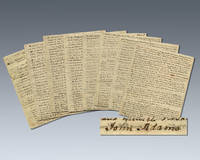
18091215601809. Exceptionally rare 16-page autograph letter signed by and entirely in the hand of Founding Father John Adams defending the ultimate necessity of American sovereignty and its precedence over international alliances. Sixteen pages entirely in the hand of John Adams and written on both the recto and verso of each page the letter is dated January 9 1809 and addressed to Speaker of the House of Representatives Joseph Bradley Varnum. Although France and America shared a strong alliance which proved crucial to winning the Revolutionary War at the onset of the French Revolution in 1789 Washington's fear that American involvement would weaken the new nation before it had firmly established itself created tensions and a new war between England and France broke out in 1793. The British Navy soon began targeting French vessels and trading interests across the Atlantic and although many Federalists thought that America should aid its ally Washington proclaimed that the United States would be "friendly and impartial toward the belligerent parties." The Neutrality Proclamation was ignored by Britain and angered France which then allowed its navy and privateers to prey on American trade. To protect American sailors and merchants without provoking Britain in March 1794 Congress passed a 30-day embargo which it then extended. Britain the strongest sea power began to seize American ships suspected of trading with France and stepped up its practice of impressment. From 1806-1807 the British navy in desperate need of men to oppose Napoleon forced roughly 5000 American sailors into service on the pretense that they were deserters. In 1807 King George III proclaimed his right to call any British subjects into war service and claimed that Britain had full discretion to determine who was a British citizen. The crisis reached one peak for America in June of 1807 when the HMS Leopard attacked the USS Chesapeake off the coast of Virginia. Three American sailors were killed eighteen were wounded and the Chesapeake surrendered after firing only one shot. The Leopard seized four American seaman claimed as deserters from the British navy and hanged one of them. Jefferson and Madison his Secretary of State responded with the Embargo of 1807 a ban on all American vessels sailing for foreign ports. Meanwhile Russia allied with Napoleon and pressed Denmark to turn over her fleet. In September 1807 Britain preemptively bombarded Copenhagen and seized the Danish-Norwegian fleet. While Jefferson's Republicans still generally favored France a schism grew in the Federalist party. Men like Timothy Pickering downplayed impressments while focusing on trade and access to British manufacturing. On October 16 1807 King George III aggravated already high tensions with American following the British attack of the USS Chesapeake off the coast of Virginia by issuing a Royal Proclamation expanding the British right to impressment the King's right to call any British subjects into war service and determine their citizenship. News of the King's Proclamation arrived in the United States in December 1807 and lacking military options President Jefferson proposed an embargo to ban all U.S. exports on American vessels in order to protect American sailors' lives and liberties despite its potential to cripple American trade. The Embargo Act was signed on December 22 1807 causing immediate economic devastation. In protesting the Embargo rather than wrestling with the difficulty of defending American sovereignty some opponents chose to declare the legality of impressments as defined by King George's Royal Proclamation. John Adams' former Secretary of State Timothy Pickering took a leading role in fighting the embargo arguing that Jefferson was using it to draw America closer to Napoleon's France. Given the devastating economic effects of the embargo Pickering's message found a wide audience. Adams on the other hand recognized the dire threat the King's Proclamation posed in denying America the right to determine its own rules for citizenship and in December took his arguments to Speaker of the House Joseph Varnum. As he stated in the present letter "He Pickering thinks that as every Nation has a Right to the Service of its Subjects in time of War the Proclamation of the King of Great Britain commanding his Naval Officers to practice Such Impressments on board not the Vessells of his own Subjects but of the United States a foreign Nation could not furnish the Slightest ground for an Embargo! . But I Say with Confidence that it furnished a Sufficient ground for a Declaration of War. Not the Murder of Pierce nor all the Murders on board the Chesapeake nor all the other Injuries and Insults We have received from foreign Nations atrocious as they have been can be of such dangerous lasting and pernicious Consequence to this Country as this Proclamation if We have Servility enough to Submit to it." Adams suggested repealing and replacing the Embargo Act with one that allowed international trade with all but the belligerents while building up the navy. Varnum asked to publish it. Before assenting Adams completely reworked his argument mustering all the reason and rhetoric at his disposal into a stirring defense of sovereignty and citizenship resulting in the present letter. On March 1 1809 Congress repealed the Embargo Act following Adams' suggestion to replace it with the Non-Intercourse Act which allowed trade with all nations except Britain and France. In fine condition. A remarkable piece of early American history illustrating the second President of the United States' impassioned devotion to the pursuit of American liberty. Housed in a custom half morocco clamshell box. The longest letter signed and entirely in the hand of John Adams obtainable. American Founding Father John Adams served as the first vice president of the United States from 1789 to 1797 and subsequently the second president of the United States from 1797 to 1801. A lawyer and political activist prior to the revolution Adams was devoted to the right to counsel and presumption of innocence. He defied anti-British sentiment and successfully defended British soldiers against murder charges arising from the Boston Massacre. Adams was a Massachusetts delegate to the Continental Congress and became a principal leader of the Revolution. He assisted in drafting the Declaration of Independence in 1776 and was its foremost advocate in Congress. As a diplomat in Europe he helped negotiate the peace treaty with Great Britain and secured vital governmental loans. Adams was the primary author of the Massachusetts Constitution in 1780 which influenced the United States' own constitution as did his earlier Thoughts on Government. Adams was elected to two terms as vice president under President George Washington and was elected as the United States' second president in 1796. He was the only president elected under the banner of the Federalist Party. He and his wife generated a family of politicians diplomats and historians now referred to as the Adams political family which includes their son John Quincy Adams the sixth president of the United States. John Adams died on July 4 1826 - the fiftieth anniversary of the adoption of the Declaration of Independence - hours after Jefferson's death. unknown books
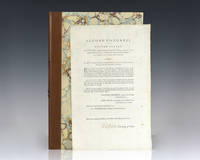
1792125388Philadelphia: Childs & Swaine 1792. Scarce printing of an early United States law providing for the funding of the national debt signed by Thomas Jefferson as Secretary of State. Folio one page. The document which also carries the printed signatures of President George Washington Vice President John Adams and House Speaker Jonathan Trumbull was approved January 23 1792. Individual acts and bills of the first Congresses were routinely printed for public consumption. A provision was made however to print a few copies of each act for dissemination to the states and to have each copy signed by Secretary of State Thomas Jefferson. One of the main priorities of the federal government in the early national period was to pay down the debt of the United States. The national debt was incurred during the Revolution and augmented in 1790 when the Congress passed the Assumption Act in accordance with a plan devised by Alexander Hamilton. Because contacting the numerous and geographically dispersed holders of the debt proved more difficult than expected it became necessary to extend the time allowed by law for making the relevant financial arrangements. The present act accomplished this and made a special extension of five months for Vermont which gave the new state time to calculate the amount of debt. Despite Jefferson's vehement opposition to Hamilton's plan when it was formulated his position as Secretary of State necessitated his signature on the presentation copies of the acts that effected it. In fine condition. Housed in a custom half morocco folding case. Scarce with only one other example signed by Jefferson located. American Founding Father Thomas Jefferson was the principal author of the Declaration of Independence and later served as the third President of the United States from 1801 to 1809. Prior to his presidency he was elected the second Vice President of the United States serving under John Adams from 1797 to 1801. A proponent of democracy republicanism and individual rights motivating American colonists to break from Great Britain and form a new nation he produced formative documents and decisions at both the state and national level. Jefferson was an avid bibliophile and by the end of his life had amassed a large library and wine collection. Childs & Swaine unknown books
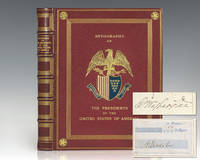
17831253841783-1956. Elaborately bound collection of Presidential autographs containing the autograph of each of the first 34 Presidents of the United States from George Washington to Dwight D. Eisenhower. Quarto bound in full red morocco by Riviere & Son with gilt titles and ruling to the spine in six compartments within raised gilt bands gilt presidential seal to the front panel with white and blue morocco onlays gilt arms and motto of George Washington to the rear panel with white and blue morocco onlays and his gilt signature in facsimile centerpieces within quintuple gilt ruling with star emblems at each corner blue morocco doublures with multiple gilt presidential signatures blue silk endpapers. This complete series of autographs of the first 34 Presidents of the United States contains the signature of each mounted on an album leaf opposite a loosely tissue-guarded engraved portrait of each. The collection includes: the signature of George Washington on an envelope addressed to Major General Knox as Secretary <span class="match">of</span> <span class="match">the</span> Society <span class="match">of</span> <span class="match">the</span> Cincinnati November 3 1783; a clipped signature of John Adams; clipped signature of Thomas Jefferson; the signature of James Madison on an envelope addressed to Reverend Frederick Freeman of Manayunk Pennsylvania; and inscription signed by James Monroe; the signature of John Quincy Adams on an envelope addressed to William Plumer jun. Esq. in Epping New Hampshire; a partially printed land grant signed by Andrew Jackson dated 1831 registering <span class="match">the</span> purchase <span class="match">of</span> 20 acres in Detroit by Peter Aldrich; clipped signature of Martin Van Buren; clipped signature of William Henry Harrison; signed inscription from John Tyler; signed inscription from James Polk; clipped signature of Zachary Taylor dated Baton Rouge March 5 1841; clipped signature of Millard Fillmore; clipped signature of Franklin Pierce; clipped signature of James Buchanan on a document dated July 18 1858; clipped signature of Abraham Lincoln; endorsement signed by Andrew Johnson as President; clipped signature of Ulysses S. Grant; card signed by Ru<span class="match">the</span>rford B. Hayes; inscription signed by James Garfield; large card signed by Chester A. Arthur and dated May 22 1884; autograph noted signed by Grover Cleveland declining an invitation dated November 16 1890; an Executive Mansion card signed by William McKinely; clipped signature of <span class="match">The</span>odore Roosevelt; clipped signature of William Howard Taft; clipped signature of Woodrow Wilson; typed letter signed by Warren G. Harding as President dated June 4 1923 on White House letterhead; card signed by Calvin Coolidge; White House card signed by Herbert Hoover; typed letter signed by Franklin D. Roosevelt as Assistant Secretary <span class="match">of</span> <span class="match">the</span> Navy February 15 1917. Laid in is a typed letter signed by Harry S. Truman as President June 30 1950 on White House stationery and a typed letter signed by Dwight Eisenhower. TLS as President November 13 1956 on White House stationery. In fine condition. Housed in a custom folding chemise and half morocco slipcase. An exceptional collection and presentation. unknown books
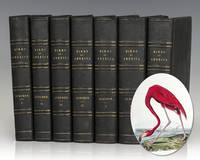
1840111832New York: Published by J.J. Audubon 1840. First octavo edition of this landmark work. Octavo bound in original publisher's morocco 7 volumes gilt titles and ruling to the spine marbled endpapers complete with 500 hand-colored lithographed plates by J.T. Bowen after J.J. Audubon; woodcuts in the text. From the library of Boston businessman and Ambassador T. Jefferson Coolidge with his bookplate to the front pastedown. Coolidge was born to a prominent Boston Brahmin family and was a great-grandson of the 3rd United States President Thomas Jefferson through his maternal grandparents Thomas Mann Randolph Jr. and Martha Jefferson Randolph. His uncles were Thomas Jefferson Randolph George Wythe Randolph Andrew Jackson Donelson and a relative of Calvin Coolidge. <sup id="cite_ref-2" class="reference"></sup>He was an uncle to Archibald Cary Coolidge through his older brother Joseph Randolph Coolidge. He was appointed by President Benjamin Harrison as United States Ambassador to France on May 12 1892 a role his great-grandfather had held from May 1785 to September 1789. Coolidge presented his credentials on June 10 1892 and he presented his recall on May 4 1893 terminating his mission. <sup id="cite_ref-state_6-0" class="reference"></sup>In 1898 and 1899 he was a member of the American delegation to the commission to resolve the Alaska boundary dispute. <sup id="cite_ref-7" class="reference"></sup>Historian Ernest May says Coolidge was "a prototype member of what today we call the foreign policy establishment." In 1898 Coolidge donated a collection of Thomas Jefferson's personal papers to the Massachusetts Historical Society in Boston. The collection contained more than 8000 items: Correspondence including 3280 letters that Jefferson had written and 4630 letters that he had received; Jefferson's garden book 1766-1824 and farm book 1774-1824; annotated almanacs from 1771-1776; account books for 1783-1790; manuscript expense accounts from 1804-1825; notes on the weather spanning the years 1782-1826; plans of American forts in 1765; law treatises 1778-1788; legal papers 1770-1772; and Jefferson's 1783 catalog of his personal library. In near fine condition. An exceptional set with noted provenance rare in the original publisher's morocco. One of the most spectacular collections of ornithological prints ever produced and a landmark attempt to document the birds of North America. "The most splendid book ever produced in relation to America and certainly one of the finest ornithological works ever printed. Audubon insisted on drawing from life never from stuffed specimens and was much in advance of his time in portraying the birds in many cases unrecorded species in their natural surroundings. The courage and faith of the Audubon family is breathtaking. This immense undertaking this unparalleled achievement was not the production of a great and long-established publishing house nor was it backed by a wealthy institution. It was the work of a man of relentless energy with no private fortune. It is a story without equal in the whole history of publishing" Great Books and Book Collectors 210-13. Published by J.J. Audubon unknown books
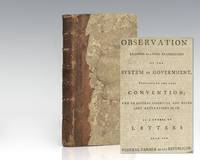
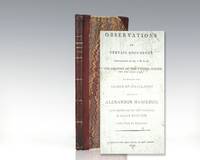
1787106800New York 1787. Rare first edition of the definitive and most important work in the Anti-Federalist canon; the antithesis of the The Federalist Papers. Octavo bound in the original calf over original boards with six raised bands edges speckled red. In very good condition. An exceptional example. On November 8 1787 the New York Journal began to advertise a new pamphlet entitled Observations Leading to a Fair Examination of the System of Government Proposed by the Late Convention; and to Several Essential and Necessary Alterations in It. In a Number of Letters from the Federal Farmer to the Republican. This pamphlet contained the first five Federal Farmer letters dated October 8 to 13. The first edition was replete with errors and a second corrected printing appeared within a week. Among the Federalists Alexander Hamilton as Publius Edward Carrington and Noah Webster acknowledged the Federal Farmer as in Hamilton's words the "most plausible" Anti-Federalist. Only one Federalist Timothy Pickering took the time to develop a complete critical response to the Federal Farmer. Though this was not published during the course of the constitutional debates it survives in a personal letter. Pickering described the Federal Farmer as "a wolfe in sheep's cloathing" and too focused on a misplaced fear of aristocracy. The work has been attributed to Richard Henry Lee a presiding officer of the Continental Congress writing under the pseudonym 'Federal Farmer'. Through these the first five letters the Federal Farmer argues that the plan of the Constitution while claimed to be a federal system and seeming to be so in some respects will in the end annihilate the states by consolidating them into one national government. This concern over consolidation was among the most important of the Anti-Federalist objections to the Constitution; they saw the destruction of state sovereignty as inimical to freedom. Honest federalists in the view of the Federal Farmer wished for the substantial preservation of the state governments but sought a federal government that was more than merely advisory. The letters indicate that the Federal Farmer ascribed to the compact theory of federalism. The Federal Farmer letters are among the best-written and convincing pieces in the Anti-Federalist canon and make regular appearances in collections of Anti-Federalist writing. "Though sometimes discursive and repetitious the letters skillfully written moderate in tone and thoughtful were perhaps the most eloquent and persuasive anti-federalist writings" Ketcham 256. hardcover books
177696237J. Almon J.S. Jordan and J. Stockdale: London 1776-1793. Finely bound collection of the works of Thomas Paine including the rare first British editions of Common Sense and Plain Truth London: J. Almon 1776 second editions of Rights of Man Parts I & II London: J.S. Jordan 1791-1792 complete with half-titles present and a rare early printing of John Quincy Adams' response to Paine's Rights of Man London: J. Stockdale 1793 attributed to his father John Adams and written when John Quincy Adams was 26 years old. Octavo bound in three quarters morocco over marbled boards with gilt titles and tooling to the spine red morocco spine label all edges speckled black. In near fine condition. A rare and desirable collection. One of the founding fathers of the United States Thomas Paine authored two of the most influential pamphlets at the start of the American Revolution which ultimately inspired the 1776 Declaration of Independence. Virtually every American rebel read Paine's powerful pamphlet Common Sense which crystallized the American Revolution and demand for independence from Britain. John Adams asserted "without the pen of the author of Common Sense the sword of Washington would have been raised in vain." London hardcover books
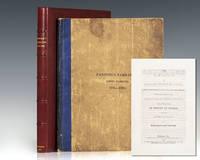
1861125637Richmond VA: Printed for Private Distribution Only 1861. First edition of the first book printed in the Confederacy. Quarto original stiff paper wrappers one of approximately 50 copies issued on regular paper. Ten being issued on thick paper and twenty copies destroyed in a fire. In very good condition reinforcement to the hinges. Housed in a custom full morocco clamshell box. Howes F26. Sabin 23778. Exceptionally rare. David Fanning was one of the most infamous of the Southern Tories raiding Patriots throughout the Carolinas. His guerilla warfare only paused when he was captured but following each of his multiple escapes he would quickly resume his vengeful predation. His narrative was to be the first in a series but the Civil War intervened and only this initial volume was produced. It was reprinted by Sabin in 1865 but this original edition was noted by Goodspeed's "as one of the finest of Confederate imprints." Printed for Private Distribution Only unknown books
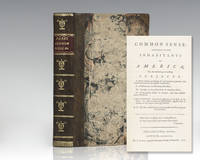
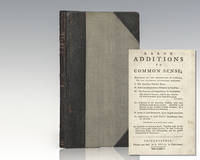
1776106523Philadelphia: Printed and sold by R. Bell in Third-Street 1776. Scarce 1776 separate edition of the Large Additions to Common Sense. The title reads in full: Large Additions To Common Sense: Addressed To The Inhabitants Of America On The Following Interesting Subjects. I. The American Patriot's Prayer. II. American Independancy defended by Candidus. III. The Propriety of Independancy by Demophilus The dread of Tyrants and the sole resource Of those that under grim Oppression groan. Thomson. IV. A Review of the American Contest with some Strictures on the King's Speech. Addressed to All Parents in the Thirteen United Colonies by a Friend To Posterity And Mankind. V. Letter to Lord Dartmouth by an English American. VI. Observations on Lord North's Conciliatory Plan by Sincerus. To Which Is Added And Given An Appendix to Common Sense; Together with an Address to the People Called Quakers on their Testimony concerning Kings and Government and the Present Commotions in America. Octavo bound in three quarters morocco over boards gilt titles and five raised bands to the spine marbled endpapers. In very good condition internally very clean. Rare with only two examples appearing at auction in the last 80 years. One of the founding fathers of the United States Thomas Paine authored two of the most influential pamphlets at the start of the American Revolution which ultimately inspired the 1776 Declaration of Independence. Virtually every American rebel read Paine's powerful pamphlet Common Sense which crystallized the American Revolution and demand for independence from Britain. John Adams asserted "without the pen of the author of Common Sense the sword of Washington would have been raised in vain." The 1776 Large Additions lends insight into the fascinating publishing history of the most important and popular tract of the American Revolution. After the publication of the first edition of Common Sense by Bell in 1776 in a small edition of 1000 copies Paine was greatly disappointed when Bell advised him there were no profits. He had intended to donate the proceeds to the causes of liberty and independence. Paine and Bell 44 had an immediate falling out and Paine subsequently hired Bradford to print a competing edition. This naturally infuriated Bell who included an attack on the still anonymous author in his next printing. The controversy between Bell and Paine played out in the press over the next several weeks and in no small part helped further ignite the popularity and widespread dissemination of Common Sense. Bell tried to compete against Bradford with a second unauthorized edition and gathered these additions to differentiate his work for the purpose of marketing. Nevertheless Bell could not easily compete since Paine refused to copyright the work and granted free permission for anyone to reprint it. Howes P22 states that "Paine was not the author of these Additions; they were gathered from various sources by Bell to make his edition 3 times larger than the enlarged edition issued at Philadelphia by Bradford to whom Paine had turned after his estrangement from Bell. Some copies were issued separately - and paged" as in the present example " . to permit their being bound with the first and second editions of Common Sense. Printed and sold, by R. Bell in Third-Street hardcover books
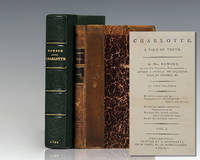
1794125183Philadelphia: Printed by D. Humphreys for M. Carey 1794. Exceedingly rare first American edition and the earliest obtainable example of the first American bestseller. Octavo two volumes bound into one in three quarter calf over marbled boards morocco spine label lettered in gilt marbled endpapers. Although it was preceded by the first English edition published in 1791 no examples of the first English edition have been traced at auction. In very good condition. Bookplate to the pastedown bibliographic description tipped in. Housed in a custom cloth chemise and half morocco clamshell slipcase. Exceedingly rare with only one other example of the first American edition traced at auction in the last 75 years. Susana Rowson's best-selling novel Charlotte Temple relates the tale of 15-year-old English schoolgirl Charlotte Temple who is lured away from her prestigious boarding school by British army officer John Montraville. While en route to New York Montraville seduces Charlotte who he swiftly abandons upon arrival to his post and after a downward spiral into remorse illness poverty and the birth of a child she dies. Seduction novels were popular in the 18th century and the widely read Charlotte Temple went through more than 200 editions. Rowson a committed republican used the success of the novel to protest the sexual double standard that ruined the lives of women like Charlotte. Later in life she wrote a sequel that was published posthumously. Printed by D. Humphreys for M. Carey hardcover books
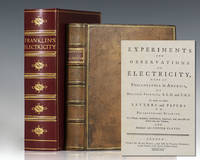
1769125438London: Printed for David Henry and sold by Francis Newbery 1769. First complete edition of "the most important scientific book of 18th-century America" and "America's first great scientific contribution" PMM. Octavo bound in full contemporary calf with gilt ruling to the spine in six compartments within raised bands red morocco spine label lettered in gilt double gilt ruling to the front and rear panels. With the rarely found half-title. Advertisement & errata leaf bound in following the preface. Illustrated with 7 copper-engraved plates 4 of which are folding. This the fourth first complete and most desirable edition of Franklin's important work contains for the first time complete notes on all of the experiments as well as correspondence between Peter Collinson Franklin and several other collaborators. The earlier editions each issued in three parts as separately published pamphlets usually bound together were carelessly published. Franklin edited this new one-volume edition himself significantly revising the text adding for the first time a number of his own philosophical letters and papers introducing footnotes correcting errors and adding an index Cohen Benjamin Franklin's Experiments. In near fine condition. Expertly rebacked. Housed in a custom full morocco clamshell box. Franklin's most important scientific publication" Experiments and Observations contains detailed accounts of the founding father's crucial kite and key experiment his work with Leiden jars lightning rods and charged clouds Norman 830. "The most dramatic result of Franklin's researches was the proof that lightning is really an electrical phenomenon. Others had made such a suggestion before him-- even Newton himself-- but it was he who provided the experimental proof" PMM. "The lightning experiments caused Franklin's name to become known throughout Europe to the public at large and not merely to men of science. Joseph Priestley in his History of Electricity characterized the experimental discovery that the lightning discharge is an electrical phenomenon as 'the greatest perhaps since the time of Isaac Newton. Franklin's achievement. marked the coming of age of electrical science and the full acceptance of the new field of specialization" DSB. Printed for David Henry and sold by Francis Newbery hardcover books
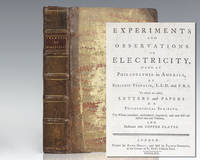
1769116750London: Printed for David Henry and sold by Francis Newbery 1769. First complete edition of "the most important scientific book of 18th-century America" and "America's first great scientific contribution" PMM. Octavo bound in contemporary half calf over marbled boards morocco spine label. Advertisement & errata leaf inserted following preface. Illustrated with 7 copper-engraved plates 2 of which are folding. In very good condition. First editions are rare exceptionally so in a contemporary binding. Franklin's most important scientific publication" Experiments and Observations contains detailed accounts of the founding father's crucial kite and key experiment his work with Leiden jars lightning rods and charged clouds Norman 830. "The most dramatic result of Franklin's researches was the proof that lightning is really an electrical phenomenon. Others had made such a suggestion before him-- even Newton himself-- but it was he who provided the experimental proof" PMM. "The lightning experiments caused Franklin's name to become known throughout Europe to the public at large and not merely to men of science. Joseph Priestley in his History of Electricity characterized the experimental discovery that the lightning discharge is an electrical phenomenon as 'the greatest perhaps since the time of Isaac Newton. Franklin's achievement. marked the coming of age of electrical science and the full acceptance of the new field of specialization" DSB. Printed for David Henry and sold by Francis Newbery hardcover books
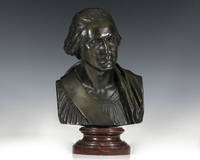
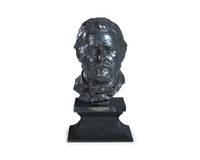
123102Fine bronze bust of George Washington after the famed Houdon bust of 1785 which is considered the most accurate depiction of Washington. Bronze mounted on a marble pedestal. French sculptor Jean-Antoine Houdon was revered for his life-like portrayals of numerous notable eighteenth-century philosophers inventors and political figures including Jean-Jacques Rousseau Voltaire Benjamin Franklin Thomas Jefferson Napoleon Bonaparte and George Washington. In 1784 the Virginia General Assembly commissioned a statue of George Washington "to be of the finest marble and the best workmanship" necessitating a European craftsman. The Governor of Virginia gave the responsibility of selecting the artist to Thomas Jefferson then ambassador to France who together with Benjamin Franklin recommended that Jean-Antoine Houdon the most famous sculptor of the day execute the work. Unsatisfied to work from a drawing of Washington by Charles Willson Peale sent for the project and lured by a potential commission for an equestrian monument by the Congress of the Confederation Houdon agreed to travel to the United States to work directly from Washington. In early October 1785 Houdon and three assistants arrived at Washington's plantation Mount Vernon where they spent two weeks taking detailed measurements of Washington's arms legs hands and chest and made a plaster cast of his face. Before returning to France to perfect his work Houdon presented his first draft of the bust sculpted in terra cotta to Washington which he is known to have placed in his study. The final statue was carved from Carrara marble depicting a standing life-sized Washington with a cane in his right hand and cape in his left. Chief Justice John Marshall a contemporary of Washington's said of the work "Nothing in bronze or stone could be a more perfect image than this statue of the living Washington." In fine condition. The bronze casting measures 14.25 inches in height. The entire piece measures 17.25 inches in height. American statesman and soldier George Washington served as the first President of the United States from 1789 to 1797 and was one of the Founding Fathers of the United States. He served as Commander-in-Chief of the Continental Army during the American Revolutionary War and later presided over the 1787 convention that drafted the United States Constitution. He is popularly considered the driving force behind the nation's establishment and came to be known as the "father of the country" both during his lifetime and to this day. unknown books
179752680Philadelphia: John Bioren for John Fenno 1797. Rare first edition of one of the major causes celebres in American governmental history. Octavo bound in contemporary morocco marbled endpapers. In near fine condition. This first edition of 1797 is rare as it was bought up by the <span class="match">Hamilton</span> family in an effort to suppress it but was ultimately reprinted in 1800 by <span class="match">Hamilton</span>'s political enemies. Housed in a custom half calf clamshell box. Alexander Hamilton resigned as Secretary of the Treasury in 1795; two years later "a baseless accusation against his honesty as secretary of the treasury brought by Monroe and others forced him to make public confession of his intrigue some years previous with a Mrs. Reynolds . his confession had the merit of a proud bravery for it showed him willing to endure any personal humiliation rather than a slur on his public integrity" DAB. Mrs. Hamilton tried to buy up all copies of the 1797 pamphlet but some escaped. In 1800 in the midst of the Jefferson-burr election anti-Federalists such as William Duane reprinted Hamilton's admission of infidelity. John Bioren for John Fenno unknown books
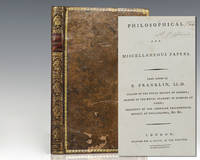
1787125345London: Printed for C. Dilly in the Poultry 1787. First edition of the last collection of Franklin's writings to appear during his lifetime; a major collection of his political philosophical and scientific writings a second volume of which was planned but never published. First issue with page 25 <span class="glossaryQtip qTip">mispaginated</span> "52." Octavo bound in full contemporary tree calf with elaborate gilt tooling to the spine red morocco spine label lettered in gilt gilt Greek key ruling to the front and rear panels. With four copper-engraved folding plates including diagrams of the Franklin stove and the earliest published map of the Gulf Stream. In very good condition. Armorial bookplate and early ownership inscriptions. Text and plates very clean. Rare. Intended by the publisher as a companion volume to the Experiments and Observations on Electricity 1769 and his Political Miscellaneous and Philosophical Pieces 1779 Franklin's Philosophical and Miscellaneous Papers contains a selection of important political essays including his Remarks concerning the Savages in North America 1784 The letter from Dr. B. Franklin to Benjamin Vaughan. of Privateering 1785 and Information to those who would remove to America 1784 which is "one of the clearest expressions of his belief that American society should be based on the virtues of the middle. classes" Isaacson 423. Also highly notable is Internal State of America his sharply optimistic postwar reply to "complaints of hard times in the American press. with an equally sharp consciousness of British propaganda" Crane William and Mary Quarterly XV:2 218. This volume additionally contains three major scientific writings: Description of a New Stove for the burning of Pitcoal 1785 Letter from Dr. B. Franklin to Dr. Ingenhausz On the Causes and Cure of Smoky Chimneys 1785 and Letter from Dr. Benjamin Franklin. containing sundry Maritime Observations 1785. Merging his political and scientific interests Franklin used Maritime's study of the sea and Gulf Stream to "proclaim the virtues of his nation and its people." This inspired others to also "think of the Gulf Stream in political terms. In 1790 Thomas Paine declared the French Revolution 'as fixed as the Gulf Stream' and Jonathan Williams claimed the current's waters were as distinct as 'the colors of red white and blue'" Chaplin 320-25. Printed for C. Dilly, in the Poultry unknown books
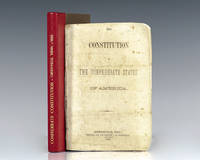
1861125394Greenneville sic Tenn.: Printed And For Sale by J. M. Robertson 1861. Scarce 1861 Tennessee printing of The Constitution of The Confederate States of America adopted on March 11 1861. Octavo original wrappers. In very good condition wrappers laminated in glassine. Housed in a custom cloth chemise and half morocco slipcase. Exceedingly rare being the only example printed in Tennessee in the year of the Constitution's adoption to appear in auction records. Adopted on March 11 1861 the Constitution of the Confederate States was the supreme law of the Confederate States of America. It was in effect from 22 February 1862 to the conclusion of the American Civil War in May 1865. The majority of its provisions follow the United States Constitution verbatim; however there are critical differences between the two documents regarding slavery. Whereas the original U.S. Constitution did not use the word "slavery" or the term "Negro Slaves" but instead used "Persons held to Service or Labour" which included whites and Native Americans in indentured servitude the Confederate Constitution addresses the legality of slavery directly and by name. Though Article I Section 9 1 of both constitutions are quite similar in banning the importation of slaves from foreign nations the Confederate Constitution permitted the Confederate States to import slaves from the United States and specified the "African race" as the subject. The importation of slaves into the United States including the South had been illegal since 1808. Printed And For Sale by J. M. Robertson hardcover books
1828102755New York: Published by S. Converse. Printed by Hezekiah Howe 1828. Rare first edition of Webster's monumental American Dictionary one of only 2500 copies with <span class="glossaryQtip qTip">frontispiece</span> portrait of the pioneering lexicographer in full contemporary calf. Quarto two volumes bound in full contemporary calf marbled endpapers illustrated frontispiece tissue guard present. In near fine condition light toning to the text. Most rare and desirable bound in contemporary calf. An exceptional example most rare without any restoration. In 1807 Webster began compiling a fully comprehensive dictionary An American Dictionary of the English Language; it took twenty-eight years to complete. To evaluate the etymology of words Webster learned twenty-six languages including Old English Anglo-Saxon Greek Hebrew and Latin. Webster completed his dictionary during his year abroad in 1825 in Paris France and at the University of Cambridge. His book contained seventy thousand words of which twelve thousand had never appeared in a published dictionary before. As a spelling reformer Webster believed that English spelling rules were unnecessarily complex so his dictionary introduced American English spellings replacing colour with color substituting wagon for waggon and printing center instead of center. He also added American words like skunk and squash that did not appear in British dictionaries. At the age of seventy Webster published his dictionary in 1828 registering the copyright on April 14. Webster did all this in an effort to standardize the American language. "This dictionary which almost at once became and has remained the standard English dictionary in the United States was the end-product of a stream of spelling books grammars readers and dcitionaries which flowed from the pen of the industrious Noah Webster.Webster's great dictionary all the 70000 entries of which he wrote with his own hand has been reprinted and brought up to date innumerable times.the book marked a definite advance in modern lexicography as it included many non-literary terms and paid great attention to the language actually spoken. Moreover his definitions of the meaning of words were accurate and concise.and have for the greater part stood the test of time superbly well" Printing and the Mind of Man. "As a whole Webster's American Dictionary was a scholarly achievement of the first order richly deserving of its great reputation at home and abroad" DAB. With definitions for "some 70000 words--15000 more than any previous English lexicon. Although only 2500 copies of the first edition were printed the work established Webster as a lexicographer of international repute" Lathem 76 United Statesiana 9. Published by S. Converse. Printed by Hezekiah Howe unknown books
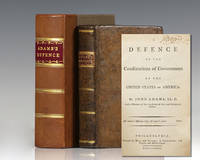
1787125308Philadelphia: Printed for Hall and Sellers; J. Cruikshank; and Young and McCulloch 1787. First edition of John Adams's greatest contribution to American political theory; from the library of one of the 39 signers of the United States Constitution Founding Father Gunning Bedford Jr. Octavo bound in full contemporary tree calf with gilt ruling to the spine red morocco spine label lettered in gilt gilt turn-ins. Signed by Gunning Bedford Jr. on the title page. Born in Philadelphia in 1747 Gunning Bedford attended the College of New Jersey where he was a classmate of James Madison and later served in the Continental Army as an aide to General George Washington. After the Revolutionary war he became a prominent political figure sitting in the legislature on the state council and in the Continental Congress 1783-85. One of the more active members of the Constitutional Convention on May 14 1787 he was one of the 39 delegates that signed the Constitution of the United States. Gunning Bedford also served as Attorney General of Delaware from 1784 until he was designated by George Washington as a federal district judge for his state in 1789 a position he held for the rest of his life. In near fine condition. Housed in a custom half morocco and chemise case. An exceptional example with fine provenance. Adams wrote this work on constitutional theory while serving as Minister to the Court of St. James as a response to liberal French statesman Turgot who had criticized the new American state constitutions for their conservative economic framework. Adams's Defence was often cited in the debates of the Constitutional Convention. "A work marked by insight breadth of views conviction courage and--we may venture to add--much wisdom" Larned Literature of American History 2287. At the start of 1787 while minister to Great Britain and a year before he returned to America John Adams "felt an urgency like that of 1776. Great events were taking place at home. Support for a stronger central government was gaining ground. A constitutional convention was in the offing and as he had been impelled in 1776 to write his Thoughts on Government so Adams plunged ahead. books piled about him his pen scratching away until all hours. By early January 1787 Adams had rushed the first installment of his effort to a London printer. Titled A Defence of the Constitutions of Government of the United States of America. copies were sent off at once to the United States and to Jefferson in Paris" McCullough John Adams 374. Of the Defence Thomas Jefferson wrote to Adams "I have read your book with infinite satisfaction and improvement. It will do great good in America. Its learning and its good sense will I hope make it an institute for our politicians old as well as young" Sowerby 3004. "From Philadelphia where the Constitutional Convention had assembled Benjamin Rush a member of the Convention wrote that the Defence had 'diffused such excellent principles among us that there is little doubt of our adopting a vigorous and compound federal legislature. To a considerable extent Adams' Defence was an expanded more erudite rendition of the case for checks and balances in government that he had championed in his Thoughts on Government 1776 and later put into operation in his draft of the Massachusetts constitution" McCullough 375. "The work did much to familiarize the European mind to the novel state of things then taking place in America" Sabin 236. This volume was issued as a stand-alone work and was followed by two supplemental volumes the following year Sabin 234. Printed for Hall and Sellers; J. Cruikshank; and Young and McCulloch unknown books
1786104062Philadelphia: Printed by Charles Cist 1786. First edition of Paine's defense of the Bank of North America. Small octavo bound in three quarters leather over marbled boards with gilt titles and tooling to the spine. Rare. "Another time that tried men's souls occurred in 1780 when the American troops were at the end of their patience because of lack of pay and scarcity of supplies. Serious features of mutiny and sedition had already appeared. A tone of discouragement swept through the Pennsylvania Assembly for the treasury was empty. One member said 'We might as well give up first as last.' But Paine did not agree and when he drew his meager salary he took $500 and started a subscription for the relief of soldiers. Robert Morris and many others followed and by June 18 1780 had raised 300000 pounds and started a bank which supplied the army through the campaign.When the bank came under attack by those who favored inflation after the war Paine rushed to its defense with this pamphlet."Gimbel 45. In very good condition with the title page backed with some restoration period ownership signature stamp to the verso of page 53 notations throughout. Printed by Charles Cist hardcover books
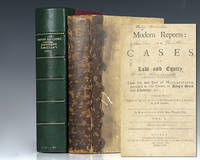
1769125709London: Printed by His Majesty's Law Printers 1769. Alexander Hamilton's copy of the tenth volume of Lucas's Modern Reports. Folio bound in one quarter contemporary calf over paper-covered boards. Signed by Alexander Hamilton and his son Philip Hamilton on the title page. In very good condition. Housed in a custom cloth chemise and half morocco slipcase. Rare and desirable books from Hamilton's library seldom appear on the market. The first treasury secretary of the United States and one of America's founding fathers Alexander Hamilton founded the nation's financial system the Federalist Party the United States Coast Guard and the New York Post newspaper. He was the main author of the economic policies of George Washington's administration and as Secretary of the Treasury established a national bank system of tariffs and trade relations with Great Britain. After the American Revolutionary War Hamilton resigned his seat in the Congress of the Confederation to practice law which he returned to in 1795 and was active in ending the legality of the international slave trade. Printed by His Majesty's Law Printers hardcover books
102885Original bronze bust of Ulysses S. Grant by Henry Shrady the famed sculptor of the Ulysses S. Grant Memorial on the west front of the United States Capitol in Washington D.C. Mounted on socle and base the entire piece measures 18.5 inches in height. In fine condition. An exceptional piece of Americana. Henry Merwin Shrady was an American sculptor known for the Ulysses S. Grant Memorial on the west front of the United States Capitol in Washington D.C. Shrady and architect Edward Pearce Casey won the competition to build the Ulysses S. Grant Memorial in 1902. In the twenty years Shrady spent executing its sculpture program he studied biology at the American Museum of Natural History and dissected horses to gain a better understanding of animal anatomy. The memorial was dedicated on April 27 1922 two weeks after Shrady's death. The Grant Memorial is described as "one of the most important sculptures in Washington" by James M. Goode in The Outdoor Sculpture of Washington D.C. It consists of a colossal equestrian statue of Grant atop a marble pedestal with bas relief plaques guarded by four lions. unknown books
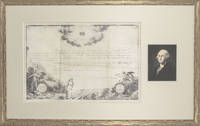
1784101412Philadelphia May 5th 1784. Rare autograph document signed by George Washington as President of the Society of the Cincinnati during the first general meeting of the Society and 5 years prior to his election and inauguration as the first President of the United States of America. One page partially printed on vellum with engraved vignettes by Auguste L. Belle after Jean-Jacques <span class="match">And</span>re LeVeau depicting America in knight's armor trampling upon the British st<span class="match">and</span>ard <span class="match">and</span> the American eagle casting the British lion <span class="match">and</span> Britannia out to sea with thunderbolts engraved seal of the Order of the Cincinnati. The document reads: Be it known that Lieutenant William Andrews is a member of the society of the Cincinnati instituted by the Officers of the American Army at the Period of Dissolution as well to commemorate the great Event which gave Independence to North American as for the laudable Purpose of inculcating the Duty of laying down in Peace Arms assumed for public Defence and of uniting in Acts of brotherly Affection and Bonds of perpetual Friendship the Members constituting the same. In Testimony whereof I the President of the said Society have hereunto set my hand at Philadelphia in Pennsylvania this fifth day of may in the Year of our Lord One Thousand Seven Hundred and Eighty Four and in the Eighth Year of the Independence of the United States. By Order " "H.<span class="match">Knox</span>" Secretary "G. Wahsington" President. William <span class="match">And</span>rews was commissioned a lieutenant on 1 January 1777 with the Third Continental Artillery. His regiment wintered at Valley Forge <span class="match">and</span>the following June <span class="match">And</span>rews was captured <span class="match">and</span> held by the British in New York until he was exchanged in September 1781. In fine condition. Double matted and framed with an engraved portrait of Washington. The entire piece measures 36 inches by 23 inches. An exceptional example. Conceived of by Henry Knox in an effort to establish a fraternal organization for all officers who had served in the American War for Independence The Society of the Cincinnati was founded in early May 1783 at the headquarters of General Friedrich Wilhelm von Steuben at Verplanck House in Fishkill New York. The three guiding principles of the organization were: First "An incessant attention to preserve inviolate those exalted rights and liberties of human nature for which they have fought and bled. ." Second "An unalterable determination to promote and cherish between the respective States that union and national honor so essentially necessary to their happiness and the future dignity of the American empire." And third "To render permanent the cordial affection subsisting among the officers. This spirit will dictate brotherly kindness in all things and particularly extend to the most substantial acts of beneficence according to the ability of the Society towards those officers and their families who unfortunately may be under the necessity of receiving it." The concept of using Cincinnatus as an emblem of the Order was particularly resonant with Americans since the life of this mid-fifth century Roman nobleman and farmer closely paralleled that of many who had served with George Washington in the vanguard. Lucius Quinctius Cincinnatus was called upon to repel two hostile tribes that threatened Rome. He issued his orders which were efficiently carried out and vanquished the enemy. Although elected a dictator for six months and voted a triumph by the Senate Cincinnatus stepped down just after fifteen days and returned to private life on his farm. Similarly at the conclusion of hostilities Washington returned to his plantation at Mount Vernon. hardcover books