Lincoln, AbrahamBiblio.com
48 402 résultats
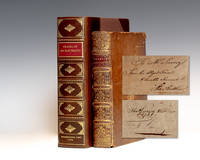
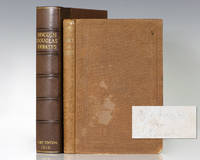
1860138634Columbus: Follett Foster and Company 1860. First edition first issue of the most famous debates in American history which cemented Lincoln as a national presidential candidate; inscribed by Lincoln in pencil to close friend Martin S. Morris and accompanied by the table from the Morris household that Lincoln signed the book on. Octavo original cloth stamped in blind. First issue with no advertisements no rule above the publisher’s imprint on the copyright page and with numeral 2 at the bottom of page 17. Association copy inscribed by Abraham Lincoln in pencil on the front free endpaper "M. S. Morris Esq A. Lincoln." The recipient Martin S. Morris was was a long-time political supporter and friend of Abraham Lincoln from Menard County Illinois. In March 1843 Lincoln wrote to Morris “It is truly gratifying to me to learn that while the people of Sangamon have cast me off my friends of Menard who have known me longest and best of any still retain their confidence in me.†Morris was selected as one of the delegates from Menard County to attend the Whig convention in Pekin in May 1843 but was detained by an illness and Francis Regnier attended in his place. The convention selected John J. Hardin rather than Lincoln as the Whig candidate for Congress from that district. In June 1852 Morris's close friend Whig Congressman and later Illinois governor Richard Yates wrote to him from Washington regarding the 1852 presidential election. The Democratic National Convention was then underway in Baltimore and after 32 ballots by the convention Yates believed the chances of receiving the nomination were against U.S. Senator Stephen A. Douglas of Illinois unless “his almost never failing good luck may avail him.†Ultimately on the 49th ballot the Convention nominated Franklin Pierce who had received no votes until the 35th ballot. Laid in is Yates' letter to Morris which reads in part “Washington June 4 1852 Dear Morris I thank you kindly. The Democratic Convention is now in session in Baltimore. The 32nd ballot has been had and no nomination. Douglass does not appear to have as much strength as anticipated and if we were to judge from present indications the chances are against him. How far his almost never failing good luck may avail him remains to be seen. The contest between Fillmore & Scott it is now believed will be very close. Some of the knowing ones who have not much to do but make calculations say that the vote of Illinois will decide the question. We do not know how the Illinois delegation stands but we suppose nearly equal for Scott and for Fillmore. Fillmore and his friends will if necessary to defeat Gen'l Scott cast their vote for Mr. Webster. My opinion and it is only an opinion is that Gen'l Scott will receive the nomination. Of one thing I feel pretty sure that either Scott or Fillmore will be supported most cheerfully by the Whigs and what is better the Whigs here and throughout the Union have an abiding confidence that they will again gloriously triumph in November. Such was not the case at the beginning of the session. There was more or less of despondency then but the skies are bright ahead now and be the result what it may the Whigs will march up to the work with unfaltering purpose and in the confident hope of victory. Your friend Richard Yates." The Whig National Convention met a few weeks later also in Baltimore and the contest remained close between Winfield Scott and incumbent president Millard Fillmore with Daniel Webster running a distant third until Scott finally received the nomination on the 53rd ballot. In his letter to Morris Yates was confident of a Whig victory in November but Pierce went on to defeat Scott with 51 percent of the vote to Scott’s 44 percent and an overwhelming 254-to-42 victory in the Electoral College. In May 1858 Morris wrote to Lincoln that he and other Republicans in Menard County “are up and doing†and “though we are in a minority we nevertheless intend to give them the Democrats the best fight we can.†Four months later he again wrote to “Friend Lincolnâ€: "If there is any reliance to be placed on the papers which I read you are certainly making a very successful electioneering tour through the state and whether you are elected to the senate or not you certainly have reason to congratulate yourself and feel proud of the manifestations of confidence every where shown you by the people I have said and believed ever since Douglass repealed the MO. Com. That you would be his successor the first chance the people had to vote in matter that was a most rascally thing and I believe would and know it ought to politically damn him and all who had anything to do with it at least in the north. But my object is not to write a dissertation on politicks knowing well that I could say nothing But which you already know But merely to inform you by way of adding to the encouragement which I believe you are every where receiving the good news that you may calculate with a very great degree of certainty on a vote from Menard & Cass. We are glad that you have made an appointment to speak here and will endeavor to get you a large crowd." Contrary to Morris’s assurances in the race for state representative from Cass and Menard Democrat William Engle defeated Republican James W. Judy for a seat in the legislature where he dutifully voted for Stephen A. Douglas for the U.S. Senate. In September 1859 Morris was a delegate from Menard County to the Republican Congressional Convention for the Sixth Congressional District in Springfield. At the Convention Morris was elected to the District Central Committee which consisted of one delegate from each county. Among the resolutions passed by the Convention were “Resolved That the Territories of the United States are the common property of all the free white citizens of the whole Union but that the institution of Slavery has no right or heritage therein.but at the same time we strenuously oppose every attempt to interfere with slavery in the States where it now exists.†and “Resolved That Freedom is universal and Slavery sectional and cannot exist where it is not authorized by virtue of special local legislation; and that the Government of the United States in the exercise of its powers whether executive legislative or judicial is bound to adhere in substance and in form to the generous and noble spirit of these important maxims.†6 Less than a month later John Brown did “interfere with slavery in the States where it now exists†by seizing the federal arsenal in Harpers Ferry Virginia. In 1862 Morris wrote to President Lincoln on behalf of his friend Henry Clay Denison who was serving as a commissary clerk in the 14th Illinois Infantry regiment. Denison wanted a position as assistant quartermaster or assistant commissary in the army. Morris stressed that Denison was “a descendant of a good Whig family of the good old Whig state of Vermont his native place being Woodstock. He is also as good a Republican as lives and if he didn’t do as much he tried as hard as any one else to bring about your nomination &election.†President Lincoln dutifully forwarded the letter to the War Department. With Yates' June 1852 letter to Morris laid in and with the ownership inscription of Morris' great granddaughter beneath Lincoln's inscription “Property of Pauline Madgett Welton Lincoln’s signature above." Provenance: kept in the Morris family for over six generations Martin S. Morris 1816-1884 husband of Elizabeth Waggoner Morris 1820-1901; Their daughter Jane Eliza Morris Nance 1857-1927 wife of Benjamin Franklin Nance 1853-1914; Their daughter Pauline E. Nance Madgett 1879-1971 wife of William P. Madgett 1875-1951; Their daughter Pauline Helen Madgett Welton 1908-1978 wife of Claude R. Welton 1908-1978; Their son William R. Welton 1939-2014; Welton family. Ownership inscription of Pauline Helen Madgett Welton. In very good condition. Housed in a custom half morocco clamshell box. Exceptionally rare signed by Lincoln with no other signed copies traced at auction. Accompanied by the original pedestal table from the Morris household that according to generations of family lore Lincoln sat at with Morris signed the book and ate apples as well as an oil portrait of Martin S. Morris which hung by the table. With a letter of provenance signed by a descendant of Pauline Helen Madgett Welton attesting to the provenance of the book table and a portrait. According to Rae Katherine Eighmey Abraham Lincoln in the Kitchen: A Culinary View 2014 fellow lawyer Charles S. Zane recalled Lincoln at a circuit town inn: "There was a 'large basket of apples in the sitting room and we were invited to help ourselves. Mr. Lincoln was a great eater of apples. He said to me once that a man should eat and drink only that which is conducive to his own health. "Apples" he said "agree with me."'" p. 131 citing Zane's article in the Journal of the Illinois State Historical Society in 1921. According to Eighmey Herndon wrote of Lincoln: "He loved best the vegetable world generally.and especially did he love apples. Running as a little-known candidate for the Illinois senatorship in 1858 Lincoln challenged incumbent and Democratic leader Stephen Douglas to a series of debates. The result was a memorable chain of lively arguments in front of cheering crowds. Though Lincoln lost the senatorial race “he began collecting a scrapbook of his best speeches particularly those from the just-concluded campaign against Douglas for possible inclusion in a book. Assiduously pasting newspaper accounts of the debates into the scrapbook Lincoln cast about for a publisher. Initial efforts failed mainly because Lincoln wanted the book printed in Springfield which had no local publishing or printing facilities. Eventually however the Columbus Ohio firm of Follett Foster & Company showed interest and he began preparing the first edition… Somewhat surprisingly for an attorney Lincoln did not seek Douglas’ permission to publish a book of their combined speeches although Douglas was later given the last-minute opportunity—he declined—to make corrections to his own remarks†Morris 121. Follett, Foster and Company hardcover
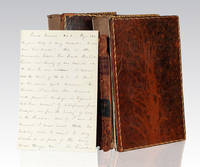
1936000125NJerusalem British Mandated Palestine. Good. 1936. Original Cloth. Evidential to the roots of Middle Eastern terror this is the extraordinary handwritten diary of Miss Doreen M. C. daughter of General and Mrs. J. C. sister of Cynthia. This British family witnesses the very beginnings of the modern era of Middle East tensions and terrorism having been residents of Jerusalem from January 1st to mid-June of 1936. Doreen writes a significant extraordinary insightful and well written diary. A young girl of 16 or 17 we estimate too young for boys - she detests them - and too old for the usual games that girls play paraphrase she writes of her time spent traveling throughout British mandated Palestine recording daily her comings and goings and all that goes on around her. She also does a great job drawing maps and other illustrations. Doreen sums it up in her own hand: in a handwritten copy of a 1963 letter to the famed Leonard Mosley of the Sunday Times found in the book Doreen admits to having in 1936 "a passion for keeping a large diary; I wrote down incidents of the strike riots and daily murders and ambushes like a recording angel!" She is modest. 1936 was a very intense very interesting and very disturbing year - Mussolini advancing against the Abyssinians in Africa Hitler on the rise in Europe Franco tearing apart Spain the King of England dies Edward VIII rises and starts to fall and Palestine is in foment as the Grand Mufti of Jerusalem has made a heinous pact with Hitler and called on the arab populous to strike - politically and through armed conflict murdering British soldiers and Jewish civilians and many many of their own people. Doreen is a "recording angel" to all this and more. From January 1st until mid-June she is for the most part based in Jerusalem living first at the King David Hotel before moving to Talbiyeh Colony in Jerusalem. There are very few idle days; many day trips visits shopping and when they move residence on 'Murhurrem' Jerusalem's famed moving days which date changes yearly and her description of the movers and hubbub are a delightful counterpoint to the atrocities she documents. Everyday she fully details her travels around the country and the news/politics of the day - even a trip to the dentist is fraught with danger given the times. Her father was highly placed at Air Headquarters research has found he ends his service a General and OBE recipient with the British Air Department. He meets frequently with generals and 'big bugs' as she calls them. She even admits that he is doing the "hush-hush work". Doreen names many of the British Colony and quite frequently makes comments - Mr. Such and Mr. Other 'complete scoundrels'. Doreen is an information and current events savant. She reads the papers listens to the radio and pumps the transient English men and women who travel throughout the Middle East and North Africa in service of Britain for the inside info and stories. A short wave ham radio operator Doreen diligently records calls and conversations as she reaches out for more news. She can quote to the day a year before when 'Mussy' promised not to go to war. Abyssinia is very important to her. The Italians the Germans and the plight of the Jews under Hitler disturbs her to no end. Many times in her writings she makes mention for example; PC 459 police constable said such and such giving her info which she then reports: "contrary to the newspaper reports" this is what really happened. She coalesced all the info and records the real story as she sees it. Here are just a very few snippets: "Mussolini is the greatest liar on earth. Hitler is number 2. Hitler is "bats" or something for he is daring to order every German Jew youth back to Germany those who have been turned out included for conscription." "I was told a few tales of storm troops that dared not to be published. They may sound a little far fetched but I do believe them as true. Poland is treating the Jews disgustingly." "I don't know what the Arabs have to grumble about.they were only too glad to sell their land to the Jews because they thought them useless and unpaying and were glad.then they saw the Jews making them pay they get wild and demand them back. More Bombs thrown." "Arab watchmen bumped off by the strikers for not stopping work." "When I look at the finely built young Jewish blokes I cannot help wondering what holds them back they could make mince meat out the Arabs. I cannot make sense of the Jews won't retaliate." "Every one of us knew there would be trouble in Acre. Two days ago the Grand Mufti was there he addressed a large crowd and said 'The Jews are doing their best to get us out of Palestine they are killing our brother Arabs and burning our homes' up to date not a single case has occurred of an Arab home being burned but tons of Jews are homeless through arson and looting. He must be stopped." "An Arab tried to blow up a bridge today up near Nazareth and blew himself up by mistake.I expect PC 239 is chasing round finding bits of ears and toes." "Big show at Acre the Jew shot early this morning had been in the police station all night for breaking curfew and had just been released." She asks the page in front of her - how can a child in this world today care about getting married and having children when the world is so full of detestable tyrants seemingly bent on war and chaos So much is happening around her to report she has taped a number of pages of paper to the days that she has run out of space. Doreen pumps her dad for info all the time: he quite pointedly informs Doreen that he 'has specific proof the Italians are funding the Arab uprising.' She adores her father but she rightly disagrees with him at times: 'Father believes the Germans are not a worry. With the way they are spending money re-arming themselves they will be bankrupt in a year or two.' Maybe her father is trying to save her from worry but Doreen is near clairvoyant in comparison. Toward the end of June Doreen her mother and sister Cynthia are off to England and though life in London is different lacking the daily horrors of terror in Palestine Doreen continues detailing her daily life and report on the conflict. Sensational significant historical diary. The book is an indexed monthly journal that she faithfully records at the start of each month the books she has read the trips she has taken. Rarely will one find as diligent as thoughtful as opinionated and as colorful a diarist as this young lady. A number of pieces of ephemera are included with the book as Doreen inserted them - one piece is a copy of a letter she writes in 1965 from her home on the Isle of Wight. Save for a loose hinge and the crack that comes with it this book is in great shape.; Manuscript; 8vo - over 7¾" - 9¾" tall; HANDWRITTEN MANUSCRIPT DOCUMENT LETTER AUTOGRAPH DIARY JOURNAL LOG KEEPSAKE WRITER HAND WRITTEN DOCUMENTS SIGNED LETTERS MANUSCRIPTS HISTORICAL HOLOGRAPH WRITERS DIARIES JOURNALS LOGS AUTOGRAPHS PERSONAL MEMOIR MEMORIAL PERSONAL HISTORY GREAT BRITAIN WORLD WAR I WW I WORLD WAR TWO II GERMANY ITALY JAPAN MIDDLE EAST T.E. LAWRENCE ARABS MUSLIM MOSLEM MUFTI SYRIA LEBANON PALESTINE BRITISH MANDATE MUSSOLINI HITLER ABYSSINIA HAILIE SELASSIE TERRORISM ISRAEL JUDAISM ZIONISM IRGUN STERN KING DAVID JERUSALEM JUDEA DEAD SEA EGYPT HAM RADIO SHORT WAVE WIRELESS KING EDWARD INTIFADA ARAB UPRISING ASSASSINATION TERROR STRIKES WORK STOPPAGE ZION ZIONISM . hardcover
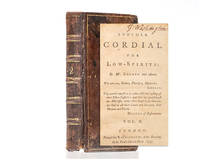
1751149416London: R. Griffiths 1751. From the library of George Washington of this compilation of political and religious essays regarding contemporary issues in Great Britain. Small octavo volume two bound in full contemporary brown calf with a gilt number two and ruling to the spine in six compartments within raised bands double gilt ruling to the front and rear panels turn-ins. From the library of George Washington with his ownership signature to the top right corner of the title page one of the earliest printed books owned by him in his youth. George Washington did not receive a classical education and never studied a foreign language beyond English. Unlike his older brothers who enjoyed more formal schooling he worked to educate himself independently frequently importing books from England to expand his knowledge. By 1783 a detailed catalog of his Mount Vernon library revealed an extensive collection that included both classical and contemporary literature as well as volumes on agriculture history and political thought. It eventually consisted of over 1200 titles countering John Adams' impression "that Washington was not a scholar is certain. That he was too illiterate unlearned unread for his station is equally past dispute." Thomas Gordon was a Scottish writer that was widely read by the American founding fathers greatly influencing their ideas of republicanism in the eighteenth century. "The bulk of the founding fathers' reading apart from history was concerned with political and legal tracts whose main focus was directed toward two subjects---liberty and property---and toward the social constitutional and legal institutions best adapted to the preservation of man's 'sacred' rights in regard to those subjects.there was little disagreement as to the indispensable 18th century writers: they are Charles Danenant John Trenchard Thomas Gordon Bolingbroke and James Burgh" Founding Fathers' Library. Gordon translated the classical authors including Tacitus Sallust and Cicero. Most notably he published Cato's Letters which were "Reprinted hundreds of times in colonial newspapers they were perhaps the most widely read source for arguments for freedom of the press and against arbitrary government power and taxation" Jacobson. The present volume contains essays such as "The True Picture of a Modern Tory" "A Vindication of the Quakers" and "The Creed of an Independent Whig." It is recorded in Lane Inventory of Washington's Library p. 490 as "an additional title not included on the original inventory". This is one of the earliest printed books from Washington's library. Based on the style of the signature it was likely signed near the time of publication when Washington was about twenty years old. The inscription’s upright and compact form featuring a shorter “s†than seen in later examples from the 1750s resembles the handwriting found in his early surveying documents though with less ornamentation than his typical ownership marks. After traveling to Barbados with his brother Lawrence in 1751 Washington assumed management of Mount Vernon following Lawrence’s death from tuberculosis in 1752. It is therefore probable that this book was among the first to enter his library at his newly inherited estate. In his will George Washington bequeathed his library to his nephew Bushrod Washington. The library remained largely intact at Mount Vernon which Bushrod also inherited until his own death in 1829 when it was divided between two of his nephews George Corbin Washington and John Augustine Washington. In 1848 George Corbin Washington sold some 350 books and 450 unbound pamphlets from his portion of the library to Henry Stevens who eventually placed it in the Boston Athenaeum where it remains today as the largest single collection of Washington's books. The part of the library that descended to John Augustine Washington was dispersed at various auction sales between 1876 and 1891 and the present volume has been traced to the 1876 sale of Washingtoniana. In very good condition. Housed in a maroon morocco solander case inside a full morocco clamshell box. As Commander-in-Chief of the Continental Army from 1775 to 1783 George Washington played a critical role in shaping the military and political outcomes of the American Revolutionary War. His leadership was marked not by tactical brilliance alone but by strategic endurance organizational discipline and an acute understanding of the symbolic and practical dimensions of command. Faced with chronic shortages of manpower supplies and financial support Washington focused on sustaining the army through long periods of adversity most notably during the winter encampment at Valley Forge. He emphasized professionalization working closely with figures like Baron von Steuben to impose standardized training and drill procedures. Washington’s decision to engage in a war of attrition rather than direct confrontation with the superior British forces reflected a broader political strategy aimed at maintaining colonial unity and prolonging resistance until foreign aid—particularly from France—could be secured. His leadership during the culminating siege of Yorktown in 1781 conducted in coordination with French forces marked a decisive turning point and demonstrated his ability to integrate diplomatic logistical and military considerations into a coherent wartime strategy. R. Griffiths hardcover
1769147283London: Printed for David Henry; and sold by Francis Newbery at the Corner of St. Paul's Church-Yard 1769. First complete edition of "the most important scientific book of eighteenth-century America" PMM inscribed by Benjamin Franklin to prominent Pennsylvania Quaker and merchant Thomas Livezey Jr. Quarto bound in full contemporary calf with elaborate gilt tooling to the spine in six compartments within raised gilt bands morocco spine label lettered in gilt gilt turn-ins. Illustrated with 7 copper-engraved plates 2 of which are folding. Presentation copy inscribed by Benjamin Franklin on the front free endpaper “To Mr. Livesy sic From his obliged Friend & humble Servant The Author.†With Thomas Livezey's ownership signature to the second free endpaper "Thomas Livezey Junior 1810." The recipient Thomas Livezey Jr. 1723-1790 was a member of the fourth generation of the prominent Pennsylvania Quaker Livezey family. His ancestor Thomas Livezey the elder 1627-1691 was among the earliest settlers of Pennsylvania; his land was a portion of William Penn's Pennsylvania colony and was granted to him directly by Penn in an early patent. Thomas Livezey Jr. established one of the largest flour mills in colonial British North America the Livezey Mill and rose to prominence as one of the major suppliers of high quality flour to the world during that era. Situated on Wissahickon Creek in Philadelphia the Livezey Mill was a major colonial operation provided flour both domestically and overseas and fed numerous armies throughout the eighteenth century including those fighting on both sides of the American Revolution. The mill was in continued operation for more than one hundred twenty-ï¬ve years until roughly 1874. Livezey was elected to the colony of Pennsylvania's legislative body the Pennsylvania Assembly in 1765. BenjamÃn Franklin had been elected to the Pennsylvania Assembly 14 years earlier in 1751 and in 1764 one year prior to Livezey's appointment Franklin was sent to London by the Pennsylvania Assembly as a colonial agent to protest against the political influence of the Penn family with whom the assembly was becoming increasingly frustrated. He remained there for five years striving to end the Penn family's prerogative to overturn legislation from the elected Assembly and their exemption from paying taxes on their land. His lack of influential allies in Whitehall led to the failure of this mission. Franklin and Livezey were warm acquaintances despite their differences. In late 1767 Livezey sent a case of wine he had made from wild grapes to Franklin in London writing “I heartely wish it may arive Safe and warm the hearts of Every one who tastes it with a Love for America. And would it Contribute towards bringing about a Change of Government but one month Sooner I would Gladly Send all I have.†In early 1768 Franklin thanked Livezey in a letter stating that he “shall apply this parcel as I did the last towards winning the hearts of the Friends of our Country and wellwishers to the Change of its Government.†PMM 199; Grolier 100 American Books 10; Dibner Heralds of Science 57. Presentation copies of this first collected edition are scarce. This is the only presentation copy to a known recipient to appear on the market over the course of the past century. In very good condition. Housed in custom three quarter morocco clamshell box. “Franklin’s most important scientific publication†Experiments and Observations contains detailed accounts of the founding father’s crucial kite and key experiment his work with Leiden jars lightning rods and charged clouds Norman 830. “The most dramatic result of Franklin’s researches was the proof that lightning is really an electrical phenomenon. Others had made such a suggestion before him— even Newton himself— but it was he who provided the experimental proof†PMM. “The lightning experiments caused Franklin’s name to become known throughout Europe to the public at large and not merely to men of science. Joseph Priestley in his History of Electricity characterized the experimental discovery that the lightning discharge is an electrical phenomenon as ‘the greatest perhaps since the time of Isaac Newton… Franklin’s achievement… marked the coming of age of electrical science and the full acceptance of the new field of specialization†DSB. Franklin’s theory encompassed static electricity lightning and stored charge paving the way for countless theoretical and technological innovations. Immanuel Kant referred to Franklin as the “new Prometheus†for he managed to steal the fire of heaven. The work brought Franklin international renown. He became the first American elected to membership in the Royal Society and he was awarded the Copley Medal the highest scientific honor of the day. Franklin edited the collected edition of his Experiments and Observations himself revising the text adding a number of his own philosophical letters and papers and publishing the complete notes on all of his experiments. Printed for David Henry; and sold by Francis Newbery, at the Corner of St. Paul's Church-Yard unknown
biblio19<p>Published in c. 1941 in Tientsin China. A photo commemorative album for <strong>B.M.I.C.C.N. </strong>Bataillon Mixte d'Infanterie Coloniale de Chine du Nord . Inscribed and signed by someone as showed. Printed photos all the album describing every aspect of the <strong>B.M.I.C.C.N. Captions in French.</strong></p><p><strong>Extremely rare. No OCLC/worldcat record. No record in any Library or in Google etc. Extremely probably the only one in the world considering the Japanese's occupying the </strong>French Concession at almost the same time of the printing time of this book<strong>.</strong></p><p>Because there is pictures limit for each item I list the other supplement pictures of this <strong>B.M.I.C.C.N. </strong>book in the following link:</p><p>https://www.biblio.com/book/other-supplement-pictures-bmiccn-photo-commemorative/d/1042741439</p> TIENTSIN paperback
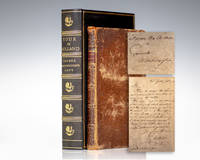
1790143919Printed at Worcester Massachusetts: Isaiah Thomas 1790. First edition presentation copy of a scarce volume from George Washington's library at Mount Vernon. Octavo bound in full contemporary sheep with pine gilt in six compartments within raised bands burgundy morocco spine label lettered in gilt type-ornament title-page vignette head and tailpieces. Presentation copy inscribed by the author to George Washington on the front pastedown "From the Author to General Washington" and further inscribed on the front free endpaper "New York Feb. 1798. Sir Please to accept this small production which has stole its way into the world. If it can beguile one moment of that anxiety which doubtless pervades your paternal mind in the present crisis of our affairs or will create a smile or amuse you for a single evening I shall put myself doubly compensated and am with profound respect & gratitude. Your fellow Citizen E. Watson." Elkanah Watson began his professional career working for businessman John Brown in Providence and during the American Revolution he represented the firm in Nantes. After the war he opened his own mercantile firm in London with fellow Freemason François Cossoul. In early 1782 the firm proposed to send to General Washington—likewise a Freemason—"elegant Masonic ornaments" in honor of his "glorious efforts in support of American liberty" Papers 23 January 1782; Early Access Document. Washington later graciously thanked his "Brothers": "The Masonick Ornamts which accompanied your Brotherly Address of the 23d of Jany last tho’ elegant in themselves were rendered more valuable by the flattering sentiments and affectionate manner in which they were presented. If my endeavours to avert the Evil with which this Country was threatned by a deliberate plan of Tyranny should be crowned with the success that is wished—the praise is due to the Grand Architect of the Universe; who did not see fit to suffer his superstructures and Justice to be subjected to the Ambition of the Princes of this World or to the rod of oppression in the hands of any power upon Earth" Papers 10 August 1782; Early Access Document. In January 1785 after returning to America from London Watson visited Mount Vernon delivering to George Washington a group of books from Granville Sharp as well as several letters from mutual acquaintances in London. Watson later wrote of the visit in his Men and Times of the Revolution: "I had feasted my imagination for several days of the near prospect of a visit to Mt. Vernon the seat of Washington. No pilgrim had ever approached Mecca with deeper enthusiasm. … I found him at table with Mrs. Washington and his private family and was received in the native dignity and with that urbanity so peculiarly combined in the character of a soldier and eminent private gentleman. He soon put me at ease by unbending in a free and affable conversation. … I found him kind and benignant in the domestic circle revered and beloved by all around him; agreeably social without ostentation; delighting in anecdote and adventures without assumption; his domestic arrangements harmonious and systematic. His servants seemed to watch his eye and to anticipate his every wish; hence a look was equivalent to a command. His servant Billy the faithful companion of his military career was always at his side. Smiling content animated and beamed on every countenance in his presence." Watson was particularly taken that Washington himself carried an evening cup of tea to his room. In 1789 Watson settled in Albany investing in land becoming an important advocate for canals in close association with Philip Schuyler and helping to found the Bank of Albany. In 1790 he had privately printed anonymously his Tour in Holland an epistolary account of his visit to the country in may and June 1784 including his time spent there in company with John Adams. In a 26 December 1790 letter to Adams Watson comments on the publication of Tour in Holland: "The present edition of the little performance I sent you consists of only 350 copies most of which have run off beyond my expectations." Besides Adams and Washington Watson also presented a copy to Thomas Jefferson Sowerby 3872. A few copies must have remained however because it was not until Washington’s term as president was nearly completed that Watson sent the volume to him: "I take the liberty to transmit to you by Mr Van Renssalaer my Short Tour in Holland in 1784 the year previous to my visit to your hospitable mansion. Shou’d it beguile a few moments from the weighty concerns of our new born Nation in the solemn crisis in which we are now involved it will be grateful to me" Papers of George Washington Presidential Series ed. Garbooshian-Huggins 21: 677–680. "Mr Van Renssalaer" is likely Jeremiah Van Rensselaer a friend of Watson’s who represented New York in the U.S. House of Representatives from 1789 to 1790. He was a member of the board of directors and later president of the Bank of Albany which Watson helped to organized. In 1791 the two men toured of central New York together to "scrutinize the opinions on the subject of inland navigation" Men and Times of the Revolution 335–36. In his will George Washington bequeathed his "library of Books and Pamphlets of every kind" to his nephew Bushrod Washington. The library remained largely intact at Mount Vernon which Bushrod also inherited until his own death 1829 when it was divided between two of his nephews George Corbin Washington and John Augustine Washington. In 1848 George Corbin Washington sold some 350 books and 450 unbound pamphlets from his portion of the library to Henry Stevens who eventually placed it in the Boston Athenaeum where it remains today as the largest single collection of Washington’s books. The part of the library descended to John Augustine Washington was dispersed at various auction sales between 1876 and 1891. Evans 23039; ESTC W28335; Sabin 102136 In very good condition. Housed in a custom full morocco clamshell box. Isaiah Thomas hardcover
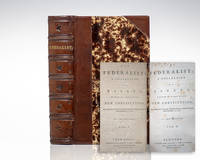
1788125980New York: Printed and Sold by J. and A. McLean 1788. First edition of The Federalist one of the rarest and most significant books in American political history which "exerted a powerful influence in procuring the adoption of the Federal Constitution." 12 mo two volumes bound in one bound in full contemporary calf rebacked preserving most of original gilt-ruled spine with red morocco label. In very good condition. Housed in a custom half morocco clamshell box. An exceptional example of this landmark book. When Alexander Hamilton invited his fellow New Yorker John Jay and James Madison a Virginian to join him in writing the series of essays published as The Federalist it was to meet the immediate need of convincing the reluctant New York State electorate of the necessity of ratifying the newly proposed Constitution of the United States. The 85 essays under the pseudonym 'Publius' were designed as political propaganda not as a treatise of political philosophy. In spite of this The Federalist survives as one of the new nation's most important contributions to the theory of government" PMM 234. The Federalist "exerted a powerful influence in procuring the adoption of the Federal Constitution not only in New York but in the other states. There is probably no work in so small a compass that contains so much valuable political information. The true principles of a republican form of government are here unfolded with great clearness and simplicity" Church 1230. "A generation passed before it was recognized that these essays by the principal author of the Constitution and its brilliant advocate were the most authoritative interpretation of the Constitution as drafted by the Convention of 1787. As a commentary and exposition of the Constitution the influence of the Federalist has been profound" Grolier American 100 56. Of the only 500 copies published Hamilton is said to have sent nearly 50 copies to Virginia for the ratifying convention. The remaining 450 copies sold poorly and "the publishers complained in October 1788 long after New York had ratified the Constitution that they still had several hundred unsold copies" Maggs 815. Printed and Sold by J. and A. McLean unknown books
1788143916New York: Printed and Sold by J. and A. McLean 1788. First edition of The Federalist one of the rarest and most significant books in American political history. 12mo two volumes bound into one in half calf over marbled boards with raised bands gilt titles to the spine. In very good condition with light toning to the pages. Text blocks trimmed. Housed in a custom half morocco clamshell and chemise box. An exceptional example of this cornerstone of Americana. The significance of The Federalist has been recognized for more than 200 years George Washington wrote "The Federalist will merit the notice of posterity; because in it are candidly and ably discussed the principles of freedom and the topics of government which will always be interesting to mankind so long as they shall be connected in Civil Society." “When Alexander Hamilton invited his fellow New Yorker John Jay and James Madison a Virginian to join him in writing the series of essays published as The Federalist it was to meet the immediate need of convincing the reluctant New York State electorate of the necessity of ratifying the newly proposed Constitution of the United States. The 85 essays under the pseudonym ‘Publius’ were designed as political propaganda not as a treatise of political philosophy. In spite of this The Federalist survives as one of the new nation’s most important contributions to the theory of government†PMM 234. The Federalist “exerted a powerful influence in procuring the adoption of the Federal Constitution not only in New York but in the other states. There is probably no work in so small a compass that contains so much valuable political information. The true principles of a republican form of government are here unfolded with great clearness and simplicity†Church 1230. “A generation passed before it was recognized that these essays by the principal author of the Constitution and its brilliant advocate were the most authoritative interpretation of the Constitution as drafted by the Convention of 1787. As a commentary and exposition of the Constitution the influence of the Federalist has been profound†Grolier American 100 56. "Of the only 500 copies published Hamilton is said to have sent nearly 50 copies to Virginia for the ratifying convention. The remaining 450 copies sold poorly and “the publishers complained in October 1788 long after New York had ratified the Constitution that they still had several hundred unsold copies†Maggs 815. Printed and Sold by J. and A. McLean hardcover
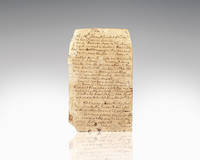
1762142654Mount Vernon March 1762. Autograph manuscript being George Washington's diary entries for a portion of March 1762 detailing the fruit grafts that he has accomplished. 2 pages 5 14/16 x 3 10/16 inches irregular on a leaf of laid paper Mount Vernon March 1762; browned left margin of recto waterstained and abraded causing a loss of text in most lines small abrasion at center of recto obscuring three words. Accompanied by an autograph note signed by James Kirke Paulding: "Memorandum in the hand of Washington taken from an old almanac for 1762 in the possession of JK Paulding." A rare Washington relic: perhaps the only leaf from Washington's diary in private hands. According to the Washington Papers these two pages were initially a blank leaf interleaved in a printed almanac that a Mrs. J. Washington gave to novelist and Secretary of the Navy James Kirke Paulding. The balance of the diary thirteen pages written on interleaved blanks in the Virginia Almanack for the Year of our Lord God 1762 was sold at Sotheby's Parke Bernet 6 December 1977 lot 35. The identifying note by Paulding accompanying the present leaf indicates that it was him who separated this leaf from the diary. Donald Jackson and Dorothy Twohig editors of The Diaries of George Washington state that the entry for 24 March 1762 was transferred from a dated memorandum on the back cover of the diary—the present leaf provides the actual entry for that day. Paulding served in the Van Buren administration as Secretary of the Navy between 1838 and 1841; it is most likely that is when the diary passed into his hands. Mrs. J. Washington is most likely Jane Charlotte Blackburn Washington 1786–1855 wife of John Augustine Washington 1789–1832. John Augustine a nephew of Bushrod Washington inherited Mount Vernon from Bushrod Washington who died without issue. Jackson and Twohig tabulate the location of all known diaries and diary fragments of George Washington. The great majority of these are in the Library of Congress with other examples in the Public Records Office London the Historical Society of Pennsylvania the Detroit Public Library the Virginia Historical Society Columbia University and Mount Vernon. Writing to a commission of the Mount Vernon Ladies' Association in 1924 John C. Fitzpatrick exclaimed: "Now that I have read every word of these Diaries from the earliest to the last one it is impossible to consider them in any light than that of a marvelous record. It is impossible for anyone to arrive at a true understanding or comprehension of George Washington without reading his diary record" Diaries of George Washington 1:xix. Washington kept no daily records until 1760; even then his keeping of diaries was erratic until 1768. His preference was to record his entries on blank pages interleaved in the Virginia Almanack; after the war he adopted blank memorandum books. But by 1795 he returned to the Almanack. Washington's biographer John Marshall and editor Jared Sparks together with Washington's nephew Bushrod carelessly dispensed his papers as souvenirs. The 1797 diary was given to Christopher Hughes who broke it up and dispersed it among friends in America and Europe. Margaret and Robert Adams of Philadelphia were the recipients of the diaries of 1795 and 1798. The whereabouts of these diaries is presently unknown as is the remainder of the Paulding diary of 1762. The entry for March 1762 is the first spring in which Washington was full owner of Mount Vernon. Since 1754 Washington had been leasing the life rights to the estate from the widow of his half brother Lawrence. The plantation became his by right of inheritance when Anne Fairfax Washington died 14 March 1761 with no surviving heirs. By March of 1762 Washington was busy grafting trees in his fruit garden: "18th. Transplanted 5 Cata … ye Birch by Quarter. Several Damson trees to the Peach Orchard. And a Bullock Heart Cherry tree from Colo. Mason's in the corner of the garden near the Spanish Chestnut." Washington has also grafted "four Apricots on Peach. Six taken just from the Nursery & transplanted into the corners adjoining the lower walk of the garden. Note the scions were cut a fortnight or three weeks ago and burried but the Bud … very much." Scion wood is vigorous growth trimmed from desirable trees in late winter for early spring grafting. Washington apparently cut the scions in February and then stored them carefully until he was ready to begin grafting in March. Typically grafting commences in April but as Virginia enjoys a relatively mild climate it could begin in March. In another entry Washington has "grafted two very early May Cherrys from Colo. Masons remarkably large and fine upon wild cherry stock standing in the middle of these Bordr." Washington also planted and grafted a number of varieties of pears plums and apples. "in the third row black Pear of —cester. Very good for baking. In the fourth row 5 Spanish pears wch are very fine. They hang till November and keep thro the winter as well as apples. Note. All these grafts from Colo. Masons." Varieties of cherries mentioned in the diary originated from England. Washington grafts the Bullock cherry or Ox Heart a dark red cherry with large heart-shaped fruit which ripens in July although Washington states May. The Carnation cherry also mentioned in a graft is a large light red cherry used for making brandy and preserves. The magnum bonum plum also known as the egg plum bears fruit that is white and yellow. The generous Colonel Mason is his neighbor George Mason whose plantation Gunston Hall was located sixteen miles south of Alexandria. Washington and Mason were both enthusiastic farmers and the two frequently exchanged thoughts on agriculture as well as on politics. Washington's diary indicates that his fruit trees were organized in four quadrants: north east north west south west and south east. There were up to nine rows of trees in the quadrants with numerous cross walks. The Diaries of George Washington 1:316 provides an illustration of a contemporary quadrant-style arrangement of an orchard from Batty Langley's New Principles of Gardening London 1728 which would have been familiar to Washington. Prior to his presidency Washington was by occupation a planter and he imported luxuries and other goods from England paying for them by exporting tobacco. In 1765 because of erosion and other soil problems he changed Mount Vernon’s primary cash crop from tobacco to wheat and expanded operations to include corn flour milling and fishing. His success in these new endeavors led him to soon be counted among the political and social elite in Virginia. From 1768 to 1775 he invited some 2000 guests to his Mount Vernon estate mostly those whom he considered people of rank. Following the conclusion of the Revolutionary War Washington returned to Mount Vernon where he oversaw the completion of the remodeling work at Mount Vernon which transformed his residence into the mansion that survives to this day although his financial situation was not strong. Creditors paid him in depreciated wartime currency and he owed significant amounts in taxes and wages. Mount Vernon had made no profit during his absence and he saw persistently poor crop yields due to pestilence and poor weather. Again Washington diversified by undertaking a new landscaping plan and succeeded in cultivating a range of fast-growing trees and shrubs that were native to North America. unknown
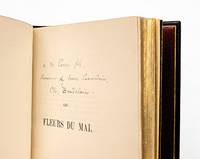
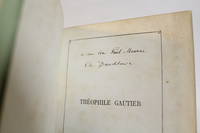
185765388Paris: Poulet Malassis & De Broise 1857. Fine. Exceptional copy inscribed by Charles Baudelaire Poulet Malassis & De Broise Paris 1857 12.10 x 18.80 cm relié sous étui First edition printed on vélin d'Angoulême paper with the usual misprints and including the six condemned poems one of the few copies given to the author and intended for friends who do not deliver literary services. Full emerald morocco binding signed by Marius Michel original wrappers preserved. Precious presentation copy inscribed and signed by the author in pencil on the half-title page: à M. Tenré fils souvenir de bonne camaraderie Ch. Baudelaire to M. Tenré Jnr a reminder of good friendship Ch. Baudelaire and three handwritten corrections in pencil on pages 29 and 110 and in ink on page 43. Exceptional inscription to a childhood friend banker and intellectual one of the rare contemporary inscriptions that were not motivated by judicial necessity or editorial interests. Indeed even the few examples on papier hollande were largely devoted to strategic gifts in order to counter or reduce the wrath of justice that in June 1857 had not yet returned its decision. Poulet-Malassis will hold a bitter memory of it: Baudelaire got his hands on all thick paper copies and addressed them to more or less influential people as a means of corruption. Since they have not got him out of trouble I believe he would do well to ask for them back. Baudelaire's correspondence makes it possible to define quite precisely the different types of inscriptions the poet made on the publication of his collection. He himself sent a list to de Broise to mention those to whom the press deliveries were dedicated mainly possible judicial intercessors and influential literary critics. The poet then requires twenty-five copies on ordinary paper intended for friends who do not deliver literary services. A letter to his mother tells us that he only got twenty. Some of them were sent in June 1857 to his friends including one for Louis-Ludovic Tenré. Others were saved by the poet or offered late like the ones for Achille Bourdilliat and Jules de Saint-Félix. If Tenré this childhood friend whom Baudelaire has just found again in December 1856 is honored with one of the poet's rare personal copies of the Fleurs du mal publication the three misprints he immediately noticed having been carefully corrected by hand it is not on account of a service delivered or in anticipation of an immediate benefit. However as always with Baudelaire neither did he send his masterpiece to his boarding companion from Louis-le-Grand school as a simple reminder of good friendship. As early as 1848 Louis-Ludovic Tenré took over from his father the publisher Louis Tenré who like other major publishers moved into investment providing loans and discounts exclusively for those in the book industry. These bookseller-bankers played a key role in the fragile publishing economy and contributed to the extreme diversity of literary production in the nineteenth century supporting the activities of small but bold publishers and liquidating other major judicial clashes. In December 1856 Baudelaire tells Poulet-Malassis that he had deposited an expired banknote with this old school mate which Tenré out of friendship agreed to accept. It was the initial advance for the printing of one thousand copies of a collection of verses entitled Les Fleurs du Mal. With this copy hot off the presses Baudelaire then offers Tenré the precious result of the work discounted by his new banker. It is the beginning of a long financial relationship. Amongst all of Baudelaire's discounters Louis-Ludovic Tenré will be the poet's favorite and the only one to whom an autographed work will be sent. Nicolas Stokopf in his work Les Patrons du Second Empire banquiers et financiers parisiens dedicates a chapter to Louis-Ludovic Tenré and evokes the privileged relationship between the poet and this unusual and scholarly financier Paraguay con Poulet Malassis & De Broise unknown
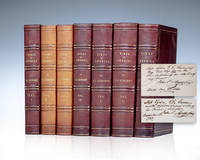
1840143567New York: Published by J. J. Audubon. Philadelphia: J. B. Chevalier 1840-1844. First octavo edition of Audubon's landmark work; one of the most spectacular collections of ornithological prints ever produced. Royal octavo 7 volumes bound in full 19th-century morocco by P. Low of Boston with their ticket gilt titles and ruling to the spine in six compartments within raised gilt bands gilt ruling to the front and rear panels gilt turn-ins marbled endpapers ribbons bound in. Illustrated with 500 hand-colored lithographed plates after Audubon by W. E. Hitchcock R. Trembly and others printed and colored by J. T. Bowen wood-engraved anatomical diagrams in text. Presentation copy inscribed by John James Audubon on the on the contents leaf of volume one "Miss Lydia E. E. Greene with the affectionate good wishes of her friend and servant John J. Audubon Boston June 8 1844" and additionally on the front free endpaper of Vol. II. "Miss Lydia E. E. Greene; and may God bless her with the sincerest wishes of her old friend and servant John J. Audubon Boston June 8 1844." The recipient Lydia E. E. Greene became a Proprietor of the Boston Athenaeum in 1854.  Audubon spent only a few months living in Boston from 1832-1833 but the city made an impact on him; his wife Lucy wrote to  a friend that the city “is a more interesting place than any I have seen in the United States and where we met with a most cordial welcome and obtained eight subscribers to our work The Birds of America.â€Â Audubon exhibited sketches of his Birds of America at the Boston Athenaeum in August 1832. In very good condition with the plates exceptionally clean. Audubon’s double-elephant folio edition of The Birds of America 1827-1838 established his reputation as the greatest ornithological artist of his time. Though that edition was published in London to ensure the quality of the plates he employed the Philadelphia firm of J. T. Bowen to produce this more commercially viable edition under the close supervision of his sons. The original subscription price was $100 and its commercial success granted Audubon financial security. To the original plate count included in the double-elephant folio edition the octavo edition adds 65 new images for a total of 500 plates making it "the most extensive color plate book produced in America up to that time" Reese. "The most splendid book ever produced in relation to America and certainly one of the finest ornithological works ever printed… Audubon insisted on drawing from life never from stuffed specimens and was much in advance of his time in portraying the birds in many cases unrecorded species in their natural surroundings… The courage and faith of the Audubon family is breathtaking… This immense undertaking this unparalleled achievement was not the production of a great and long-established publishing house nor was it backed by a wealthy institution. It was the work of a man of relentless energy with no private fortune… It is a story without equal in the whole history of publishing†Great Books and Book Collectors 210-13. Nissen IVB 51; Reese 34; Sabin 2364 Published by J. J. Audubon. Philadelphia: J. B. Chevalier unknown
1885145720New York: Charles L. Webster & Company 1885-86. Exceedingly rare first edition of the autobiography of Ulysses S. Grant the 18th President of the United States which focusing mainly on his military career during the Mexican War and the Civil War entirely singular owned and annotated by Grant's close friend and most esteemed general: William Tecumseh Sherman. Octavo 2 volumes bound in the original full deluxe tree calf with gilt titles and elegant tooling to the spine gilt ruled borders to the front and rear panels gilt inner dentelles all edges gilt engraved portrait frontispieces illustrated with numerous facsimile letters 2 folding maps and wood engravings. William Tecumseh Sherman evidently read thes volumes in great detail making marginal notes on at least 18 pages in Vol. I several of them signed with his initials. On the last page of Vol. I Sherman wrote: "Read at St. Louis Mo. Dec 5 6 1885. This account of the Civil War is wonderfully accurate and him. W.T.S." Many of the notes are small corrections and additions by Sherman. On a passage regarding the Yazoo Pass Expedition on page 435 of Vol. I Sherman pointedly writes: "This conforms literally to my memoirs on the point most contested by Grant's pretended friends. W.T.S." He provides further thoughts regarding political interference on the next page: "If Grant had gone ahead living off the country we would have been inside of Vicksburg by Christmas 1862 the distance from Grenada to Vicksburg is little more than the circuit we afterward made from Bruinsberg via Jackson to Vicksburg --- This was my understanding when we parted at Oxford and the intervening country was better supplied with hay hominy. W.T.S." On p. 440-441 Grant wrote about the need to assign politically-connected John McClernand as Corps Commander: "I would have been glad to put Sherman in command to give him an opportunity to accomplish what he had failed in the December before; but there seemed no other way out of he difficulty for he was junior to McClernand. Sherman's failure needs no apology." In the margins Sherman's distinctive hand writes passionately: "because it was no failure at all." There is only one marginal annotation in Vol. II; however an autograph note is laid in at p. 123 supplying Sherman's recollection of Grant's first meeting with Lincoln which corroborates Grant's account. While Sherman was not present at the meeting between Grant and Lincoln he almost certainly heard about what transpired from Grant himself. The note reads in full: "Grants Memoirs Vol 2 Page 123 A good story is very correct. 'Si non vero ben trovalo.' Even if it is not true it is well conceived. This is the conversation between Genl. Grant President Lincoln and Secretary of War Stanton at the time he was addressed to command all the Armies of the U.S. Grant said in his usual quiet manner 'Mr. Lincoln I am told that several well planned campaigns in Virginia have been marred by interference from Washington viz from the Secretary of War or the President now if I am to command I must insist that no military order be issued to any detachment or part of the Army except through me' Mr. Lincoln in his inimitable way turning to Stanton said 'Stanton you and I have been running this machine for two years and have not made a brilliant success. I guess we had better trust this little man' Grant and then then and there the promise was made. And it is to the credit of Mr. Lincoln to say that he kept his word literally never interfering or making any order even when Washington was in real peril from Early's Army in 1865." Grant's insistence that there would be no political interference was likely particularly important to General Sherman who famously hated politicians. In good condition with detaching of the front boards and spines of each volume detaching of the rear board and separation of the folding facsimile letter at p. 312-313. Copies bound in highly polished gilt tree calf are extremely rare with only three other copies known. The first prospectus of Grant's Memoirs listed only 4 bindings: fine cloth full sheep fine half morocco and full Turkey morocco. The only other copy of Grant's Memoirs bound in tree calf was sold at auction - a copy presented to Mark Twain by Julia Grant and inscribed by both. Only two other known copies are located in private collections. To date no copies bound in the tree calf have been traced to institutional collections. As Grant died before publication was complete the only copy that he saw before his death was a prospectus bound in cloth; the extant tree calf copies suggest that the binding was perhaps reserved exclusively for presentations made by Julia Grant. Even the copies presented by publisher Mark Twain to his friends and colleagues were bound in one of the other available bindings. Though this copy bears no presentation inscription by Julia Grant Mark Twain or anyone else it is plausible that one of these figures would have sent the copy directly to General Sherman. After his second presidential term and world tour President Grant was stripped of nearly all of his life's earnings by conman Ferdinand Ward. Grant had forfeited his and his widow's military pension when he resigned as general to assume the presidency and his recent throat cancer diagnosis brought him deep concern about how his wife and family would manage financially after his death. In this moment of crisis Sherman rushed to Grant's aid and assisted him in restructuring his debt ensuring that Grant was able to keep his most prized possesions. Most importantly Sherman also encouraged Grant to do what he should have done years ago - write his memoirs. By June 1884 Grant had begun publishing articles on his major engagements of the Civil War for 'Century Magazine' which paid him $500 for each submission. The articles were received with great enthusiasm and Grant met with the magazine's representatives in early September to arrange for the publication of his memoirs. However when Samuel Clemens popularly Mark Twain learned of the potential arrangement with 'Century Magazine' he convinced Grant to sign with his own subscription publishing company which was able to offer Grant 70% of the net profit made from the sale of his memoirs. This rate was exorbitantly higher than what 'Century Magazine' had proposed. Grant began writing his memoirs in earnest racing against the illness to finish and ensure his family's financial stability. During this time Grant welcomed Sherman's repeated visits. On December 24 1884 Sherman wrote to his wife Ellen: "Grant says my visits have done him more good than all the doctors" Flood p.395. Grant with the moral support of Sherman lived to finish the memoir dying five days after its completion. Widely considered the finest military narrative ever published the memoirs were a national bestseller and Grant's widow Julia would eventually receive nearly $450000 about ~$14000000 today in royalties from their sale. Charles L. Webster & Company hardcover
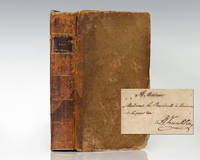
1783138381Paris: D. Pierres/Pissot Pere & Fils Libraries 1783. First French edition of the Constitution of the United States of America inscribed by Founding Father Benjamin Franklin who had the translation published and personally distributed each of the 600 copies produced. Octavo bound in one quarter calf with gilt ruling to the spine burgundy morocco spine label lettered in gilt. Presentation copy inscribed by Benjamin Franklin on the front free endpaper "A Madame Madame la Presidente de Manieres sic de la parte du. B. Franklin." The recipient Madame Durey de Meinires was a a French writer best known for her translations of Samuel Johnson David Hume and Sarah Fielding. On March 24th 1783 Franklin wrote to the Comte de Vergennes "I am desirous of printing a translation of the Constitutions of the United States of America published at Philadelphia by Order of Congress. Several of these Constitutions have already appeared in the English and American newspapers but there has never yet been a complete translation of them." At Franklin's suggestion the Duc de La Rochefoucault produced the first French translation and Franklin is believed to have contributed the fifty-plus footnotes. Franklin had 600 copies of Constitutions des Treize Etats-Unis de l'Amerique privately printed by Philippe-Denis Pierres first printer ordinary of Louis XVI which were not made available for sale. Franklin distributed them himself and was happy to fulfill the request of Madame Durey de Meinires who wished to receive a copy. On August 31 1783 Franklin sent a copy of the newly published volume to Madame Durey de Meinires along with a letter "I send with great Pleasure the Constitutions of America to my dear & much respected Neighbour being happy to have any thing in my Power to give that she will do me the honour to accept and that may be agreeable to her." The inscribed page included in the present volume was previously sold as a loose flyleaf by Charles Hamilton in 1959 and it has since been professionally tipped into an edition of the book with which it was originally sent. The book contains the Constitutions of each of the thirteen States of America the Declaration of Independence of the 4th of July 1776 the Friendship and Commerce Treaty the Alliance Treaty between France and the United States as well as the treaties between the United States and the Netherlands and Sweden. The title page contains the first appearance of imprint of the United States seal in a book. Franklin's grand gesture in publishing and distributing these constitutions‚ about which there was intense interest and curiosity among statesmen‚ was one of his chief achievements as a propagandist for the new American republic. In good condition. Benjamin Franklin earned the title of "The First American" for his early and indefatigable campaigning for colonial unity initially as an author and spokesman in London for several colonies. As the first United States Ambassador to France he exemplified the emerging American nation. Franklin’s contributions to science and politics were immense and his passion for making books more available to a broader audience prompted him to establish North America’s first subscription library. In 1731 Franklin convinced the members of his Junto a mutual improvement club he founded to pool their money to purchase books they would collectively share. The collection became the Library Company of Philadelphia and is now regarded as the predecessor to the public library. Franklin was also instrumental in the establishment of the Library of the Pennsylvania Hospital North America’s first medical library the Pennsylvania State Library The Library of the American Philosophical Society and the Library of the University of Pennsylvania. D. Pierres/Pissot, Pere & Fils, Libraries unknown
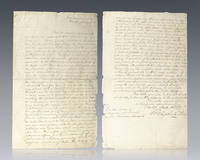
1781125872April 10 1781. Exceptionally rare autograph letter signed by George Washington as Commander-in-Chief of the Continental Army to French ally Jean-Baptiste Donatien de Vimeur comte de Rochambeau whose military assistance in the Siege of Yorktown essentially ended the Revolutionary War. The body of the letter is entirely in the hand of Alexander Hamilton and dated 10 April 1781. In the spring of 1781 officials from Massachusetts approached Rochambeau with a proposal to attack the British post at the mouth of the Penobscot river which had been established in June 1779 to secure timber for shipyards in Halifax and to protect Nova Scotia from any American advance. On April 6 Rochambeau informed Washington that he was willing to send a detachment of troops and that Admiral Destouches would offer naval assistance but observing that he was under Washington's command he would await his approval before approving the action Rochambeau to Washington 6 April 1781 Papers of George Washington Library of Congress. Washington here responds offering his gratitude that Destouches who had only recently lost a naval engagement with the British in an unsuccessful attempt to relieve Lafayette in Virginia would be willing "to undertake the expedition to Penobscot and to you for your readiness to furnish a detachment of troops for the same purpose. The object is certainly worth attention and if it can be effected will be very agreeable to the States particularly to those of the East." He trusts that Destouches "can best judge from the situation of the enemy's fleet how far it may be attempted with prudence and Your Excellency from the information you have recently received what number of troops will be sufficient for the enterprise--I am persuaded it will be calculated how far it is probable the enemy may follow with a part of their fleet--whether the post can be carried by a coup de main or may require so much time as to make it likely the operation will be interrupted before its conclusion--in case of a superior squadron being sent by the enemy what possibility there is of protection or a safe retreat for the ships and even for the land force through an unsettled country in which numbers perished for want of provision in a former attempt--All these are points too important not to have been well weighed and your conversations with the Massachusetts deputies will have been able to enlighten you upon them." Here he is referencing the unsuccessful attempt by Massachusetts in 1779 to destroy the post abandoned when British ships with reinforcements forced an arduous overland retreat by the Americans. Despite his assurances that <span class="match">Rochambeau</span> and Destouches had matters well in hand <span class="match">Washington</span> took the "liberty to remark on two things--one that it appears to me frigates without any ships of the line will answer the purpose as well as with them and less will be risked than by dividing the body of the fleet. Frigates especially the forty fours will afford a safe escort to the troops against any thing now in those Seas and with respect to a detachment from the enemy's fleet it would be always proportioned to the force we should send and if we have two sixty fours they would even be an object for their whole fleet. The other observation I would make is that dispatch being essential to success it will in my opinion be adviseable not to depend on any cooperation of the Militia but to send at once such a force from your army as you deem completely adequate to a speedy reduction of the post. The country in the neighbourhood of Penobscot is too thinly inhabited to afford any resource of Militia there and to assemble and convey them from remote places would announce your design--retard your operations and give leisure to the enemy to counteract you. Indeed I would recommend for the sake of secrecy to conceal your determination from the State itself." On 15 April <span class="match">Rochambeau</span> replied to <span class="match">Washington</span> observing that while he had sufficient troops to spare "your Excellency's observations upon the Separation of our fleet and upon the danger to be interrupted by superior forces during the course of the Expedition which Mr Destouches does not Look on as possible to be undertaken with his frigates only are the motives which cause this project to be Laid aside for the present moment." <span class="match">Rochambeau</span> to <span class="match">Washington</span> 15 April 1781 Papers of George <span class="match">Washington</span> Library of Congress. Soon <span class="match">Washington</span> and <span class="match">Rochambeau</span>'s attention returned again to Virginia and within months their combined forces would be closing in on Yorktown. In near fine condition. Exceptionally rare and desirable being the only communication between the storied commanders of the Yorktown campaign to appear at auction in more than a century. In 1780 French nobleman Jean-Baptiste Donatien de Vimeur comte de Rochambeau was appointed commander of land forces as part of the project code named Expedition Particuliere. He was given the rank of Lieutenant General in command of some 7000 French troops and sent to join the Continental Army under George Washington during the American Revolutionary War. He landed at Newport Rhode Island on 10 July but was held there inactive for a year due to his reluctance to abandon the French fleet blockaded by the British in Narragansett Bay. The College in the Colony of Rhode Island and Providence Plantations now known as Brown University served as an encampment site for some of Rochambeau's troops and the College Edifice was converted into a military hospital now known as University Hall.3 In July 1781 the force left Rhode Island and marched across Connecticut to join Washington on the Hudson River in Mount Kisco New York. Washington and Rochambeau then marched their combined forces to the siege of Yorktown and the Battle of the Chesapeake. On 22 September they combined with the Marquis de Lafayette's troops and forced heavily outnumbered and trapped Lord Cornwallis to surrender on 19 October. The siege of Yorktown was a decisive victory for the American Continental Army and proved to be the last major land battle of the American Revolutionary War in the North American region as the surrender by Cornwallis and the capture of both him and his army prompted the British government to negotiate an end to the conflict and ultimately resulted in the Treaty of Paris of 1783. unknown books
1781125872April 10 1781. Highly important letter signed “Go: Washington†as Commander-in-Chief 2 pages folio “Head Quarters New Windsor April 10 1781†to his French ally Jean-Baptiste Donatien de Vimeur comte de Rochambeau the body of the letter in the hand of his trusted aide-de-camp Alexander Hamilton; horizontal fold separation repaired minor tears and chips along margins. In the spring of 1781 officials from Massachusetts approached Rochambeau with a proposal to attack the British post at the mouth of the Penobscot river— established in June 1779 to secure timber for shipyards in Halifax and to protect Nova Scotia from any American advance. On 6 April Rochambeau informed Washington he was willing to send a detachment of troops and that Admiral Destouches was willing to offer naval assistance. But observing that he was under Washington's command he would await his approval before approving the action Rochambeau to Washington 6 April 1781 Papers of George Washington Library of Congress. Washington responds in the present letter offering his gratitude. The Commander-in Chief explains that Destouches who had only recently lost a naval engagement with the British in an unsuccessful attempt to relieve Lafayette in Virginia would be willing “to undertake the expedition to Penobscot and to you for your readiness to furnish a detachment of troops for the same purpose. The object is certainly worth attention and if it can be effected will be very agreeable to the States particularly to those of the East.†He trusts that Destouches “can best judge from the situation of the enemy's fleet how far it may be attempted with prudence and Your Excellency from the information you have recently received what number of troops will be sufficient for the enterprise—I am persuaded it will be calculated how far it is probable the enemy may follow with a part of their fleet—whether the post can be carried by a coup de main or may require so much time as to make it likely the operation will be interrupted before its conclusion—in case of a superior squadron being sent by the enemy what possibility there is of protection or a safe retreat for the ships and even for the land force through an unsettled country in which numbers perished for want of provision in a former attempt—All these are points too important not to have been well weighed and your conversations with the Massachusetts deputies will have been able to enlighten you upon them." Here Washington is referencing the unsuccessful attempt by Massachusetts in 1779 to destroy the post abandoned when British ships with reinforcements forced an arduous overland retreat by the Americans. Despite his assurances that Rochambeau and Destouches have matters well in hand Washington takes the “liberty to remark on two things—one that it appears to me frigates without any ships of the line will answer the purpose as well as with them and less will be risked than by dividing the body of the fleet. Frigates especially the forty fours will afford a safe escort to the troops against any thing now in those Seas and with respect to a detachment from the enemy’s fleet it would be always proportioned to the force we should send and if we have two sixty fours they would even be an object for their whole fleet. The other observation I would make is that dispatch being essential to success it will in my opinion be adviseable not to depend on any cooperation of the Militia but to send at once such a force from your army as you deem completely adequate to a speedy reduction of the post. The country in the neighbourhood of Penobscot is too thinly inhabited to afford any resource of Militia there and to assemble and convey them from remote places would announce your design—retard your operations and give leisure to the enemy to counteract you. Indeed I would recommend for the sake of secrecy to conceal your determination from the State itself.†On 15 April Rochambeau replies to Washington observing that while he had sufficient troops to spare “your Excellency’s observations upon the Separation of our fleet and upon the danger to be interrupted by superior forces during the course of the Expedition which Mr Destouches does not Look on as possible to be undertaken with his frigates only are the motives which cause this project to be Laid aside for the present moment.†Rochambeau to Washington 15 April 1781 Papers of George Washington Library of Congress. It was not long before the attention of both Washington and Rochambeau returned again to Virginia and within months their combined forces would be closing in on Yorktown. The sole communication between the storied commanders of the Yorktown campaign to appear at auction in more than a century. Most of the letters from Washington to Rochambeau were kept by the Rochambeau family until 1952 when the collection was sold to H.P. Kraus who in turn sold them to Paul Mellon in 1958. In 1992 Mellon bequeathed the collection to Yale University and the collection is now housed at the Beinecke Library. The only other communication from Washington to Rochambeau that can be found in auction records was part of the collection of James Crimmons Anderson Galleries 5 May 1904 being Washington’s autograph letter signed of 13 July 1781 to Rochambeau for the reconnaissance in force of the British defenses around northern Manhattan. Provenance: The family of Charles-René-Dominique Sochet Destouches. In 1780 French nobleman Jean-Baptiste Donatien de Vimeur comte de Rochambeau was appointed commander of land forces as part of the project code named Expédition Particulière. He was given the rank of Lieutenant General in command of some 7000 French troops and sent to join the Continental Army under George Washington during the American Revolutionary War. He landed at Newport Rhode Island on 10 July but was held there inactive for a year due to his reluctance to abandon the French fleet blockaded by the British in Narragansett Bay. The College in the Colony of Rhode Island and Providence Plantations now known as Brown University served as an encampment site for some of Rochambeau's troops and the College Edifice was converted into a military hospital now known as University Hall.3 In July 1781 the force left Rhode Island and marched across Connecticut to join Washington on the Hudson River in Mount Kisco New York. Washington and Rochambeau then marched their combined forces to the siege of Yorktown and the Battle of the Chesapeake. On 22 September they combined with the Marquis de Lafayette's troops and forced heavily outnumbered and trapped Lord Cornwallis to surrender on 19 October. The siege of Yorktown was a decisive victory for the American Continental Army and proved to be the last major land battle of the American Revolutionary War in the North American region as the surrender by Cornwallis and the capture of both him and his army prompted the British government to negotiate an end to the conflict and ultimately resulted in the Treaty of Paris of 1783. unknown
124196Rare original Anthony Berger carte-de-visite signed by Abraham Lincoln as President; the most recognizable portrait of Lincoln which was later used as the model for the Lincoln cent. Original mounted albumen photograph double ruled in gilt with "Brady's National Photographic Portrait Galleries" stamp to the verso. Boldly signed by Abraham Lincoln "A Lincoln." With an additional inscription on the verso which reads "Contributed for the benefit of the S.A.S. of Westford Mass. at their Levee Dec. 14th 1864 by Mr. Lincoln." Through the use of many paid assistants renowned 19th century portraitist Mathew B. Brady produced thousands of photographs documenting the American Civil War including portraits of Lincoln Grant and both Union and Confederate soldiers in camps and battlefields. The body of work created by Brady's photographers including Anthony Berger Alexander Gardner and Timothy O'Sullivan has become the most important visual documentation of the Civil War. Taken on February 9 1864 by the manager of Brady's Washington studio Anthony Berger this the most recognizable portrait of the 16th president of the United States was later used by Victor David Brenner to create the Lincoln cent. During this same sitting Berger also took the photograph of Lincoln that would later appear on the five dollar bill. The present example was signed by Lincoln to help the Sanitary Association of Westford Massachusetts raise funds for Unions soldiers toward the end Civil War. An example at Heritage Auction brought 175000 in 2006. In near fine condition. An exceptional piece. Abraham Lincoln served as the 16th President of the United States from March 1861 until his assassination in April 1865. He led the United States through the American Civil War the country's greatest moral cultural constitutional and political crisis and in doing so preserved the Union of the United States of America abolished slavery and strengthened the federal government. Lincoln ran for President in 1860 sweeping the North in victory. The South was outraged by Lincoln's election and in response secessionists implemented plans to leave the Union before he took office in March 1861. War began in April 1861 when secessionist forces attacked Fort Sumter in South Carolina just over a month after Lincoln's inauguration and after years of deadly military conflict officially ended on April 9 1865 when Confederate General Robert E. Lee surrendered to Union General Ulysses S. Grant at the Battle of Appomattox Court House. On April 14 1865 just days after the war's end at Appomattox Lincoln was attending a play at Ford's Theatre with his wife Mary when he was assassinated by Confederate sympathizer John Wilkes Booth. Lincoln is remembered as the martyr hero of the United States and is consistently ranked as one of the greatest presidents in American history. unknown books
1941125419Raphael Tuck & Sons Ltd. 1941. Rare lithographic broadside signed by Franklin Delano Roosevelt as the thirty-second President of the United States and Winston S. Churchill as Prime Minster of the United Kingdom at the Atlantic Conference; one of only two known examples of this broadside specially printed at Churchill's direction and signed by both world leaders at their first wartime conference. One page the lithograph features the famed Henry Wadsworth Longfellow verse first used by FDR in a letter of support to Churchill before the United States entered the war and a galleon at sea. The letter sent the day before Roosevelt's third inauguration on January 20 1941 read in full "Dear Churchill Wendell Wilkie will give you this. He is truly helping to keep politics out over here. I think this verse applies to you people as it does to us: "Sail on Oh Ship of State! Sail on Oh Union strong and great. Humanity with all its fears With all the hope of future years Is hanging breathless on thy fate." As ever yours Franklin D. Roosevelt." "R<span class="match">o</span><span class="match">o</span>sevelt never made a m<span class="match">o</span>re graceful <span class="match">o</span>r effective gesture than that" R. Sherw<span class="match">o</span><span class="match">o</span>d R<span class="match">o</span><span class="match">o</span>sevelt and H<span class="match">o</span>pkins 234. The letter and the verse were hand-carried by Wendell Wilkie t<span class="match">o</span> L<span class="match">o</span>nd<span class="match">o</span>n and given by H<span class="match">o</span>pkins t<span class="match">o</span> the Prime Minister. Churchill desperate for American support found the letter "an inspiration" had it framed and proudly displayed it at Chartwell for many years. In early August of 1941 Churchill had this dec<span class="match">o</span>rative br<span class="match">o</span>adside printed and when he arrived in Newf<span class="match">o</span>undland f<span class="match">o</span>r the c<span class="match">o</span>nference with the President he br<span class="match">o</span>ught tw<span class="match">o</span> c<span class="match">o</span>pies t<span class="match">o</span> be signed "<span class="match">o</span>ne f<span class="match">o</span>r himself and <span class="match">o</span>ne f<span class="match">o</span>r the President" Warren F. Kimball F<span class="match">o</span>rged In War: R<span class="match">o</span><span class="match">o</span>sevelt <span class="match">Churchill</span> and the Sec<span class="match">o</span>nd W<span class="match">o</span>rld War 98. Signed by Roosevelt "Franklin D. Roosevelt" and Churchill "Winton S. Churchill." Double matted and framed. The entire piece measures 22 inches by 20.5 inches. The last known example achieved $96000 in a 2008 auction. Scarce and desirable. The historic secret Atlantic Conference was held between August 9th and 12th 1941 on a warship anchored in Placentia Bay Newfoundland. At that momentous meeting the two leaders and their military aides agreed upon critical policies for the conduct of a joint war against Germany even though the U.S. was still officially neutral and would remain so until December 8. The meetings culminated in the Atlantic Charter a declaration of principles issued a few days after the conference. Often compared to Wilson's Fourteen Points the Charter also laid the foundation for the United Nations Declaration signed by 26 nations in January 1942. Raphael Tuck & Sons, Ltd. unknown books
18091215601809. Exceptionally rare 16-page autograph letter signed by and entirely in the hand of Founding Father John Adams defending the ultimate necessity of American sovereignty and its precedence over international alliances. Sixteen pages entirely in the hand of John Adams and written on both the recto and verso of each page the letter is dated January 9 1809 and addressed to Speaker of the House of Representatives Joseph Bradley Varnum. Although France and America shared a strong alliance which proved crucial to winning the Revolutionary War at the onset of the French Revolution in 1789 Washington's fear that American involvement would weaken the new nation before it had firmly established itself created tensions and a new war between England and France broke out in 1793. The British Navy soon began targeting French vessels and trading interests across the Atlantic and although many Federalists thought that America should aid its ally Washington proclaimed that the United States would be "friendly and impartial toward the belligerent parties." The Neutrality Proclamation was ignored by Britain and angered France which then allowed its navy and privateers to prey on American trade. To protect American sailors and merchants without provoking Britain in March 1794 Congress passed a 30-day embargo which it then extended. Britain the strongest sea power began to seize American ships suspected of trading with France and stepped up its practice of impressment. From 1806-1807 the British navy in desperate need of men to oppose Napoleon forced roughly 5000 American sailors into service on the pretense that they were deserters. In 1807 King George III proclaimed his right to call any British subjects into war service and claimed that Britain had full discretion to determine who was a British citizen. The crisis reached one peak for America in June of 1807 when the HMS Leopard attacked the USS Chesapeake off the coast of Virginia. Three American sailors were killed eighteen were wounded and the Chesapeake surrendered after firing only one shot. The Leopard seized four American seaman claimed as deserters from the British navy and hanged one of them. Jefferson and Madison his Secretary of State responded with the Embargo of 1807 a ban on all American vessels sailing for foreign ports. Meanwhile Russia allied with Napoleon and pressed Denmark to turn over her fleet. In September 1807 Britain preemptively bombarded Copenhagen and seized the Danish-Norwegian fleet. While Jefferson's Republicans still generally favored France a schism grew in the Federalist party. Men like Timothy Pickering downplayed impressments while focusing on trade and access to British manufacturing. On October 16 1807 King George III aggravated already high tensions with American following the British attack of the USS Chesapeake off the coast of Virginia by issuing a Royal Proclamation expanding the British right to impressment the King's right to call any British subjects into war service and determine their citizenship. News of the King's Proclamation arrived in the United States in December 1807 and lacking military options President Jefferson proposed an embargo to ban all U.S. exports on American vessels in order to protect American sailors' lives and liberties despite its potential to cripple American trade. The Embargo Act was signed on December 22 1807 causing immediate economic devastation. In protesting the Embargo rather than wrestling with the difficulty of defending American sovereignty some opponents chose to declare the legality of impressments as defined by King George's Royal Proclamation. John Adams' former Secretary of State Timothy Pickering took a leading role in fighting the embargo arguing that Jefferson was using it to draw America closer to Napoleon's France. Given the devastating economic effects of the embargo Pickering's message found a wide audience. Adams on the other hand recognized the dire threat the King's Proclamation posed in denying America the right to determine its own rules for citizenship and in December took his arguments to Speaker of the House Joseph Varnum. As he stated in the present letter "He Pickering thinks that as every Nation has a Right to the Service of its Subjects in time of War the Proclamation of the King of Great Britain commanding his Naval Officers to practice Such Impressments on board not the Vessells of his own Subjects but of the United States a foreign Nation could not furnish the Slightest ground for an Embargo! . But I Say with Confidence that it furnished a Sufficient ground for a Declaration of War. Not the Murder of Pierce nor all the Murders on board the Chesapeake nor all the other Injuries and Insults We have received from foreign Nations atrocious as they have been can be of such dangerous lasting and pernicious Consequence to this Country as this Proclamation if We have Servility enough to Submit to it." Adams suggested repealing and replacing the Embargo Act with one that allowed international trade with all but the belligerents while building up the navy. Varnum asked to publish it. Before assenting Adams completely reworked his argument mustering all the reason and rhetoric at his disposal into a stirring defense of sovereignty and citizenship resulting in the present letter. On March 1 1809 Congress repealed the Embargo Act following Adams' suggestion to replace it with the Non-Intercourse Act which allowed trade with all nations except Britain and France. In fine condition. A remarkable piece of early American history illustrating the second President of the United States' impassioned devotion to the pursuit of American liberty. Housed in a custom half morocco clamshell box. The longest letter signed and entirely in the hand of John Adams obtainable. American Founding Father John Adams served as the first vice president of the United States from 1789 to 1797 and subsequently the second president of the United States from 1797 to 1801. A lawyer and political activist prior to the revolution Adams was devoted to the right to counsel and presumption of innocence. He defied anti-British sentiment and successfully defended British soldiers against murder charges arising from the Boston Massacre. Adams was a Massachusetts delegate to the Continental Congress and became a principal leader of the Revolution. He assisted in drafting the Declaration of Independence in 1776 and was its foremost advocate in Congress. As a diplomat in Europe he helped negotiate the peace treaty with Great Britain and secured vital governmental loans. Adams was the primary author of the Massachusetts Constitution in 1780 which influenced the United States' own constitution as did his earlier Thoughts on Government. Adams was elected to two terms as vice president under President George Washington and was elected as the United States' second president in 1796. He was the only president elected under the banner of the Federalist Party. He and his wife generated a family of politicians diplomats and historians now referred to as the Adams political family which includes their son John Quincy Adams the sixth president of the United States. John Adams died on July 4 1826 - the fiftieth anniversary of the adoption of the Declaration of Independence - hours after Jefferson's death. unknown books
18091215601809. Exceptionally rare 16-page autograph letter signed by and entirely in the hand of Founding Father John Adams defending the ultimate necessity of American sovereignty and its precedence over international alliances. Sixteen pages entirely in the hand of John Adams and written on both the recto and verso of each page the letter is dated January 9 1809 and addressed to Speaker of the House of Representatives Joseph Bradley Varnum. Although France and America shared a strong alliance which proved crucial to winning the Revolutionary War at the onset of the French Revolution in 1789 Washington's fear that American involvement would weaken the new nation before it had firmly established itself created tensions and a new war between England and France broke out in 1793. The British Navy soon began targeting French vessels and trading interests across the Atlantic and although many Federalists thought that America should aid its ally Washington proclaimed that the United States would be “friendly and impartial toward the belligerent parties.†The Neutrality Proclamation was ignored by Britain and angered France which then allowed its navy and privateers to prey on American trade. To protect American sailors and merchants without provoking Britain in March 1794 Congress passed a 30-day embargo which it then extended. Britain the strongest sea power began to seize American ships suspected of trading with France and stepped up its practice of impressment. From 1806-1807 the British navy in desperate need of men to oppose Napoleon forced roughly 5000 American sailors into service on the pretense that they were deserters. In 1807 King George III proclaimed his right to call any British subjects into war service and claimed that Britain had full discretion to determine who was a British citizen. The crisis reached one peak for America in June of 1807 when the HMS Leopard attacked the USS Chesapeake off the coast of Virginia. Three American sailors were killed eighteen were wounded and the Chesapeake surrendered after firing only one shot. The Leopard seized four American seaman claimed as deserters from the British navy and hanged one of them. Jefferson and Madison his Secretary of State responded with the Embargo of 1807 a ban on all American vessels sailing for foreign ports. Meanwhile Russia allied with Napoleon and pressed Denmark to turn over her fleet. In September 1807 Britain preemptively bombarded Copenhagen and seized the Danish-Norwegian fleet. While Jefferson’s Republicans still generally favored France a schism grew in the Federalist party. Men like Timothy Pickering downplayed impressments while focusing on trade and access to British manufacturing. On October 16 1807 King George III aggravated already high tensions with American following the British attack of the USS Chesapeake off the coast of Virginia by issuing a Royal Proclamation expanding the British right to impressment the King's right to call any British subjects into war service and determine their citizenship. News of the King’s Proclamation arrived in the United States in December 1807 and lacking military options President Jefferson proposed an embargo to ban all U.S. exports on American vessels in order to protect American sailors' lives and liberties despite its potential to cripple American trade. The Embargo Act was signed on December 22 1807 causing immediate economic devastation. In protesting the Embargo rather than wrestling with the difficulty of defending American sovereignty some opponents chose to declare the legality of impressments as defined by King George’s Royal Proclamation. John Adams’ former Secretary of State Timothy Pickering took a leading role in fighting the embargo arguing that Jefferson was using it to draw America closer to Napoleon’s France. Given the devastating economic effects of the embargo Pickering’s message found a wide audience. Adams on the other hand recognized the dire threat the King’s Proclamation posed in denying America the right to determine its own rules for citizenship and in December took his arguments to Speaker of the House Joseph Varnum. As he stated in the present letter “He Pickering thinks that as every Nation has a Right to the Service of its Subjects in time of War the Proclamation of the King of Great Britain commanding his Naval Officers to practice Such Impressments on board not the Vessells of his own Subjects but of the United States a foreign Nation could not furnish the Slightest ground for an Embargo! … But I Say with Confidence that it furnished a Sufficient ground for a Declaration of War. Not the Murder of Pierce nor all the Murders on board the Chesapeake nor all the other Injuries and Insults We have received from foreign Nations atrocious as they have been can be of such dangerous lasting and pernicious Consequence to this Country as this Proclamation if We have Servility enough to Submit to it.†Adams suggested repealing and replacing the Embargo Act with one that allowed international trade with all but the belligerents while building up the navy. Varnum asked to publish it. Before assenting Adams completely reworked his argument mustering all the reason and rhetoric at his disposal into a stirring defense of sovereignty and citizenship resulting in the present letter. On March 1 1809 Congress repealed the Embargo Act following Adams’ suggestion to replace it with the Non-Intercourse Act which allowed trade with all nations except Britain and France. In fine condition. A remarkable piece of early American history illustrating the second President of the United States' impassioned devotion to the pursuit of American liberty. Housed in a custom half morocco clamshell box. The longest letter signed and entirely in the hand of John Adams obtainable. American Founding Father John Adams served as the first vice president of the United States from 1789 to 1797 and subsequently the second president of the United States from 1797 to 1801. A lawyer and political activist prior to the revolution Adams was devoted to the right to counsel and presumption of innocence. He defied anti-British sentiment and successfully defended British soldiers against murder charges arising from the Boston Massacre. Adams was a Massachusetts delegate to the Continental Congress and became a principal leader of the Revolution. He assisted in drafting the Declaration of Independence in 1776 and was its foremost advocate in Congress. As a diplomat in Europe he helped negotiate the peace treaty with Great Britain and secured vital governmental loans. Adams was the primary author of the Massachusetts Constitution in 1780 which influenced the United States' own constitution as did his earlier Thoughts on Government. Adams was elected to two terms as vice president under President George Washington and was elected as the United States' second president in 1796. He was the only president elected under the banner of the Federalist Party. He and his wife generated a family of politicians diplomats and historians now referred to as the Adams political family which includes their son John Quincy Adams the sixth president of the United States. John Adams died on July 4 1826 – the fiftieth anniversary of the adoption of the Declaration of Independence – hours after Jefferson's death. unknown
1941125419Raphael Tuck & Sons Ltd. 1941. Rare lithographic broadside signed by Franklin Delano Roosevelt as the thirty-second President of the United States and Winston S. Churchill as Prime Minister of the United Kingdom at the Atlantic Conference; one of only two known examples of this broadside specially printed at Churchill's direction and signed by both world leaders at their first wartime conference. One page the lithograph features the famed Henry Wadsworth Longfellow verse first used by FDR in a letter of support to Churchill before the United States entered the war and a galleon at sea. The letter sent the day before Roosevelt's third inauguration on January 20 1941 read in full "Dear Churchill Wendell Wilkie will give you this. He is truly helping to keep politics out over here. I think this verse applies to you people as it does to us: "Sail on Oh Ship of State! Sail on Oh Union strong and great. Humanity with all its fears With all the hope of future years Is hanging breathless on thy fate." As ever yours Franklin D. Roosevelt." "Roosevelt never made a more graceful or effective gesture than that" R. Sherwood Roosevelt and Hopkins 234. The letter and the verse were hand-carried by Wendell Wilkie to London and given by Hopkins to the Prime Minister. Churchill desperate for American support found the letter "an inspiration" had it framed and proudly displayed it at Chartwell for many years. In early August of 1941 Churchill had this decorative broadside printed and when he arrived in Newfoundland for the conference with the President he brought two copies to be signed "one for himself and one for the President" Warren F. Kimball Forged In War: Roosevelt Churchill and the Second World War 98. Signed by Roosevelt "Franklin D. Roosevelt" and Churchill "Winton S. Churchill." Double matted and framed. The entire piece measures 22 inches by 20.5 inches. The last known example achieved $96000 in a 2008 auction. Scarce and desirable. The historic secret Atlantic Conference was held between August 9th and 12th 1941 on a warship anchored in Placentia Bay Newfoundland. At that momentous meeting the two leaders and their military aides agreed upon critical policies for the conduct of a joint war against Germany even though the U.S. was still officially neutral and would remain so until December 8. The meetings culminated in the Atlantic Charter a declaration of principles issued a few days after the conference. Often compared to Wilson's Fourteen Points the Charter also laid the foundation for the United Nations Declaration signed by 26 nations in January 1942. Raphael Tuck & Sons, Ltd. unknown
185968622Paris: Poulet Malassis & De Broise 1859. Fine. Baudelaire and Hugo: The Storm-Swept Meeting of the Albatross and the Man of the Ocean Poulet Malassis & De Broise Paris 1859 11.50 x 18 cm relié First edition of which only 500 copies were issued. With an etched frontispiece portrait of Théophile Gautier by Émile Thérond. With a substantial prefatory letter by Victor Hugo. Full red morocco binding gilt date at the foot of spine marbled endpapers Baudelairian ex-libris from Renée Cortots collection on the first endpaper wrappers preserved top edge gilt. Pale foxing affecting the first and last leaves beautiful copy perfectly set. Rare handwritten inscription signed by Charles Baudelaire: À mon ami Paul Meurice. Ch. Baudelaire. To my friend Paul Meurice. Ch. Baudelaire. In addition we have mounted on a guard an autograph ex-dono slip by Victor Hugo addressed to Paul Meurice. This slip which was doubtless never used had nevertheless been prepared along with several others by Victor Hugo in order to present his friend with a copy of his works published in Paris during his exile. If History did not allow Hugo to send this volume to Meurice this presentation note hitherto unused could not in our view be more fittingly associated. Provenance: Paul Meurice then Alfred and Renée Cortot. This exceptional inscription from Charles Baudelaire to Paul Meurice the true surrogate brother of Victor Hugo bears witness to a singular literary encounter between two of the most important French poets Hugo and Baudelaire. Paul Meurice was indeed the indispensable intermediary between the condemned poet and his illustrious exiled counterpart for asking Victor Hugo to associate their names with this elegy to Théophile Gautier was one of Charles Baudelaires great audacities and would scarcely have had any chance of succeeding without the invaluable assistance of Paul Meurice. Ghost-writer to Dumas author of Fanfan la Tulipe and the theatrical adaptations of Victor Hugo George Sand Alexandre Dumas and Théophile Gautier Paul Meurice was a gifted writer who chose to remain in the shadow of the great artists of his time. His unique relationship with Victor Hugo nevertheless granted him a decisive role in literary history. More than a friend Paul together with Auguste Vacquerie stood in place of Victor Hugos deceased brothers: I have lost my two brothers; he and you you and he you replace them; only I was the younger; I have become the elder that is the only difference. It was to this brother of the heart whose wedding he witnessed alongside Ingres and Dumas that the exiled poet entrusted his literary and financial affairs and it was he whom Hugo named together with Auguste Vacquerie as his executor. After the poets death Meurice founded the Maison Victor Hugo which remains today one of the most celebrated writers house-museums. In 1859 Pauls home had become the Parisian antechamber to Victor Hugos Anglo-Norman retreat and Baudelaire therefore turned quite naturally to this official ambassador. Baudelaire knew Meurice well ever since an earlier intercession on his behalf with Hugo had earned him an exceptional copy of Les Fleurs du mal as a testament of friendship. The two men also shared a close friend Théophile Gautier with whom Meurice had worked from 1842 on an adaptation of Falstaff. Meurice thus stood as the ideal intermediary through whom to secure the goodwill of the otherwise inaccessible Hugo. Baudelaire had however already met Victor Hugo briefly. At the age of nineteen he sought an audience with the greatest modern poet to whom he had been devoted since childhood: I love you as one loves a hero a book as one loves purely and disinterestedly every beautiful thing. Even then he imagined himself as a worthy successor as he half-confesses: At nineteen would you have hesitated to write as much to . Chateaubriand for instance For the young apprentice poet Victor Hugo belonged to the past and Baudelair Poulet Malassis & De Broise unknown
188785181s. l.: S. n. 1887. Fine. S. n. s. l. 1887 divers 11 pages sur 7 feuillets pour les manuscrits 4 feuillets pour la transcription Very important and last remaining archives in private hands including autograph manuscripts typescripts corrected proofs offprints first editions etc. Exceptional collection of manuscript and printed archives the last in private hands of the founder of liberalism and modern economics Léon Walras preserved and annotated by his most prominent scholar William Jaffé. One of the 5 most important sets of personal archives belonging to Walras considered by Schumpeter the greatest of all economists. This collection of 42 important documents including complete autograph manuscripts corrected proofs abundantly annotated offprints and expanded printed material was given by his daughter Aline Walras and then Gaston Leduc to William Jaffé who added his autograph notes to some of them and used them to edit the first translation of Éléments déconomie politique pure. PROVENANCE AND HISTORY OF THE WALRAS ARCHIVES A founder of economic science along with Stanley Jevons and Carl Menger he is considered the father of liberalism while his social and humanist commitment is generally omitted. The general equilibrium theory developed by Walras has in fact disrupted the classic conception of the economy which since Smith Riccardo and Marx based value on the labor necessary for production and on the opposition of social classes. Despite the importance of Léon Walras' manuscript production and his numerous contributions to several economic journals original documents whether autographed or printed by one of the most important economists of the late 19th century are extremely rare whether in private hands in public auctions or in institutions. This extreme rarity has contributed to a lack of recognition of Walras' name while the co-founders of marginal theory are often presented as his predecessors. However as the historian of economic thought Mark Blaug writes: Jevons' Theory of Political Economy 1871 was not well received when it appeared but it was read. Menger's Principles of Economics 1871 was both read and well received at least in his own country. But Walras's two-part Elements of Pure Economics 1844-77 was monstrously neglected everywhere despite his indefatigable efforts to get the book noticed. That was in part because Walras set himself a task that went beyond Jevons and Menger his co-discoverers of marginal utility theory namely to write down and solve the first multi-equational model of general equilibrium in all markets. In addition Walras went far beyond Jevons in employing a mathematical mode of exposition and this was enough to scare off most of his contemporary readers. But whereas Jevons and Menger are now regarded as historical landmarks rarely read purely for their own sake posthumous appreciation of Walras's monumental achievement has grown so markedly since the 1930s that he may now be the most widely-read nineteenth-century economist after Ricardo and Marx particularly since the translation of the Elements into English in 1954. Indeed it was only thanks to this first translation by William Jaffé almost 80 years after the original that the theories of Léon Walras will experience international diffusion and become a pillar of twentieth-century economics as Milton Friedman noted in his essay on Léon Walras on the publication of Elements of Pure Economics: Though I regard as somewhat extravagant Schumpeter's judgment that ""so far as pure theory is concerned Walras is . . . the greatest of all economists""2 there can be no doubt that the Elements is a great work which marked an important step forward in the development of economics as a science and which still plays an important role in economic thinking. It is well worth having a translation even at this late date in order to make it more readily accessible both to the profession at large and particularly t S. n. unknown
179167693s. l. Londres London Paris Toulon. 1791. Fine. s. l. Londres London Paris Toulon. 1791-1832 12 000 feuillets de divers formats en feuilles Unpublished political scientific and historical archives The complete manuscript unpublished papers of Louis Chevalier de Sade 1753-1832 author of the Lexicon politique and cousin of the famous Marquis. The important geopolitical historical and scientific archives of a learned aristocrat a privileged witness of the end of the Ancien Régime the French Revolution the Consulate Empire and Restoration. A unique fund of research on the implementation of a constitutional monarchy. Exceptional collection of the Chevalier Louis de Sade's personal archives the cousin of the Marquis de Sade representing 12000 handwritten pages including several thousand unpublished and written by his hand. The Chevalier shows a thought system that he describes as «holistic» including historical political and scientific reflections. Louis Chevalier de SADE If we take the French Revolution as the birth of an experiment both secular and political the Chevalier de Sade was without doubt one of its early critics. Not only of the Revolution which had many other detractors but of its political ideology which would go on profoundly to impact the two hundred years that followed. What he calls «positive politics» is «based on reasoning and experience». «The theory did have some attractions for me; I studied it with care I savored its principles. Now I see their value only in terms of the impact of their implementation what we've seen them produce in the peoples of which history has given me knowledge. This is my method; I know that it is all in all the opposite of the methods utilized by the men who have governed us and written our constitutions to this very day without deviation. This continuous divergence between what has been done and what should never have been done increased my confidence in the path to be followed and at the same time fortified my determination to keep to the views I had adopted of judging laws by the historic consequences they entail rather than by the lyrical supposedly conclusive metaphysical arguments with which these innovators continually and still to this day assault us.» The Chevalier de Sade who saw the world in terms of his own time and place could be nothing other than a Royalist. There were practically no examples of democracy in the history known to the Chevalier apart from the Classical democracies of Greece and Rome which had been experiments only in very elitist forms of democracy. These were very well known to this political scientist whose papers contain 7000 pages dedicated to the history of the Classical world. The republic ushered in by the Revolution was more than just a political system it was the realization of a philosophical political ideal. And while most of those opposed to the new regime saw in it above all a threat to their personal situations their religious beliefs or even more simply their habits the writings of the Chevalier de Sade show no such dogmatic influence; or at least he never uses dogma to justify his arguments. Louis de Sade a gentleman without a fortune and without significant ties was conservative through philosophical and historical conviction and not out of interest. It is with this perfect intellectual honesty that he studies the essays memoirs and political or theoretical works of his contemporaries. Running counter to Enlightenment thought the Chevalier's view of society owed very little to philosophy. Though he puts together a serious theoretical history of the development of Man from the condition of «savages» to the forging of various societies he does not posit Man's ideal nature as some of his contemporaries did. Rather the Chevalier examines the gap between nature and the civilized being without passing moral or philosophical judgment as was the fashion at the time. «The political error that damned Europe in the 18th unknown
1793151910London: Printed for E. and R. Brooke Bell-Yard near Temple-Bar 1793. Third edition of this important late-eighteenth-century legal treatise from the library of Alexander Hamilton signed twice by him and additionally by his eldest son Philip Hamilton. Octavo bound in full calf with stamping to the spine and panels in blind. Signed by Alexander Hamilton on the title page “A. Hamilton†and again on the final leaf "Alexander Hamilton." Additionally signed twice by Hamilton's eldest son Philip Hamilton on the verso of the front board. In November 1801 Philip Hamilton 1782–1801 a recent Columbia College graduate then beginning the study of law was killed in a duel with the New York attorney George Eacker. The quarrel arose from remarks Eacker had made disparaging Alexander Hamilton which Philip then nineteen took it upon himself to answer. He died of his wound the following day. Less than three years later on 11 July 1804 his father met Vice President Aaron Burr on the duelling ground at Weehawken and was himself mortally wounded dying the next afternoon. In good condition. Housed in a custom clamshell box. Books bearing Alexander Hamilton’s signature are known; examples bearing Philip Hamilton’s signature are markedly uncommon owing to his early death. Volumes containing the signatures of both father and son together are of the utmost scarcity. Cooke's Bankrupt Laws was a standard late-eighteenth-century treatise on the English statutes governing insolvency the administration of bankrupt estates and the procedures attending commissions of bankruptcy. Works of this kind belonged to the practical literature consulted by attorneys whose practice touched questions of commerce credit and debt. That Hamilton kept such a volume in his library accords with his work at the bar and more pointedly with his tenure as the first Secretary of the Treasury in which the credit of the United States the management of the public debt and the architecture of American finance were the central concerns of his office. Printed for E. and R. Brooke, Bell-Yard, near Temple-Bar unknown
1792125388Philadelphia: Childs & Swaine 1792. Scarce printing of an early United States law providing for the funding of the national debt signed by Thomas Jefferson as Secretary of State. Folio one page. The document which also carries the printed signatures of President George Washington Vice President John Adams and House Speaker Jonathan Trumbull was approved January 23 1792. Individual acts and bills of the first Congresses were routinely printed for public consumption. A provision was made however to print a few copies of each act for dissemination to the states and to have each copy signed by Secretary of State Thomas Jefferson. One of the main priorities of the federal government in the early national period was to pay down the debt of the United States. The national debt was incurred during the Revolution and augmented in 1790 when the Congress passed the Assumption Act in accordance with a plan devised by Alexander Hamilton. Because contacting the numerous and geographically dispersed holders of the debt proved more difficult than expected it became necessary to extend the time allowed by law for making the relevant financial arrangements. The present act accomplished this and made a special extension of five months for Vermont which gave the new state time to calculate the amount of debt. Despite Jefferson's vehement opposition to Hamilton's plan when it was formulated his position as Secretary of State necessitated his signature on the presentation copies of the acts that effected it. In fine condition. Housed in a custom half morocco folding case. Scarce with only one other example signed by Jefferson located. American Founding Father Thomas Jefferson was the principal author of the Declaration of Independence and later served as the third President of the United States from 1801 to 1809. Prior to his presidency he was elected the second Vice President of the United States serving under John Adams from 1797 to 1801. A proponent of democracy republicanism and individual rights motivating American colonists to break from Great Britain and form a new nation he produced formative documents and decisions at both the state and national level. Jefferson was an avid bibliophile and by the end of his life had amassed a large library and wine collection. Childs & Swaine unknown