[Lee, Richard Henry]Biblio.com
43 665 résultats
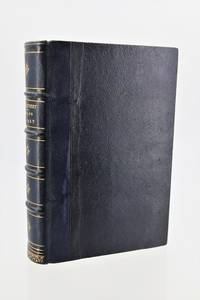
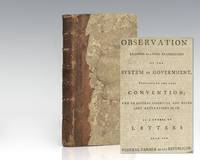
1787106800New York 1787. Rare first edition of the definitive and most important work in the Anti-Federalist canon; the antithesis of the The Federalist Papers. Octavo bound in half calf over boards with six raised bands edges speckled red. In very good condition. An exceptional example. On November 8 1787 the New York Journal began to advertise a new pamphlet entitled Observations Leading to a Fair Examination of the System of Government Proposed by the Late Convention; and to Several Essential and Necessary Alterations in It. In a Number of Letters from the Federal Farmer to the Republican. This pamphlet contained the first five Federal Farmer letters dated October 8 to 13. The first edition was replete with errors and a second corrected printing appeared within a week. Among the Federalists Alexander Hamilton as Publius Edward Carrington and Noah Webster acknowledged the Federal Farmer as in Hamilton's words the "most plausible" Anti-Federalist. Only one Federalist Timothy Pickering took the time to develop a complete critical response to the Federal Farmer. Though this was not published during the course of the constitutional debates it survives in a personal letter. Pickering described the Federal Farmer as "a wolfe in sheep's cloathing" and too focused on a misplaced fear of aristocracy. The work has been attributed to Richard Henry Lee a presiding officer of the Continental Congress writing under the pseudonym 'Federal Farmer'. Through these the first five letters the Federal Farmer argues that the plan of the Constitution while claimed to be a federal system and seeming to be so in some respects will in the end annihilate the states by consolidating them into one national government. This concern over consolidation was among the most important of the Anti-Federalist objections to the Constitution; they saw the destruction of state sovereignty as inimical to freedom. Honest federalists in the view of the Federal Farmer wished for the substantial preservation of the state governments but sought a federal government that was more than merely advisory. The letters indicate that the Federal Farmer ascribed to the compact theory of federalism. The Federal Farmer letters are among the best-written and convincing pieces in the Anti-Federalist canon and make regular appearances in collections of Anti-Federalist writing. "Though sometimes discursive and repetitious the letters skillfully written moderate in tone and thoughtful were perhaps the most eloquent and persuasive anti-federalist writings" Ketcham 256. hardcover
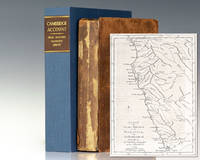
1761137375London: Printed for T. Jefferys 1761. Benjamin Franklin's first edition copy of Cambridge's account of the progression of the Seven Years' War in India from Franklin's private library. Quarto bound in full contemporary calf marbled endpapers illustrated with 12 engraved maps and plans and 6 plates mostly folding. From the private library of Benjamin Franklin. Franklin's contributions to science and politics were immense and his passion for making books more available to a broader audience prompted him to establish North America's first subscription library. In 1731 Franklin convinced the members of his Junto a mutual improvement club he founded to pool their money to purchase books they would collectively share. The collection became the Library Company of Philadelphia and is now regarded as the predecessor to the public library. Franklin was also instrumental in the establishment of the Library of the Pennsylvania Hospital North America's first medical library the Pennsylvania State Library The Library of the American Philosophical Society and the Library of the University of Pennsylvania. Franklin's private library has a long and complex history and although he was known to have produced a list its contents shortly before his death it has never been discovered. After his death in 1790 a large portion of his library became the property of his grandson William Temple Franklin who upon receiving it quickly sold it to financier and Signer of the Declaration of Independence Robert Morris. When Morris went bankrupt at the end of the decade the collection went into the hands of Philadelphia bookseller and former French tutor Nicholas G. Dufief in 1801 who began offering volumes for sale to the public. Dufief attempted to interest Congress in obtaining most of the library but ultimately sent most of it to auction. On March 12 1803 Philadelphia auctioneers Shannon & Poalk sold the library and Philadelphia attorney William Rawle purchased the present volume inscribing it: "W. Rawle 1803 – bo't at sale of Dr. Franklin's library." Dufief was also known to have compiled a list of the contents of Franklin's library but it has never been recovered and although printed catalogs were known to be issued advertising the contents of the 1803 Shannon & Poalk auction a copy has not been located. Philadelphia autograph collector Ferdinand J. Dreer obtained this copy and in 1886 and presented it to the Society of the Sons of St. George. In good condition. With Dreer's bookplate and presentation inscription. Housed in a custom clamshell box. Rare and desirable from Franklin's private library and with noted provenance. Benjamin Franklin earned the title of "The First American" for his early and indefatigable campaigning for colonial unity initially as an author and spokesman in London for several colonies. As the first United States Ambassador to France he exemplified the emerging American nation. Franklin was foundational in defining the American ethos as a marriage of the practical values of thrift hard work education community spirit self-governing institutions and opposition to authoritarianism both political and religious with the scientific and tolerant values of the Enlightenment. In the words of historian Henry Steele Commager "In a Franklin could be merged the virtues of Puritanism without its defects the illumination of the Enlightenment without its heat." To Walter Isaacson this makes Franklin "the most accomplished American of his age and the most influential in inventing the type of society America would become." Printed for T. Jefferys unknown
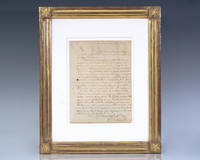
1790141583January 24 1790. Rare autograph letter signed by George Washington as the first President of the United States. Quarto one page the letter reads in full "New York Jany 24th 1790 Sir Capt. Burnett delivered me your letter of the 18th and is so obliging as to take charge of this answer - It is my sincere opinion that the land mentioned in it is worth what I asked for it--to wit four dollars per acre and once would have sold for it; but if in the present scarcity of cash it rather fetch that sum let those who are really inclinable to buy come forward like men that are in earnest and say what they will give--If they or their Agent have seen the land and without this it is useless to name any price have examined its qualities and improvements they can say what they will give and ought to act with candour. -On these terms I am ready to treat with them. It is not my intention to dispose of the land for a song nor is it my wish to higgle or make many words to the bargain--for which reason I pray them to come to a decision at once and that you would inform me of the result. At any rate it would be proper for you to write to me & soon that I may not miss any other offer should any be made to. Sir Yr most Obed. Hble Serv G Washington." In very good condition silked on recto and verso. Matted and framed. The entire piece measures 18 inches by 15 inches. An exceptional letter. American statesman and soldier George Washington served as the first President of the United States from 1789 to 1797 and was one of the Founding Fathers of the United States. He served as Commander-in-Chief of the Continental Army during the American Revolutionary War and later presided over the 1787 convention that drafted the United States Constitution. He is popularly considered the driving force behind the nation's establishment and came to be known as the "father of the country" both during his lifetime and to this day. unknown
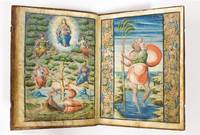
156957498s. l. Grenade Granada: S. n. 1569. Fine. S. n. s. l. Grenade Granada 1569 21.50 x 30.50 cm relié ILLUMINATED MANUSCRIPT ANONYMOUS Regla y Constitutiones de la Cofradia del Sanctissimo Sacramento de la Yglesia de San Christoval de Granada Autograph manuscript with three miniatures no publisher Granada 1569 folio 21.5 x 30.5 cm upper margin: 35 mm bottom margin: 50 mm interior margin: 30 mm exterior margin: 40 mm 31 ff. 16th-century full calf gilt Manuscript on vellum comprising 31 leaves: 50 pages of text ruled and lined and 3 full-page miniatures in colours heightened in gold. The four final leaves were numbered and partly ruled but left empty. Contemporary manuscript ex-libris on front endpaper. In Spanish throughout written in Caroline minuscule on 24 lines the text is very readable and very regular. The manuscript begins with a three-page summary covering the 24 chapters that comprise the Regla y constitutiones de la cofradia del Sanctissimo sacramento de la yglesia de San Christoval de Granada. One illuminated capital in red and blue indents and pagination in red small sketch in black ink to the inner margin. The verso of the final page of the summary has been ruled and lined in red but left blank. There follow the three full-page miniatures. The first shows a Communion scene on the recto of one leaf the second the Tree of Jesse verso of the same leaf and the third Saint Christopher bearing the baby Jesus recto of the following leaf. The verso of the miniature bears a short manuscript text explaining that these rules are those of the confraternity and brotherhood of the Holy Sacrament established in the Church of Saint Christopher of Granada on the 1st of May 1568. This is followed by the prohemio a prologue of two and a half pages in which the confraternity takes an oath; this starts with an imposing illuminated capital in red and blue. The chapters then follow on directly each with a tidy initial. The important terms are heightened in red allowing for quick navigation in the text. A long manuscript annotation to the outer margin of leaf 24. The aforementioned rules take up 23 ruled leaves ruled and lined in red. Leaf 27 bears two manuscript privileges. We have not been able to read the signature on the first dated May 1569 though quite elaborate. The second later one May 1596 is signed by Justino Antolinez de Burgos 1557-1637 at the time the Chaplain Royal charged with the inspection of ecclesiastical lodges. Long contemporary manuscript note to reverse of leaf 24. Contemporary light-brown calf spine in five compartments with gilt fillets and fleurons gilt fillet frame to boards small gilt fleurons to corner and a larger gilt fleuron to centre of covers. One clasp preserved. A few very skilful repairs and regilding practically invisible. This manuscript has three spectacular full-page miniatures in gouache heightened in gold. The first shows the Holy Communion with Christ himself establishing the Eucharist with the words This is my body this is my blood. The Apostles and Jesus with a halo blessing them are seated around a table set with bread and fish. This motif became a major theme of Christian art in the Renaissance as this miniature also shows. The second miniature shows the Tree of Jesse which symbolises the genealogy of Christ traced from Jesse Xese shown as an old man reclining. In keeping with the iconographic tradition a tree protrudes from his side the main branches of which bear some of Jesus's ancestors. Here they are: Zachary Jeremiah David an unidentified king and at the pinnacle Mary holding the Christ child within a mandorla. The third miniature presents a scene with Saint Christopher the patron of the Church in Granada to which the Confraternity of the Holy Sacrament was attached with a child on his shoulders as he was commonly represented. The iconography derives from a passage in the Golden Legend in which St Christopher helps a small b S. n. hardcover
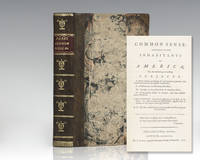
177696237J. Almon J.S. Jordan and J. Stockdale: London 1776-1793. Finely bound collection of the works of Thomas Paine including the rare first British editions of Common Sense and Plain Truth London: J. Almon 1776 second editions of Rights of Man Parts I & II London: J.S. Jordan 1791-1792 complete with half-titles present and a rare early printing of John Quincy Adams' response to Paine's Rights of Man London: J. Stockdale 1793 attributed to his father John Adams and written when John Quincy Adams was 26 years old. Octavo bound in three quarters morocco over marbled boards with gilt titles and tooling to the spine red morocco spine label all edges speckled black. In near fine condition. A rare and desirable collection. One of the founding fathers of the United States Thomas Paine authored two of the most influential pamphlets at the start of the American Revolution which ultimately inspired the 1776 Declaration of Independence. Virtually every American rebel read Paine’s powerful pamphlet Common Sense which crystallized the American Revolution and demand for independence from Britain. John Adams asserted "without the pen of the author of Common Sense the sword of Washington would have been raised in vain. London hardcover
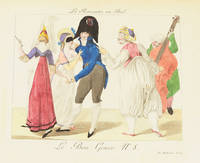
182787629Paris: chez l'éditeur boulevard Montmartre no 1Vassalet EsslingImprimeurs 1827. Fine. Princess Murat's copy chez l'éditeur boulevard Montmartre no 1 Vassal et EsslingImprimeurs Paris 1801-1827 ; 1827 pour le texte 41.20 x 27.80 cm relié Complete set of 115 copper-engraved plates with an additional plate 116 plates all printed on either laid or wove paper all hand-colored with watercolor. Two entirely different plates 39 follow each other in first issue: ""Les Titus et les cache-folies"" was published in the 1817 and 1822 sets and the other ""La Politicomanie"" appeared in 1827. This is the most complete series which also includes the 11 new plates published from 1818 to 1822 numbered 105 to 115. According to Vicaire the plates were probably all printed between 1801 and 1822 and only the text preceding the plates was reprinted in 1827. 3/4 long-grained cherry half-morocco smooth spine elaborately framed in gilt lentghwise gilt tooled center of spine gilt lettered title at head of spine framed in gilt marbled boards marbled paper endpapers and flyleaves. Minor brown spots are mainly confined to the 24 pp. of text with very few on the plates mainly on the margins and versos. A rare and famous collection of costumes genre and entertainment scenes from the French First Empire and Restoration eras with very wide margins and magnificently hand-colored at the time. A veritable encyclopedia of thrills pleasures and pageantry published by Pierre de la Mésangère leading fashion editor at the turn of the century. This copy includes two versions of plate 39 both of which are extremely scarce. These magnificent copper-engraved prints by Georges Jacques Gatine Schenker and others were based on drawings by the greatest painters of Parisian fashion: Carle Vernet Philippe-Louis Debucourt Jean-Baptiste Isabey Louis-Marie Lanté Dutailly. They were initially sold as a supplement to the successful magazine Le Journal des Modes before being published as a collection. Some plates bear the engraver's name and several the draftsmen's. This gallery of figures is singularly representative of a period of upheaval in French history in terms material but also moral and intellectual values - depicting a frivolous and daring part of feminine society eager to please and well-versed in the games of love. The ensemble perfectly combines social satire with the refinement expected of fashion engravings. It includes the famous portraits of the extravagantly dressed Directoire women called ""Merveilleuses"" and ""Incroyables"" - representations that have henceforth served as a reference. From beautiful silhouettes reclining on Greek-style beds to provocative and undressed courtesans everything is designed to illustrate the finery of these pretty coquettes often followed by a host of suitors and servants. Dresses hats and furs rub shoulders with elegant male figures in frock coats and even a few transvestites Trois grâces parisiennes no. 16. Many of the scenes have a clear erotic connotation especially the salon games featuring suggestive embraces and positions. Dancing takes pride of place: no fewer than twenty plates feature fashionable ballroom dances ""Danse du Schall"" named after the popular scarf quadrille figures such as ""La Poule"" ""La Trénis"" or more daring ones like ""La Sauteuse"" ballets or even the famous tightrope dancers Ravel and Forioso. The movement of the characters is reflected in the drapery of the large Empire muslin gowns and hair flowing in the wind. Among the dozens of hand-colored plates a great many are devoted to leisure and entertainment activities available at the beginning of the 19th century. Gastronomy games of skill sports acrobatics circus tricks music and even real sensational attractions: several plates depict the very first Parisian roller coaster installed in Belleville then at the Odeon for the 1817 Carnival. Clowns pierrots and masked figures are seen dancing in front of the structures and hurtling down steep slopes on small carriages. Anothe chez l'éditeur, boulevard Montmartre, no 1Vassalet EsslingImprimeurs hardcover
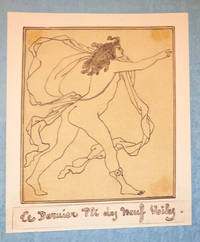
1920759331920. Fine. A priceless poetic testament from Marcel Proust's mentor hidden away and out of sight since the death of the author. s. d. ca 1920 25 x 33 cm en feuilles sous chemises The set of largely unpublished autograph poems by Robert de Montesquiou-Fezensac is brought together by the Count in a collection entitled Le Dernier Pli des neuf voiles whose composition extends from his very first collection Les Chauves-Souris 1892 to his last trilogy Offrandes 1915. Set of 620 autograph leaves. 532 unpublished first draught handwritten on the recto and numbered in pencil preserved in 3 chemises in half red contemporary morocco red morocco labels with gilt author and title; the poems are then placed in the chemises with a handwritten title and a number for publication. According to a note from the author the differences in ink have no meaning mere change of copy. Rare pages from the hand of his secretary Henri Pinard: p. 20 of Huitième voile and p. 29 of Neuvième voile. 23 pages present the printed or typewritten texts of the poems and are enriched with Montesquiou's handwritten corrections. A set of printed proofs are found at the top of the first chemise as well as a pencil tracing after Aubrey Beardsley drawn by the author and accompanied by his handwritten indications. Sublime ode to dandyism to homosexuality and beauty this worldly and poetic promenade by Montesquiou embarks the reader into the decadent fin-de-siècle Paris described in In Search of Lost Time by his friend Marcel Proust. Imbued with his legendary enthusiasm for pictorial decorative theatrical and floral art the collection also delivers hundreds of mournful verses after the disappearance of Montesquiou's lover Gabriel Yturri. Thanks to this collection of poems by Robert de Montesquiou-Fezensac all of which had been lost since 1986 it is now possible to complete the rehabilitation of the aristocratic poet who has long embodied and shaped the Parisian spirit. In May 1920 Montesquiou left handwritten instructions for the posthumous publication of the collection initially announced in two volumes and never produced. On his death a year later the poems were bequeathed to his secretary Henri Pinard who in turn sold them on an unknown date. Auctioned on 24 November 1986 they were mentioned in the LoWire-Littérature colloquium in 1989. This considerable manuscript by Montesquiou forms a veritable home of poetry like his famous aesthetic apartments described by Huysmans. The series of Voiles contain dozens of unpublished poems written in parallel with his previous collections. The author himself indicated the kinship of each voile with a published set of poems announcing here the total completion of his work by the addition of poems which still lay dormant in his papers. The three thick chemises contain rare and curious treasures sometimes drawn on colored sheets often pasted on larger sheets rigorously ordered while awaiting their publication. The poems are written without crossings-out they are fluid with rounded and precious handwriting and stand alongside other first-draught manuscripts: redactions and corrections also bear witness to the work in progress on the new poems; they were applied in the printed proofs of the work present at the top of the manuscript's first chemise. Some poems are taken as they are from collections already published but are slightly modified according to the explanations given by the author. Montesquiou also adds some handwritten notes detailing his intentions. The manuscript contains a poetic anthology of sacred art of extremely rare flowers and of antique furniture adorning his famous Parisian apartments around which so many legends were built Jacques Saint-Cère which fuelled the personalities of Des Esseintes Baron Charlus Dorian Gray and the vain peacock in Edmond Rostand's Chantecler. Moreover Montesquiou was overwhelmed by the features of these famous fictional ghosts of w unknown
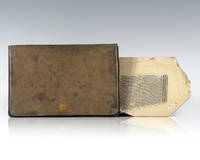
17591342281759. Original swatch from Martha Washington's golden yellow silk wedding dress given by her as a gift to Mrs. Alexander Hamilton Elizabeth and handed down through generations of the Hamilton family. The silk swatch measures roughly 2.75 inches by 2 inches mounted on a stiff paper card inscribed in pencil on the verso "A bit of Martha Washington's wedding dress Wh. was Mrs. Alex Hamilton's" in the hand of Hamilton's granddaughter-in-law Mrs. Allan McLane Hamilton and from her collection. Hamilton’s grandson Allan McLane Hamilton was a prominent psychiatrist and founded the New York Psychiatric Society. In 1910 he published The Intimate Life of Alexander Hamilton which was published by Scribner & Sons. In very good condition. Housed in an antique leather carrying case. An exceptional association with wonderful provenance. On May 15 1750 at age 18 Martha Dandridge Custis married Daniel Parke Custis a rich planter two decades her senior and moved to his residence White House Plantation in New Kent County Virginia. The couple had four children together and Daniel Parke Custis's death in 1757 left Martha a rich young widow at age 26 with independent control over a dower inheritance for her lifetime and trustee control over the inheritance of her minor children. In all she was left in custody of some 17500 acres of land and 300 slaves apart from other investments and cash. Martha Custis age 27 and George Washington age 26 married on January 6 1759 at the White House plantation after only three months of courtship. The wedding was grand. George's suit was of blue and silver cloth with red trimming and gold knee buckles. The bride wore purple silk shoes with spangled buckles which are displayed at Mount Vernon. The couple honeymooned at the Custis family's White House plantation for several weeks before setting up house at George's Mount Vernon estate. hardcover
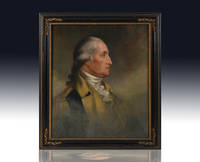
18621492021862. Fine oil portrait of George Washington as General and Commander-in-Chief of the Continental Army by Joseph Alexander Ames. Oil on canvas the portrait depicts Washington in profile in his Continental Army uniform. Signed and dated by the artist in the lower right corner "J. Ames 1862." Ames a self-taught artist born in 1816 in Roxbury New Hampshire was known for his portraits and genre scenes. He was influenced by Washington Allston's "old master" techniques which is evident in the rich layered colors and detailed rendering of this portrait. Ames's works were exhibited in prominent venues such as the Boston Athenaeum and the National Academy of Design. His portraits including those of Daniel Webster and Abraham Lincoln were widely recognized and reproduced during his lifetime. In near fine condition with a repair on the right side of the painting. Framed. The painting measures 30.25 inches by 25 inches. The entire piece measures 35.75 inches by 30 inches. As Commander-in-Chief of the Continental Army from 1775 to 1783 George Washington played a critical role in shaping the military and political outcomes of the American Revolutionary War. His leadership was marked not by tactical brilliance alone but by strategic endurance organizational discipline and an acute understanding of the symbolic and practical dimensions of command. Faced with chronic shortages of manpower supplies and financial support Washington focused on sustaining the army through long periods of adversity most notably during the winter encampment at Valley Forge. He emphasized professionalization working closely with figures like Baron von Steuben to impose standardized training and drill procedures. Washington’s decision to engage in a war of attrition rather than direct confrontation with the superior British forces reflected a broader political strategy aimed at maintaining colonial unity and prolonging resistance until foreign aid—particularly from France—could be secured. His leadership during the culminating siege of Yorktown in 1781 conducted in coordination with French forces marked a decisive turning point and demonstrated his ability to integrate diplomatic logistical and military considerations into a coherent wartime strategy. unknown
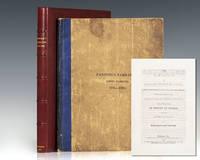
1861125637Richmond VA: Printed for Private Distribution Only 1861. First edition of the first book printed in the Confederacy. Quarto original stiff paper wrappers one of approximately 50 copies issued on regular paper. Ten being issued on thick paper and twenty copies destroyed in a fire. In very good condition reinforcement to the hinges. Housed in a custom full morocco clamshell box. Howes F26. Sabin 23778. Exceptionally rare. David Fanning was one of the most infamous of the Southern Tories raiding Patriots throughout the Carolinas. His guerilla warfare only paused when he was captured but following each of his multiple escapes he would quickly resume his vengeful predation. His narrative was to be the first in a series but the Civil War intervened and only this initial volume was produced. It was reprinted by Sabin in 1865 but this original edition was noted by Goodspeed's "as one of the finest of Confederate imprints. Printed for Private Distribution Only unknown
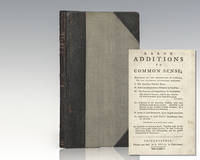
1776106523Philadelphia: Printed and sold by R. Bell in Third-Street 1776. Scarce 1776 separate edition of the Large Additions to Common Sense. The title reads in full: Large Additions To Common Sense: Addressed To The Inhabitants Of America On The Following Interesting Subjects. I. The American Patriot’s Prayer. II. American Independancy defended by Candidus. III. The Propriety of Independancy by Demophilus The dread of Tyrants and the sole resource Of those that under grim Oppression groan. Thomson. IV. A Review of the American Contest with some Strictures on the King’s Speech. Addressed to All Parents in the Thirteen United Colonies by a Friend To Posterity And Mankind. V. Letter to Lord Dartmouth by an English American. VI. Observations on Lord North’s Conciliatory Plan by Sincerus. To Which Is Added And Given An Appendix to Common Sense; Together with an Address to the People Called Quakers on their Testimony concerning Kings and Government and the Present Commotions in America. Octavo bound in three quarter morocco over boards gilt titles and five raised bands to the spine marbled endpapers. In very good condition internally very clean. Rare with only two examples appearing at auction in the last 80 years. One of the founding fathers of the United States Thomas Paine authored two of the most influential pamphlets at the start of the American Revolution which ultimately inspired the 1776 Declaration of Independence. Virtually every American rebel read Paine’s powerful pamphlet Common Sense which crystallized the American Revolution and demand for independence from Britain. John Adams asserted "without the pen of the author of Common Sense the sword of Washington would have been raised in vain." The 1776 Large Additions lends insight into the fascinating publishing history of the most important and popular tract of the American Revolution. After the publication of the first edition of Common Sense by Bell in 1776 in a small edition of 1000 copies Paine was greatly disappointed when Bell advised him there were no profits. He had intended to donate the proceeds to the causes of liberty and independence. Paine and Bell 44 had an immediate falling out and Paine subsequently hired Bradford to print a competing edition. This naturally infuriated Bell who included an attack on the still anonymous author in his next printing. The controversy between Bell and Paine played out in the press over the next several weeks and in no small part helped further ignite the popularity and widespread dissemination of Common Sense. Bell tried to compete against Bradford with a second unauthorized edition and gathered these additions to differentiate his work for the purpose of marketing. Nevertheless Bell could not easily compete since Paine refused to copyright the work and granted free permission for anyone to reprint it. Howes P22 states that “Paine was not the author of these Additions; they were gathered from various sources by Bell to make his edition 3 times larger than the enlarged edition issued at Philadelphia by Bradford to whom Paine had turned after his estrangement from Bell. Some copies were issued separately - and paged†as in the present example “ . to permit their being bound with the first and second editions of Common Sense. Printed and sold, by R. Bell in Third-Street hardcover
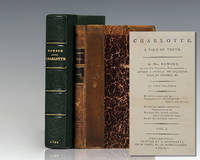
1794125183Philadelphia: Printed by D. Humphreys for M. Carey 1794. Exceedingly rare first American edition and the earliest obtainable example of the first American bestseller. Octavo two volumes bound into one in three quarter calf over marbled boards morocco spine label lettered in gilt marbled endpapers. Although the first American edition was preceded by the first English edition published in 1791 no examples of the first English edition have been traced at auction. In very good condition. Bookplate of D. Appleton to the pastedown bibliographic description tipped in. Housed in a custom cloth chemise and half morocco clamshell slipcase. Exceedingly rare with only one other example of the first American edition traced at auction in the last 75 years. Susana Rowson's best-selling novel Charlotte relates the tale of 15-year-old English schoolgirl Charlotte Temple who is lured away from her prestigious boarding school by British army officer John Montraville. While en route to New York Montraville seduces Charlotte who he swiftly abandons upon arrival to his post and after a downward spiral into remorse illness poverty and the birth of a child she dies. Seduction novels were popular in the 18th century and the widely read Charlotte Temple went through more than 200 editions. Rowson a committed republican used the success of the novel to protest the sexual double standard that ruined the lives of women like Charlotte. Later in life she wrote a sequel that was published posthumously. Printed by D. Humphreys for M. Carey hardcover
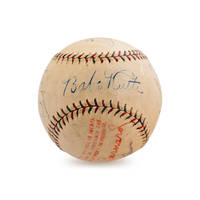
148863Rare Reach Official American League Baseball signed by a legendary group of baseball legends and Hall of Famers. Signed by Babe Ruth on the sweetspot setting the tone for one of the most remarkable gatherings of baseball legends captured on a single ball. Surrounding the "Sultan of Swat" are the signatures of Lou Gehrig Jimmie Foxx and Al Simmons — for a total of four of the five Hall of Famers famously struck out in succession by Carl Hubbell during the 1934 All-Star Game. Additionally signed by Connie Mack Lefty Grove and George Earnshaw. Crowning the collection is the autograph of Hank Aaron the man who ultimately eclipsed Ruth’s career home run record bridging two eras of baseball greatness. In fine condition. Housed in a plastic case. Accompanied by a letter of authenticity from Beckett Authentication Services. Babe Ruth Lou Gehrig Hank Aaron Jimmie Foxx Al Simmons Connie Mack Lefty Grove and George Earnshaw collectively embody the pantheon of Major League Baseball legends whose careers span the sport’s formative decades and its evolution into a national institution. Each figure holds a distinct place in the game’s legacy: Ruth and Gehrig as the iconic heart of the New York Yankees’ dominance in the 1920s and 1930s; Aaron as the embodiment of consistent excellence and the breaking of Babe Ruth’s home run record; Foxx and Simmons as prolific sluggers of the Philadelphia Athletics’ golden years; Mack as the longest-serving and most storied manager in baseball history; and Grove and Earnshaw as dominant pitchers who shaped the Athletics’ championship success. Together these figures represent a cross-generational legacy that defines baseball’s golden age and its enduring mythos. unknown
1907579131907. Fine. ca.1907-2003 30 x 32 cm Maurice BLANCHOT Extraordinary collection of Maurice Blanchot's original photographs taken in the family setting the only printings C. 1907-2003 272 photographs various format Blanchot challenged photographers and caricaturists of the literary press for a long-time. His 'portraits' over so many years are minimalist and rare: in 1962 in L'Express a hand holds up a book at the bottom of the page; in 1979 in Libération a blank square is in the middle of the page with only Maurice Blanchot's name and a quote from the Entretien infini as a caption: an empty universe: nothing that was visible nothing that was invisible' C. Bident Maurice Blanchot. In 1986 at the time of an exhibition of writers' portraits he requested that his photo be replaced by a text showing his desire to appear as little as possible not to glorify his books but to avoid the presence of an author who was entitled to an independent existence. A photo taken without him knowing by a paparazzi in a supermarket carpark was used as the writer's portrait for a long time before his friend Emmanuel Levinas revealed a few rare photographs of their youth. The fact that Maurice Blanchot did not oppose this release and the fact that this was his closest friend's deed could be explained by what Bident calls the spacing of worry as the revealed portraits were not up-to-date similar to the postponed publications of his books L'Idylle Le Dernier Mot L'Arrêt de mort. Only a few photographs gathered on the central pages of the Cahiers de l'Herne issue dedicated to Maurice Blanchot and published in 2014 supplement these unique shots of the 20th-century's most secret writer. In his chapter The indisposition of the secret Christophe Bident devotes several pages to the almost total absence of images of this invisible partner questioning the intellectual and psychological motivation of the writer who was aware of the inevitable future revelation of his appearance: Everything must become public. The secret must be told. The darkness must emerge. That which cannot be said must however be heard. Quidquid latet apparebit all that is hidden is that which must appear. Maurice Blanchot L'Espace littéraire In general Maurice Blanchot refused to be photographed even in private life as confirmed by the family of his sister-in-law Anna who revealed in a letter to her nephew that she had not taken any photographs of the writer thus respecting his wishes. However the photographs taken with his close family show us a perfectly willing Blanchot and one even playing very elegantly with the image of himself that he projects to the photographer generally his brother. As such we discover an elegant man posing proudly on a boat pontoon or on the banks of the Seine or more mysteriously playing with lighting effects in the corner of an empty room. Here we see a real photographic staging and a symbolic reappropriation of image particularly in a surprising seated portrait of the writer holding the Inconnue de la Seine death mask in his arms the well-known plaster head of a young woman supposedly drowned who adorned artists' studios after 1900. A true romantic legend this sculpture with a mysterious post-mortem smile is at the heart of Aragon's novel Aurélien and haunts the work of artists at the beginning of the century including Rainer Maria Rilke Vladimir Nabokov Claire Goll Jules Supervielle Louis-Ferdinand Céline Giacometti and Man Ray who produced a worrying photographic portrait of the mask at Aragon's request. Maurice Blanchot described the unknown woman as an adolescent girl with her eyes closed but full of life with a smile so slender so rich . that we could believe that she was drowned in a moment of extreme happiness. This photograph of an impervious Blanchot cradling the white mask of the Mona Lisa of suicide asserts itself as a true deconstruction of representation. It becomes an ill unknown
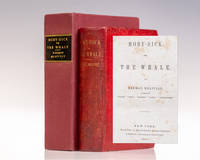
1851150358New York: Harper & Brothers Publishers 1851. First edition first issue binding of Melville’s masterpiece. Octavo original red variant cloth BAL’s A grain covers stamped in blind with Harper’s circular device at the center of the front panel within a heavy blind ruled frame plain orange endpapers. Issued in a single volume in black green blue red purple slate or brown cloth gilt. The first state of the binding has a circular device at center of covers that is absent from the second state binding. Much has been made of whether the earliest copies bound should have orange-coated end papers but in fact there is no priority between copies with orange dark orange maroon veined in gold or marbled end papers. Of uncertain status are three copies that have been seen with plain white end papers and a copy seen with yellow-coated end papers. Copies in bindings with beaded rope-like designs or Grolier-esque strapwork borders are very likely copies that survived Harper's terrible fire of December 10 1853 which destroyed 287 copies 212 were still unbound in sheets. The first printing by Harper's in 1851 numbered 2915 copies approximately 300 copies were destroyed in a warehouse fire in 1853 and as late as 1854 copies of the first edition were still available from the publisher. A second printing of 250 copies was issued in 1855 and in 1863 the third printing of 253 copies was issued. In very good condition rebacked. Housed in a custom cloth clamshell box. Rare and desirable in the rare variant publisher's red cloth. Initially panned by critics and readers when published in 1851 "in the 20th century Moby Dick would be rediscovered and acknowledged as possibly the greatest of all American novels" Chronology of American Literature. Arguably the greatest single work in American literature Moby-Dick was initially “a complete practical failure misunderstood by the critics and ignored by the public. Nevertheless Melville’s permanent fame must always rest on the great prose epic of Moby-Dick a book that has no equal in American literature for variety and splendor of style and for depth of feeling†DAB. Harper & Brothers, Publishers hardcover
18941307<p>London/Hammersmith: Kelmscott Press 1894. Limited First Edition. green goatskin. Fine. 16mo: 5 13/16" x 4 1/8" x 3/4" 14.8 x 10.5 x 1.9 cm.</p><p>First Printing. Printed by and sold by William Morris. Bound in fine tooled in gilt by Deborah Evetts with a diaper pattern of alternating small Kelmscott flowers and dots across covers and spine title running across top and bottom of upper cover uncut stamp-signed "DE'08" on rear turn-in. One of 20 at two guineas velum copies plus 525 at seven shillings and sixpence on paper; this copy on vellum. Colophon in red and black. iv 130 pp.</p><p>Printed in black and red throughout in the Chaucer type designed by Morris for his press. Woodcut frontispiece title within a floral border and facing page with full woodcut floral page-border borders 11a and 11. Numerous 7- 6- and 3-line woodblock initial capitals all designed by Morris engraved by William Harcourt Hooper. Shoulder notes and some lines including colophon in red.</p><p>A medieval French tale translated by Morris who found them in a collection of medieval romances printed in Paris in 1856 NOUVELLES FRANcAISES EN PROSE DU XIIIEME SIeCLE. The Kelmscott Press also published two other works from the same source. THE TALE OF EMPEROR COUSTANS was the source of THE MAN BORN TO BE KING in THE EARTHLY PARADISE. The second story is A TALE OF OVER SEA. Cockerell 26. Peterson A26. Walsdorf 26.</p><p>Housed in green buckram drop-back box brown goatskin label titled in gilt on spine. Condition overall: Fine.</p> Kelmscott Press
180858602Charenton asylum: S. n. 1808. Fine. S. n. Charenton asylum août 1808 17.50 x 21.50 cm broché sous chemise et étui The complete original manuscript of one of Sade's first works ruled in pencil throughout comprising 40 leaves written recto and verso. This manuscript like the other extant items from the Marquis was dictated to a scribe and corrected by Sade himself. Contemporary green paper wrappers with a small lack to middle of spine. Ink title partly erased to upper cover: 9/ Net et corrigé en août 1808 bon brouillon. Les Antiquaires. Comédie en prose en 1 acte Copied and corrected August 1808 a good draft. The Antiquaries. A prose comedy in 1 Act. This title is repeated on the verso of the upper cover. Numerous manuscript corrections annotations and deletions in Sade's hand principally adding blocking and rich in both stage and acting directions. Written in 1776 and re-copied at Charenton in 1808 and most likely augmented at the time with various topical references notably including an allusion to Napoleon of whom he was hoping in vain to receive permission to leave the asylum at Charenton as a free man p.94 Les Antiquaires is one of the first theatrical pieces written by the Marquis and therefore one of his first literary works overall written eight years before the Dialogue entre un prêtre et un moribond Dialogue Between a Priest and a Dying Man. Though the precise dating of these pieces is made difficult due to the lack of the original manuscripts several clues have allowed bibliographers to date the initial composition of this piece to 1776 possibly with a corrected version during the Revolution and a few final changes at the time of this last edit which is today the only extant manuscript of this play. These clues include the status of the Jewish and English characters the style of the dialogues and Sade's correspondence with theatres; the strongest clue being biographical in nature. Les Antiquaires can essentially be considered the true theatrical version of Sade's Voyage en Italie with which it shows a sustained intertextuality. The play is about an antiquary in the 18th century sense of the term which is to say a learned devotee of Classical culture who wants to marry off his daughter to a friend with the same passion who nonetheless finds a way of convincing him to let her marry her young lover. Whether it be in the learned dialogues of the antiquaries or in their eccentric parody by the young lover imitating them Sade draws upon his own experience and observations from his travels which he expands or twists according to the viewpoint of his various characters. Hence the description of Mount Etna by the lover Delcour is a parody of Sade's detailed description of the Pietra Malla volcano and the made-up subterranean tunnel linking Etna to America is directly inspired by the tunnel of the Crypta Neapolitana described by Sade in his Voyage. The Marquis would reach back to this same experience of volcanoes in one of the most famous scenes in his Histoire de Juliette. Barely returned from his latest grand tour and almost at the same time as writing his passionate and detailed account of the experience Sade was thus also writing a satirical version of his own work until his problems with the military authorities. The work is at the same time a social critique of pointless erudition and a self-mockery of his own passion for history and of his zeal to see everything his insatiable curiosity cf. Maurice Lever preface to Voyage en Italie. This virulent satire is paradoxically twinned with a very erudite display of the author's knowledge of the latest architectural discoveries and the major contemporary questions in the field. This was in fact the element criticized by the two heads of theatres to whom Sade sent the play for consideration most likely during 1791 or 1792: The work is well-written. It shows the author's spirit and depth of knowledge but it's too serious too scientific S. n. unknown
184387676Paris: Chez Gihaut frères Edit. Boulevard des Italiens 5 1843. Fine. Chez Gihaut frères Edit. Boulevard des Italiens 5 Paris s.d. 1843 36.40 x 49.80 cm relié Complete set of 13 original lithographs by Eugène Delacroix in first edition first issue with the letter one of 20 copies on Chine paper pasted on laid paper: ""It was originally printed in a few proofs on Chine the format of which exceeds the square line by one or two centimeters. They are highly sought-after even though they bear the letter"" Robaut. Bound in the original publisher's brown half-shagreen binding title gilt stamped on first board original first cover wrapper preserved. Small restored tear to the margin of the wrapper over 5 cm sunned spine joints and corners rubbed scattered foxing and a dampstain to the lower part of the laid paper on which the lithographs are pasted on without affecting the lithographs themselves. Exceptional and rare set of original lithographs by Eugène Delacroix on Chine paper illustrating Shakespeare's masterpiece. A cornerstone of Romantic art this series was ""made at M. Delacroix's personal expense. Only 80 copies were printed 60 on blanc and 20 on chine and these were sold out at the time of the author's death"" Henri Béraldi. It is now esteemed as Delacroix's most accomplished graphic undertaking which took him more than ten years to achieve and generally considered to be one of the first modern livres de peintre. This is Delacroix's second lithographic portfolio based on a literary work after Goethe's 'Faust' in 1828. Strongly influenced by Goya's Caprices the plates feature deep black tones and striking contrasts magnified by the Chine paper: ""No one is unaware of the important role played by Delacroix in lithography . in the Hamlet in the Horse struck down by a tiger or better still in the Lion of the Atlas and the Royal Tiger these marvels he shows what vigor and color the lithographic pencil can acquire in the hand of a master""Henri Béraldi. Despite good reviews from Théophile Gautier and Jules Janin the Hamlet suite remained little-known from the moment of its publication by the Gihaut brothers upon Delacroix's request: ""I had them printed in small numbers and I was well advised for they were not successful and were far from having met printing costs"" wrote Delacroix in a letter to Champfleury May 1 1852. Even in the 19th-century copies on Chine paper were almost impossible to find: only twenty years after publication Philippe Burty considered the set ""so rare now"" regardless of its different issues Colonel De La Combe sale 1863. His contribution to Hamlet's visual imagination and iconography is immense. Delacroix first created the pose of Ophelia's lifeless body lying horizontally on the water - foreshadowing John Everett Millais' famous painting. It was from these lithographs that a number of his paintings were created: ""Between the 1830s and his death Delacroix also painted oil versions of a number of lithographs including Hamlet and His Mother now in the Metropolitan Museum."" Alan R. Young Hamlet and the Visual Arts 1709-1900. Delacroix showed interest in Shakespeare's theater - and Hamlet in particular - early on. As a youth he signed some of his letters ""Yorick"" when recounting his first passions for the young Englishwoman Elizabeth Salter. According to his diary studied by Luciana Lourenço Paes he probably read the play in the original English and identified with the main protagonist who inspired his ""Self-portrait as Hamlet"" now in the Musée Delacroix. In 1825 the painter traveled to London where he attended several of the Bard's plays and apparently regretted missing the Hamlet performed by the legendary Henry Keane at the Drury Lane Theater. Two years later Delacroix was among the Romantics who fell under the spell of a special performance of Hamlet at the Théâtre de l'Odéon by the English company of Covent Garden director Charles Kemble. It was the first time Shakespeare had been played in his origin Chez Gihaut frères, Edit. Boulevard des Italiens, 5 unknown
185783397Paris: Michel Lévy frères 1857. Fine. Flauberts masterpiece on deluxe paper bound at the time Michel Lévy frères Paris 1857 11.50 x 18.50 cm relié First edition one of the very rare copies on heavy vellum paper Clouzot counts 75. Bound in contemporary half navy blue shagreen spine with four raised bands decorated with gilt garlands partly faded and tooled with gilt fillets and fleurons gilt roll at foot dark blue paper-covered boards marbled endpapers and pastedowns a period binding. Some occasional foxing. Unlike the trade copies printed in two volumes the deluxe paper copies are presented in a single volume without title-page or half-title for the second part the gatherings being continuously signed. They also retain all the first-issue points including the misprint ""Sénart"" on the dedication leaf. A very rare deluxe paper copy strictly bound at the time of publication. Michel Lévy frères hardcover
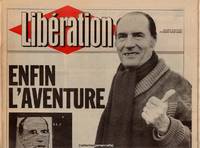
197375634Paris: Libération 1973. Fine. Libération Paris 1973-2004 6200 numéros en feuillets Complete run of the first twenty years of the newspaper Libération founded in 1973 by Jean-Paul Sartre Serge July Philippe Gavi Bernard Lallement and Jean-Claude Vernier. 6200 issues in pristine condition never opened. This unique collection comprises 6200 issues of Libération in impeccable condition never opened and is absolutely complete including all the numéros zéros promotional issues special reports thematic supplements including the entire series of the celebrated Sandwich issues and the commemorative twentieth anniversary album from Monday 5 February 1973 to Monday 3 January 1994. The collection is offered with its custom-made display unit 2.60 m high 4.20 m wide and 50 cm deep. It consists of 35 stackable compartments each measuring 84 x 36.5 x 50 cm each housing two sliding drawers. Each drawer holds approximately one hundred issues of the newspaper. Provenance: Frédéric Fredj Collection. Libération unknown
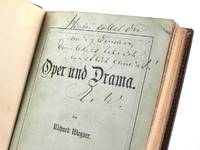
186983415Leipzig: Verlagsbuchhandlung von J.J. Weber 1869. Fine. Verlagsbuchhandlung von J.J. Weber Leipzig 1869 14.50 x 23 cm relié Inscribed copy concealing the secret truth of Wagner's thwarted love story Second edition with parts previously unpublished with a new preface ""An Constantin Frantz"" dated April 28 1868 Tribschen bei Luzern. The first edition was published by the same publisher in 1852. Full burgundy morocco binding spine with five raised bands gilt date at foot marbled endpapers and pastedowns gilt turn-ins original first softcover preserved top edge gilt gilt leading edges. Some foxing more pronounced on some leaves a small restoration to the upper right-hand corner on pages IX-XIV not affecting the text pencil annotation on pages 116 and 139 skillful restorations to head and foot of the upper joint. Exceptionally and intimately signed and inscribed by Richard Wagner to a mysterious dedicatee:« Hierbei sollst du meiner gedenken denn alles habe ich ernstlich gemeint. R. W. » At this you shall remember me for I have meant everything seriously. This moving autograph confession with its highly personal tone written on the most important of his theoretical writings radically differs from the hasty ""Zur Erinnerung"" written by the composer on his opera scores or the little notes he used to hand out to patrons after concerts. We did not find any other inscribed copies of Oper und Drama' on the market or in public institutions. However the composer's autobiography and correspondence reveal the existence of two dedications on this major work. The first was addressed to Theodor Uhlig on the original manuscript with an autograph inscription inspired by Goethe. The second and only other inscription mentioned in a letter from Wagner is said to have been made for Malwida von Meysenbug on the same edition as our copy. Although it is not impossible this could be the very same inscription written on the ""book of all books on music"" according to Richard Strauss the style and content of the inscribed words allow for an even more prestigious attribution. A ""VERY SOLID"" MANIFESTO In February 1851 Wagner completed Oper und Drama. This ""very solid book"" - as described in a letter to Franz Liszt - sets out the revolutionary principles of Leitmotiv and Gesamtkunstwerk political and aesthetic utopia of a musical drama acting as a synthesis of the Arts. The text is part of his Zürcher Kunstschriften three seminal essays written during his Swiss exile along with Kunstwerk der Zukunft' and Die Kunst und die Revolution'. He outlines in his treatises the shape of his future scenic festival"" - the celebrated Ring and includes his reflections on the relationship between art and society as well as his theories on the future of opera. In 1868 he decided to complete the composition of this monumental tetralogy and simultaneously worked on the second edition of Oper und Drama' published at the end of 1868 - mistakenly stated on the cover as 1869. In the end it differed from the previous edition only in its new preface the very few changes proving once more the permanence of his musical and artistic vision almost twenty years after it was first written. Wagner will tirelessly defend and promote his ideas which found their ultimate achievement during the 1876 Bayreuth festival. This second corrected edition with a revised preface is an integral part of the artist's creative process giving his reflections the status of a political and musical manifesto as evidenced by the intimate and enigmatic dedication on our copy. The importance of this work in the eyes of the composer the absence of any explicit attribution to the inscription's recipient the use of the familiar form of address and the content of the message confirm the importance of the dedicatee and his place within the author's inner circle. Among the personalities around the master at the time of this inscription several may have inspired these words: FRIEDRICH Friedrich Nietzsch Verlagsbuchhandlung von J.J. Weber paperback
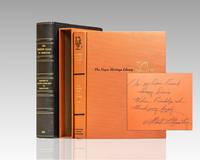
1965149476Yonkers: Educational Heritage Inc 1965. First edition of this comprehensive anthology that compiles historical documents speeches and firsthand accounts to trace the evolving struggle for African American freedom and equality. Quarto original publisher's orange cloth boards with black and white illustrations. Association copy inscribed by Martin Luther King Jr. to Sammy Davis Jr. on the front free endpaper "To my Dear Friend Sammy Davis Whose Friendship I Cherish very deeply Martin Luther King." Sammy Davis Jr. 1925–1990 was an American singer dancer and actor whose extraordinary versatility made him one of the most celebrated entertainers of the twentieth century. As the only Black member of the Rat Pack Davis broke racial barriers in entertainment while confronting segregation both on and off stage. His friendship with Dr. Martin Luther King Jr. began through Davis’s activism and fundraising for King’s civil-rights efforts and deepened during the Civil Rights Movement. Davis used his fame to raise awareness and funds for King’s initiatives performing at civil rights benefits and supporting the 1963 March on Washington. In near fine condition with a small loss to the crown of the spine. Edited by Alfred E. Cain. Illustrated by Horace Varela. Housed in the original orange cloth slipcase within a custom folding chemise within a custom half morocco slipcase with gilt titles to the spine. Martin Luther King Jr. was a Baptist minister and activist who became the most visible spokesperson and leader in the civil rights movement from 1954 through 1968. He is best known for his role in the advancement of civil rights using the tactics of nonviolence and civil disobedience based on his Christian beliefs and inspired by the nonviolent activism of Mahatma Gandhi. King led the 1955 Montgomery bus boycott and in 1957 became the first president of the Southern Christian Leadership Conference SCLC. With the SCLC he led an unsuccessful 1962 struggle against segregation in Albany Georgia and helped organize the nonviolent 1963 protests in Birmingham Alabama. He also helped organize the 1963 March on Washington where he delivered his famous "I Have a Dream" speech. On October 14 1964 King received the Nobel Peace Prize for combating racial inequality through nonviolent resistance. In 1965 he helped to organize the Selma to Montgomery marches and the following year he and the SCLC took the movement north to Chicago to work on segregated housing. In his final years he expanded his focus to include opposition towards poverty and the Vietnam War alienating many of his liberal allies with a 1967 speech titled "Beyond Vietnam". In 1968 King was planning a national occupation of Washington D.C. to be called the Poor People's Campaign when he was assassinated on April 4 in Memphis Tennessee. He was posthumously awarded the Presidential Medal of Freedom and the Congressional Gold Medal. Martin Luther King Jr. Day was established as a holiday in numerous cities and states beginning in 1971 and as a U.S. federal holiday in 1986. The Martin Luther King Jr. Memorial on the National Mall in Washington D.C. was dedicated in 2011. Educational Heritage, Inc hardcover
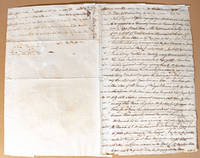
1785139571Mount Vernon July 28 1785. Rare letter signed by George Washington to his land agent in Virginia Battaile Muse. Quarto three pages on a single folded leaf the letter is addressed to Mr. Battaile Muse. The body of the letter in a secretarial hand reads in full: "Mount Vernon July 28 1785 Sir: A few days ago by a Mr. Hickman who either is or wants to be a tenant of mine in Frederick County. I sent you a Dozen Blank leases. The Tract on which he says he is fixed is part of two lots which I purchased at the sale of Colo. George Mercer's Estate in the year 1774: a plot of which I send you that the whole may be arranged into four tenements as conveniently disposed as water &c. will admit. In Sept. last whilst I was at my Brother's in Berkely sic many Persons applied for this Land. But from causes which then existed I came to no positive agreement with any; referring them to Mr. Snickers who was so kind as to promise that he would fix matters for me as I was in a hurry and could not go upon the Land myself on the terms which if I recollect right I gave him in a letter. Some time after two men of the names of Winzer and Beaver with the letter enclosed from Mr. Snickers came here and were told that I would comply with whatever agreement was made with them by him: among other things they said Mr. Snickers had promised them Leases for fourteen years: this I observed could not I conceived to be the case because I had expressly named ten years the term for which Mr. Burwell let his Lands adjoining but notwithstanding if the case was so and Mr. Snickers would declare it the Leases should be filled up accordingly: this I repeat and as far as the matter respects Winzer for it seems Beaver has changed his mind the other conditions endorsed on the back of Mr. Snicker's letter to me are to be granted him: he paying all the taxes which may be on the Land he holds However as filling up one Lease may be a guide with respect to the others I enclose one in the name of Winzer with the blanks as completely filled as I can do under my uncertainty with respect to the term of years for which he is to have it and which is to be determined by Mr. Snickers: and for want of the quantity of acres in and description of the Lot which he is to have. There are already three Tenants on this tract to whom you may fill up Leases on the same terms and I have done for Winzer and whenever they will bring evidences to prove them I will sign them. As Beaver has declined taking the Lot which he agreed first with Mr. Snickers and afterwards with me for you may let it to any good tenant who offers upon the terms the others are held. The three now engaged will have rents to pay thereon the first of next Jan. It will be necessary to take an Assignment of Mr. Whiting's Lease before one can be made to Mr. Airess; or some instrument of writing by which it will be can be cancelled in order to render the new one valid; and I hope payment of the money due on the Replevy Bonds of the former will not be delayed longer than the time mentioned in your last letter viz Sept. Having got a Gentleman to assist me in my business I hope shortly to have my Accts. so arranged as to send you a rental of what is due to me in London Fauquier and Berkely sic Counties. I have a Lot in the town and common of Winchester which when you have occasion to go thither I beg the state and condition of them may be enquired into and information given what can be made of them. The one in the Town I believe a Doctr. McKay has something to do with. I would be obliged to you for enquiring of Mr. Wormley's manager if he has any good red clover seed for sale; what quantity and the price thereof and let me know the result by the first conveyance to Alexandria." Washington closes his letter and signs the letter in his own hand: "I am Sir Yr Very Hble Serv G Washington." In very good condition with an archival reinforcement to the inner fold remnants of earlier mounts. Housed in a large custom slipcase. The recipient Battaile Muse was the son of Colonel George Muse who served with Washington in the Virginia Regiment during the Fort Necessity Campaign. Washington hired Battaile in November 1784 as his agent for land in Berkeley Frederick Fauquier and Loudoun counties a position he would hold until 1791. Prior to his presidency Washington was by occupation a planter and he imported luxuries and other goods from England paying for them by exporting tobacco. In 1765 because of erosion and other soil problems he changed Mount Vernon's primary cash crop from tobacco to wheat and expanded operations to include corn flour milling and fishing. His success in these new endeavors led him to soon be counted among the political and social elite in Virginia. From 1768 to 1775 he invited some 2000 guests to his Mount Vernon estate mostly those whom he considered people of rank. Following the conclusion of the Revolutionary War Washington returned to Mount Vernon where he oversaw the completion of the remodeling work at Mount Vernon which transformed his residence into the mansion that survives to this day although his financial situation was not strong. Creditors paid him in depreciated wartime currency and he owed significant amounts in taxes and wages. Mount Vernon had made no profit during his absence and he saw persistently poor crop yields due to pestilence and poor weather. Again Washington diversified by undertaking a new landscaping plan and succeeded in cultivating a range of fast-growing trees and shrubs that were native to North America. American statesman and soldier George Washington served as the first President of the United States from 1789 to 1797 and was one of the Founding Fathers of the United States. He served as Commander-in-Chief of the Continental Army during the American Revolutionary War and later presided over the 1787 convention that drafted the United States Constitution. He is popularly considered the driving force behind the nation's establishment and came to be known as the "father of the country" both during his lifetime and to this day. unknown
biblio18<p>Hand-drawing Chinese propaganda poster: "Holding highly the flags of Maoism Thought to eliminate leptospirosis thoroughly." 1971. 89cm x 62cm. All of the painting and red Chinese characters are hand-drawing only the below black Chinese characters were typed on a paper and then adhered to the painting. Have slight fold which probably can be recovered because the fold is formed by whole put together with others.</p><p>The soldier worker and peasant are holding a red books with title "Maoism Thought" . The three banners are captioned with "Ready for Battle Ready for Famine For People" "Long Live For the Victory of the hygienism Route of Chairman Mao’s Proletariat Revolution" and "Put the emphasis of the work of hygienism and Health into Rural Area" respectively. The two plates are captioned with "Must Demolish thoroughly the remaining toxin of the hygienism Route of Anti-revolutionary Revisionism" and "Must eliminate leptospirosis thoroughly " respectively.</p><p>At the bottom the adhered small paper was typed "printed by Revolutionary Committee of Epidemic Prevention of Yunnan Province printed in June 1971" so it is the original hand-drawing poster for printing in 1971 but do not know if its printed counterpart had been publised later because as far as I know I have not seen its printed counterpart.</p>
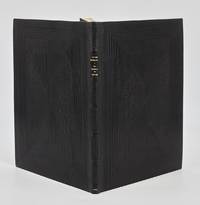
187381415Bruxelles Brussels: Alliance typographique M.J. Poot & Cie 1873. Fine. Alliance typographique M.J. Poot & Cie Bruxelles Brussels 1873 12.50 x 18.50 cm relié sous étui Une saison en enfer A Season in Hell Alliance typographique M. J. Poot & Cie Bruxelles 1873 125 x 185 cm full morocco and custom slipcase First edition published in small numbers at the author's expense. Binding in full black morocco elaborately decorated in blind original wrappers preserved half black morocco slipcase outstanding binding signed Semet & Plumelle. This very scarce first edition of Une saison en enfer is a major collector's piece on several counts: it remains the only work published by Rimbaud himself then a young unknown 19-year-old poet. He eventually never honored his debt towards the printer. The latter therefore kept almost the entire print subsequently forgotten in the workshop Arthur Rimbaud obtained only a dozen copies offered to his friends. The stock was found in 1901 by a bibliophile who retrieved the well-preserved 425 copies and destroyed the rest damaged by humidity. The curious composition of the work is also a surprising peculiarity of this precious edition: without a title page nor endpapers the text begins ex abrupto after the cover and finishes the same way the seventeen blank pages inserted far and wide in the book as well as the misprints and spelling errors peppered through the text are also curiosities studied by scholars. Sought-after and collected very early on by bibliophiles copies of this mythical edition were bound by the greatest French binders namely Pierre Lucien Martin Semet & Plumelle Paul Bonet or Georges Leroux. A very beautiful copy set in an outstanding blind tooled full morocco binding by Semet & Plumelle. Alliance typographique (M.J. Poot & Cie) unknown