Louis ANQUETINBiblio.com
43 665 résultats
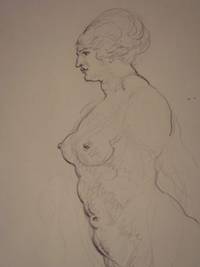
1899257951899. Fine. Fin XIXème - Début XXème 23 x 36 cm Original pencil drawing. Stamp signature of the artist in the lower right corner of the work and stamp signature of the studio on verso. Light fold marks two tiny tears in left margin 1 cm and right margin 0.5 cm otherwise very fine condition. Provenance: artist's studio referenced in the catalogue Atelier Louis Anquetin Thierry de Maigret 28/11/08. Louis Anquetin born in Étrépagny in 1861 and died in Paris in 1932 is an important French painter. He began his career alongside avant-garde painters such as Vincent Van Gogh or Henri de Toulouse-Lautrec. With Émile Bernard he invented Cloisonnism. From 1884 to 1893 Louis Anquetin continuously explored the new possibilities offered by the liberation introduced by Impressionism in French painting. From 1893 onwards following a long confrontation with the ""old masters"" he adopted a pictorial stance that would place him on the margins of the general art movement and distance him from his friends. Dazzled by baroque art and its creative vigor he then thought that his youthful friends had embarked on a path that would lead to the death of painting. He believed in a ""perfect painting"" embodied in the remembrance of the lessons of Michelangelo and Rubens in particular. His work thus became more classical; he advocated a return to craftsmanship proposing to reflect on the a priori conditions of any possible form of art while respecting the rules of perspective and anatomy as practiced by the masters of the 16th and 17th centuries. Leaving only a few works that could be qualified as monumental Anquetin proved prolific through his numerous studies and sketches he who considered drawing to be ""an all-powerful means of expression"" the obligatory foundation of all plastic arts. By deliberately working against his era Louis Anquetin made possible the existence of an original modern figuration. Through his obstinacy and passion for painting he indeed prevented the complete obstruction of the path of the great Western tradition. His works can be admired in numerous and prestigious museums such as the Musée d'Orsay or the Louvre in Paris in San Francisco or Detroit at the Hermitage Museum in Saint Petersburg at the National Gallery and the Tate in London etc. unknown
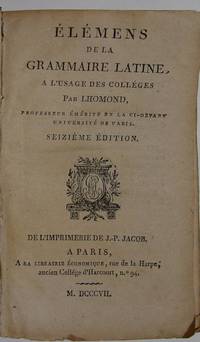
120102Paris De l'Imprimerie de J.-P. Jacob à la librairie Économique rue de la Harpe ancien Collége d'Harcourt no. 94 1807. 12mo. 2164 p. Vellum over boards. 17 cm Details: The binder has covered the boards of this book with two strips of vellum of an old contract or charter. The handwriting on it is cursive and illegible for a layman but 6 signatures are clearly visible 2 first names are legible of one 'Charles' and 'Jacques' Condition: After the titlepage and before the beginning of the first chapter 4 pages are missing. Probably a praefatio or perhaps the 4 pages which have been bound at the end of the book. These 4 pages contain a stocklist of the titles available at the 'Librarie économique'. Vellum soiled. Well read. On some pages marginal numbers in pencil. Paper yellowing Note: Numerous editions of this Latin grammar were published in France during the 19th century. The 'abbé' Charles-François Lhomond 1727-1794 was 20 years 'régent de sixième' at the College of Cardinal Lemoine. After his retirement he dedicated himself to the writing of schoolbooks. His 'Élémens de la grammaire latine' was first published in 1780. Since 1789 he is one of the most reprinted and revised school authors in France. There are 166 plus one more at least editions of his Latin works. A. Chopin 'Les manuels scolaires en France de 1789 à nos jours 3: Les manuels de latin' Paris 1988 We found no copy of this 1807 edition in Chopin nor did we find one in KVK Karlsruher Virtueller Katalog. So this schoolbook must be rare Photographs on request hardcover
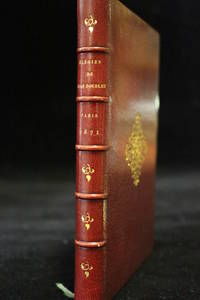
187149410Paris: Librairie des Bibliophiles 1871. Fine. Librairie des Bibliophiles Paris 1871 10.50 x 17 cm relié Reprint for the Cabinet du bibliophile Collection of the Elegies of the Dieppe poet Jean Doublet born at the beginning of the 16th century and died around 1580. Edition of 333 copies this one of 15 numbered copies on Whatman paper. Contemporary binding in full red morocco signed Allô - Wampflug spine with five raised bands decorated with gilt fleurons in compartments gilt fleurons stamped at center of boards double gilt fillet emphasizing edges and headcaps wide gilt dentelle framing pastedowns all edges gilt. Handsome copy in a fine binding by Allô gilt by Wampflug gilder at Lortic from 1856 to 1876. From the library of Baron de Marescot 1879 no. 151 with his engraved armorial bookplate. Librairie des Bibliophiles hardcover
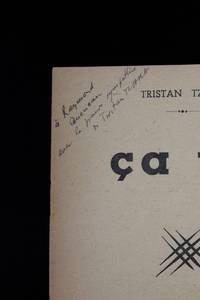
194348247Cahors: Comité national des écrivains Centre des intellectuels 1943. Fine. Comité national des écrivains Centre des intellectuels Cahors 1943 11 x 13.50 cm agrafé First edition on ordinary paper. Handsome autograph inscription signed by Tristan Tzara to Raymond Queneau : "". avec toute la grande sympathie.with all great good wishes "" Tiny insignidficant marginal tears to covers. Comité national des écrivains, Centre des intellectuels unknown
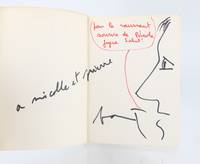
197087446Paris: Le Soleil Noir 1970. Fine. Le Soleil Noir Paris 1970 14.50 x 19.50 cm broché First edition one of 150 numbered copies on Arjomari laid paper. Work illustrated with drawings by Enrico Baj. Handsome copy complete with publisher's slip. Autograph inscription signed by Joyce Mansour to a couple of friends enriched with an original drawing in black felt-tip pen by Enrico Baj representing Joyce Mansour's face in profile. Le Soleil Noir unknown
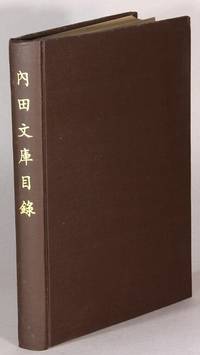
193764182Tokyo: Ko Uchida Kakichi-shi Kinen JigyÅkai 1937. First edition large 8vo pp. 40 375 3; gravure frontispiece portrait and 41 plates; original brown cloth gilt-stamped spine; near fine copy. A catalogue of the private library of Kakichi Uchida chiefly in Japanese with some parts in multiple languages including English. In all 464 items bibliographically described. Kakichi Uchida 1866-1933 was the 9th Governor-General of Taiwan from 6 September 1923 to September 1924. Prior to assuming the office of Governor-General Uchida also served as Chief of Home Affairs under Governors-General Sakuma Samata and Ando Sadami the second highest position in the colonial government. Ko Uchida Kakichi-shi Kinen JigyÅkai unknown
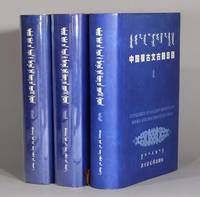
199971242Beijing: Beijing tushuguan chubanshe = Beijing Library Press 1999. First edition 3 volumes large heavy quartos; pp. 18 1132; 6 1133-2310; 6 1141 1; text largely in double column throughout; volume III is indexes; illustrations some in color; a fine set in original dust jackets. "The Catalogue of Ancient Chinese Mongolian Books is compiled by the editorial board of the General Catalogue of Ancient Chinese Mongolian Books. With the support of the National Research Office of Ancient Books of Ethnic Minorities of the National Commission for Nationalities and other units the book unites 180 bibliophiles and 80 individual collectors across the country to systematically sort out Mongolian ancient books before 1949 and includes 13115 entries in four categories: book volumes archival materials gold and stone rubbings periodicals and newspapers. The book adopts international and Chinese national standards for bibliography establishes a special classification system for ancient Mongolian books and completes the Latin transcription and Chinese translation of the title. The book won the first prize of the Inner Mongolia Autonomous Region Social Science Award and the second prize of the National Ethnic Book Award" baidudotcom. Beijing tushuguan chubanshe = Beijing Library Press unknown
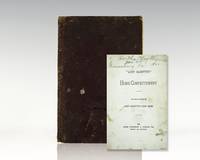
189375073Chicago and Cincinnati: Bloch Publishing & Printing Co 1893. First edition of this early collection of confectionery recipes published as a companion to the author's first book Aunt Babette's Cook Book the first American Jewish cookbook to become a best-seller in 1889. Also published by Bloch Publishing Company the oldest Jewish printing house in the United States Aunt Babette's Cook Book was perhaps so successful because of the extensive inclusion of non-Kosher recipes reflecting the early assimilation tendencies of the 19th-century Reform Jewish movement. Small octavo original cloth. In good condition. This 'little pocket edition' of Aunt Babette's Home Confectionery includes a selection of recipes for popular candies simple enough for even a child to make. Recipes include chocolate kisses cherries in cream butter taffy marshmallows tutti-frutti candy and vanilla caramels. Bloch Publishing & Printing Co hardcover
188863597Paris 1888. Fine. Paris 20 juin 1888 12.40 x 16.70 cm un feuillet Autograph letter signed addressed to Jacques Le Lorrain from Joris-Karl Huysmans 30 lines written in black ink on 2 pages. Manuscript correction by the author. Fold inherent to the letter's mailing. Remarkable letter with sometimes obscure remarks where Huysmans emphasizes the importance and rarity of the writing craft at work in the novel Nu by the cobbler-poet Jacques Le Lorrain. « In these times when people rush books in simple language - you know as well as I what these indigences mean - it is a pleasure to see elucidated sentences labored over expression delivered with forceps ». Sharp as usual Huysmans positions himself as a fierce defender of literary writing experienced as labor which contemporary production seems to be abandoning: « this concern is too exhausted by all and despised for me not to congratulate you on your care ». Accustomed to receiving works from his colleagues Huysmans endeavors to highlight the innovative particularities of each author he receives: « Many pages are truly curious. Lorgeral on the grass closing his eyes listening to the voices - it's fresh and absolutely accurate. The scene of Juliette's armpit kissing. This work so well explained of man's jealousy for the child are particular original corners of this book whose very scrupulous style has captivated me. ». The author Huysmans distinguishes himself here always attentive to the right measure necessary according to him for literary expression: « you have managed to enhance the language to make it neither powerless nor inert. And I know how difficult and rare that is! » unknown
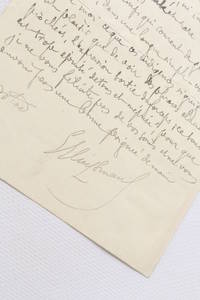
188060600Paris 1880. Fine. Paris s. d. décembre 1880-juillet 1884 11.70 x 9 cm en feuilles Autograph letter-card signed by Guy de Maupassant to Countess Potocka 19 lines in black ink on letterhead ""GM 83 rue Dulong"". Published in Marlo Johnston ""Lettres inédites de Maupassant à la comtesse Potocka"" Histoires littéraires n°40 October-November-December 2009. Maupassant was part of the circle of suitors of Countess Potocka whom she had nicknamed the ""Macchabées"". The author was much in social demand and this created scheduling problems for him: ""Or voici le cas . Legrand m'avait recommandé de ne pas m'engager . à ce dîner en m'annonçant une invitation de sa belle-soeur invitation qui n'est pas venue."" ""Now here is the case . Legrand had recommended that I not commit . to this dinner by announcing an invitation from his sister-in-law an invitation which never came."" He decides to clear up the doubt by going to his friend Georges Legrand's: ""prendre le vent."" ""to test the waters."" A close friend of Maupassant's it was he who introduced him to Countess Potocka. The author would dedicate to him in 1884 the short story Suicide reprinted in the volume Les Soeurs Rondoli and which had previously been published in the magazine Le Gaulois. Maupassant seems more anxious about visiting Potocka whom he had nicknamed ""présidente"" ""president"" and whose ""conscience le préoccupe. Je m'efforcerai de bien la diriger."" ""conscience worries him. I shall endeavor to guide it well."" He refers to the creation of the ""Société religieuse Coopérative sous la dénomination de Société Anonyme Anti-Soporifique pour la Récréation perpétuelle de la comtesse Potocka"" ""Religious Cooperative Society under the name of Anti-Soporific Anonymous Society for the perpetual Recreation of Countess Potocka"" one of the many games that took place during evenings at Countess Potocka's. Before leaving her he reiterates his admiration: ""Je suis aux pieds de ma présidente."" ""I am at the feet of my president."" Provenance: Jean Bonna collection. unknown
1805669741805. Fine. 10 Floréal 13 30 avril 1805 18.50 x 23.10 cm une feuille Stendhal's autograph letter addressed to his sister Pauline. 28 lines written with a fine writing in black ink. First name ""Pauline"" from the hand of the sender at the bottom of the letter. Inventory number ""36"" in ink from another hand. Two small traces of stamp and stamp a small tear restored in the bottom margin of the page. A few tiny folds inherent in the enveloping of the letter. Rare and beautiful letter of Stendhal addressed to his sister Pauline in which all the sensitivity of the young man and his love for the dramatic art shows more than twenty years before his big romantic successes. This letter comes from the correspondence between Henri Bayle here twenty-two years with his sister Pauline three years younger. This true epistolary liaison which quickly took the form of a ""diary"" - Pauline's answers were rare - is an essential milestone in the constitution of the intellectual journey of the future Stendhal. Our letter of a great lyricism testifies to the strength of the bond uniting the young writer and his sister: ""Let's shake each other my good friend. We will never find anyone who loves Pauline as Henry nor will Henry ever find a more beautiful soul than Pauline. ""The use of the third person and a lover vocabulary erects the young woman to the rank of alter ego a sister-soul and even perfect mistress. The young Henri is then precisely under the yoke of a devouring passion for the actress Melanie Guilbert whom he met during his declamation classes at Dugazon: "" I'm going to be bored perhaps by my dark sadness. I know very well that the seriousness of ardent passions is not pleasant. "" Contrasting with this passionate relationship Pauline symbolizes reason and balance a figure that Henri like a pygmalion can fashion at leisure. In good tutor he advises: ""Learn by heart roles. About declamation I will teach you a thousand things. I'm bringing you a Gil Blas and a Tracy. ""We understand here worship Stendhal devoted to the theater from his earliest years both as a player as a playwright the fund of its archives to the Grenoble Library contains nearly 700 sheets of blanks:"" I am in despair at not being able to wear you Beanies. But wait maybe someday will come . as Ulino says. ""This passion for theater Henry intends to pass it to his sister:"" We will work like hell during the time that I stay in Grenoble. ""In total opposite view with the education of women in his time he put a point of honor that Pauline is an educated person; In several letters moreover we find injunctions from the brother ordering his sister to give up needlework in favor of the reading he recommends. Truly obsessed with theater and convinced that he will become an author of successful comedies he works tirelessly: ""I am told a room where I will not be free and where I can not just declaim. Try to disturb this arrangement. ""Years before writing great novels that make her famous Stendhal already understands that loneliness is for him a source of creation and says:"" A lonely is jealous of his freedom. It is his greatest good as that of all men. "" unknown
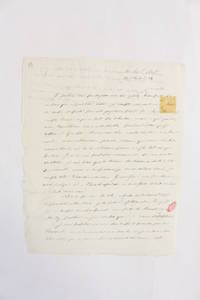
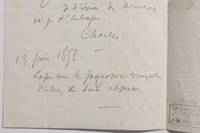
185862164Paris 1858. Fine. ""My dear little mother you are mad"" Paris 13 juillet 1858 mal datée « juin » 13.30 x 20.60 cm 2 pages sur un feuillet remplié sous chemise et étui Autograph letter signed by Charles Baudelaire written in pencil and addressed to his mother. Dry-stamped stationery of the Grand Hôtel Voltaire Faubourg Saint-Germain. Address to Madame Aupick in Honfleur Calvados in the author's hand together with several postal markings dated 13 and 14 July 1858. Several underlinings deletions and corrections by Baudelaire. Trace of a wax seal bearing Charles Baudelaire's initials in pencil probably in the author's hand. A small portion of the second leaf has been excised with no loss of text. This letter was first published in the Revue de Paris on 15 September 1917. From the former collection of Armand Godoy no. 102.The letter is preserved in a half black morocco chemise with abstract-patterned paper boards housed in a matching slipcase edged in the same black morocco and covered with abstract-patterned paper boards. A precious document bearing witness to a decisive moment in the poet's life: his reconciliation with the now widowed Madame Aupick that revered mother «who haunts her son's heart and mind». Victorious Baudelaire had overcome the obstacle represented by his burdensome stepfather whose death he had at times wished for; he was now ready to reclaim his place beside the mother by whom he had so often felt neglected. Following the death of her husband in April 1857 she invited her son to come and live with her in her « toy-house » at Honfleur. This letter reveals a Baudelaire torn by complex emotions: divided between his longing for an ideal union with his mother and his irresistible attraction to spleen. For the « low bohemian » as the Goncourts called him hounded by creditors Honfleur and the exclusive attention of his mother held out the promise of fulfilling his poetic destiny. The poet expressed this hope to his friends notably Antoine Jaquotot mentioned at the end of the present letter: « Je veux décidément mener cette vie de retraite que mène un de mes amis . qui par la vie commune qu'il entretient avec sa mère a trouvé un repos d'esprit suffisant pour accomplir récemment une fort belle uvre et devenir célèbre d'un seul coup. » 20 February 1858 «Tu vas dans peu de jours recevoir le commencement de mon déménagement . Ce seront d'abord des livres tu les rangeras proprement dans la chambre que tu me destines.» By entrusting his books to her he asks his mother to create for him an ideal world in which to write and create. Yet alongside these promises and hopes of a life finally serene and peaceful Baudelaire also reveals his attachment to the existence of the cursed poet: «Tu sais cependant bien que ma destinée est mauvaise.» Beyond his «nouveaux embarras d'argent» it is above all his work that keeps him in Paris: «Si mon premier morceau à la Revue contemporaine a été retardé c'est uniquement parce que je l'ai voulu ; j'ai voulu revoir relire recommencer et corriger.» The «premier morceau» referred to here is none other than « De l'Idéal artificiel le Haschisch » the first text of the future Paradis artificiels 1860 which would not appear until the issue of 30 September 1858. This passage illustrating Baudelaire's relentless perfectionism recalls the extraordinary complexity of the poet's drafts and proofs which he continued to revise meticulously until the very last moment even on the first copies of Les Fleurs du Mal; see the copy we offer. Despite his financial difficulties Baudelaire revised and altered his texts incessantly limiting the number of articles he could produce. Yet he remained convinced that writing would bring him prosperity and confidently declared: «Cette fois-ci je m'en tirerai à moi tout seul sans emprunter un sol.» Baudelaire ultimately left Paris for Honfleur only in January 1859 and did not remain there long. After only a few weeks he hardcover
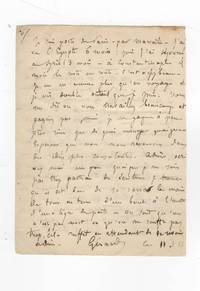
184475148Paris 1844. Fine. Paris 11 février 1844 10.40 x 13.60 cm quatre pages sur deux feuillets Three autograph letters signed by Gérard de Nerval 2 pages signed «Gérard» Théophile Gautier 1 page and a third unsigned letter 1 page penned by a certain «Robert» cf. Nerval's letter Louis Desessart Théophile Gautier's appointed publisher co-published Nervals play Léo Burckart with Barba in 1839. Following financial difficulties he was forced to take refuge «in that sad and charming city of Brussels». The three friends wrote this letter from Paris where they had reunited following Nervals long journey to the East: «I spent six months in Egypt; then three months in Syria four months in Constantinople and the rest en route. Its quite beautiful. I only enjoy myself while traveling and try to live twice as much as I can.» This journey deeply impressed Théophile Gautier who would only travel to Turkey and Egypt years later: «I am in Paris and wish I were in Cairo from where Gérard is returning.» The exoticism of distant lands starkly contrasts with the melancholy and severity of Europe: «How sad Paris is when one returns from sunlit countries.» Nerval And in Paris far from dreams of escape life means toil and melancholy: «We are like sick people who are never comfortable anywhere. I think the good times are gone and the golden hours of the past when we spoke such wise follies will never return. Whats the point of living if we must work and cannot see our friends or write to them or do anything we would like» Gautier The two writers express great compassion for their friends Belgian exile with Brussels appearing as the capital of spleen: «What! Youre still in that sad and charming city of Brussels! . Brussels is even darker poor fellow!» Nerval This joint letter was in fact initiated by «Robert»: «Isnt it true my dear friend that Im quite skilled at making you forget my faults . as a way of making it up to you Im sending you the autographs of two of your . comrades your fondest memories two men of fame who despite all their affection and friendship for you would never have written a word had I not trimmed their quills and handed them paper like sulky children and told them: write at once at once to the exile you love most.» unknown
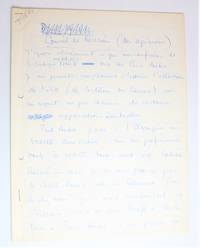
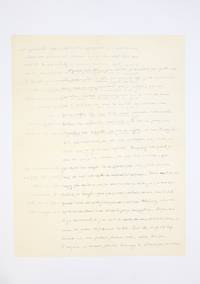
1958738631958. Fine. s. d. 1958 20.90 x 26.90 cm 4 pages sur 4 feuillets Autograph manuscript by Boris Vian titled ""Conseil de révision des opinions"" on Paul Anka: ""Paul Anka is a boy of 20 who writes his own songs and sings them."" n. d. but 1958 20.9 x 26.9 cm 4 pages on 4 leaves Autograph manuscript by Boris Vian titled ""Conseil de révision des opinions Recommendations for a review of opinions"" on Paul Anka. 4 pages written in blue ballpoint pen on 4 perforated leaves stapled. Crossings out and corrections. Lateral fold to left margin but light. The manuscript was for the elite"" which is to say the readers of Canard enchaîné but was eventually published in La Belle époque 1980. A fine article promoting the Olympia concert of a young Paul Anka 17 at the time more than ten years before the global success of My Way. Incidentally Boris Vian made the ""American star"" a little older than his actual years: "" Paul Anka is a boy of 20 who writes his own songs and sings them"". Vian himself a songwriter and musician nonetheless points out: ""Since he has not written dozens and dozens of songs he also sings other people's for example 'Jingle Bells' because it's winter and Christmas."" Vian insists on the snobbery of the Parisian public that is obviously less receptive to American innovations: ""Paul Anka the evening of the premiere had a triumph with the 'people' which chilled the stalls composed of knowing stars semi-stars demi-stars and the usual suspects at such occasions."" Vian then responds point by point to the singer's detractors singing his praises. ""He sings very well and seems able to 'swing' in the Latin way.He has an excellent presence and almost too much craft for his age.He has far fewer 'airs' than one might have feared given his sales and publicity."" Very aware of new American musicians Boris risks a little bit of judgement without losing his legendary humor in keeping with the caustic tone of Canard enchaîné : ""He is thus a classic singer when he wants to be and unfortunately Anka is to be regarded well above the Kalin twins those two awful monkeys and the grimacing Presley whom we saw at the cinema."" As the title of this article indicated ""A recommendation for a revision"" Boris Vian seems to have changed his mind about the young singer after attending his French premiere. In another article planned for Canard enchaîné and written a little while earlier he had declared: ""You clearly know the latest nickname for the young singer Paul Anka 'the Canadian bawler. He is short and charming; the Anka of misfortune."" Provenance : Fondation Vian unknown
186562589Biponti Deux-Ponts 1865. Fine. Biponti Deux-Ponts Vendredi 12 mai 1865 13.20 x 20.80 cm 1 page sur un feuillet remplié Autograph letter signed by Charles Baudelaire written in ink and addressed to his mother. A few underlinings deletions and authorial corrections. This letter was first published in Charles Baudelaire Dernières lettres inédites à sa mère in 1926. Former collection of Armand Godoy no. 197. A precious letter from Baudelaire's Brussels period during the poet's voluntary exile at the end of his life. « Il est douteux que j'habite quelque part à Paris. Je crois que j'habiterai surtout une voiture dans laquelle je ferai si je peux toutes mes courses en un ou deux jours. » Haunted by Paris the city of vice and creditors he dreads this brief return. His exile in Brussels is in his eyes a sign of failure and ever since arriving in Belgium he has delayed his return to France. Yet weary of the flat country he despises he mocks its inhabitants: « On est lent ici. » The poet like the seventeen-year-old student who once promised his mother he would get back on track now vows: « Me voici en mesure d'accomplir tous mes plans. Je ne sais comment t'exprimer ma reconnaissance ; et je crois que la meilleure manière sera d'exécuter mes promesses. » Literally obsessed with this sacred mother « who haunts his heart and his mind » the « grateful son » sees himself as incapable of fulfilling his poetic destiny without her undivided attention. unknown
194875175Antibes 1948. Fine. Antibes 9 mars 1948 21.80 x 27 cm 2 pages sur un feuillet Unpublished autograph letter signed by André Breton addressed to Gaston Puel; two pages on one leaf written in blue ink with fine and careful handwriting numerous underlinings. Foxing and marginal adhesive traces. A very fine letter imbued with benevolence in which the Pope of Surrealism shares his numerous and time-consuming occupations with his young correspondent while reassuring him about his talent and future. Gaston Puel began corresponding with André Breton at the Liberation. They had never met at the time of this letter written four years later: « Je suis heureux que vous ayez pensé à m'adresser votre photographie. C'est un grand pas de fait pour rompre la distance et il ne se peut guère que nous ne nous rencontrions bientôt. » ""I am happy that you thought to send me your photograph. It is a great step towards breaking the distance and it can hardly be that we will not meet soon."" The two writers seem very close as evidenced by Breton's paternal and reassuring tone: « Ne parlez pas comme à regret de ceux qui avancent : vous en êtes et j'en sais bien peu qui soient si loin que vous déjà. Ce que vous m'écrivez - pas seulement cette fois - est toujours pour moi de haute importance. » ""Do not speak regretfully of those who advance: you are among them and I know very few who are already as far along as you. What you write to me - not just this time - is always of great importance to me."" A tireless worker Breton here shares his frustration and weariness with Puel: « Mais il faut continuer à vivre et pour cela se réserver une part de solitude qu'avec angoisse aussi je vois diminuer chaque jour. » ""But one must continue to live and for that reserve a share of solitude which I also see diminishing each day with anguish."" Gaston Puel then 24 years old had been participating for some time in the activities of the surrealist group around Joë Bousquet André Breton and René Char. His mentor here predicts a clear future for him: « Mon cher Ami je souhaite très vivement que vous preniez une part active à la rédaction de « Néon ». Il suffirait d'une très légère transposition de ton pour que les pages que vous m'adressez puissent y trouver place et en constituer un des éléments primordiaux. Il en va naturellement de même pour « Supérieur inconnu » si cette revue peut voir le jour. » ""My dear Friend I very much wish that you would take an active part in the editing of 'Néon'. It would only require a very slight transposition of tone for the pages you send me to find their place there and form one of its primordial elements. The same goes naturally for 'Supérieur inconnu' if this magazine can see the light of day."" This latter review meant to reconcile and unite the conservatives and innovators of surrealism would only come to light forty-eight years later under the impetus of Sarane Alexandrian. Gaston Puel would indeed join the editorial team of Néon but would eventually turn away from the surrealists - while maintaining his friendship with Breton - in 1950. unknown
194060698s. l. Paris 1940. Fine. s. l. Paris s. d. 1940-1943 13.40 x 20.40 cm 2 pages sur un feuillet Autograph letter signed by Georges Bataille to Denise Rollin 25 lines in black ink on one leaf. The first letter Bataille sends to Denise Rollin after her departure for Vézelay. Bataille remains in Paris as he is employed at the Bibliothèque nationale which does not close during the war. The separation has just occurred but Bataille hastens to write: « J'ai hâte de mettre la lettre à la poste elle vous suivra de très près comme tout ce que je suis voudrait vous suivre partout. » ""I am eager to post this letter it will follow you very closely as all that I am would wish to follow you everywhere."" To reassure her he seeks in events signs of good omen: « La sirène que vous avez entendue à l'instant même où nous avons été séparés l'un de l'autre annonçait une fin d'alerte. D'abord j'ai été déprimé par une coïncidence désarmante mais quand j'ai su que c'était la fin de l'alerte je me suis pris au contraire à espérer. » ""The siren you heard at the very moment we were separated from each other was announcing the end of an alert. At first I was depressed by a disarming coincidence but when I learned it was the end of the alert I began on the contrary to hope."" In this separation though essential words are poor to express Bataille's distress: « Mais combien c'est dur de me sentir ainsi tout à coup arraché à vous de ne plus rien pouvoir vous dire d'être réduit à cette lettre. » ""But how hard it is to feel myself thus suddenly torn away from you to no longer be able to say anything to you to be reduced to this letter."" He seeks to make Denise understand the frustration that inhabits him: « Je voudrais que cela soit si transparent entre nous et si ardent en même temps que lorsque vous toucherez ce papier ce soit comme si nous nous touchions. » ""I would wish this to be so transparent between us and so ardent at the same time that when you touch this paper it would be as if we were touching each other."" He wishes to rediscover that closeness they both experienced: « Comme j'ai été près de vous dans la voiture tout à l'heure presque comme jamais : je suis sûr que c'était la même chose pour vous. » ""How close I was to you in the car just now almost as never before: I am sure it was the same for you."" unknown
194360661s. l.: S. n. 1943. Fine. S. n. s. l. s. d. circa 1940-1943 207 x 270 cm 2 pages sur un feuillet Fine and long autograph letter signed by Georges Bataille to Denise Rollin unpublished torn in five pieces not affecting readability 34 lines in black ink on one leaf. Both frequenting Parisian intellectual and artistic circles Georges Bataille and Denise Rollin met during 1939. She was notably the friend of Cocteau Prévert and Breton. Bataille described her thus in his notebooks for Le Coupable: « une illusion aussi fragile qui se dissiperait au moindre souci au moindre relâchement de l'inattention. » ""an illusion so fragile that it would dissipate at the slightest worry at the slightest relaxation of inattention."" Few details remain about their relationship since Georges Bataille's private life particularly during this period is not well documented. The profound feelings that Denise Rollin provoked in Bataille appear in this letter: « Maintenant je n'aspire plus qu'à une chose c'est à vous prouver que je n'appartiens plus qu'à vous que je suis rivé à vous . » ""Now I aspire to only one thing which is to prove to you that I belong only to you that I am bound to you . "" The absolute nature of this love is such that Bataille is ready for anything: « . que vous le sachiez à tel point que si je ne devais plus avoir d'autre moyen qu'une profanation pour vous le prouver je ferais devant vous cette profanation. » ""that you know it to such a degree that if I were to have no other means than a profanation to prove it to you I would commit this profanation before you."" Yet he feels guilty: « Je ne peux pas parler de l'état auquel je suis arrivé je suis trop agité. Je sens j'espère que c'est absurde. J'ai honte même de tant souffrir et de vous ennuyer avec ma souffrance quand vous seule êtes malade. » ""I cannot speak of the state I have reached I am too agitated. I feel I hope it is absurd. I am even ashamed to suffer so much and to trouble you with my suffering when you alone are ill."" The previous year he had lost his companion to tuberculosis. Helpless before illness he admits: « . moi je ne peux pas vous guérir je ne peux même pas vous soigner . » ""I cannot cure you I cannot even care for you . "" Only Denise Rollin would be capable of soothing him: « Tout était noir auparavant . ce que je souffre et que vous pouvez si facilement guérir chaque fois que vous le voudrez . » ""Everything was dark before . what I suffer and which you can so easily cure whenever you wish . "". Abandoned to the throes of anguish Bataille admits: « Je suis tellement fou en ce moment et de cela je veux vous parler que je ressens comme une complicité et une perfidie de tous pour me faire mal comme si vous vous prêtiez au jeu pour que je sois encore plus désespéré . » ""I am so mad at this moment and I want to speak to you about this that I feel like a complicity and perfidy of everyone to hurt me as if you were lending yourself to the game so that I would be even more desperate . "" On the verge of paranoia he begs Rollin: « La seule chose dont je veux vous supplier . c'est de ne plus douter sans cesse de moi comme vous l'avez fait. » ""The only thing I want to beg of you . is to no longer constantly doubt me as you have done."" Yet he understands: « . il y avait en moi et dans mon passé de quoi vous paraître insupportable . » ""there was in me and in my past enough to seem unbearable to you . "" He offers her a solution: « Ce qui m'apaiserait le plus si vous m'écriviez ce serait que vous me disiez que vous me croyez que vous voulez bien que je sois votre chose. » ""What would soothe me most if you were to write to me would be for you to tell me that you believe me that you are willing for me to be your thing."" S. n. unknown
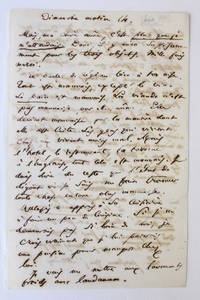
186459356Biponti Deux-Ponts 1864. Fine. Biponti Deux-Ponts Dimanche matin 14 août 1864 13.40 x 20.60 cm 3 pages sur un feuillet remplié N. p. Bruxelles Sunday morning 14 August 1864 134 x 206 cm 3 pages on a folded leave Autograph letter signed in black ink addressed to his mother and dated Sunday morning the 14th. A few underlinings deletions and corrections by the author. Formerly in the collection of Armand Godoy n°188. A fading Baudelaire: The state of disgust in which I find myself makes everything seem even worse. Drawn by the promise of epic fame Baudelaire went to Belgium in April 1864 for a few conferences and in the hope of a fruitful meeting with the publishers of Les Misérables Lacroix and Verboeckhoven. The meeting didn't happen the conferences were a failure and Baudelaire felt boundless resentment for Poor Belgium. Nonetheless despite numerous calls to return to France the poet would spend the rest of his days in this much-castigated country living the life of a melancholic bohemian. Aside from a few short stays in Paris Baudelaire floored by a stroke that left him paralyzed on one side would only return to France on 29 June 1866 for a final year of silent agony in a sanatorium. Written barely a few months after his arrival in Brussels and his initial disappointments this letter shows us all the principal elements of the mysterious and passionate hatred that would keep the poet definitively in Belgium. In his final years in France exhausted by the trial of The Flowers of Evil humiliated by the failure of his candidacy to the Académie Française a literary orphan after the bankruptcy of Poulet-Malassis and disinherited as an author by the sale of his translation rights to Michel Lévy Baudelaire was above all deeply moved by the inevitable decline of Jeanne Duval his enduring love while his passion for la Présidente had dried up her poetic perfection not having withstood the prosaic experience of physical possession. Thus on 24 April 1864 he decided to flee these decomposing loves of which he could keep only the form and the divine essence. Belgium so young as a country and seemingly born out of a Francophone Romantic revolution against the Dutch financial yoke presented itself to the poet phantasmagorically as a place where his own modernity might be acknowledged. A blank page on which he wanted to stamp the power of his language while affirming his economic independence Belgium was a mirror onto which Baudelaire projected his powerful ideal but one that would send him tumbling even more violently into the spleen of his final disillusionment. Published in the Revue de Paris in November 1917 without the sensitive passage about his cold enemas this emblematic letter evokes all of Baudelaire's work as poet writer artist and pamphleteer. The first such reference is via the reassuring mentor-like figure of the publisher of The Flowers of Evil Poulet-Malassis: If I was not so far from him I really think I'd end up paying so I could take my meals at his. This is followed by a specific reference to the venal value of his Aesthetic Curiosities: all these articles that I so sadly wrote on painting and poetry . Baudelaire then confides in his mother his hopes for his latest translations of Poe which to his great frustration are not getting published by L'Opinion La Vie Parisienne or in Le Monde illustré. He concludes with his Belgian Letters which Jules Hetzel had just told him had been after negotiations with Le Figaro received with great pleasure. Nonetheless as Baudelaire literally underlined they were only to be published when I come back to France. His perennially imminent return to France is a leitmotiv of his Belgian correspondence: Certainly I think I'll go to Paris on Thursday. It is nonetheless always put off I'm putting off going to Paris until the end of the month he corrects himself eight days later and it seems to stoke up the poet's ferocity towards his new unknown
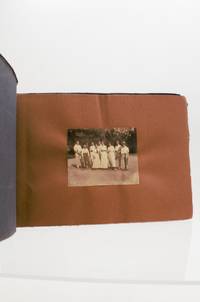
191475823s. l. 1914. Fine. s. l. s. d. 1914 26 x 17.50 cm 8 photographies dans un album cousu Eight period albumen photographs depicting an amateur tennis team. Blue paper album sewn with red cord title and date in silver ink on the first cover. Very fine condition. unknown
194060700s. l. 1940. Fine. s. l. s. d. circa 1940 20.90 x 26.90 cm 2 pages sur un feuillet Autograph letter signed from Georges Bataille to Denise Rollin 40 lines in black ink two pages on one leaf. George Bataille and Denise Rollin's relationship lasted from the autumn of 1939 to the autumn of 1943 and left behind it a short but passionate correspondence. This letter dates from the early days of their connection but already reveals Bataille's agonies: Perhaps I was too happy with you for some months even though suffering did not wait long to interrupt at least for a time a happiness that was almost a challenge. A passionate lover Bataille moved from exultation to the deepest doubt and even offered his lover a potential way out of their relationship: If you can't take it me any more I beg you don't deceive yourself any longer: tell me it's me and not some foible I could have avoided and which is easily repairable. He would rather be sac- rificed on the altar of their love than have a relationship that was bland and flavorless: Understand me when I tell you that I don't want everything to get bogged down that I would really rather suffer than see a sort of shaky mediocrity as a future for you and me. Earlier in the letter he turns to humor to tear him away from his worries: I hardly dare make you laugh by telling you that I've lost weight so that my trousers occasionally fall down because I've not yet gotten into the habit of tightening my belt to the new notch. Then he goes back to pleading: I write to you like a blind man because that is what you make me when you talk to me the way you do when you leave or when you phone you make me fall into a darkness that is almost unbearable. He then tries to get a grip on himself: there are moments I'm ashamed of doubting you and being afraid or of stupidly losing my head. Finally hemmed in by all his doubts as a lover Bataille tried to find some respite in talking about the family that he had made up with Denise and her son Jean alias Bepsy: If you write me tell me how Bepsy's doing which is perhaps the only thing that you can tell me that doesn't touch something painful in me. Although Bataille's life as a writer is well known in these years little is known about his private life. And it is not the least paradox of his very revealing work that it only tells the minimum of his private affairs and usually the worst of it. M. Surya G. Bataille la mort à l'uvre. When Georges Bataille met Denise Rollin in 1939 he had just lost his lover Colette Peignot to tuberculosis. His friends had abandoned him and war had just been declared. This sentimental and social chaos however does not affect Bataille as much as the tumultuous relationship he took up with Denise Rollin who was a friend of Cocteau Breton Prévert and a muse of painters Kisling and Derain. Their romance lasted four years and left very few details of their sentimental life during this period of Occupation except what Bataille is willing to tell us in his novel Le Coupable The Guilty partly inspired by this passionate and painful relationship. In a 1961 interview Bataille looked back on this time: ""Le Coupable is the first book that gave me a kind of satisfaction an anxious one at that that no book had given me and that no book has given me since. It is perhaps the book in which I am the most myself which resembles me the most. because I wrote it as if in a sort of quick and continuous explosion."" The letters addressed by Bataille to Denise during this period contain the seeds of the feelings that explode in Le Coupable as in all of Bataille's work. His writing is an ebb and flow of love and suffering between ecstasy and disappointment calm and energy mixing familiar and formal tones compliments and reproaches. The letters are often impossible to date with precision as they all proceed from the same movement of ecstatic flagellation. In 1943 Georges Bataille found a house i unknown
188460604s. l. Paris 1884. Fine. s. l. Paris s. d. circa juillet 1884-décembre 1889 7 x 9.10 cm 2 pages sur une carte-lettre Autograph letter-card signed by Guy de Maupassant to Countess Potocka 13 lines in black ink on letterhead « GM 10 rue Montchanin ». Published in Marlo Johnston « Lettres inédites de Maupassant à la comtesse Potocka » Histoires littéraires no. 40 October-November-December 2009. From 1877 onwards Maupassants health underwent continuous decline beginning that year with the contraction of syphilis. In addition he had to contend with hereditary dementia within the family. Subject to violent migraines his sociability sometimes suffered: « Je dois vous prévenir que je suis plus muet et plus ennuyeux que jamais je le sais vous pouvez donc ne pas me le dire. » He nevertheless took care to reassure his correspondent: « Moi je serai ravi de vous voir. Je vais rester fort peu de temps à Paris je ne vous fatiguerai donc pas trop. » Provenance: Jean Bonna collection. unknown
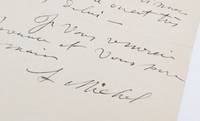
188683952s. l. Paris 1886. Fine. Letter to the Tiger: ""Before returning to the cage"" s. l. Paris 7 août 1886 13.20 x 19.20 cm 3 pages sur un bifeuillet Autograph signed letter from Louise Michel addressed to Georges Clemenceau; three pages written in black ink on a bifolium of white paper. Transverse creases inherent to posting. Fine letter from Louise Michel to Clemenceau one of her most important supporters before yet another incarceration: « Il faut avant de rentrer en cage . que je vous demande le grand service de faire entrer à l'hospice mon cousin le petit Dacheux à qui vous avez bien voulu faire avoir sa dispense d'âge. » ""Before returning to the cage . I must ask you the great favor of having my cousin little Dacheux admitted to the hospice for whom you were kind enough to obtain his age exemption."" The former communard has indeed just been sentenced to four months in prison for having given a speech in favor of the Decazeville miners alongside Jules Guesde Paul Lafargue and Étienne Susini. But for now it is the condition of her cousin Lucien Dacheux that concerns her: « Son genou étant de plus en plus malade on l'envoie en congé de deux mois mais il faut qu'il entre à l'hospice s'il ne veut pas rester estropié. De plus on n'a pu lui donner une mécanique pour son genou et en même temps le médecin lui disait que c'était indispensable - peut-être pourra-t-il en avoir une au Val de Grâce - je le recommande bien à vous et au citoyen Lafont - J'irai vous voir pour cela et une autre chose du même genre avant le 12 mais s'il était possible de faire entrer avant à l'hospice le petit Lucien Dacheux je serais bien heureuse car il sera tout à fait estropié et incapable de continuer son service où on est très content de lui. » ""His knee being increasingly ill they are sending him on two months' leave but he must be admitted to the hospice if he doesn't want to remain crippled. Moreover they couldn't give him a mechanism for his knee while at the same time the doctor told him it was indispensable - perhaps he could get one at Val de Grâce - I recommend him highly to you and to citizen Lafont - I will come to see you about this and another matter of the same kind before the 12th but if it were possible to have little Lucien Dacheux admitted to the hospice beforehand I would be very happy because he will be completely crippled and unable to continue his service where they are very pleased with him."" Louise Michel met Clemenceau in October 1870 when he was mayor of Montmartre and she was assistant schoolmistress. From their first meeting was born a strong friendship that lasted until Louise Michel's death. Clemenceau never ceased to support her particularly during her banishment to Nouméa and they maintained an extensive correspondence. A moving letter testimony to the unwavering devotion of the former communard and to the great friendship that united Louise Michel to Georges Clemenceau. unknown
188460657Paris 1884. Fine. Paris s. d. début janvier 1884 10.20 x 13 cm 4 pages sur un feuillet double Signed autograph letter from Guy de Maupassant to the Countess Potocka 67 lines in black ink on a letterhead ""GM 83 rue Dulong"" envelope attached. This long letter begins with a commission that was made to Maupassant: "" I immediately pay for a commission for which I am charged although I seem to find a little irony in it. The Princess Ourosow who has just written to me to ask to see her this evening begs me in postscript to remind her of your memory when I see you. Princess Ourosov was the wife of the Russian ambassador to Paris. With the Countess she was part of that worldly gotha that surrounded authors and artists. The irony he mentions is this: "" As reputed perceptive people asserted that all the thought of a woman's letter is in the postscript . I wanted to fulfill my role immediately 'intermediate. Because of this addition he deduced: "". that the letter of the Princess despite what it contains of amiable for me was addressed to you ."" This amazing letter then addresses a little-known leaning of Maupassant: his taste for fetishes. He informs his correspondent that: "" The hand since she came home seems to me in an extraordinary agitation. This is the famous hand that Maupassant had bought from George Powell. It was through the poet Charles Swinburne whom Maupassant almost saved from drowning that the two men met at Etretat in 1868. Powell and Swinburne shared a house there filled with Powell's collection of curiosities. The hand in question was mummified and it inspired Maupassant twice. A first in 1875 with La Main de l'écorché then in 1885 with La Main . This nervousness of the lucky charm makes Maupassant wonder: "" Perhaps you were wrong not to keep it as a fetish He adds: ""But I have other singular fetishes. Do you want one Indeed he possesses a collection: "" I own the shoe of a little Chinese woman who has died of love for a Frenchman. He comments on the potential effects of these objects: "" This talisman brings happiness to the desires of the heart. I still have a large copper cross very ugly which worked miracles in the village where I found it. But these talismans do not all work as they should: "" Since she is at home she does not. Maybe it's the environment that's bothering her. But it is not the most astonishing: ""But what I possess most singular are the two ends of a man deceived by his wife and died of shagreen. The guilty wife kept the husband's foot and horn . and made them weld together. I do not know what the effect of this object may be. Despite the seriousness of the affair Maupassant did not abandon his humor: "" Say madam do you want a fetish"" I add that my friends pretend that I bring happiness myself! I place at your feet this last vegetarian who asks for the preference . "" To echo his statement regarding female postscript he adds two to his letter. The first asked the Countess Potocka to recall Maupassant to the memory of Madame Lambert. This lady was the wife of Eugene Lambert a painter known for his cats and who frequented the same milieu as Maupassant and the Countess. The second is much more flavourful: "" Men should not be attached to the postscript of the same importance as to women. "" unknown
194360699s. l. 1943. Fine. s. l. s. d. 1943 13.50 x 20.80 cm 2 pages sur un feuillet BATAILLE Georges. Autograph letter signed to Denise Rollin: Cela me déchire toujours de me séparer de vous. It always tears me up to part from you. N. d. 1943 135 x 208 cm 2 pages on a single leaf Autograph letter signed from Georges Bataille to Denise Rollin 46 lines in black ink to one leaf dampstain to upper right not touching text. The majority of the letter is given over to the search for a house in Vézelay: I've already seen a house and an apartment. In 1943 Georges Bataille had the idea of renting a house in Vézelay where the couple could move in with Laurence the daughter of Georges and Sylvia and Jean alias Bepsy Denise Rollin's son. The lovers had just parted: It always tears me up to part from you. Yesterday I felt a terrible malaise. I'd hardly managed to come out of it when I realized that I had surely not come for nothing and that we would be able to settle here. To help Denise in his choice he describes to her the various advantages and inconveniences of the two places: The house is really good but sadly has one serious downside: the garden ends in a low wall onto which Jean could climb and fall down the other side which is lower. We look out over the countryside from high up and far off into the distance. The garden is pretty the interior a little sad and dilapidated. The apartment isn't bad but it doesn't have a garden and no view of the countryside either. The couple took great pains in choosing the ideal place to bring together their patched-up family. There was even a suggestion of bringing Sylvia Bataille and Jacques Lacan to live in Vézelay as well. Bataille is unsure about the apartment: there's nothing else to rent other than what I've already seen; this was perhaps intended for Jacques Lacan and Sylvia Bataille. Bataille and his ex-wife Sylvia separated in 1934 and she had found love with the psychoanalyst Jacques Lacan whom she went on to marry in 1953. After these questions of real estate Bataille goes on worrying about another problem food: As for provisions it's certainly hard but all in all one has to get by one way or another. The Second World War was in essence at its turning point and the Nazis feeling their gains threatened became even harsher. This coupled with a rise in agricultural taxes resulted in a shortage of food: I say that we would surely find a way around the provisions problem in the sense that there is as much meat as you want. It's vegetables that are hard to find. You can get milk but not butter. People say that here if the Zervoses wanted to they could help us get along nicely Christian and Yvonne Zervos were important figures in the town of Vézelay where they had bought a second home in 1937. He was the publisher of Cahiers d'art in which Bataille had published and she was the director of the gallery of the same name. At the start of the war they decided to move there permanently and used the isolation of the property to hide their friends Paul Éluard and Nusch. The Zervoses were thus well established by the time of this letter and Bataille had been told by people in the area: they think that knowing the Zervoses will be a great advantage over people who come to settle here knowing no one. But he doesn't seem to have taken advantage of this advice no doubt dominated by his feelings and the editing of his work Le Coupable Guilty. Diane Kotchoubey's Bataille's future lover settling in Vézelay shortly after this letter sealed the fate of the Bataille-Rollin relationship. By the end of 1943 Bataille had left Denise Rollin for his new flame. unknown