Joris-Karl HUYSMANSBiblio.com
43 665 résultats
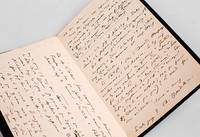
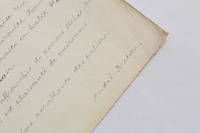
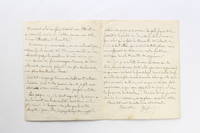
189463596Paris 1894. Fine. Paris 8 février 1894 10.60 x 13.50 cm un feuillet remplié Autograph letter of Joris-Karl Huysmans signed to Camille Mauclair 44 lines written in black ink 3 pages on a folded sheet handwritten correction of the author. Two restorations using strips of paper in high and low fold of the letter the second band very slightly affects a word of the text a fold inherent in the enveloping of the letter. A long and beautiful letter in which all Huysmans' respect and interest are shown for the writings of the young Symbolist generation. Both author and literary critic Huysmans embodies a central figure for young poets like the 22-year-old Camille Mauclair who sends him one of his first poetic collections: "" The chapter on the symbol is perfect ; it is certainly the first time that we explain and with such lucidity we put things back in place. "" Heart of the symbolism and the poetic fiber of Huysmans the music of the language is particularly honored both in the lyrics and in the author's writing: "" the pieces on death on sensuality are woven into the most vivid language . and the fine writer who found the cold and ethereal absentee who wrote such sentences: ""we strive to determine our true ghost in the tumult of appearances "". "" Introduced by the mention of the myth of Narcissus Symbolist figure par excellence the letter shows the philosophical questions that underlie the movement. « Narcissus is God - It is not very beautiful to contemplate the soul . It is true that you in a melancholy return on the vanity of being have shown in a vibrant page the actors of ourselves as we are. The mystical evocations direct to Satan and more ambiguous to God echo the literary conversion of Huysmans who in 1894 prepares the writing of En Route the first part of his trilogy during direct ""black book"" that is there : ""Ah! the damn God! Really that makes me dream of a literature that feeds less his Satan as you say to a literature of humility! "" Accustomed to digressive theoretical reflections on literature Huysmans concludes his letter with: "" At bottom I am stupid to quibble over ideas because in short all the ones we express and that we will make are already in d ' other times and they are more or less new depending on whether they are more or less forgotten but what is not done before you what you own is the way to coat them. And that's where I admire you wholeheartedly because those are your sentences. "" unknown
188566470s. l. 1885. Fine. s. l. s. d. juillet-août 1885 9.60 x 15.50 cm une feuille Autograph manuscript by Guy de Maupassant to Countess Potocka 36 lines in ink on one page. Horizontal fold at center. Published in Philippe Dahhan ""Guy de Maupassant et les femmes : essai"" Bertout 1996. Unusual manuscript by Maupassant giving a false rabies vaccine formula he calls ""Élixir Pasteur"" made with namely ""seven tears of a rejected academic candidate"" ""five drops of journalist's drool"" and ""one centimeter of novelist's pride"". This amusing prescription is addressed to Countess Potocka a wealthy aristocratic socialite and intellectual whose beauty and fickle personality greatly inspired feminine Maupassant characters: Christiane Andermatt in Mont-Oriol and Michèle de Burne in Notre cur Our Heart. Maupassant writes to Emmanuela Pignatelli di Cergharia wife of the extremely rich Polish count Nicolas Potocki who allowed her a great deal of freedom. Her Parisian salon in the avenue Friedland was from 1882 onwards the exclusive meeting place for an elite composed of writers socialites and literary types. It hosted each Friday a council of suitors ""dying of love"" ironically nicknamed the ""Maccabees"" in reference to the seven martyred brothers of the Bible. Visitors included Guerlain who made a perfume for her called Shore's caprice and composer Camille Saint-Saëns who wrote a mazurka for her artist Léon Bonnart who painted her portrait as well as young Marcel Proust who wrote a Figaro column about her renowned gathering. She remained Maupassant's greatest conquest and muse whom he courted until the end of his life. The author gives the Countess an unlikely recipe for Elixir Pasteur inspired by Louis Pasteur's rabies experiments using rabbit marrow. The undated autograph manuscript was probably written in July-August 1885 when Pasteur successfully administered his rabies vaccine to nine-year-old Joseph Meister. Maupassant deploys his talents for farce and parody twisting medical jargon to create a fake vaccine: ""So this last animal receives the rabies virus at its seventh potency and instantly goes into a rage. You then remove its left eye and extract the visual fluid with a morphine syringe. You put this fluid in a small granite jar with five drops of journalist's slime"". Diagnosed with syphilis some ten years earlier Maupassant was in fact particularly familiar with remedies and potions. He was a frequent visitor to spa towns and consulted numerous doctors before his internment at Doctor Blanche's clinic where he died of general paralysis on July 6 1893. This humorous note to Countess Potocka is one of his countless seduction attempts. He remained an eternally thwarted lover despite having written numerous manuscripts for her composed poems written on fans and visited her almost daily during his stays in Paris. Their correspondence went on for many years with Maupassant going so far as to create the ""Société Anonyme Anti-Soporifique pour la Récréation perpétuelle de la Comtesse Potocka"" with the sole aim of entertaining the Countess and escaping her indifference: ""Realizing that my efforts are often fruitless in the face of your deliberate indifference I've tried to find a way to overcome your boredom on every occasion"" Letter August 1885 The Morgan Library New York. Maupassant ends his note with an amusing remark proving the effectiveness of his remedy against rabies: ""It is by this method that all accidents were avoided during the last Congress"" in reference to the Berlin Conference of 18841885 also known as the Congo Conference where the colonial partitioning of Africa was decided. Provenance: Jean Bonna collection. unknown
188960645Triel Triel-sur-Seine 1889. Fine. Triel Triel-sur-Seine s. d. 8 juillet 1889 9.90 x 15.20 cm 3 pages sur un feuillet rempliée Autograph letter signed by Guy de Maupassant to Countess Potocka 38 lines in black ink on a double sheet. Published in Marlo Johnston ""Lettres inédites de Maupassant à la comtesse Potocka"" Histoires littéraires no. 40 October-November-December 2009. Darker than usual Maupassant seems troubled by some incident he does not mention but for which he apologizes to the Countess: ""Je vous demande encore pardon ce qui du reste n'atténue pas mon remords ; et je vous assure qu'il est cuisant car j'ai cette arrière-pensée que cous m'en voudrez un peu pendant longtemps."" ""I ask your pardon once again which moreover does not diminish my remorse; and I assure you that it is stinging for I have this nagging thought that you will hold it against me for a long time."" Maupassant had earned a reputation as a prankster as well as a man of very free speech; he had no doubt crossed a line in word or deed. A few years earlier he had distinguished himself with the famous doll prank. Countess Potocka had given Maupassant rag dolls representing the guests at a dinner she was hosting at her home. As a joke he stuffed the bellies of said dolls and sent them back to the Countess the next day thus claiming to have impregnated them overnight. The prank became known and provoked many outraged reactions but the Countess had eventually assured him of her forgiveness. Whatever the unfortunate event may have been the letters seem to have crossed in the mail: ""Votre lettre m'a été renvoyée à Triel car le facteur ne me savait pas à Paris."" ""Your letter was forwarded to me at Triel because the postman did not know I was in Paris."" Thinking he would again face reproaches he admits to having: "". été en la lisant pénétré de confusion."" ""been upon reading it filled with confusion."" Anxious to please the Countess he expresses his concern: ""Pourquoi suis-je ainsi nerveux par moments comme une femme sans motifs réels et sans avoir ressenti vraiment aucun froissement. Je n'en sais rien. Je ne peux que le constater."" ""Why am I thus nervous at times like a woman without real motives and without having truly felt any offense. I know nothing of it. I can only observe it."" Whether they were the early signs of the madness in which he would end his days or the consequences of his feelings for the Countess whom he feared to anger these fits of nervousness would never cease for the rest of the author's life. To ensure the Countess's visit to Triel Maupassant asks for confirmation: ""Je compte sur vous demain n'est-ce pas."" ""I count on you tomorrow do I not."" To this end he advises her to take the train: ""Si vous venez par le chemin de fer comme vous y paraissez décidée j'irai vous attendre à Meulan . Si vous veniez par le bateau de Georges je vous prie de vouloir bien m'en informer par une dépêche."" ""If you come by railway as you seem decided to do I will go wait for you at Meulan. If you were to come by Georges's boat I beg you to kindly inform me by telegram."" The Georges in question is Georges Legrand journalist one of the Countess's ""Macchabées"" whom she introduced to Maupassant and according to painter Jacques-Émile Blanche the only one who enjoyed her favors. Provenance: Jean Bonna collection. unknown
185965117Honfleur 1859. Fine. Honfleur 28 février 1859 13.10 x 20.50 cm 3 pages sur un feuillet remplié Remarkable autograph letter signed by Charles Baudelaire to Auguste Poulet-Malassis publisher of Les Fleurs du Mal dated 28 February 1859 and written in Honfleur. 64 lines in black ink some passages underlined housed in a modern black half-morocco folder. Baudelaire appears preoccupied with the Sainte-Beuve/Babou affair one of the many controversies following the Fleurs du Mal trial in which the writer Hippolyte Babou accused Sainte-Beuve of failing to defend Baudelaire during the proceedings. Excerpts from this letter were quoted by Marcel Proust in his celebrated Contre Sainte-Beuve where he lamented Sainte-Beuves cowardice during the trial of Les Fleurs du Mal and the undue esteem Baudelaire continued to show him. The poet writes from Honfleur where he had retired in January to live with his mother a revered figure who haunts her sons heart and mind. This letter was written eight days after a new development in the aftermath of the Fleurs du Mal trial. Torn by conflicting emotions Baudelaire confides in Malassis after his friend Hippolyte Babou had on 20 January published an article in La Revue française attacking Sainte-Beuve for failing to defend Baudelaire during the trial: He will glorify Fanny by Ernest Feydeau the honest man and remain silent about Les Fleurs du Mal he wrote. Despite Baudelaires pleas Sainte-Beuve had never published anything in support of the collection. In response to Babous attack Baudelaire received a horrible letter from Sainte-Beuve: It seems the blow . struck Sainte-Beuve deeply. I must do him the justice of saying he did not believe I had prompted Babou in any way. Although outraged by the accusations Sainte-Beuve did not hold Baudelaire personally responsible. Baudelaire is surprised by the critics vehemence writing to Poulet-Malassis: Truly here is a passionate old man with whom it is dangerous to fall out . You cannot imagine what that letter from Sainte-Beuve is like. It appears that for twelve years he had been noting every sign of malice from Babou. Baudelaire stands helpless amid the quarrel between two respected men while expressing a clear attachment to Sainte-Beuve now jeopardised by Babous article: Either Babou wanted to help me which would imply a certain degree of stupidity or he wanted to play a trick on me; or he simply pursued a mysterious grudge without any concern for my interests. Baudelaire indeed held Sainte-BeuveUncle Beuvein the highest regard. A senator an academician and the undisputed master of literary criticism Sainte-Beuves opinions carried great weight in Parisian literary circles. For years Baudelaire had awaited a formal sign of approval from Sainte-Beuve which might have bolstered his fragile career still tarnished by the scandal of Les Fleurs du Mal. The poet thus finds himself torn between his admiration for Sainte-Beuve and his long-standing friendship with Hippolyte Babouwho according to legend suggested the title Les Fleurs du Mal. To Poulet-Malassis he confides: What made this situation dangerous for me was that Babou appeared to be defending me against someone who had done me a great many favours. It remains unclear what Baudelaire meant by favours given that Sainte-Beuve had done relatively little to advance his career. This letter was later quoted in Marcel Prousts posthumously published Contre Sainte-Beuve 1954 a fierce and famous indictment in which Proust reproaches Sainte-Beuve for failing to recognise Baudelaires poetic genius and highlights his cowardice during the Fleurs du Mal trial. To preserve his position in the Senate Sainte-Beuve refrained from public support and provided only a defence strategy which the lawyer was authorised to use provided Sainte-Beuves name was not mentioned. Nearly two years after the verdict the disastrous trial of Les Fleurs du Mal still haunted B unknown
178059110s. l.: S. n. 1780. Fine. S. n. s. l. 17 août 1780 10 x 16 cm 2 pages sur un feuillet Handwritten letter to his wife. Sufferance and philosophy: Punish as much as you like but do not kill me: I did not deserve it . Ah! If you could read to the bottom of my heart see everything that happens there I think you would give up using it!August 17 1780 10 x 16 cm loose leaves Handwritten letter from the Marquis de Sade addressed to his wife. One recto-verso leaf written in fine tight writing. It has the partial date at the top ce jeudi 17 this Thursday 17th. Two slight signs of folding. The end of the letter was mutilated at the time probably by the prison administration which destroyed the Marquis' licentious correspondence. So several months later in March 1781 his wife wrote to him: My dear you really must change your style so that your letters can reach me whole. If you give the truth it offends turns against you. If you give any untruths they say: this is an incorrigible man always with the same head that ferments ungrateful false etc. In any case your style can only harm you. So change it. The letter was found as it was when in 1948 the Marquis' trunk that had been sealed by the family since 1814 was open and it was published in this reduced form in the correspondence of the Marquis de Sade. Provenance: family archives. This letter was written on 17 August 1780 during the Marquis' incarceration in Vincennes Prison. Following the umpteenth altercation with the prison guard the right to go for a walk was taken away from him on 27 June and was not reinstated until 9 March the following year. The Marquis' physical and mental health is strongly affected by not being able to go out and he constantly begs Renée-Pélagie for the right to be quickly reinstated: I urge you to let me get some fresh air: I absolutely cannot take it any longer. The suffering caused by these deprivations is a pretext for setting up a mechanism of guilt and blackmail with his wife: There three days that I have felt an awful dizziness with blood rushing to my head so much so that I do not know how I have not fainted. One of these days they will find me dead and you will be responsible after having warned you as I do and having asked you for the help which I need to avoid it. Here the Marquis is intentionally pulling on Renée-Pélagie's heartstrings really putting her Christian values to the test and giving her the role of grand inquisitor: You can grant me what I ask for whilst keeping on your signal the same strength. We note as in Tancrède's letter a new appearance of signal which masks completely different semantics. An essential component of the Marquis' prison mindset this encoded language like the fantasised interpretations of his correspondents' letters feeds the theories of researchers philosophers mathematicians. and poet biographers. As such Gilbert Lely estimates that far from being symptomatic of psychosis the return to signals is his psyche's defence reaction a subconscious struggle against despair where without the help of such a distraction his motivation could have declined. Missing from his correspondence during his eleven years of freedom these enigmatic semantic depths a real challenge to semiological judgement Lever p.637 reappear in his Charenton diary. This letter is also an opportunity for the Marquis to deploy his rhetorical panel confronting the sadistic antonyms in the same sentence. Pleasure is synonymous with abominable revolting cemeteryand garden are superimposed I suffer is conjugated as I enjoy and softness stands alongside darkness. The mastered practice of this eloquence exercise is united with the depths of Sadian thought: sufferance and pleasure are closely mixed simultaneously endured inflicted and desired. Through these associations we glimpse the sensitive Manicheism of the Marquis's philosophical thought which reaches its climax at the S. n. unknown
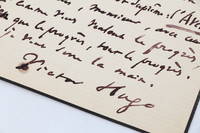
1871833181871. Fine. « So that justice finally be done for women » Mardi 7 novembre 1871 13.30 x 20.80 cm 2 pages sur un feuillet double Autograph letter signed by Victor Hugo to Léon Richer two pages in black ink on a double sheet framed in black. Crosswise folds inherent to envelope inserting. A central tear at the junction of the two sheets. Published in uvres complètes de Victor Hugo Ollendorff 1905. Manuscript housed in a blue half morocco chemise and slipcase marbled paper boards marbled paper slipcase signed Boichot. A magnificent and important letter to Léon Richer one of the first male feminist activists considered by Hubertine Auclert as the ""father of feminism"" and later regarded by Simone de Beauvoir as its ""true founder"". This deeply humanist text is a compendium of Victor Hugo's campaign for the abolition of capital punishment and the female attainment of social equality and civil rights. « Mardi 7 novembre 1871 Monsieur on m'a demandé d'urgence mon intervention pour les condamnés à mort. L'accomplissement de ce devoir a retardé ma réponse à votre excellente lettre. Vous avez raison de compter sur moi pour affirmer l'avenir de la femme. Dès 1849 dans l'Assemblée nationale je faisais éclater de rire la majorité réactionnaire en déclarant que le droit de l'homme avait pour corollaires le droit de la femme et le droit de l'enfant. En 1853 à Jersey dans l'exil j'ai fait la même déclaration sur la tombe d'une proscrite Louise Julien mais cette fois on n'a pas ri on a pleuré. Cet effort pour qu'enfin justice soit rendue à la femme je l'ai renouvelé dans les Misérables je l'ai renouvelé dans le Congrès de Lausanne et je viens de le renouveler encore dans ma lettre au Rappel que vous voulez bien me citer. J'ajoute que tout mon théâtre tend à la dignification de la femme. Mon plaidoyer pour la femme est vous le voyez ancien et persévérant et n'a pas eu de solution de continuité. L'équilibre entre le droit de l'homme et le droit de la femme est une des conditions de la stabilité sociale. Cet équilibre se fera. Vous avez donc bien fait de vous mettre sous la protection de ce mot suprême : l'Avenir. Je suis Monsieur avec ceux qui comme vous veulent le progrès rien que le progrès tout le progrès. Je vous serre la main. Victor Hugo » ""Tuesday november 7 1871 Sir I have been urgently asked to intervene on behalf of those sentenced to death. The fulfillment of this duty has delayed my reply to your excellent letter. You are right to count on me to defend the future of women. As early as 1849 in the National Assembly I made the reactionary majority burst into laughter by declaring the rights of man as natural counterparts to the rights of woman and the rights of children. In 1853 in my Jersey exile I made the same declaration on the grave of an outlaw Louise Julien but this time people didn't laugh they wept. I renewed this effort to finally do justice to women in Les Misérables I renewed it in the Congrès de Lausanne and I've just renewed it again in my letter to Le Rappel which you are kind enough to publish. I would add that every single one of my theatrical works aims to dignify women. As you can see my plea for women is long-standing and persevering and no other has ventured to continue with this endeavor. Balance between men's rights and women's rights is one of the conditions of social stability. This balance will be achieved. I commend you for placing yourself under the protection of this supreme word: the Future. I am Sir with those who like you want progress nothing but progress the whole of progress. I shake your hand. Victor H Although this letter focuses primarily on advocating for women's rights it begins with the death penalty: I have been urgently asked to intervene on behalf of those sentenced to death. The fulfillment of this duty has delayed my reply to your excellent letter. Shortly after the Paris Commune the October 1871 pages of Hugo's diary la hardcover
188060635Paris 1880. Fine. Paris s. d. 16 janvier 1884 10.10 x 13 cm 2 pages sur un feuillet rempliée Signed autograph letter of Guy de Maupassant to Countess Potocka 26 lines in black ink on a sheet of laid paper headed ""GM 83 Dulong Street"". Maupassant evokes the episode that marks his entry into familiarity with the countess: the famous story of dolls. Following a lost bet the Countess Potocka sent Maupassant rag dolls representing the ladies invited to a future dinner. By play Maupassant took six of them and stuffed them with the belly of cloth before autograph dedication of the author them back to the countess. In a word that accompanied the mail Maupassant boasted of having them all engrossed in one night. To get out of an evening that he would prefer to spend with the countess he had to "". make diplomacy employ the ruses and machinations of the most skilful. In spite of everything he will only be able to: "". save around eleven o'clock or eleven thirty. In order to know the guests who will be at the party he asks Potocka: "" I'll have to give six dolls back to me "". A little joke that reflects their level of intimacy. He regrets to have committed for this evening which prevents him from going to the countess's house: "" Do you see where I am The evening for which I had engaged should not begin to be pleasant until midnight all guests left. At last he proposes to: "". scream like the brother-in-law of your friend:"" To me camphor and water lily ""! Both substances were used as anaphrodisiac or to calm nervousness. Despite his lack of desire he will have to go to this dinner but he plans to offer: "". to God and to you this sacrifice which will seem delicious to me. I will come with feelings of contrition and sacred exaltation. To conclude the most humorous of Maupassant's letters to Countess Potocka the author signs: "" Maupassant free priest ."" hardcover
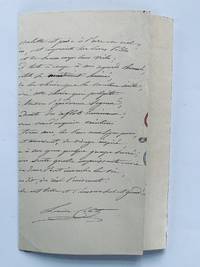
1846730741846. Fine. ""Aimer c'est vivre ! / C'est incarner le rêve et sentir les transports / Dont l'art ne peut donner que des emblèmes morts !"" ""To love is to live! / It is to incarnate the dream and feel the transports / Of which art can give only dead emblems!"" s. d. 1846 19.50 x 35.50 cm une feuille Autograph manuscript poem signed by Louise Colet titled ""Le Vrai Beau"" ""True Beauty"" 38 Alexandrine verses in black ink on a folded sheet of satined cardboard paper in oblong format folded in two places. A small stain to the blank verso. Published in 1852 under the title ""L'Art et l'Amour"" ""Art and Love"" dated 1846 in Ce qui est dans le cur des femmes : Poésies nouvelles What is in Women's Hearts: New Poems. This manuscript version with a different title presents one verse and several unpublished words. Superb cry from the heart by Louise Colet who puts into verse the conceptions - of life love art - that set her against her lover Gustave Flaubert witnessing the first stirrings of their tumultuous relationship. Written shortly after their meeting on July 29 1846 the poem is an impassioned response to a letter from Flaubert of September 2nd ""Oh! va aime plutôt l'Art que moi"" ""Oh! go love Art rather than me"" to which its first verse makes explicit reference: ""Tu me dis : Aime l'art il vaut mieux que l'amour . Et moi. je te réponds : La langue du poête Ne rend du sentiment que l'image incomplète"" ""You tell me: Love art it is better than love . And I answer you: The poet's language renders only an incomplete image of feeling"". After granting Louise Colet a few rare passionate nights following their meeting in James Pradier's studio the aptly named hermit of Croisset had kept his distance to devote himself to writing while proclaiming his love for her. This poetic response by Louise Colet to Flaubert's epistolary exchanges is all the more important as her letters were destroyed by the writer in 1879. The Alexandrines address Flaubert in the second person in this theoretical and lyrical manifesto addressed to her lover eleven years her junior from the hand of a poetess already recognized by her peers who first captivated the philosopher Victor Cousin and later Musset and Vigny. She gives form to their dialogues under the grip of Romanticism which she embodies and of Realism to which Flaubert clings fiercely. Beyond the role of exasperating lover often attributed to her Colet claims the impulses of her heart that Flaubert ignores in himself; and argues that the transports of reality will always surpass those of Art condemned to imitate them: ""Des maîtres les plus grands les uvres les plus belles Auprès du beau vivant compare que sont-elles "" ""The most beautiful works of the greatest masters compared to living beauty what are they"" Rare vestige rescued from Flaubert's censorship restoring Louise Colet's voice within their amorous dialogue. Louise Colet's poem takes the form both of a discussion on aesthetics and a tender declaration of love to Flaubert; their destinies as writers being inextricably linked to their intimate life. Tu me dis : Aime l'art il vaut mieux que l'amour ; Tout sentiment s'altère et doit périr un jour ! Pour que le cur devienne une immortelle chose Il faut qu'en poésie il se métamorphose Et que chaque pensée en sorte incessamment En parant sa beauté d'un divin vêtement. Sentir c'est aspirer!. c'est encor la souffrance ; Mais créer c'est jouir ! c'est prouver sa puissance ; C'est faire triompher de la mort de l'oubli Toutes les passions dont l'âme a tressailli! Et moi. je te réponds : La langue du poête Ne rend du sentiment que l'image incomplète ; Concevoir le désir goûter la passion Nous fait dédaigner l'art et sa création ; Formuler les pensers dont notre esprit s'enivre Ce n'est que simuler la vie : aimer c'est vivre ; ! C'est incarner le rêve et sentir les transports Dont l'art ne peut donner que des emblèmes morts ! Des maîtres unknown
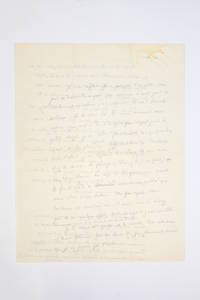
194060684Paris 1940. Fine. Paris s. d. 3 ou 4 juin 1940 20.90 x 26.90 cm 2 pages sur un feuillet Touching handwritten letter signed by Georges Bataille to Denise Rollin 37 lines in pencil small water stain in the top right not affecting the text. Georges Bataille tries to reassure his companion Denise Rollin: Je t'en supplie. Il ne faut pas t'inquiéter mais pas du tout. I beg you. You must not worry not at all. She moved to Vézelay where Bataille would soon join her. He stayed in Paris where the bombings did not disrupt Parisian lives at all: Tu n'imagines point à quel point les petits dégâts qu'on voit paraissent insignifiants à côté de la place intacte qu'il y a de tous les côtés. Pendant toute l'alerte j'ai déjeuné bien tranquille avec mon chef de service de passage à Paris il vit au front You have no idea how insignificant the little damage you see seems next to the square untouched on all sides. Throughout the alert I had a very quiet lunch with my head of service passing through Paris he lives on the front Bataille did not give up his job as librarian at the National Library. Suffering from tuberculosis he was not sent to the front and he took the opportunity to write several texts at that time such as Madame Edwarda and Le Coupable. Further on he mentions a visit: Un peu après Henri Michaux est venu me voir A little after Henri Michaux came to see me The two men had participated in the magazine Mesures and both had in common being separate from the surrealist nebula. In both of their respective works there is a violent independence and the same tension towards spirituality a form of mysticism. Bataille had attended the seminary in his youth and Michaux pleasantly said of him: Il donne l'impression d'un séminariste sortant furtivement d'une pissotière. He gives the impression of a seminarian surreptitiously coming out of a public urinal. After this almost trivial news Bataille embarks on an analysis of his feelings: Ce que tu me dis dans ta lettre c'est pour moi ce qui délivre c'est comme la nudité tout ce qui se déchire entre toi et moi. Mais encore une fois je ne me suis jamais senti aussi près de toi. What you tell me in your letter is for me what delivers it is like nudity everything that is torn apart between you and me. But once again I have never felt so close to you. He asks his correspondent: il faut me dire tout. C'est très doux que j'aie vu où tu es que je connaisse les chemins que tu prendras les ponts par où tu passeras. you must tell me everything. It is very sweet that I have seen you where you are that I know the roads you will take the bridges over which you will pass. Sensuality is never far from the author's feelings: Dis-moi aussi quelle chambre tu as: pour que je songe à toi dans cette chambre et à tout ce qui arrivera là quand nous serons de nouveau ensemble. Also tell me which room you have: so that I may think of you in that room and all that will happen there when we are together again. From this and past sensualities there remain the fruits that are the children. Denise Rollin left for Vézelay in the company of her son Jean nicknamed Bepsy: Tu ne me dis rien de ta vie avec Bepsy . Bepsy est-il plus calme: moi aussi je l'ai entendu crier dans tes bras. You don't tell me anything of your life with Bepsy . Is Bepsy calmer: I too heard him screaming in your arms. Bataille thanks Rollin: Pour Sylvia je t'ai une immense reconnaissance de m'avoir aidé à changer. For Sylvia I am immensely grateful to you for helping me change. Sylvia Bataille was the first wife of Georges Bataille. They were separated in 1934 but did not divorce until 1946. From this relationship for the author: Il ne reste que Laurence et la nécessité d'envisager les choses sans heurt This only thing that remains is Laurence and the need to consider things smoothly Laurence was the daughter born of this marriage in 1930. She joined Bataille Rollin and Bepsy in 1943 when h unknown
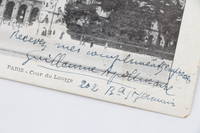
191382418Paris 1913. Fine. Paris 1913 13.30 x 21 cm une carte Unpublished autograph signed postcard by Guillaume Apollinaire addressed to the Dijon art historian Marcel Mayer. Two pages written in black ink on a photographic postcard depicting the courtyard of the Louvre. Charming letter praising the attachment to their roots of the "".fameux Flamands-Espagnols Hollandais et Bourguignons que j'admire tant"" ""famous Flemish-Spanish Dutch and Burgundians whom I admire so much"" and informing his correspondent of the writing and forthcoming publication of a ""petit livre sur Rude"" ""little book on Rude"" that Guillaume Apollinaire will not fail to send him. Fine autograph signature with the autograph address of 202 Boulevard Saint-Germain. unknown
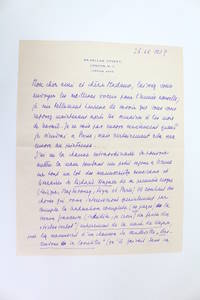
193770612Londres London 1937. Fine. Londres London 26 décembre 1937 17.90 x 22.90 cm une feuille Signed autograph letter to Alfred Cortot and his wife about Richard Wagner's manuscript collection: ""I was lucky enough to be able to acquire the entire lot one day before Bayreuth sent a trusted buyer"". London 26 December 1937 17.9x22.9cm one leaf. Autograph letter signed by Stefan Zweig to Alfred Cortot two pages on one sheet written in violet ink. An outstanding autograph letter in which the avid collector informs his friend Alfred Cortot of his acquisition of unpublished manuscripts of Wagner. Alfred Cortot himself owes his career as a conductor to his early discovery of the German composer. Cortot shared with Zweig his ""almost tyrannical bewitchment suffered with as much intoxication as fervor"" for the composer. Zweig who spoke of his collection as ""more worthy of surviving me than my own works"" The World of Yesterday: Memories of a European 1942 recounts for his friend the details of this incredible discovery of hundreds of forgotten leaflets including Wagner's intimate correspondence handwritten scores and excerpts from opera librettos including The Flying Dutchman The Sublime Fiancée or Bianca and Giuseppe Die Feen Das Liebesverbot The Ban on Love and a lost orchestral version of Rule Britannia. In December 1937 as he fled the Nazi regime and settled in London Zweig became fascinated by the archives of a time when intellectual Europe was living in perfect syncretism. The writer takes a nostalgic look at the manuscripts of Wagner who like him spent his youth travelling through the capitals of Europe: ""I was extraordinarily fortunate to be able to get my hands on a whole lot of Richard Wagner's musical and literary manuscripts from his early period Leipzig Magdeburg Riga and Paris during a short stay in Vienna"". Among these precious manuscripts is the extremely rare orchestral arrangement of the patriotic song Rule Britannia which had been missing for more than sixty years. Sharing his passion for Wagner with his friend the pianist Cortot Zweig announced his discovery with the wonder so familiar to collectors when faced with an exceptional find: "". the manuscript is the only one of its kind in the world that has been preserved. It contains things that will be of special interest to you for example the complete translation 60 pages of the French version unpublished I believe of the text of the ""Liebesverbot"" entirely in Wagner's hand as well as the manuscripts of a vaudeville song ""Descendons la Courtille"" which he performed in his darkest moments . almost thirty pieces of the highest interest and precisely from the rarest period. All this was hidden for 50 years in a private collection and I was lucky enough to be able to acquire the entire lot one day before Bayreuth sent a buyer"". The letter is a fascinating account of Zweig's parallel life which had earned him a reputation as an accomplished collector. His collection also inspired one of his most beautiful short stories The Invisible Collection die Unsichtbare Sammlung and a pioneering essay in the Deutscher Bibliophilen Kalender The Autograph Collection as an Art. His hundreds of historical musical and literary autographs from the Middle Ages to the 20th century were carefully catalogued and collected in the library-museum of his house in Kapuzinerberg: ""In this library a 'place of worship' he also exercises a real activity as an expert in autographs . . The library will attract a number of distinguished scholars sometimes accompanied by their assistants who will not hesitate to return to work there quietly for days or even weeks at a time"" Stefan Zweig le voyageur des mondes Serge Niemetz. With this acquisition Zweig sees the dream of every collector come true. After two years of exile in England Zweig returned to Vienna in time to purchase these exceptional documents from Bayreuth's emissaries who had already built up unknown
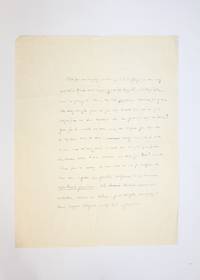
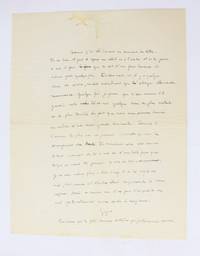
1948652491948. Fine. s. d. ca 1948 14.60 x 19 cm 2 pages sur un feuillet sous chemise Magnificent and unpublished handwritten letter signed by Fernand Léger about American jazz and colours addressed to Gaston Criel author of a pioneering essay on Swing. The painter looks back on his exile in the United States from 1940 to 1945 talks about Louis Armstrong and of his captivating discovery of experimental jazz in New York in the company of the Afro-American painters of the Harlem Renaissance. 29 lines in black ink written on one leaf. The hand-written letter is presented under a half forest green morocco chemise green paper boards with a stylised motif endpapers lined with green lamb slip case lined with the same morocco the piece is signed by Goy & Vilaine. Léger replies to Georges Criel and congratulates him on his American jazz essay: Votre « swing » m'intéresse. Vous avez trouvé un style sonore qui colle au sujet. Your swing' interests me. You have found a sound style that suits the subject. Indeed in his essay entitled Swing Criel had adopted the very bebop rhythmic style that Léger had had the opportunity to listen to in New York. This first French language study of jazz was unanimously recognised by the likes of Sartre and Stravinsky Gide Senghor and Poulenc. The undated letter was written in 1948 the year Criel's essay was published. After a long exile in the United States between 1940 and 1945 Léger went back to France and joined the communist party . Living in Paris at the same time he reopened his painting academy in a new location on Boulevard de Clichy which will bring him an influx of American students former demobilised GIs such as Sam Francis and Kenneth Noland. As early as 1924 Léger was acquainted with jazz and America at the same time in his experimental film Ballet mécanique shot by the Americans Dudley Murphy and Man Ray on music by Duke Ellington and George Antheil. Three stays in New York between 1931 and 1939 many projects and meetings - particularly with the writer Dos Passos - had familiarised Léger with this city that was emblematic of modernity. However it was his exile during the war that really introduced him to America and to jazz music: J'ai pu pendant 5 ans d'Amérique réagir pour ou contre cette expression nègre I was able during 5 years of America to react in favour or against this negro expression. In 1941 he discovered the country whilst travelling on a bus towards the West he gave lectures in California and had his Ballet Mécanique screened at the famous experimental university Black Mountain in North Carolina. It is also in the United States that in 1942 he invented a new use of colour inspired by the way advertising lights sweep the facades of Time Square: colour is now separated from the drawing and gives rise to the painting Starfish Solomon R. Guggenheim Museum his series of Cyclistes Cyclists Biot Musée national Fernand Léger and the Plongeurs Divers of which he produces a enormous copy in 1943 for the architect's house Rockefeller Wallace K. Harrison in Long Island. Jazz synonymous with modernity and freedom was also an opportunity to explore colour. Léger gives his sound experiences a striking synthetic description: J'ai souvent pensé en les écoutant à des équivalences colorées possibles. Les sardanes espagnols par exemple c'est de la couleur pure. Jaune bleu rouge. Le Jazz comporterait souvent des nuances When listening to them I have often thought of the possible colour equivalents. The Spanish Sardanas for example are pure in colour. Yellow blue red. Jazz often contains different shades. He helped in New York's clubs as bebop emerged a new form of fast-paced jazz with breath-taking skill whose harmonic and rhythmic innovations left their mark on the painter in his compositions. The painter recalls the discovery of this furious jazz in the 1940s: La confusion du départ m'intéressait surtout. Leur côté animal instincti hardcover
178159108s. l. Vincennes 1781. Fine. s. l. Vincennes s. d. circa 1781 15.70 x 20.10 cm une feuille SADE Donatien Alphonse François Marquis de Autograph letter to his wife. Hommages à la Présidente: Faire noyer vive l'exécrable coquine qui depuis neuf ans . suce mon sang. N. p. Vincennes Castle n. d. circa 1781 157 x 201 mm 6 3/16 x 7 15/16 single leaf The more I think about it however the more I think you have to have quite a nerve to dare write to a poor suffering unfortunate. Autograph letter unsigned from the Marquis de Sade to his wife. One page closely written in ink on 31 lines. This letter was written during Sade's imprisonment at Vincennes probably in April 1781 if one is to believe the occasional indicators of date referenced by the writer. Sade mentions the end of his exile from Marseilles referring to the decision of the court in Aix-en-Provence to overturn his conviction for debauchery and libertinage on the 14 July 1778 but which nonetheless banned him from living in or visiting Marseilles for three years. Sade also mentions one of the defining episodes of his life his flight to Italy between January and November 1776: they may as well have killed me straight off as left me in that foreign country where I was. Sade also mentions the amazing favor that befell him of moving house which is to say his potential transfer to the fort at Montélimar. In April 1781 Madame de Sade through the good offices of her friend Madame de Sorans got authorization from the King for her husband to be transferred to the prison there. Sade explains in the letter: I think you have to have quite a nerve to dare write to a poor suffering unfortunate who has been beset these nine years.telling him to thank ever so humbly the woman who obtained for him the amazing favor of moving house. Sade is here no doubt referring to the famous Madame de Sorans a lady of Louis XVI's sister's bedchamber and a friend of his wife's who out of a spirit of adventure accepted the task of petitioning the King in his favor. It was to Commissioner Le Noir referenced in this letter that Renée-Pélagie left the task of breaking the news to the prisoner: Ah I see now what this nice little visit by M. Lenoir means I'm used to seeing him in the middle of my incarcerations. Despite the fact that as Pauvert points out in Sade vivant this change of house occupied the Marquis' thoughts to a large extent he was never actually moved preferring to stay in the gaols of the keep at Vincennes. At this point Sade had been imprisoned for several years and this letter full of movement reveals his thirst for freedom. This letter was written when Madame de Sade withdrew to the convent at Sainte-Aure. If she saw this act as a liberation from the yoke of her marriage the Marquis for his part was obsessed by the idea of his own liberation and mentions a potential date: October 1783. His long incarceration which began in 1777 would last till April 1790 when lettres de cachet were abolished. Madame de Sade's visits were not reauthorized by the prison authorities until 13 July 1781 after four years and five months of separation. Several important themes in Sade's correspondence already appear in this letter from his first years in prison. First of all his hatred for his mother-in-law the Présidente de Montreuil an execrable wretch who drinks my blood.disgraces her children who has not yet done scattering her horrific deeds and platitudes and whom he would like to drown alive. The Marquis also complains of his poor physical health: my head spins and in my condition I hardly need any more misery using very Sadean epithets to express his despair. A poor suffering unfortunate who has been beset these nine years; what have I done what have I done dear Lord to suffer for twelve years. Provenance: family archives. unknown
194060697s. l. Paris 1940. Fine. s. l. Paris circa 1940-1943 21 x 27.30 cm 1 page Autograph letter from Georges Bataille to Denise Rollin 14 lines in black ink and pencil. This letter from the amorous correspondence that Bataille addressed to Denise Rollin during the war and Occupation contains in embryo the feelings that explode throughout Bataille's entire work. Incessant ebb and flow of love and suffering of ecstasy and disappointment of calm and energy mixing familiar and formal address compliments and reproaches this letter resembles its author and the era: « Comment pouvez-vous être assez aveugle pour ne pas voir le mal que vous me faîtes en vous laissant aller au premier caprice venu Que je le veuille ou non une vie ne peut pas dépendre de caprices vides de sens. » ""How can you be blind enough not to see the harm you do me by giving in to the first whim that comes along Whether I want it or not a life cannot depend on meaningless caprices."" The relationship was turbulent both protagonists passionate. In his work Le Coupable he summarizes the throes of amorous passion: ""Love has this requirement: either its object escapes you or you escape it. If it did not flee from you you would flee love. Lovers find themselves on condition that they tear each other apart. Both thirst to suffer. Desire must in them desire the impossible. Otherwise desire would be satisfied desire would die."" Thus Bataille in love suffers: « Je n'ai même plus le courage de vous dire ce que je souffre : en tout cas imposer une pareille souffrance à un homme exactement pour rien cela devient comme une maladie comme un délire. » ""I no longer even have the courage to tell you what I suffer: in any case to impose such suffering on a man for exactly nothing it becomes like an illness like delirium."" Was Denise Rollin showing herself cruel or was Bataille needlessly anguished The fact remains that he shows himself weary of these agitations: « Je ne sais pas comment j'ai trouvé moyen d'espérer malgré tout jusqu'ici. » ""I don't know how I found the means to hope despite everything until now."" unknown
194060696s. l. 1940. Fine. s. l. s. d. circa 1940-1943 20.90 x 27 cm 1 page Autograph signed letter to Denise Rollin: As if the truest love could only be matched with the inconvenience of everything ca 1940-1943 20.9 x 27 cm 1 page Autograph letter signed by Georges Bataille to Denise Rollin 18 lines in black ink. Letter of a passionate love during the war. Georges Bataille is in Paris where the German offensive is in full swing: . the German attack begins again. But this destruction does not reach Bataille's loving exaltation on the contrary: Sometimes I think that it is as if there was something more violent and terrible between you and me because we found ourselves in the middle of such a great turmoil. As if the truest love could only be matched with the inconvenience of everything. The writing has an almost magical quality of incarnation: By writing this to you it is as if everything opened up between you to me and in such a way that whatever is alive there could laugh at everything. Coupled with imagination and the strength of feelings it is possible to overcome absence: . suddenly you are there beside me it is as if the distance was powerless to separate us. Bataille tries to reassure his correspondent: But under no circumstances must you worry about me. I will meet you again tonight at nine o'clock. He ends his letter by asking her: Give little Laurence a big kiss and tell her that I will write to her tomorrow. Laurence is the daughter that Georges Bataille had with Sylvia Bataille his first wife. At the time of this letter she was in Vézelay with Denise Rollin in this blended family that also includes Jean the son that Denise had with her husband. Evidence if needed of the author's claims of the Bataille-Rollin couple's sexual and moral freedom which was still rare at the time. Although Bataille's life as a writer is well known in these years little is known about his private life. And it is not the least paradox of his very revealing work that it only tells the minimum of his private affairs and usually the worst of it. M. Surya G. Bataille la mort à l'uvre. When Georges Bataille met Denise Rollin in 1939 he had just lost his lover Colette Peignot to tuberculosis. His friends had abandoned him and war had just been declared. This sentimental and social chaos however does not affect Bataille as much as the tumultuous relationship he took up with Denise Rollin who was a friend of Cocteau Breton Prévert and a muse of painters Kisling and Derain. Their romance lasted four years and left very few details of their sentimental life during this period of Occupation except what Bataille is willing to tell us in his novel Le Coupable The Guilty partly inspired by this passionate and painful relationship. In a 1961 interview Bataille looked back on this time: ""Le Coupable is the first book that gave me a kind of satisfaction an anxious one at that that no book had given me and that no book has given me since. It is perhaps the book in which I am the most myself which resembles me the most. because I wrote it as if in a sort of quick and continuous explosion."" The letters addressed by Bataille to Denise during this period contain the seeds of the feelings that explode in Le Coupable as in all of Bataille's work. His writing is an ebb and flow of love and suffering between ecstasy and disappointment calm and energy mixing familiar and formal tones compliments and reproaches. The letters are often impossible to date with precision as they all proceed from the same movement of ecstatic flagellation. In 1943 Georges Bataille found a house in Vézelay where the couple settled with Laurence Georges and Sylvia's daughter and Denise's son Jean. It was there that Bataille completed his book Le Coupable as well as his love story since barely a month after their arrival Diane Kotchoubey a young woman of 23 moved in with them. Before the end of the year Bataille left Denise Roll unknown
1917642621917. Fine. circa 1917-1918 22.30 x 27.60 cm une feuille sous chemise et étui Remarkable autograph poem by a young André Breton signed titled ""Poème"" and dedicated to Léon-Paul Fargue 21 lines in black ink on laid paper dated by the author February 19 1916 and probably composed ten days earlier. Our manuscript was written between March 1917 and early 1918. Presented in a chemise and slipcase covered with abstract-patterned paper boards the chemise spine in olive-green morocco endpapers and pastedowns in cream suede with a flexible plexiglass sheet protecting the poem; the slipcase edged with olive-green morocco bearing on its lower front cover an olive paper label inscribed ""poème autographe""; the whole signed by Thomas Boichot. A key poem from Bretons pre-Dadaist period it belongs to a coherent group of seven autograph poems identified as coll. X. in the uvres complètes d'André Breton vol. I La Bibliothèque de la Pléiade Gallimard 1988 p. 1071. These poems in the authors youthful hand are neatly penned in black ink on watermarked laid paper. The set was addressed to his circle of friends and fellow writers including Valéry Apollinaire Théodore Fraenkel and his comrade André Paris. It was later published in his first collection Mont de piété issued in June 1919 by Au sans Pareil the publishing house newly founded by his friend René Hilsum. The precise dating of this group of autograph poems is established by the composition of the last poem in the series ""André Derain"" completed on March 24 1917 providing an absolute terminus post quem. Moreover the present manuscript is an earlier version of the poem Age dedicated to Léon-Paul Fargue. Dated by the author February 19 1916 his twentieth birthday and composed ten days earlier according to his correspondence it was not retitled and revised until its publication in July 1918 in Les Trois Roses. Most likely preceding this publication the seven autograph poems were probably written during 1917 or early 1918 while Breton was completing his medical internship at the Val-de-Grâce hospital and meeting Louis Aragon. The poems that would later form Mont de piété represent a rare and precious testimony to Bretons early influences on the threshold of his adherence to the Dada movement and his discovery of automatic writing. Brief and sometimes cryptic they reveal Symbolist inflections inherited from Mallarmé whom Breton rediscovered at poetic matinées at the Théâtre Antoine and the Vieux-Colombier with his school friend Théodore Fraenkel. During the first months of the war Breton also devoted himself to Rimbaud immersing himself in Les Illuminations the only book he carried away amid the confusion following the declaration of war. From his Rimbaldian readings were born the poems Décembre Age and André Derain while he borrowed Apollinaires muse Marie Laurencin to whom he dedicated Lan suave. The poetic legacy of Valéry with whom he began corresponding in 1914 was also decisive. Valéry played a crucial role in shaping the poems of Mont de piété through his attentive guidance and advice to the young poet. Admiring his disciples audacity to whom he sent each poem Valéry praised Facon 1916 in these terms: Thème langage visée métrique tout est neuf mode future façon Letter from June 1916 uvres complètes d'André Breton vol. I La Bibliothèque de la Pléiade Gallimard 1988 p. 1072. These essential landmarks of Bretons youth were composed between the ages of seventeen and twenty-three. Caught in Lorient at the outbreak of war he became a military nurse serving in several hospitals and on the front during the Meuse offensive. In Nantes he met Jacques Vaché who inspired a collective writing project and the illustration of the future collection Mont de Piété ultimately carried out by André Derain. His friendship with this dandy revolted against art and war who shared his admiration for Jarry and his encount hardcover
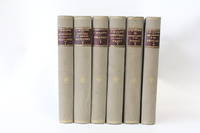
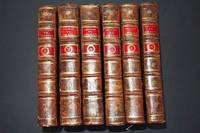
188563739Paris: Librairie des Bibliophiles 1885. Fine. Librairie des Bibliophiles Paris 1885-1887 11.50 x 18.40 cm 6 volumes reliés First edition in 6 volumes bound. Contemporary Bradel binding in half mouse-grey percale decorated with floral motifs and double gilt fillets brown morocco title label marbled paper boards original covers preserved. Manuscript bookplate on the half-title pages of all volumes. Some soiling to the spines foxing principally on the first and last pages. Librairie des Bibliophiles hardcover
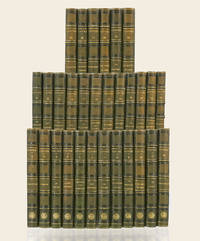
183986661Paris: Furne & CieCharles Gosselin 1839. Fine. Furne & Cie Charles Gosselin Paris 1839-1852 10.50 x 18 cm 30 volumes reliés First edition of the French translation by A. J. B. Defauconpret. Illustrated vignette on the title page of each volume with two illustrations in each volume 60 in total by Louis Marckl after Noël Bertrand. Green half shagreen binding spine with five raised bands elaborately framed in gilt and blind spine-ends stamped with a gilt rosette bearing cabbalistic signs marbled paper boards marbled endpapers and pastedowns speckled edges contemporary bindings. Spines slightly lightened some corners slightly dulled more pronounced foxing on some volumes a tear not affecting text to pp. 303-304 of vol. 2 a restored tear and a marginal lack of paper not affecting text to pp. 213-214 of vol. 5. Autograph letter signed by James Fenimore Cooper in French bound in the first volume written to Charles Gosselin publisher of his complete works. Slight folds to the corners of the leaf pencil and pen notes by a previous bibliographer. Handsomely bound set exceptionally containing an autograph letter signed by the author to his publisher. Furne & CieCharles Gosselin hardcover
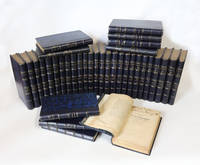
182669321Paris: Ladvocat 1826. Fine. Ladvocat Paris 1826-1831 & 1824 & 1838 13 x 21.50 cm 36 volumes reliés First collected edition partly original by far the most important and most sought-after cf. Clouzot with Chateaubriand having revised and reworked a large part of his writings.This set also contains in first edition several texts including Les Natchez Le Dernier Abencérage Le Voyage en Amérique and Moïse placed at the end of vol. XXII and often lacking. Each volume illustrated with a frontispiece by Charles Thompson. Bound in contemporary navy blue half shagreen spines with five raised bands marbled paper boards marbled endpapers and pastedowns. A few spots of foxing. Together with these collected works uniformly bound: a volume entitled uvres diverses collecting several political pamphlets in first edition; Le Congrès de Vérone 2 vols. Delloye 1838; Essai sur la littérature anglaise and Miltons Paradise Lost both Gosselin 1839. In the volume uvres diverses important presentation inscription signed by François-René de Chateaubriand to Monsieur Henri Bayart on the half-title of La nouvelle proposition relative au bannissement de Charles X et de sa famille. This inscription dating from the writers final years is addressed to Henri Bayart 18251892 godson of the Duchesse de Berry and brother of Sophie-Josèphe Bayart a close friend of François-René and his wife. The Chateaubriands and the Bayart family formed bonds of friendship and business during the Hundred Days and remained close until the end of their lives. As staunch legitimists devoted to the Bourbon cause they even attempted the impossible in seeking to have the writer appointed governor to the young Comte de Chambord claimant to the French throne. When writing this inscription probably around 1843 Chateaubriand was at the twilight of his political and literary life; close to the Comte de Chambord then exiled in England the Bayarts once again tried to intercede on his behalf sending Henri Bayart without success to persuade the last Bourbon heir to invite the ageing writer into his circle. A rare and fine set in uniform bindings containing numerous first editions and enriched with an important presentation inscription. Ladvocat hardcover
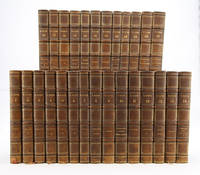
183777301Paris: Félix BonnaireVictor MagenComonHippolyte Souverain 1837. Fine. Félix Bonnaire Victor Magen Comon Hippolyte Souverain Paris 1837-1841 13 x 20.50 cm longueur totale de la série 72 cm 27 volumes reliés Extremely important edition comprising a large number of works appearing here in their first edition. The complete set of these 27 volumes is rare Clouzot. The titles present in first edition are: Mattea Lettres dun Voyageur La Dernière Aldini Les Maîtres mosaïstes LUscoque Spiridion Les Sept Cordes de la lyre Gabriel Pauline and Un hiver à Majorque.Illustrated with a portrait of the author at the head of the first volume. Bound in contemporary half brown sheep spines uniformly faded with four raised bands decorated with double gilt panels double gilt fillets at head and foot marbled-paper boards marbled endpapers and pastedowns marbled edges a few very lightly rubbed corners contemporary bindings. Some occasional foxing a light dampstain affecting the final leaves of the twenty-first volume. A very rare complete set in contemporary bindings. Félix BonnaireVictor MagenComonHippolyte Souverain hardcover
178952032à Paris: la veuve Duchesne et filsDe l' imprimerie de Monsieur 1789. Fine. la veuve Duchesne et fils De l' imprimerie de Monsieur à Paris 1789 13 x 21 cm 4 volumes reliés The finest and most complete edition of Regnard when it contains the fifth and sixth volumes printed in small numbers as indicated by Cohen and which are rarely found bound with the first four. These two volumes have not been added to this copy. It is illustrated with a portrait of the author by Rigaud engraved by Tardieu and 7 fine plates by Moreau and Marillier engraved by Delignon Duponchel etc. The notes and prefaces are by Garnier. Contemporary full sheep bindings in polished mottled leather signed with a Mouillié label probably slightly later. Spine with raised bands decorated with 4 fleurons in dotted lozenges. Morocco title and volume labels in red. Decorative border on covers. Edges gilt. A crack to the upper joint of volume IV. Rubbing to headcaps joints and corners. Very handsome copy. Volume 1 is devoted to travel narratives volumes 2 to 4 to theater. This carefully produced edition with fine printing and quality engravings ranks among the great achievements of editions produced at the printing house of Monsieur Racine Corneille. la veuve Duchesne et filsDe l' imprimerie de Monsieur hardcover
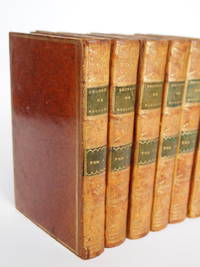
179053843à Paris: chez la veuve Duchesne et filsDe l' imprimerie de Monsieur 1790. Fine. chez la veuve Duchesne et fils De l' imprimerie de Monsieur à Paris 1790 13 x 20.50 cm 6 tomes en 6 volumes reliés The finest and most complete of the editions of Regnard when it contains the fifth and sixth volumes printed in small numbers as Cohen indicates and which are rarely found together with the first four. It is illustrated with a portrait of the author by Rigaud engraved by Tardieu and 11 fine figures by Moreau and Marillier engraved by Delignon Duponchel etc. The remarks and prefaces are by Garnier. Contemporary full blonde porphyry and glazed calf bindings. Smooth decorated spines roll tooling at head and foot. Green morocco title and volume labels. Triple fillet frame on boards. Slight lack to one title label. Rubbing to headcaps and edges. One wormhole at foot of volume II. Spines lightened. Joint at foot of volume VI cracked. Very handsome copy despite minor defects. Interior generally fresh with rare spotting. Volume 1 is dedicated to travel narratives volumes 2 to 4 to theatre and volumes 5 and 6 to Italian theatre. This careful edition with fine printing and quality engravings ranks among the great successes of editions produced by Monsieur's printing house Racine Corneille. IHS Domus Parisian bookplate. ADS Germany. Gift inscription: ""Coll. complet. Lez 23 gbre 1792. DB. J. J. De Bure fils aîné."" chez la veuve Duchesne et filsDe l' imprimerie de Monsieur hardcover
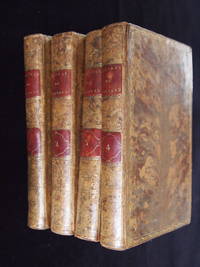
179037927à Paris: chez la veuve Duchesne et filsDe l' imprimerie de Monsieur 1790. Fine. chez la veuve Duchesne et fils De l' imprimerie de Monsieur à Paris 1790 12.50 x 20 cm reliés The finest and most complete edition of Regnard when it properly contains the fifth and sixth volumes printed in small numbers as Cohen indicates and which are rarely found together with the first four. It is illustrated with a portrait of the author by Rigaud engraved by Tardieu and 11 fine figures by Moreau and Marillier engraved by Delignon Duponchel etc. The remarks and prefaces are by Garnier. Contemporary full tree calf binding. Spine with raised bands decorated with 4 stars and fillets. Red morocco title and volume labels. Framing fillet on covers. Lacking at foot of volume 1 and at head of volume 3. Joints of volume 2 cracked. Despite some defects quite a handsome set. Volume 1 is dedicated to travel narratives volumes 2 to 4 to theater and volumes 5 and 6 to Italian theater. This carefully produced edition with fine printing and quality engravings joins the great successes of editions produced by the Imprimerie de Monsieur Racine Corneille. chez la veuve Duchesne et filsDe l' imprimerie de Monsieur hardcover
182671528Paris: N. Delangle 1826. Fine. N. Delangle Paris 1826 10 x 15.30 cm relié Edition illustrated with vignettes from the Petits Classiques françois collection printed in 500 copies at the expense and under the supervision of Charles Nodier and the publisher using Didot l'Aîné's typefaces. Half navy blue morocco binding with corners spine with five raised bands decorated with double blind-stamped compartments marbled paper boards marbled endpapers and pastedowns marbled edges two corners slightly bumped. Handsome copy despite some light foxing. N. Delangle hardcover
182663853Paris: N. Delangle 1826. Fine. N. Delangle Paris 1826 10 x 15.30 cm relié First edition illustrated with vignettes part of the Petits Classiques françois collection printed in 500 copies at the expense and under the care of Charles Nodier and the publisher with Didot l'Aîné typefaces. Contemporary half green sheep binding spine with four raised bands decorated with gilt roulettes featuring a central gilt tool as well as lozenges and cold fillets multiple gilt fillets and roulettes at foot boards pastedowns and endpapers of marbled paper. Spine uniformly faded corners rubbed some foxing. Handsome full-margined copy. N. Delangle hardcover