BARTOK BélaLivre Rare Book
328 résultats
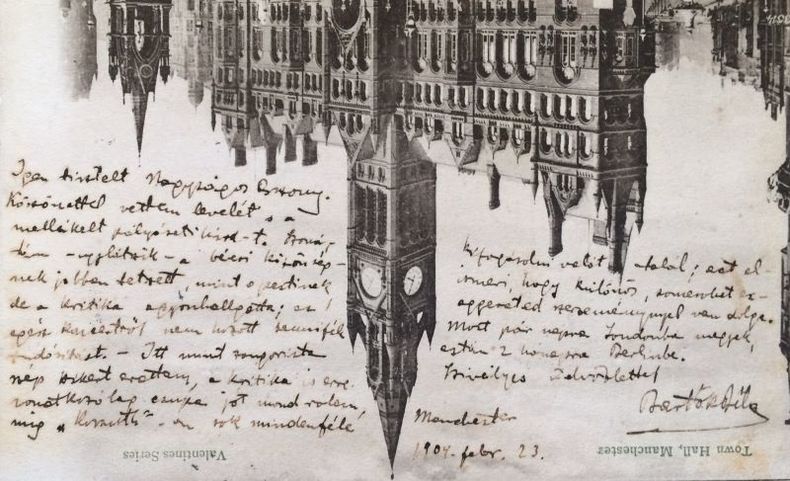
38Les débuts musicaux de Bartok.« Merci pour votre lettre et l’annonce jointe de la compétition. Il semble que ma sonate a été plus appréciée par le public à Vienne qu’à Pest. Cependant, il y a un grand silence de la part des critiques. Il n’y a eu absolument aucun compte-rendu du concert entier. Comme pianiste, j’ai eu un grand succès ici, et de cette façon je n’ai eu que des réponses positives des critiques. Alors qu’ils trouvent plein de défauts avec Kossuth, ils reconnaissent cependant qu’il s’agit d’une composition spéciale, quelque peu excessive. Je vais partir d’ici pour Londres où ke resterai quelques jours, puis j’irai à Berlin pour deux mois (…) ».
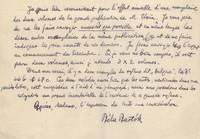
19342245Budapest 1934. Bartok thanks to the recipient's earlier letter. He apologizes for the late reply but on the one hand he was very busy and on the other hand he wanted to wait for the publication of a study of folk music a copy of which he would send to Katzarova's boss Vasil Stoin with a German summary. He expresses his gratitude for the kind offering of an early work by Stoin. He mentions at the end of the letter that he also writes about Bulgarian rhythm in his latest essay. unknown
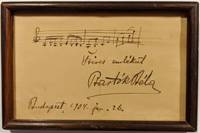
19042018Budapest 1904. Handwritten note in ink signed in Budapest: 26 January 1904. Text reads “SzÃves emlékül†“As a pleasant memoryâ€. Folded once. In fine condition. Handwritten note in ink signed in Budapest: 26 January 1904. Text reads “SzÃves emlékül†“As a pleasant memoryâ€. Ca. 18.5 × 11.5 mm. <p><br /> A signed autograph score detail from Schumann’s Album für die Jugend Op. 68 No.12 Knecht Ruprecht by Béla Bartók.<br /> <p><p><br /> Around 1903–1904 Bartók gave numerous concerts sometimes at 3–4 different venues and countries per week where he often played Schumann’s compositions. Schumann’s work had a big influence on him in other ways as well: according to Suchoff Bartók found Schumann’s Album für die Jugend one of the few good material available for beginners. “From 1908 to 1909 he Bartók worked on a collection of eighty-five piano pieces titled For Children which were based on Hungarian and Slovakian folk music. In his lecture notes Bartók explains his purpose in composing this work: Already at the very beginning of my carrier as a composer I had the idea to write some easy works for piano students. This idea originated in my experience as a piano teacher; I had always the feeling that the available material especially for beginners has no real musical value with the exception of very few works—for instance Bach’s easiest pieces and Schumann’s Jugendalbum.†Suchoff 2004.<br /> <p><p><br /> Literature: Suchoff B. 2004: Bartók’s Mikrokosmos: Genesis Pedagogy and Style p. 13. Rowman & Littlefield.<br /> <p>. unknown