HAYDN GiuseppeBiblio.com
34 résultats
180075497Chez Le Duc 1800. Pamphlet. <b>Livre en français</b>. Couverture souple. Ecrit par Ribière. Partition gravée de 10 pages. Importante mouillure. Papier bruni. Couverture muette ancienne. <i>ref. 75497</i> Chez Le Duc unknown
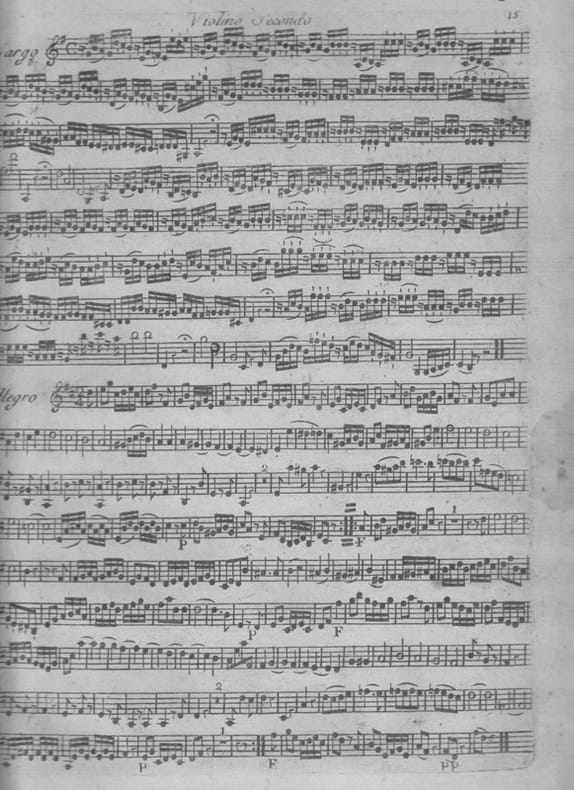
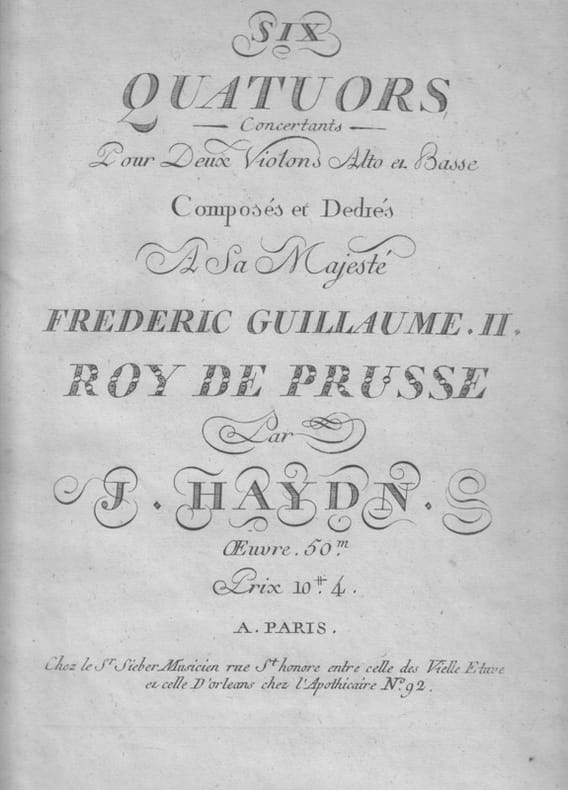
1800271111800 Paris. Sieber. Ca 1800. In-f°(254 x 330mm) broché, tiré d'un recueil factice, 15 pages. Page de titre gravée par Sieber imprimée de travers et un peu piquée. taches en marge. Partition pour violino secondo V2, seulement. Il s'agit sans doute de l'Oeuvre 17, N°1 de Haydn (Moderato, Menuetto, Adagio, Presto), malgré l'orthographe du nom. Bon état,rousseurs.
1788271151788 Sieber, [1788]- in folio broché,tiré d'un recueil factice,Titre,21p., partition entièrement gravée sur cuivre,bon état
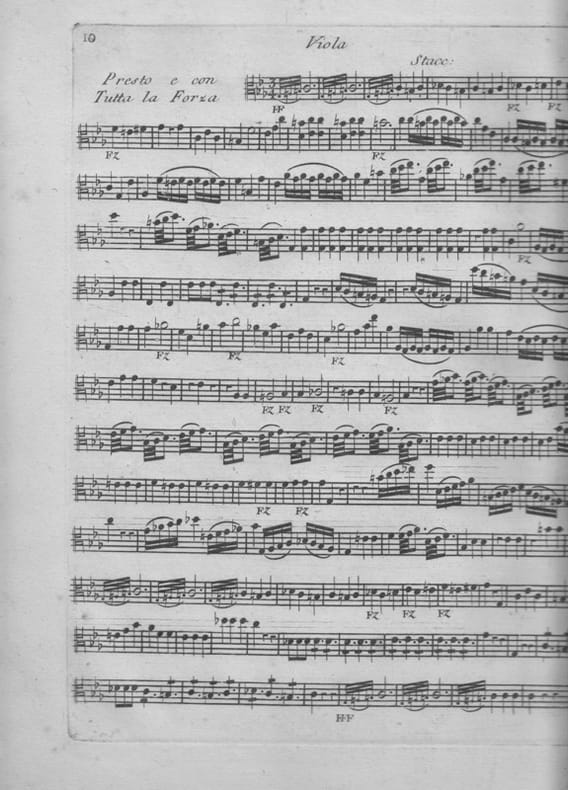
1785271161785 à Paris chez Le Duc, Successeur de Mr. de la Chevardière sd ( 1785)-in folio broché,tiré d'un recueil factice,Titre,10p., partition entièrement gravés sur cuivre,partie alto seule- bon état.
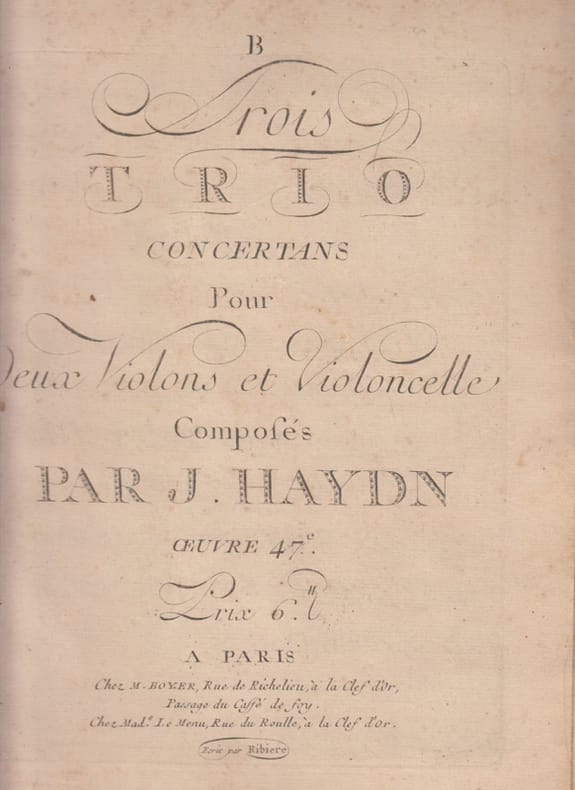
1775281901775 Paris : Boyer : Le Menu,chez M. Boyer, rue de Richelieu, a la Clef d'or, passage du caffe du Foy chez Made. Le Menu, rue du Roulle, a la Clef d'or, A Paris, [approximately 1785] [1787?] RISM H 4181. basso 7p. double - en double; sans titre (tirage different sans titre) 7+7p.- Disbound.
180056337ABBonn, N. Simrock. (1800). Quer-4°. 1 Bl. mit Titel und rückseitig Katalog, 135 S. gestochene Noten, 1 S. Katalog. Grüner Pappband mit grün/blauen Kleisterpapierbezügen und rotem goldgeprägtem Rückenschild.
179074582bound music collection with handwritten contents to pastedown including: Haydn's Celebrated Symphonies composed for Mr Salomon's and The Opera Concerts no. 47 and 8; Three Sonatas for Piano Forte by Philip Knapton; Three Sonatas with Scotch and German Airs by Dussek; Eighteen Favorite Preludes for the Piano Forte by J. Jousse; The Celebrated Gavotte de Vestris with variations for the Piano Forte with an accompaniment for the Flute by T. Latour; Mrs Macdonald a Scotch Air with variations by Philip Knapton Published by Clementi, Banger, Collard, Davis & Collard; Goulding, D'Almaine, Potter & Co; Rt. Birchall; Preston hardcover
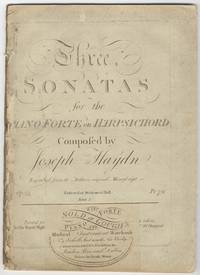
180074638Collection includes: Concerto No.3 for the Piano Forte and several Sonatas for Piano Forte by George Eugene Griffin; The Highland Laddie; Dramatic Airs from English Italian German and French Operas arranged as Rondos no 4; Sixth Concerto for Piano Forte by Cramer; Third Concerto by Dussek; Grand Concerto a la Chasse by Steibelt; Three Sonatas for Piano Forte by Haydn; A Favorite Air Nos.1-4 by Mozart Published by Regent's Harmonic Institution; Clementi, Banger, Collard, Davis and Collard; Goulding, D'Almaine, Potter & Co;Chapp hardcover
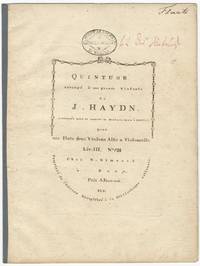
179940463Bonn: N. Simrock PN 81 1799. Folio. Unbound as issued. Laid into early mid-blue stiff paper folder with olive green ties decorative cut-paper manuscript title label to upper and additional label to spine.<br /> <br /> Flute: i title 12-16 pp.<br /> Violin I: iblank 16-23 i blank pp.<br /> Violin II: i blank 14-19 i blank pp. <br /> Viola: i blank2 copies in 19th century manuscript<br /> Piano: 23-31 i blank pp. <br /> Engraved throughout. <br /> <br /> With small oval handstamp of the "Musikalische Gesellschaft in Worms" to each part; early signature in dark pink ink to blank upper outer corner of violin I part; identification in early manuscript to most parts; "58" in dark pink ink to most parts.<br /> <br /> Folder worn with portions of spine and ties lacking. Slightly worn soiled foxed browned and dampstained internally. Coll.Sy.17b-3. Hoboken Collection Vol. 6 439. Not in RISM but see H4085 for related edition.<br /> <br /> An arrangement of Symphony No. 94 in G major the "Surprise Symphony" the second of the twelve London symphonies composed in London in 1791 and first performed there at the Hanover Square Rooms on 23 March 1792 with Haydn conducting. N. Simrock [PN 81] unknown
180074620a bound collection of Military and popular music including Military Concerto for the Piano Forte with Accompaniments composed for his Royal Highness the Prince of Wales by T. Latour; A concerto for the Piano Forte in which is Introduced the Favourite Air of the Plough Boy with an accompaniment for the Violin composed by I.L. Dussek; Auld Langsyne for piano or harp; A Favorite Air by Gelinek; Maid of Derby by Knapton; Caller Herring; La Rose Blanche; How Excellent from Handel's Oratorio of Saul for two performers; The bells of St. Michael's by Knyvett; La ci darem la Mano duetto from Il Don Giovanni and Forget me Not by Mozart; Griffin's Grand March; Six Concertos for the Organ Harpsichord or Piano Forte by Handel; with handwritten contents and one manuscript music sheet loose in the front Published by R. Birchall; Goulding, D'Almaine, Potter & Co; G. Walker; Clementi hardcover
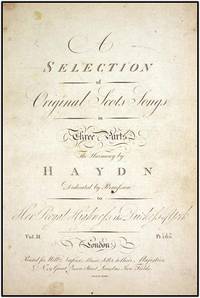
17952392London: Napier 1795. First edition. Used; Like New/Used; Like New. Vol. II of 3 only. Folio contemp. tree sheep repaired & rebacked. Lacking frontis & subscriber's list. 100 songs numbered 2-101. Engraved music & lyrics facing full type-set songs. Internally generally clean & crisp. Scattered light foxing lacking frontis & subscriber's list. <br><br /><br><br />Includes the first appearance of Barbara Allen. Hoboken XXXI vol. 2 p. 460 Napier unknown books
179074584bound music collection with handwritten contents to front pastedown including: Six Sonatas for Piano Forte by D. Steibelt; Bouquet de Flore No.7 by J.Woelfl; Haydn's Surprise arranged as a duet with accompaniment for a flute or violin by R. Plati; Six Sonatas for the Piano Forte by Dussek; La Petite Surprise a Divertimento for the Piano Forte by A. Moralt; Grand Duetto for two performers on the Piano Forte or Harp & Piano Forte by Theodore Smith; The Soldier Tired a duet for two performers on one Piano Forte by L. Jansen; Three Waltzes by Lanza; The Red Red Rose by Thompson; Little Mary on the Dee by John Parry; Fly Not Yet by J. White; Life Let us Cherish by Mozart; The Favorite Guitar Dance with variations for the Piano Forte by T. Latour; The Feast of Erin by P. Antony Corri; A Thema no. 49 Air and Variations by Mozart; The Heavens are Telling Haydn's Grand Chorus from the Creation as a duet; For Unto us a Child is Born from the Messiah by Handel duet for Piano Forte; A Selection of Handel's Choruses adapted as Duets for Piano Forte; Overture to Henry IV for two performers by M. Martini; Three Duetts for Piano Forte from the Works of Mozart; Ball's Occasional Collection of Duetts for two performers on one Piano Forte by eminent composers; A Grand Duet for two performers …by J. Gildon; Sweet Robin Stay by R. Bishop and others Published by Birchall; Clementi, Banger Collard Davis and Collard; J. Balls; L. Lavenu; Chappell & Co; Goulding, Phipps and D'A hardcover
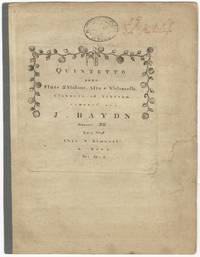
180040468Bonn: N. Simrock PN 125 1800. Folio. Unbound as issued. Laid into early mid-blue stiff paper folder with dark blue ties decorative cut-paper manuscript title label to upper and additional label to spine.<br /> <br /> Flute: 1f. recto title verso blank i blank 6-9 pp.<br /> Violin I: i blank 8-14 pp.<br /> Violin II: i blank 8-15 i blank pp.<br /> Viola: i blank 8-13 i blank pp. <br /> Violoncello: i blank 8-13 i blank pp.<br /> Engraved throughout.<br /> <br /> With small oval handstamp of the "Musikalische Gesellschaft in Worms" to folder and each part; early signature in dark pink ink to blank upper outer corner of flute part; identification in early manuscript to blank upper outer corner of all parts; "42" in dark pink ink to all parts except flute part.<br /> <br /> Folder worn with small portion of spine lacking. Slightly worn soiled foxed and browned internally. Coll. Sy.17b-3. Hoboken Collection Vol. 6 443. RISM H4089.<br /> <br /> An arrangement of Symphony No. 104 in D major the last of the twelve London symphonies composed in 1795 and first performed in London at the King's Theatre on 4 May 1795 in a concert devoted exclusively to Haydn's works directed by the composer. N. Simrock [PN 125] unknown
178930384Vienne: Hoffmeister PN 173 1789. Folio. Unbound. <br/><br/>Violin: 1 title 12-2 pp. <br/>Viola: 1 title 2-7 i blank pp. <br/>Cello: 1 title 2-7 i blank pp. <br/><br/>Manuscript price added to title of violin part. <br/><br/>Somewhat worn and soiled especially at edges; foxed primarily to margins; spine of violin part reinforced with paper tape. First Edition of the arrangement of the piano sonatas Hoboken XVI:40-42 first published in 1784. RISM H4184 no copies in the U.S. Hoffmeister [PN 173] unknown books
179575760Beethoven's Trois Trios pour le Piano Forte Violin & Violoncelle Oeuvre 1r Paris: Pleyel circa 1800 3 62pp. engraved throughout bound with 26 contemporary engraved pieces of music including 7 pieces of music from Figaro Il Consiglio Imprudente Don Giovanni Cosi Fan Tutte by Mozart; Oh Magnify the Lord Angels Ever Bright & Fair Ye Sacred Priests by Handel; Music to A Midsummer Night's Dream and Two Gentlemen of Verona by Henry Bishop Published by Goulding D'Almaine, Potter & Co; Rt Birchall; G Shade; Pleyel hardcover
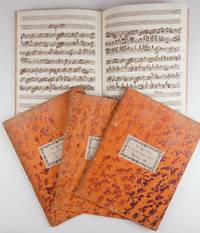
180040069Italy 1800. 4 volumes. Small folio 218 x 291 mm. Early flexible dark orange marbled boards with manuscript title label to uppers within decorative printed border. Notated in a professional hand on fine quality l12-stave rastrum-ruled laid paper.<br /> <br /> Contents in order of appearance: 41no. 5 38 no. 2 37 no. 1 39 no. 3 42 no. 6 and 40 no. 4. <br /> <br /> Violino primo: i title 40 pp. <br /> Violino secondo: i title 38 pp. <br /> Viola: i title 36 pp. <br /> Violoncello: i title 36 pp.<br /> With several additional leaves of blank rastrum-ruled paper.<br /> <br /> Boards worn faded and abraded with very small portions of spine lacking. Occasional showthrough. <br /> <br /> In very good internal condition overall. "A decade or so after the Op. 20 set came the fateful Op. 33 again comprising six quartets. It wasn't so much Haydn's fate of which these works proved full as a Mozart's: they prompted him to return to the string quartet and write his own first six masterpieces in the medium - the set that bear a more affectionate and admiring dedication to Haydn than does any great composer's dedicated to any other great composer ." Hans Keller: The Great Haydn Quartets p. 64. unknown
1791231801791 Paris : Chez Pleyel, [179-?]in folio broché,1 score (4 volumes) ; 33 cm [v. 1] Violino I.;19p--[v. 2] Violino II.;19p.--[v. 3] Violoncello.;13p. avec titre faux--[v. 4] Viola Alto ; 15p..- 4 parties. ; 37 cm. trés rare
18003067France 1800. Manuscript score. Unbound. Oblong. N. Notated on 9-stave page in brown ink. Contains the music for the string quartet the score for the second violin is incomplete. Pages untrimmed. Light stains and dust to some of the edges otherwise in fine condition. Manuscript score. Unbound. Oblong. N. 24 p. An early manuscript copy of the string quartet for Haydn’s Keyboard Concerto in G major. <br /> Haydn composed this keyboard concerto during his time at the Esterházy court probably around 1770. It was premiered on 28th April 1784 in Paris and first published in the same year by Boyer also in Paris RISM A/I H 3305; HH 3305. <br /> The present manuscript score was copied around the turn of the 19th century and contains the score for two violins viola and “basse†basso violone unfortunately the third movement rondo presto of the second violin is missing. unknown
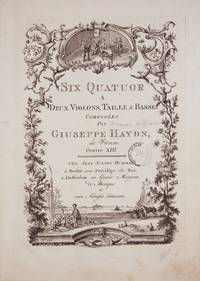
177540401à Berlin avec Privilége du Roi à Amsterdam: Jean Julien Hummel PN 356 1775. 4 volumes. Folio. Quarter dark tan mottled calf with marbled boards decorative cut paper label to uppers with titling in contemporary manuscript. <br /> <br /> Violino primo: 1f. recto title verso blank 3-15 pp.<br /> Violino secondo: 1f. recto title verso blank 3-14 pp. <br /> Viola: 1f. recto title verso blank i blank 4-15 pp.<br /> Basso: 1f. recto title verso blank i blank 4-15 pp.<br /> <br /> With a fine illustrated title to each part depicting two groups musicians within an elaborate border incorporating vegetation and animals. Engraved throughout.<br /> <br /> Small circular handstamp of the "Musik=Schule des Cantons" of Solothurn Switzerland to to each title.<br /> <br /> Binding slightly worn rubbed and bumped; upper hinges slightly split; "Oberlin 1812" in contemporary manuscript to front pastedown of each part. Minor signs of wear soiling and staining; some annotations in pencil.<br /> <br /> A very good crisp and attractive copy overall. Rare. RISM H 6244 three holdings all incomplete. <br /> <br /> These quartets were formerly thought to be by Haydn. <br /> <br /> "Hoffstetter's musical ideas are memorable easily accessible and popular in style but his working out of material does not attain Haydn's concentration. Apart from three viola concertos which might suggest that he was himself a viola player he composed various pieces of church music. His masses show some uncertainty in tonal structure. Writing to F.S. Silverstolpe on 11 January 1802 he confessed as much and acknowledged that 'everything that flows from Haydn's pen seems to me so beautiful and remains so deeply imprinted on my memory that I cannot prevent myself now and again from imitating something as well as I can'. Appropriately several of his works became known under Haydn's name." Hubert Unverricht in Grove Music Online. Jean Julien Hummel [PN 356] unknown
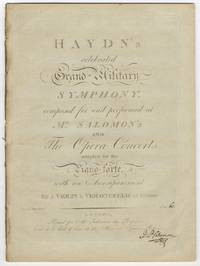
179740149London: Mr. Salomon 1797. Folio. Disbound. i title 98-115 pp. Engraved. Watermark 1796. "Sinfonia XII" printed at left of first system.<br /> <br /> With autograph control signature "J Salomon" with flourish to lower outer corner of title. <br /> <br /> Slightly worn and browned; very small tear to blank outer margin of title. First Edition of this arrangement by Johann Peter Salomon 1745-1815 entered at Stationer's Hall on 2 October 1797. HWV Vol. I p. 208 and appendix Coll.Sy.15b. Hoboken Collection Vol. 6 265 lacking string parts. RISM H4522 no complete sets of parts; copy in the Österreichische Nationalbibliothek ex-Hoboken lacks the Violoncello part; separate piano parts at Österreichische Nationalbibliothek and Royal Danish Library Copenhagen. WorldCat records two complete sets of parts only at the University of Oxford OCLC 28445245 and the Sächsische Landesbibliothek Dresden OCLC 315930218 and a piano part only OCLC 41830929 at Princeton University. <br /> <br /> "Haydn's London symphonies nos. 93-104 crown his career as a symphonic composer. Not only do they outdo the Paris symphonies stylistically but he produced them in person for rapturous audiences; this interaction stimulated him to ever bolder and more original conceptions. . No. 104 begins with a massive dotted motif on the 5th D-A which some commentators describe as dominating the entire symphony; the first movement is one of Haydn's freest and the finale has greater relative weight than that in any other of the London symphonies." James Webster in Grove Music Online<br /> <br /> Johann Peter Salomon a German violinist impresario and composer "played a leading part in English musical life not only in London but in the provinces as well. Having made his name as a brilliant violinist he made progressively fewer solo appearances and turned his attention to conducting and especially promoting concerts. He mounted subscription concerts from 1783 featuring such international artists as the soprano Mme Mara and his greatest triumph was to secure Haydn's visits to London in 1790-91 and 1794-5 for which the two sets of six 'Salomon' or 'London' symphonies h I:93-104 were written. Haydn's esteem for his impresario and orchestral leader can sometimes be seen in the symphonies for example the phrase marked 'Salomon solo ma piano' in the trio of no.97 and the florid violin part of no.103 second movement; the Concertante in B♭ h I:105 was composed for Salomon who played the solo violin part; and the six string quartets opp.71 and 74 h III:69-74 written between the two London visits in 1793 though dedicated to Count Apponyi were clearly designed for the public performances that Salomon's quartet gave in London. Salomon is also said to have had a hand in providing Haydn with the original model for the text of The Creation." Hubert Unverricht in Grove Music Online. Mr. Salomon unknown
178840118London: Longman & Broderip 1788. Folio. Disbound. 1f. recto title verso blank i blank 2-23 i blank pp. Engraved throughout. <br /> <br /> With contemporary London instrument dealer's overpaste to foot of title: "Sold at Gough's Harp and Piano-Forte Musical Instrument Warehouse No. 4 Sackville Street near the New Bridge ." <br /> <br /> Occasional light wear and foxing; several small tears with minor loss to edges; title and final leaf slightly soiled; repair to inner margin of blank verso of title. Published in the same year as the edition published in Vienna by Artaria. BUC p. 469. RISM 3850 one copy only in the U.S. at the University of Michigan. OCLC 34921913. Worldcat one copy only in the U.S. <br /> <br /> Hob. XVI:17 is most probably by Johann Gottfried Schwanenberger 1737-1804 "although authenticated by Haydn in ca. 1799-1803." Larson and Feder: The New Grove Haydn p. 187. Longman & Broderip unknown
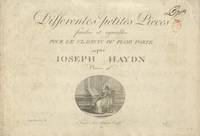
178641286Vienne: Chez Artaria Comp. PN 86 1786. Oblong folio. Disbound. i title with oval vignette engraved by Seb. Mansfeld of an aristocratic lady seated at a fortepiano playing from a large folio music book 2-15 i blank pp. Engraved throughout.<br /> <br /> Contains 10 short works for keyboard including arrangements of music from Haydn's opera La Vera Costanza. <br /> <br /> With contemporary signature and early stamp incorporating a shield topped by a crown to blank upper outer corner of title.<br /> <br /> Slightly worn; minor foxing mainly to blank margins of title; small dampstain to upper outer corner; some pages with irregular vertical ink lines as a result of printing from cracked plates. First Edition in this form. Rare. Weinmann p. 18. Hob. I:81/2 Hob. XXVIII:8/6 Hob. I:79/2 Hob. I:85/3 Hob. I:85/2 Hob. Ia:15/2 Hob. XVII:9 Hob. XXVIII:8 Hob. I:53/2 Hob. III:41/4. RISM H 4300 and HH 4300 no copies in the U.S. <br /> <br /> Haydn "began his career in the traditional patronage system of the late Austrian Baroque and ended as a 'free' artist within the burgeoning Romanticism of the early 19th century. Famous as early as the mid-1760s by the 1780s he had become the most celebrated composer of his time and from the 1790s until his death was a culture-hero throughout Europe. Since the early 19th century he has been venerated as the first of the three 'Viennese Classics' Haydn Mozart Beethoven. He excelled in every musical genre; during the first half of his career his vocal works were as famous as his instrumental ones although after his death the reception of his music focussed on the latter except for The Creation. He is familiarly known as the 'father of the symphony' and could with greater justice be thus regarded for the string quartet; no other composer approaches his combination of productivity quality and historical importance in these genres. In the 20th century he was understood primarily as an 'absolute' musician exhibiting wit originality of form motivic saturation and a 'modernist' tendency to problematize music rather than merely to compose it but earnestness depth of feeling and referential tendencies are equally important to his art." Georg Feder and James Webster in Grove Music Online. Chez Artaria Comp. [PN 86] unknown
179540395Offenbach sur le Mein: Jean André PN 760 1795. Folio. Unbound. Preserved in a custom-made reddish brown linen clamshell box with dark brown leather title gilt to spine.<br /> <br /> Violino primo: 1 title incorporating engraved vignette 2-5 pp.<br /> Violino secondo: 4 pp.<br /> Viola: 3 pp.<br /> Basso è violoncello: 4 pp. 2 copies<br /> Flauto: 2 pp.<br /> Oboe primo: 2 pp.<br /> Oboe secondo: 2 pp.<br /> Corno secondo in Es: 2 pp.<br /> Engraved throughout. <br /> <br /> Slightly worn and soiled; uniformly trimmed. Lacking Fagotti Corno primo Clarino primo and secondo and Timpani parts. One of the London symphonies. Published in the same year as the first "authentic edition" issued by Artaria and possibly pre-dating such. HWV Vol. I p. 95 considers this the André edition to take precedence. Robbins Landon p. 752. RISM H3188 and HH3188 no copies in the U.S. Jean André [PN 760] unknown
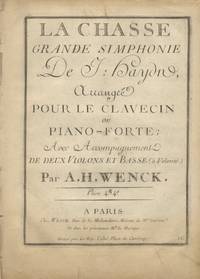
179041127Paris 1790. Folio. Disbound. Engraved. <br /> <br /> Wenck arr. La Chasse Grande Simphonie de J: Haydn Arrangée pour le Clavecin ou Piano-Forte; Avec Accompagnement de Deux Violons et Basse à Volonté par A. H. Wenck. Prix 4₶. 4s. Hob. I/73. Keyboard part only. Paris: Chez Wenck Rue de la Michaudiere Maison de Mr. Garnier et chez les principaux Mds. de Musique. Gravé par Le Roy l'aîné Place de Cambray . 10e. Ca. 1785. Keyboard part. i title 2-15 i blank pp. With "No. 14" in contemporary black ink to head of first page of music. RISM H4478 1 copy of the keyboard part only at the Biblioteca civica musicale "A. della Corte" in Milan.<br /> <br /> Bound with: <br /> Fodor arr. Simphonie Composés Par J Haydn Arrangées pour Clavecin ou Piano forte Avec Accompagnement d'un Violon Par M Fodor. Prix 3₶. Hob. I/47. Keyboard part only. Paris: Chez le Sr. Sieber Musicien rue St. Honore entre la rue des Vieilles Etuve et celle Dorleans chez l'Apothicaire No 92 A. P. D. R. Ca. 1790. 1f. recto title verso blank i "Catalogue de Musique Vocale et Instrumentale appartenant à Mons. Sieber Rue St. Honore entre la Rue des Vielles Etuves et celle d'Orleans chez l'Apothicaire No. 92" 2-13 i blank pp. With Sieber's control signature to lower outer corner of title "3" to head of title and "No 15" to head of first page of music in contemporary manuscript. Outer margin of publisher's catalogue very slightly trimmed just touching text in several instances. RISM H4498 1 copy of the keyboard part only at the Bibliothèque nationale. <br /> <br /> Bound with:<br /> Wenck arr. Quatuor Détache de l'Œuvre XXXIIIe. de M. Haydn Arrangé pour le Piano-Forte ou Clavecin avec Accompagnement de Violon et Violoncelle à volonté par M. Wenck. Op. 33/5 Hob. III:41. Keyboard part only. Paris: Chez M. Wenck rue de la Michodiere Maison de M. Garnier. Et Chez Melle. Rivet au Palais Royal à côté du Caffé de foy. No. 55. Prix 3₶.12f. . 12e. . i title 2-11 i blank pp. With first ten measures printed to head of title. "No. 16." in contemporary manuscript to head of first page of music. Not located in RISM.<br /> <br /> Slightly worn browned and soiled; a few small tears. Haydn "began his career in the traditional patronage system of the late Austrian Baroque and ended as a 'free' artist within the burgeoning Romanticism of the early 19th century. Famous as early as the mid-1760s by the 1780s he had become the most celebrated composer of his time and from the 1790s until his death was a culture-hero throughout Europe. Since the early 19th century he has been venerated as the first of the three 'Viennese Classics' Haydn Mozart Beethoven. He excelled in every musical genre; during the first half of his career his vocal works were as famous as his instrumental ones although after his death the reception of his music focussed on the latter except for The Creation. He is familiarly known as the 'father of the symphony' and could with greater justice be thus regarded for the string quartet; no other composer approaches his combination of productivity quality and historical importance in these genres. In the 20th century he was understood primarily as an 'absolute' musician exhibiting wit originality of form motivic saturation and a 'modernist' tendency to problematize music rather than merely to compose it but earnestness depth of feeling and referential tendencies are equally important to his art." Georg Feder and James Webster in Grove Music Online<br /> <br /> Wenck was a German composer and glass harmonica player. "According to Gerber he studied the violin with Hataš and the harpsichord and composition with Georg Benda. He went to Paris with the latter in 1778 and stayed there until at least 1792 as an arranger of popular overtures and airs. On his return to Gotha he became honorary ducal secretary lived on his small estate made pianos that were much sought after and worked at perfecting the glass harmonica with which he toured as a virtuoso. In 1788 he launched a periodical music collection which was intended to appear quarterly but which seems never to have got beyond its first issue: Variétés musicales pour le piano-forte ou clavecin avec accompagnements . mêlées de chant avec paroles italiennes et françaises. In addition he published overtures and airs from favourite operas mostly for piano or harpsichord with violin accompaniment but in one case for string quartet. He also published a set of Six petites sonates op. 1 n.d. and another of Sonates et pièces op.2 four of each for keyboard with violin ad libitum as well as a Ier simphonie op.3 for the same combination. These last two were advertised in 1783; the simphonie in the style of a piano reduction of orchestral textures was to have been the first of six. In addition Gerber reported three violin trios and a bassoon concerto in manuscript. In 1798 Wenck made improvements to the metronome of Sauveur and Duclos which he described in Beschreibung eines Chronometers Magdeburg 1798 and which he sold in quantity. In 1806 he moved to Holland settling in Amsterdam where he was still living in 1810." David Fuller in Grove Music Online<br /> <br /> Fodor was a French harpsichordist of Dutch birth. "One of the foremost harpsichordists of his time in about 1780 he settled in Paris where he gave concerts and taught and composed harpsichord concertos and sonatas as well as a symphony and music for piano and strings." Elizabeth Forbes in Grove Music Online. unknown
1790302878Vienna: Artaria et Comp 1790. Engraved music plate number 77 in 4 parts engraved title on front wrapper. Folio. Uncut and loose as issued. Front wrapper detached and worn lacking back wrapper stain to first and second violin parts foxing to final leaf of cello part. Engraved music plate number 77 in 4 parts engraved title on front wrapper. Folio. Franz Joseph Haydn 1732-1809 was born in Austria. Known as the 'father of the symphony' adnd 'father of the quartet' his work was eclipsed by that of Beethoven until the late twentieth century when much of his music finally became available in modern editions. <br/><br/>It has been argued that while he did not 'invent' the quartet he was "certainly the first composer to appreciate their potential . and Haydn projected an unequalled mastery of the language of music." Oxford Dictionary of National Biography<br/><br/>These string quartets in A major F minor and B-flat major are written for two violins viola and cello and were written in 1788 for Haydn's violinist friend Johann Tost. Hoboken III:60-62 Artaria et Comp unknown books