Haydn, JosephBiblio.com
34 résultats
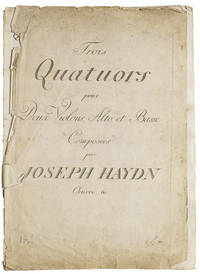
1790302878Vienna: Artaria et Comp 1790. Engraved music plate number 77 in 4 parts engraved title on front wrapper. Folio. Uncut and loose as issued. Front wrapper detached and worn lacking back wrapper stain to first and second violin parts foxing to final leaf of cello part. Engraved music plate number 77 in 4 parts engraved title on front wrapper. Folio. Franz Joseph Haydn 1732-1809 was born in Austria. Known as the 'father of the symphony' adnd 'father of the quartet' his work was eclipsed by that of Beethoven until the late twentieth century when much of his music finally became available in modern editions. <br /> <br /> It has been argued that while he did not 'invent' the quartet he was "certainly the first composer to appreciate their potential . and Haydn projected an unequalled mastery of the language of music." Oxford Dictionary of National Biography<br /> <br /> These string quartets in A major F minor and B-flat major are written for two violins viola and cello and were written in 1788 for Haydn's violinist friend Johann Tost. Hoboken III:60-62 Artaria et Comp unknown
18008581Paris Pleyel 1800 plein veau moucheté, dos lisse à décor floral, motif central sur les plats avec effet de teinte plus foncé, guirlande, tranche dorée. in-4 oblong, titre, 118pp., [Cot. 358]
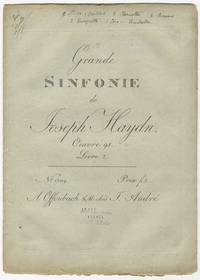
179940334Offenbach s/m: J. André PN 1369 1799. Folio. Unbound.<br /> <br /> Violino primo: 1 title 2-7 pp.<br /> Violino secondo: 1 blank 2-6 pp.<br /> Due viole: 4 pp.<br /> Basso e violoncello: 4 pp.<br /> Flauti: 4 pp.<br /> Oboe primo: 3 pp.<br /> Oboe secondo: 2 pp.<br /> Clarinetto primo: 2 pp.<br /> Clarinetto secondo: 2 pp.<br /> Fagotti: 3 pp.<br /> Clarino primo in D: 2 pp.<br /> Clarino secondo in D: 2 pp.<br /> Corno primo in D: 2 pp.<br /> Corno secondo in D: 2 pp.<br /> Timpani in D: 2 pp.<br /> Engraved throughout.<br /> <br /> Small binder's hole to upper inner margin; early manuscript note regarding instrumentation to upper margin of title with "Comptoir Général de Musique" stamps to lower margin; "Salomon's Concert" printed to foot of first page of music of each part. Early edition of Haydn's "Clock" symphony. Robbins Landon p. 772 10 giving precedence to the Artaria edition of Autumn 1799 as the first "authentic" edition and suggesting that the present edition was most probably derived from the first edition published by Gombart in 1798 or 1799. Hoboken Catalogue 6 266. RISM H3199 and HH 3199 no copies in the U.S. J. André [PN 1369] unknown
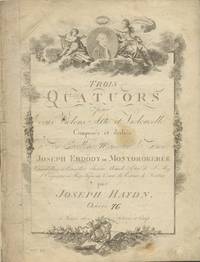
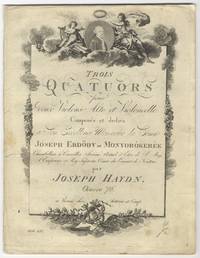
180040445Vienne: Artaria et Comp. PN 837 1800. Folio. First violin part in early marbled wrappers with decorative cut-paper title label in manuscript to upper; other parts with thin strips of marbled paper reinforcing spines.<br /> <br /> Violino primo: 1f. recto title verso blank 19 i blank pp. Title within elaborate border engraved by J. E. Mansfeld incorporating a portrait of Haydn at head a muse holding a flute and trumpet and an angel playing a lyre. <br /> Violino 2o.: 17 i blank pp. <br /> Viola: 17 i blank pp.<br /> Violoncello: 17 i blank pp.<br /> Engraved throughout.<br /> <br /> Wrappers quite worn and torn at spine. Slightly worn foxed soiled and stained; old paper repair to inner margins of title and final leaf; margins of two leaves of first violin part trimmed with partial loss of plate number. First Edition with the noted title page incorporating a portrait of the composer. Hoboken 7 647. Hoboken Collection Vol. 7 647. BUC p. 466. RISM H3574. <br /> <br /> "The last of Haydn's six great E-flat quartets 1797 is perhaps - dare one compare on this level - the greatest of them all; in any case it is amongst the greatest of the his great quartets as well as being the very greatest of the 'celebrated' which status it no doubt again owes to its symmetrical themes - the only aspect of the work one is tempted to suggest which is not drastically innovatory. One hardly knows where to start when listing its lasting innovations . but inasmuch as they affect one's performance of the work one can concentrate on them with a quiet conscience." Keller: The Great Haydn Quartets p. 228. Artaria et Comp. [PN 837] unknown
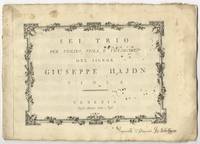
178740113Venezia: Antonio Zatta e Figli 1787. Oblong folio. Sewn. Three parts each with identical title excepting instrument names. Engraved throughout. <br /> <br /> Violino: i title incorporating decorative engraved border with floral motifs and musical instruments including lute recorder trumpet and violin 15 pp. <br /> Viola: i title 14 i blank pp. <br /> Violoncello: i title 12 i blank pp. <br /> <br /> With "Proprietà di Bianconi de Valleta" in contemporary ink to lower outer corner of title to viola part: "Per uso di cancelled" and in another hand to lower outer corner of each title.<br /> <br /> Violin: Title detached soiled foxed and stained with some marginal dampstaining losses to edges and small holes; light dampstaining mainly to upper outer quadrant of first and final leaves; occasional small stains. <br /> Viola: Staining and soiling to title; stain to blank outer upper corner of all leaves; occasional stains and soiling.<br /> Violoncello: Some foxing and small stains mainly to blank margins; final blank leaf stained and soiled. First Edition. Rare. Hoboken 7 966. RISM H3816.<br /> <br /> Originally composed for baryton trio in 1768 during Haydn's period of service to Nikolaus I Prince Esterházy 1714-1790 here cast in a version for violin viola and cello. <br /> <br /> Antonio Zatta fl. late 18th century was an Italian printer and publisher. "He was in business with his sons under the name 'Antonio Zatta e figli Librai e Stampatori veneti' with premises in Venice 'al traghetto di S Barnaba'; theirs was the largest engraving works in the city their activity dating back to about 1750. . From 1786 the firm began printing on its own press from engraved plates a weekly piece of instrumental music for sale by subscription; in the following years this initiative expanded to include trios duos quartets symphonies or sonatas for various instruments and even vocal pieces issued on a monthly basis. In the letters circulated to 'professori e dilettanti di musica' inviting them to become subscribers the firm explained the preponderance of instrumental music by the fact that Italy 'abounds without doubt more in professional and amateur players than in singers.' Instrumental works by Corelli Bertoni Boccherini Capuzzi Andreozzi Cirri Cambini Pichl Fodor Stabinger Grazioli Haydn Mozart and Salieri and vocal pieces arias by Cimarosa Guglielmi Paisiello Anfossi Naumann Gazzaniga Borghi Traetta and Piccinni were printed and published. Many of Zatta's editions were reprints from German or Viennese publications especially of Hoffmeister's a publisher with whom Zatta had connections. Zatta also published didactic methods Pfeiffer La bambina al cembalo and music theory. After 1788 all editorial activity ceased but Zatta continued to trade in music publications. One of Antonio's daughters Marina married the publisher Sebastiano Valle who continued the work of the Zatta family until about 1806." Mariangela Donà in Grove Music Online. Antonio Zatta e Figli unknown
180040068Vienne: Artaria et Comp. PN 837 1800. Folio. Preserved in a custom-made full dark brown linen clamshell box with black leather label with titling gilt to spine. <br /> <br /> Violino primo: 1f. recto title verso blank 19 i blank pp. Title within elaborate border engraved by J. E. Mansfeld incorporating a portrait of Haydn at head a muse holding a flute and trumpet and an angel playing a lyre. <br /> Violino 2o.: 17 i blank pp. <br /> Viola: 17 i blank pp.<br /> Violoncello: 17 i blank pp.<br /> Engraved throughout.<br /> <br /> Slightly worn; occasional soiling and small stains primarily to blank margins; small tear to blank inner margin of title to first violin part extending slightly into border. First Edition with the famous title page incorporating a portrait of the composer. Hob. III:78-80. Hoboken Collection Vol. 7 647. BUC p. 466. RISM H3574. <br /> <br /> "The last of Haydn's six great E-flat quartets 1797 is perhaps - dare one compare on this level - the greatest of them all; in any case it is among the greatest of the his great quartets as well as being the very greatest of the 'celebrated' which status it no doubt again owes to its symmetrical themes - the only aspect of the work one is tempted to suggest which is not drastically innovatory. On hardly knows where to start when listing its lasting innovations . but inasmuch as they affect one's performance of the work one can concentrate on them with a quiet conscience." Keller: The Great Haydn Quartets p. 228. Artaria et Comp. [PN 837] unknown
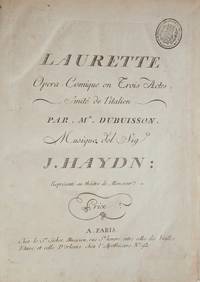
179140111Paris: Sr. Sieber Musicien rue St honoré entre celles des Vielles Etuve et celle D'orleans chez l'Apothiciare No. 92 PN 1171 1791. Folio. Ivory vellum-backed marbled boards dark red leather label to spine with titling gilt. 1f. recto title verso blank 254 pp. with "Personnages" to lower portion of p. 12 following overture. Engraved throughout.<br /> <br /> Overture and arias with spoken dialogue provided as text; "Laurette" was performed without recitatives. <br /> <br /> Handstamp of "Cercle des amateurs de musique Strasbourg" incorporating lyre and floral motif to upper outer corner of title and first page of music.<br /> <br /> Binding worn rubbed and bumped. Light uniform browning; occasional small stains and foxing; abrasion to p. 101 affecting several bars of music; price erased from title. First Edition. Hoboken Collection Vol. 9 1615. Lesure p. 299. RISM H2563<br /> <br /> Laurette to a libretto by Francesco Puttini was first performed on 25 April 1779. <br /> <br /> "Contrary to claims made by Haydn's early biographers insufficent evidence supports the hypothesis that Haydn wrote this opera to fulfill an imperial commission for Vienna. The libretto represents a considerably shortened version of Puttini's text for Anfossi 1776 Rome already somewhat condensed especially in Act 3 for performances later that year in Venice as La pescatrice fedele and in Vienna 1777. Andrea Totti who sang Count Errico in Venice also performed in Haydn's opera at Eszterháza. . The opera was subsequently performed as Der flatterhafte Liebhaber oder Der Sieg der or Die wahre Beständigkeit in Pressburg Bratislava 1786-7 Budapest 1789 Vienna 1790 and Brno 1792 and with numerous changes as Laurette in Paris 1791." Caryl Clark in Grove Music Online<br /> <br /> "La vera costanza 1778-9 is the subject of implausible and conflicting anecdotes in Griesinger and Dies according to which it was originally commissioned for the Burgtheater in Vienna but scuttled by intrigue neither Joseph II nor his musicians were well-disposed towards Haydn; in fact it had its première at Eszterháza on April 25 1779. It was lost in the fire that largely destroyed the Eszterháza opera theatre on November 18 1779; the surviving version represents Haydn's reconstruction of the work from 1785." Georg Feder and James Webster in Grove Music Online. Sr. Sieber, Musicien, rue St honoré entre celles des Vielles Etuve et celle D'orleans chez l'Apothiciare, No. 92 [PN 1171] unknown
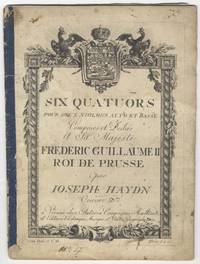
178740066Vienne: Artaria PN 109 1787. Folio. Sewn. <br /> <br /> Violino primo: 1f. recto title with elaborate engraved border incorporating coat of arms crowned eagles crown and floral and architectural motifs verso blank i blank 2-25 pp. <br /> Violino secondo: 1f. recto title verso blank i blank 2-21 i blank pp. <br /> Viola: 1f. recto title verso blank i blank 2-21 i blank pp. <br /> Violoncello: 1f. recto title verso blank i blank 2-21 i blank pp. <br /> Engraved throughout.<br /> <br /> Occasional fingerings in contemporary ink to first violin part.<br /> <br /> 19th century annotation: "Tenor - Fundament" and "Anton Kulhanek" to head of blank page preceding music to second violin part with hand-drawn stave and scale with note names and on the same page a small chart with note or string names and transpositions and the name "Franz Rücker." Some dynamics modified in ink in viola part transforming "f" to "sf." <br /> <br /> Somewhat worn foxed soiled and stained; spines reinforced with early dark blue paper tape; edge tears with minor loss to blank margins of first violin part; outer and lower margin of final leaf reinforced just touching staff lines. First Edition of the Prussian Quartets. Hob. III:44-49. Hoboken Catalogue Vol. 7 574. BUC p. 465. RISM H3494 two copies only in North America one in Britain and none in France or Italy. <br /> <br /> The fourth quartet in this group in F sharp minor is regarded as one of Haydn's finest. "It shows for the first time in the quartets Haydn's definite renunciation of tragic ends to sonata movements and his now typical association of the minor mode with a passionate somewhat blustering temper ending with a recapitulation in these circumstances regular in the tonic major so that everything turns out well. . In striking contrast to the happy end of the first movement the final fugue quietest and deepest of all the . instrumental fugues since Bach strikes a note so tragic that Beethoven's C sharp minor quartet is the first thing that one can connect with it." Tovey in Landon: Haydn Chronicle and Works II p. 627. Artaria [PN 109] unknown
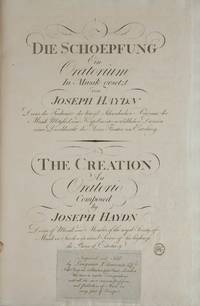
180040127Vienna: The Composer 1800. Folio. Contemporary quarter dark tan mottled calf with ivory vellum-edged marbled boards titling gilt to spine. 1f. recto title verso blank 4ff. subscribers list 303 i blank pp. Text in German and English. Title and music engraved list of subscribers typeset.<br /> <br /> With Haydn's small circular monogrammatic handstamp "JH" to foot of title. <br /> <br /> Binding worn rubbed and bumped; minor loss to head and tail of spine. Occasional small stains and moderate browning; some signatures partially split at lower portion. In very good internal condition overall. First Edition. HWV Vol. II p. 36. Hirsch IV 799. Leipzig catalogue p. 19. Vecsey 303. Eitner V p. 66. BUC p. 456. RISM H2521. <br /> <br /> The Creation to a libretto by Gottfried von Swieten was first performed at the Palais Schwarzenberg in Vienna on 29 and 30 April 1798; its first public performance took place on 19 March of the following year at the Burghteater in Vienna. <br /> <br /> "There is hardly any doubt in the mind of the average music-lover that Haydn's Oratorio The Creation is tutto sommato his greatest single accomplishment and certainly ranks as one of the greatest products of any eighteenth-century mind. It occupies a central position in choral literature and its composition and first performances were the dominant features of Haydn's life in the late 1790s." Robbins Landon: Haydn Chronicle and Works Vol. IV: Haydn The Years of 'The Creation' 1796-1800 p. 12.<br /> <br /> Copies of the first edition of this monumental work containing the subscribers list are very scarce to the market. [The Composer] unknown