LISZT, Franz 1811-1886Biblio.com
1 186 résultats
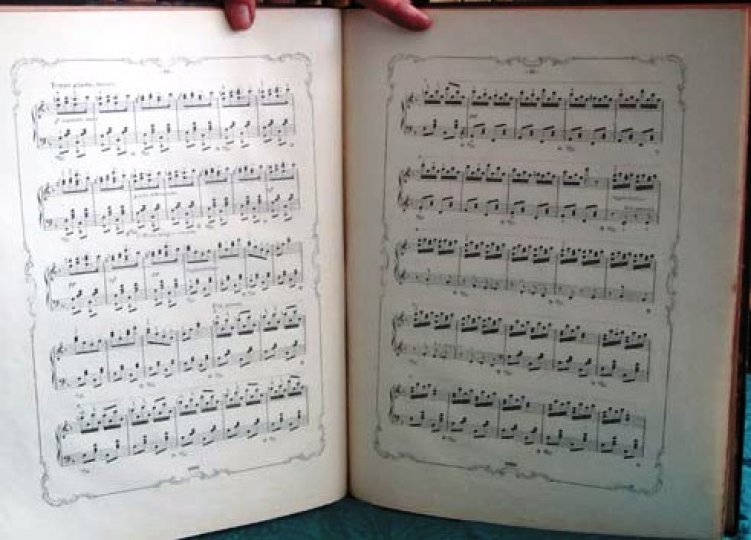
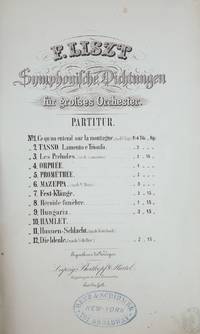
186241066Leipzig: Breitkopf & Härtel PN 9056 1862. Octavo. Original publisher's blue printed wrappers. 1f. recto title verso blank 1f. recto composer's note on performance practice in German verso same note in French dated "Weimar Mars 1856" 1f. recto preface in German verso preface in French 97 iii blank pp. Title note and preface lithographed; music engraved. <br /> <br /> With publisher's catalogue to verso of lower wrapper. <br /> <br /> With Beer & Schirmer New York and Musik-Antiquariat Doblinger handstamps to upper wrapper; Beer and Schirmer and publisher's handstamp to title.<br /> <br /> Wrappers worn soiled chipped and torn; spine reinforced with paper tape with small pieces of same tape to verso of upper wrapper. Minor internal wear. First Edition later issue. Searle 97. Raabe 414. Sonneck Orchestral Music p. 266. <br /> <br /> Liszt was a distinguished Hungarian composer pianist conductor and writer.<br /> <br /> "Sketchbook evidence points to 1846-7 as the years when Liszt began to conceive the idea of a series of programmatic orchestral works. Of the four works he named all based on French poetry Ce qu'on entend sur la montagne and Les Préludes eventually became symphonic poems. . <br /> <br /> Liszt's concentration on the symphonic poem largely coincided with his tenure as Kapellmeister in Weimar where he had an orchestra at his disposal and provided music for performances at the Court Theatre. The Grand Duke commissioned Liszt's 'overtures' to preface specific dramas which thereby determined the subject matter of what were to become a number of his symphonic poems. Cormac F2017 argues that Liszt's approach to the overtures and their transformation into symphonic poems was influenced by his experience of an array of dramatic media opera plays melodramas tableaux vivants and by his interaction with staff and actors involved in the dramatic productions in Weimar. A New German School acolyte Felix Draeseke writing about the symphonic poems in a series of essays from the late 1850s acknowledged the influence of dramatic music especially opera on Liszt's Festklänge. Draeseke also addressed the issue that continues to interest scholars - the symphonic poems' engagement with sonata form. .<br /> <br /> Looking at the 12 Weimar symphonic poems Vande Moortele . views all but three Orpheus Héroide funèbre and Hunnenschlacht as using sonata form as one of the central principles guiding their large-scale organization. Furthermore Liszt seems to have attempted the same merging of sonata form and sonata cycle evident in the B Minor Sonata in Tasso Les préludes and Die Ideale and possibly Ce qu'on entend sur la montagne. .<br /> <br /> Some of the symphonic poems include mimetic representation of scenes and actions such as Hunnenschlacht's depiction of a battle and Prometheus's evocation of a voice followed by a storm. The inclusion of such passages drew criticism that a number of the symphonic poems seemed formless and could not be understood without access to a programme. In other symphonic poems such as Les Préludes and Orpheus Liszt responded to a philosophical programme without compromising musical logic. In these cases critics recognized Liszt the 'tone poet' who could capture a poetic stimulus in an expressive evocative musical flow unified by a single theme that underwent transformations. In general Liszt's sumptuous orchestral colorings were the dominant focus of critics' positive reception of his symphonic poems and programme symphonies." Dolores Pesce Maria Eckhardt and Rena Charnin Mueller in Grove Music Online. Breitkopf & Härtel [PN 9056] unknown
45226508-nnew. unknown
45226508like new. unknown
190011344Paris, Rouart, Lerolle et Cie. non daté, vers 1900 - 2 parties 10 et 21 pp.Belle reliure à la bradel demi-maroquin bleu à coins. Dos lisse orné et doré. Tête dorée. Couverture conservée. Pas de rousseur. Dos et coins légèrement frottés. Bon état. Format in folio (35x28).
feb41117Used. For more details please contact me unknown
198617805AMünchen, List, 1986. Ca. 31,5 x 27,5 cm. 346 Seiten, mit zahlreichen Abbildungen. Original-Leinenband mit illustriertem Original-Umschlag. Im Original-Schuber.
2 Bde. 351 S., 1 Tafel, 19 S.; 379 S., 1 Tafel, 46 S. Gr.-8°. In 2 Schubern. Beide Bände mit eigenh. Widmung und Unterschrift des Verfassers, in Bd. I mit Notenzitat..
a54986Berlin c.1820 Schlesinger'schen Buch- u. Musikhandlung S. 3297. In German. smfolio. 20pp. original wraps. Small owner stamp on front. VG. Not a modern reprint. No owner marks. No tears almost no wear at all. Pictures available on request. . paperback
188128117AB1881. Nouvelle édition. Leipzig Breitkopf & Haertel 1881. Gross-8°. 1 Bl. 4 538 S. 1 Bl. Illustr. silbergeprägter Orig.-Leinenband Um 200 S. erweitere Neuauflage über die von Liszt beschriebene Volksmusik der Roma und der Juden in Ungarn und Russland. - Mit getilgtem Namenszug auf dem Halbtitelblatt. Einband berieben und bestossen. unknown
188128117ABNouvelle édition. Leipzig, Breitkopf & Haertel, 1881. Gross-8°. (1) Bl., (4), 538 S., (1) Bl. Illustr. silbergeprägter Orig.-Leinenband
2010__3112679857De Gruyter 2010. Hardcover. New. reprint edition. 109 pages. German language. 6.14x0.63x9.21 inches. De Gruyter hardcover
2010__3112679830De Gruyter 2010. Hardcover. New. reprint edition. 115 pages. German language. 6.14x0.69x9.21 inches. De Gruyter hardcover
__3111173062de Gruyter 1900. Hardcover. New. 78 pages. German language. 9.06x6.10x0.39 inches. de Gruyter hardcover
185040941Leipzig: Breitkopf & Härtel PN 8090 1850. Folio. Unbound as issued. 1f. recto title verso blank 3-29 i blank pp. Engraved.<br /> <br /> Small oval handstamp to blank lower margin of title.<br /> <br /> Slightly worn browned and foxed. First Edition. Searle 414:3. Raab 223.<br /> <br /> Liszt made numerous transcriptions from the operas of Meyerbeer including L'Africaine Le Prophète Les Huguenots and Robert le Diable. Breitkopf & Härtel [PN 8090] unknown
ria9783111173061_inpHardcover. New. New Book; Fast Shipping from UK; Not signed; Not First Edition; N/A hardcover
ria9783111231327_inpHardcover. New. New Book; Fast Shipping from UK; Not signed; Not First Edition; N/A hardcover
ria9783111173108_inpHardcover. New. New Book; Fast Shipping from UK; Not signed; Not First Edition; N/A hardcover
ria9783111173115_inpHardcover. New. New Book; Fast Shipping from UK; Not signed; Not First Edition; N/A hardcover
ria9783111173122_inpHardcover. New. New Book; Fast Shipping from UK; Not signed; Not First Edition; N/A hardcover
ria9783111173245_inpHardcover. New. New Book; Fast Shipping from UK; Not signed; Not First Edition; N/A hardcover
ria9783112444870_inpHardcover. New. New Book; Fast Shipping from UK; Not signed; Not First Edition; N/A hardcover
93098Wien Neff 1986. Kl.8° 31 u. 99 S. Kart. in Schmuckschuber. Tadellos. EA. Das Faksimile frz. der Textbd. dt. 010 Wien, Neff, 1986 unknown
1801387559.Gpaperback. Good. Access codes and supplements are not guaranteed with used items. May be an ex-library book. paperback
105104William Reeves. Fine in Fine dust jacket. Hardcover. Hardcover. 370 pages. Book is in FINE condition. Stiff card Dust Jacket. Indentation and mark length of spine else FINE condition also. William Reeves publisher. ; 8vo 8" - 9" tall; 370 pages . William Reeves hardcover
187514164Berlin - Wien: Schlesinger-Haslinger Ca. 1875. Used; Like New/Used; Like New. Score of Liszt's Hungarian Rhapsody no. 12 "A J. Joachim" with the ownership stamp of the important twentieth-century German pianist Elly Ney who has also penned "12. Ungarische Rhapsodie" in blue ink at the head. A few paper repair within edges lightly nicked with small tears spine reinforced with green cloth overall very good. There are no markings within the score. <br style="">Elly Ney was one of the 20th century's outstanding pianists and at 16 won the Mendelssohn prize 1900—in a contest of which the famous Hungarian violinist Joseph Joachim was one of the judges.  The present work by Liszt is dedicated to Joachim. <br>Of Ney's great performing Willhelm Kempff wrote: "My ears still hear her melodious voice with its unmistakable hint of her Rhineland origins which had the gift of establishing immediate contact with everyone she spoke to. This happened even more intensely when she stepped onto the concert platform. Just one mysterious chord Beethoven's D minor sonata for instance and the listener was drawn into her magnetic field. What then ensued cannot and should not be described in words nor should it be scientifically dissected. Those who had ears heard for themselves. But that was by no means the end of the matter. A realisation continued to resonate in her listeners' hearts as it had begun to resonate from the moment this greatest of performers stepped onto the platform - the realisation that artistry of this quality draws its strength from roots that have their being in the unfathomable depths of the human soul."<br style=""> Schlesinger-Haslinger hardcover books