59 résultats
186036281Leipzig 1860. Oblong folio approximately 234 x 320 mm. 19 measures. Notated in dark brown ink on 9-stave rastrum-drawn paper on the first page of a bifolium. With several corrections in Liszt's hand and the addition of numbering both above and within the staves referring to additional measures possibly being directions to a copyist. <br/><br/>Pages 2 and 3 of the bifolium contain a manuscript copy of Felix Mendelssohn's Gondellied opus 19 number 6 entitled "Venetianisches Gondellied" at the head of the first page<br/><br/>Page 4 is ruled but blank except for a short 1-1/2 measure sketch in pencil in an unknown hand. <br/><br/>Moderate browning; somewhat creased and with some showthrough; small 7 mm tear to upper edge of first leaf; paperclip stain to upper corner of outer pages; minor remnants of mounting paper to final page. <br/><br/>In quite good condition overall. The Liszt manuscript would appear to be an accompaniment to a song. <br/><br/>The inclusion of the Mendelssohn copyist manuscript with the present Liszt autograph is quite interesting; it may in fact be in the hand of one of the copyists in Liszt's circle in Leipzig although this point will require further research. Liszt made arrangements of six of Mendelssohn's songs in the 1840s.<br/><br/>We would like to thanks Drs. Rena Mueller David Cannata and Alan Walker for their advice regarding this manuscript. unknown books
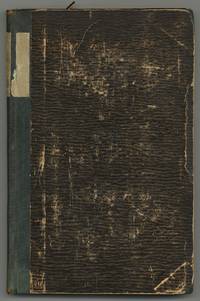
1851578930Leipzig: Brockhaus 1851. Hardcover. Very Good. First edition. Thin octavo. 185 1 errata pp. Text in French. Contemporary quarter cloth and patterned paper over boards with paper label on spine. Folded sheet of music tipped-in at rear. Boards well rubbed a few marginal light pencil notes in text some modest foxing throughout but a pleasing very good copy of a rare first edition preceding by a year the German language edition published in Cologne. The first book by Liszt who wrote it in French and the first serious appraisal of Wagner before he was widely recognized. Brockhaus hardcover
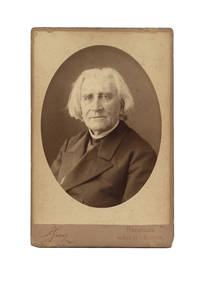
1882Liszt1<p><strong>LISZT Franz 1811-1886</strong></p><p>Original photograph by Julien Ganz Period albumen print 1882 cabinet format 145 x 105 cm Mounted on thick cardboard in the photographer's credit 165 x 108 cm Dark red edge all around "Liszt" annotation on back side from an unknown hand</p><p><strong>Striking and unpublished portrait of the musician</strong></p><p>Several variants taken on the same day are known. However none of them show Liszt staring at the lens. His portrait is all the more intense here.</p><p>Some traces of an old assembly mounting on margins small scratches and small accidents at the lower corners of the cardboard see scans otherwise good condition.</p>
1859008609Paris: Librairie Nouvelle / A. Bourdilliat et C. 1859. SCARCE in First Edition and lovely period perhaps Hungarian binding. In unique Art Nouveau binding that has been rebound preserving the embossed boards and with newer back and end papers. Stamped at front end page and title page "Mária Dorothea Egyesület" a Hungarian institution in Budapest that houses retired teachers.Near Fine some pencil notations at end pages and title page. . First Edition. Embossed Morocco . Near Fine. 12mo - over 6¾" - 7¾" tall. Librairie Nouvelle / A. Bourdilliat et C. Hardcover books
185940579Viennae: Typis Caes. Reg. Status Officinae 1859. Elephant folio 545 x 390 mm. Original black cloth-backed grey printed boards. 1f. recto title. verso blank 130 pp. With J. Schuberth & Co. overpaste to upper board and title.<br /> <br /> Binding somewhat worn rubbed and bumped. First Edition. Scarce. Raabe 484. Searle 9. Hoboken Catalogue Vol. 10 38. <br /> <br /> The "Grau" mass is one of Liszt's major works composed for the consecration of the new basilica at Grau in his native Hungary. It was first performed under Liszt's direction on 31 August 1856 to an audience of approximately 4000 people. "This music is religious to the point of converting Satan himself!" Walker II pp. 403-406. <br /> <br /> An important work in large striking format. Typis Caes. Reg. Status Officinae unknown
1859008609Paris: Librairie Nouvelle / A. Bourdilliat et C. 1859. Book. Near Fine. Hardcover. First Edition. 12mo - over 6¾" - 7¾" tall. SCARCE in First Edition and RARE in a punched gilt leather binding the punched gilt leather panels applied over the original leather binding to the front and rear boards leaving the original leather spine uncovered and with newer end papers. The panels are remnants of a much larger gilt leather wall hanging likely Dutch or Flemish in origin. Stamped at front end page and title page "Mária Dorothea Egyesület" a Hungarian institution in Budapest that houses retired teachers. Near Fine some pencil notations at end pages and title page. Hungarian composer Franz Liszt's " Des Bohemiens et De Leur Musique En Hongrie" was a pioneering work in creating a national music for Hungary which he believed to be the folk music of the Roma Gypsies. The book sparked much debate and controversy throughout 19th century Hungary and the world of music and remains controversial today. An essential Classical music study in an exceedingly uncommon and virtuosic binding. . Librairie Nouvelle / A. Bourdilliat et C. Hardcover
185231153Wien: C.A. Spina 1852. KRIEHUBER Josef 1800-1876 artist. Image ca. 320 x 255 mm. Sheet 560 x 410. Lithograph; chine appliqué. Half length standing in pensive pose with sheets of music manuscript paper beneath his right hand. Signed in the stone by the artist at lower right and with "Gedr. bei Joh. Hofelich" printed at lower left. Mounted on heavy dark ivory paper with facsimile signature "F. Liszt" below image and imprint at center of lower margin.<br/><br/>Lithograph slightly foxed primarily to upper right with only a few spots affecting the image itself. Mount heavily browned where formerly matted; some slightly heavier foxing; several small tears to blank edges; lower right blank corner chipped. Second issue. Wurzbach 1204. László and Mátéka 170. Burger 320 first issue dated 1846 in the stone. <br/><br/>An attractive portrait of the young Liszt who would go on to become a highly distinguished composer pianist and teacher a towering figure of the Romantic movement in music.<br/><br/>Josef Kriehuber is regarded as the most important portrait lithographer of the Viennese Biedermeier period; both the Albertina and the Austrian National Library hold significant collections of his works. C.A. Spina unknown books
1871125188Leipzig: J. Schuberth & Co 1871. 1871 or that era. Folio. Fair Ex-lib. usual markings; heavy wear to extremities of boards; spine mostly gone; front and back boards detached but present; ffep and title pages detached and heavily chipped; main block secure and mostly in good condition but with brittle page edges. Tan paper over boards; Dark brown cloth at spine; 129 pp. comprised totally of a musical score. Oversize 15 x 21.5 inches and heavy 7.5 pounds / 3.4 kilos. The mass was composed by Franz Liszt between 1855 and 1858 for the dedication of the new part of the cathedral at Esztergom Hungary by Archbishop Janos Scitovszky. Liszt conducted the work and the organist was Alexander Winterberger. The dedication concert the work's premiere was on August 31 1856. The reverberation time in the cathedral is 9 seconds Wikipedia creating the potential for an acoustic nightmare in performing a piece of this magnitude! The performance was attended by 4000 guests including Emperor Franz Joseph I and other imperial majesties of Austria-Hungary ecclesiastical dignitaries well-known musicians and members of the press. After the premiere Liszt and others continued to make various small changes and corrections to the original score. The first publication was in 1859 by the Imperial Printing House Vienna followed by subsequent editions and variations piano reductions etc. by J. Schuberth 1871. G. Schirmer 1909. etc. This particular edition/volume contains NO individual parts violin flute soprano etc. for actual performance but IS an actual complete copy of the entire conductor's score meaning that it includes all the orchestral organ vocal soloist SATB and choral SATB parts with vocal text all together for a conductor to use in rehearsal or performance. This edition was published by J. Schuberth & Co. no date likely in Leipzig rather than New York or Philadelphia as the names of the instruments are listed in German and the price on the front cover is listed in Thaler an old German/European coinage. The work is complete: Kyrie Gloria Credo Sanctus Benedictus Agnus Dei with all parts readable even where margins are chipped. An excellent copy for the conducting student Liszt afficionado musical researcher or someone interested in Hungarian/Esztergom ecclesiastical history. For an excellent article by Morten Solvik on Liszt's writing of this work see this link from the American Symphony Orchestra's web site. J. Schuberth & Co hardcover books
1871125188Leipzig: J. Schuberth & Co 1871. 1871 or that era. Folio. Fair Ex-lib. usual markings; heavy wear to extremities of boards; spine mostly gone; front and back boards detached but present; ffep and title pages detached and heavily chipped; main block secure and mostly in good condition but with brittle page edges. Tan paper over boards; Dark brown cloth at spine; 129 pp. comprised totally of a musical score. Oversize 15 x 21.5 inches and heavy 7.5 pounds / 3.4 kilos. The mass was composed by Franz Liszt between 1855 and 1858 for the dedication of the new part of the cathedral at Esztergom Hungary by Archbishop Janos Scitovszky. Liszt conducted the work and the organist was Alexander Winterberger. The dedication concert the work's premiere was on August 31 1856. The reverberation time in the cathedral is 9 seconds Wikipedia creating the potential for an acoustic nightmare in performing a piece of this magnitude! The performance was attended by 4000 guests including Emperor Franz Joseph I and other imperial majesties of Austria-Hungary ecclesiastical dignitaries well-known musicians and members of the press. After the premiere Liszt and others continued to make various small changes and corrections to the original score. The first publication was in 1859 by the Imperial Printing House Vienna followed by subsequent editions and variations piano reductions etc. by J. Schuberth 1871. G. Schirmer 1909. etc. This particular edition/volume contains NO individual parts violin flute soprano etc. for actual performance but IS an actual complete copy of the entire conductor's score meaning that it includes all the orchestral organ vocal soloist SATB and choral SATB parts with vocal text all together for a conductor to use in rehearsal or performance. This edition was published by J. Schuberth & Co. no date likely in Leipzig rather than New York or Philadelphia as the names of the instruments are listed in German and the price on the front cover is listed in Thaler an old German/European coinage. The work is complete: Kyrie Gloria Credo Sanctus Benedictus Agnus Dei with all parts readable even where margins are chipped. An excellent copy for the conducting student Liszt afficionado musical researcher or someone interested in Hungarian/Esztergom ecclesiastical history. For an excellent article by Morten Solvik on Liszt's writing of this work see this link from the American Symphony Orchestra's web site. J. Schuberth & Co hardcover
1877mon0000210225William Reeves 1877-01-01. Hardcover. Acceptable. in x in x in. Ex-library book usual markings. Hardback with dust cover. Well read copy with some spine wear. Pages are rough cut and have coloured edges due to age. The bottom corner of the back cover board has been torn off. William Reeves hardcover
1851W1410FLLeipzig: F.A.Brockhaus 1851. Red calf spine with gilt titling and rules and blindstamped rules. Red cloth covered boards and red patterned endpapers. Some wear and scuffing on spine. Original work in paper wraps is bound in in entirety. Wraps a little darkened and lower wrap has a small repair on top edge. A little foxing especially at rear. Errata page at rear is followed by fold outs of music sheets from each of the works. . First Edition. Half-Leather. Good/No Dust Jacket. 8vo - over 7¾" - 9¾" tall. Music. F.A.Brockhaus Hardcover books
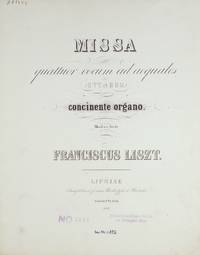
185340935Lipsiae: Breitkopfii et Härtelii PN 8636 1853. Folio. Dark yellow cloth-backed light gray boards. 1f. recto title verso blank 1f. recto dedication to "Patri Venerabili Albach" verso blank 3-35 i blank pp. Engraved.<br /> <br /> Scored for Tenors I and II Basses I and II and Organ.<br /> <br /> Handstamps of the Music Institute of the University of Vienna to title and dedication; deaccession note and stamp to verso of title.<br /> <br /> Binding somewhat worn rubbed and bumped with remnants of label to inner corner of upper board. Minor internal wear; lower outer corners bumped. First Edition of the first version. Searle 8a. Raab 485a. <br /> <br /> The Mass for four male voices and organ was composed in 1846-47 and was first performed in 1852 in Weimar "to celebrate the birthday of the President of the French Republic - later the Emperor Napoleon III. This is an unusual and austere work in which singers effectively declaim not sing parts of the Credo. The melodic line of the Gloria reveals the influence of plainchant." Collet: Franz Liszt. The Man & His Music Alan Walker ed. p. 340. Breitkopfii et Härtelii [PN 8636] unknown
188025355ALeipzig, Breitkopf & Härtel, 1880-1894. Ca. 22,7 x 15,5 cm. XII Seiten, 570 (2) Seiten; VIII Seiten, 315 Seiten, XII Seiten, 531 (1) Seiten, mit 2 Abbildungen auf Tafeln. Mit zahlreichen Notenbeispielen. Original-Leinenbände mit goldgeprägten Deckel- und Rückentiteln und Farbschnitt. 3 Teile in drei Bänden.
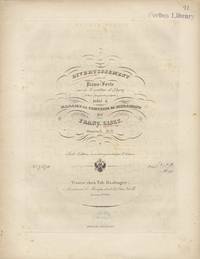
184031559Leipzig: Breitkopf & Härtel PN 6266 1840. BEETHOVEN Ludwig van 1770-1827. Folio. 1 decorative lithographic title printed in green 2-15 1 blank pp. Engraved. Music printed within decorative blue borders.<br/><br/>Disbound. Slightly soiled and foxed; occasional performer's markings in pencil. Publisher's handstamp to foot of title. First Edition. LW A58. Searle 466. Raabe 121. LC Catalog 146. Hoboken 10 98. <br/><br/>Liszt's transcription of Beethoven's Adelaide Op. 46; 1795 was the first of many arrangements he made of Beethoven's songs. He dedicated the work to the Marchese Maria Martellini an Italian noblewoman who was one of Liszt's early supporters and patrons. Breitkopf & Härtel [PN 6266] unknown books
187831536Mainz: B. Schott's Söhnen PN 16617 1878. Folio. Sewn. 1f. decorative lithographic title 1 blank 2-55 1 blank pp. Engraved.<br/><br/>Common title page with plate numbers of the version for two pianos 16617 as well as for solo piano 22109. Musicseller's handstamp to foot of title.<br/><br/>Partially disbound; outer leaves worn and frayed with minor paper loss to blank right margin of title. Moderate soiling; corners slightly thumbed; occasional offsetting. First Edition later issue. LW C23. Searle 651. Raabe 373. Hoboken 10 16 first issue.<br/><br/>Liszt's Piano Concerto No. 2 in A major was dedicated to pianist and composer Hans von Bronsart 1830-1913 who premiered the work on January 7 1857 in Weimar with Liszt conducting.<br/><br/>As with the first concerto the second has both its detractors and admirers - in this regard there is similarity to the concertos of Chopin. <br/><br/>"Like its predecessor the A major Concerto is a continuously unfolding 'cyclic' structure in which Liszt employs his 'metamorphosis of themes' technique to great advantage. Unlike the E flat major Concerto however it does not easily lend itself to a division into separate movements; neither does it conform to the opposite kind of structural pattern evinced by the B minor Sonata-a single long movement constructed on the principles of sonata first-movement form. It is possible that Liszt was here aiming at a type of structure intermediate between the two and this may explain why the Concerto may seem to have a certain ambiguity of form." Robert Collet: Franz Liszt: The Man and his Music p. 267. B. Schott's Söhnen [PN 16617] unknown books
1881106040Leipzig : Breitkopf et Haertel 1881. 250x170mm. reliure demi-toile coins avec dos muet. Plats papier marbr. Bel exemplaire. 1233 Breitkopf et Haertel unknown
189461511London:: H. Grevel & Co. Very Good. 1894. Hardcover. Complete in two volumes. Volume I: From Paris to Rome: Years of Travel as Virtuoso. Volume II: From Rome to the End. Collected and edited by La Mara. Translated by Constance Bache. First edition thus. Octavos half-bound in green leather with green cloth covered boards raised band along spines gilt lettering and elaborate design along the spines top edges gilt marbled endpapers. Previous owner's book-plate on front paste-downs leather along the spines is toned brown else both volumes are very good or better. Bindings are solid and tight. . H. Grevel & Co., hardcover books
186030660AB1860. Leipzig Breitkopf & Härtel um 1860. 4°. 51 S. Moderner Einband. Platten-Nr. V.A. 484. 6 Etüden «seule édition authentique entièrment revue et corrigée par l'auteur» Titelbatt. Ders.: Zwei Episoden aus Lenau's Faust für grosses Orchester Piano zu zwei Händen. Leipzig J. Schuberth um 1860. 26 S. Ders.: Etudes d'exécution transcendante pour le piano par F. Liszt. Cah. 1. Leipzig Breitkopf und Härtel um 1860. 54 S. gestochene Noten. Ders.: Légendes. No. 1 St. Francois d'Assise. Piano. Pars Ménestrel um 1870. 13 S. Platten-Nr. H. 4612. Papier gebräunt zum Teil mit hinterlegten Einrissen. Mit handschr. Namenszügen auf den Titelblättern. unknown
185131564Leipzig: Breitkopf & Härtel PN 8271 1851. MENDELSSOHN Felix 1809-1847. Folio. Disbound. 1f. title 3-27 1 blank pp. Engraved.<br/><br/>Title detached and slightly foxed with publisher's and musicseller's handstamps to foot. First Edition. LW A166. Searle 410. Raabe 219. LC Catalog 114. <br/><br/>Liszt's paraphrase of Mendelssohn's incidental music to Midsummer Night's Dream includes the fairies' music and the famous wedding march. Breitkopf & Härtel [PN 8271] unknown books
183840939Vienne: Tob. Haslinger PN T. H. 7573 1838. Folio. Disbound. i title 2-23 i blank pp. Engraved. With secondary pagination to rectos in manuscript.<br /> <br /> Small oval handstamp of P.K. Weizel Brooklyn NY to lower margin of title. <br /> <br /> Formerly in the collection of the Forbes Library in Northampton Massachusetts with their handstamp to upper outer corner of title and several pages.<br /> <br /> Very slightly worn soiled and foxed; outer bifolium separated at spine; small blank piece of ivory paper laid down to final blank page. First Edition. Searle 419. Raabe 230. Tob. Haslinger [PN T. H. 7573] unknown
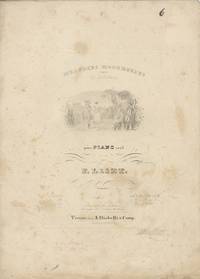
184040936Vienne: A. Diabelli & Comp. PN D et C No. 6959 1840. Folio. Unbound. 1f. recto title with vignette of dancing couple and group of musicians 3-1. i blank pp. Engraved<br /> <br /> Some wear and minor foxing; outer bifolium separated at spine' 6" in contemporary manuscript to upper outer corner of title.<br /> <br /> Indecipherable signature in pencil to lower outer corner of title with several annotations in purple ink. First Edition. Searle 425. Raab 250. Auman and White 124a. A. Diabelli & Comp. [PN D et C No. 6959] unknown
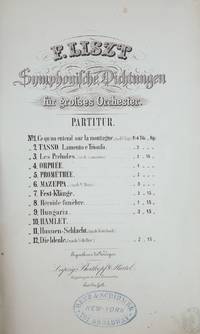
186241066Leipzig: Breitkopf & Härtel PN 9056 1862. Octavo. Original publisher's blue printed wrappers. 1f. recto title verso blank 1f. recto composer's note on performance practice in German verso same note in French dated "Weimar Mars 1856" 1f. recto preface in German verso preface in French 97 iii blank pp. Title note and preface lithographed; music engraved. <br /> <br /> With publisher's catalogue to verso of lower wrapper. <br /> <br /> With Beer & Schirmer New York and Musik-Antiquariat Doblinger handstamps to upper wrapper; Beer and Schirmer and publisher's handstamp to title.<br /> <br /> Wrappers worn soiled chipped and torn; spine reinforced with paper tape with small pieces of same tape to verso of upper wrapper. Minor internal wear. First Edition later issue. Searle 97. Raabe 414. Sonneck Orchestral Music p. 266. <br /> <br /> Liszt was a distinguished Hungarian composer pianist conductor and writer.<br /> <br /> "Sketchbook evidence points to 1846-7 as the years when Liszt began to conceive the idea of a series of programmatic orchestral works. Of the four works he named all based on French poetry Ce qu'on entend sur la montagne and Les Préludes eventually became symphonic poems. . <br /> <br /> Liszt's concentration on the symphonic poem largely coincided with his tenure as Kapellmeister in Weimar where he had an orchestra at his disposal and provided music for performances at the Court Theatre. The Grand Duke commissioned Liszt's 'overtures' to preface specific dramas which thereby determined the subject matter of what were to become a number of his symphonic poems. Cormac F2017 argues that Liszt's approach to the overtures and their transformation into symphonic poems was influenced by his experience of an array of dramatic media opera plays melodramas tableaux vivants and by his interaction with staff and actors involved in the dramatic productions in Weimar. A New German School acolyte Felix Draeseke writing about the symphonic poems in a series of essays from the late 1850s acknowledged the influence of dramatic music especially opera on Liszt's Festklänge. Draeseke also addressed the issue that continues to interest scholars - the symphonic poems' engagement with sonata form. .<br /> <br /> Looking at the 12 Weimar symphonic poems Vande Moortele . views all but three Orpheus Héroide funèbre and Hunnenschlacht as using sonata form as one of the central principles guiding their large-scale organization. Furthermore Liszt seems to have attempted the same merging of sonata form and sonata cycle evident in the B Minor Sonata in Tasso Les préludes and Die Ideale and possibly Ce qu'on entend sur la montagne. .<br /> <br /> Some of the symphonic poems include mimetic representation of scenes and actions such as Hunnenschlacht's depiction of a battle and Prometheus's evocation of a voice followed by a storm. The inclusion of such passages drew criticism that a number of the symphonic poems seemed formless and could not be understood without access to a programme. In other symphonic poems such as Les Préludes and Orpheus Liszt responded to a philosophical programme without compromising musical logic. In these cases critics recognized Liszt the 'tone poet' who could capture a poetic stimulus in an expressive evocative musical flow unified by a single theme that underwent transformations. In general Liszt's sumptuous orchestral colorings were the dominant focus of critics' positive reception of his symphonic poems and programme symphonies." Dolores Pesce Maria Eckhardt and Rena Charnin Mueller in Grove Music Online. Breitkopf & Härtel [PN 9056] unknown
188128117AB1881. Nouvelle édition. Leipzig Breitkopf & Haertel 1881. Gross-8°. 1 Bl. 4 538 S. 1 Bl. Illustr. silbergeprägter Orig.-Leinenband Um 200 S. erweitere Neuauflage über die von Liszt beschriebene Volksmusik der Roma und der Juden in Ungarn und Russland. - Mit getilgtem Namenszug auf dem Halbtitelblatt. Einband berieben und bestossen. unknown
185040941Leipzig: Breitkopf & Härtel PN 8090 1850. Folio. Unbound as issued. 1f. recto title verso blank 3-29 i blank pp. Engraved.<br /> <br /> Small oval handstamp to blank lower margin of title.<br /> <br /> Slightly worn browned and foxed. First Edition. Searle 414:3. Raab 223.<br /> <br /> Liszt made numerous transcriptions from the operas of Meyerbeer including L'Africaine Le Prophète Les Huguenots and Robert le Diable. Breitkopf & Härtel [PN 8090] unknown
187514164Berlin - Wien: Schlesinger-Haslinger Ca. 1875. Used; Like New/Used; Like New. Score of Liszt's Hungarian Rhapsody no. 12 "A J. Joachim" with the ownership stamp of the important twentieth-century German pianist Elly Ney who has also penned "12. Ungarische Rhapsodie" in blue ink at the head. A few paper repair within edges lightly nicked with small tears spine reinforced with green cloth overall very good. There are no markings within the score. <br style="">Elly Ney was one of the 20th century's outstanding pianists and at 16 won the Mendelssohn prize 1900—in a contest of which the famous Hungarian violinist Joseph Joachim was one of the judges.  The present work by Liszt is dedicated to Joachim. <br>Of Ney's great performing Willhelm Kempff wrote: "My ears still hear her melodious voice with its unmistakable hint of her Rhineland origins which had the gift of establishing immediate contact with everyone she spoke to. This happened even more intensely when she stepped onto the concert platform. Just one mysterious chord Beethoven's D minor sonata for instance and the listener was drawn into her magnetic field. What then ensued cannot and should not be described in words nor should it be scientifically dissected. Those who had ears heard for themselves. But that was by no means the end of the matter. A realisation continued to resonate in her listeners' hearts as it had begun to resonate from the moment this greatest of performers stepped onto the platform - the realisation that artistry of this quality draws its strength from roots that have their being in the unfathomable depths of the human soul."<br style=""> Schlesinger-Haslinger hardcover books