Franz 1811-1886 LisztBiblio.com
637 résultats
43895567like new. unknown
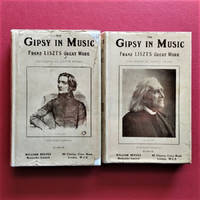
192675820hLondon: William Reeves Bookseller 1926. Book. Near Fine. Hardcover. 8vo - over 7¾ - 9¾" tall. Two volumes complete set. Original brown cloth hard covers with decorative gilt titles to front and spine in dust jackets. Edges lightly toned and foxed with old owner's name-stamp to front endpaper in each volume. Jackets are stained with some moderate edge-chipping and a closed tear now neat in new archival mylar sleeves. Otherwise clean tight and unmarked. Very neat -- a sound and handsome very smartly published set. xx208;iv209-370pp. William Reeves Bookseller Hardcover
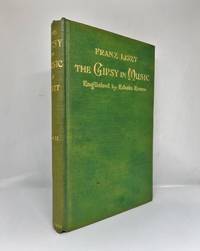
65305London: William Reeves Bookseller Ltd. hardcover. very good. Lacking dust jacket but otherwise very goodcondition. All gold gilding on spine and cover is intact. Subtitled 'The result of the Author's Life-long Experiences and Investigations of the Gipsies and their Music'. Translated by Edwin Evans. Volume 2 of 2. Page block edges foxed browning to endpapers sporadic foxing to text but otherwise clean. Top edge gilt in good condition. Minor wear to boards including bumping to board corners. Da Capo Behind desk PAS 17-7-2018 PAS 27/8/2019 Cathal 9/23 William Reeves Bookseller Ltd. hardcover
1013765745.Ghardcover. Good. Access codes and supplements are not guaranteed with used items. May be an ex-library book. hardcover
1014306434.Ghardcover. Good. Access codes and supplements are not guaranteed with used items. May be an ex-library book. hardcover
192623.068London: William Reeves s.a. 1926. 1ª ed. Tela con sobrecubierta. 14.5x22. William Reeves hardcover
105104William Reeves. Fine in Fine dust jacket. Hardcover. Hardcover. 370 pages. Book is in FINE condition. Stiff card Dust Jacket. Indentation and mark length of spine else FINE condition also. William Reeves publisher. ; 8vo 8" - 9" tall; 370 pages . William Reeves hardcover
19981-1890159018Greenery Pr 1998. Paperback. New. 288 pages. 9.25x6.25x1.00 inches. Greenery Pr paperback
1997Q-1890159018Greenery Press 1997-12-01. Paperback. New. New. In shrink wrap. Looks like an interesting title! Greenery Press paperback
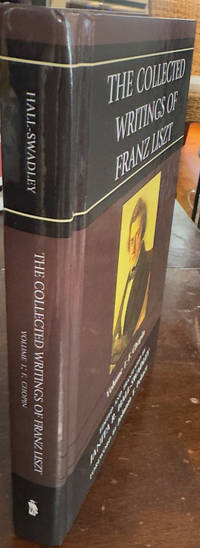
20132508060007Scarecrow Press 2013. Hardback. Very Good. ISNM: M-0800-001000 - Universal Edition UE 13340ELike New Pictorial glossy covers with no dust jacket as issued. Appears unread. Fresh as if new. xv 293 pages : illustrations music ; 24 cm. . . . . . . Shortly after Chopin's death in 1849 Franz Liszt wrote the first full-length biography of his fellow composer. As one of Chopin's friends Liszt created a unique biography that allows the reader to experience the world of Chopin through the memories of one of his most adamant supporters. Liszt provides insight into Chopin's early childhood and musical development the cultural traditions and customs that inspired the polonaises and mazurkas and the final days and hours of the composer before he died. Liszt also offers the reader a psychological view of the composer that had not been seriously undertaken by anyone prior to Liszt. Although Liszt offered what some scholars regard as perhaps an idealized image of the composer readers will enjoy the personal anecdotes and memories that only one close to the late composer could have known. Liszt even takes on the sensitive topic of the love affair between Chopin and the great French woman writer George Sand much to the displeasure of the former's family. Scarecrow Press hardcover
1998Q-0963976311Greenery Press 1998-12-01. Paperback. New. In shrink wrap. Looks like an interesting title! Greenery Press paperback
0963976311.Gpaperback. Good. Access codes and supplements are not guaranteed with used items. May be an ex-library book. paperback
0265916356.Ghardcover. Good. Access codes and supplements are not guaranteed with used items. May be an ex-library book. hardcover
1334212678.Gpaperback. Good. Access codes and supplements are not guaranteed with used items. May be an ex-library book. paperback
1019879769.Ghardcover. Good. Access codes and supplements are not guaranteed with used items. May be an ex-library book. hardcover
0266881068.Ghardcover. Good. Access codes and supplements are not guaranteed with used items. May be an ex-library book. hardcover
1016954816.Ghardcover. Good. Access codes and supplements are not guaranteed with used items. May be an ex-library book. hardcover
1971Q-0739022121Alfred Music 1971-06-01. Paperback. New. In shrink wrap. Looks like an interesting title! Alfred Music paperback
feb102392Used. For more details please contact me unknown
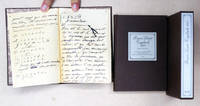
93098Wien Neff 1986. Kl.8° 31 u. 99 S. Kart. in Schmuckschuber. Tadellos. EA. Das Faksimile frz. der Textbd. dt. 010 Wien, Neff, 1986 unknown
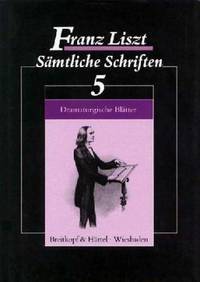
Z1-B-019-01866BREITKOPF. Used - Good. Ships from UK in 48 hours or less usually same day. Your purchase helps support Sri Lankan Children's Charity 'The Rainbow Centre'. Ex-library so some stamps and wear but in good overall condition. 100% money back guarantee. We are a world class secondhand bookstore based in Hertfordshire United Kingdom and specialize in high quality textbooks across an enormous variety of subjects. We aim to provide a vast range of textbooks rare and collectible books at a great price. Our donations to The Rainbow Centre have helped provide an education and a safe haven to hundreds of children who live in appalling conditions. We provide a 100% money back guarantee and are dedicated to providing our customers with the highest standards of service in the bookselling industry. BREITKOPF unknown
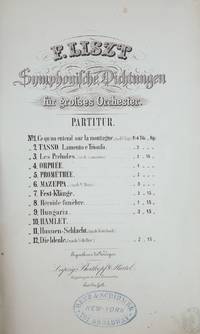
187441065Leipzig: Breitkopf & Härtel PN 9056 1874. Octavo. Original publisher's dark ivory wrappers. 1f. recto title verso blank 1f. recto preface in German verso preface in French 1f. recto composer's note in German on performance practice verso same note in French dated "Weimar Mars 1856" 97 i blank pp. Title preface and note lithographed; music engraved. <br /> <br /> Small B & H stamp to lower outer corner of title.<br /> <br /> With publisher's catalogue to verso of lower wrapper. <br /> <br /> Wrappers slightly worn and soiled; spine lacking. Occasional small stains; dampstaining to lower outer corners of first leaves; one signature partiallky detached. Re-issue from first edition plates. Searle 97. Raabe 414. Sonneck p. 266. <br /> <br /> Liszt was a distinguished Hungarian composer pianist conductor and writer.<br /> <br /> "Sketchbook evidence points to 1846-7 as the years when Liszt began to conceive the idea of a series of programmatic orchestral works. Of the four works he named all based on French poetry Ce qu'on entend sur la montagne and Les Préludes eventually became symphonic poems. . <br /> <br /> Liszt's concentration on the symphonic poem largely coincided with his tenure as Kapellmeister in Weimar where he had an orchestra at his disposal and provided music for performances at the Court Theatre. The Grand Duke commissioned Liszt's 'overtures' to preface specific dramas which thereby determined the subject matter of what were to become a number of his symphonic poems. Cormac F2017 argues that Liszt's approach to the overtures and their transformation into symphonic poems was influenced by his experience of an array of dramatic media opera plays melodramas tableaux vivants and by his interaction with staff and actors involved in the dramatic productions in Weimar. A New German School acolyte Felix Draeseke writing about the symphonic poems in a series of essays from the late 1850s acknowledged the influence of dramatic music especially opera on Liszt's Festklänge. Draeseke also addressed the issue that continues to interest scholars - the symphonic poems' engagement with sonata form. .<br /> <br /> Looking at the 12 Weimar symphonic poems Vande Moortele . views all but three Orpheus Héroide funèbre and Hunnenschlacht as using sonata form as one of the central principles guiding their large-scale organization. Furthermore Liszt seems to have attempted the same merging of sonata form and sonata cycle evident in the B Minor Sonata in Tasso Les préludes and Die Ideale and possibly Ce qu'on entend sur la montagne. .<br /> <br /> Some of the symphonic poems include mimetic representation of scenes and actions such as Hunnenschlacht's depiction of a battle and Prometheus's evocation of a voice followed by a storm. The inclusion of such passages drew criticism that a number of the symphonic poems seemed formless and could not be understood without access to a programme. In other symphonic poems such as Les Préludes and Orpheus Liszt responded to a philosophical programme without compromising musical logic. In these cases critics recognized Liszt the 'tone poet' who could capture a poetic stimulus in an expressive evocative musical flow unified by a single theme that underwent transformations. In general Liszt's sumptuous orchestral colorings were the dominant focus of critics' positive reception of his symphonic poems and programme symphonies." Dolores Pesce Maria Eckhardt and Rena Charnin Mueller in Grove Music Online. Breitkopf & Härtel [PN 9056] unknown
186241066Leipzig: Breitkopf & Härtel PN 9056 1862. Octavo. Original publisher's blue printed wrappers. 1f. recto title verso blank 1f. recto composer's note on performance practice in German verso same note in French dated "Weimar Mars 1856" 1f. recto preface in German verso preface in French 97 iii blank pp. Title note and preface lithographed; music engraved. <br /> <br /> With publisher's catalogue to verso of lower wrapper. <br /> <br /> With Beer & Schirmer New York and Musik-Antiquariat Doblinger handstamps to upper wrapper; Beer and Schirmer and publisher's handstamp to title.<br /> <br /> Wrappers worn soiled chipped and torn; spine reinforced with paper tape with small pieces of same tape to verso of upper wrapper. Minor internal wear. First Edition later issue. Searle 97. Raabe 414. Sonneck Orchestral Music p. 266. <br /> <br /> Liszt was a distinguished Hungarian composer pianist conductor and writer.<br /> <br /> "Sketchbook evidence points to 1846-7 as the years when Liszt began to conceive the idea of a series of programmatic orchestral works. Of the four works he named all based on French poetry Ce qu'on entend sur la montagne and Les Préludes eventually became symphonic poems. . <br /> <br /> Liszt's concentration on the symphonic poem largely coincided with his tenure as Kapellmeister in Weimar where he had an orchestra at his disposal and provided music for performances at the Court Theatre. The Grand Duke commissioned Liszt's 'overtures' to preface specific dramas which thereby determined the subject matter of what were to become a number of his symphonic poems. Cormac F2017 argues that Liszt's approach to the overtures and their transformation into symphonic poems was influenced by his experience of an array of dramatic media opera plays melodramas tableaux vivants and by his interaction with staff and actors involved in the dramatic productions in Weimar. A New German School acolyte Felix Draeseke writing about the symphonic poems in a series of essays from the late 1850s acknowledged the influence of dramatic music especially opera on Liszt's Festklänge. Draeseke also addressed the issue that continues to interest scholars - the symphonic poems' engagement with sonata form. .<br /> <br /> Looking at the 12 Weimar symphonic poems Vande Moortele . views all but three Orpheus Héroide funèbre and Hunnenschlacht as using sonata form as one of the central principles guiding their large-scale organization. Furthermore Liszt seems to have attempted the same merging of sonata form and sonata cycle evident in the B Minor Sonata in Tasso Les préludes and Die Ideale and possibly Ce qu'on entend sur la montagne. .<br /> <br /> Some of the symphonic poems include mimetic representation of scenes and actions such as Hunnenschlacht's depiction of a battle and Prometheus's evocation of a voice followed by a storm. The inclusion of such passages drew criticism that a number of the symphonic poems seemed formless and could not be understood without access to a programme. In other symphonic poems such as Les Préludes and Orpheus Liszt responded to a philosophical programme without compromising musical logic. In these cases critics recognized Liszt the 'tone poet' who could capture a poetic stimulus in an expressive evocative musical flow unified by a single theme that underwent transformations. In general Liszt's sumptuous orchestral colorings were the dominant focus of critics' positive reception of his symphonic poems and programme symphonies." Dolores Pesce Maria Eckhardt and Rena Charnin Mueller in Grove Music Online. Breitkopf & Härtel [PN 9056] unknown
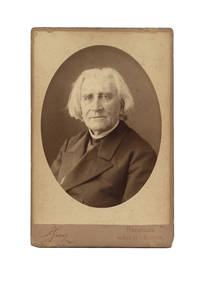
1882Liszt1<p><strong>LISZT Franz 1811-1886</strong></p><p>Original photograph by Julien Ganz Period albumen print 1882 cabinet format 145 x 105 cm Mounted on thick cardboard in the photographer's credit 165 x 108 cm Dark red edge all around "Liszt" annotation on back side from an unknown hand</p><p><strong>Striking and unpublished portrait of the musician</strong></p><p>Several variants taken on the same day are known. However none of them show Liszt staring at the lens. His portrait is all the more intense here.</p><p>Some traces of an old assembly mounting on margins small scratches and small accidents at the lower corners of the cardboard see scans otherwise good condition.</p>
0267745281.Gpaperback. Good. Access codes and supplements are not guaranteed with used items. May be an ex-library book. paperback