JAZZBiblio.com
1 000 résultats
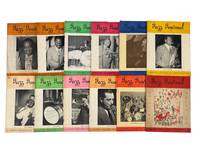
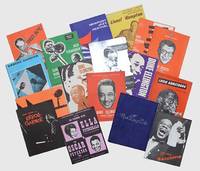
1950137205Late 1950s - early 70s. Excellent group of UK tour programmes for a constellation of jazz greats: Armstrong 2 Basie 8 Bechet Brubeck 2 Nat King Cole Eddie Condon Sammy Davis Jr. 2 Tommy Dorsey Ellington 4 Errol Garner 3 Lionel Hampton Ella Fitzgerald and Oscar Peterson Woody Herman Harry James JATP 4 Newport Jazz Festival Glen Miller Earl Hines and Jack Teagarden Bal du Moulin Rouge. 36 programmes quarto. Illustrated throughout. Original pictorial wrappers wire-stitched as issued. Overall in excellent condition. unknown
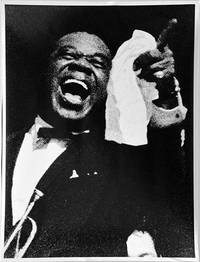
1950190253London: 1950s. Vivid images of jazz greats by one of the "obscure guys" of British jazz photography - from the collection of Charlie Watts From the collection of Rolling Stones drummer and jazz aficionado Charlie Watts: a delightful and absorbing archive of largely unpublished photographs by Jamie Hodgson an unsung hero of British jazz photography capturing both the exuberance and inwardness of the music. Among the jazz greats pictured are Dizzy Gillespie Ella Fitzgerald Duke Ellington Billy Strayhorn and Louis Armstrong. Perhaps the stand out photographs here are two superb studio images of Strayhorn one a memorable image showing him observing a goldfish in its bowl used on the cover of David Hajdu's 1996 biography Lush Life but unattributed another a delightful and unforgettable portrait of "Strays" lying on the studio floor cigarette in hand legs crossed wine glass within reach working on a score marked in 12/8 time with a quill pen and ink stand. A sequence of eight images focus on Louis Armstrong and date from 1956 through to 1970: one a particularly exuberant portrait of Pops sharing the limelight with Trummy Young Barrett Deems at the kit. These were nearly all taken in concert the exception being one marked "solo visit. Rehearsing with Norman del Mar conductor of the Royal Philharmonic Orchestra at the Royal Festival Hall for a concert in aid of the Hungarian Releif sic Fund. December 10th 1956". There are two fine shots of Dizzy Gillespie both in tux in his dressing room looking thoughtful and another of his up-tilted horn in its case the tag from his recent visit to France still attached to the handle. There is a witty bleached-out studio shot of Jimmy Rushing leaning into the horn of a gramophone and further images of the great singer one a boisterous backstage portrait of Rushing with Harry Carney and Jimmy Hamilton sitting in Rushing's capacious lap! smiling and laughing gathered on the stairs leading up to the gents' toilets and holding a gamut of reed instruments; plus a terrific image of "Mr. Five by Five" raising a pint behind the bar of a pub recalling Basie's reminiscence that "Me and old Rush. We were some pair. We just wanted to have a good time" Basie p. 37. Other portraits include a petulant Ella Fitzgerald Duke Ellington and individual images of Ellington alumni Paul Gonsalves Johnny Hodges Ray Nance Harry Carney Barrett Deems and Sam Woodyard; a chuckling Oscar Peterson; Lionel Hampton with Humphrey Lyttelton; Bud Freeman; a humorous shot of Eddie Condon sitting at a bar and scowling playfully; a tight close-up of a beaming Lionel Hampton; drummer Gus Johnson accompanying bassist Bob Haggart; and Ray Charles performing at the Capital Radio Jazz Festival in 1982. A full listing is available on request. For Hodgson 1930-2006 jazz was a private passion and these remarkable photographs did not see the light of day until a 2006 exhibition Masters of Jazz: Unseen Portraits held in the foyer of the National Theatre. In 2007 Jazz Improv magazine described him as one of the "obscure guys" of British jazz photography. His Guardian obituary noted that he "became known for his hobby rather than his profession. The man who owned the Kinnerton Street studio in London's Knightsbridge for many years earned his living in fashion and family photography. But it was the recent exhibition of 50 of his pictures in the National Theatre foyer that attracted more attention than anything previously shown by the largely anonymous Hodgson. Few knew of his work within the music world and fewer still knew of these unguarded often intimate images which were Hodgson's personal homage to the stars he observed and worshipped. All were taken during British tours many in the privacy of dressing rooms across London or in Hodgson's studio The Guardian jazz critic John Fordham regards these images as 'wonderful pictures'. 'They catch the mood on the night of jazz on and offstage' he said 'and they are very expressive of the big personalities of a lot of those old guys who started touring here in the 1950s and 60s after there had been a dearth of live US jazz in Britain'. Hodgson was a Londoner who took up photography after completing his national service in 1950. Starting out as a freelance he began by taking whatever commissions came his way - news and features aerial and architectural photography or commercial and children's pictures. A stint with the Mayflower Studios brought him into contact with advertising and various television personalities including Frankie Howerd Harry Secombe the Crazy Gang and the Ted Heath Band. In 1956 he set up his own studio where he did fashion shoots with Tania Mallet Jean Shrimpton and Sandra Paul He caught the change in mood from the snooty static haute couture fashion shoots of the 1950s to the more playful popular looks of swinging London in the 1960s. And at night he sneaked out to shoot his favourite jazz and blues bands playing across the capital". An important and captivating collection of jazz images imbued with the photographer's deep affection for the musicians the spontaneity of the portraits matching that of the music itself. Together 95 black and white photographs 46 measuring 223 x 170 mm; 49 measuring 402 x 305 mm each with identifying caption on verso by the photographer some with studio wet stamps or labels a number signed by Hodgson. Preserved in the photographer's own commercial boxes. Three prints Duke Ellington Billy Sytrayhorn Louis Armstrong framed and glazed by auction house overall measuring 445 x 620 mm. In excellent condition. Count Basie Good Morning Blues: The Autobiography of Count Basie 1987. unknown
1940169491United States: c.1940-60. A visual record of a rarely seen and poorly documented world - an accidental history An unusually extensive group of these evocative "table photographs" striking records of largely African-American audiences in the glamorous sociable and intentionally inclusive world of mid-century nightclubs. Shot by in-house photographers developed on site and sold for a dollar at the end of the evening these quick souvenirs now amount to a rare visual history of a poorly documented milieu. As Gold notes they "turn the camera round": instead of performers we see the audiences - a critical part of what Jason Moran calls the jazz "ecosystem." The collection offers a nationwide survey of venues from the extravagant to the resolutely down-home. At New York's Café Zanzibar with its spectacular floor shows and "Zanzibeauts" the audience was integrated but largely white prompting Langston Hughes's caustic observation about the seating hierarchy - an impression borne out by the image here. Detroit's Gay Bar Lounge another "black and tan" joint catered to a mostly Black clientele and offered a rougher edge: in 1947 the barkeep famously shot two stick-up artists with the.38s kept beneath the cash register. Equally compelling are the histories of Black enterprise that surface. Oakland's Athens Elks Cocktail Lounge home to Lodge 70 of the Improved Benevolent and Protective Order of Elks of the World stood at the centre of West Oakland's vibrant musical scene hosting countless jam sessions and serving as the informal checkpoint for touring African-American musicians. In Los Angeles Dootsie Williams's Dooto Music Center founded by the trumpeter-turned-entrepreneur provided one of the city's foremost Black cultural venues praised by the Los Angeles Sentinel as "the most-needed cultural and recreation center in Southern California." The photographers themselves remain surprisingly elusive though a few can be traced. In Columbus George Pierce ran a record shop and studio in Bronzeville and supplied images to the Ohio Sentinel and other regional papers; in Detroit Earl Fowler's Top Hat Photo developed into a significant presence in the Black Press with Fowler later serving as chief of the Los Angeles bureau of Now! magazine. Beyond these contexts the photographs' enduring appeal lies in the human dramas unfolding across their tabletops: the conviviality style and fleeting alliances captured in a moment of collective ease. A scene from Gamby's in Baltimore is emblematic - six convivial hat-tipping men and two young women smiling through a forest of shot glasses presided over by a portrait of Fats Waller. It is warmly enigmatic yet inviting an offhand welcome extended across time. A more detailed description and full listing is available on request. Together 66 black and white gelatin silver print photographs 62 c.127 x 178 mm; 3 approximately 178 x 254 mm around 50 are in their original plain or printed souvenir folders the balance loose. Loose photos and folders with occasional wear and mild damp-staining some annotations verso of prints and to folders prints occasionally stapled into folders overall the group remains about very good. Ronald Auther "The Oakland Larks" The Shadow Ball Express: African American Baseball Renderings and other Facts of Life online; Clora Bryant et al Central Avenue Sounds; Jazz in Los Angeles 1930s-1950s 1998; Jeff Gold Sittin' In: Jazz Clubs of the 1940s and 1950s 2020; Robert Petersen "Before Motown: L.A.'s Black-owned Music Empire" PBS SoCal online. unknown
192447496Dayton OH: The Comer Manufacturing Co. 1924. Tall 8vo. 5.5 x 10.5 in. 36 pp. Numerous illustrations 4 colour plates 4 sepia-tinted plates 64 wool wool blend canvas linen leather cotton and patterned fabrics some treated w/ coating tipped-in occasional offsetting from samples either surrounding the sample or on facing leaves. Dark red printed softcovers decoration & lettering in orange & blue minor soiling some creasing still a VG- copy. First edition of this scarce salesman sample catalogue for men and women’s Jazz Age raincoats and overcoats in the mid-1920s. The company was founded before World War I by Charles E. Comer b. 1887 who quickly established the company as one of the largest manufacturers in Ohio of raincoats. The colour fashion plates are quite striking for the period and offer invaluable historical reference for the styles and weight of raincoats sold during the Flapper Era. Comer produced rubber-lined coats offered deals if you ordered two coats at once and also offered Mackinaws General Purpose coats Rubber rain slickers reversible coats and even waterproof aprons for housewives. This catalogue notes that they had just completed their new 40000 square foot and even offered waterproof luggage and garment bags. They were well known for advertising in labor magazines trade magazines and professional magazines constantly promoting their product and recruiting new salesmen. Worldcat locates only 1 copy Vol. 166. The Comer Manufacturing Co., paperback
198648043Virgin, 1986. CDV 2397 CD CD
1950223221950. Complete 1950 run of Jazz Journal Vol. 3 Nos. 1-12. London: L. M. Publications 1950. Complete run of the 1950 volume. Twelve issues with each issue around 20 pages. Black-and-white photo illustrations throughout. Printed paper wraps. Founded in 1948 by editor Sinclair Traill Jazz Journal became a critical platform for serious jazz criticism in Britain at a time when the country began appreciating the impact of African American musical innovation. This volume features twelve monthly issues each spotlighting legendary musicians in deeply reverent portraits: Louis Armstrong Baby Dodds Coleman Hawkins Fats Waller Earl Hines and others. The December cover has a Christmas theme.<br /> <br /> This archive is a window into Britain's postwar jazz awakening. The articles range from retrospectives to musicology and artist discographies. Floyd Levin's "The American Jazz Scene" captures the transatlantic tone of the journal mourning the death of Buster Wilson and lauding figures like Sidney Anderson and Kid Ory as vanguards of "authentic" jazz-framed as endangered in a postwar America increasingly seduced by commercialism. Meanwhile Derrick Stewart-Baxter's "Preachin' the Blues" traces rural-to-urban migration patterns in blues development analyzing Sleepy John Estes' discography and folk influences. The December issue features a full-page bibliophilic essay "A Case for Books" reviewing A Treasury of the Blues by W. C. Handy whom it names "the composer of the classic Memphis Blues and Joe Turner Blues" emphasizing the book's role in preserving "the true and historical survey of the blues." Taken together the essays discographies and image curation construct a coherent theory of jazz not only as music but as cultural heritage. Moderate and consistent soiling and creasing to wrappers; binding intact but some covers remain delicate. Occasional chipping at spine. Covers remain vivid with strong photographic contrasts. Overall good condition. A complete year's run of one of the earliest and most influential British jazz journals with signatures from leading musicians of the era such as Armstrong Dodds and Hawkins. unknown
199551974Document, 1995. DOCD-5385 CD CD
199551973Document, 1995. DOCD-5384 CD CD
199551971Document, 1995. DOCD-5382 CD CD
199551972Document, 1995. DOCD-5383 CD CD
199551970Document, 1995. DOCD-5381 CD CD
199945035Definitive Records, 1999. DRCD11148 4 CD CD
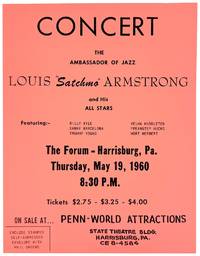
196045557Harrisburg PA: Penn-World Attractions 1960. Very Good . Harrisburg PA: Penn-World Attractions 1960. Broadside flyer 28x21.6cm printed on peach stock advertising a Louis Armstrong concert at The Forum in Harrisburg Pennsylvania May 19 1960. Minor wear and creasing to edges; Very Good or better. <br /> <br /> Promotion from a late career concert for Armstrong which took place a year after he suffered a heart attack while touring in Italy. Features Armstrong's bandmates Danny Barcelona "Peanuts" Hucko and Velma Middleton. Not separately cataloged in OCLC. . Penn-World Attractions unknown
195011434NNew York, New World Music, 1950. (VNr. S-1027-116), Klein-Quart (22,8 x 17,2 cm), (2), 116 Seiten, 1 Portr. Roter Original-Karton (hint. Deckel lichtschattig)
199755111Verve, 1997. V6-8526 Digipack Digipack
198564086Mainz ; London ; New York ; Tokyo : Schott 1985. 302 S. : Noten ; 24 cm kart., Softcover/Paperback, ++ Schnitt oben stockfleckig, +++ sonst Exemplar in gutem Erhaltungszustand
198851253Blue Note, 1988. CDP 784222 2 CD CD
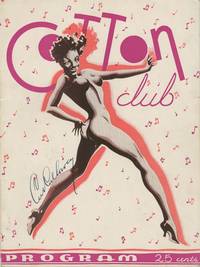
1938List3674New York City 1938. Small folio 12 x 9 inches 16 unnumbered pages. Signed boldly by Calloway on the front cover above the leg of the dancer in the illustration. Near Fine. An illustrated program for the Cotton Club from 1937/1938 with photographs of Cab Calloway the Nicholas Brothers and Mae Johnson in addition to information about the Club’s fifth edition of their Cotton Club Parade though this is a larger program. This copy documents the Midtown Manhattan iteration of the Cotton Club which moved from Harlem to Broadway and 48th Street in 1936 after the Harlem location closed following the Harlem riot of 1935. The new venue attempted to reproduce the earlier club’s formula of elaborate revues combining jazz orchestras chorus lines and specialty dancers in large-scale stage productions such as the Cotton Club Parade. While the performers remained overwhelmingly African American—including Calloway’s orchestra and many of the dancers—the audience at the club continued to be largely white reflecting the segregated entertainment culture of the period. This arrangement had long been criticized by Harlem writers and intellectuals; Langston Hughes writing during the Harlem Renaissance famously described the Cotton Club as a “Jim Crow club for gangsters and monied whitesâ€1 objecting to the racial restrictions placed on patrons even as Black musicians and dancers provided the entertainment. The Midtown Cotton Club continued presenting revues and broadcasts through the late 1930s but ultimately closed in 1940 bringing an end to one of the most famous nightclubs associated with the Harlem Renaissance and the swing era.<br /> <br /> Not in OCLC though see 951748496 for a shorter four page program for the fifth edition of the Cotton Club Parade published in 1938 and held at East Carolina University.<br /> <br /> 1 Langston Hughes “When the Negro was in Vogue†in The Big Sea Alfred A. Knopf 1940. unknown
198847039Eastwest, 1988. 244145-2 CD CD
199355198Blue Note, 1993. 8284472 CD CD
1971176257-1London, November Books ( 1971). 112 S. Mit Abb. Original-Kartonband
200051245EMI Latin, 2000. H2 7243 5 25329 2 6 CD CD
199427496Talkin Loud, 1994. 1 CD Slim-Case
1959NotenXa500New York: Colin, 1959. 32 Seiten Noten und Erläuterungen, 4°, broschiert.
199560334ABMainz, Schott., (um 1995). 4°. 28 Seiten mit 12 Nummern. Farbig illustrierte Originalbroschur. - Ein sehr gut erhaltenes, annähernd neuwertiges Exemplar. = KLB 34.