DONIZETTI, Gaetano 1797-1848Biblio.com
909 résultats
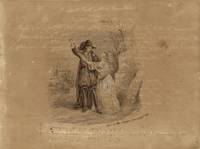
398711 leaf. Oblong quarto 210 x 284 mm.<br /> <br /> Four measures in keyboard score from the duet between Lucia and Edgardo in Act I Scene IV set to the words "A' miei voti in vovo il cielo" From all danger be guarded for ever. Notated in ink at the blank lower margin of an original accomplished drawing depicting a male and female figure in costume presumably the characters Lucy and Edgardo in Donizetti's opera. Signed and dated by the artist in ink: "Clelia de Vera d'Aragona fece 14 Luglio 1838." In pen watercolor and brown wash with highlights in light gray gouache.<br /> <br /> Slightly worn; quite browned; offsetting from contact with another leaf of textual manuscript creating a slightly bleached appearance; small binding holes and fraying to left edge. Partial watermark most probably of the English paper maker J. Whatman.<br /> <br /> Provenance<br /> Christie's Rome 13 December 2001 Lot 337. Lucia di Lammermoor with a libretto by Salvatore Cammarano was first performed in Naples at the Teatro San Carlo on 26 September 1835. <br /> <br /> "It . very quickly became one of the most universally popular operas of the nineteenth century. . Donizetti himself writing to Ricordi three days after the première was in a rare state of excited exaltation: 'Lucia di Lammermoor went on . It pleased and it pleased very much if I am to believe in the applause and the compliments I received. I was called out many times the singers even more often. . Its title role has been impersonated by almost every soprano since 1835 who has supposed herself or has been supposed by others to have sufficient agility and enough dependable very high tones; the role of Edgardo has been favored by most of the non-Wagnerian tenors . The opera's second-act sextet 'Chi mi frena in tal momento' achieved an almost unique universal familiarity . The 'Mad Scene' became the chosen proving ground and applause-gatherer for an apparently unending succession of prima donnas. . With Rossini operatically inactive and Bellini dead Lucia di Lammermoor went far toward establishing Donizetti as the most eagerly sought-for of living Italian composers of opera - and therefore of all Italian composers - for the rest of his active life." Weinstock: Donizetti pp. 110-111 <br /> <br /> The artist was presumably a member of the historic Italian family De Vera d'Aragona of Naples. <br /> <br /> A unique and attractive document despite defects as noted. unknown
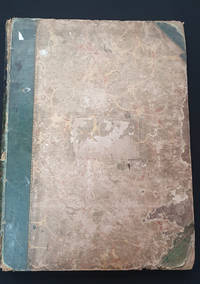
008610D'Almaine and Co; A Bertioli; S Chappell; Goulding and D'Almaine; Keith Prowse; T Holloway; J Power; H Falkner; . 1st Edition . Half Calf. Fair/No Jacket. Folio - over 12 - 15" tall. Circa 1830 - 1850. This is a fascinating bound volume of guitar music scores from the early part of the 19th Century including an early instruction book on how to play the Spanish Guitar: "A complete instruction book for the Spanish guitar with rules to facilitate a knowledge of that elegant instrument progressive lessons duets and songs. Written and arranged by Alexander Sosson." This section runs to 35 pages and has music and exercises for the guitar student discussing finger position tuning arpeggios slurring chords barring and much more. Thereafter are bound 24 contemporary scores as follows most pub by D'Almaine unless otherwise stated: 1. Three Variations for the Spanish Guitar Die Feindlichen Vollkstame composed by Mauro Guiliani Op 7 Fingered by A Bertioli published by the Author expressly for his Pupils 42 Rathbone Place Oxford Street. 2. An Italian Air Composed for the Piano Forte and Spanish Guitar respectfully dedicated with permission to Miss Spike by Alexander Bertioli pub by S Chappell 50 New Bond Street. 3. Love Will Play The Leading Part sung by Mr H Phillips at the Theatre Royal Covent Garden in the Grand Opera of Lestocq or the Fete of the Hermitage arranged for the Spanish Guitar and Dedicated to James Hepburn Esq by F W Brandau pub by D'Almaine. 4. Come Dwell With Me Ballad Sung by Mrs Waylett The Poetry by T Haynes Bayly The Music Composed by Alexander Lee arranged. by F W Brandau. 5. Bochsa's Celebrated Harp March arranged. by Osmond G Phipps pub by D'Almaine and Co. 6. The Wind and the Beam Loved The Rose sung by Mrs Keeley in the Musical Romance of the Last Days of Pompeii arranged by F W Brandau pub by D'Almaine. 7. Vivi Tu Te Ne Scongiuro from Anna Bolena composed by Donizetti arranged. by F W Brandau. 8. Cielo A Miei Lunghi Spasimi Prayer. by Donizetti arr. Brandau. 9. Masquerade Song sung by Miss Shirreff. in the Grand Opera Gustavus the Third. by Auber arr. Brandau. 10. Teach Me To Forget Ballad. Poetry by Thomas Haynes Bayly. arr. C M Sola. 11. Non Giova Il Sospirar arr. C Eulenstein 12. A Savoyard Air arr. A Bertioli. 13. Carulli's Preludes and Scale with Six Variations by Giuliani. by Bertoli 14. Though the Day of My Destiny's Over. by Lord Byron. Alexander Lee. by F W Brandau 15. Kate Kearney. by Miss Owenson. arr C Eulenstein 16. Non V'Ha Squardi Cavatina. by Donizetti arr. F W Brandau 17. Night At Sea. composed by Henri Herz. arr. Osmond G Phipps. 18. Oh! Gentle Love!. arr. F W Brandau 19. Ye Banks and Braes from Flowers of Song arr by T B Phipps and other composers pub T Holloway London 20. Memory from Flowers of Song arr by T B Phipps and other composers pub T Holloway London. 21. Ye Mariners of Spain Song of the Galley from a Set of Six Ancient Spanish Ballads. words by John Lockhart. composed. by Mrs Robert Arkwright. pub J Power. 22. The Light Bark. by Miss Mahony. arr by J T Craven. 23. Roland the Brave. by Thomas Campbell. arr by Mrs Robert Arkwright 24. A Canadian Boat Song arr for Three Voices by Thomas Moor. The book is in half green calf rubbed and worn with the backstrip separating. There is a small amount of of bookworm damage to the outer edge of the leaves not affecting the print area and one leaf has a lateral closed tear no loss. In all this is a rarety with guitar scores being fairly unusual and with songs here little-known. Searches for the titles herein reveal most are not available for sale elsewhere. Scarce if not rare. <br/> <br/> D'Almaine and Co; A Bertioli; S Chappell; Goulding and D'Almaine; Keith Prowse; T Holloway; J Power; H Falkner; unknown
21221New York: Eclipse Publishing. As New. Beaux Arts Edition. FREE UPGRADE to Courier/Priority Shipping Upon Request - IN STOCK AND IMMEDIATELY AVAILABLE FOR SHIPMENT - 3 pages of music with cover graphic; also includes a one page composition on inside front cover entitled "Love and Passion" by J. Messina and a one page composition entitled "Love and Devotion" by L. Drumheller on back cover --- Small tears and nicks and light creasing. Also available via email in digital format on an urgent shipment basis. Consult the bookseller for this premium service. -- with a bonus offer--; Folio - over 12" - 15" tall . Eclipse Publishing unknown
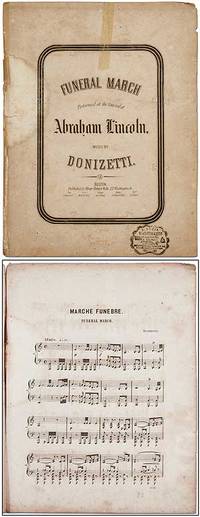
1865235590Boston: Oliver Ditson & Co 1865. First edition front wrapper without portrait of Lincoln appearing in later issues. Engraved title and piano score; 5 pp. 1 vols. Folio. Loose as issued; split along spine with some chipping to extremities. First edition front wrapper without portrait of Lincoln appearing in later issues. Engraved title and piano score; 5 pp. 1 vols. Folio. Donizetti died 17 years before Lincoln having gone mad from syphilis. His Funeral March gained a measure of recognition in America after it was performed during Lincoln's funeral ceremonies. It is a heavy solemn piece in a minor with droning octaves in the bass a haunting chromatic figure in the middle register and a lyrical upper voice. see Barret Sale Lot 693; Stern Collection of Lincolniana Oliver Ditson & Co unknown
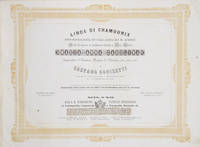
184228417Milano: Ricordi PNs 13931-55 1842. Oblong folio. Contemporary dark blue cloth with decorative blindstamping gilt rules to edges and spine "E.P. Mavromihali" stamped in gilt to upper. 1f. title within decorative dark yellow border ii recto named cast list verso listing 25 numbers 3-275 pp. Engraved. Each individual number with separate pagination. With overpaste of the contemporary music seller Domenico Vicentini of Trieste to title. <br /> <br /> Cast list includes Eugenia Tadolini as Linda Agostino Rovere Napoleone Moriani Prospero Derivis Felice Varese and Marietta Brambilla.<br /> <br /> With early musical embellishments to Linda's part in Number 12 p. 127 and additional occasional performance markings in pencil. <br /> <br /> Binding worn rubbed and bumped at extremities. Slightly worn; some minor foxing; minor thumbing to lower outer corners; very minor staining to lower margin of final leaves; occasional vertical creasing; upper margin trimmed occasionally just affecting printed area and titles but with no loss of music. Second edition first Italian edition published just months after the first edition published in Vienna in May of 1842. Bergamo catalogue 46. Inzaghi IN. 73 p. 192. Crawford pp. 146-7 incorrectly describing this as the first edition. <br /> <br /> A melodramma semiserio in three acts to a libretto by Gaetano Rossi after Adolphe-Philippe d'Ennery and Gustave Lemoine's play La grace de Dieu Linda di Chamounix was first performed in Vienna at the Kartnerthortheater on May 19 1842. <br /> <br /> "The score of Linda is a monument to Donizetti's unfailing good taste from the finely crafted overture to the final ensemble. Along with Bellini Donizetti epitomized the Italian Romantic spirit of the 1830s. If Bellini expressed Italian Romanticism in its most concentrated form Donizetti compensated by a greater versatility and resource and a stronger feeling for dramatic movement. He also had the benefit of a more thorough musical training under Mayr and Mattei and this contributed much to his superior fluency of technique and invention." TNG II online. Ricordi [PNs 13931-55] unknown
BN103763Actes Sud. Softcover. Anna Boléna <br/><br/>Anna Boléna Actes Sud paperback
2000DADAX887592077XCasa Ricordi 2000-06-15. 1. hardcover. New. 10.50x2.80x14.50. Buy with confidence. Excellent Customer Service & Return policy. Casa Ricordi hardcover
R320072386CERF LEOPOLD. NON DATE. In-4. Relié demi-cuir. Bon état, Couv. convenable, Dos satisfaisant, Intérieur frais. 95 + 127 + 111 + 85 pages de partition - Plats et contre-plats jaspés - Auteurs et filets dorés au dos - Coins émoussés - 3 PHOTOS DISPONIBLES. . . . Classification Dewey : 780.26-Partitions
006221Milano: Presso Epimaco e Pasquale Artaria. Half Vellum. Marbled paper on boards. Very Good. N.d. circa 1830s. Oblong 19.5 by 26.5 cm. The pagination is disorganized with a return to page one several times then many numbers skipped and ending on page 112 but it seems that the book is complete as published. Partial hand-coloring of the title page including of the lettering and the copper engraved illustration beneath. Scarce -- no copies found on OCLC First Search. This Donizetti opera had its premier in 1833 and thus this published piano version based on the opera score is both early and quite possibly the first published piano reduction of the score. Condition: soiling of the vellum spine and light wear to the binding generally. Occasional light foxing and soiling to the interior but mostly clean and tight. Presso Epimaco e Pasquale Artaria unknown
1918052375Pera - Constantinople: Imprimerie D'Andria 1918. 1st Edition . Soft cover. Very Good. Folio - over 12 - 15" tall. Paperback. Folio. 33 x24cm. In Ottoman script and French. 3 1 p. Ottoman stamped in period. The Ottoman Empire used anthems since its foundation in the late 13th century but did not use a specific imperial or national anthem until the 19th century. During the reign of Mahmud II when the military and imperial band were re-organized along Western lines Giuseppe Donizetti was invited to head the process. Donizetti Pasha as he was known in the Ottoman Empire composed the first Western-style imperial anthem the Mahmudiye Marsi. Like in many other monarchies of its time the anthem of the Ottoman Empire was an imperial anthem not a national one. Hence it paid homage to a specific ruler and a new anthem was composed at each imperial succession. However in 1844 with the Tanzimat reforms the Mecidiye Marsi was recognized as the first official Ottoman national anthem. The first official Ottoman national flag which was in essence identical to the present-day Turkish flag was also adopted in 1844. Giuseppe Donizetti was an Italian musician. From 1828 he was Instructor General of the Imperial Ottoman Music at the court of Sultan Mahmud II 1808-39. His younger brother was the famous opera composer Gaetano Donizetti. He studied music first with his uncle Carini Donizetti and later he was a pupil of Simone Mayr. After enlisting in Napoleon's army 1808 he served there as band leader. He took part in the campaigns against Austria and in Spain and followed Napoleon to Elba. He was present at the Battle of Waterloo. After the fall of Napoleon he continued his career as a bandmaster in the Savoy army. Giuseppe Donizetti Pasha as he was called in the Ottoman Empire played a significant role in the introduction of European music to the Ottoman military. Apart from overseeing the training of the European-style military bands of Mahmud's modern army he taught music at the palace to the members of the Ottoman royal family the princes and the ladies of the harem is believed to have composed the first national anthem of the Ottoman Empire supported the annual Italian opera season in Pera organised concerts and operatic performances at court and played host to a number of eminent virtuosi who visited Istanbul at the time such as Franz Liszt Parish Alvars and Leopold de Meyer. Although the elder Donizetti was born in Bergamo Italy Constantinople became a second home for him and he lived there until his death in 1856. He is buried in the vaults of the St. Esprit Cathedral near the Beyoglu district of Istanbul in Pera. Giovanni Avolio 1849-1936 was an Italian conductor and composer. According to the sheet musical paper this first anthem was composed in 1831 by Donizetti and arranged by Avolio into piano in 1918. J. D. Andria is one of the best known music publishers among the Ottoman Empire mionrities. According to he documents in hand it can be estimated that he began musical score publication in the year of 1904. Andria dealt with music publication at the address of Beyoglu Istiklal Street Near Agha Mosque at 68 no. Andria also published four pieces of Turkish marche parties for piano as far as we know; besides his big sized west music works which were published in general by him. Donizetti's 'Marche' is one of them as well besides Halit Recep Arman's Miilok's and Orente's ones. It is known when publishing life of Andria ended. Source: Musical publications from Ottoman Empire up today 1876-1986.; BÜLENT ALANER. <br/> <br/> Imprimerie D'Andria paperback
In-4 p. oblungo (mm. 300x395), elegante legatura in mz. pelle edit., piatti in tela rossa con cornice a secco e titolo oro, dorso a cordoni con fregi in oro, tagli super. dorati, risguardi rossi con grandi e belle cornici dorate, pp. 17 (frontesp. con titolo in rosso - nota introduttiva all’opera - dati biografici - in quanto tempo fu scritta la Lucia di Lammermoor? - produzioni musicali donizettiane, a cura di Guido Zavadini, Conservatore del museo Donizettiano di Bergamo); è pure incluso il ritratto in tricromia del musicista (1797-1848). Edizione in fac-simile dell’opera: la partitura autografa è qui riprodotta a colori in 374 facciate di note musicali del prezioso manoscritto di proprietà del Conte Giovanni Treccani degli Alfrieri - Senatore del Regno. Tiratura di soli 300 esemplari. Il ns., contenuto in astuccio di tela edit. rossa (tracce d’uso), è in ottimo stato.
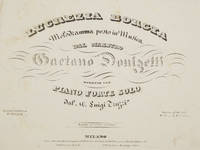
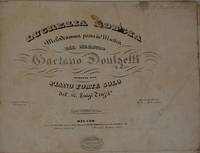
183431259Milano: Gio. Ricordi PNs 7210-7224 1834. Oblong folio. Light yellow calf-backed marbled boards gilt-ruled compartments to spine. 1f. recto title verso blank 1f. recto table of contents verso blank 5-107 pp. Each number with separate caption title some with separate pagination. Engraved. <br /> <br /> From the collection of Italian conductor vocal coach and close associate of Puccini and Mascagni Luigi Ricci 1893-1981.<br /> <br /> Binding worn rubbed and bumped; minor loss to head and tail of spine; narrow strip cut from upper margin of front free endpaper with remnants of contemporary markings in all likelihood related to ownership. Light foxing and a few small stains to title; very minimal scattered foxing throughout. First edition for piano solo. Inzaghi IN. 47 pp. 164-166.<br /> <br /> Lucrezia Borgia to a libretto by Felice Romani after Victor Hugo's play Lucrèce Borgia was premiered in Milan at the Teatro alla Scala on December 26 1833. Despite an uneven reception it became one of Donizetti's most successful operas particularly after the second production of the work in 1840. <br /> <br /> Ricci was an important figure in the transmission of 19th century traditions passed on to him by noted baritone Antonio Cotogni 1831-1918 whom he accompanied from the age of 12. He was active as a vocal coach at the Accademia Nazionale di Santa Cecilia where he taught amongst many others Sesto Bruscantini Anna Moffo Rosalind Elias Ezio Flagello Peter Lindroos and Martti Wallén. Gio. Ricordi [PNs 7210-7224] unknown
a77112Milano c. 1857 date on music advertisment inside rear cover. Giovanni Ricordi . Piano score. Oblong 4to. 91p. original green printed wraps fully decorated with vignette illustrations of cherubim and dancing girls and interior of concert hall etc . VG cover light wear and light soiling; text near fine page edges light ripled. Scarce in original wrapper. Pictures available on request. . paperback
1865386080Boston: Oliver Ditson & Co. 277 Washington St 1865. Softcover. Fair. First edition. Folio. 5pp. engraved cover and music. A stain and early thin piece of tape at the spine three inch tape repair on the top margin of the front cover foxing a sound fair copy. Two early dealer ink stamps on the bottom margin of the front cover: "C.E. Dudley Music Dealer 299 Chapel St. New Haven Ct" and "E. Lucas Watchmaker . AnsoniaCt. also dealer in music fancy goods &c." Scarce. OCLC locates six copies over two records. Oliver Ditson & Co. 277 Washington St unknown
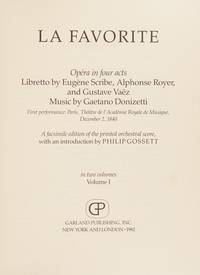
1981biblio1937<p>TWO VOLUMES SET. Garland Publishing Inc. 1981. Hardcover Red cloth. Gilt title on the spine. Exlibrary copy. No wear. Clean unmarked. Looks as never used. VERYGOOD. 12.3"x9.25". be75295. For International and/or Expedited shipping contact seller.</p> Garland Publishing, Inc. hardcover
19192092902138300712Senoo Music Publishing Company 1919. Soft Cover. Fine. The book is in fine condition. Senoo Music Publishing Company paperback
1982biblio1935<p>TWO VOLUMES SET. Garland Publishing Inc. 1982. Hardcover Red cloth. Gilt title on the spine. Exlibrary copy. No wear. Clean unmarked. Looks as never used. VERYGOOD. 12.1"x9.25". be75296. For International and/or Expedited shipping contact seller.</p> Garland Publishing, Inc. hardcover
186226082BARCELONA-MADRID: Imprenta de Tomás Gorchs 1862. Gran 8º.- Rústica cubiertas originales.- 53 páginas. . Imprenta de Tomás Gorchs unknown
1840152051840 demi-basane. in-4, (2ff.), 200pp., P. L. Mayaud (cot. BL 2485), ca. 1840
RO50045034LEON GRUS. NON DATE. In-8. Relié demi-cuir. Etat d'usage, Tâchée, Dos frotté, Quelques rousseurs. 268 pages de partitions. Titre, compositeur et filets dorés sur le dos de l'ouvrage.. . . . Classification Dewey : 780.26-Partitions
RO80043009TALLANDIER Jules. Non daté. In-4. Relié toilé. Bon état, Couv. convenable, Dos satisfaisant, Quelques rousseurs. 220 + 244 pages. Planches de partitions, accompagnées des chants. Titre et filets dorés sur le dos toilé rouge.. . . . Classification Dewey : 780.26-Partitions
2006BN197796Ricordi Berlin 2006. 2006. Softcover. Die Sitten und Unsitten am Theater Klavierauszug <br/><br/>Die Sitten und Unsitten am Theater Klavierauszug Gaetano Donizetti Ricordi Berlin paperback
1839102816ABLeipzig, Breitkopf & Härtel, (1839). 33 x 27 cm. Mit lithogr. Titelblatt u. 154 S. (ab S. 3 gestoch. Notenblätter). Halblederbd. der Zeit. - Plattennummer 6060. - Gutes bis sehr gutes Ex.
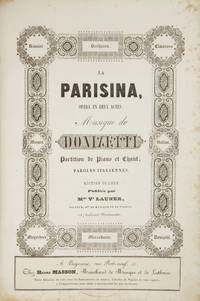
184330256Paris: Launer PN Vve. L. 3396 1843. Large octavo. Quarter black calf with marbled boards. 1f. recto blank verso publisher's catalogue 1f. recto title within decorative border verso blank 220 pp. Engraved. <br /> <br /> Overpaste of the French 19th century music and musical instrument dealer Henri Masson to foot of title with small oval handstamp to lower margin obscured.<br /> <br /> Named cast list in pencil to verso of title.<br /> <br /> Binding worn rubbed and bumped; minor paper loss; hinges partially split; minor discoloration to rear pastedown; minor ink staining to verso of front endpaper and facing blank leaf. Occasional light foxing; some signatures split or partially split; minor dampstaining to upper corners of pp. 177 on; minor tear to upper outer margin of pp. 95/96 and outer margin of pp. 165/166 not affecting music; pp. 217-20 partially detached with wear and minor tears to outer edge not affecting music. The present edition includes an additional aria on pp. 216-220 composed by Tadolini for the Italian tenor Giovanni Rubini 1794-1854 known particularly for his performances of the works of both Bellini and Donizetti. Launer [PN Vve. L. 3396] unknown
183424293Milan: Gio. Ricordi 1834. Wraps. Very good overall. Scarce Donizetti musical score for the piano for 'Lucrezia Borgia' printed from copper plates considered to be his bel canto masterpiece. WorldCat records one copy at the Staats & Universitatsbibliothek Hamburg. <br /> <br /> Lucrezia Borgia is a melodramatic opera in a prologue and two acts. The libretto was based on the play of the same name by Victor Hugo. The opera was first performed in December of 1833 at La Scala in Milan. <br /> <br /> Oblong 4to 107pp. Originally bound in hardcover; disbound. Text block tight and complete; all pages called for in Indice. Music shop stamp at title page. OCLC: 837960631. Gio. Ricordi paperback