557 résultats
190186408s. l. 6 Février 1901 | 11.50 x 17.50 cm | quatre pages sur un feuillet et une enveloppe
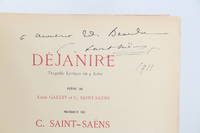
191088499Paris: Durand & Cie 1910. Fine. Durand & Cie Paris 1910 22.5 x 30.5 cm Broché sous étui First edition of the vocal and piano score of the opera Déjanire by Camille Saint-Saëns. A few pencil annotations in the margins of certain staves. Our copy is presented in a 3/4 shagreen clamshell box spine with five raised bands framed by gilt garlands and decorated with gilt fleurons gilt lettering at foot of spine: ""Inscribed by composer"". Boards endpapers and pastedowns in marbled paper. Spine of the box slightly faded. Inscribed dated and signed by Camille Saint-Saëns to music critic Edouard Beaudu. Saint-Saëns presented this copy to Edouard Beaudu a journalist writing for the Intransigeant who would later publish a glowing review of Durand & Cie hardcover
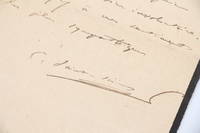
190186408s. l. 1901. Fine. I never stopped saying those who denigrate Mozart do not understand music s. l. 6 Février 1901 11.50 x 17.50 cm quatre pages sur un feuillet et une enveloppe Autograph letter signed by Camille Saint-Saëns to the essayist musicologist and music critic Adolphe Boschot. 43 lines written in black ink on a double leaf edged in black. Transverse fold inherent to the mailing with slight tears to the ends envelope enclosed in Saint-Saëns's hand to Boschot's address at 71 rue de Grenelle. Note in pencil from a previous bibliographer on the back of the envelope. Saint-Saëns wrote this wonderful demonstration of reverence for the Salzburg composer in 1901. That same year his friend Boschot the recipient of this letter was playing Mozart's chamber music at his home at 71 rue de Grenelle. The composer apologized for his absence: ""It's not my fault that in spite of my objurgations the earth refuses to stop in its course around the sun; for the 65th time I am witnessing this gyratory movement and the public performance of pieces of music on the piano is no longer my prerogative. Besides your sessions finish before the end of March and I won't be back until April 1st so I won't even be able to attend"". In his youth it was precisely as an interpreter of the divine artist that the prodigy Saint-Saëns had earned the nickname ""little Mozart"". In the letter he congratulates Boschot the author of a study entitled ""La Lumière de Mozart"" for his defense of the composer whom he himself had supported against the advice of the majority: ""Believe me I regret it and I'll be very happy to see that someone is taking care of getting the public to follow Mozart's path again. Thirty years ago the advanced party wanted to declare war on him so I defended him and never stopped saying those who denigrate Mozart don not understand music. Allow me to recommend his little-known motets with orchestra including the famous Ave Verum."" He ends the letter with a fine analysis of the composer's style: May we learn from listening to Mozart that there is more to music than sensations and nervous vibrations and that delicate artistry and purity of form are things not to be scorned. An exceptional expression of admiration and respect from one musical genius to another. unknown
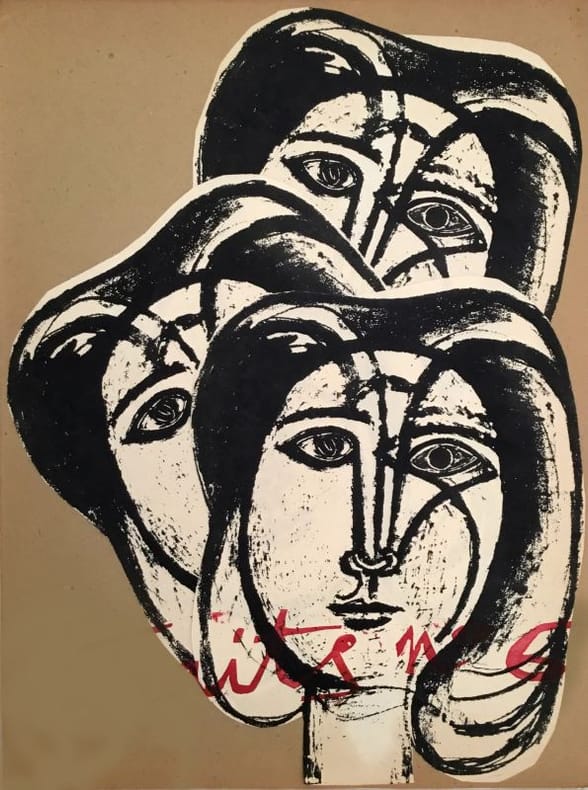
1947104416Paris 1947 10 Paris, Le cercle des arts de l'Union de la jeunesse républicaine de France, 1947-1952, formats et présentations divers.Publication artisanale, dirigée par F.Giusti, entièrement manufacturée par de jeunes artistes et des étudiants en art appartenant à v l'Union de la jeunesse républicaine de France proche du parti communiste français, TRAITS paraît à des dates difficiles à déterminer. Ses huit premiers numéros sont présentés dans des chemises aux couvertures illustrées notamment de bois gravés et de collages. Louis Aragon, Paul Colin, Gimond, Francis Jourdain, Fernand Léger, Marcel Lods, André Marchand, Matisse, Léopoldo Mendez, Henry Moore, Paul Nelson, Richard J. Neutra, Auguste Perret, Paul Eluard, Marcel Gromaire, Le Corbusier, Pablo Picasso, Candido Portinari, Marc Saint-Saëns y collaborèrent. (104416)
196630521966 Paris, C. de Acevedo, 1966. En feuilles : 29x39 cm. Ensembles de 20 fables choisies, chacune illustrée par un artiste différent (1 in-texte et 1 hors-texte pour chacune des fables, soit 40 illustrations au total). Couverture rempliée. Avec une SUITE DES ILLUSTRATIONS sur pur fil d'Arches, une SUITE DES ILLUSTRATIONS sur pur fil de Lana, une DECOMPOSITION de l'un des hors-texte sur pur fil d'Arches, et la SIGNATURE AUTOGRAPHE au crayon de chacun des vingt peintres sur leur hors-texte respectif. Le tout dans un emboîtage en chagrin orangé imitant la forme d'un grand livre et portant le titre en lettres dorées sur le dos. Petites traces de frottement sur le dos de l'emboîtage. Contenu en parfait état.
187087776novembre 1870 | 33.20 x 24.50 cm | un bifeuillet
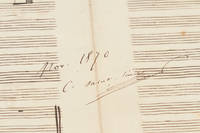
1870877761870. Fine. An exceedingly rare Saint-Saëns unpublished score novembre 1870 33.20 x 24.50 cm un bifeuillet Unpublished and signed autograph score by Camille Saint-Saëns. Two pages of handwritten music for solo voice and piano on an oblong bifolium with twenty staves. Autograph inscription on the first page signed by Saint-Saëns with his signature and date ""Nov. 1870"" appearing again on the second page. Trace of vertical fold with a tiny tear along the fold a small marginal tear on 1 cm of the first page without damage to the manuscript. An exceptional unpublished autograph manuscript of a Persian melody for voice and piano composed by Camille Saint-Saëns during the Siege of Paris in November 1870 enriched with a autograph inscription: 'A Geneviève Bréton / Hommage de respectueux dévouement' To Geneviève Bréton / In homage with respectful devotion signed and dated on the second page 'Nov 1870 C. Saint Saëns'. The lyrics of the piece were directly inspired by its dedicatee the fiancée of the painter and tenor Henri Regnault 'the most musical of all the painters' Saint-Saëns École buissonnière translation by Edwin Gile Rich who was the first performer of several other Mélodies persanes. Geneviève Bréton a cultured and passionate woman was a fixture in the literary and artistic salons of her time surrounded by composers painters and the young Parnassian poets of her generation. Saint-Saëns likely met her through his friend the orientalist painter Henri Regnault a Prix de Rome laureate with whom she fell madly in love in Italy in 1867. A handsome young man already celebrated for his art Regnault also fascinated Saint-Saëns with his 'exquisite tenor; voice . alluring in its timbre and irresistible in its attractiveness just as he was himself' as the composer would later recall in 1913. Regnault premiered several of his compositions: 'In 1868 Regnault was the first to embody the role of Samson in the second act of the celebrated opera Samson et Dalila created during a private evening performance. Saint-Saëns renewed their collaboration by entrusting the artist with two of the Mélodies persanes composed for tenor voice.' Manon Bertaux. The Mélodies persanes op. 26 based on verses by the Parnassian poet Armand Renaud consist in their published version of three works for tenor Sabre en main Au Cimetière Tournoiement and three for contralto La Brise La Splendeur vide La Solitaire. They form one of Saint-Saëns's most famous cycles and belong to the golden age of French mélodie. This manuscript for voice and piano with its ardent colourful tone can unquestionably be linked to this set of melodies begun in June 1870 and sold by Saint-Saëns to his publisher Hartmann shortly afterwards. However Manon Bertaux's research has shown that 'the composer sold Hartmann an incomplete cycle having composed his final melodies at the beginning of the Siege of Paris from September onward"". Dated November 1870 our melody - as far as we know unknown to biographers and musicologists - is one of those composed in the midst of the Franco-Prussian war: 'Serving as a National Guard during the Siege of Paris Saint-Saëns continued his activities as a musician and composer alongside his duties guarding the ramparts'. It appears that both the text and music of this composition remained entirely unpublished and were never sent to Hartmann. For his part the painter Henri Regnault enlisted as a maverick also risked his life in an attempt to break the siege much to the dismay of Geneviève who confided her worries in her now famous diary Ramsay 1985. The young lovers had finally become engaged after years of opposition from the young woman's mother. Saint-Saëns likely offered this exquisite melody to Geneviève as a betrothal gifta radiant piece of warmth for the anxious young woman and here is the first of its two verses: « Ka-douja la chanteu-se Au manteau noir Qu'on trouve sous l'y-eu-se Quand unknown