GERSHWIN S BBiblio.com

634 résultats
CBS 9781402073038USA Edition . New. Brand New! Fast Delivery US Edition and ship within 24-48 hours. Deliver by FedEx and Dhl & Aramex UPS & USPS and we do accept APO and PO BOX Addresses. Order can be delivered worldwide within 6-10 days and we do have flat rate for up to 2LB. Extra shipping charges will be requested if the Book weight is more than 5 LB. This Item May be shipped from India United states & United Kingdom. Depending on your location and availability. unknown
2003416FB2003. Boston Kluwer 2003. XXI 429 p. Hardcover. Versand aus Deutschland / We dispatch from Germany via Air Mail. Einband bestoßen daher Mängelexemplar gestempelt sonst sehr guter Zustand. Imperfect copy due to slightly bumped cover apart from this in very good condition. Stamped. International Series in Operations Research & Management Science. hardcover
2002AME_9781402073038kluwer 2002. 1st. Hardcover. New/New. kluwer hardcover
2002Q-1402073038Springer 2002-11-30. Hardcover. New. In shrink wrap. Looks like an interesting title! Springer hardcover
2002DBS-9781402073038kluwer 2002. 1st. Hardcover. New. kluwer hardcover
2002DBS-9781402073038kluwer 2002. 1st. Hardcover. New. kluwer hardcover
2012DADAX1461353548Springer 2012-10-31. 2003. paperback. New. 6.10x1.03x9.25. Buy with confidence. Excellent Customer Service & Return policy. Springer paperback
2012SONG1461353548Springer 2012-10-31. 2003. paperback. Used: Good. 6.10x1.03x9.25. Buy with confidence. Excellent Customer Service & Return policy. Springer paperback
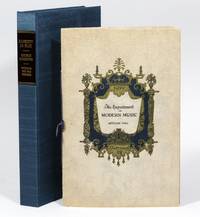
19242957New York: Aeolian Hall 1924. First edition. Very Good. ORIGINAL PROGRAM FOR THE FIRST PERFORMANCE OF GERSHWIN'S RHAPSODY IN BLUE. About six weeks before the premiere of Rhapsody in Blue George Gershwin was shooting pool at the Ambassador Billiard Parlor on Broadway and 52nd Street when his brother Ira entered the hall carrying an early edition of the New York Tribune. Ira proceeded to read an article from the paper announcing a new experimental music concert organized by bandleader Paul Whiteman. In this concert Ira continued a piece by George Gershwin would be performed. Adrian Symphony Orchestra<br /> <br /> This was news to Gershwin who had been asked some months earlier by Whiteman to contribute a piece but had turned down the request believing the several months not enough time. And now Gershwin had only six weeks. Whiteman as it turned out had decided to include Gershwin’s name after learning his musical nemesis—Vincent Lopez—would be releasing a similar concert series. Whiteman knew Gershwin’s name would bring his concert more coverage and went ahead with the inclusion hoping to propel his concert above Lopez’s Adrian Symphony Orchestra.<br /> <br /> Understanding Whiteman’s difficult position Gershwin agreed to write the piece planning to begin work during an upcoming train ride from New York to Boston where he was headed for an out-of-town preview for a new musical of his. Gershwin later claimed that the sounds of this train hitching and roaring down the track inspired the thematic division of his score into five themes: Ritornello Train aptly named Stride Shuffle and Love. Gershwin hoped to harness the energy of modern machinery in this piece to convey the hustle and bustle of city life. Adrian Symphony Orchestra; Dotsey<br /> <br /> As Gershwin later commented on his writing process:<br /> <br /> “I set to work composing with unwonted rapidity. No set plan was in my mind – no structure to which my music would conform. The rhapsody as you see began as a purpose not a plan. I tried to conceive the composition as a whole. I heard it as a sort of musical kaleidoscope of America – of our vast melting-pot of our unduplicated national pep of our blues our metropolitan madness.†Dotsey<br /> <br /> Gershwin himself had been raised in close contact with the diverse musical traditions of the Lower East Side exposed to the competing influences of Russian Eastern European African American and popular American music. Resultantly he decided that a mixture of jazz classical in conjunction with the rhythmic and thematic implements of almost all these styles was the perfect medium for portraying the city’s kaleidoscopic bustle. Adrian Symphony Orchestra<br /> <br /> Rhapsody in Blue received mixed reviews upon its release. The New York Times noted the piece displayed “extraordinary talent†and public opinion was largely positive. Still many critics felt that Rhapsody in Blue lacked focus calling it a string of disconnected themes. Hebblethwaite Adrian Symphony Orchestra<br /> <br /> Much of this confusion stemmed from the genuinely innovative fusion at the heart of Rhapsody in Blue. As mentioned Gershwin took classical form and infused it with the varied musical influences of his youth—blues ragtime Jewish folk music and Harlem jazz. To some extent Gerswhin’s intention was to write these genres in a way which concentrated their essence within small segments of a classical concerto as a more culturally dominant format of music. Though some viewed these borrowings as derivative of their original cultural contexts Gershwin’s usages of Klezmer-like arrangements for example nonetheless represented a groundbreaking expansion of popular music enabling the usage of non-classical genres in dominant American culture. Adrian Symphony Orchestra; Dotsey<br /> <br /> Later reflecting on his work Gershwin wrote about his usage of Jazz:<br /> <br /> “There had been so much chatter about the limitations of jazz not to speak of the manifest misunderstandings of its function. Jazz they said had to be in strict time. It had to cling to dance rhythms. I resolved if possible to kill that misconception with one sturdy blow.†Dotsey<br /> <br /> Although Gershwin hoped to expand the possibilities of jazz he failed to credit the African American traditions that clearly inspired him claiming in this program that jazz “sprang into existence ten years ago from nowhere in particular.†In this way Gershwin’s Great American kaleidoscope remained incomplete.<br /> <br /> Despite being one of the most famous works of the 20th century audiences will never know exactly what the original performance sounded like. Pressed for time Gershwin improvised many of the solo parts himself. This program is one of the very few surviving records of that original performance. Although enough programs were printed for a 1100 seat hall only a few examples survive. No copies exist at auction and there are only three institutional holdings— at the New York Public Library the George and Ira Gershwin Collection at the Library of Congress and the Center for Popular Music at Middle Tennessee State University. <br /> <br /> Rhapsody in Blue is loud dramatic and undeniably iconic—but few if any living people remember the sensation and sound of its improvised premiere. Very few material records have been preserved. This program offers a rare opportunity to relive the texture of that historic moment. <br /> <br /> The show’s program provides biographies of Whiteman’s collaborators. The biography of Gershwin reads as follows:<br /> <br /> “Mr. Gershwin has written a “Rhapsody in Blue†which he has consented to play accompanied by the orchestra. He is capable of everything from “Swanee†to “A Stairway to Paradiseâ€: from “Ingenue Baby†and “Virginia†to “Do It Again.†Delicacy even dreaminess is a quality he alone brings into Jazz music. Gershwin’s sense of variation in rhythm of shifting accents of emphasis and color is faultless. He has moreover an insatiable curiosity about everything connected with his work and for that matter with music in general. He is learning and he is not forgetting and being one of the youngest of the composers he is actually one of the brightest hopes of our popular music.â€<br /> <br /> Further descriptions of Gershwin’s Rhapsody in Blue:<br /> <br /> “This is the first rhapsody written for solo instrument and modern orchestra. Prophesy being not the function of an annotator it may be said that the importance of the rhapsody quite apart from its own value must depend to an extent upon its being kept alive in a repertoire—and there is no organization to do this unless the present concert is as its conductor hopes only the beginning of a series. Gershwin is a close student of music and a listener; yet there is not a derivative phrase in his work. He has composed a rhapsody and has chosen to build it out of materials known to him: the rhythms of popular American music the harmonies produced by American jazz bands. None of the thematic material has been used before; the rhapsody is not a pastiche. The structure is simple and it resembles concertos written by pianists in what seems at first the predominance of the single instrument. Mr. Gershwin’s manuscript is complete for the piano. The orchestral treatment was developed by Mr. Grofé.<br /> <br /> The rhapsody is a free development of almost all of Gershwin’s qualities alluded to in the earlier pages of this program. It has a little more crispness a shade more of jazz and a shade less of gentleness than some of his compositions; there is more of “A Stairway to Paradise†than of “Do It Againâ€; and this is natural in a composition intended specifically for jazz orchestra.<br /> <br /> Those who care for jazz will naturally be grateful to Mr. Whiteman for urging Mr. Gershwin to compose this Rhapsody. He had had it in mind for some time but had no intention of going to work upon it until the announcement was made that the Rhapsody would be played at this concert. For those who remain skeptical another test-case may be provided. It is not inconceivable that an intelligent conductor of a symphony orchestra may want to play the rhapsody; it would probably need re-scoring but the saxophone which has been used ever since Meyerbeer in serious music need not be exiled.â€<br /> <br /> The program also includes photos of Mr. Whiteman and his band alongside collaborators such as Gershwin and Victor Herbert.<br /> <br /> Provenance: With signature and Yale address of "Frederick Ullman" in pencil on back. Anecdotally later gifted by Ira Gershwin's wife Lenore to her vocational nurse and caretaker; appearing on the market now for the first time. <br /> <br /> New York: Aeolian Hall 1924. Concert program measuring 9.5 x 6.25 inches. 12 pages in original decorated textured grey wrappers; side-stitched with original blue cord. Housed in custom silk box. Abrasion to text at bottom of page 1 with loss of a few words. Wrappers in a remarkable state of preservation; very clean and fresh with some light rubbing to cover decoration corresponding to the textured ridges on cover. <br /> <br /> EXCEEDINGLY RARE: We find no records at auction and three institutional holdings only: at the New York Public Library the George and Ira Gershwin Collection at the Library of Congress and the Center for Popular Music at Middle Tennessee State University. Aeolian Hall unknown
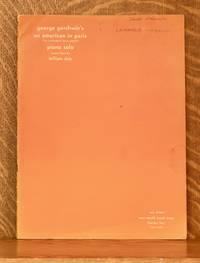
193953588New York: New World Music Corp./ Harms Inc. 1939. First Thus. Paperback. Very good. 9 x 12 inches. 36 pages. Condition is Very Good; previous owners' names at top of front cver pages are very clean and unmarked. STK New World Music Corp./ Harms Inc. paperback
0769278205.Gpaperback. Good. Access codes and supplements are not guaranteed with used items. May be an ex-library book. paperback
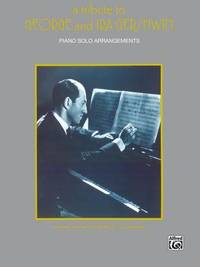
1994Q-0769235794Alfred Music 1994-12-01. Paperback. New. In shrink wrap. Looks like an interesting title! Alfred Music paperback
1994DADAX0769235794Alfred Music 1994-12-01. paperback. New. 7.42x0.24x10.22. Buy with confidence. Excellent Customer Service & Return policy. Alfred Music paperback
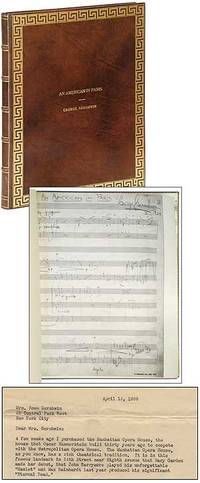
193899122New York: Privately printed 1938. Hardcover. Fine. Facsimile of the handwritten score. Folio. Full leather ruled with a Greek key design and lettered in gilt. Blue silk endpapers all edges gilt. Fine. Laid in is a Typed Letter Signed dated 12 April 1938 from Abraham Ellis to Gershwin's mother Rose who was the unmarried composer's heir. Ellis announces in the letter that he has just purchased the Manhattan Opera House which became the Manhattan Center and that with Rose's permission he would like to rename the rebuilt auditorium the Gershwin Room. This volume was apparently a private photographic reproduction of the score that was produced for family and friends before the manuscript was eventually donated to the Library of Congress. Gershwin's mother's copy with the letter dated less than a year after the composer's untimely death. A classic of 20th Century composition and inspiration for the Vincente Minnelli film scripted by Alan Jay Lerner around Gershwin's music and starring Gene Kelly Leslie Caron and Oscar Levant. Privately printed hardcover
199221663EMI Classics, 1992. 1 CD Audio-CD
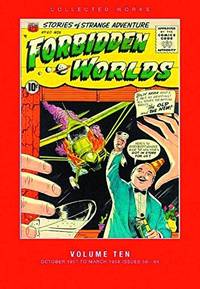
2022155174U.K.: PS Artbooks 2022. First Edition. Trade Paperback. Fine. John Forte; John Rosenberger; Leo Morey; Emil Gershwin; Pete Costanza; Dick Beck; Harry Lazarus; Tom Hickey. Book is in excellent condition. Binding is solid and square covers have sharp corners exterior shows no blemishes text/interior is clean and free of marking of any kind. Contains 6 Forbidden Worlds #89-94 August 1960 to March/April 1961 complete in full color throughout with front cover reprints and ads at back page / back cover for such things as weight loss devices prizes to win muscle building programs Charles Atlas How to write thrilling love letters books Swiss watch sacrifice sale $7.95 Get prizes and make money the easy way 1000 live baby turtles Sea Monkey parks Learn to draw first day with no talent! etc. Unpaginated about 85 pages. high production values on glossy paper. Keywords: 1960's Comic Aliens Invasion Rocket Ships Romance Explosions Future Action Aliens Superpowers Herbie Fat Nothing Strange Stories Weird Stories Occult Ghosts Time Travel Reprint Compilation PS Artbooks paperback
2004G1560536195I3N00Mosby 2004. Hardcover. Good. Pages can have notes/highlighting. Spine may show signs of wear. ~ ThriftBooks: Read More Spend Less.Dust jacket quality is not guaranteed. Mosby hardcover
2004G1560536195I4N00Elsevier - Health Sciences Division 2004. Paperback. Very Good. May have limited writing in cover pages. Pages are unmarked. ~ ThriftBooks: Read More Spend Less.Dust jacket quality is not guaranteed. Elsevier - Health Sciences Division paperback
C--24659Brand New. Brand New! Fast Delivery US Edition and ship within 24-48 hours. Deliver by FedEx UPS & USPS and we do not accept APO and PO BOX Addresses. Order can be delivered worldwide within 7-12 days and we do have flat rate for up to 2LB. Extra shipping charges will be requested if the Book weight is more than 5 LB. This Item May be shipped from India. unknown
1560534141.Gpaperback. Good. Access codes and supplements are not guaranteed with used items. May be an ex-library book. paperback
mon0000078817PS Artbooks Ltd. 2015-01-01. Hardcover. New. 1.0000 in x 9.0000 in x 7.0000 in. PS Artbooks Ltd. hardcover
190732009New York: Scribner's 1907. First edition. Red cloth gilt very good minor staining. With Ira Gershwin's ownership signature and address dated 1923. Ira Gershwin and Yip Harburg "shared a special interest in a long line of light satirical poetry from Renaissance parodists and W.S. Gilbert to the latest newspaper verse of Franklin P. Adams Bert Taylor and the young Dorothy Parker. Carolyn Wells's anthology of society verse in particular became an indispensable resource as the two boys experimented with such classic forms as the ballad limerick ode rondeau and triolet. In time these two friends . would help usher in the so-called golden age of American popular song by applying the traditions of light verse to modern lyric writing" Pollock George Gershwin p. 15. <br/><br/> Scribner's hardcover books
1983Q-0897242610Alfred Publishing 1983-11-01. Paperback. New. In shrink wrap. Looks like an interesting title! Alfred Publishing paperback
1956304984New York Henry Holt 1956. 1956. First edition. 8vo. Illustrated. Dust jacket unclipped; small chips; few nicks. Very good. 384 pages. No other signatures or bookplates. Signed and inscribed on front free endpaper by Ewen to 20th Century-Fox executive Buddy Adler: "For Buddy Adler with best wishes of the author David Ewen Feb. 12 1956.". Inscribed by Authors. 1st Edition. Hardcover. Very Good/Very Good. New York, Henry Holt, 1956. hardcover books
1956304984New York Henry Holt 1956. 1956. First edition. 8vo. Illustrated. Dust jacket unclipped; small chips; few nicks. Very good. 384 pages. No other signatures or bookplates. Signed and inscribed on front free endpaper by Ewen to 20th Century-Fox executive Buddy Adler: "For Buddy Adler with best wishes of the author David Ewen Feb. 12 1956.". Inscribed by Authors. 1st Edition. Hardcover. Very Good/Very Good. New York, Henry Holt, 1956. hardcover