DEBUSSY (Claude).Livre Rare Book
730 résultats
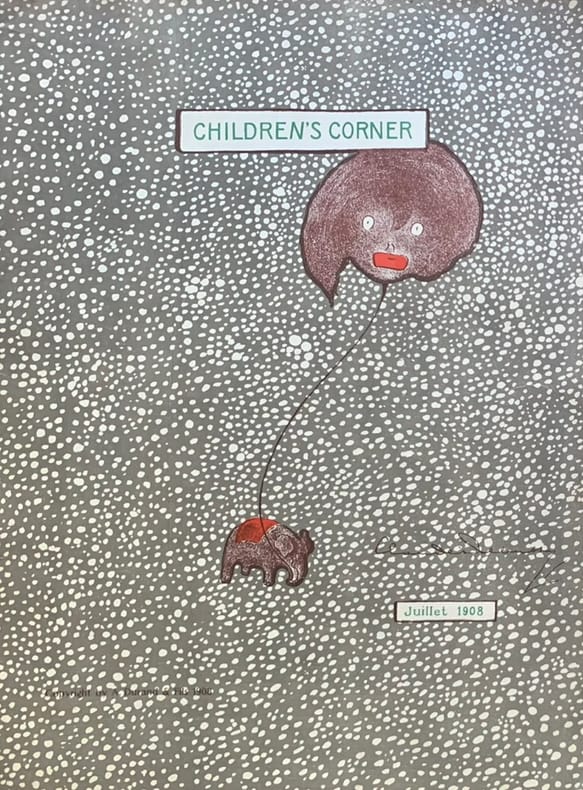
190513661905 Paris, A. Durand, 1905. Édition originale de la partition pour piano seul. In-4 agrafé, couverture illustrée, 28 pp.
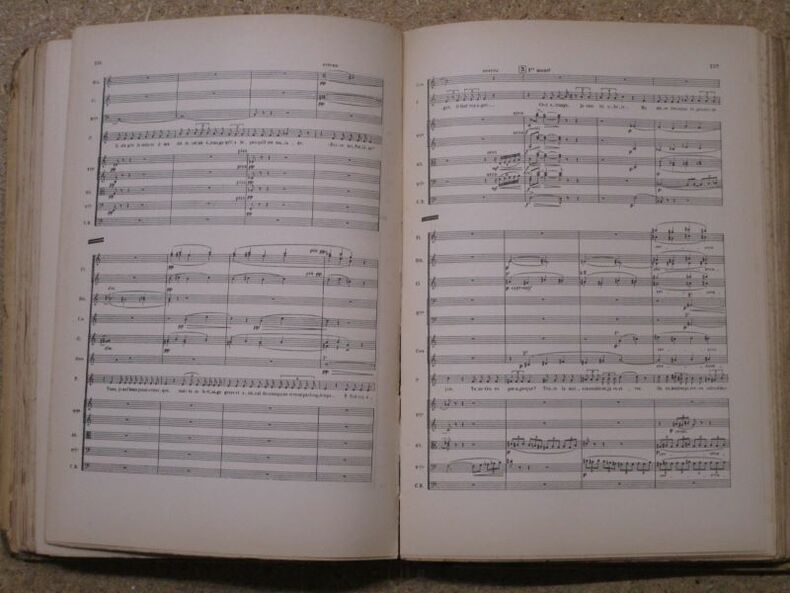
1902111093Durand Théatre National de l'Opéra-Comique 1902 Paris, A. Durand & Fils Editeurs, Théâtre National de l'Opéra-Comique, 1902 (copyright), 409 p., cartonnage éditeur, environ 225x160mm, exemplaire numéroté 346. Des frottements et des mouillures sur le cartonnage, des trous de ver sur les mors, coins émoussés avec manques, cartonnage fragile, un tampon d'appartenance sur la page de garde et la suivante, mors internes fendus, des rousseurs sur les premières et les dernières pages.
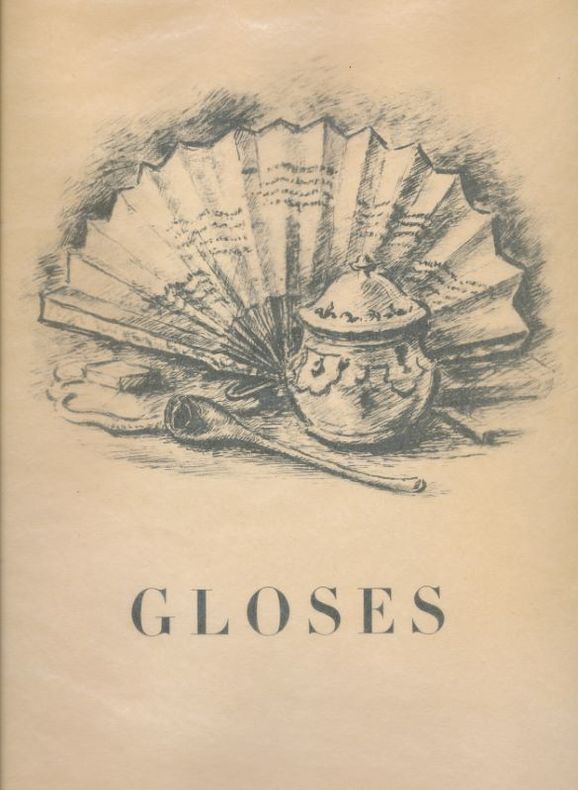
194318572Rombaldi Paris, Rombaldi, 1943. In-4 en feuillets sous couvertures illustrées rempliées, et double étui demi parchemin ivoire . DEBUSSY Claude: Prélude à l'après midi d'un faune (reproduction en fac-similé du manuscrit musical). MALLARME Stéphane : Un faune. MALLARME Stéphane : L'après midi d'un faune. CHARPENTIER Henri : Gloses. 72 lithographies originales en noir de René DEMEURISSE. Edition originale de ces poèmes qui font suite à l'après-midi d'un faune.Tirage limité numéroté à 220 exemplaires, celui ci n° 194 sur vélin pur chiffon à la forme des papeteries de Lana. L'impression des lithographies a été exécutée sur presse à bras par Mourlot frères. CARTERET : Tome 2 page 251. Bel exemplaire.
324796A. Durand & Fils 1913. First Edition. Hardcover. Good. Oblong folio in a very recent binding of tan cloth title in gilt. The first issue with the 12 and 15 franc prices on the title page. Lacking the final plate; there's nothing after page 48 except the new endsheet supplied in the rebinding. Ten of the other plates are bright and undamaged; one has a closed tear repaired with cello tape. Several other pages have such tears. The lower right corner of the very first leaf is torn away. Inserted after the cover leaf is the presentation leaf from the premier performance at Le Theatre Lyrique on December 10 1919. A. Durand & Fils hardcover
7048Paris, A. Durand & Fils, Éditeurs, 1912. 32,5 x 25 cm, 42 pp. Broché, légèrement usé, manque au bas du dos.
7048Paris, A. Durand & Fils, Éditeurs, 1912. 32,5 x 25 cm, 42 pp. Broché, légèrement usé, manque au bas du dos.
19008515Eugène Fromont - Imprimerie Dupré Paris 1900 In-folio, s.d. [1900], reliure demi-vélin de l'époque à la bradel, dos lisse, titre doré au dos, plats marbrés, [8]-111-[2] pp. E 1415 F - E 1417 F. Couverture conservée, la dernière présentant "Les compositions musicales de Claude Debussy". Blason doré du compositeur René de Castéra (1873-1955) en tête. Edition de la partition d'orchestre du triptyque symphonique avec choeur de femmes dédié à Georges Hartmann (1843-1900). Composition orchestrale que Claude Debussy composa entre 1892-1899, inspirée des "Poèmes anciens et romanesques" d'Henri de Régnier. La famille d'Avezac de Castéra est originaire du département des Landes. Bonne reliure, rousseurs notamment sur les premières pages. Belle provenance. Au crayon dans l'angle droit de la page de titre, mention "R. de Castéra, 11 [rue d'] Assas".(adresse parisienne des frères Castéra dans les années 1900).(BeauB17) PHOTOS NUMERIQUES DISPONIBLES PAR EMAIL SUR SIMPLE DEMANDE-DIGITAL PHOTOGRAPS MAY BE AVAILABLE ON REQUEST 28 x 36
19008515Eugène Fromont - Imprimerie Dupré Paris 1900 In-folio, s.d. [1900], reliure demi-vélin de l'époque à la bradel, dos lisse, titre doré au dos, plats marbrés, [8]-111-[2] pp. E 1415 F - E 1417 F. Couverture conservée, la dernière présentant "Les compositions musicales de Claude Debussy". Blason doré du compositeur René de Castéra (1873-1955) en tête. Edition de la partition d'orchestre du triptyque symphonique avec choeur de femmes dédié à Georges Hartmann (1843-1900). Composition orchestrale que Claude Debussy composa entre 1892-1899, inspirée des "Poèmes anciens et romanesques" d'Henri de Régnier. La famille d'Avezac de Castéra est originaire du département des Landes. Bonne reliure, rousseurs notamment sur les premières pages. Belle provenance. Au crayon dans l'angle droit de la page de titre, mention "R. de Castéra, 11 [rue d'] Assas".(adresse parisienne des frères Castéra dans les années 1900).(BeauB17) PHOTOS NUMERIQUES DISPONIBLES PAR EMAIL SUR SIMPLE DEMANDE-DIGITAL PHOTOGRAPS MAY BE AVAILABLE ON REQUEST 28 x 36
19923Paris, A. Durand & fils, 1919. In-folio oblong, 48 pp. 13 pl., cartonnage à dos de toile écrue (petites taches et rousseurs, plusieurs feuillets débrochés).
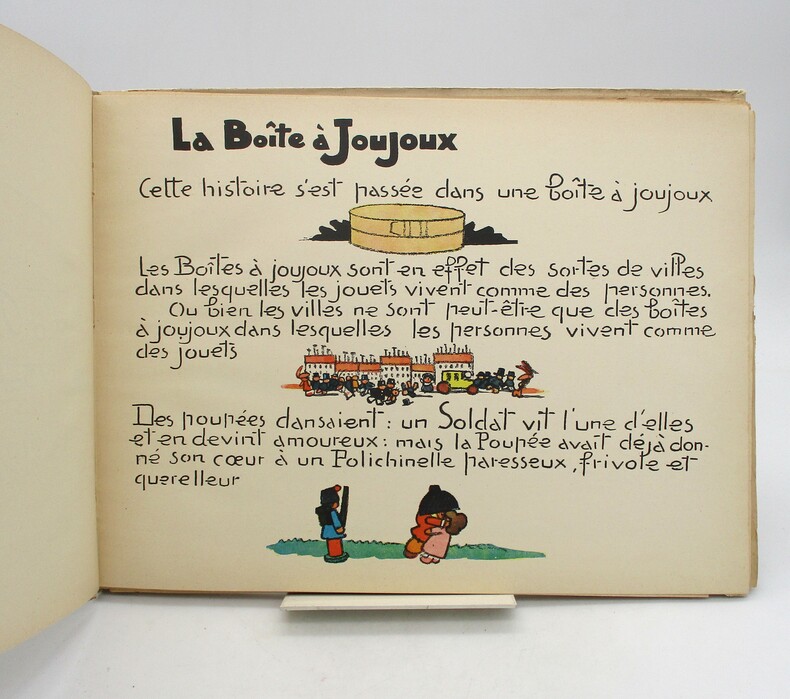
191326681Paris: Durand et Cie 1913. Boards. Very Good. Andre Helle. Andre Helle. Boards. A charming and scarce copy of Debussy's ballet score piano reduction only for "La Boite a Joujoux" with delightful color pochoir illustrations by Andre Helle. The ballet was inspired by Debussy's daughter and her toys and toy box. This was one of Debussy's final works and the ballet was in fact not staged until after his death with costumes and decor by Helle. Published in hardbound and softbound editions this copy has been recased in tan paper-covered boards with a digital reproduction of Helle's illustrated title affixed to front cover. The original paper covers are bound in. In very good plus condition with a few small closed tears on the lower margin of a few pages. 10 x 13 inches. 48 pages. MUS/040513. Durand et Cie unknown
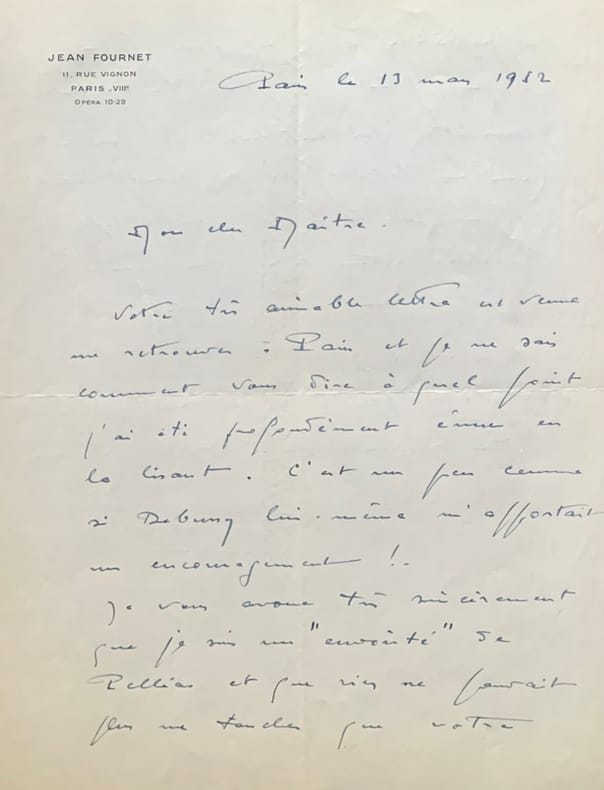
1375Trois lettres manuscrites autographes signées adressées à Désiré-Émile Ingelbrecht, fondateur de l’Orchestre National de France et puissant artisan de la vie musicale à Radio-France, à propos de Pelléas et Mélisande.« Paris, le 13 mars 1952, Mon cher Maître, Votre très aimable lettre est venue me retrouver à Paris et je ne sais comment vous dire à quel point j’ai été profondément ému en la lisant. C’est un peu comme si Debussy lui-même m’apportait un encouragement ! Je vous avoue très sincèrement que je suis un “ envoûté ” de Pelléas et que rien ne pourrait plus me toucher que votre approbation. C’est vous dire à quel point je désire très vivement connaître vos critiques et puisque vous me le proposez si aimablement, je me permettrai de vous téléphoner à votre retour pour vous demander quelques instants d’entretien. Croyez, mon cher Maître, je vous prie, en mes sentiments très reconnaissants et tout dévoués. » « Tokyo, le 14 décembre 1958, Mon Cher Maître, En attendant de pouvoir vous narrer de vive voix notre aventure japonaise, permettez-moi de vous adresser mes pensées fidèles et reconnaissantes, avant de quitter le pays du Soleil levant. Je n'oublie pas que c’est à vous que je dois la joie d’avoir pu faire ici la création de notre cher Pelléas. Je crois que notre ami vous a déjà donné quelques échos. Ce qu’elle ne vous a certainement pas dit, c’est qu’elle a été une Mélisande extrêmement sensible, touchante, mystérieuse. Enfin ‘ elle fut Mélisande ‘. Je suis parti de Paris depuis fin juillet – six concerts à Buenos Aires en août, deux mois et demi à l’opéra de San Francisco pour le répertoire courant (sauf création du Médée de Cherubini). Vous dirai-je que c’est ici, avec ces sept Pelléas et les concerts, que j’aurais eu le plus de joies musicales ? A très bientôt, mon cher Maître. Après un nouveau crochet pour deux concerts à Cleveland, je rentre à Paris pour début janvier. Voulez-vous, je vous prie, présenter mes hommages à Madame Inghelbrecht, et croire à mes sentiments bien fidèlement dévoués. » « Paris, le 15 septembre 1960, Mon cher Maître, J’ai été extrêmement sensible à l’envoi que vous avez bien voulu me faire de la partition du ‘Requiem’ et je vous en remercie vivement. Ce que je souhaite beaucoup, c’est pouvoir le donner quelque part. Comme vous le savez peut-être, je deviens, à partir de l’an prochain, chef titulaire de l’Orchestre philharmonique de la radio hollandaise. On fait, dans ce sympathique pays où je vais depuis longtemps, beaucoup de musique dans de bonnes et agréables conditions ! … ce qui n’est pas, hélas, toujours le cas ailleurs… J’espère donc, dès que possible, inscrire une de vos œuvres à mes programmes, ce que je n’ai pu faire depuis assez longtemps, à mon grand regret. Veuillez, mon cher Maître, présenter de respectueux hommages à Madame Ingelbrecht, et croire, je vous prie, en mes sentiments fidèlement dévoués. »
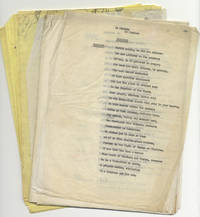
30632Folio. 24 pp. On onionskin. With typed note at conclusion "Translation by Leonard Bernstein August 29th 1962." <br/><br/>Contents: <br/>Prologue: 2 pp. <br/>Act I: First Window: the Court of Lilies 5 pp.<br/>Act II: Second Window: The Magic Chamber 3 pp.<br/>Act III: Third Window: The Council of False Gods 9 pp.<br/>Act IV: Fourth Window: The Wounded Laurel 4 pp. <br/>Act IV: 1 p. <br/><br/>With numerous annotations corrections etc. in ink and lead red and blue pencil throughout by Yuri Krasnapolsky 1934-2018. Somewhat worn and creased; several leaves stapled together at upper inner corners.<br/><br/>Together with: <br/>- An extensively corrected draft of an interesting autograph letter from Krasnapolsky to Leonard Bernstein. 5 pp. Folio. In pencil on 4ff. of yellow lined paper. No date. Addressed "Dear Lenny." Krasnapolsky writes regarding his travels in Europe after seeing Bernstein in Vienna possible conducting engagements having been blacklisted during the McCarthy era etc. The letter is particularly poignant regarding his relationship with and feelings of indebtedness to Bernstein: "The European experience. showed me that my association with you over the past eighteen years has been crucial & pervasive. Your working style in every respect became for me as for many others an object of tremendous admiration and imitation. My own style took longer. to evolve but now that it has I can see & feel more clearly what it owes to yours." Krasnapolsky very much regrets the fact that he has apparently offended Bernstein in some way and is struggling to understand "how & when." He goes on to say that "it is a simple fact of my life that I am deeply indebted to and in a sense derived from you and can no more separate myself from that fact than I can deny my love for music. I literally cannot survive professionally without your help." Krasnapolsky goes on to request various letters of endorsement. <br/><br/>- A corrected draft of an autograph letter from Krasnapolsky to Sir John Barbirolli. 3 pp. Folio. In pencil on 3ff. of yellow lined paper. No date. Addressed "Dear Sir John." Krasnapolsky apologizes for the delay in writing but says that he has been "unexpectedly but unavoidably busy with a series of youth concerts." He thanks Barbirolli for his kindness and hospitality. "It was a great pleasure and a privilege to see you at work again and to have assisted you however briefly." Krasnapolsky has regarded Barbirolli as a "heroic musical figure. for many years." He mentions going to a concert of Barbirolli's at Carnegie Hall "at age 8 and/or 9 quite alone" with Gieseking as soloist. "Furthermore now that I am at the age you were when you took on the N.Y. Phil. I realize more than ever what an enormous task and brilliant achievement that was. Who else could have done that I don't know. But you have remained undeniably a heroic figure of 20th century music. I can only wish that someone. will say the same of me someday. My wife and I are planning to be in London again just after the first of the year. I'll be looking for ways to become a part of the musical life of London and the Continent." <br/><br/>- A corrected draft of a letter to John S. Edwards General Manager of the Chicago Symphony. 1 page. Folio. In pencil on 1f. of yellow lined paper. Thanking him for his time whle in New York mentioning "the Florida affair" etc.<br/><br/>- A corrected draft of a letter to Walter Hendl at the Eastman School of Music. 2 pp. Folio. In pencil on 1f. of yellow lined paper. Recommending a colleague Francois Jarosely for a possible conducting appointment at the school. <br/><br/>- Biographical notes. 5 pp. Folio. In pencil on 5 ff. Le Martyre de Saint Sébastian a "mystère" in five acts to a libretto by Gabriele D'Annunzio composed for the dancer Ida Rubinstein was first performed in Paris at the Châtelet on May 22 1911. Debussy's last stage work it is "a synthesis of orchestra and vocal music dance mime and speech." <br/><br/>Bernstein translated D'Annunzio's text and conducted a recording of the work in 1962 with the Choral Art Society and the New York Philharmonic featuring his wife Felicia Montealegre as Sebastian one of the narrators: ".among its best moments the serenely celestial 'Magic Chamber' in which the NYPO strings bloom and 'The Wounded Laurel' which could have come from La mer. Mr and Mrs. Bernstein were having a good day judging by the passion which comes across." Christopher Fifield BBC Music Magazine. <br/><br/>"The following year 1963 he conducted The Martyrdom of Saint Sebastian to commemorate Debussy's centenary. The sung parts were in German the dialogue in English. Fritz Weaver the actor was the narrator and Felicia appeared as the male saint. Bernstein probably thought of her as at least a saint. If he tested orchestra managements and presidents to see how far he could push them he repeatedly tested Felicia too. She seemed to pass all his tests right up to the end of her life. As for the Debussy critics remarked on the clean articulation of the text." Peyser: Bernstein p. 359. <br/><br/>Krasnapolsky was an assistant conductor of the New York Philharmonic under Leonard Bernstein. unknown books
69347P., Durand, 1913, grand in 4° oblong, cartonnage crème de l'éditeur, 5 feuillets non chiffrés et 51 pages ; cartonnage fané avec petites taches, coins frottés ; rares rousseurs.
2024__3761826508Bärenreiter 2024. New. German language. 13.19x1.02x18.50 inches. Bärenreiter unknown
191921859Paris:: A. Durand & Fils 1919. Later issue: initially priced 12 and 15 francs this copy is bears the printed prices15 and 20 francs on the title page beneath which is the publisher's stamped price in purple ink of 75 frs. original printed boards. A few leaves detached; tiny tears to a few leaves; some rubbing and wear to edges of boards which are very lightly soiled; but still a nice copy of a very attractive book. . Oblong folio. Title page and four preliminary leaves in color; five color divisional titles and twelve charming color plates final color illustrated leaf "Fin" A. Durand & Fils, hardcover
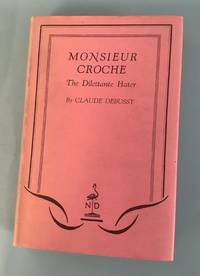
192725470London: Noel Douglas 1927. First English edition. Hardcover. Fine in a fine example of the scarce dust jacket. 8vo. With a frontispiece portrait of Debussy. Anonymously translated from the French. Selected music criticism from various periodicals that appear here for the first time in book form. Another largely unknown string in the composer's bow. <br /><br /> Noel Douglas hardcover
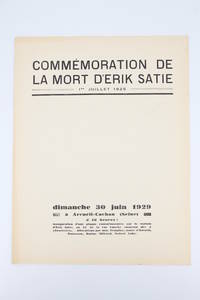
192979902Imprimerie de la presse française | Paris s. d. [1929] | 27 x 35 cm | un double feuillet et une feuille volante
192979902Paris: Imprimerie de la presse française 1929. Fine. Imprimerie de la presse française Paris s. d. 1929 27 x 35 cm un double feuillet et une feuille volante First edition of this program for the concert commemorating the death of Erik Satie held in Arcueil-Cachan on 30 June 1929. Our copy retains the photographic reproduction of the bust of Erik Satie modeled by Robert Caby in September 1925. A handsome copy despite a few minute marginal spots. Imprimerie de la presse française unknown
4314Soucis financiers : ...Permettez moi de vous rappeler que vous m'avez promis d'obtenir de M. Lacolle (?) qu'il ne fasse prsenter la seconde traite que le 3 avril prochain...Cette lettre est adresse Lon Bertault homme daffaires auquel Debussy eut souvent recours partir de 1909 pour effectuer de difficiles emprunts. partir de 1912 les difficults financires de Debussy saggravent et il se voit plusieurs fois contraint de demander une avance son diteur Jacques Durand avant demprunter une socit de capitalisation appele LAvenir du proltariat contre une part de ses droits dauteurs.
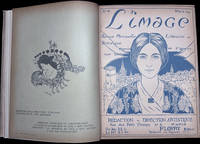
1896N - 2026 - 31<p>French Literary and Artistic Magazine 12 Issues bounded. Paris Floury 1896-1897. Important magazine founded by Wood Engravers Corporation of France published under the direction of Roger Marx and Jules Rais and under the artistic direction of Tony Beltrand Auguste Lepere and Leon Ruffe. It includes hundreds woodcut compositions and the 12 pictorial covers especially designed from the artists who contributed to the publication each cover presents an original composition the first is by Alfons Mucha and the N. 11 was designed by Toulouse-Lautrec. The magazine contains illustrations from important artists as: Alfons Mucha Lepere Vogel De Feure Denis Degas Van Dongen Rodin Toulouse-Lautrec and others. Also in the magazines literary contributions from prestigious authors as Geffroy Debussy Pierre Louys Mellerio Rosny Remy de Gourmont and others.</p> Floury
0486269744New. Brand new and still unused unknown
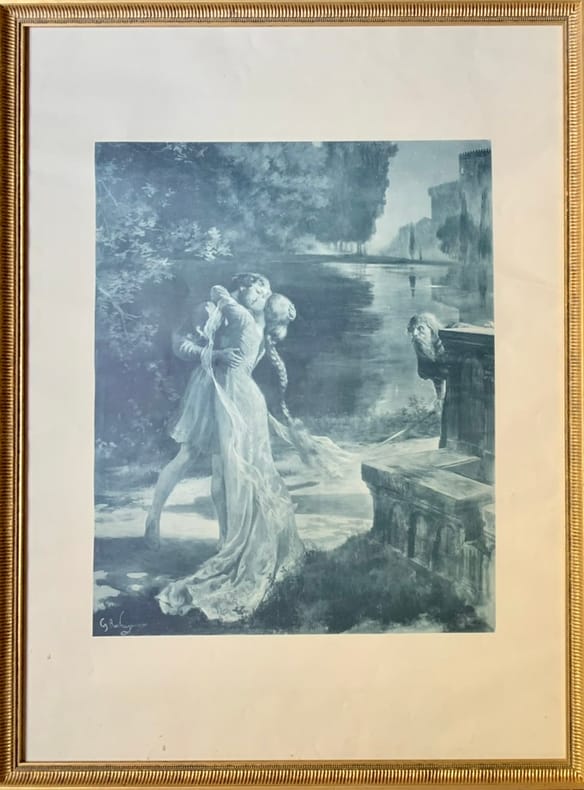
1368Affiche originale de la création au Théâtre de l’Opéra-Comique, le 30 avril 1902, sous la direction d’André Messager. Imprimée en noir sur papier blanc cassé par la Phototypie Berthaud. Tirage avant la lettre, sous encadrement contemporain (62/86 cm).
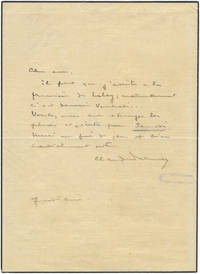
268361 page. Octavo ca. 168 x 122 mm. Dated Thursday evening. On mourning stationery. In French with translation. <br/><br/>"I have to attend Louis Laloy's premiere; naturally that is tomorrow on Friday. Would you change the enclosed tickets for Saturday Thanks again."<br/><br/>Slightly worn and browned; creased at folds and upper outer corner of final blank folio; small rust stain from paper clip to inner margin of final folio not affecting text. "One of the most important musicians of his time Debussy's harmonic innovations had a profound influence on generations of composers. He made a decisive move away from Wagnerism in his only complete opera Pelléas et Mélisande and in his works for piano and for orchestra he created new genres and revealed a range of timbre and colour which indicated a highly original musical aesthetic." François Lesure and Roy Howat in Grove Music Online.<br/><br/>"Laloy 1874-1944 was a noted defender of contemporary French music and was a close friend of and mediator between Ravel and Debussy with whom he collaborated on some unrealized stage works; he was also the author of the first major work and the first in the French language on Debussy." John Trevitt in Grove Music Online. unknown books
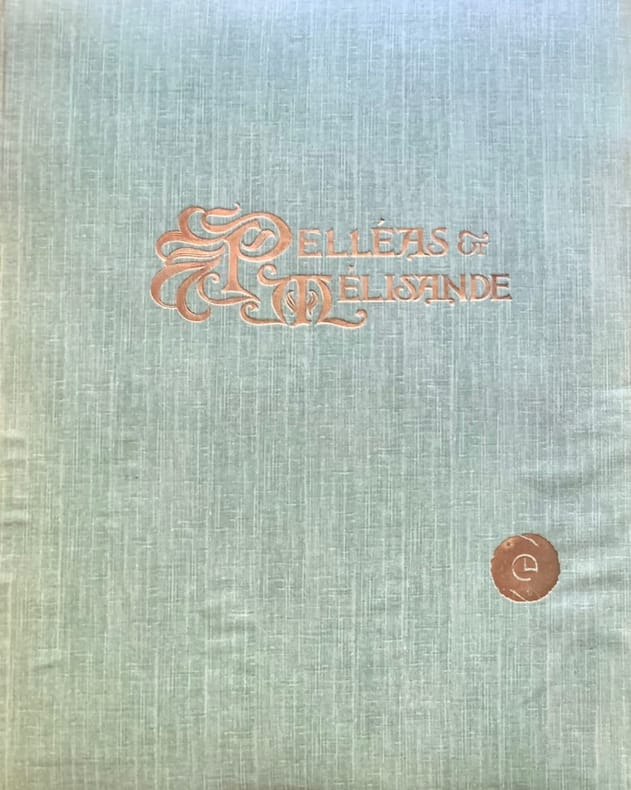
190613651906 Paris, Durand et Fils, copyright Fromont, 1906. Reliure in-folio en toile verte de l’éditeur, titre calligraphié sur le 1er plat et sur le dos, 284 pp. Rare édition originale, avec page de titre de seconde émission (Durand, après avoir racheté l'ouvrage à Fromont, a interchangé le double feuillet de titre). Un des 50 ex. numérotés sur Hollande. Corrections fautives conformes : le prénom du chef de chant a été modifié sur la page de distribution (Louis Landry au lieu d’Edmond) ; à la 7ème mesure, la cinquième note du chant de Mélisande (Elle va pleurer aussi) est bien un si bécarre et non un do (p. 272). Ex. offert en 1928 à Jean Touche, violoncelliste fondateur des Concerts Touche, par sa sœur Marthe et son frère Firmin, qui ont apposé leur signature sur l’ex-dono. Avec un beau portrait anonyme du violoncelliste au crayon joint. Très bel exemplaire.