730 résultats
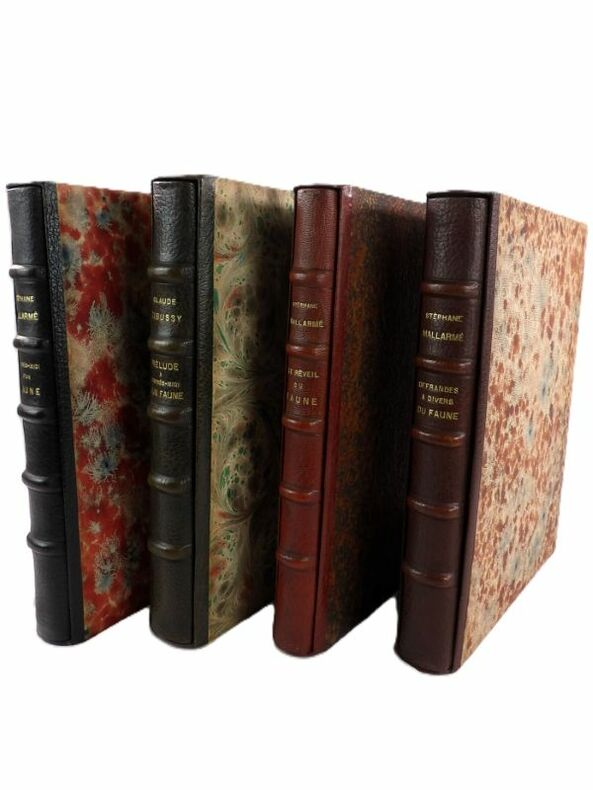
19432694Paris, Rombaldi, 1943-1944. 4 Volumes, complet. In-folio - 33 x 26,5 cm. Reliures signées Legendre en plein maroquin (noir, sapin, bordeaux et brun), dos ornés de 5 nerfs, roulette dorée sur les coiffes, filet doré sur les coupes, quintuple filet doré en encadrement des contreplats, vélins incrustés au centre des contreplats, étui et chemise assortis. Edition en partie originale établie par Henry Charpentier d'après les manuscrits de Mallarmé, dont il était l'exécuteur testamentaire.Tirage limité à 140 exemplaires pour Le Réveil du Faune, celui-ci non numéroté, et à 220 exemplaires pour Gloses et Offrandes à divers du Faune, celui-ci exemplaire B, imprimé spécialement pour René Gas, qui dirigea cette publication. L'Après-Midi d'un faune est enrichi de 2 dessins originaux, le premier signé Demeurisse, le second non signé, et Prélude à l'Après-midi d'un Faune est également enrichi de 3 dessins originaux, tous signés et datés de 1943 par Demeurisse. Cet exemplaire exceptionnel comprend : 6 suites de 21 planches chacune pour L'Après-midi d'un Faune, 7 suites de 16 planches pour Prélude à l'Après-midi d'un faune, 3 suites de 21 planches pour Le Réveil du Faune et enfin, 6 suites de 19 planches pour Gloses et Offrandes à divers du Faune. Ce qui fait un total de 24 suites et de 415 planches.Pour parachever l'ensemble, le dernier volume, Gloses et Offrandes à divers du Faune contient une affiche d'annonce de parution des éditions Rombaldi in fine, ainsi qu'une lettre autographe signée d'Henry Charpentier à René Gas, lui indiquant qu'il pourra conserver cet autographe et qu'il lui confie l' "épreuve du Mallarmé", ce qui explique cet exemplaire hors normes.
3741Debussy sadresse au Prsident du Conseil LOUIS BARTHOU afin quil intercde auprs du ministre de la Guerre Alexandre Millerand en faveur de son frre ALFRED [n en 1870, Alfred Debussy est le 4me enfant (sur 5) de la famille Debussy, Claude tant lan] & Voulez-vous tre assez bon pour me prter votre prcieux appui, encore une fois. Il sagit de mon frre Alfred Debussy, g de 45 ans, de la classe 90 qui vient de passer les examens dinterprte anglais. Il est port sur ltat de propositions soumis au Ministre de la Guerre, mais une recommandation touchant Mr Millerand laiderait puissamment, car, si cela est possible il voudrait tre attach ltat-major anglais et non croupir dans un bureau& Il ajoute : & Personne mieux que vous, (& ), ne peut faire cela. En mexcusant de tenir devant vous le rle ingrat de la statue de Qumandeur [jeu de mots sur la statue du Commandeur de Dom Juan], voulez-vous croire ma reconnaissance et ma respectueuse sympathie& Louis Barthou tait un homme politique de centre droit et crivain. Il fut prsident du conseil sous la prsidence de Raymond Poincar de mars 1913 dcembre 1913. lu lAcadmie franaise en 1919, il tait surnomm le ministre des potes . Ctait aussi un bibliophile, un amateur dart et un mlomane. Grand admirateur de Debussy, lorsquil fut interrog propos de ce dernier en 1932, il affirma qu Il y a dans son art une nigme et un ensorcellement. LOlympe a plus dune demeure. Aprs Bach, Mozart, Beethoven et Wagner, Claude Debussy sest fait la sienne, o il sest install par une immortalit dont la France, quil honore, saura garder le culte et entretenir lclat. . Debussy fit recours aux services de Barthou plusieurs fois. En 1908, alors que Barthou tait ministre des Travaux Publics, Debussy lui demanda la conservation du poste de son frre Alfred en tant que sous-inspecteur la Cie du chemin de fer de lOuest. En octobre 1913 il lui envoya son passeport pour que Barthou puisse le faire signer par lambassadeur russe Alexandre Izvolski afin dtre invulnrable lors de sa tourne Saint-Ptersbourg.
1916022588Paris: Devambez. Rare First Printing of Claude Debussys Elegie for Piano L. 146 138 Wrappers. First and Limited Edition: No. 11 of only 25 copies on Imperial Japanese Paper and signed by Mary Mellor. Large 4to. 211 pp. printed text and facsimiles of manuscripts. This book was composed to honor the contributions of women during World War I. Debussy was one of 92 men and 30 women who participated in the project offering a range of artistic contributions from France England the United States Canada and Russia. Among contributors in addition to Debussy were Auguste Rodin Rudyard Kipling Robert Baden-Powell Anatole France Lord Kitchner Pierre Loti Marcel Prevost Jerome K. Jerome and Gertrude Atherton. The book is dedicated to Queen Alexandra of Denmark Queen of the United Kingdom and the British Dominions and Empress of India. The portrait of Queen Alexandra is bordered with hand-colored stenciled roses. Debussy wrote his Elegie in December 1915 when he was still experiencing the devastating events of the First World War. Shortly before he had undergone a cancer operation from which he never quite recovered. The Elegie was the only piano piece he wrote during that year and it was to be his last piano work. Due to his deteriorating health he wrote very little afterwards. The spine has been superbly restored. Edge roughness on a blank that is not Japanese Imperial Paper mostly unopened. Very Good. Rare collectable. . Very Good. Soft cover. 1st Edition. 1916. Devambez paperback
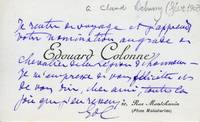
13609Used; Like New/Used; Like New. A fascinating collection of 14 autograph letters and cards and 2 telegrams addressed to the important French composer dated between 1903 and 1917 from musicians and other artistic figures of the era. The letters from correspondents including conductors critics dancers composers and visual artists mention the very positive reception of Debussy's works during the last years of his life including his 1903 nomination as a Chevalier of the Légion d'Honneur the Chicago premiere of his opera Pelléas et Melisande and Toscanini's 1911 performance of La Mer; other works discussed include his ballet Jeux the cantata L'enfant prodigue and his work for piano L'isle joyeuse. Letters range from 4 x 2.5 inches to 5.25 x 8.25 inches and are overall in very good to fine condition with some light toning and age wear. All letters in French.Contents:Three letters congratulate Debussy on his nomination to the Légion d'honneur in 1903: one autograph note on the visiting card of conductor Edouard Colonne Paris February 1903 1 p.; one ALS  from the soprano Lucienne Bréval n.p. February 4 1903 4 pp. which also mentions her desire to sing one of Debussy's mélodies with orchestra; and one ALS from the architect Charles Plumet Paris n.d. 1 p.Two telegrams dated June 11 1910 send congratulations to Debussy on the successful performance of his Pelléas et Mélisande in Chicago from the conductor Cleofonte Campanini and the director general of the Chicago Grand Opera Company Andreas Dippel: "Four thousand people were impressed and touched. Our congratulations."Two letters send congratulations to Debussy on the performance of his La Mer under Toscanini in Turin in 1911. On a photograph postcard Turin September 30 1911 the composer Leone Sinigaglia writes that "It would have been a joy for you a lasting memory. Toscanini put his whole soul into it all his intelligence and all his will. His execution of your admirable masterpiece was prodigious. The public wary at the beginning as you may imagine! you know this well was won over -- at the end it was a great success which was repeated yesterday evening." The critic Giuseppe Depanis Turin October 12 1911 2 pp. writes that "not only was the second presentation Toscanini of La Mer received with the same good favor as the first but Vincent D'Indy also performed Nuages andFêtes in his concert on the 10th of the month with great success."An autograph letter from Nadejda Rimsky-Korsakov St Petersburg August 20 1911 1 p. with envelope thanks Debussy for his telegram and mentions in reference to the Ballets Russes' adaptation of her husband's famous work Scheherazade that "the appearance before the artistic Parisian public of my husband's works changed and transformed into ballet caused me great pain last summer and this time."  An autograph letter from the caricaturist Beppe Fabiano Paris May 29 1912 2 pp. confesses to Debussy that "I have just exhibited your portrait at the Salon des Humanistes -- in a series of celebrated composers -- without asking your permission beforehand. Fearing I may have overstepped I would be delighted if you would forgive me."<br style="">A short autograph letter from the sculptor Denys Puech Paris June 4 1912 1 p. mentions L'après-midi d'un faune. A short autograph letter from the sculptor Albert Bartholomé Budapest May 25 1913 1 p. informs Debussy that his cantata L'enfant prodigue "was admirably executed by truly passionate performers. I was able to obtain the poster from the theater and will be pleased to send it to you." The Russian ballerina and soloist with the Ballets Russes Ludmilla Chollar writes to Debussy about her role in Jeux in which she starred with Nijinsky and Tamara Karsavina London June 26 1913 2 pp. She thanks the composer for the "the most beautiful memories which I could bring from Paris: the very kind words with which you dedicated Jeux your photography and some measures of my role . If I take from the creation of Jeux one exquisite and ineffable memory it is to you that I owe it to your work and to the happy chance that I met you away from the mirage of celebrities an artist as great as you whose work is dear to me above all others."<br style="">An autograph letter from the composer Ildebrando Pizzetti Florence September 17 1913 1 p. with envelope asks Debussy to comment on his new composition: "You would do me a great honor Maître if you would send me a few words on the subject but of course with no obligation on your part to give me compliments if my musical work does not interest you!"An interesting wartime letter from the Italian conductor Bernardino Molinari Rome September 18 1915 4 pp. calls on Debussy's patriotic feelings to ask him to collaborate with his orchestra: "I still remember what you said to me yourself here in Rome about "L'isle joyeuse" when you gave me hope that you might make a transcription for orchestra. If you have the desire and the time I would be very flattered to have the score to perform it during the next concert season at the Augusteo. You understand that in this season we very much wish to form a program in which our allies in France figure prominently. In a political moment like this one where the souls of all the Allied nations are unified and united into one ideal all of us at the Academie ask you for your valid support in the coming season." He goes on to apologize that because of the war he will be unable to offer the same fee as the previous time and reports that performances of Debussy's works around Italy have been very successful: "This shows with evidence that your musical language speaks to great and small touching the heartstrings of all." An autograph letter from the composer and musicologist Jean D'Udine Paris April 27 1917 3 pp. invites Debussy to one of Udine's salons despite Debussy's known disdain for his school of dance: "I know you have no sympathy for rhythmic gymnastics which seem to you you have written 'a very disagreeable domestication of rhythm.' I believe that you are wrong and that they are rather an emancipation of rhythm when taught well. Without any hostility on your part towards the method which I teach with conviction I would like to ask you to honor with your presence one of the evenings which I am hosting at present. You would there see danced with extreme love and respect by one of my students a remarkable artist your beautiful dances for chromatic harp . I did not want to give these evenings April 28 and May 3 and 5 without informing you pour memoire and without letting you know that it is sometimes where one feels the least loved that one is actually the most seriously and profoundly loved."The violinist and composer Francesco Guarnieri writes N.p. October 17 1917 2 pp. on black-bordered stationery to ask Debussy for a signed copy of his violin sonata which he will perform in Italy and also recalls a much earlier performance of Debussy's famous quartet at which Debussy gave him a copy of the score. unknown books
190215457Paris: E. Fromont 1902. First Edition First Issue. Used; Like New/Used; Like New. 283 pp. PN E. 1416 F. Signed and inscribed by the composer on the page opposite the title to the French restauranteur Xavier Marcel Boulestin and dated June 1902. Pencil annotations to the front. Page 1 stamped in violet ink "Hommage de l'Editeur." Handling wear scattered soiling toning and foxing mostly to the printed wrappers the score nicely rebound in a pale green cloth with gilt leather title plate to spine. 4to. <br style="">Pelléas et Mélisande is an opera in five acts with libretto adapted from Maurice Maeterlinck's Symbolist play. First performed at the Opéra-Comique in Paris on 30 April 1902 with Jean Périer as Pelléas and Mary Garden as Mélisande in a performance conducted by André Messager it is the only opera Debussy ever completed and considered a landmark in 20th-century music. <br>Before becoming a successful restauranteur in England the Restaurant Boulestin opened in 1927 was known as the most expensive in London the young Xavier Marcel Boulestin worked as secretary and ghostwriter to the author "Willy" Henry Gauthier-Villars. Gauthier-Villars and his wife the novelist Colette were associated with Debussy with Colette leaving some evocative descriptions of the composer.<br style=""> E. Fromont hardcover books