89 résultats
1881212191881. BKW 18/3738. - Berlin August Hirschwald 1881 4° pp.529-560 feine Broschur. The operation of nerve grafting transplantation was performed by Philipeaux and Velpian in 1870 and independently by Gluck in 1880. - Walker No.933 unknown
186611193Paris Bureau de la Revue des Deux Mondes 1866 -in-8 demi-Maroquin un fort volume, reliure demi-maroquin cerise grand in-octavo à coins (binding half morocco with corners), reliure d'époque signée "PETIT" successeur de "SIMIER", dos 4 nerfs (spine with raised bands) décoré "or" et à froid (gilt and blind stamping decoration), titre et tomaison frappés "or" (gilt title and volume numbering) dans un encadrement d'un double filet fin "or", triple filets fins "or" en place des nerfs avec un filet à froid de part et d'autre des nerfs, plats décorés or (gilt decoration on the cover) avec 3 filets fins "or" aux mors et aux coins (joints and corners with three gilt line), papier marbré aux plats (cover with marbled paper), toutes tranches lisses (all edges smoothes) peignées (painting edges) rouge et bleu, sans illustrations (no illustration), 1056 pages, 1866 Paris Bureau de la Revue des Deux Mondes Editeur,
1859231958Ed Bote & G. Bock Berlin 1859. Hardcover Leinen Großformat Die Jahresangabe ist ungefähr. Zustand: keine Beschädigungen eine Namenseintragung. Rücken Ecken Kanten gut. Innen braunfleckig. Ed Bote & G. Bock, Berlin, hardcover
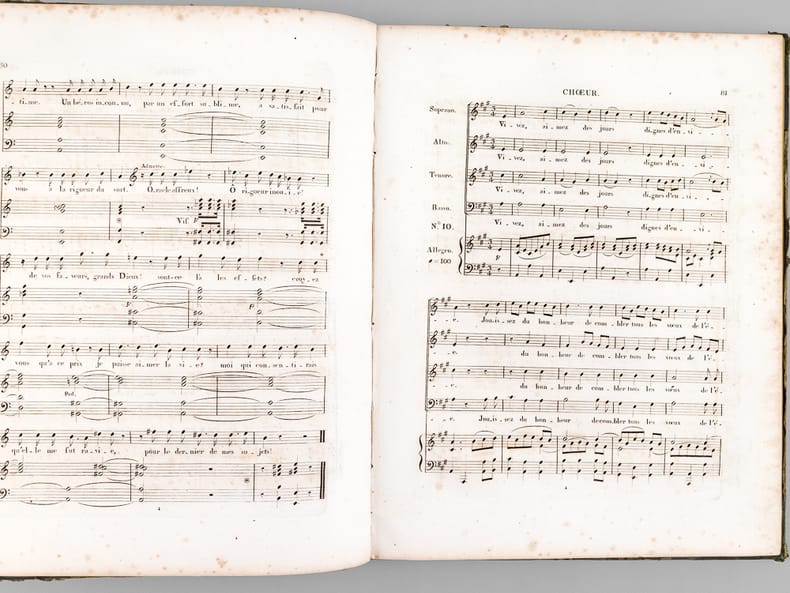
181525656Bonn: N Simrock PN 1125. 1815. Oblong folio. Contemporary marbled boards. 1f. recto title verso blank 3 cast list and table of contents 4-159 i blank pp. Engraved.<br/><br/>Disbound. Boards quite worn; spine lacking. Slightly worn soiled foxed and stained; some corners slightly turned; minor underlining and annotations in red pencil to cast list; early repairs to inner margins of title and table of contents not affecting text; small binder's holes to inner margins. Later edition of the French version. Hopkinson 44C a. <br/><br/>The French version of Alceste to a libretto by Marie François Louis Gand Leblanc Roullet was first performed at the Académie Royale de Musique in Paris on April 23 1776. <br/><br/>"Gluck's revision of Alceste for performance in Paris in 1776 amounts almost to a recomposition. His alterations were far more extensive than those he had made in his Paris adaptation of Orfeo . The French Alceste had a new text by Roullet Gluck's librettist for Iphigénie en Aulide based on Calzabigi's libretto; but alterations to the plot and the order of events led to major differences between the two. The principals at the première of the French version included Rosalie Levasseur Alcestis Joseph Legros Admetus Henri Larrivée Hercules Moreau Apollo and Nicolas Gélin High Priest. At the first Paris performances of Alceste the Act 3 denouement was substantially different from the version familiar today and closer to the Italian original. Gluck and Roullet after much criticism altered the act to incorporate a part for Hercules who has no place in the Italian original. Just as Gluck was arranging more music to enlarge the final divertissement again to please Parisian taste he heard of the death of his adopted daughter Marianne in Vienna; he left Paris and assigned the completion of the divertissement to Gossec. This revised version published in Paris in 1776 is the one that has nearly always been performed subsequently." Jeremy Hayes in Grove Music Online. N Simrock [PN 1125.] unknown books
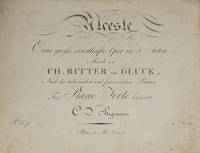
181525656Bonn: N. Simrock PN 1125. 1815. Oblong folio. Contemporary marbled boards. 1f. recto title verso blank 3 cast list and table of contents 4-159 i blank pp. Engraved.<br /> <br /> Disbound. Boards quite worn; spine lacking. Slightly worn soiled foxed and stained; some corners slightly turned; minor underlining and annotations in red pencil to cast list; early repairs to inner margins of title and table of contents not affecting text; small binder's holes to inner margins. Later edition of the French version. Hopkinson 44C a. <br /> <br /> The French version of Alceste to a libretto by Marie François Louis Gand Leblanc Roullet was first performed at the Académie Royale de Musique in Paris on 23 April 1776. <br /> <br /> "Gluck's revision of Alceste for performance in Paris in 1776 amounts almost to a recomposition. His alterations were far more extensive than those he had made in his Paris adaptation of Orfeo . The French Alceste had a new text by Roullet Gluck's librettist for Iphigénie en Aulide based on Calzabigi's libretto; but alterations to the plot and the order of events led to major differences between the two. The principals at the première of the French version included Rosalie Levasseur Alcestis Joseph Legros Admetus Henri Larrivée Hercules Moreau Apollo and Nicolas Gélin High Priest. At the first Paris performances of Alceste the Act 3 denouement was substantially different from the version familiar today and closer to the Italian original. Gluck and Roullet after much criticism altered the act to incorporate a part for Hercules who has no place in the Italian original. Just as Gluck was arranging more music to enlarge the final divertissement again to please Parisian taste he heard of the death of his adopted daughter Marianne in Vienna; he left Paris and assigned the completion of the divertissement to Gossec. This revised version published in Paris in 1776 is the one that has nearly always been performed subsequently." Jeremy Hayes in Grove Music Online. N. Simrock [PN 1125.] unknown
1893694241893. Verh. Berl. med. Ges. 24 1893. - Berlin Gedruckt bei L. Schumacher 1894 8° XLII 250; 389 pp.; mit Abbildungen Halbleinenband d.Zt.; St. verso Tit. Erste Auflage! Verhandlungen der Berliner medicinischen Gesellschaft aus dem Gesellschaftsjahr 1983. Separat-Abdruck aus der Berliner klinischen Wochenschrift. Hrsg. von dem Vorstande der Gesellschaft. Themistocles Gluck 1853-1942 Chirurg. unknown
1899346621899. Verh. Dtsch. Ges. Chir. 28. - Berlin Verlag von August Hirschwald 1899 8° LVI 2 184 2; 815 1 pp. Holzschnitte Autotypien 11 Tafeln Halbeinenband. Erstdruck! unknown
1890288451890. BKW 27/19. - Berlin August Hirschwald 12. Mai 1890 4° pp.421-440 feine Broschur. Erstdruck! Ausführlicher Vortrag gehalten in der Berliner medicinischen Gesellschaft am 30.April 1890. It is of historical interest to note that atempts at fixatng a prosthesis date back to 1890 when Gluck in a lecture to the German Medical Society discussed the use of bone glue or cement to fasten ivory devices." -cf. Nas Ser Eftekhar Principles of total hip arthroplasty p.4 unknown
1894346841894. BKW 31/ 7. - Berlin August Hirschwald Montag den 12. Februar 1894 4° pp.153-184 feine Broschur. Erstdruck! unknown
1897346201897. BKW 34/43-45. - Berlin August Hirschwald 1897 4° pp.929-996 feine Broschur. unknown
1891346361891. Verh. Berl. med. Ges. 21 1890. - Hrsg. von dem Vorstande der Gesellschaft. - Berlin Gedruckt bei L. Schumacher 1891 8° XLV 3 192; 2 328 pp. orig. Broschur.; unaufgeschnittenes Expl. Erste Auflage "Separat-Abdruck aus der Berliner klinischen Wochenschrift" Ausführlicher Vorträge gehalten in der Berliner medicinischen Gesellschaft. "Themistokles Gluck 1853-1942 studierte Medizin in Leipzig und Berlin wo Rudolf Virchow und Bernard von Langenbeck seine Lehrer wurden. Schon als Student arbeitete er unter Langenbecks Leitung an Problemen der Nervennaht und der Nervenregeneration. Seine erste Arbeit auf diesem Gebiet wurde mit dem '1.Staatspreis der Berliner Universität' ausgezeichnet. Von 1878 bis 1884 war er Assistent bei Langenbeck und von Bergmann 1836-1907. Als letzter Schüler Langenbecks habilitierte er sich 1882. 1890 wurde er chirurgischer Chefarzt an das Kaiser und Kaiserin Friedrich-Krankenhaus berufen. Gluck wurde nicht nur durch seine Arbeiten zur Nervenregeneration bekannt sondern ebenso durch seine frühen Versuche zur Implantationschirurgie und durch richtungsweisende neue Operationsmethoden in der plastischen Chirurgie. - cf.H.P.Schmiedebach R.Winau Rudolf Häring Erste Operationen Berliner Chirurgen 1817-1931 p.195 It is of historical interest to note that atempts at fixatng a prosthesis date back to 1890 when Gluck in a lecture to the German Medical Society discussed the use of bone glue or cement to fasten ivory devices." -cf. Nas Ser Eftekhar Principles of total hip arthroplasty p.4 unknown
1883345891883. Arch. klin. Chir. 28. - Berlin Verlag von August Hirschwald 1883 8° VI 931 pp. Holzschnitte 10 lith. Taf. Halbledereinband der Zeit. unknown
1883345901883. Arch. klin. Chir. 28. - Berlin Verlag von August Hirschwald 1883 8° VI 931 pp. Holzschnitte 10 lith. Taf. Halbledereinband der Zeit. unknown
1883345881883. Arch. klin. Chir. 28. - Berlin Verlag von August Hirschwald 1883 8° VI 931 pp. Holzschnitte 10 lith. Taf. Halbledereinband der Zeit. Erstdruck! unknown
1854158337Leipzig, Fleischer, 1854. M. 1 gef. faks. Taf. XII, 508 S. Neuer Hlwdbd. m. goldgepr. Rtit. Stellenw. leicht stockfl.
1882345951882. Arch. klin. Chir. 26. - Berlin Verlag von August Hirschberg 1882 8° VI 1011 pp. Holzschnitte 16 lith. Taf. Portrait von B.v.Langenbeck Pappband der Zeit. Frist Edition! "In 1881 Foulis reported on 27 recorded cases of total laryngectomy. Half of these patients died of pneumonia and other infections within the first week after surgery. Another 25% died of tumor recurrence within ten months. In the same year Gluck recommended that in laryngectomized patients the bottom of the pharynx be completely sewn up in order to obviate the greatest hazard of laryngectomy aspiration pneumonia. By the beginning of the 20th century Gluck reported the mortality of laryngectomy being just 8.5%. This is extremely low considering the major problems that occurred in those days with anesthesia wound infection and shock. For example in 1906 the mortality rate for radical neck dissections was still 13%." "Gluck's modification of the surgical technique of laryngectomy in 1881 - closure of the pharyngostoma in order to decrease the risk of aspiration pneumonia - ruled out internal reed mechanisms. After all the trachea was completely severed from the pharynx in these patients. Accordingly a pneumatic mechanical voice source was devised by Stork in l877 following Czermak's lead. It was based on a similar yet external metal reed connected by an external tube with the patient's tracheal cannula and the sound conveyed into the mouth by another external tube. Between 1892 and 1918 this external pneumatic mechanical voice source was further refined by Hochenegg Gluck Gottstein Tapia Onodi and Stockman. Respectively their modifications consisted of a pair of bellows for a patient that was unable to exhale with sufficient strength a reed concealed in the patient's nose or upper denture an inflatable cuff for the tracheal cannula a reed connected to the tracheal cannula by way of a side butt to make non-phonatory breathing easier and a battery-powered compressor as air supply for the reed. In the 1920s MacKenty together with two scientists of the Western Electric Company Fletcher and Lane developed an external pneumatic mechanical voice source that was soon superseded by the Western Electric No° 2 type larynx. It comprised a soft-rubber tracheal pad to strap over the tracheostoma a flexible tube a slightly curved bronze reed in a silver cylinder and a mouthpiece attachable to this reed box . It was successfully marketed from 1930 to 1959 by the Western Electric Company and the Bell Telephone Laboratories: 5500 No° 2 type larynges were sold." "The first electrolarynx was devised by Gluck in 1910 and comprised an Edison type portable phonograph connected with a telephone receiver in the patient's nose or mouth. On the cylinder of the phonograph a vowel produced by a singer had been recorded. The electric current from the phonograph was converted by the telephone receiver to sound which was propagated in the buccal cavity air. There the representation of the singer's voice was given the timbre belonging to the patient's vocal tract. For demonstration purposes Gluck not only used a recorded vowel but also a phonograph containing a Waltz." Marein van der Torn : A sound-producing voice prosthesis. ACADEMISCH PROEFSCHRIFT Utrecht 2005 See - Gluck T.: Flüstersprache und Phonationsapparate. Berliner klinische Wochenschrift 36 1899 pp.215-216. Gluck T.: Patienten mit Totalextirpation des Pharynx Larynx und Oesophagus denen eine künstliche Stimme durch einen automatisch arbeitenden Apparat geliefert wird. Berliner klinische Wochenschrift 47/1 1910 pp.33-35. Gottstein G.: Pseudo-Stimme nach Totalexstirpation des Larynx. Archiv für die klinische Chirurgie 62 1900 pp.126-46. Tapia A.: Presentacion de un laringuectomizado hablando con un sencillisimo aparato artificial. Revista Espanola de Laringologia 5 1914 pp.48-55. Onodi A.: Ergebnisse der Abteilung für Hör- Sprach- und Stimmstörungen und Tracheotomierte vom Kriegsschauplatz. Monatsschrift für Ohrenheilkunde 52 1918 p. 85. Riesz R.: Description and demonstration of an artificial larynx. Journal of the Acoustical Society of America 1 pp.273-9. unknown
1882345871882. Arch. klin. Chir. 27. - Berlin Verlag von August Hirschwald 1882 8° IV 940 pp. zahlr. Holzschnitten 9 lith. Taf. Halbleinenband der Zeit. unknown
1882345961882. Arch. klin. Chir. 26. - Berlin Verlag von August Hirschwald 1882 8° VI 1011 pp. Holzschnitte 16 lith. Taf. Portrait von B.v.Langenbeck Halbledereinband der Zeit. First Edition! "In 1881 Foulis reported on 27 recorded cases of total laryngectomy. Half of these patients died of pneumonia and other infections within the first week after surgery. Another 25% died of tumor recurrence within ten months. In the same year Gluck recommended that in laryngectomized patients the bottom of the pharynx be completely sewn up in order to obviate the greatest hazard of laryngectomy aspiration pneumonia. By the beginning of the 20th century Gluck reported the mortality of laryngectomy being just 8.5%. This is extremely low considering the major problems that occurred in those days with anesthesia wound infection and shock. For example in 1906 the mortality rate for radical neck dissections was still 13%." "Gluck's modification of the surgical technique of laryngectomy in 1881 - closure of the pharyngostoma in order to decrease the risk of aspiration pneumonia - ruled out internal reed mechanisms. After all the trachea was completely severed from the pharynx in these patients. Accordingly a pneumatic mechanical voice source was devised by Stork in l877 following Czermak's lead. It was based on a similar yet external metal reed connected by an external tube with the patient's tracheal cannula and the sound conveyed into the mouth by another external tube. Between 1892 and 1918 this external pneumatic mechanical voice source was further refined by Hochenegg Gluck Gottstein Tapia Onodi and Stockman. Respectively their modifications consisted of a pair of bellows for a patient that was unable to exhale with sufficient strength a reed concealed in the patient's nose or upper denture an inflatable cuff for the tracheal cannula a reed connected to the tracheal cannula by way of a side butt to make non-phonatory breathing easier and a battery-powered compressor as air supply for the reed. In the 1920s MacKenty together with two scientists of the Western Electric Company Fletcher and Lane developed an external pneumatic mechanical voice source that was soon superseded by the Western Electric No° 2 type larynx. It comprised a soft-rubber tracheal pad to strap over the tracheostoma a flexible tube a slightly curved bronze reed in a silver cylinder and a mouthpiece attachable to this reed box . It was successfully marketed from 1930 to 1959 by the Western Electric Company and the Bell Telephone Laboratories: 5500 No° 2 type larynges were sold." "The first electrolarynx was devised by Gluck in 1910 and comprised an Edison type portable phonograph connected with a telephone receiver in the patient's nose or mouth. On the cylinder of the phonograph a vowel produced by a singer had been recorded. The electric current from the phonograph was converted by the telephone receiver to sound which was propagated in the buccal cavity air. There the representation of the singer's voice was given the timbre belonging to the patient's vocal tract. For demonstration purposes Gluck not only used a recorded vowel but also a phonograph containing a Waltz." Marein van der Torn : A sound-producing voice prosthesis. ACADEMISCH PROEFSCHRIFT Utrecht 2005 See - Gluck T.: Flüstersprache und Phonationsapparate. Berliner klinische Wochenschrift 36 1899 pp.215-216. Gluck T.: Patienten mit Totalextirpation des Pharynx Larynx und Oesophagus denen eine künstliche Stimme durch einen automatisch arbeitenden Apparat geliefert wird. Berliner klinische Wochenschrift 47/1 1910 pp.33-35. Gottstein G.: Pseudo-Stimme nach Totalexstirpation des Larynx. Archiv für die klinische Chirurgie 62 1900 pp.126-46. Tapia A.: Presentacion de un laringuectomizado hablando con un sencillisimo aparato artificial. Revista Espanola de Laringologia 5 1914 pp.48-55. Onodi A.: Ergebnisse der Abteilung für Hör- Sprach- und Stimmstörungen und Tracheotomierte vom Kriegsschauplatz. Monatsschrift für Ohrenheilkunde 52 1918 p. 85. Riesz R.: Description and demonstration of an artificial larynx. Journal of the Acoustical Society of America 1 pp.273-9. unknown
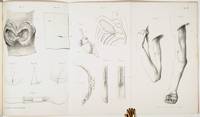
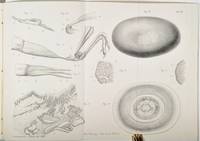
1882345841882. Arch. klin. Chir. 26. - Berlin Verlag von August Hirschwald 1882 8° VI 1011 pp. Holzschnitte 16 lith. Taf. Portrait von B.v.Langenbeck Halbledereinband der Zeit. Erstdruck! Folgende Arbeiten von Th. Gluck sind in diesem Band enthalten: Ueber Muskel- und Sehnenplastik pp.61-76 Taf. IV. Fig. 1-4. Ueber offene antiseptische Wundbehandlung in Glasapparaten und über Glasschienen pp.785-788 4 Abb. auf lith. Taf. Ueber Transplantation Regeneration und entzündliche Neubildung pp.896-915 8 Abb. auf lith. Taf. Die prophylactische Resection der Trachea pp.427-436. Ueber Exstirpation der Harnblase und Prostata pp.916-924 3 Abb. unknown
1882345851882. Arch. klin. Chir. 26. - Berlin Verlag von August Hirschwald 1882 8° VI 1011 pp. Holzschnitte 16 lith. Taf. Portrait von B.v.Langenbeck Halbledereinband der Zeit. unknown
1882345861882. Arch. klin. Chir. 26. - Berlin Verlag von August Hirschwald 1882 8° VI 1011 pp. Holzschnitte 16 lith. Taf. Portrait von B.v.Langenbeck Halbledereinband der Zeit. Erstdruck! unknown
182564538Edition Nicolo, 1 vol. in-4 reliure demi-vélin vert, Chez Madame Veuve Nicolo, à Paris, édition gravée et imprimée par Marquerie, s.d. [ circa 1825 ], 1 f. et 226 pp.
1833224827Palm`sche Verlagsbuchhandlung Erlangen 1833. Hardcover kartoniert 18331840. Zustand: keine Beschädigungen keine Eintragungen. Rücken Ecken Kanten gut. Innen fleckenfrei. Palm`sche Verlagsbuchhandlung, Erlangen, hardcover
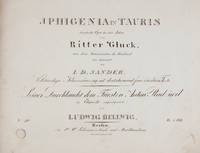
181241214Berlin: Schlesinger's Buch= und Musikhandlung Unter den Linden No. 34. PN 50 1812. Oblong folio. Contemporary dark brown mottled calf-backed marbled boards with oval label titled in manuscript to upper. 1f. recto title verso blank 3 "Personen" and incipits 4-123 i blank pp. <br /> <br /> Provenance<br /> Noted American harpsichordist Louis Bagger 1926-2024<br /> <br /> Binding worn rubbed and bumped. Very occasional minor soiling to blank lower margins; occasional minor showthrough; small stains to title with small circular publisher's handstamp to inner margin. Hopkinson 46Ca. <br /> <br /> Gluck's work is a tragedy in four acts to a libretto by Nicolas-François Guillard after Guymond de la Touche's Iphigénie en Tauride itself based on Euripides's work of the same name. <br /> <br /> "Iphigénie en Tauride was the crowning achievement of Gluck's career a result of the combination of his lifelong experience as an opera composer and a libretto which is arguably the best he ever set." Jeremy Hayes in Grove Music Online<br /> <br /> It was first performed in Paris at the Opéra on 18 May 1779 "with excellent singers; Rosalie Lavasseur sang Iphigénie Larrivée Oreste Legros Pylade and Moreau Thoas. . The opera had a great success immediately and even Grimm wrote of it - I do not know whether this is melody but perhaps it is something better. When I hear Iphigénie I forget I am at the opera; I seem to be listening to a Greek tragedy with music by Lekain and Mlle Clarion. It was the crowning point of Gluck's career. Guillard had provided an excellent libretto more classical than Goethe's poem less Christian and more ruthless; and Gluck had seized on the contrast between Scythians and Greeks upon the perfectly dramatic figures of Iphigenia and Orestes and had produced a work which both re-created a part of Greek tragedy and at the same time foretold a new world." Cooper: Gluck p. 258. Schlesinger's Buch= und Musikhandlung, Unter den Linden No. 34. [PN 50] unknown
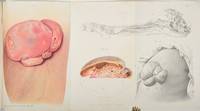
1880345821880. Arch. klin. Chir. 25. - Berlin Verlag von August Hirschwald 1880 8° IV 952 pp. Holzschnitte 14 lith. Taf. Leinenband d.Zt. Erstdruck! "Bei der Häufigkeit mit welcher Tumoren der Haut einen lappigen Charakter annehmen wie. z.B. das Fibroma molluscum einen rein polypösen Habitus zeigt ist die ungemeine selten Erscheinung reiner Fibrome der Cutis in dieser Form auffällig. Herr Geheimrath v. Langenbeck hatte die Güte mir bei Gelegenheit eines kürzlich in der Klinik operirten Falles zwei vor langen Jahren beobachtete analoge Fälle zur Publication zu übergeben." Th. Gluck unknown