2 074 résultats
202354004Paris Editions d'Art FMA 2023 Deux leporelli in-4 maroufls et contrecolls en regard, (8 feuillets pour le texte, 4 feuillets pour la suite), assembls dans une chemise en velours bleu nuit. Etui (reliure de l'diteur).Inspir de lOdysse d'Homre, rcit fondateur de la culture occidentale, le rcit-pome indit de Michal Glck enlumin des ?uvres originales de Bernard Alligand nous transporte dans une toile arachnenne immersive, lumineuse et envotante. Les ?uvres parcourent lensemble du livre. Elles nous invitent suivre la main narrative de Pnlope par lillusion du tissage faisant cho au rcit-pome de lauteur. Le choix des matires (diffrentes textures de papier et gravures), rsine, poudres dor et dargent, le tumulte des effets marins (bleu/mer), la succession de bandes (tissage), la figuration suggestive (geste de Pnlope) ou symbolique des personnages (or/Dieux), crent une intensit particulire l?uvre-livre (extrait de la prsentation de l'diteur). Edition originale, illustre par Bernard Alligand de somptueuses compositions en couleurs qui ornent presque toutes les pages du livre et qui ont ncessit prs de 9.000 interventions manuelles (hors essais), selon de multiples techniques appliques soit sur un papier imprim offset bleu et recouvert dune acrylique blanche, soit sur un papier mtallis: photographies de compositions originales, impressions numriques, colorations avec de la rsine, enduits et incrustations de poudres argent et or. La mise en pages des lments dcoratifs a t ralise par des dcoupes, des assemblages et des collages. Certaines pages ont t rehausses d'empreintes froid obtenues par l'utilisation de plaques graves en carborundum avec des apports de matire et des passages sous presse sec bande/bande. Tirage limit 31 exemplaires numrots sur papier Moulin du Gu, signs par l'auteur et l'artiste. Un des 18 premiers exemplaires, seuls comporter une suite de 7 ?uvres originales en couleurs runies sous la forme d'un leporello sign par Bernard Alligand et mont en regard du livre. Cet ouvrage est une relle russite, tant par la qualit du texte et des illustrations, que par la typographie utilise et la mise en pages. Chacune des illustrations entirement ralises la main, est unique.
R160198130NON INDIQUE. NON DATE. In-8. Broché. Bon état, Couv. convenable, Dos satisfaisant, Intérieur frais. 18 pages - Quelques photographies et illustrations en noir et blanc dans le texte. . . . Classification Dewey : 782.1-Théâtre musical, opéra
RO50038825HENRY LEMOINE. non daté. In-4. Broché. Bon état, Couv. convenable, Dos satisfaisant, Intérieur frais. 5 pages. Partition pour Piano et chant + paroles. Petites déchirures sur le dos n'altérant pas la lecture de la partition.. . . . Classification Dewey : 780.26-Partitions
RO50038827HENRY LEMOINE. non daté. In-4. Cartonnage d'éditeurs. Etat d'usage, Couv. convenable, Dos abîmé, Intérieur acceptable. 11 pages. Partition pour Piano et chant + paroles. scotch marron sur le dos et tampons sur le premier plat n'altérant pas la lecture de la partition.. . . . Classification Dewey : 780.26-Partitions
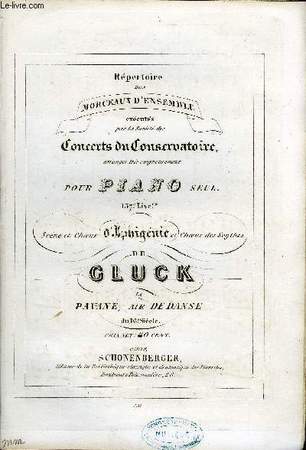
RO50013123Schonenberger. XIXème. In-8. Broché. Bon état, Couv. légèrement passée, Dos satisfaisant, Quelques rousseurs. 24 pages.. . . . Classification Dewey : 780.26-Partitions
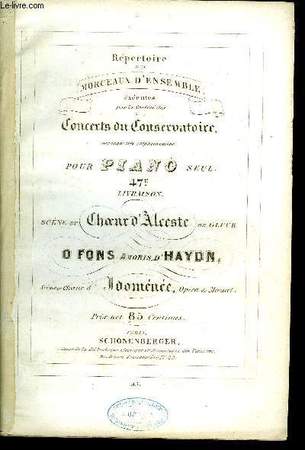
RO50013118Schonenberger. XIXème. In-8. En feuillets. Bon état, Couv. légèrement passée, Dos satisfaisant, Quelques rousseurs. 7 pages.. . . . Classification Dewey : 780.26-Partitions
RO50032022Schonenberger. XIXème. In-8. En feuillets. Bon état, Couv. légèrement passée, Dos satisfaisant, Quelques rousseurs. 16 pages. Imprimé sur du papier à la forme.. . . . Classification Dewey : 780.26-Partitions
1908RO50003662Monde Musical. 1908. In-4. En feuillets. Bon état, Couv. légèrement passée, Dos satisfaisant, Papier jauni. 2 pages.. . . . Classification Dewey : 780.26-Partitions
RO50056347HENRY LEMOINE & CIE. NON DATE. In-4. En feuillets. Etat d'usage, Couv. légèrement passée, Dos satisfaisant, Intérieur acceptable. 12 pages de partitions. Soprano ou Mezzo de demi caractère. Premier plat illustré en couleur par A. Giraldon. Tampon et annotation sur le premier plat.. . . . Classification Dewey : 780.26-Partitions
9789812836694New. unknown
ria9780323014670_inpPaperback. New. New Book; Fast Shipping from UK; Not signed; Not First Edition; Focuses on the role of the dental public health care professional in the socially conscious health field. This book is organized to follow the objectives of dental hygiene courses in community dentistry. paperback
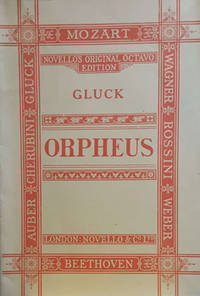
005612London: Novello's Original Octavo Edition - Novello & Co Ltd. Undated. Circa 1938. Full score. Excellent clean and tightly bound sheet music. Novello's Original Octavo Edition - Novello & Co, Ltd. paperback
9780198704577New. unknown
0340693355.Gpaperback. Good. Access codes and supplements are not guaranteed with used items. May be an ex-library book. paperback
503503on verso of letter from Mrs. Alice Strong of Arlington MA Torrington CT ca. September 1928; response to a request for "helpful quotations" for Strong's personal collection and possible publication: "'He lives who builds not boasts a noble race'! Greetings.". 8vo 1p. Signed by Authors. unknown books
193650404bdNew York: The Permanent Good Health Publishing Company 1936. Third Revised and Enlarged Edition. Octavo gray cloth hardcover 335 pp. Good with light edgewear in a Good mylar protected dust jacket with edgewear that includes light chipping and soiling. The Permanent Good Health Publishing Company, 1936. Third, Revised and Enlarged Edition. hardcover books
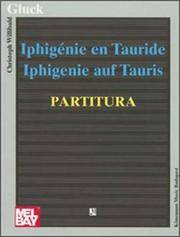
1995039569Budapest: Könemann Music 1995. viii 164p. music original stiff printed wrappers quarto format. Könemann Music unknown books
1962283186New York: St. Martin's 1962. hardcover. fine/very good. Ed. by Hedwig and E. H. Mueller von Asow. Illus. 8vo black cloth d.w. slightly chipped. New York: St. Martin's Press 1962. A fine copy in a very good dust wrapper<br/><br/> St. Martin's unknown books
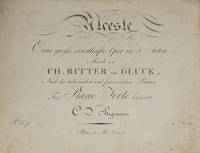
181525656Bonn: N Simrock PN 1125. 1815. Oblong folio. Contemporary marbled boards. 1f. recto title verso blank 3 cast list and table of contents 4-159 i blank pp. Engraved.<br/><br/>Disbound. Boards quite worn; spine lacking. Slightly worn soiled foxed and stained; some corners slightly turned; minor underlining and annotations in red pencil to cast list; early repairs to inner margins of title and table of contents not affecting text; small binder's holes to inner margins. Later edition of the French version. Hopkinson 44C a. <br/><br/>The French version of Alceste to a libretto by Marie François Louis Gand Leblanc Roullet was first performed at the Académie Royale de Musique in Paris on April 23 1776. <br/><br/>"Gluck's revision of Alceste for performance in Paris in 1776 amounts almost to a recomposition. His alterations were far more extensive than those he had made in his Paris adaptation of Orfeo . The French Alceste had a new text by Roullet Gluck's librettist for Iphigénie en Aulide based on Calzabigi's libretto; but alterations to the plot and the order of events led to major differences between the two. The principals at the première of the French version included Rosalie Levasseur Alcestis Joseph Legros Admetus Henri Larrivée Hercules Moreau Apollo and Nicolas Gélin High Priest. At the first Paris performances of Alceste the Act 3 denouement was substantially different from the version familiar today and closer to the Italian original. Gluck and Roullet after much criticism altered the act to incorporate a part for Hercules who has no place in the Italian original. Just as Gluck was arranging more music to enlarge the final divertissement again to please Parisian taste he heard of the death of his adopted daughter Marianne in Vienna; he left Paris and assigned the completion of the divertissement to Gossec. This revised version published in Paris in 1776 is the one that has nearly always been performed subsequently." Jeremy Hayes in Grove Music Online. N Simrock [PN 1125.] unknown books
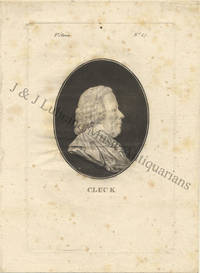
25612With "2e Année No. 25" printed to upper margin in all likelihood indicating that this portrait was issued as part of a periodical publication. <br/><br/>Slightly foxed and creased. "More successfully than any of his contemporaries Gluck translated the widespread agitation for reform of opera and theatrical dance on the part of European intellectuals into actual works for the stage first in pantomime ballets and Italian serious operas for Vienna and then in operas of various sorts for Paris. His long experience in setting Metastasian drammi per musica and his work in Vienna as music director of the Burgtheater court theatre were not without utility in these more innovative efforts." Bruce Alan Brown and Julian Rushton in Grove Music Online. unknown books
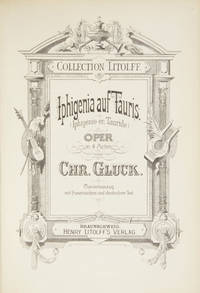
190028967Braunschweig: Henry Litolff PN Collection Litolff No. 80 1900. Large octavo. Half mid-tan mottled calf with marbled boards raised bands on spine in gilt-ruled compartments titling gilt. 1f. recto title within architectural border verso cast list and contents 3-144 pp.<br/><br/>Binding slightly worn. A tragedy in four acts to a libretto by Nicolas-François Guillard after Guymond de la Touche's Iphigénie en Tauride itself based on Euripides Iphigénie en Tauride was first performed in Paris at the Opéra on May 18 1779.<br/><br/>"Iphigénie en Tauride was the crowning achievement of Gluck's career a result of the combination of his lifelong experience as an opera composer and a libretto which is arguably the best he ever set." Jeremy Hayes in Grove Music Online. Henry Litolff [PN Collection Litolff No. 80] unknown books
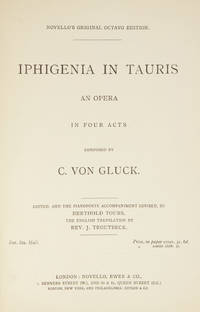
190028969London: Novello Ewer & Co 1900. Large octavo. Full dark red blindtooled cloth with titling gilt to upper and spine all edges gilt. 1f. recto title verso blank 1f. recto cast list and argument verso explanation of abbreviations 137 i blank 1f. recto index verso printer's device pp.<br/><br/>Binding slightly worn rubbed and bumped. Some signatures split or partially split. A tragedy in four acts to a libretto by Nicolas-François Guillard after Guymond de la Touche's Iphigénie en Tauride itself based on Euripides Iphigénie en Tauride was first performed in Paris at the Opéra on May 18 1779.<br/><br/>"Iphigénie en Tauride was the crowning achievement of Gluck's career a result of the combination of his lifelong experience as an opera composer and a libretto which is arguably the best he ever set." Jeremy Hayes in Grove Music Online. Novello, Ewer & Co unknown books
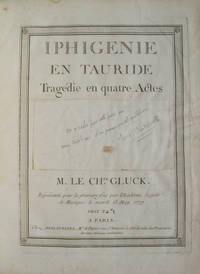
179224757Paris: Des Lauriers without PN 1792. Folio. Full contemporary green vellum with mid-tan leather label with decorative border gilt lettered "Romagnat" to upper edges colored in red. 1f. title 211 i blank pp. Engraved.<br/><br/>With blank overpaste to title with later manuscript note in pencil: "On a caché par cette . un nom . d'une personne qui a été guillotinée: Marie-Antoinette" by this overpaste a name of a guillotined person has been obscured: Marie-Antoinette. <br/><br/>Labels to verso of upper board: printed advertisement of "Husson Marchand Papier" to upper left corner; "Ex libris Georges van Parys" in the shape of a G clef to center. Bass figures entered throughout: pp. 1-31 164-70 and 174-end in pencil otherwise in ink.<br/><br/>Some moderate browning; occasional creasing and staining. Second edition first issue. Hopkinson 46A a. Wotquenne 46 pp. 215-16. Lesure p. 239. RISM G2816. <br/><br/>"Iphigénie en Tauride was given on May 18 1778 with excellent singers; Rosalie Lavasseur sang Iphigénie Larrivée Oreste Legros Pylade and Moreau Thoas . The opera had a great success immediately and even Grimm wrote of it - I do not know whether this is melody but perhaps it is something better. When I hear Iphigénie I forget I am at the opera; I seem to be listening to a Greek tragedy with music by Lekain and Mlle Clarion. It was the crowning point of Gluck's career. Guillard had provided an excellent libretto more classical than Goethe's poem less Christian and more ruthless; and Gluck had seized on the contrast between Scythians and Greeks upon the perfectly dramatic figures of Iphigenia and Orestes and had produced a work which both re-created a part of Greek tragedy and at the same time foretold a new world." Cooper: Gluck p. 258. <br/><br/>While Marie-Antoinette is not actually mentioned on the title she was the queen to whom the work is dedicated. Hopkinson describes a later issue with a new title without the dedication 46 A c.<br/><br/>Georges van Parys 1902-1971 was a French composer of operetta and film music. Des Lauriers [without PN] unknown books
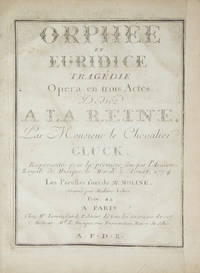
177429643Paris: Lemarchand 1774. Folio. 19th century quarter dark brown leather-backed marbled boards spine in decorative compartments gilt titling gilt. 1f. recto title verso publisher's catalogue 1f. recto dedication verso argument 217 pp. <br/><br/>With an inscription signed by the Canadian conductor Wilfrid Pelletier 1896-1982 to Italian conductor Tullio Serafin 1878-1968 dated New York 1928 to front flyleaf.<br/><br/>Bass figurings added in manuscript to pp. 10-12 Act I scene 1; final page of music signed by the publisher Lemarchand. <br/><br/>Binding worn; edges rubbed; spine split at joints and hinges; chipped at head and tail. Slightly worn and browned; title soiled with outer edge reinforced with paper tape; some minor staining; several repairs to inner margins; occasional small holes. First Edition variant issue. Hopkinson 41Af. Wotquenne 41. Lesure p. 240. RISM G2852 not distinguishing among issues. <br/><br/>"The classical orientation of Calzabigi evident in Orfeo ed Euridice from the moment the curtain rose on the almost archaeologically recreated ancient funerary ritual e.g. the threefold calling of the name of the deceased coloured the entirety of his collaboration with Gluck. Despite the ambiguous attributions of the prefaces signed by the composer it is clear that Gluck largely shared his librettist's classical enthusiasms. It is revealing that Gluck sought out subject matter from Greek tragedy independently of Calzabigi after the latter's departure from Vienna - most probably with his inner conviction mixing with a desire to exploit the goût grec then prevailing in France. Calzabigi's poetry was almost completely devoid of metaphors and similes and placed a mere three characters in a fluid context of dances and choruses or both simultaneously. The action was reduced to essentials: a demonstration of the persuasive powers of music and a cautionary tale on the dangers of curiosity with Orpheus bewailing the loss of his wife already as the curtain rose. Gluck's approach as composer was no less radical particularly in his near-complete elimination of coloratura and of opening ritornellos in the solo numbers. Above all the opera was remarkable in its emphasis on continuity which was achieved chiefly through the enchaining of harmonically open-ended sections of music and through the complete avoidance of recitativo semplice in favour of orchestrally accompanied recitatives so as to avoid sharp contrasts of texture with the set pieces. This continuity and the nearly syllabic vocal writing were calculated to prevent applause and thus also to promote the audience's absorption in the spectacle." Bruce Alan Brown and Julian Rushton in Grove Music Online. Lemarchand unknown books
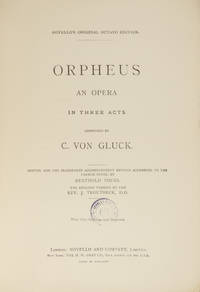
189128576London: Novello and Company PN 8146 1891. Large octavo. Original publisher's dark ivory wrappers printed in dark orange. 1f. recto title verso blank 1f. recto argument verso blank 1f. index 135 i printer's' device 1f. publisher's catalogue pp.<br/><br/>Wrappers somewhat worn and torn; portions of spine lacking at head and tail. Minor wear to outer margins of first six leaves. First performed in Vienna at the Burgtheater on October 5 1762 in Italian to a libretto by Ranieri de' Calzabigi and in Paris at the Opéra on August 2 1774 in French to a libretto by Pierre Louis Moline after Calzabigi.<br/><br/>"Orfeo ed Euridice was the first of Gluck's three so-called reform operas written with Ranieri de' Calzabigi the other two were Alceste and Paride ed Elena in which a 'noble simplicity' in the action and the music was intended to replace the complicated plots and florid musical style of opera seria." Jeremy Hayes in Grove Music Online. Novello and Company [PN 8146] unknown books