GLUCK, Christoph Willibald 1714-1787Biblio.com
89 résultats
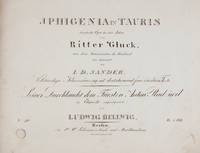
181241214Berlin: Schlesinger's Buch= und Musikhandlung Unter den Linden No. 34. PN 50 1812. Oblong folio. Contemporary dark brown mottled calf-backed marbled boards with oval label titled in manuscript to upper. 1f. recto title verso blank 3 "Personen" and incipits 4-123 i blank pp. <br /> <br /> Provenance<br /> Noted American harpsichordist Louis Bagger 1926-2024<br /> <br /> Binding worn rubbed and bumped. Very occasional minor soiling to blank lower margins; occasional minor showthrough; small stains to title with small circular publisher's handstamp to inner margin. Hopkinson 46Ca. <br /> <br /> Gluck's work is a tragedy in four acts to a libretto by Nicolas-François Guillard after Guymond de la Touche's Iphigénie en Tauride itself based on Euripides's work of the same name. <br /> <br /> "Iphigénie en Tauride was the crowning achievement of Gluck's career a result of the combination of his lifelong experience as an opera composer and a libretto which is arguably the best he ever set." Jeremy Hayes in Grove Music Online<br /> <br /> It was first performed in Paris at the Opéra on 18 May 1779 "with excellent singers; Rosalie Lavasseur sang Iphigénie Larrivée Oreste Legros Pylade and Moreau Thoas. . The opera had a great success immediately and even Grimm wrote of it - I do not know whether this is melody but perhaps it is something better. When I hear Iphigénie I forget I am at the opera; I seem to be listening to a Greek tragedy with music by Lekain and Mlle Clarion. It was the crowning point of Gluck's career. Guillard had provided an excellent libretto more classical than Goethe's poem less Christian and more ruthless; and Gluck had seized on the contrast between Scythians and Greeks upon the perfectly dramatic figures of Iphigenia and Orestes and had produced a work which both re-created a part of Greek tragedy and at the same time foretold a new world." Cooper: Gluck p. 258. Schlesinger's Buch= und Musikhandlung, Unter den Linden No. 34. [PN 50] unknown
1899RO50023220"Imprimerie des Annales. 17 décembre 1899. In-4. En feuillets. Bon état, Couv. convenable, Dos satisfaisant, Quelques rousseurs. Non paginé. 4 pages environ. Gravures noires et blanches représentant ""Lady Smith"" par Reynolds, ""Les accusés de la haute-cour (Paul Deroulède et Jules Guérin)"" de Malteste, et photos et gravures noires et blanches ayant pour thème ""Le congrès socialiste : les chefs du parti socialistes"".. . . . Classification Dewey : 780.26-Partitions"
1888345681888. BKW 25/45. - Berlin August Hirschwald 1888 4° pp.901-920 feine Broschur. Erstdruck! Nach in der Gesellschaft für Psychiatrie und Nervenkrankheiten in Berlin am 9. Juli 1888 gehaltenen Vorträgen. unknown
1874307171Leipzig: Geibel, 1874. XII, 357 Seiten. Originalhalbleinen. 22 cm
186050572Darmstadt, Koehler, um 1860. Bild ca. 16 x 12 cm, Blatt ca. 24 x 17 cm. 1 Blatt, verso weiß.
186333849ABerlin, Verlag von Otto Janke, 1863. Ca. 22,5 x 15,5 cm. Frontispizporträt, 2 Blätter, 464 Seiten, mit Notenbeispielen; 2 Blätter, 390 Seiten, mit Notenbeispielen, 80 Seiten Notenanhang, 1 gefaltetes Faksimile, 1 Blatt Verlagswerbung. Leinenbände der Zeit mit Kopffarbschnitt. 2 Bände.
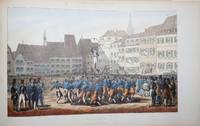
1840008068Strasbourg: Emile Simon Fils 1840. First Edition. Quarter Morocco. Marbled paper pastedown on boards. Very Good. Colorful 1840 three day celebration of the unveiling of a statue to Johann Gutenberg which occurred on June 24 through the 26th 1840. This stunning color plate book is almost entirely devoted to the endless parade organized for the event that proceeded during the second day or the 25th -- based on the dates given in the plate captioning. In this parade each of many professions had its own contingent and dressed and carried a sometimes impressive prop reflecting on the profession. From the vast number of paraders it would seem that virtually everyone in Strasbourg was an active participant. Oblong folio 32 by 53 cm. 48 hand-colored plates with five of the plates with fold-outs and thus extra long. Fold-out plates are counted as two plates in the enumeration which thus goes up to the number 53. In complete form this book is scarce. Outside of France and Germany the only hard copy showing on OCLC First Search is at the Morgan. It isn't clear to us whether the copies in Europe are commensurate but at most there may be half a dozen copies. No copies found in commerce on the date of this listing. Contemporary morocco spine moderately rubbed and scratches on the paper pastedown. Leaves age toned with deeper age toning affecting the fold-out plates. Occasional foxing with perhaps two plates with a considerable amount. A very short closed tear or two. Some shake to the binding as typical in such an extreme oblong book. Emile Simon Fils unknown
1899347181899. BKW 36/10. - Berlin August Hirschwald 6. März 1899 4° pp.204-228 feine Broschur. Erstdruck! Berliner medicinischen Gesellschaft. Sitzung vom 15.Februar 1899. unknown
1881345701881. BKW 18/44. - Berlin August Hirschwald 31. October 1881 4° pp.641-656 feine Broschur. Erstdruck! Themistokles Gluck 8155-1942 - "Die arbeit dieses ideenreichen Chirurgen enthält Berichte über die geglückte Pneumonektomien im Tierexperiment." Rudolf Nissen Erlebtes aus der Thoraxchirurgie 1955 p.31 unknown
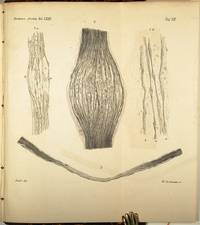
1878346341878. Virch. Arch. path. Anat. 72. - Berlin Verlag von Georg Reimer 1878 8° VI 650 pp. 12 Tafeln Halbleinenband. Erstdruck! "Ein Hauptvertreter der prima intentio nervorum war Gluck der sich schon als Student durch eine Preisaufgabe der Berliner Fakultät angeregt mit Tierversuchen über Nervenregeneration befaßt hatte. Die gekrönte Preisschrift "Experimentelles zur Frage der Nervennaht und Nervenregeneration" findet sich im 72. Bande des Virchowschen Archivs 1877. Durchschnitt Gluck einen 3-4 Tage zuvor genähten Ischiadicus eines Huhnes oberhalb der Nahtstelle so rief nicht nur elektrische sondern auch mechanische Reizung des oberen Nervenstückes Zuckung hervor. Auch etwas kompliziertere Versuche mit Durchschneidung und Naht der beiden Vagi schienen für die prima intentio zu sprechen. Auf dem 9. Kongreß 1880 II. 22 hielt Gluck jetzt Assistent von Langenbeck einen Vortrag über Neuroplastik auf dem Wege der Transplantation und demonstrierte Hühner an denen er 3-4 cm lange Defekte des Ischiadicus durch Stücke von Kaninchennerven ersetzt hatte. Obgleich nur wenige Wochen seit der Operation verstrichen waren glaubte er eine Wiederherstellung der Funktion bis zu einem gewissen Grade feststellen zu können." Trendelenburg Die ersten 25 Jahre der Deutschen Gesellschaft für Chirurgie: Ein Beitrag . p. 158 unknown
1825195865diParis, Chez Antoine-Augustin Renouard, Quatrieme Edition, MDCCCXXV (1825). Halbleder, mit marmorierten Deckeln, ca. DinA 6, Kleinformat, XIV+337 Seiten, marmorierte Einbandinnenseiten/Vorsatzblatt, Einband mit einigen Gebrauchsspuren, sehr STARK beschabt, berieben und bestoßen, marmorierter Schnitt fleckig, Schnitt und Seiten papierbedingt gebräunt, Name auf dem Titelblatt, Seiten zum Teil STARK stockfleckig, trotz der deutlichen Gebrauchs- und/oder Altersspuren ausreichender Zustand [5 Warenabbildungen]
1880345831880. Arch. klin. Chir. 25. - Berlin Verlag von August Hirschwald 1880 8° IV 952 pp. Holzschnitte 14 lith. Taf. Halbledereinband der Zeit. unknown
1891346061891. BKW 28/48. - Berlin August Hirschwald 23. November 1891 4° pp.1141-1156 feine Broschur. unknown
1883345891883. Arch. klin. Chir. 28. - Berlin Verlag von August Hirschwald 1883 8° VI 931 pp. Holzschnitte 10 lith. Taf. Halbledereinband der Zeit. unknown
1882345951882. Arch. klin. Chir. 26. - Berlin Verlag von August Hirschberg 1882 8° VI 1011 pp. Holzschnitte 16 lith. Taf. Portrait von B.v.Langenbeck Pappband der Zeit. Frist Edition! "In 1881 Foulis reported on 27 recorded cases of total laryngectomy. Half of these patients died of pneumonia and other infections within the first week after surgery. Another 25% died of tumor recurrence within ten months. In the same year Gluck recommended that in laryngectomized patients the bottom of the pharynx be completely sewn up in order to obviate the greatest hazard of laryngectomy aspiration pneumonia. By the beginning of the 20th century Gluck reported the mortality of laryngectomy being just 8.5%. This is extremely low considering the major problems that occurred in those days with anesthesia wound infection and shock. For example in 1906 the mortality rate for radical neck dissections was still 13%." "Gluck's modification of the surgical technique of laryngectomy in 1881 - closure of the pharyngostoma in order to decrease the risk of aspiration pneumonia - ruled out internal reed mechanisms. After all the trachea was completely severed from the pharynx in these patients. Accordingly a pneumatic mechanical voice source was devised by Stork in l877 following Czermak's lead. It was based on a similar yet external metal reed connected by an external tube with the patient's tracheal cannula and the sound conveyed into the mouth by another external tube. Between 1892 and 1918 this external pneumatic mechanical voice source was further refined by Hochenegg Gluck Gottstein Tapia Onodi and Stockman. Respectively their modifications consisted of a pair of bellows for a patient that was unable to exhale with sufficient strength a reed concealed in the patient's nose or upper denture an inflatable cuff for the tracheal cannula a reed connected to the tracheal cannula by way of a side butt to make non-phonatory breathing easier and a battery-powered compressor as air supply for the reed. In the 1920s MacKenty together with two scientists of the Western Electric Company Fletcher and Lane developed an external pneumatic mechanical voice source that was soon superseded by the Western Electric No° 2 type larynx. It comprised a soft-rubber tracheal pad to strap over the tracheostoma a flexible tube a slightly curved bronze reed in a silver cylinder and a mouthpiece attachable to this reed box . It was successfully marketed from 1930 to 1959 by the Western Electric Company and the Bell Telephone Laboratories: 5500 No° 2 type larynges were sold." "The first electrolarynx was devised by Gluck in 1910 and comprised an Edison type portable phonograph connected with a telephone receiver in the patient's nose or mouth. On the cylinder of the phonograph a vowel produced by a singer had been recorded. The electric current from the phonograph was converted by the telephone receiver to sound which was propagated in the buccal cavity air. There the representation of the singer's voice was given the timbre belonging to the patient's vocal tract. For demonstration purposes Gluck not only used a recorded vowel but also a phonograph containing a Waltz." Marein van der Torn : A sound-producing voice prosthesis. ACADEMISCH PROEFSCHRIFT Utrecht 2005 See - Gluck T.: Flüstersprache und Phonationsapparate. Berliner klinische Wochenschrift 36 1899 pp.215-216. Gluck T.: Patienten mit Totalextirpation des Pharynx Larynx und Oesophagus denen eine künstliche Stimme durch einen automatisch arbeitenden Apparat geliefert wird. Berliner klinische Wochenschrift 47/1 1910 pp.33-35. Gottstein G.: Pseudo-Stimme nach Totalexstirpation des Larynx. Archiv für die klinische Chirurgie 62 1900 pp.126-46. Tapia A.: Presentacion de un laringuectomizado hablando con un sencillisimo aparato artificial. Revista Espanola de Laringologia 5 1914 pp.48-55. Onodi A.: Ergebnisse der Abteilung für Hör- Sprach- und Stimmstörungen und Tracheotomierte vom Kriegsschauplatz. Monatsschrift für Ohrenheilkunde 52 1918 p. 85. Riesz R.: Description and demonstration of an artificial larynx. Journal of the Acoustical Society of America 1 pp.273-9. unknown
1890148091890. BKW 27/3233. - Berlin August Hirschwald 11. und 18. August 1890 4° pp.721-764 feine Broschur. Erstdruck! "Themistokles Gluck 1853-1942 studierte Medizin in Leipzig und Berlin wo Rudolf Virchow und Bernard von Langenbeck seine Lehrer wurden. Schon als Student arbeitete er unter Langenbecks Leitung an Problemen der Nervennaht und der Nervenregeneration. Seine erste Arbeit auf diesem Gebiet wurde mit dem '1.Staatspreis der Berliner Universität' ausgezeichnet. Von 1878 bis 1884 war er Assistent bei Langenbeck und von Bergmann 1836-1907. Als letzter Schüler Langenbecks habilitierte er sich 1882. 1890 wurde er chirurgischer Chefarzt an das Kaiser und Kaiserin Friedrich-Krankenhaus berufen. Gluck wurde nicht nur durch seine Arbeiten zur Nervenregeneration bekannt sondern ebenso durch seine frühen Versuche zur Implantationschirurgie und durch richtungsweisende neue Operationsmethoden in der plastischen Chirurgie. - cf.H.P.Schmiedebach R.Winau Rudolf Häring Erste Operationen Berliner Chirurgen 1817-1931 p.195 unknown
1897346201897. BKW 34/43-45. - Berlin August Hirschwald 1897 4° pp.929-996 feine Broschur. unknown
1857042531Munchen: Literarisch-Artistische Anstalt 1857. Hardcover. Good. 8vo - over 7¾ - 9¾" tall. .in Ihrer Echtheit Festgestellt und Erflautert.' Quarter bound in black cloth with decorated boards worn at corners <br/> <br/> Literarisch-Artistische Anstalt hardcover
1893694241893. Verh. Berl. med. Ges. 24 1893. - Berlin Gedruckt bei L. Schumacher 1894 8° XLII 250; 389 pp.; mit Abbildungen Halbleinenband d.Zt.; St. verso Tit. Erste Auflage! Verhandlungen der Berliner medicinischen Gesellschaft aus dem Gesellschaftsjahr 1983. Separat-Abdruck aus der Berliner klinischen Wochenschrift. Hrsg. von dem Vorstande der Gesellschaft. Themistocles Gluck 1853-1942 Chirurg. unknown
1894346841894. BKW 31/ 7. - Berlin August Hirschwald Montag den 12. Februar 1894 4° pp.153-184 feine Broschur. Erstdruck! unknown
1895346171895. BKW 32/28. - Berlin August Hirschwald 1895 4° pp.601-624 feine Broschur. Gesellschaft der Charité Aerzte. Sitzung vom 7.März 1895. unknown
18826878BBBerlin Leipzig, Guttentag, 1882. 8°. VIII, 199, 36 S. Noten. OLn., 1Heissmann, Christoph Willibald von Gluck
1854158337Leipzig, Fleischer, 1854. M. 1 gef. faks. Taf. XII, 508 S. Neuer Hlwdbd. m. goldgepr. Rtit. Stellenw. leicht stockfl.
186527503AB1865. Zürich Orell Füssli und Comp. 1865. Gr.-8°. 28 S. Mit einem lithogr. Porträt von J. Lier nach H. Bodmer. Orig.-Heft angestaubt und leicht stockfleckig. = "53. Neujahrsblatt Neujahrsgeschenk an die Zürcherische Jugend sic. von der allgemeinen Musik-Gesellschaft in Zürich auf das Jahr 1865". Rohr 878. unknown
186527503ABZürich, Orell, Füssli und Comp., 1865. Gr.-8°. 28 S. Mit einem lithogr. Porträt von J. Lier nach H. Bodmer. Orig.-Heft (angestaubt und leicht stockfleckig). = "53. Neujahrsblatt (Neujahrsgeschenk an die Zürcherische Jugend sic.) von der allgemeinen Musik-Gesellschaft in Zürich auf das Jahr 1865".