2 075 résultats
1926RO50049925PROCURE GENERALE. 1926. In-8. En feuillets. Etat d'usage, Tâchée, Dos satisfaisant, Quelques rousseurs. 2 pages de partitions non paginées. Adaptation de A. Mahot. Annotations sur quelques phrases. Tampon sur le premier plat.. . . . Classification Dewey : 780.26-Partitions
1992189852San Francisco: Out/Look Foundation 1992. Magazine. 17 issues various pagination 8.5x11 inches b&w illustrations and photos features columns editorials reviews very good complete run of the well-produced LGBT magazine in glossy color pictorial wraps. A complete run of this slick serious glossy that tried to combine literature and politics with almost all strands of gay pop culture. Gladys Bently: Bulldagger who sang the blues; Are lesbians and gay men addicted to addiction programs; Tom of Finland-the gay Norman Rockwell;Gay Lib vs AIDS; Pomo Afro Homos;What do Bisexuals want Jody Foster Hugged Me! aka Out/Look goes Tabloid! Publication ended with volume 5 #1 whole #17. Out/Look Foundation unknown books
200977840Köln : Kiepenheuer & Witsch, 2009. 214 S. ; 20 cm Hardcover/Pappeinband mit OU.
200931658Köln : Kiepenheuer & Witsch, 2009. 214 S. ; 20 cm OPappbd.
199112033Reinbek b. Hamburg: Rowohlt Verlag GmbH, WUnderlich, 1991. 63 Seiten , 24 cm, Pappeinband
ria9783749449606_inpPaperback. New. New Book; Fast Shipping from UK; Not signed; Not First Edition; N/A paperback
1895347491895. Zbl. Chir. 22/27 Bericht über die Verhandlung der Deutschen Gesellschaft für Chrirugie XXIV. Kongress. - Leipzig Verlag von Johann Ambrosius Barth 1895 8° pp.641-656; 154 pp. Halbleinenband. Erstdruck! Es "ist der Gedanke Elfenbeinstücke nicht nur zu vorübergehendem sondern zu dauerndem Einsatz von Knochendefekten und aus Elfenbein hergestellte künstliche Gelenke zum Einsatz zu benutzen von Gluck ausgegangen. Er berichtete darüber 1890 und ausführlicher in einem Vortrag im Jahre 1895 über Osteoplastik und einheilbare Prothesen der aber nicht in den gedruckten Verhandlungen aufgenommen ist. Ein Autoreferat findet sich im Zentralblatt für Chirurgie Bd. 22 pp.30 ff. Er hob darin den praktischen Nutzen von Implantation von Elfenbein und Knochen sowie vernickeltem Stahl Aluminiumbronze und dergleichen in Knochendefekten nochmals hervor. Wenn Elfenbein und Knochen auch allmählich von dem neuen sich bildenden Knochen umwachsen resorbiert substituiert würden so dienten sie doch als innere Schiene und als Reiz für die Knochenneubildung und erzwängen die Regeneration in der zweckmäßigen Bahn. Die anorganischen Fremdkörper auch künstliche Gelenke könnten für lange Zeit vielleicht dauernd einheilen und reizlos funktionieren. Dem Vortrag folgte eine reichhaltige Demonstration von Präparaten und Modellen von Elfenbeinmetallprothesen und Mittheilungen über klinische Beobachtungen. Einem großen Hunde war ein Metallscharnierapparat eingeheilt. Pean implantierte als Ersatz des resezierten Schultergelenkes ein Gelenk aus Platiniridium und Hartgummi das seit 2 1/4 Jahr tadellos funktionierte." Friedrich Trendelenburg Die ersten 25 Jahre der Deutschen Gesellschaft für Chirurgie 1923 p.163 unknown
0332586987.Ghardcover. Good. Access codes and supplements are not guaranteed with used items. May be an ex-library book. hardcover
036498404X.Ghardcover. Good. Access codes and supplements are not guaranteed with used items. May be an ex-library book. hardcover
0656595760.Gpaperback. Good. Access codes and supplements are not guaranteed with used items. May be an ex-library book. paperback
1391751124.Ghardcover. Good. Access codes and supplements are not guaranteed with used items. May be an ex-library book. hardcover
1396474447.Ghardcover. Good. Access codes and supplements are not guaranteed with used items. May be an ex-library book. hardcover
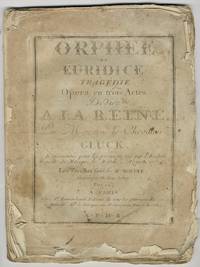
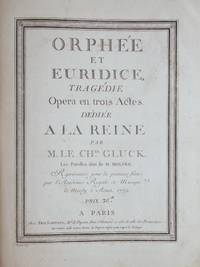
177440430Paris: Chez Mr. Lemarchand . A.P.D.R. 1774. Folio. Unbound. Sewn. 1f. recto title verso publisher's catalogue 1f. recto dedication verso "Argument" 52 pp. Engraved.<br /> <br /> Incomplete with only first act and three pages of second act present.<br /> <br /> Worn overall with occasional staining foxing and soiling throughout primarily to blank margins; title worn and heavily browned stained and soiled with paper loss to edges; corners slightly bumped and creased; signatures separated; binder's holes to blank inner margin. First Edition unrecorded variant. Wotquenne 41. Hopkinson p. 43 41A. BUC p. 386. Lesure p. 240. RISM G2582. <br /> <br /> First performed in Vienna at the Burgtheater on 5 October 1762 in Italian to a libretto by Ranieri de' Calzabigi and in Paris at the Opéra on 2 August 1774 in French to a libretto by Pierre Louis Moline after Calzabigi.<br /> <br /> "The classical orientation of Calzabigi evident in Orfeo ed Euridice from the moment the curtain rose on the almost archaeologically recreated ancient funerary ritual e.g. the threefold calling of the name of the deceased coloured the entirety of his collaboration with Gluck. Despite the ambiguous attributions of the prefaces signed by the composer it is clear that Gluck largely shared his librettist's classical enthusiasms . It is revealing that Gluck sought out subject matter from Greek tragedy independently of Calzabigi after the latter's departure from Vienna - most probably with his inner conviction mixing with a desire to exploit the goût grec then prevailing in France . Calzabigi's poetry was almost completely devoid of metaphors and similes and placed a mere three characters in a fluid context of dances and choruses or both simultaneously. The action was reduced to essentials: a demonstration of the persuasive powers of music and a cautionary tale on the dangers of curiosity with Orpheus bewailing the loss of his wife already as the curtain rose. Gluck's approach as composer was no less radical particularly in his near-complete elimination of coloratura and of opening ritornellos in the solo numbers. Above all the opera was remarkable in its emphasis on continuity which was achieved chiefly through the enchaining of harmonically open-ended sections of music and through the complete avoidance of recitativo semplice in favour of orchestrally accompanied recitatives so as to avoid sharp contrasts of texture with the set pieces. This continuity and the nearly syllabic vocal writing were calculated to prevent applause and thus also to promote the audience's absorption in the spectacle." Bruce Alan Brown and Julian Rushton in Grove Music Online. Chez Mr. Lemarchand ... A.P.D.R. unknown
178340431Paris: Chez Des Lauriers Md. de Papiers Rue St. Honoré à côté de celle des Provaires 1783. Folio. Early full dark brown leather with double rule gilt to edges of boards spine in compartments gilt with titling gilt marbled endpapers. 1f. recto title verso blank 1f. recto dedication verso "Argument" 217 pp. Bound with an extra title that of Hopkinson 41Ak. 1f. recto title verso blank 1f. recto blank verso "Argument" pp. <br /> <br /> Binding quite worn rubbed and bumped with loss to spine. Occasional minor soiling to blank outer margins; paper repairs to blank inner margins of approximately fifteen leaves; small binder's holes to blank inner margin of numerous leaves; occasional staining; worming to blank inner margin of final third of volume; extra title and Argument worn and soiling with worming to blank margins. Second edition of the French version. Wotquenne 41. A variant issue of Hopkinson 41Ai but with the price of 36 instead of 24 tt. Lesure p. 240. RISM G2853. <br /> <br /> First performed in Vienna at the Burgtheater on 5 October 1762 in Italian to a libretto by Ranieri de' Calzabigi and in Paris at the Opéra on 2 August 1774 in French to a libretto by Pierre Louis Moline after Calzabigi.<br /> <br /> "More successfully than any of his contemporaries Gluck translated the widespread agitation for reform of opera and theatrical dance on the part of European intellectuals into actual works for the stage first in pantomime ballets and Italian serious operas for Vienna and then in operas of various sorts for Paris." Bruce Alan Brown and Julian Rushton in Grove Music Online<br /> <br /> "The classical orientation of Calzabigi evident in Orfeo ed Euridice from the moment the curtain rose on the almost archaeologically recreated ancient funerary ritual e.g. the threefold calling of the name of the deceased coloured the entirety of his collaboration with Gluck. Despite the ambiguous attributions of the prefaces signed by the composer it is clear that Gluck largely shared his librettist's classical enthusiasms. . It is revealing that Gluck sought out subject matter from Greek tragedy independently of Calzabigi after the latter's departure from Vienna - most probably with his inner conviction mixing with a desire to exploit the goût grec then prevailing in France. . Calzabigi's poetry was almost completely devoid of metaphors and similes and placed a mere three characters in a fluid context of dances and choruses or both simultaneously. The action was reduced to essentials: a demonstration of the persuasive powers of music and a cautionary tale on the dangers of curiosity with Orpheus bewailing the loss of his wife already as the curtain rose. Gluck's approach as composer was no less radical particularly in his near-complete elimination of coloratura and of opening ritornellos in the solo numbers. Above all the opera was remarkable in its emphasis on continuity which was achieved chiefly through the enchaining of harmonically open-ended sections of music and through the complete avoidance of recitativo semplice in favour of orchestrally accompanied recitatives so as to avoid sharp contrasts of texture with the set pieces. This continuity and the nearly syllabic vocal writing were calculated to prevent applause and thus also to promote the audience's absorption in the spectacle." Bruce Alan Brown and Julian Rushton in Grove Music Online. Chez Des Lauriers, Md. de Papiers, Rue St. Honoré à côté de celle des Provaires unknown
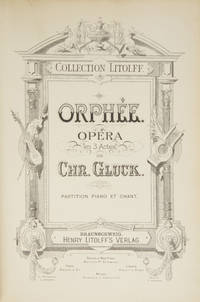
190028577Braunschweig: Henry Litolff PN Collection Litolff No. 82 1900. Large octavo. Half brown calf with marbled boards raised bands on spine in gilt-ruled compartments titling gilt. i title within architectural border 2-3 cast list and contents 4-138 pp.<br/><br/>Binding slightly worn rubbed and bumped. Light uniform browning. First performed in Vienna at the Burgtheater on October 5 1762 in Italian to a libretto by Ranieri de' Calzabigi and in Paris at the Opéra on August 2 1774 in French to a libretto by Pierre Louis Moline after Calzabigi.<br/><br/>"Orfeo ed Euridice was the first of Gluck's three so-called reform operas written with Ranieri de' Calzabigi the other two were Alceste and Paride ed Elena in which a 'noble simplicity' in the action and the music was intended to replace the complicated plots and florid musical style of opera seria." Jeremy Hayes in Grove Music Online. Henry Litolff [PN Collection Litolff No. 82] unknown books
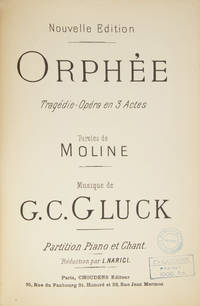
189928620Paris: Choudens PN A. C. 11331 1899. Large octavo. Original publisher's dark ivory wrappers printed in red and black. 1f. recto title verso blank 1f. recto notes on first performance named cast list and contents verso blank 118 pp.<br/><br/>Named cast includes Delna Bréjean-Gravière Eyreams and Chasles. <br/><br/>Wrappers slightly worn browned and chipped; former owner's signature in blue ink to upper. Some edges slightly damaged; handstamps to title; manuscript annotation to second leaf. Choudens [PN A. C. 11331] unknown books
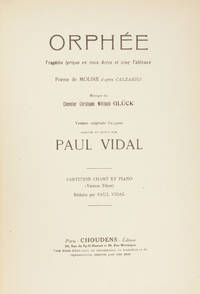
193428968Paris: Choudens PN A.C. 15000 1934. Large octavo. Original publisher's ivory printed wrappers. 1f. recto title verso blank 1f. recto notes on first performance and named cast list verso blank 1f. recto contents verso blank 2f. preface 177 i blank pp.<br/><br/>Occasional lyrics translated into Norwegian in pencil and black ink.<br/><br/>Named cast includes Fernand Ansseau Aline Vallandri Yvonne Brothier and Marthe Coiffier.<br/><br/>Wrappers slightly worn and soiled and worn; former owner's handstamp "Hjørdis Wied Koncertsangerinde" and small price handstamp to lower margin of upper wrapper; spine worn with some loss. Wied's handstamp to upper margin of free front endpaper and lower margin of three leaves; annotations in pencil and red crayon to contents; tear to outer margin of pp. 87-92. Revised Paris version. Re-issue of Hopkinson 41Cu. <br/><br/>First performed in Paris at the Theâtre National de l'Opéra-Comique on October 11 1921 under Albert Carré and Isola A. Frères.<br/><br/>"Orfeo ed Euridice was the first of Gluck's three so-called reform operas written with Ranieri de' Calzabigi the other two were Alceste and Paride ed Elena in which a 'noble simplicity' in the action and the music was intended to replace the complicated plots and florid musical style of opera seria." Jeremy Hayes in Grove Music Online. Choudens [PN A.C. 15000] unknown books
480087Berlin.: Ed. Bote & G. Bock. Ohne Jahr. Halbleinen nachgebunden. Noten im Text. Collection des Oeuvres Classiques. Gr.4°. Aufgeklebte Plastikschutzhülle. Titelblatt lichtrandig sonst gut erhalten. Ed. Bote & G. Bock. unknown
1859231958Ed Bote & G. Bock Berlin 1859. Hardcover Leinen Großformat Die Jahresangabe ist ungefähr. Zustand: keine Beschädigungen eine Namenseintragung. Rücken Ecken Kanten gut. Innen braunfleckig. Ed Bote & G. Bock, Berlin, hardcover
19563222DEUTSCHE GRAMMOPHON GESELLSCHAFT 07/1956. 1. hardcover. Sung in German! DEUTSCHE GRAMMOPHON GESELLSCHAFT hardcover
In-8 (Cm 27,5 x 19), pp. 96, leg. mz. tela con titolo e fregio in oro al piatto ant., frontespizio illustrato, rari segnetti a lapis, millimetrica allentatura tra le pp. 32 e 33. Ordinari segni del tempo. MOLTO BUONO
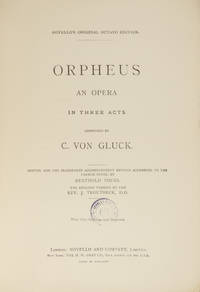
189128576London: Novello and Company PN 8146 1891. Large octavo. Original publisher's dark ivory wrappers printed in dark orange. 1f. recto title verso blank 1f. recto argument verso blank 1f. index 135 i printer's' device 1f. publisher's catalogue pp.<br/><br/>Wrappers somewhat worn and torn; portions of spine lacking at head and tail. Minor wear to outer margins of first six leaves. First performed in Vienna at the Burgtheater on October 5 1762 in Italian to a libretto by Ranieri de' Calzabigi and in Paris at the Opéra on August 2 1774 in French to a libretto by Pierre Louis Moline after Calzabigi.<br/><br/>"Orfeo ed Euridice was the first of Gluck's three so-called reform operas written with Ranieri de' Calzabigi the other two were Alceste and Paride ed Elena in which a 'noble simplicity' in the action and the music was intended to replace the complicated plots and florid musical style of opera seria." Jeremy Hayes in Grove Music Online. Novello and Company [PN 8146] unknown books
Q-0793512433G. Schirmer Inc. Paperback. New. New. In shrink wrap. Looks like an interesting title! G. Schirmer, Inc paperback
AB4407various: privately bound various. First Thus. . Hardcover. Good. 4to. A good copy with some damp spotting and discolouration to green cloth covers front cover slightly bowed. 5 individual musical scores bound together. None dated but estimate ca 1890. Orpheus edited and the pianoforte accompaniment revised according to the Italian score by Berthold Tours 35pp Novello's original octavo edition. Preciosa translated by the Rev J Troutbeck 65pp. Der Rattenfanger von Hameln with separat ausgabe der sammtlichen lieder des Hunold Singuf pub J Schuberth Leipzig 41pp. Frithiof Op 23 Clavier-Auszug with Germand and English text 67pp. The Longbeards' Saga chorus for male voices with pianoforte obligato Novello Ewer and Co 40pp. Immediate despatch from the UK. <br/> <br/> privately bound various hardcover
0366899821.Ghardcover. Good. Access codes and supplements are not guaranteed with used items. May be an ex-library book. hardcover