GluckBiblio.com
2 075 résultats
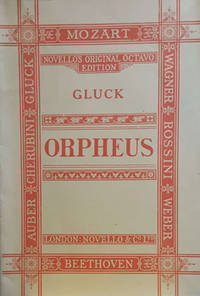
005612London: Novello's Original Octavo Edition - Novello & Co Ltd. Undated. Circa 1938. Full score. Excellent clean and tightly bound sheet music. Novello's Original Octavo Edition - Novello & Co, Ltd. paperback
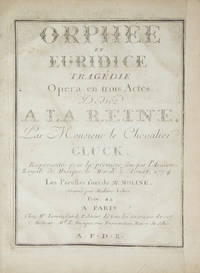
177429643Paris: Lemarchand 1774. Folio. 19th century quarter dark brown leather-backed marbled boards spine in decorative compartments gilt titling gilt. 1f. recto title verso publisher's catalogue 1f. recto dedication verso argument 217 pp. <br/><br/>With an inscription signed by the Canadian conductor Wilfrid Pelletier 1896-1982 to Italian conductor Tullio Serafin 1878-1968 dated New York 1928 to front flyleaf.<br/><br/>Bass figurings added in manuscript to pp. 10-12 Act I scene 1; final page of music signed by the publisher Lemarchand. <br/><br/>Binding worn; edges rubbed; spine split at joints and hinges; chipped at head and tail. Slightly worn and browned; title soiled with outer edge reinforced with paper tape; some minor staining; several repairs to inner margins; occasional small holes. First Edition variant issue. Hopkinson 41Af. Wotquenne 41. Lesure p. 240. RISM G2852 not distinguishing among issues. <br/><br/>"The classical orientation of Calzabigi evident in Orfeo ed Euridice from the moment the curtain rose on the almost archaeologically recreated ancient funerary ritual e.g. the threefold calling of the name of the deceased coloured the entirety of his collaboration with Gluck. Despite the ambiguous attributions of the prefaces signed by the composer it is clear that Gluck largely shared his librettist's classical enthusiasms. It is revealing that Gluck sought out subject matter from Greek tragedy independently of Calzabigi after the latter's departure from Vienna - most probably with his inner conviction mixing with a desire to exploit the goût grec then prevailing in France. Calzabigi's poetry was almost completely devoid of metaphors and similes and placed a mere three characters in a fluid context of dances and choruses or both simultaneously. The action was reduced to essentials: a demonstration of the persuasive powers of music and a cautionary tale on the dangers of curiosity with Orpheus bewailing the loss of his wife already as the curtain rose. Gluck's approach as composer was no less radical particularly in his near-complete elimination of coloratura and of opening ritornellos in the solo numbers. Above all the opera was remarkable in its emphasis on continuity which was achieved chiefly through the enchaining of harmonically open-ended sections of music and through the complete avoidance of recitativo semplice in favour of orchestrally accompanied recitatives so as to avoid sharp contrasts of texture with the set pieces. This continuity and the nearly syllabic vocal writing were calculated to prevent applause and thus also to promote the audience's absorption in the spectacle." Bruce Alan Brown and Julian Rushton in Grove Music Online. Lemarchand unknown books
177429643Paris: Lemarchand 1774. Folio. 19th century quarter dark brown leather-backed marbled boards spine in decorative compartments gilt titling gilt. 1f. recto title verso publisher's catalogue 1f. recto dedication verso argument 217 pp. <br /> <br /> With an inscription signed by the Canadian conductor Wilfrid Pelletier 1896-1982 to Italian conductor Tullio Serafin 1878-1968 dated New York 1928 to front flyleaf.<br /> <br /> Bass figurings added in manuscript to pp. 10-12 Act I scene 1; final page of music signed by the publisher Lemarchand. <br /> <br /> Binding worn; edges rubbed; spine split at joints and hinges; chipped at head and tail. Slightly worn and browned; title soiled with outer edge reinforced with paper tape; some minor staining; several repairs to inner margins; occasional small holes. First Edition variant issue. Hopkinson 41Af. Wotquenne 41. Lesure p. 240. RISM G2852 not distinguishing among issues. <br /> <br /> First performed in Vienna at the Burgtheater on 5 October 1762 in Italian to a libretto by Ranieri de' Calzabigi and in Paris at the Opéra on 2 August 1774 in French to a libretto by Pierre Louis Moline after Calzabigi.<br /> <br /> "The classical orientation of Calzabigi evident in Orfeo ed Euridice from the moment the curtain rose on the almost archaeologically recreated ancient funerary ritual e.g. the threefold calling of the name of the deceased coloured the entirety of his collaboration with Gluck. Despite the ambiguous attributions of the prefaces signed by the composer it is clear that Gluck largely shared his librettist's classical enthusiasms . It is revealing that Gluck sought out subject matter from Greek tragedy independently of Calzabigi after the latter's departure from Vienna - most probably with his inner conviction mixing with a desire to exploit the goût grec then prevailing in France . Calzabigi's poetry was almost completely devoid of metaphors and similes and placed a mere three characters in a fluid context of dances and choruses or both simultaneously. The action was reduced to essentials: a demonstration of the persuasive powers of music and a cautionary tale on the dangers of curiosity with Orpheus bewailing the loss of his wife already as the curtain rose. Gluck's approach as composer was no less radical particularly in his near-complete elimination of coloratura and of opening ritornellos in the solo numbers. Above all the opera was remarkable in its emphasis on continuity which was achieved chiefly through the enchaining of harmonically open-ended sections of music and through the complete avoidance of recitativo semplice in favour of orchestrally accompanied recitatives so as to avoid sharp contrasts of texture with the set pieces. This continuity and the nearly syllabic vocal writing were calculated to prevent applause and thus also to promote the audience's absorption in the spectacle." Bruce Alan Brown and Julian Rushton in Grove Music Online. Lemarchand unknown
192235997Paris France: Choudens. Spine has been taped with library-type tape but it has some wear along front hinge and a chunk missing top edge. A few 1" black marker lines at lower front cover. Prev. owner's name plate inside. Toning to pages due to age. Rough-cut pgs. 177 pgs. . Good. Paperback. 1922. Choudens paperback
1997R260149172GRAND THEATRE DE BORDEAUX. 1997. In-8. Broché. Bon état, Couv. convenable, Dos satisfaisant, Intérieur frais. Monographie d'opéra de 41 pages. Premier plat illustré en couleurs. Couverture rempliée. Nombreuses illustrations en noir et blanc dans le texte.. . . . Classification Dewey : 782.1-Théâtre musical, opéra
20040Paris, Mellottée, les chefs d'oeuvre de la musique expliqués. In-8 (185x120mm) broché de 349 p. Très bon état général.
RO50013476Journal des Jeunes Personnes. XIXème. In-4. En feuillets. Bon état, Couv. légèrement passée, Dos satisfaisant, Quelques rousseurs. 4 pages.. . . . Classification Dewey : 780.26-Partitions
RO50013222Enoch & cie. XXème. In-8. Broché. Bon état, Couv. légèrement passée, Dos très frotté, Intérieur frais. 138 pages. Ornements en couverture et en page titre. Coiffe en pied manquante.. . . . Classification Dewey : 780.26-Partitions
R150023152CALMANN LEVY .. Non daté.. In-12. Broché. Bon état, Couv. convenable, Dos satisfaisant, Intérieur acceptable. 21 pages.. . . . Classification Dewey : 840-Littératures des langues romanes. Littérature française
RO80080306CHOUDENS. Non daté. In-Folio. Broché. Etat d'usage, Couv. convenable, Dos satisfaisant, Intérieur acceptable. 7 pages de partitions. Petits accrocs en marges.. . . . Classification Dewey : 780.26-Partitions
1942RO50015764Durand & Cie. 1942. In-8. En feuillets. Bon état, Livré sans Couverture, Dos satisfaisant, Intérieur frais. 3 pages.. . . . Classification Dewey : 780.26-Partitions
1896RO50023023"Imprimerie des Annales. 8 mars 1896. In-4. En feuillets. Bon état, Couv. convenable, Dos satisfaisant, Quelques rousseurs. Non paginé. 4 pages environ. Gravures noires et blanches représentant les directeurs du conservatoire de l'époque, ""Un secret"" de M. Gruet, ""Thermidor, la dernière charette - M. Coquelin dans Labussière"".. . . . Classification Dewey : 780.26-Partitions"
1905RO50023494"Imprimerie des Annales. 19 mars 1905. In-4. En feuillets. Bon état, Couv. convenable, Dos satisfaisant, Quelques rousseurs. Non paginé. 4 pages environ. Photos noires et blanches ayant pour thèmes ""La famille des Coquelin"", ""A travers l'actualité"" et ""La guerre russo-japonaise"".. . . . Classification Dewey : 780.26-Partitions"
RO20042608LITOLFF'S / ENOCH FRERES. non daté. In-8. Relié demi-cuir. Bon état, Couv. convenable, Dos satisfaisant, Intérieur frais. 138 pages. Recueil de partitions accompagnées de paroles. Titre et filets dorés sur le dos en cuir noir.. . . . Classification Dewey : 780.26-Partitions
1997R260106692OPERA DE BORDEAUX. 1997. In-8. Broché. Bon état, Couv. convenable, Dos satisfaisant, Intérieur frais. Monographie d'opéra de 41 pages. Premier plat illustré en couleurs. Couverture rempliée. Nombreuses illustrations en noir et blanc dans et hors texte.. . . . Classification Dewey : 782.1-Théâtre musical, opéra
1899RO50043318CHOUDENS. 1899. In-8. Broché. Bon état, Plats abîmés, Dos frotté, Intérieur acceptable. 118 pages de partitions. Premier plat illustré en noir et blanc. Inscription sur la première page blanc. Couverture plastique transparente de protection. Paroles de Moline.. . . . Classification Dewey : 780.26-Partitions
RO50043321CHOUDENS. NON DATE. In-8. Broché. Bon état, Couv. légèrement passée, Dos abîmé, Intérieur frais. 118 pages de partitions. Paroles de Moline.. . . . Classification Dewey : 780.26-Partitions
RO50044766PETERS. NON DATE. In-8. Broché. Etat d'usage, Tâchée, Dos satisfaisant, Intérieur acceptable. 142 pages de partitions. Protection plastique transparente. Couverture en couleur. Texte en allemand et français.. . . . Classification Dewey : 780.26-Partitions
RO50047552M. LABBE. NON DATE. In-8. En feuillets. Bon état, Tâchée, Dos satisfaisant, Quelques rousseurs. 2 pages de partitions non paginées. Tampon sur le premier plat ainsi que sur la première page. Chantée par Delna de l'opéra comique.. . . . Classification Dewey : 780.26-Partitions
RO50049448C.F. PETERS. NON DATE. In-8. Relié. Etat d'usage, Coins frottés, Coiffe en pied abîmée, Intérieur acceptable. 138 pages de partitions. Compositeur, titre et filets dorés au dos de l'ouvrage. Annotation et tampon sur la page de titre. Coins et plats frottés.. . . . Classification Dewey : 780.26-Partitions
RO50053382PETERS. NON DATE. In-8. Broché. Etat d'usage, Tâchée, Dos abîmé, Quelques rousseurs. 138 pages de partitions. Couverture en couleur. Tampon et annotation sur le premier plat, sur la page de titre ainsi que sur la première page.. . . . Classification Dewey : 780.26-Partitions
1922RO50056476CHOUDENS. 1922. In-8. En feuillets. Etat d'usage, Plats abîmés, Dos très frotté, Quelques rousseurs. 177 pages de partitions. Version originale française adaptée et revue par Paul Vidal. Représenté pour la première fois au Théâtre National de l'opéra comique le 11 Octobre 1921. Plats frottés. Poème de Moline d'après Calzabigi.. . . . Classification Dewey : 780.26-Partitions
RO50056746RENE GODFROY. NON DATE. In-Folio. En feuillets. Etat d'usage, Tâchée, Dos satisfaisant, Papier jauni. 4 pages de partitions. Premier plat illustré en couleur monochrome.. . . . Classification Dewey : 780.26-Partitions
RO50056977PHILIPPO. NON DATE. In-Folio. En feuillets. Etat d'usage, Couv. légèrement passée, Dos abîmé, Papier jauni. 7 pages de partitions. Paroles de M. Moline.. . . . Classification Dewey : 780.26-Partitions
RO50059623C.F. PETERS. NON DATE. In-8. Relié. Etat d'usage, Coins frottés, Dos satisfaisant, Quelques rousseurs. 138 pages de partitions. Tampon sur la page de titre illustrée en couleur monochrome.. . . . Classification Dewey : 780.26-Partitions