160 résultats
19362111902160201403Great Japan Yutenkai Kodansha 1936. Soft Cover. Fine. Volume: 1 Great Japan Yutenkai Kodansha paperback
19182091502135420007Teishin kyokai 1918. Soft Cover. Fine. Number of books: 1 Teishin kyokai paperback
19162091502135419066Teishin kyokai 1916. Soft Cover. Fine. Number of books: 1 Teishin kyokai paperback
19262091502135420981Electric Association 1926. Soft Cover. Fine. Number of books: 1 Electric Association paperback
19262091502135420982Electric Association 1926. Soft Cover. Fine. Number of books: 1 Electric Association paperback
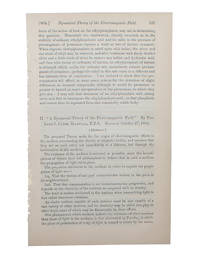
186441709London Taylor and Francis 1864. No wrappers as extracted from"Proceedings of the Royal Society". From November 19 1863 to December 22 1864 inclusive." Vol. XIII. Pp 531-536. <br/><br/><em>First printing of the first announcement of Maxwell unification of light-waves electricity and magnetism the most importent of the papers relating to his electromagnetic theory in which he brought electro-magnetical phenomena on a clear mathematical form. The present paper is an abstract of the larger paper which was read to the Royal Academy in 1864 but only issued the year later 1865 in "Philosophical Transactions of the Royal Society" where it was printed in full and as an abstract in "Philosophical Magazine" 1865."A generation later Einstein's work on relativity was founded directly oupon Maxwell's electromagnetic theory; it was this that led him to equate Faraday with Galileo and Maxwell with Newton." PMM No 355 but only the paper from 1865. - Dibner. Heralds of Science No 68 1865 paper. </em> unknown
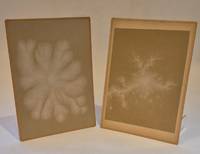
356<p>Set of two photographs of electricity from the same unidentified photographer France circa 1890.</p><p>Silver gelatin prints mounted on card print sizes: 12.7 x 17.5 cm and 12 x 15.3 cm; mount size: 18.3 x 13.3 cm.</p><p>Rare set by a single anonymous photographer of two photographs of electricity or electric sparks. Prints slightly faded but a rare pair.</p><p>See Canguilhem Le merveilleux scientifiques 2044 pages 102-113.</p>
174753510Verona: Giannalberto Tumermani 1747. First edition. Engraved title vignette and headpiece. 8 189 7 pp. 1 vols. 4to. Original boards uncut. Some early but faint dampstaining throughout -- otherwise a fine wide-margined copy. First edition. Engraved title vignette and headpiece. 8 189 7 pp. 1 vols. 4to. Collection of fifteen letters on the origins of lightning by the enlightened polymath Maffei 1675-1755 "said by Grimelli Storia to contain all the anterior letters on Lightning published by him i.e. all before 1746 the date of the censorship." - Ronalds<br /> <br /> The book is rare in institutions -- OCLC gives only one location. Ronalds p. 314; Gartrell p. 334; OCLC: 23628231 one location: U. of Michigan; Mottelay p. 321; Baaken Library p. 83; not in Wheeler; not in RLIN Giannalberto Tumermani unknown
175846557Berlin Haude et Spener 1758. 4to. No wrappers as issued in "Mémoires de l'Academie Royale des Sciences et Belles-Lettres" 1756 tome XII. Pp. 105-121. With titlepage to the volume printed in red/blac and with engraved titlevignette. Also having the parttitlepage. Titlepage with 2 small wormtracts. <br/><br/><em>First appearance of a milestone paper in the history of electricity as Aepinus here found that a heated tourmaline attracted and repelled light bodies. He decided that the effect was electrical and that its ends was carrying charges of opposite sign much as soft iron is magnetized by a lodestone. This paper is a forerunner of his "Tentamen Theoriae electricitatis et magnetismi" - published 1759 and one of the most original and important books in the history of electricity. It is the first reasoned fruitful exposition of electrical phenomena based on action-at-a-distance."Aepinus’ first reseraches on the thermoelectric properties of this stone Tourmalin which was then of extreme rarity were fundamental. He recognized the electrical nature of the attractive power of a warmed tourmaline and attempted not altogether successfully to reduce its apparent capriciousness to rule. He was particularly struck by the formal similarity between the tourmaline and the magnet in regard to polarity which inspired him to reconsider the possibility then occasionally discussed that electricity and magnetism were basically analogous. This thought became the This thought became the theme for his masterwork Tentamen theoriae electricitatis et magnetismi 1759."DSB."Aepinus is known in the history of electricity for his attempt to develop the one fluid theory of Franklin. His theory was for a while generally adopted but was gradually displaced by the two fluid theory in consequence chiefly of the necessity of ascribing to uncharged matter repulsions of the same force as those which were ascribed to electrical charges. His theory exhibits interesting similarities to the present theory of the constitution of matter"Magie "A Source Book in Physics" pp.406-8.Ronalds p. 4. </em> unknown
173546590Paris L'Imprimerie Royale 1735. 4to. Without wrappers. Extracted from "Mémoires de l'Academie des Sciences. Année 1733". Pp. 23-39 pp. 73-84 pp. 233-254 a. 1 engraved plate pp. 457-476. With titlepage to the volume 1733/1735. Margins of titlepage with a few brownspots. <br/><br/><em>First appearance of these milestone papers in the histroy of electricity in which Dufay explains his discovery of two kinds of electricity and the relation between them attraction and repulsion shocks and sparking and the full recognition of electrostatic repulsion. He formulates the two-fluid theory of electricity. He further showed that "not all bodies can become electrified themselves" by friction and went on to show "that they can all acquire a considerable electrical virtue when the tube of rubbed glass wood metals or liquids are brought near them" provided only that they are insulated by beiing stood on "a support of glass or of sealing-wax".Dufay "TRANSFORMED A COLLECTION OF MISCELLANEOUS WEEDS INTO THE FIRST GARDEN OF EUROPE" Heilbron"Dufay's substantive discoveries - ACR the two electricities shocks and sparking - are but one aspect and perhaps not the most significant of his achievement. His insistence on the impiortence of the subject on the universal character of electricity on the necessity of organizing digesting and regulariizing known facts before grasping new ones all helped to introduce order and professionel standards into the study of electricity at precisely the moment when the accumulation of data began to require them. He foundthe subject a record of often capricious disconnected phenomena the domain of the polymaths textbook writers and prfesional lecturers and left a body of knowledge that invited and rewarded prolonged scrutinity from serious physicists." Heilbron "Electricity in the 17 & 18 Centuries" p. 260.Parkinson "Breakthroughs" 1734 P - Ronalds Library p. 145. - Not in Wheeler Gift Cat. </em> unknown