160 résultats
173546590Paris L'Imprimerie Royale 1735. 4to. Without wrappers. Extracted from "Mémoires de l'Academie des Sciences. Année 1733". Pp. 23-39 pp. 73-84 pp. 233-254 a. 1 engraved plate pp. 457-476. With titlepage to the volume 1733/1735. Margins of titlepage with a few brownspots. <br/><br/><em>First appearance of these milestone papers in the histroy of electricity in which Dufay explains his discovery of two kinds of electricity and the relation between them attraction and repulsion shocks and sparking and the full recognition of electrostatic repulsion. He formulates the two-fluid theory of electricity. He further showed that "not all bodies can become electrified themselves" by friction and went on to show "that they can all acquire a considerable electrical virtue when the tube of rubbed glass wood metals or liquids are brought near them" provided only that they are insulated by beiing stood on "a support of glass or of sealing-wax".Dufay "TRANSFORMED A COLLECTION OF MISCELLANEOUS WEEDS INTO THE FIRST GARDEN OF EUROPE" Heilbron"Dufay's substantive discoveries - ACR the two electricities shocks and sparking - are but one aspect and perhaps not the most significant of his achievement. His insistence on the impiortence of the subject on the universal character of electricity on the necessity of organizing digesting and regulariizing known facts before grasping new ones all helped to introduce order and professionel standards into the study of electricity at precisely the moment when the accumulation of data began to require them. He foundthe subject a record of often capricious disconnected phenomena the domain of the polymaths textbook writers and prfesional lecturers and left a body of knowledge that invited and rewarded prolonged scrutinity from serious physicists." Heilbron "Electricity in the 17 & 18 Centuries" p. 260.Parkinson "Breakthroughs" 1734 P - Ronalds Library p. 145. - Not in Wheeler Gift Cat. </em> unknown
175846557Berlin Haude et Spener 1758. 4to. No wrappers as issued in "Mémoires de l'Academie Royale des Sciences et Belles-Lettres" 1756 tome XII. Pp. 105-121. With titlepage to the volume printed in red/blac and with engraved titlevignette. Also having the parttitlepage. Titlepage with 2 small wormtracts. <br/><br/><em>First appearance of a milestone paper in the history of electricity as Aepinus here found that a heated tourmaline attracted and repelled light bodies. He decided that the effect was electrical and that its ends was carrying charges of opposite sign much as soft iron is magnetized by a lodestone. This paper is a forerunner of his "Tentamen Theoriae electricitatis et magnetismi" - published 1759 and one of the most original and important books in the history of electricity. It is the first reasoned fruitful exposition of electrical phenomena based on action-at-a-distance."Aepinus’ first reseraches on the thermoelectric properties of this stone Tourmalin which was then of extreme rarity were fundamental. He recognized the electrical nature of the attractive power of a warmed tourmaline and attempted not altogether successfully to reduce its apparent capriciousness to rule. He was particularly struck by the formal similarity between the tourmaline and the magnet in regard to polarity which inspired him to reconsider the possibility then occasionally discussed that electricity and magnetism were basically analogous. This thought became the This thought became the theme for his masterwork Tentamen theoriae electricitatis et magnetismi 1759."DSB."Aepinus is known in the history of electricity for his attempt to develop the one fluid theory of Franklin. His theory was for a while generally adopted but was gradually displaced by the two fluid theory in consequence chiefly of the necessity of ascribing to uncharged matter repulsions of the same force as those which were ascribed to electrical charges. His theory exhibits interesting similarities to the present theory of the constitution of matter"Magie "A Source Book in Physics" pp.406-8.Ronalds p. 4. </em> unknown
174753510Verona: Giannalberto Tumermani 1747. First edition. Engraved title vignette and headpiece. 8 189 7 pp. 1 vols. 4to. Original boards uncut. Some early but faint dampstaining throughout -- otherwise a fine wide-margined copy. First edition. Engraved title vignette and headpiece. 8 189 7 pp. 1 vols. 4to. Collection of fifteen letters on the origins of lightning by the enlightened polymath Maffei 1675-1755 "said by Grimelli Storia to contain all the anterior letters on Lightning published by him i.e. all before 1746 the date of the censorship." - Ronalds<br /> <br /> The book is rare in institutions -- OCLC gives only one location. Ronalds p. 314; Gartrell p. 334; OCLC: 23628231 one location: U. of Michigan; Mottelay p. 321; Baaken Library p. 83; not in Wheeler; not in RLIN Giannalberto Tumermani unknown
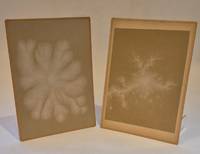
356<p>Set of two photographs of electricity from the same unidentified photographer France circa 1890.</p><p>Silver gelatin prints mounted on card print sizes: 12.7 x 17.5 cm and 12 x 15.3 cm; mount size: 18.3 x 13.3 cm.</p><p>Rare set by a single anonymous photographer of two photographs of electricity or electric sparks. Prints slightly faded but a rare pair.</p><p>See Canguilhem Le merveilleux scientifiques 2044 pages 102-113.</p>
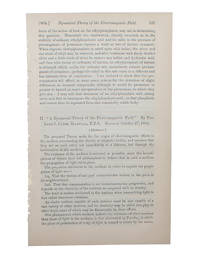
186441709London Taylor and Francis 1864. No wrappers as extracted from"Proceedings of the Royal Society". From November 19 1863 to December 22 1864 inclusive." Vol. XIII. Pp 531-536. <br/><br/><em>First printing of the first announcement of Maxwell unification of light-waves electricity and magnetism the most importent of the papers relating to his electromagnetic theory in which he brought electro-magnetical phenomena on a clear mathematical form. The present paper is an abstract of the larger paper which was read to the Royal Academy in 1864 but only issued the year later 1865 in "Philosophical Transactions of the Royal Society" where it was printed in full and as an abstract in "Philosophical Magazine" 1865."A generation later Einstein's work on relativity was founded directly oupon Maxwell's electromagnetic theory; it was this that led him to equate Faraday with Galileo and Maxwell with Newton." PMM No 355 but only the paper from 1865. - Dibner. Heralds of Science No 68 1865 paper. </em> unknown
19182091502135420007Teishin kyokai 1918. Soft Cover. Fine. Number of books: 1 Teishin kyokai paperback
19162091502135419066Teishin kyokai 1916. Soft Cover. Fine. Number of books: 1 Teishin kyokai paperback
19262091502135420981Electric Association 1926. Soft Cover. Fine. Number of books: 1 Electric Association paperback
19262091502135420982Electric Association 1926. Soft Cover. Fine. Number of books: 1 Electric Association paperback
19362111902160201403Great Japan Yutenkai Kodansha 1936. Soft Cover. Fine. Volume: 1 Great Japan Yutenkai Kodansha paperback
19312111902160304704Ministry of Railway Tokyo Electricity Office 1931. Soft Cover. Fine. Number of pages: 96 pages Size: 46 size horizontal length 80 Ministry of Railway Tokyo Electricity Office paperback
183448203Leipzig Johann Ambrosius Barth 1834. 8vo. Contemp. hcalf. Spine gilt and with gilt lettering. Spine slightly rubbed. In: "Annalen der Physik und Chemie. Hrsg.von Poggendorff" Bd. 35. X6308 pp. a. 5 folded lithographed plates. Entire volume offered. Faraday's papers: pp. 1-45 a. 222-226 1 plate 8. Reihe - pp. 413-444 9. Reihe. Stamp to verso of titlepage and verso of plates. Clean and fine printed on good paper. <br/><br/><em>First appearance in German - prepared by Faraday himself for publication in Annalen - of two groundbreakings papers in chemistry and physiscs.In the FIRST PAPER 8. Reihe Faraday brings forth the idea "that the atoms of matter are in some way endowed or associated with electrical powers to which they owe their most striking qualities and amongst them their mutual chemical affinity." He showed how natural it is to suppose that the electricity which passes through the electrolyte is exact equivaklent of that which is possessed by the atoms separated at the electrode: which implies that there is A CERTAIN ABSOLUTE QUANTITY OF THE ELECTRIC POWER ASSOCIATED WITH EACH ATOM OF MATTER.- Faraday further verifies that the electricity of the violtaic pile is proportionate in its intensity to the intensity of the affinities concerned in its production. - Dealing with the the decompositions in electrolysis he shows that THE FORCES TERMED CHEMICAL AFFINITY AND ELECTRICITY ARE THE SAME.In the SECOND PAPER 9. Reihe Faraday independent of Henry's discovery of the same phenomena in 1832 discovers SELF-INDUCTION or the "extra current" and points out the importent influence it must have in the construction of electro-magnetic machines electro-motors."Faraday showed that the powerful momentary current which was observed when the circuit was interrupted was really an induced current governed by the same laws as all other induced currents but with this peculiarity that the induced and inducing current now flowed in the same circuit. In fact the current in its steady state establishes in the surrounding region a magnetic field whose lines of force are linked with the circuit; and teh removal of these lines of forcewhen the circuit is broken originates an induced current which reatly reinforces the primary current just before its final extinction."Whittaker in "A History of the Aether and Electricity""In the series of experiments which are detailed in this paper the author inquires into the causes of some remarkable phenomena relating to the action of an electrical current upon itself under certain circumstances wherby its intensity is highly exalted and occasionally increased to ten twenty or even fifty times that which it originally possessed."Abstract. </em> unknown
19622110502150411669Iwasaki shoten 1962. Soft Cover. Fine. Number of books: 7 Iwasaki shoten paperback
19302111902160500013Not Available 1930. Soft Cover. Fine. Number of pages: A4/B5 55-80p each with many tables attached Size: Age discoloration etc. Not Available paperback
189743448Leipzig Johann Ambrosius Barth 1897. No wrappers. In "Annalen der Physik und Chemie Neue Folge" Bd. 60 No 3. Pp. 401-576 textillustr. and 2 folded plates. the entire issue offered "Heft 3". Braun's paper: pp. 552-559 a. 6 textillustrations showing the Braun tube and its operations. Clean and fine. <br/><br/><em>First printing of this groundbreaking paper being the first description of the principles governing the "BRAUN TUBE" which moves the elctron beams of alternating voltage the principle on which ALL TELEVISON TUBES operate. - Braun shared the Nobel Prize for 1909 with Marconi "in recognition of their contributions to the development of wireless telegraphy"."Cold cathode tube with side anode annular diaphragm to control spot size and built-in fluorescent screen. Beam deflection by one external coil with the trace viewed indirectly in a rotating mirror or by two coils at right angles for direct viewing. Excitation by hand-drive influence machine friction generator or by an induction coil. This "indicator tube" which enabled Braun to demonstrate how a variety of periodic and transient electrical phenomena could be visually examined is the ancestor of electric oscilloscopes televison picture tubes and other electron-beam display devices." Shiers & Shiers "Early Televison. A Bibliography to 1940" No. 263."The first oscilloscope or Braun tube was introduced in 1897. In order to study high-frequency alternating currents Braun used the alternating voltageto move the electron beam within the cathode tube. The trace on the face of the cathode tube represented the amplitude and frequency of the alternating-current voltage. He then produced a graph of this trace by use of a rotating mirror. The Braun tube was a valuable laboratory instrument and modifications of it are a basic devise in electronic testing and research. The principle of the Braun tube moving a electron beam by means of alternating voltage is the principle on which all televison operate."DSB II pp. 427-428.In 1909 he shared the Nobel Prize for physics with Guglielmo Marconi for their development of wireless telegraphy. </em> unknown
180243637Halle Rengerschen Buchhandlung 1802-1803. Without wrappers as published in "Annalen der Physik. Herausgegeben von Ludwig Wilhelm Gilbert" Bd. 10 Viertes Stück. The entire issue offered = Stück 4. Titlepage to vol. 10. Pp. 389-512 a. 1 engraved plate. Extract from Ergänzungsheft zum Jahre 1802. =Zweite Abhandlung. Volta's papers: pp. 421-449 a. pp. 497-520. Very light browning to 2. Abhandlung. <br/><br/><em>First appearance in German of Volta's importent paper in which he describes the electrical forces that acts between the metal-plates in the Voltaic Pile. The German publication was printed in the same year as the Italian original "Sull' identita del Fluido Elettrico col Fluide Galvanico" 1802."A long memoir by Volta in two parts.reports that by measuring the electrometer deflections with different pairs of metals he found that the forces which drive the electric fluid.from the first metal to the second are: silver/copper 1 copper/iron 2 iron/thin 3 lead/tin 1 lead/zinc 5. Then the force for silver/zinc in immidiate contact is 12 12315 copper/tin 5 = 32 iron/zinc 9 513 etc. Thus 'the force or impulsion with which two metals act on the electric fluid is equal to the sum of the forces of the series of metals which stands between them and.the electric force is the same as that which arises when the two extreme metals have no effect on the force of the latter'. This is the first statement of what Maxwell called 'Volta'slaw of contact electricity'."Partington IV p.15. </em> unknown
19142091502135420008Teishin kyokai 1914. Soft Cover. Fine. Number of books: 1 Teishin kyokai paperback
19302091502135419065Electric Association 1930. Soft Cover. Fine. Number of books: 1 Electric Association paperback
19312091502135420980Electric Association 1931. Soft Cover. Fine. Number of books: 1 Electric Association paperback
19362091502135420977Electric Association 1936. Soft Cover. Fine. Number of books: 1 Electric Association paperback
19372091502135420003Electric Association 1937. Soft Cover. Fine. Number of books: 1 Electric Association paperback
19322091502135420979Electric Association 1932. Soft Cover. Fine. Number of books: 1 Electric Association paperback
19332091502135420005Electric Association 1933. Soft Cover. Fine. Number of books: 1 Electric Association paperback
19342091502135420978Electric Association 1934. Soft Cover. Fine. Number of books: 1 Electric Association paperback
19382091502135419064Electric Association 1938. Soft Cover. Fine. Number of books: 1 Electric Association paperback