MONCELLivre Rare Book
NOTICE SUR L'APPAREIL D'INDUCTION ELECTRIQUE DE RUHMKORFF
1859PHO-104TRES RARE EXEMPLAIRE EDITION ORIGINALE
Librairie Voyage et Exploration · Cerny, France350,00 €
220 résultats
183343488Leipzig Johann Ambrosius Barth 1833. Without wrappers. In "Annalen der Physik und Chemie. Hrsg.von Poggendorff" Bd. 28. 6. u. 8. Stück. Entire issues offered Pp. 244-448 a. pp. 530-646 a. 4 engraved plates. Gauss' paper: pp.241-273 a. pp. 591-615. Clean and fine. <br/><br/><em>First German translation of Gauss' "Intensitas vis magneticae terrestris ad mensuram absolutam revocata" Gauss' first work on magnetism issued the same year as this first German edition and in which appeared the first systematic use of of absolute units distance mass time to measure nonmechanical quantity magnetism and electricity. - "It contains the first measurement of magnetic and electric quantities" Magie A Source Book in Physics p. 519.The volume contains other notable papers: by Mitscherlich Döbereiner Dutrochet Graham Berzelius Stromeyer F. Wöhler Heinrich u. Gustav Rose Hansteen Arago Pelouze Liebig etc. etc.G. Waldo Dunnington No. 99. - Weaver: 867 Latin ed. </em> unknown
183447416Paris Crochard 1834. Without wrappers. In: "Annales de Chimie et de Physique Par MM. Gay-Lussac et Arago." Tome 57 2e Series. Cahier 1. 112 pp. entire issue offered with titlepage to vol. 57. Gauss' paper: p. 5-69. Some brownspots. <br/><br/><em>First French edition of Gauss' "Intensitas vis magneticae terrestris ad mensuram absolutam revocata" 1833 Gauss' first work on magnwetism in which appeared the first systematic use of of absolute units distance mass time to measure nonmechanical quantity magnetism and electricity. - "It contains the first measurement of magnetic and electric quantities" Magie A Source Book in Physics p. 519.G. Waldo Dunnington No. 99. - Weaver Cat.: 867 Latin ed. </em> unknown
185745075Leipzig Johann Ambrosius Barth 1857. Without wrappers. In "Annalen der Physik und Chemie. Hrsg. von J.C. Poggendorff" Bd. 100 No 2 . Pp. 177-252 a. 1 plate. Entire issue offered. Kirchhoff's paper: pp. 193-217. With titlepage to volume 100. <br/><br/><em>First printing of an importent papers on the theory of electricity in conductors telegraph-cables etc. determining the velocity of the electrical propagation. He found that the propagation velocity of electricity to be "very close to the velocity of light in empty space"."The work of Thomson on signalling along cables was followed in 1857 the paper offered by a celebrated investigation by Kirchhoff's on the propagation of electrical disturbance along a telegraph wire of circular cross-section. Whittaker "A History of the Theories of Aether and Electricity" pp. 230 ff."The field was still open the nature of the electric current when Kirchhoff entered it in 1857 with his own general theory of the motion of electricity in conductors. His first paper in which he treated linear conductors from the same premises as Weber turned out to coincide in all essentials with an investigation carried out by Weber shortly before but delayed in publication. Both physicists noticed a remarkable implication of their theory: in a perfectly conducting circuit oscillating currents could be propagated with a constant velocity independent of the nature of the conductors and numerically equal to the velocity of light. Both Kirchhoff and Weber however pointing to the extreme character of the condition of infinite conductivity dismissed this result as a mere accidental coincidence."DSB </em> unknown
188086871880 4 volumes + 1 volume, reliure demi-maroquin (binding half morocco) vert in-quarto, in-quarto à coins, dos 5 nerfs (spine with raised bands) ornés de filets (illuminated with a gilt line) - entre-nerfs à fleuron (floweret) - titre frappé or (gilt title), papier marbré aux plats (cover with marbled paper), tranches jaspées (marbled edges), illustrations : figures (pictures) in et hors-texte (in text and full page engraving) et pour "les nouvelles conquêtes" illustrations d'après des dessins de Jules Férat - A. Gilbert - Broux - Etc., légères piqûres (smalls points of redness marks), 743+703+752+744 et 644 pages, sans date (no date) (les années 1867-1870) à Paris Furne - Jouvet et Compagnie Editeurs et sans date (no date) (les années 1870 environ) à Paris Librairie Illustrée Marpon et Flammarion,
1859PHO-104TRES RARE EXEMPLAIRE EDITION ORIGINALE
180243637Halle, Rengerschen Buchhandlung, 1802-(1803). Without wrappers as published in ""Annalen der Physik. Herausgegeben von Ludwig Wilhelm Gilbert"", Bd. 10, Viertes Stück. (The entire issue offered (= Stück 4). Titlepage to vol. 10. Pp. 389-512 a. 1 engraved plate. + Extract from Ergänzungsheft zum Jahre 1802. (=Zweite Abhandlung). Volta's papers: pp. 421-449 a. pp. 497-520. Very light browning to 2. Abhandlung.
180243637Halle Rengerschen Buchhandlung 1802-1803. Without wrappers as published in "Annalen der Physik. Herausgegeben von Ludwig Wilhelm Gilbert" Bd. 10 Viertes Stück. The entire issue offered = Stück 4. Titlepage to vol. 10. Pp. 389-512 a. 1 engraved plate. Extract from Ergänzungsheft zum Jahre 1802. =Zweite Abhandlung. Volta's papers: pp. 421-449 a. pp. 497-520. Very light browning to 2. Abhandlung. <br/><br/><em>First appearance in German of Volta's importent paper in which he describes the electrical forces that acts between the metal-plates in the Voltaic Pile. The German publication was printed in the same year as the Italian original "Sull' identita del Fluido Elettrico col Fluide Galvanico" 1802."A long memoir by Volta in two parts.reports that by measuring the electrometer deflections with different pairs of metals he found that the forces which drive the electric fluid.from the first metal to the second are: silver/copper 1 copper/iron 2 iron/thin 3 lead/tin 1 lead/zinc 5. Then the force for silver/zinc in immidiate contact is 12 12315 copper/tin 5 = 32 iron/zinc 9 513 etc. Thus 'the force or impulsion with which two metals act on the electric fluid is equal to the sum of the forces of the series of metals which stands between them and.the electric force is the same as that which arises when the two extreme metals have no effect on the force of the latter'. This is the first statement of what Maxwell called 'Volta'slaw of contact electricity'."Partington IV p.15. </em> unknown
189743448Leipzig Johann Ambrosius Barth 1897. No wrappers. In "Annalen der Physik und Chemie Neue Folge" Bd. 60 No 3. Pp. 401-576 textillustr. and 2 folded plates. the entire issue offered "Heft 3". Braun's paper: pp. 552-559 a. 6 textillustrations showing the Braun tube and its operations. Clean and fine. <br/><br/><em>First printing of this groundbreaking paper being the first description of the principles governing the "BRAUN TUBE" which moves the elctron beams of alternating voltage the principle on which ALL TELEVISON TUBES operate. - Braun shared the Nobel Prize for 1909 with Marconi "in recognition of their contributions to the development of wireless telegraphy"."Cold cathode tube with side anode annular diaphragm to control spot size and built-in fluorescent screen. Beam deflection by one external coil with the trace viewed indirectly in a rotating mirror or by two coils at right angles for direct viewing. Excitation by hand-drive influence machine friction generator or by an induction coil. This "indicator tube" which enabled Braun to demonstrate how a variety of periodic and transient electrical phenomena could be visually examined is the ancestor of electric oscilloscopes televison picture tubes and other electron-beam display devices." Shiers & Shiers "Early Televison. A Bibliography to 1940" No. 263."The first oscilloscope or Braun tube was introduced in 1897. In order to study high-frequency alternating currents Braun used the alternating voltageto move the electron beam within the cathode tube. The trace on the face of the cathode tube represented the amplitude and frequency of the alternating-current voltage. He then produced a graph of this trace by use of a rotating mirror. The Braun tube was a valuable laboratory instrument and modifications of it are a basic devise in electronic testing and research. The principle of the Braun tube moving a electron beam by means of alternating voltage is the principle on which all televison operate."DSB II pp. 427-428.In 1909 he shared the Nobel Prize for physics with Guglielmo Marconi for their development of wireless telegraphy. </em> unknown
189743448Leipzig, Johann Ambrosius Barth, 1897. No wrappers. In ""Annalen der Physik und Chemie, Neue Folge"", Bd. 60, No 3. Pp. 401-576, textillustr. and 2 folded plates. (the entire issue offered, ""Heft 3""). Braun's paper: pp. 552-559 a. 6 textillustrations (showing the Braun tube and its operations). Clean and fine.
1804(LCPCSCI-0003)(Les différents appareils galvaniques et leurs utilisations dans un rare exemplaire en édition originale, tel que paru, avec un envoi autographe de l'auteur à un ami) IZARN Joseph. (Cahors, 1766 - Paris, 1847) "MANUEL DU GALVANISME OU DESCRIPTION ET USAGE DES DIVERS APPAREILS EMPLOYES JUSQU'A CE JOUR, TANT POUR LES RECHERCHES PHYSIQUES ET CHIMIQUES, QUE POUR LES APPLICATIONS MEDICALES". 1804, Paris, J.F. Barrau et Dumotiez. 1 volume in-8° (218x138 mm) (dimensions pages 218x138 mm) (2) ff. (faux-titre et titre), XXII pp. (dédicace et discours), 293, (1) pp. (errata), (4) ff. (table), (13) ff., 6 planches h.t. Brochure bleue-grise de l'époque. Etiquette avec titre imprimé sur le dos. Edition Originale, rare. Petites brunissures à quelques cahiers, petites traces de poussière dans les marges, mais très bel exemplaire tel que paru, à toutes marges, non rogné et complet de ses six planches h.t. Exemplaire avec un envoi autographe de l'auteur à un ami, E. Bonafons. Joseph Izarn (1766-1847) était médecin de l'armée française et professeur de physique. De 1811 à 1815 il fut inspecteur général de l'Université. Son ouvrage trace une histoire du galvanisme et, à partir des expériences de Volta, galvani, Aldini et d'autres, décrit les appareils galvaniques et les inventions de l'époque et leur possible utilisation dans la médecine. "... je mets le lecteur à portée de prendre le Galvanisme à son origine, de le suivre, pas à pas, d'expérience en expérience, de découverte en découverte, et de voir les modifications et les applications que l'on a su faire. Je lui montre les pierres d'attente qu'ont laissées nos prédécesseurs dans plusieurs points de l'édifice. Ce plan est donc, à la fois, celui d'une Histoire et d'un Traité Pratique du Galvanisme". "Le Galvanisme ne viendra pas renverser le cours de la nature... mail il peut être très utilement employé pour l'espèce humaine, dans beaucoup de circonstances qu'il ne s'agit que de bien observer pour bien décrire, pour les rendre faciles à reconnaitre, et pour les distinguer de celles ou il pourrait devenir très-nuisible". "... le Galvanisme, n'eut-il été jusqu'ici d'aucune utilité pour l'art de guérir, n'en sera pas moins encore le chemin de grandes découvertes et qu'il est impossible que les expériences se multiplient et soient variées dans des vues différentes, sans qu'elles donnent des résultats propres à étendre les bornes de nos connaissances physiques, chimiques et physiologiques". Provenance : Envoi autographe de l'auteur à un ami, E. Bonafons. Conservé à l'intérieur du livre un billet manuscrit de l'auteur avec une demande d'un petit prêt à l'ami. (Poggendorf, 1174) (LCPCSCI-0003) (550,00 €)
183448203Leipzig, Johann Ambrosius Barth, 1834. 8vo. Contemp. hcalf. Spine gilt and with gilt lettering. Spine slightly rubbed. In: ""Annalen der Physik und Chemie. Hrsg.von Poggendorff"", Bd. 35. X,630,(8) pp. a. 5 folded lithographed plates. (Entire volume offered). Faraday's papers: pp. 1-45 a. 222-226, 1 plate (8. Reihe) - pp. 413-444 (9. Reihe). Stamp to verso of titlepage and verso of plates. Clean and fine, printed on good paper.
183448203Leipzig Johann Ambrosius Barth 1834. 8vo. Contemp. hcalf. Spine gilt and with gilt lettering. Spine slightly rubbed. In: "Annalen der Physik und Chemie. Hrsg.von Poggendorff" Bd. 35. X6308 pp. a. 5 folded lithographed plates. Entire volume offered. Faraday's papers: pp. 1-45 a. 222-226 1 plate 8. Reihe - pp. 413-444 9. Reihe. Stamp to verso of titlepage and verso of plates. Clean and fine printed on good paper. <br/><br/><em>First appearance in German - prepared by Faraday himself for publication in Annalen - of two groundbreakings papers in chemistry and physiscs.In the FIRST PAPER 8. Reihe Faraday brings forth the idea "that the atoms of matter are in some way endowed or associated with electrical powers to which they owe their most striking qualities and amongst them their mutual chemical affinity." He showed how natural it is to suppose that the electricity which passes through the electrolyte is exact equivaklent of that which is possessed by the atoms separated at the electrode: which implies that there is A CERTAIN ABSOLUTE QUANTITY OF THE ELECTRIC POWER ASSOCIATED WITH EACH ATOM OF MATTER.- Faraday further verifies that the electricity of the violtaic pile is proportionate in its intensity to the intensity of the affinities concerned in its production. - Dealing with the the decompositions in electrolysis he shows that THE FORCES TERMED CHEMICAL AFFINITY AND ELECTRICITY ARE THE SAME.In the SECOND PAPER 9. Reihe Faraday independent of Henry's discovery of the same phenomena in 1832 discovers SELF-INDUCTION or the "extra current" and points out the importent influence it must have in the construction of electro-magnetic machines electro-motors."Faraday showed that the powerful momentary current which was observed when the circuit was interrupted was really an induced current governed by the same laws as all other induced currents but with this peculiarity that the induced and inducing current now flowed in the same circuit. In fact the current in its steady state establishes in the surrounding region a magnetic field whose lines of force are linked with the circuit; and teh removal of these lines of forcewhen the circuit is broken originates an induced current which reatly reinforces the primary current just before its final extinction."Whittaker in "A History of the Aether and Electricity""In the series of experiments which are detailed in this paper the author inquires into the causes of some remarkable phenomena relating to the action of an electrical current upon itself under certain circumstances wherby its intensity is highly exalted and occasionally increased to ten twenty or even fifty times that which it originally possessed."Abstract. </em> unknown
1876PHO-282
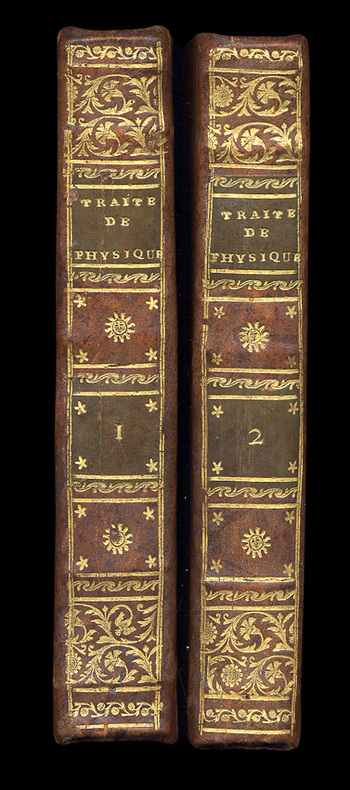
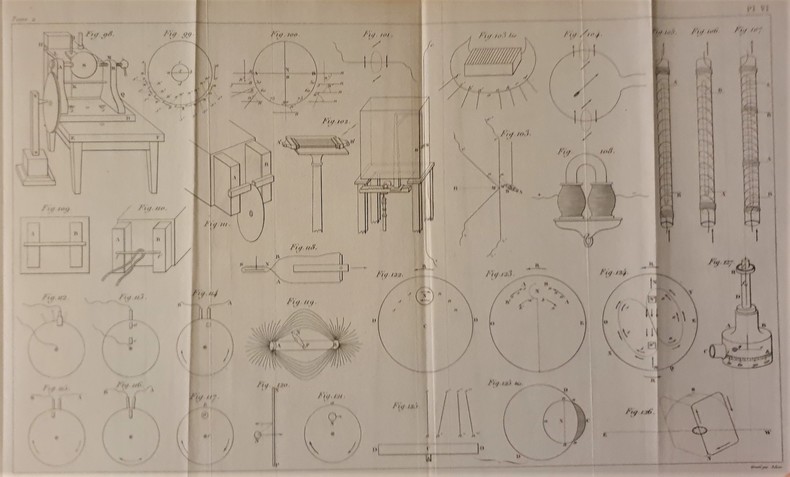
180315508Paris, Imprimerie Delonce et Lesueur, an XII, 1803 ; 2 tomes in-8 ; plein veau marbré havane glacé, dos à faux-nerfs torsadés dorés, dos décorés d'un entrelacs de feuillage, fleurons au soleil, étoiles, etc., pièces de titre et de tomaison bronze, tranches mouchetées de rouge (reliure de l'époque) ; (6), XXXIV, 426 ; (4), III, (1 bl.), 447 pp., et en tout 24 planches dépliantes gravées, représentant 157 figures.
186441709(London, Taylor and Francis, 1864). No wrappers, as extracted from""Proceedings of the Royal Society"". From November 19, 1863, to December 22, 1864, inclusive."", Vol. XIII. Pp 531-536.
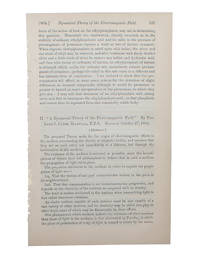
186441709London Taylor and Francis 1864. No wrappers as extracted from"Proceedings of the Royal Society". From November 19 1863 to December 22 1864 inclusive." Vol. XIII. Pp 531-536. <br/><br/><em>First printing of the first announcement of Maxwell unification of light-waves electricity and magnetism the most importent of the papers relating to his electromagnetic theory in which he brought electro-magnetical phenomena on a clear mathematical form. The present paper is an abstract of the larger paper which was read to the Royal Academy in 1864 but only issued the year later 1865 in "Philosophical Transactions of the Royal Society" where it was printed in full and as an abstract in "Philosophical Magazine" 1865."A generation later Einstein's work on relativity was founded directly oupon Maxwell's electromagnetic theory; it was this that led him to equate Faraday with Galileo and Maxwell with Newton." PMM No 355 but only the paper from 1865. - Dibner. Heralds of Science No 68 1865 paper. </em> unknown
180235107DBBreslau, bei Wilhelm Gottlieb Korn, 1802. 8°. XXIV, 540 S. Mit 2 gefalteten gestochenen Tafeln. Geflammter Halblederband der Zeit mit rotem goldgeprägtem Rückenschild und wenig Rückenvergoldung.
180235107DBBreslau, bei Wilhelm Gottlieb Korn, 1802. 8°. XXIV, 540 S. Mit 2 gefalteten gestochenen Tafeln. Geflammter Halblederband der Zeit mit rotem goldgeprägtem Rückenschild und wenig Rückenvergoldung. + Wichtig: Für unsere Kunden in der EU erfolgt der Versand alle 14 Tage verzollt ab Deutschland / Postbank-Konto in Deutschland vorhanden +
1834PHO-927 TOMES ET 1 ATLAS EDITION ORIGINALE
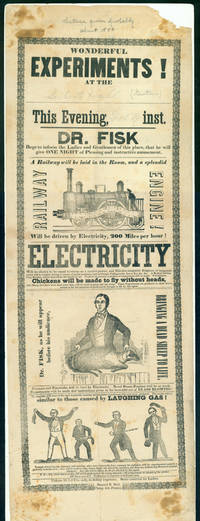
1850408771850. <p>Rare 19th Century American Electricity Broadside</p> <p>Electricity Wonderful experiments! At the Liberty Hall Groton this evening Feb. 19 inst. Dr. Fisk begs to inform the ladies and gentlemen of this place that he will give one night of pleasing and instructive amusement . . . Broadside. Woodcut illustrations. N.p.: Samuel B. Hall n.d. ca. 1850. 627 x 225 mm. Small portion of one corner torn not affecting text some creasing minor stains but very good.</p> <p>Rare nineteenth-century American broadside advertising Dr. Fisk's traveling show offering a "pleasing and instructive" demonstration of the many and varied uses of electricity. Among the marvels promised were "a splendid railway engine . . . driven by electricity 200 miles per hour" "electro-magnetic engines of immense power . . . driving a variety of useful machines" and "cannons and fireworks . . . fired by electricity." The broadside also proclaims that "a medical galvanizing machine will be at work for the benefit of all" which Dr. Fisk whom we have not been able to identify would use to make "chickens . . . fly without heads" and "sheep that have been dead some time . . . jump and run about." The broadside has blank spaces for inserting the place and date of Dr. Fisk's performance which have been filled in with the words "Liberty Hall Groton Connecticut" and "Feb. 19" in pencil in a nineteenth-century hand. </p> . unknown books
_2.jpg)