15 402 résultats
St. Petersburg, 1869. 8vo. Extract in contemporary or slightly later blank blue paper wrappers. Wrappers with neat professional restorations from verso, barely noticeable. A very fine and clean copy. Pp. 60-77.
2523Un vol. in folio, de 201pp., plein parchemin (reliure de l'époque) (manque de parchemin au dos, petits trous de vers dans les marges inf. de qq. ff.).
[20] + 154 + [6] pp., engraved vignette on title page, with a full page engraving with Porta's portrait signed I. [Iacobus] Laurus and with over 40 woodcut illustrations in text representing a.o. distilling apparatus, original first 1608-edition, nice recent binding in half leather and marbled boards in fine condition, gilt lettering on spine, engraved capitals in text, text clean and bright with only some occasional foxing, 22cm., most text is in Latin, very good condition, [This is a rare first edition of Porta's work on distillation, in which he offers a compilation of any knowledge available at that time regarding experiments and observations of distillation, its methods, apparatus and applications such as the preparation of perfumes and essential oils. It includes beautiful and quite bizarre woodcut illustrations of apparatus and stills resembling animals. Cfr. Duveen (481) who describes this work "as rare as it is beautiful". Porta (1535-1618) was an Italian philosopher, scientist and alchemist, and was/is often referred to as "professor of secrets". The engraved portrait of Porta included in this work is surrounded by various figures and gives a good impression of his scientific interests: distillation, astrology, chemistry, alchemy, optics, magnetism, etc. Content of this book: Liber I: Primordia pandit distillationis eiusq[ue], causas & instrumenta (pp.1-45), II: De odoratis Aquis eliciendis (pp.46-67), III: In quo de Oleorum tractatur (pp.68-87), IV: De distillatione oleorum exocitarum plantarum (pp.88-94), V: De refinis distillandis (pp.95-106), VI: De Oleo ex Lignis extrahendo (pp.107-112), VII: De Aquis validis extrahendis (pp.113-125), VIII: Quo de extrahendis rerum virtutibus varia experimenta traduntur (pp.126-144), IX: Oleorum extractio cum praelo (pp.145-154), + 6pp. of index and colophon], V96189
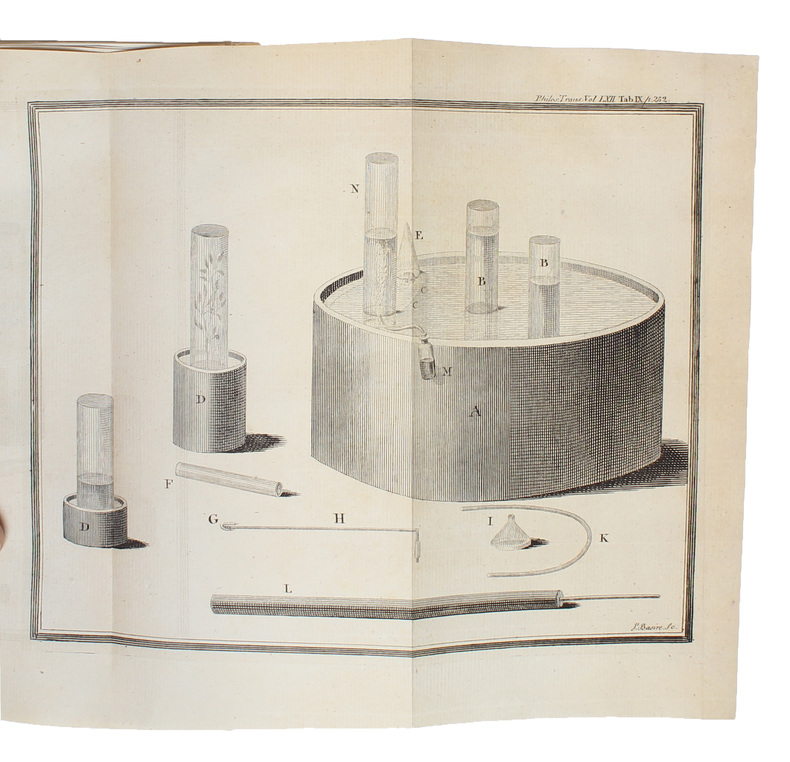
London, Philosophical Transactions, 1807. 4to. Bound to style in recent plain blue wrappers. Offprint, with the separate printed title-page, from ""Philosophical Transactions"" 1807 - Part I. With author's presentation to title-page: ""From the Author"". Occassional brownspotting throughout and a small tear, not affecting text, to lower margin of B4. (2), 56 pp. + 1 plate.
1608V96189Romae [Rome], Ex typographia Reu. Camerae Apostolicae 1608 [20] + 154 + [6] pp., engraved vignette on title page, with a full page engraving with Porta's portrait signed I. [Iacobus] Laurus and with over 40 woodcut illustrations in text representing a.o. distilling apparatus, original first 1608-edition, nice recent binding in half leather and marbled boards in fine condition, gilt lettering on spine, engraved capitals in text, text clean and bright with only some occasional foxing, 22cm., most text is in Latin, very good condition, [This is a rare first edition of Porta's work on distillation, in which he offers a compilation of any knowledge available at that time regarding experiments and observations of distillation, its methods, apparatus and applications such as the preparation of perfumes and essential oils. It includes beautiful and quite bizarre woodcut illustrations of apparatus and stills resembling animals. Cfr. Duveen (481) who describes this work "as rare as it is beautiful". Porta (1535-1618) was an Italian philosopher, scientist and alchemist, and was/is often referred to as "professor of secrets". The engraved portrait of Porta included in this work is surrounded by various figures and gives a good impression of his scientific interests: distillation, astrology, chemistry, alchemy, optics, magnetism, etc. Content of this book: Liber I: Primordia pandit distillationis eiusq[ue], causas & instrumenta (pp.1-45), II: De odoratis Aquis eliciendis (pp.46-67), III: In quo de Oleorum tractatur (pp.68-87), IV: De distillatione oleorum exocitarum plantarum (pp.88-94), V: De refinis distillandis (pp.95-106), VI: De Oleo ex Lignis extrahendo (pp.107-112), VII: De Aquis validis extrahendis (pp.113-125), VIII: Quo de extrahendis rerum virtutibus varia experimenta traduntur (pp.126-144), IX: Oleorum extractio cum praelo (pp.145-154), + 6pp. of index and colophon], V96189
180760110London, Philosophical Transactions, 1807. 4to. Bound to style in recent plain blue wrappers. Offprint, with the separate printed title-page, from ""Philosophical Transactions"" 1807 - Part I. With author's presentation to title-page: ""From the Author"". Occassional brownspotting throughout and a small tear, not affecting text, to lower margin of B4. (2), 56 pp. + 1 plate.
1984211351Heidelberg, Leipzig u. Weinheim, Winter u. Vlg. Chemie, 1837-1984. Verschieden geb. u. brosch. Teils etwas berieben u. angestaubt. St. u. Sign. a. Tit. Fehlen: Bd. 759-761; TI zu Bd. 27; 3 Taf. zu Bd. 49.
In-4°; pp. (12), 85, (3), frontespizio stampato in rosso e nero. Legatura in cartonato coevo. Esemplare di dedica, inviato al chimico Giovan Battista Mazzacurati. Prima edizione rara. Opera di notevole importanza per la scoperta dei sali d'argento come sostanze fotosensibili, studio scientifico che aprì la strada alla nascita della fotografia. In questo studio, fondamentale per la storia della luminescenza, Beccari prende in rassegna una quantità straordinaria di sostanze luminescenti, organiche e inorganiche, che fu il primo a sottoporre a osservazione al fine di classificarli, fornendo un moderno metodo di classificazione della luminescenza secondo il sistema dell'eccitazione. I suoi esperimenti che approfondirono la conoscenza circa i fosfori, che godono della facoltà di diventare luminosi dopo l'esposizione al sole, e i loro effetti sul cloruro d'argento, contribuirono in maniera sostanziale allo sviluppo della tecnica dell'impressione fotografica. I materiali fosforescenti vengono infine considerati corpi elettrici, secondo un'associazione derivante dal nascente interesse per l'elettricità. Jacopo Bartolomeo Beccari (1682-1766) fu il primo professore ad avere una cattedra di chimica in Italia, a Bologna, ed è considerato a tutt’oggi il fondatore della moderna chimica italiana. È anche noto per la sua scoperta del glutine nei cereali. (JACOPO BARTOLOMEO BECCARI), De quamplurimis phosphoris nunc primum detectis commentarius, Bologna, Laelius a Vulpe, 1744 In-4 °; pp. (12), 85, (3), title page printed in red and black. Contemporary hardcover binding. Copy with dedication sent to the chemist Giovan Battista Mazzacurati. Rare first edition. Work of considerable importance for the discovery of silver salts as photosensitive substances, a scientific study that paved the way for the birth of photography. In this study, fundamental for the history of luminescence, Beccari reviews an extraordinary quantity of luminescent substances, organic and inorganic, which he was the first to put under observation in order to classify them, providing a modern method of classification of luminescence according to the excited state of a system. His experiments which deepened the knowledge about phosphors, which have the ability to become luminous after exposure to the sun, and their effects on silver chloride, contributed substantially to the development of the photographic impression technique. Finally, phosphorescent materials are considered electrical bodies, according to an association deriving from the rising interest in electricity. Jacopo Bartolomeo Beccari (1682-1766) was the first professor to have a chair of chemistry in Italy, in Bologna, and is still considered the founder of modern Italian chemistry. He is also known for his discovery of gluten in corn. Only 500 copies printed. Canterzani, p. 123, n. 14:"Di questa non comune edizione furono impressi 500 esemplari". E. Bequerel, La lumiére, ses causes et ses effects, 1868, I, p. 26; Harvey, History of Luminescence, pp. 156-158, 324-327; Partignon, III.339, Provenzal, Bio bibliografia di Chimici Italiani, pp. 27-29; Weeks, Discovery of the elements, p. 514; cf Beach, E. F., "Beccari of Bologna", in Journ. His. Med. 16 (1961), pp. 354-373; Quagliarello, Chimica biologica in "Un secolo di progresso scientifico italiano", Roma, 1939.
London & New York, Cambridge University Press, 1954. 4to. In publisher's original full red cloth with gilt letter- and numbering to spine. Corner's bumped and light wear to extremities. Small white embossed [Starfield, Crowborough, Sussex] label measuring 2x5 cm pasted on to lower right corner of p. 41. In ""Philosophical Transactions of the Royal Society of London, Series B, Volume 237, Biological Sciences"". Entire volume offered. A fine and clean copy without institutional stamps.[Turing's paper:] Pp. 37-72. [Entire volume:] (6), 605 pp. + 40 photographic plates.
18472111902160200374Jiemon Katsumura Akitaya Taiemon Ihachi Suharaya 1847. Soft Cover. Fine. Number of books: 9 books Jiemon Katsumura Akitaya Taiemon Ihachi Suharaya paperback
16993700London:: printed for Dan. Brown at the Black Swan without Temple-Bar; Tho. Bennet at the Half-Moon D. Midwinter and Tho. Leigh at the Rose and Crown and R. Wilkin at the King’s-Head in St. Paul’s Church-yard 1699. FIRST ENGLISH EDITION of Jean Haudicquer de Blancourt's "De l’art de la verrerie". Octavo:. 18.3 x 11.5 cm. 16 355 13 p. Collation: A-Z8 Aa8. With 9 engraved plates. Bound in contemporary English paneled calf rebacked. Very fine condition. Two plates lightly browned marginal foxing to a few leaves. Illustrated with 9 engraved plates of glass-making furnaces tools crucibles and other apparatus. The core of Blancourt's text is Christopher Merret's annotated Latin edition 1668 of Antonio Neri's "L'Arte Vetraria"1612. Merret had produced his own English unillustrated translation of Neri's work in 1662. Among Blancourt's notable contributions to the text are a chapter on crystal glass and metal mirrors; and an appendix on a secret technique for making glass eyes look "Very Natural". "Antonio Neri’s 'L'Arte Vetraria' as the first printed book solely devoted to the art of glass formulation. It is a work committed to the subject of refining raw materials and combining them into a range of glasses and a rainbow of colors. The book divides into seven parts each devoted to a different aspect of the glassmaker’s art. He starts with the basics: preparing the fundamental ingredients of glass. Next he combines those materials into “cristallo.†Named after its mineral cousin rock crystal cristallo was a sophisticated Venetian specialty renowned for its delicate clarity. Neri details its traditional composition as brought to the Medici court by Venetian masters and then innovates with variations of his own. "At the other end of the spectrum is his “common†glass used for daily utilitarian purposes. He shows the standard formulas used in shops throughout the region and then proceeds to improve upon them. He presents a gamut of colors as well as advice for the glass “to emerge in full beauty and perfection." He shows the way to decolorize glass to take away even a slight tinge of hue that may be present and bring the melt to perfect crystal clarity. He walks us through numerous recipes in preparation for making an iconic Renaissance glass including the exquisite chalcedony—engineered to replicate the swirling colors of its namesake mineral. Beautiful to behold and thought by many to engender mystical properties Neri describes it as “adorned with so many graceful and beautiful areas of undulations and enhanced with the play of diverse lively flaming colors.†He goes on to describe leaded glasses artificial gems enamels and glass paints. Each time he innovates each time he guides us with encouragement admonition and painstaking clarity. "That Neri’s book was the first of its kind in print is a notable distinction but one that his deeper accomplishment easily surpasses; 'L'Arte Vetraria' preserves a rare glimpse of skilled practical knowledge. In his era prized techniques were frequently lost to subsequent generations lost because artisans so often spared the pen. Their precious knowledge went purposely unrecorded passing in strict confidence from master to apprentice working side by side. In 1612 Neri published his expertise to the world preserving the techniques and science of glass practices but also its art. Just as a great painter relies on the quality of pigments at hand so must a master glass artisan depend upon the materials of the melt. For the glassblowers and furnace workers who shaped hot glass a superior batch was crucial to superior results. A great piece of glasswork owes its form to the talent of the artist but its substance is the province of the craftsmen who make the glass. "Neri wrote 'L’Arte Vetraria' shortly before his death at the age of thirty-eight. Soon after Galileo sent it to a friend in Rome who was anxious for a copy."Paul Engle "Antonio Neri Alchemist Glassmaker Priest" Corning Museum of Glass ESTC R16918; Wing CD-ROM 1996 H1150. See Dwight P. Lanmon and David Whitehouse "Glass in the Robert Lehman Collection" p. 102 printed for Dan. Brown at the Black Swan without Temple-Bar; Tho. Bennet at the Half-Moon, D. Midwinter and Tho. Leigh at the Ro unknown books
106082Gedruckt zu Franckfurt am Mayn, durch Johan Feyerabendt, 1598, 1 volume in-4 de 285x195x25 mm environ, 1f. blanc, 4ff. (titre en rouge et noir avec belle vignette, 134 feuillets (un numéro pour 2 pages), 3 ff. (BeschluB, Register, colophon), demi basane brune, dos à nerfs portant titres en noir sur pièce de titre papier ancien, orné de caissons à froid. Notre exemplaire date de 1598, troisième édition. Illustrations dans le texte de 41 figures gravées sur bois dans le texte+ une vignette de titre gravée sur bois et une gravure sur bois d'armoiries sur la feuille de dédicace, texte agrémenté de délicates lettrines et fins culs-de-lampe. Rousseurs et pages brunies, ex-libris manuscrit ancien sur la page de titre, cartonnage frotté, une galerie de ver sur une coiffe et petite déchirure sur l'autre coiffe, petite déchirure marginale p. 129, intérieur bien conservé, exemplaire complet.
London, Tho. Snowden, 1680. - London, Printed by R.E. for B. Tooke, 1681/2. Bound together in one contemp. full calf. Raised bands. Spine somewhat worn. Lacking some leather on backcover along hinge. Binding tight and not loose. (6),(1 leaf errata),109,2 lvs. blank,(14),104,(8),113-150,(1 leaf errata). Internally a fine clean and broadmargined copy, printed on good paper.
Franckfurt am Main, Johann David Zunners, 1676. Contemp. full calf. Raised bands. Tooled in gold and blind on compartments. Titlelabel with lettering. Light wear to top of spine. With the royal monogram of king Frederik V in gold on red background on both covers. Stamp on titlepage. Engraved frontispiece. (14),232,(4) " Engraved title-page. 116,(4) pp., 47 fine engraved plates (22 + 25). First title-page cut close and mounted. No loss. Clean and fine. A few marginal annotations on the first leaves in a contemporary hand.
1906110676Berlin, Springer, 1906-66. Versch. geb., 8 Bde. in Heften. St. a. Tit. Einige Bde. teilw. leicht beschäd. bzw. wellig. Eine berieben u. angestaubt. Bd. 295 einige S. m. leichten Textverl. Fehlen: Bd. 1 4 Taf.; 9, 47, 48, 172, 296-300.
1920608068Leipzig, Barth, 1920-84. In 194 Hlwdbdn., Rest in Heften. Teilw. Angeschmutzt, leicht angerissen, St. a. Tit. o. OU. Bd. 132 fleckig; 309 einige S. zusammengeklebt.; 516 beschäd. Fehlen: Bd. 207 TI; 252 H. 1-2; 284 S. 289-305.
177257072London, Lockyer Davis, 1772, 1775, 1776 & 1783. 4to. In recent marbled paper wrappers. Extracted from ""Philosophical Transactions"". Including title-page of volume. Most leaves reinforced in margin. Light offsetting from folded plates as usual. Plate depicting the full telescope with professional repair to lower right corner. Pp. (4), 147-264, 383-394, 225-248, 397-434.
London, Lockyer Davis, 1772, 1775, 1776 & 1783. 4to. In recent marbled paper wrappers. Extracted from ""Philosophical Transactions"". Including title-page of volume. Most leaves reinforced in margin. Light offsetting from folded plates as usual. Plate depicting the full telescope with professional repair to lower right corner. Pp. (4), 147-264, 383-394, 225-248, 397-434.
2011LBS14-01<p>Brand New Set 18 Volumes includes the original set of 15 Volumes and 3 Supplementary Volumes</p> Wiley
1973221705Leipzig, Barth, 1834-1973. Meist Hlwd., sonst OBr. Teilw. leicht beschabt bzw. St. a. Tit. Fehlt: 315 H. 6 u. TI.
8535P., Ruault, 1777, un volume in 8 relié en pleine basane, dos orné de fers dorés, tranches rouges (reliure de l'époque), brunissures dans les marges des deux derniers feuillets, manque de papier d'origine dans la marge du dernier feuillet), notes manuscrites de l'époque dans les marges de quelques feuillets, 32pp., 216pp., 2 PLANCHES
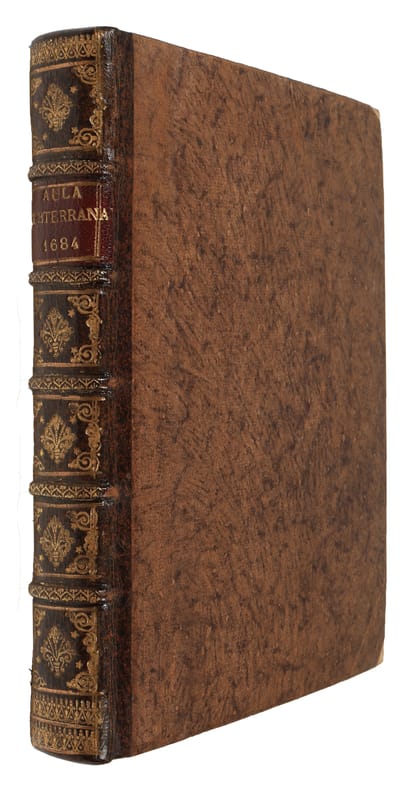
168461343Franckfurt, Zunner, 1684 (+) Franckfurt am Mayn, Zunner, 1684. 4to (215 x 185 mm). Recently bound in a magnificent pastiche-binding of brown half calf with five raised bands and gilt red leather title-label to elaborately gilt spine. Vellum corners. The frontispiece/engraved half title trimmed with loss to upper and lower part of the plate. Closed tear to outer margin. Title-page closely trimmed with loss to first line of title. A few leaves with marginal repairs. Light occassional browning throughout, otherwise internally nice and clean. (14), 220, 123, (5), 68 pp. + folded frontispiece/engraved half title. 41 woodcut in text depicting various processes of mining and metallurgy.
162017868Franckfurt, Jacobi di Zetter, 1620. Folio. Old full vellum made out of manuscript vellum leaves (from 15th century with letters in red and black, 1 coloured initial, 2 columns, a bible-commentary). Re-backed, 3/4 of the old vellum-back preserved. Remains of blue and yellow ties. Fine engraved pictorial title (canons, equipment etc.), (12),145,(3) pp. and 15 double-page engraved plates, 8 showing artillery in function, technical descriptions, and diving equipments shown on plate 14 !!) - Second Part with fine engraved title (showing bombs and fireworks),(8),71,(5) pp. and 9 double-page engraved plates showing different kinds of fireworks. A few, mainly marginal brownspots and some faint browning to leaves. With exlibris from ""Comit: Fuggeri 1630 (?)"" in old hand on title. On fol. 2 a later rubberstamp: ""Fürstliche Fuggersche Bibliothek in Augsburg"".
Franckfurt, Jacobi di Zetter, 1620. Folio. Old full vellum made out of manuscript vellum leaves (from 15th century with letters in red and black, 1 coloured initial, 2 columns, a bible-commentary). Re-backed, 3/4 of the old vellum-back preserved. Remains of blue and yellow ties. Fine engraved pictorial title (canons, equipment etc.), (12),145,(3) pp. and 15 double-page engraved plates, 8 showing artillery in function, technical descriptions, and diving equipments shown on plate 14 !!) - Second Part with fine engraved title (showing bombs and fireworks),(8),71,(5) pp. and 9 double-page engraved plates showing different kinds of fireworks. A few, mainly marginal brownspots and some faint browning to leaves. With exlibris from ""Comit: Fuggeri 1630 (?)"" in old hand on title. On fol. 2 a later rubberstamp: ""Fürstliche Fuggersche Bibliothek in Augsburg"".