3 018 résultats
18472111902160200374Jiemon Katsumura Akitaya Taiemon Ihachi Suharaya 1847. Soft Cover. Fine. Number of books: 9 books Jiemon Katsumura Akitaya Taiemon Ihachi Suharaya paperback
2011LBS14-01<p>Brand New Set 18 Volumes includes the original set of 15 Volumes and 3 Supplementary Volumes</p> Wiley
1991DBS-9780851864174Royal Society 1991. 4th. Hardcover. New. Royal Society hardcover
1973CH-22Michigan: Ann Arbor Science 1973. Classic comprehensive reference set presents by photomicrographs and electron micrographs the relationship between the appearance of images of many different types of particles and their identities including improvements in ultramicroscopy automatic image analysis electron microprobe analyses fractionation methods source testing applications of dispersion staining etc. Set includes: Vol. 1: Principles and Techniques Vol. II: The Light Microscopy Atlas Vol. III: The Electron Microscopy Atlas Vol. IV: The Particle Analyst's Handbook Vol. V: Light Microscopy Atlas and Techniques & Vol. VI: Electron Optical Atlas and Techniques. 1454 pp. collectively. Illustrated. Gilt front covers and spines. Corners and spine edges slightly rubbed on some volumes. Vol. I rear endpaper taped and tiny chip to bottom of pp. 295-296. Former ownership label pastedown and small stamps on the front endpaper title page and outer edge of all volumes. Minor light rubbing to lower spine on some volumes from label removal no residue. Text crisp and clean with no marks or highlights. Minimal shelfwear. Heavy item. Scarce. . . Second Edition. Hard Cover. Very Good. Folio - over 12" - 15" tall. Ex-Professional Library. Ann Arbor Science Hardcover
1798039646Brookfield: E. Merriam` 1798. 1st Edition . Hardcover. Good. Viii 1 10-139 2 About 100 Blank Pages Bound In At End Of Which Have Manuscript Additions By The Author. Full Calf Red Morocco Spine Label5 Thin Gilt Bands On Spine. Original Text With 100 Pages Bound In For The Author In His Personal Copy. The Book Is Not Signed By Ellis But The Handwriting And In Particular The Elaborate Scrolling Decorations Compare Favorably With Asa Ellis's Ownership Signature In His Copy Of Jonathan Edwards' "The Salvation Of All Men New Haven 1790 At Harvard Ac7.Ed969.790S Hollis Number 005244896. The Additions Include Detailed Recipes For L. Brown Black Fancy Blue Smoke Green India Brown Wine Colour Ash Colour Fawn Colour Light Wellington Snuff Indigo Or Blue Vat Cotton And Linen Blue Mauve Woolen Aquafortis Woolen; The Last Page Has A Clipping About "Dr. Beebe's Remedy" A Short "Cure For Diphtheria And A Formula For Restoring Grey. The Bottoms Of Pages 137-140 Were Torn Away And Have Now Been Replaced With Facsimiles On Old Paper Made From A High Resolution Scan Of The Harvard Copy. <br/> <br/> E. Merriam` hardcover
187150071Leipzig und Heidelberg C.F. Winter'sche Verlagshandlung 1871 1872. Recent marbled marbled boards. Spine gilt and with titlelabel in leather with gilt lettering: "Annalen der Pharmacie VIII Suppl. Band. In "Annalen der Chemie und Pharmacie. Hrsg. und Redigiert von Friedrich Wöhler Justus Liebig und Hermann Kopp" VIII. Supplementband. Pp. 4392 pp. entire volume offered. 2 small stamps on title-page. Mendelejeff's paper pp. 133-229 2 periodic tables on p. 149 a. 151. Internally fine and clean. <br/><br/><em>First printing of the first German translation of this milestone paper ONE OF THE GREAT CLASSICS OF CHEMISTRY in which Mendelejeff first coined the word "periodic" and in which he for the first time presented his great discovery of the periodicity of the elements in its full and complete form. At the same time the paper is the first to present his discoveries in a western language. In the paper he described and predicted the properties of a number of undiscovered elements - three of them were discovered in his lifetime. His periodic table was more complete than any of the preceding ones and more thoroughly founded on experiment. The periodicity of the elements he himself formulated as "Elements placed according to the value of their atomic weights present a clear periodicity of properties."The offered paper is the German translation of his paper which was issued in "Journal of the Russian Chemical Society" vol. 3 pp. 25-56 the same journal in which he first announced his discovery vol. 1 pp.66-77 1869 ."In March 1871 two years after his discovery of the law Mendeleev first named it "periodic". That summer he published in Justus Liebigs Annalen der Chemie his article "Die periodische Gesetzmässigkeit der chemischen Elemente." - the paper offered - which he later characterized as "the best summary of my views and ideas on the periodicity of the elements and the original after which so much was written later about this system. This was the main reason for my scientific fame because much was confirmed - much later.""DSB IX p. 289-90"Lothar Meyer and Dimitri Mendeleev independently discovered the periodic system but "Meyer did not publish this work until after the appearance of Mendeleev's first paper on the subject in 1869. His table was very similar to that of Mendeleev but it contained some improvements and was perhaps influential in causing some of the revisions made by Mendeleev in the second version of his table published in 1870. In general Meyer was more impressed by the periodicity of the physical properties of the elements while Medeleev saw more clearly the chemical consequences of the periodic law."Source Book in Chemistry p. 434.Horblitt "100 Books famous in Science" the Russian paper 1869 No 74. - Dibner "Heralds of Science" No 48 only the later book of 1891 - Partington IV: pp. 891-897. - Source Book in Chemistry pp. 442 ff. - PMM: 407 under Moseley. - Neville "Historical Chemical Library" II: p. 162 only the French edition from 1879. </em> hardcover
1871025478Paris: Gauthier-Villars 1871. First Edition . Original Blue Printed Wrappers. Very Good . 8 7/8" Tall. 40 Pp. Original Blue Printed Wrappers. Preserved Nicely In A Well Made Maroon Chemise And Slipcase With Morocco Spine Label Gilt. Inscribed And Signed By Pasteur " Hommage De L'autour / L. Pasteur" In Small Handwriting At Upper Right Of Front Cover. A Scarce Book In The Trade Particularly Scarce When Inscribed And Otherwise Unmarked As Here And A Very Early Inscription From Pasteur In Any Case. <br/> <br/> Gauthier-Villars unknown
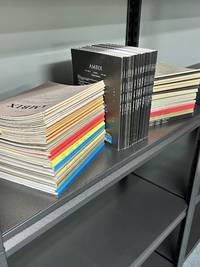
13419Cambridge UK: W. Heffner & Sons Ltd.; Black Bear Press Ltd.; Maney Publishing 2023. First printing. Original Wraps. Very Good in Wraps. First printing. Original Wraps. "Ambix is an internationally recognized peer-reviewed quarterly journal devoted to publishing high-quality original research and book reviews in the intellectual social and cultural history of alchemy and chemistry. It publishes studies discussions and primary sources relevant to the historical experience of all areas related to alchemy and chemistry covering all periods ancient to modern and geographical regions. Topics covered by Ambix include but are not limited to interactions between alchemy and chemistry and other disciplines; chemical medicine and pharmacy; molecular sciences; practices allied to material instrumental institutional and visual cultures; environmental chemistry; the chemical industry; the appearance of alchemy and chemistry within popular culture; biographical and historiographical studies; and the study of issues related to gender race and colonial experience within the context of chemistry."--Publisher. Ambix is one of the oldest journals of the history of science in the English-speaking world it was founded in 1936 and has appeared continuously from 1937 to the present other than from 1939 to 1945 during World War II. It is currently published by the Society for the History of Alchemy and Chemistry. This set is incomplete but begins with 1937.2023. There are a few reprints of the earliers issues. Also included is the Table of Contents and Cumulative Index 1937-2003 compiled by William A. Smeaton and William H. Brock.<br /> From the personal library collection of Brian Cotnoir alchemist artist and award-winning filmmaker. Author of Practical Alchemy: Guide to the Great Work The Emerald Tablet a series of Alchemical 'Zines Alchemical Meditations Alchemy: The Poetry of Matter and most recently On Alchemy: Essential Practices and Making Art as Alchemy. He has presented seminars and workshops around the world on various aspects of the alchemy.<br /> Khepri Press was started in 2014 as a place to organize and distribute his work. It is a very small press dedicated to alchemical book arts. Some of this work is publishable and others may exist only in manuscript or object form - alchemical results or talismans. The Ambix collection is not full run but each issue has articles on alchemy. Minor shelfwear light foxing smudging buckling else tight bright and unmarred. 8vo. Digest. var.pg. Index. Perfect bindings. Incomplete run. Beginning with 1937.2023. W. Heffner & Sons Ltd.; Black Bear Press Ltd.; Maney Publishing unknown
1940029599New York: John Wiley & Sons 1940. 1st Edition 1st Printing. Hardcover. Fine/Very Good DJ. Xi 495 Pp. Maroon Cloth Gilt. A Fine Example With No Wear All Gilt Brilliant And Just Slight Aging To Pages. In The Scarce DjVery Light Wear A Few Small Chips And Tears. The First Separate Publication By Nobel Prize Winner Maria Goeppert Mayer As Co-Author After Journal Publications Including Some As A Co-Author With Max Born. "The Rapid Increase In The Past Few Decades Of Knowledge Concerning The Structure Of Molecules Has Made The Science Of Statistical Mechanics A Practical Tool For Interpreting And Correlating Experimental Data.It Is Therefore Desirable To Present This Subject In A Simple Manner In Order To Make It Easily Available To Scientists Whose Familiarity With Theoretical Physics Is Limited.We Express Our Gratitude To Professors Max Born Karl F. Herzfeld And Edward Teller Who Have Read And Criticized Several Parts Of The Manuscript." A Fine Copy Just A Trace Of Rubbing At Corners. Dj With Almost No Wear A Few Small Losses At Corners A Very Few Short Edge Tears. Ownership Signature Of Pioneering Computer Engineer Willis H. Ware. Maria Goeppert Mayer June 28 1906 - February 20 1972 Was A German-Born American Theoretical Physicist And Nobel Laureate In Physics For Proposing The Nuclear Shell Model Of The Atomic Nucleus. She Was The Second Female Nobel Laureate In Physics After Marie Curie. A Graduate Of The University Of Göttingen Goeppert Mayer Wrote Her Doctorate On The Theory Of Possible Two-Photon Absorption By Atoms. At The Time The Chances Of Experimentally Verifying Her Thesis Seemed Remote But The Development Of The Laser Permitted This. Today The Unit For The Two-Photon Absorption Cross Section Is Named The Goeppert Mayer Gm Unit. Goeppert Mayer Married Joseph Edward Mayer And Moved To The United States Where He Was An Associate Professor At Johns Hopkins University. Strict Rules Against Nepotism Prevented Johns Hopkins University From Taking Her On As A Faculty Member But She Was Given A Job As An Assistant And Published A Landmark Paper On Double Beta Decay In 1935. In 1937 She Moved To Columbia University Where She Took An Unpaid Position. During World War Ii She Worked For The Manhattan Project At Columbia On Isotope Separation And With Edward Teller At The Los Alamos Laboratory On The Development Of The Teller's "Super" Bomb. After The War Goeppert Mayer Became A Voluntary Associate Professor Of Physics At The University Of Chicago Where Teller And Her Husband Worked And A Senior Physicist At The Nearby Argonne National Laboratory. She Developed A Mathematical Model For The Structure Of Nuclear Shells For Which She Was Awarded The Nobel Prize In Physics In 1963 Which She Shared With J. Hans D. Jensen And Eugene Wigner. In 1960 She Was Appointed Full Professor Of Physics At The University Of California At San Diego. Ware'S Participation In A Classified World War Ii Project To Identify Friendly Aircraft Led The Mathematician John Von Neumann To Recruit Him To Help Develop A Computer At The Institute For Advanced Study In Princeton N.J. In 1946. That Machine Was Not The First Digital Computer But It Was Based On A Set Of Design Ideas Described By Dr. Von Neumann That Were Broadly Influential - First On The Design Of Computers Built By Scientists Around The World And Then On An Early Ibm Computer Known As The 701. Many Of These Concepts Are Still Visible In The Structure Of Modern Computers And Smartphones. Mr. Ware Part Of A Small Group Of Engineers Working On That Machine Was The First To Try To Engineer Many Of The Components That Would Become Vital To Modern Computers. His Experience In Designing High-Speed Electronic Circuits During The War Was Essential To His Work On The Computer At The Institute For Advanced Study Said George Dyson A Historian Of The Project. <br/> <br/> John Wiley & Sons hardcover
2014x-1782620818Royal Society of Chemistry 2014. Hardcover. New. 2756 pages. 9.21x11.50x8.50 inches. Royal Society of Chemistry hardcover
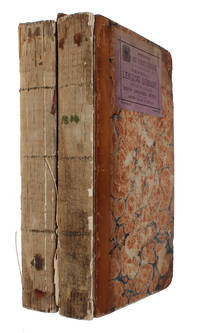
181146030Paris Chez J. Klostermann fils 1811-12. Bound in 6 contemp. hcalf. Gilt spines slightly rubbed. Wear to top of spines. In: "Annales de Chimie ou Recueil de Mémoires concernant la Chemie" Tome 78 79 80 81 82 and 83. Entire volumes offered. The 14 parts: Tome 78: pp. 5-37 105-132 217-242. - Tome 79: pp. 113-142 233-264. - Tome 80: pp. 5-37 225-258. - Tome 81: pp. 5-36 278-303. - Tome 82: pp. 5-33 113-125 225-72. Tome 83: pp. 5-35 a. pp. 117-127. With in all 3 engraved plates. Some scattered brownspots. <br/><br/><em>The papers represents one of the first announcements of Berzelius' discovery of the fixed chemical proportions determining the weights and valencies of the various constituent elements in inorganic compounds. The papers were published at the same time in Swedish German both here in Annalen and in Schweiger's Journal and in French. By running many hundreds of analysis of chemical compounds he gave so many examples of the law of definite proportions that the world of chemistry could no longer doubt its validity and in so doing he gave experimental evidence to the atomic theory. He hereby laid a solid fundation for the further development of chemistry. A reprint is found in Ostwald's Klassiker der exakten Wissenschaften No. 35.According to Söderbaum Jac. Berzelius 2 p.12 "It was a giant work one of the most importent in the history of chemistry which was here presented. One is even more impressed when one remembers that it was a pioneer undertaking in every sense of the term. Analytic and synthetic methods existed before Berzelius' time to be sure but there were no precise methods of the sort which he required. They all had to be elaborated at the cost of time and labour."J. Erik Jorpes "Jac. Berzelius" p.45."In general Berzelius's efforts were directed toward the consolidation and extension of the atomic theory. He improved chemical analysis and determined the composition of a large number of compounds thus verifying the laws of constant and multiple proportions and furnishing the most accurate equivalent weights then available. By ingenious methods he arrived at the correct atomic composition of most common substances and thus was enabled to draw up in 1826 a table of atomic weights very nearly identical with the modern one."Leicester & Klicktein "A Source Book in Chemistry" p. 258.Parkinson "Breakthroughs" 1810-20 C. </em> unknown
181346988London Robert Baldwin 1813 a. 1814. 8vo. 2 contemp. hcalf. Marbled boards. Spines lacks and boards detached. In: "Annals of Philosophy; or Magazine of Chemistry Mineralogy Mechanics. By Thomas Thomson". Vol. II and Vol. III. Entire volumes offered. Berzelius' papers: pp. 276-284 357-368 the first paper in vol. II pp. 443-454 vol. II a. pp. 51-62 93-106 244-257 a. 353-364. vol. III. Internally fine and clean. <br/><br/><em> First printing of these milestone papers in the history of chemistry where Berzelius introduced his famous chemical symbolism whereby an element is generally represented by the first letter of its Latin name or in the event of elements having the same first letter by the first two letters. Even though his atomic symbols were introduced in 1813 see the note on p. 359 in the first paper it was quite a few years before Berzelius's symbols were adopted by the chemistry community. But once accepted they became the new international language of chemistry.Berzelius "contributed more to the development of the atomic theory and to the setting up of accurate values of the atomic weights than did any other worker of the time. Of his contributions moreover to the development of the atomic theory and the advancement of chemical science not the least valuable was the introduction of a chemical symbolism which with slight modification is in use at the present day. By giving his symbols a quantitative meaning - the symbol of an element representing one atomic proportion by weight - it was possible "to show briefly and clearly the number of elementary atoms in each compound and after the determination of their relative weights present the results of each analysis in a simple and easely retained manner". This symbolism was speedily adopted on the Continent but in England only after some considerable time."Findlay "A Hundred Years of Chemistry" p. 14.Parkinson "Breakthroughs" 1813 C. - Leicester & Klickstein "A Source Book in Chemistry" p. 258 ff. - Holmberg 1813:28 a. The volume contains other notable papers THOMAS THOMSON "On the Discovery of the Atomic Theory" pp. 329-338. and JOHN DALTON "Remarks on the Essay of Dr. Berzelius on the Cause of Chemical Proportions" pp. 174-180 Vol. III. </em> hardcover
1967ME-96New York: Macmillan 1967. Comprehesive six-volume in nine parts reference text from the 1968 gold medal award-winning author presents a detailed work including thermal radiative properties thermal diffusivity specific heat thermal expansion thermal conductivity heats of fusion electrical resistivity density melting point vapor pressure heats of transformation etc. Text volumes includes the following: Volume I: Elements; Volume II: Nonferrous Alloys- Part 1: Nonferrous Binary Alloys & Part 2: Nonferrous Multiple Alloys; Volume III: Ferrous Alloys; Volume IV: Oxides and Their Solutions and Mixtures: Part 1: Simple Oxygen Compounds and Their Mixtures & Part 2: Solutions and Their Mixtures of Simple Oxygen Compounds Including Glasses and Ceramics; Volume V: Nonoxides and Their Solutions and Mixtures Including Miscellaneous Ceramic Materials; Volume VI: Intermetallics Cermets Polymers and Composite Systems: Part1: Intermetallics & Part 2: Cermets Polymers Composite Systems. Over 8500 pp. Illustrated. Vol. I pp.85-86 slightly taped; Vol. IV part 1 p.944 slightly taped. Small stamp and clean pocket remnant and prior owner's name on front endpaper. Corners and edges slightly to moderately rubbed on some volumes. Heavy item. First Edition. Hard Cover. Very Good. 4to - over 9¾" - 12" tall. Ex-Professional Library. Macmillan Hardcover
2014x-1782620990Royal Soc Chem 2014. Paperback. New. box edition. 1746 pages. 9.21x6.14x4.00 inches. Royal Soc Chem paperback
DADAX1782620915Royal Society of Chemistry 2014-02-21. 1. hardcover. New. 11.50x4.50x14.00. Buy with confidence. Excellent Customer Service & Return policy. Royal Society of Chemistry hardcover
6519085Royal Society of Chemistry RSC pp. 6550 4th Edition . Hardback. Used. Royal Society of Chemistry RSC hardcover
2014x-1782620796Royal Soc Chem 2014. Hardcover. New. 3500 pages. 9.21x6.14x4.50 inches. Royal Soc Chem hardcover
1781ST13831Venice: Giovanni Gatti 1781. 214 x 147 mm. 8 1/2 x 5 3/4". Four volumes. <br/> Attractive contemporary limp paper boards patterned with yellow red and black inks paper manuscript labels on spines deckle edges. With four folding engraved plates at the end of volume IV. Pastedown of volume I with a small square of paper with some inscrutable pencil notations glued down. Bolton p. 646; Cole 893; Partington III pp. 80-90. ◆Edges just a touch bumped a few pages with some very light foxing one page with a small hole affecting a word or two of text plates a little browned along the fold and one plate partially torn along the fold but still A SUPERB COPY exceptionally fresh and clean inside and out.<br/> <br/> Offered here in very pleasing contemporary paper boards this is the first combined edition in Italian of two of Macquer's most popular works: "Élémens de chymie-théorique" 1749 and "Élémens de chymie-pratique" 1751. Coherently written in a straightforward manner primarily with the classroom in mind Macquer himself was a highly respected teacher these works became instantly successful as university-level textbooks. Partington tells us that they replaced Lemery's rather outdated "Cours de Chymie" as the favored text for teaching and they were eventually translated into English German Russian and Italian. Macquer 1718-84 made a few modest chemical discoveries but his chief contributions to the science were his applications of chemistry in particular to the porcelain industry and most importantly his writing. In addition to the present work he also penned "the first dictionary of chemistry in the modern sense" according to Partington. Given that Macquer's works were often destined for the hands of students our copy is a fortunate survival indeed not to mention enormously charming with its original deckle edges clean contents and vibrant pattern. This edition also appears to be quite rare. OCLC locates only 10 copies worldwide with just one in the US Huntington and one in the UK Wellcome. Giovanni Gatti unknown
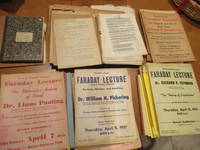
1928019866Pasadena: Pasadena City College 1928. Original Records . No Binding. Near Fine. The remaining archive of materials maintained as records of each of the Annual Faraday lectures given at Pasadena City College 1928-1972. The lectures were on scientific subjects and an award was given for the best notes of the lectures by a Junior High School Student. Almost all of the lectures were by well-known scientists who were innovative leaders in their field many being professors at CalTech. The Fourth and Fifth Lectures were given by Paul L. Johnson of Bell Laboratories on Sound Reproduction and on Television; the Sixth Lecture by Nobel Prize Winner Linus Pauling "Recent Developments Regarding the Structure of Atoms and Molecules" with an original photo of Pauling in front of the display; the Seventh by G. Ross Robertson was "Modern Miracles of Organic Chemistry" with a signed letter; The Eighth by Leroy G. Leishman "The Magic Story of Television" with his signature; the Ninth by Arnold O. Beckman Acidity and Its Practical Significance with his signature; the Tenth by Nobel Prize winner Carl D Anderson "Delving Into the Atom"; the Nineteenth 1946 by Nobel Prize winner Robert A Millikan "The Atomic age and Its Interpretation"; the Twentieth by Nobel Prize winner Glenn T. Seaborg; "New Elements and How to Make Them"; the Twentieth agaiin by Nobel Prize winner Linus Pauling "Molecular Nature of Blood"; the Twenty-third by Nobel Prize winner Wendell M Stanley; the Twenty-Firth by Nobel Prize winner Edwin M. McMillan "Cyclotrons and Synchrotrons"; the Thirtieth by JPL Director William H Pickering "Rockets Missiles and Satellites"; the Thirty-Second by Charles F. Richter "Measuring Earth's Gravitation"; the Thirty-Third by Nobel Prize winner Willard F. Libby; the Thirtieth by Nobel Prize winner Richard Feynman etc. The archive consists of records maintained by the faculty member responsible for the lectures after 1934; signatures of those attending the Faraday Dinners including the speakers G. Ross Robertson Leroy G. Leishman Arnold O. Beckman and some correspondence but no signatures of Nobel Prize winners; posters announcing the upcoming lectures most on card from 1935 on including Pauling Feynman etc some in multiple copies; some correspondence; newspaper clippings about the lectures; signed records from attendance at the Annual Faraday Dinners; some notes on the lectures by the winning students; odd tickets programs invitations. An interesting archive 3/4 of a file box in total. To be sold only as an entire archive no individual items with the possible exception of a few duplicates of the posters. <br/> <br/> Pasadena City College unknown
1985ME-92Metals Park OH.: American Society for Metals 1985. Comprehensive highly acclaimed three-volume reference work comprises critically evaluated data from over 33000 references covering the international literature from 1913 through 1983 including all phases elements ternary binary etc except halides and ternary and quaternary oxides. Older data from the classical structure compilations have been re-evaluated and replaced where necessary. Volume I contains a structure type index which includes structure type Pearson symbol and space group symbol; a mineral name index which includes the mineral name compound and Pearson symbol; a structure type table with over 2200 entries ordered according to the Pearson symbol space group number and number of occupied point sets. Volumes II and III contains critically evaluated data for each of the 22000 individual phases; crystallographic data of all Daltonide phases including temperature and pressure dependence of the space lattice; crystallographic data and remarks on the concentration temperature and pressure dependence of the space lattice of Berthollide phases; comments regarding the associated binary ternary and quaternary phase diagrams and pressure-temperature diagrams; a CODEN index of cited references. 3260 pgs. collectively. Prior owner's small name-stamps on lower front and rear endpaper. Small labels to base of text spines. Dustjackets have minor rubbing to edges; in mylar. Minimal shelfwear. Heavy item. First Edition. Hard Cover. Very Good/Very Good. 4to - over 9¾" - 12" tall. Ex-Professional Library. American Society for Metals Hardcover
2014x-1782621008Royal Soc Chem 2014. Paperback. New. box edition. 1604 pages. 9.21x6.14x4.41 inches. Royal Soc Chem paperback
2014x-178262080XRoyal Soc Chem 2014. Hardcover. New. 1444 pages. 14.00x11.50x4.00 inches. Royal Soc Chem hardcover
2014x-1782620915Royal Soc Chem 2014. Hardcover. New. 1878 pages. 9.21x11.50x4.50 inches. Royal Soc Chem hardcover
2014x-178262094XRoyal Soc Chem 2014. Paperback. New. box edition. 2020 pages. 9.21x6.14x4.45 inches. Royal Soc Chem paperback